Showing posts with label catechumens. Show all posts

Saturday, September 26, 2026

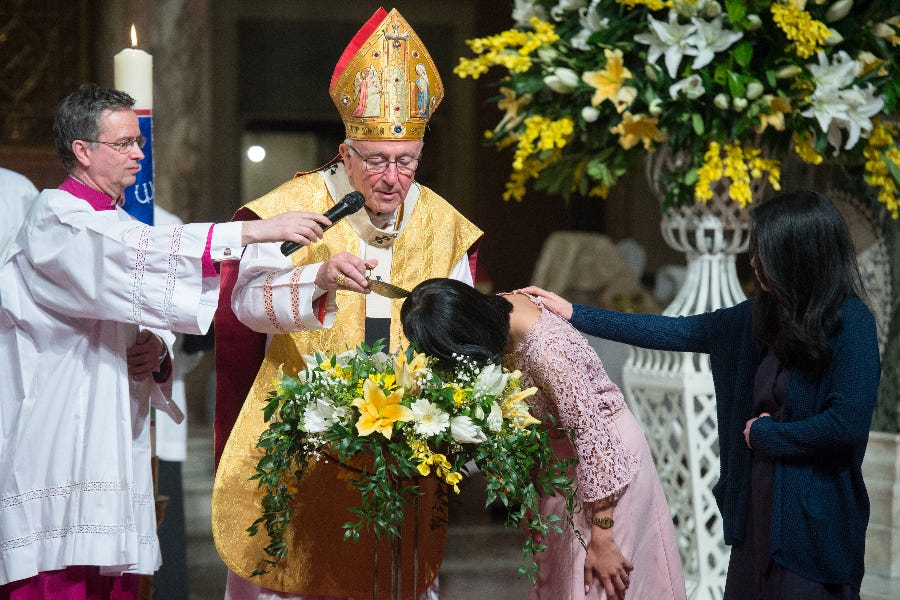
Pope Leo XIV in Paris addresses France's synodal assembly, catechumens and newly baptized Catholics


Pope Leo calls on Church in France to nurture seeds of faith

Addressing France’s synodal assembly, catechumens and newly baptized Catholics, Pope Leo XIV highlights the growing number of adults approaching the faith and urges the Church to accompany them beyond Baptism.

Vatican News

Pope Leo XIV has called on the Church in France to become a “Church in a state of initiation,” capable of welcoming, accompanying, and integrating the growing number of adults who are seeking the faith or returning to it.

Speaking on Saturday at the Catholic University of Paris, during the second day of his Apostolic Journey to France, the Pope addressed members of the Provincial Synodal Assembly, catechumens, and newly baptized Christians. He reflected on what he described as signs of God’s action in a society marked by deep secularization.

“I am struck by the number of people returning to the threshold of the faith, and by the many adults seeking the sacraments of Christian initiation,” Pope Leo said, expressing gratitude for the testimonies of Jaodie, Marielle and Sophie.

A sign of God’s grace

The Pope said the growing number of people rediscovering the Gospel and embracing the faith may appear paradoxical in contemporary France but should be recognized as “a tangible sign of the action of God’s grace” that goes beyond statistical and sociological analysis.

He warned against both defeatism and complacency, recalling Pope Francis’ criticism of what he called “sterile pessimism.”

Instead, Pope Leo urged the Church to recognize and protect what he described as “the small flame that the Holy Spirit has kindled in the darkness of the night” and “the tiny seed that strives to grow even amid the thorns.”

This, he said, requires concrete pastoral initiatives and a willingness to ask where the Holy Spirit is leading the Church in its accompaniment of catechumens, newly baptized Catholics, and those “beginning anew.”

A Church that accompanies

Recalling an expression previously used by the French Bishops, Pope Leo urged the faithful to envision and embody a Church “in a state of initiation.”

Such a Church, he explained, must offer those entering the faith “solid and steadfast guidance” over time. He pointed to France’s longstanding pastoral experience in Christian initiation, including developments following the Second World War and the renewal of the catechumenate associated with the Second Vatican Council.

Christian initiation, he stressed, does not conclude with the reception of the Sacraments.

Those newly approaching the faith should be welcomed with respect for their personal histories and spiritual experiences, while the Christian community has the responsibility to continue accompanying them after Baptism.

The Pope referred in particular to the danger of “post-baptismal emptiness,” highlighted in one of the testimonies he had heard. He called for newly baptized Christians to be fully integrated into parish communities and prayer gatherings and to receive comprehensive formation in Scripture, theology, doctrine and Christian moral life.

The liturgy at the heart of initiation

Pope Leo also highlighted the importance of the liturgy in the process of Christian initiation.

The liturgy, he said, should not be viewed as something that comes “after” catechesis, merely applying what has already been learned. Rather, it makes Christ’s Paschal Mystery present and can itself reveal the meaning of the Gospel and the life of God.

Its rhythms, language, and rites, he explained, are part of the journey of conversion and preparation for the Sacraments.

Forming those who accompany others

The Pope underlined the importance of accompanying all Catholics throughout life.

Godparents and godmothers, he said, should receive appropriate preparation and formation, while pastoral workers need not only biblical, theological, liturgical and spiritual training but also the human qualities required to accompany people whose life experiences may include loneliness, suffering and other profound difficulties.

Such accompaniment requires what Pope Leo described as a style of “closeness, compassion and tenderness,” together with a respect for each person’s pace.

“It means adopting the style of ‘walking together,’” he said, reiterating that priests and laypeople, godparents and catechumens, pastoral leaders, and the newly baptized all have something to contribute to one another along the Christian journey.

‘Be missionaries of the Gospel’

Pope Leo pointed to Saint Augustine as an example of how a small beginning in faith can grow over time.

Augustine, he recalled, was introduced to the faith by Saint Ambrose, and at the time of his Baptism his faith was still “a tiny seed.” Yet that seed grew into a tree whose branches continue to offer shelter.

Looking at the catechumens and newly baptized Christians gathered before him, Pope Leo said he sees both the work of the Holy Spirit and “the promise of fruitfulness for the Church in France.”

“In turn, be missionaries of the Gospel in this society,” he told them.

Mission in everyday life

The Pope concluded by invoking the witness of French saints, including Saint Thérèse of the Child Jesus and Saint Martin of Tours.

Saint Thérèse, he said, teaches through her “little way” that trust opens the doors to grace, while Saint Martin represents sharing and fraternal charity.

Together with the many other saints of France, they remind Christians that mission is built today, above all, by remaining faithful to the Lord’s presence in daily life.

Finally, Pope Leo urged those present to welcome one another and together form “the living people of the Church in France, capable of passing on the faith.”

Tuesday, September 8, 2026

The Worthy and Suitable Catechist program in the Diocese of Salt Lake City


Bishop Solis initiates lay ministry role, a first in the United States


September 4, 2026
by Lorena Needham, Special to the Intermountain Catholic

SALT LAKE CITY — The Christian initiation of adults in the Diocese of Salt Lake City is getting a boost from a groundbreaking initiative of Bishop Oscar Solis called the Worthy and Suitable Catechist appointment process. It is a first for our diocese and we believe it is a first among dioceses in the United States. Over the past few months, 30 lay ministers were nominated by their pastors and are being trained by the Office of Worship. Soon they will be appointed by the bishop to celebrate some of the minor rites of the Order of Christian Initiation of Adults (OCIA). Once they are commissioned by Bishop Solis during the closing ceremony of the Utah Catholic Conference, they will be known as “Worthy and Suitable Catechists.” 
The rites they will be authorized to lead are powerful expressions of our faith. They are an encounter with Christ. They transform seekers and they transform the assembly by their witness. It is liturgical law that we celebrate these rites during the period called the Catechumenate – when people are learning about the faith and preparing to be baptized and fully initiated in the Church.


Pictured are participants in the first of four classes for the Worthy and Suitable Catechist program: Sarah Maland, Saint Ambrose Parish; Teranie Pelch, Blessed Sacrament Parish; Jaime Morley,  Saint Thomas Aquinas Parish; Truc Tran, Our Lady of Perpetual Help Parish; John Valdez, Saint James the Just Parish; Gina Medina, Saint Mary Parish; Gracie Cortes, Saint Mary of the Assumption Parish/Saint Lawrence Mission; Roberto Cortes, Saint Mary of the Assumption Parish/Saint Lawrence Mission; Julie Boerio-Goates, Saint Francis of Assisi Parish; Maria Santillan, Sacred Heart Parish. 

At present, liturgical law only allows priests and deacons to preside over the special blessings and minor exorcisms of the catechumenate period of formation for unbaptized adults seeking to be members of the Church. However, the law also offers a way for bishops to depute or appoint experienced OCIA catechists with the authority to preside.
With the shortage of priests and deacons in our diocese, lay ministers are essential. Most of our OCIA coordinators are already lay ecclesial ministers who, with the permission of their pastors, are leading prayers and catechetical teams. With this additional training and commissioning they will be able to provide even greater support to pastors and all who are on the journey of faith.
Their ministry in the OCIA is all about helping people develop a living relationship with Jesus Christ, preparing them for initiation and incorporating them into the parish community and life of the Church. The most important aspect of their ministry is discernment for signs of spiritual growth and for obstacles which might get in the way. 
When they observe a Catechumen exhibiting fears, feelings of unworthiness, or even family opposition, then Worthy and Suitable Catechists are able to administer one of 11 special prayers called minor exorcisms to strengthen them, to help them recognize the influence of sin, and to direct their hearts to God.
When Worthy Catechists observe setbacks, anxieties, loneliness, grief, or even a need for a Catechumen to celebrate a joyful event like a promotion or anniversary, they may administer one of nine special blessings. In all, there are 20 different prayers to help catechumens grow toward Christ and transform their hearts during the time they are learning about the faith.
The Order of Christian Initiation of Adults is a series of more than 40 rituals leading to the full initiation of adults with the sacraments of Baptism, Confirmation and the Eucharist at the Easter Vigil. It is followed by a time of mystagogy or reflection on the experiences of faith and how God is present and working in their lives. 
Celebration of each of the rites is immensely important to the process of Christian initiation and an essential part of our top diocesan goal: comprehensive faith formation. We are blessed that this initiative will allow laity to assist our priests and deacons with responsibility for celebrating them and will improve the way we accompany people on their journey of faith. 
Congratulations to all who have been nominated for this responsibility. Their dedication to the OCIA process and their concern for our catechumens is a blessing for all. 
Lorena Needham is director of the Diocese of Salt Lake City’s Office of Worship.

Thursday, April 17, 2025

Adult Catholic Baptisms as we approach Easter are way up; records being set!


Adult baptisms: What’s driving the rise?

Where are adults becoming Catholic this year?

Catholic dioceses across the world are reporting that record numbers of adults are seeking baptism at this year’s Easter Vigil.

A baptism at the Easter Vigil in Westminster Cathedral, London, England, in 2019. © Mazur/catholicnews.org.uk.

What kind of figures are dioceses seeing? And what are the baptismal candidates, known as catechumens, saying about their journeys to the Catholic Church?

The Pillar takes a country-by-country look.

🇦🇹 Austria

What’s happening?

Around 240 adults are preparing to be baptized in Austria’s dioceses this Easter, up from roughly 130 people in 2024, an 85% year-on-year increase. In the Austrian Church, an adult is defined as anyone over the age of 14.

In the Vienna archdiocese, which has reported rising adult baptisms for almost a decade amid an influx of refugees, 118 adults will be baptized at the Easter Vigil, 50 more than in 2024. A third of the catechumens are under the age of 20.

There were approximately 5 million Catholics in Austria in 2021, slightly more than half the country’s population. In that year, there were more than 3,000 parishes in 11 dioceses.

Daniel Vychityl, who oversees the catechumenate for the archdiocese and the Austrian bishops’ conference, said: “In the past, we primarily had baptism candidates between the ages of 20 and 40, but now the adolescent age group represents the largest group, with the majority of them being Austrian citizens.”

What are catechumens saying?

Bettina Farasin decided to be baptized in 2018, at the age of 44 in the city of Linz. She was scheduled to be baptized as a baby but the ceremony was canceled after the sudden death of her godmother, she told the Austrian Church magazine Grüß Gott.

Throughout her adult life, she intended to be baptized but repeatedly postponed the thought. She became involved in her local church and even put her name forward for a seat on the parish council in 2017, but withdrew it because of her unbaptized status.

She began a year-long preparation for the sacrament with her pastor. “That’s when I got to know my faith in a completely new way. I began to understand the Bible in a new way, but also to see prayers like the Creed with different eyes,” she said.

🇦🇺 Australia

What’s happening?

More than 200 catechumens are preparing to be baptized in the Archdiocese of Melbourne. They were joined in March by 150 candidates — who are already baptized but seeking to become Catholics — at what Archbishop Peter Comensoli described as one of the biggest Rite of Election groups at St. Patrick’s Cathedral.

There were 7 million Catholics in Australia in 2021, more than one quarter of the population. The country had that year 1,353 parishes, in 30 Latin Catholic dioceses, and five Eastern Catholic eparchies.

What are catechumens saying?

This year’s catechumens include a father named Jason, who said that his eight-year-old daughter Ivy asked one day if she could start going to church.

Neither he nor Ivy’s mother came from religious families. But Jason wanted to support his daughter, so they began attending the local Catholic church, where a parishioner suggested he join the RCIA class.

“I feel weird when we miss Mass. We try to go a few times a week,” he said in a report on the Melbourne archdiocese website. “I enjoy going, but I also get enjoyment from seeing my daughter happy.”

🇧🇪 Belgium

What’s happening?

The number of adult baptisms in Belgium is expected to rise to 536 this year, an almost 50% increase from 2024, when there were 362.

Ten years ago, in 2015, there were 180 adult baptisms, meaning the number has almost tripled over the past decade.

There are notable variations in numbers within Belgium’s nine dioceses. The Diocese of Bruges has the fewest this year (14), while the Archdiocese of Mechelen-Brussels (173) has the most, followed by the Diocese of Tournai (136).

The figures suggest more adult baptisms may be occurring in French-speaking parts of the country than in Flemish-speaking regions. But the main source of the baptisms is in the bilingual capital region around Brussels.

In total, there were 8.3 million Catholics in Belgium in 2021, 72% of the national population, in 3,681 parishes in nine dioceses.

What are catechumens saying?

Maëlle Montoisy, a 22-year-old literature student, did not grow up in a church-going family. But she attended a Catholic school and was influenced by her grandfather, a Mass-goer who offered her words of encouragement, she told the website CathoBel.

After her grandfather died in 2021, she entered a dark period, which ended when she spontaneously decided to attend Mass. At the church, she met a woman called Georgette, who will be her godmother.

“She welcomed me with such kindness. She spoke to me about baptism, as if it were obvious. And little by little, I began this journey,” Montoisy said.

🇨🇦 Canada

What’s happening?

More than 600 catechumens are preparing for baptism in the Archdiocese of Vancouver, as a record number of people prepare to become Catholics.

In all of Canada, there were almost 17 million Catholics in 2021, 44% of the national population, spread across almost 4,000 parishes in 60 Latin Catholic dioceses and 15 Eastern Catholic eparchies.

What are catechumens saying?

Sarah Hurley, a catechumen in the Vancouver archdiocese, said the Rite of Election in March was profoundly moving.

“Stepping into Holy Rosary Cathedral for the Rite of Election felt like entering a sacred embrace, its majestic stained-glass windows glowing with divine light,” she said in a report on the archdiocese’s website.

🇫🇷 France

What’s happening?

A record 17,800 catechumens will be baptized at this year’s Easter Vigil in France, including more than 7,400 young people aged 11 to 17.

France is arguably the country that is driving the growing discussion about a Catholic adult baptism “boom.”

In total, there are 49 million Catholics in 2021, 75% of the national population, in more than 13,000 parishes across almost 100 Latin Catholic dioceses and three Eastern Catholic eparchies.

What are catechumens saying?

Sébastien, 51, grew up in an anti-clerical family, but felt a strong sense of a “benevolent presence” in his youth. At the age of 48, the father of three was out walking when he decided to enter a small church near his house.

“That day, I made the decision to open the door, take the plunge and get baptized,” he told Aleteia.

His parents were unhappy at the decision, but he committed himself to learning about and living out the faith, becoming a volunteer at Secours Catholique – Caritas France.

In 2024, his youngest daughter was baptized. He said: “We talked about it together. It’s a coincidence, but in the end not so much…”

🇲🇳 Mongolia

What’s happening?

When Pope Francis visited Mongolia in 2023, the Vatican estimated there were only 1,394 Catholics in the country that is roughly the size of Alaska. While the numbers are small, the Church is on an upward trajectory, thanks in part to adult baptisms.

What are catechumens saying?

Two of Tserenchimed Chuluunbaatar’s daughters were baptized Catholics at the Easter Vigil in 2023. Each week, they would bring home the Sunday Mass booklet containing the Gospel readings, which Chuluunbaatar, a Buddhist, would examine closely.

“I became interested in the Bible, the Church, and the Christian faith,” the retired finance ministry worker said in an interview with UCA News.

When the family attended the papal Mass in Ulaanbaatar, Chuluunbaatar decided he wanted to be a Catholic. He is due to be baptized April 19, alongside his wife and third daughter.

🇳🇱 Netherlands

What’s happening?

It’s hard to find overall figures for adult baptisms in the Netherlands. But in the Diocese of ’s-Hertogenbosch, 42 catechumens are preparing to be baptized.

There were 4.8 million Catholics in the Netherlands in 2021, less than 30% of the population, in 615 parishes across eight Latin Catholic dioceses and one Eastern Catholic diocese.

What are catechumens saying?

Guusje Peters, 26, did not grow up in a religious family, but she felt there was a higher power and wrestled with spiritual questions. Around a year ago, she entered a “dark time,” she told the Katholiek Nieuwsblad.

“I wondered why this was part of his plan, but decided to surrender completely and made a kind of cry for help in prayer,” said Peters, who lives in a village in the Limburg province.

“It was a dark moment, but I will never forget how a ray of sunlight began to light up the room. A certain warmth and peace came over me, and I knew in that moment that I was being called. That longing only grew stronger as time went by.”