reflections, updates and homilies from Deacon Mike Talbot inspired by the following words from my ordination: Receive the Gospel of Christ whose herald you have become. Believe what you read, teach what you believe and practice what you teach...
New study examines growing interest in Catholic faith
A national U.S. study finds growing interest in Catholic faith driven by the search for truth, purpose and community
Vatican News
A new national study of more than 2,100 participants in the Order of Christian Initiation of Adults (OCIA) across 20 Catholic dioceses in the United States points to a growing interest in the Catholic faith, particularly among young adults seeking truth, meaning and spiritual depth.
Published on 18 June by the Archdiocese of Chicago in collaboration with 19 other dioceses, the surveyexamined the experiences of 2,127 people who participated in OCIA between February and May 2026. The dioceses involved reported record levels of participation in adult faith formation programs.
The study found that those entering the Church were motivated primarily by two broad factors: a personal search for goodness, truth, inner peace and purpose, and an attraction to the Catholic Church’s liturgy, teachings and two-thousand-year tradition.
Among respondents, 28 percent said they had no prior religious affiliation before beginning their journey toward the Catholic faith, while others came from Protestant communities or were Catholics completing their sacramental initiation.
Desire to grow in virtue
Researchers noted that spiritual motivations ranked far above political or social considerations. Seventy-seven percent of participants cited a desire to grow in virtue, 76 percent sought a deeper understanding of truth, and 72 percent reported a search for greater inner peace.
The study also highlighted the growing role of digital evangelisation. Many respondents credited online resources such as prayer apps, podcasts, videos and social media content for helping them explore Catholicism.
At the same time, participants identified several obstacles to entering the Church, especially among members of Generation Z. Common concerns included feeling spiritually unprepared, uncertainty about acceptance within parish communities, and anxiety about participating in the liturgy.
Call for personal accompaniment
The report concludes that dioceses and parishes should focus on personal accompaniment, clearer pathways for faith exploration, and continued formation after reception into the Church. It also emphasizes the importance of creating welcoming communities capable of accompanying those who are taking their first steps in faith.
According to the authors, the findings suggest that many people today are approaching the Catholic Church not primarily through family tradition or marriage, but through a personal search for meaning, truth and a deeper relationship with God.
New record in France: More than 20,000 adults and teens baptized at Easter
The surge in baptisms of young persons continues in France in 2026, a 20% increase over the already previous record-high number in 2025. The influx represents a major challenge for the French Church.
A baptismal font. | Credit: Fernando Rayo/Shutterstock
This Easter, France recorded more than 20,000 adult and adolescent baptisms, a 20% increase compared with the previous year.
A new report published by the French Bishops’ Conference presents the latest statistical data from Easter 2026, during which approximately 8,200 adolescents and 13,200 adults embraced the Catholic faith.
The report indicates that the majority of converts are young adults between the ages of 18 and 25, closely followed by the 26-to-40 age group. Women constitute the largest segment, accounting for approximately 62% of the total.
In general, the new catechumens have no prior religious tradition, driven primarily by difficult life experiences, a profound search for meaning, or spiritual encounters that left a lasting mark on their lives, according to the report.
The ecclesiastical provinces with the highest number of baptisms were Paris, with 3,184, followed by Marseille with 1,437 and Lyon with 1,200. The report highlights a notable increase in the military diocese, headquartered in the French capital, particularly during the military pilgrimage to Lourdes.
The ‘magnitude of the thirst for God’
Olivier de Germay, archbishop of Lyon and the official responsible for the catechumenate in the country, reflected on this new reality, one that “never ceases to surprise and challenge us.”
Although society has long been aware of the world’s failure to provide answers to “the deep aspirations of the human being,” the French prelate expressed his surprise at the “rapidity and magnitude of the thirst for God manifesting itself today.”
This phenomenon opens up a new horizon and presents a “major challenge” for the Church, he said, which must offer appropriate guidance for initiation into the Christian life.
For De Germay, the situation also calls upon the “seasoned veterans of the Christian life,” who are invited “to once again become aware of how God can break into [a person’s life] and transform it.”
Among some new initiatives to address the increasing numbers, the regional council launched by the eight dioceses of the Île-de-France region stands out. Titled “Catechumens and Neophytes: New Perspectives for the Life of Our Church in Our Dioceses,” the council will run until May 2027. After gathering feedback from Catholics, including the newly baptized, the council aims to develop an appropriate response to the growing number of converts and to establish common guidelines at the provincial level.
The provincial council is encouraging the other dioceses outside the Île-de-France region to launch other initiatives focused on specific proposals to increase the participation of the newly baptized in the liturgy.
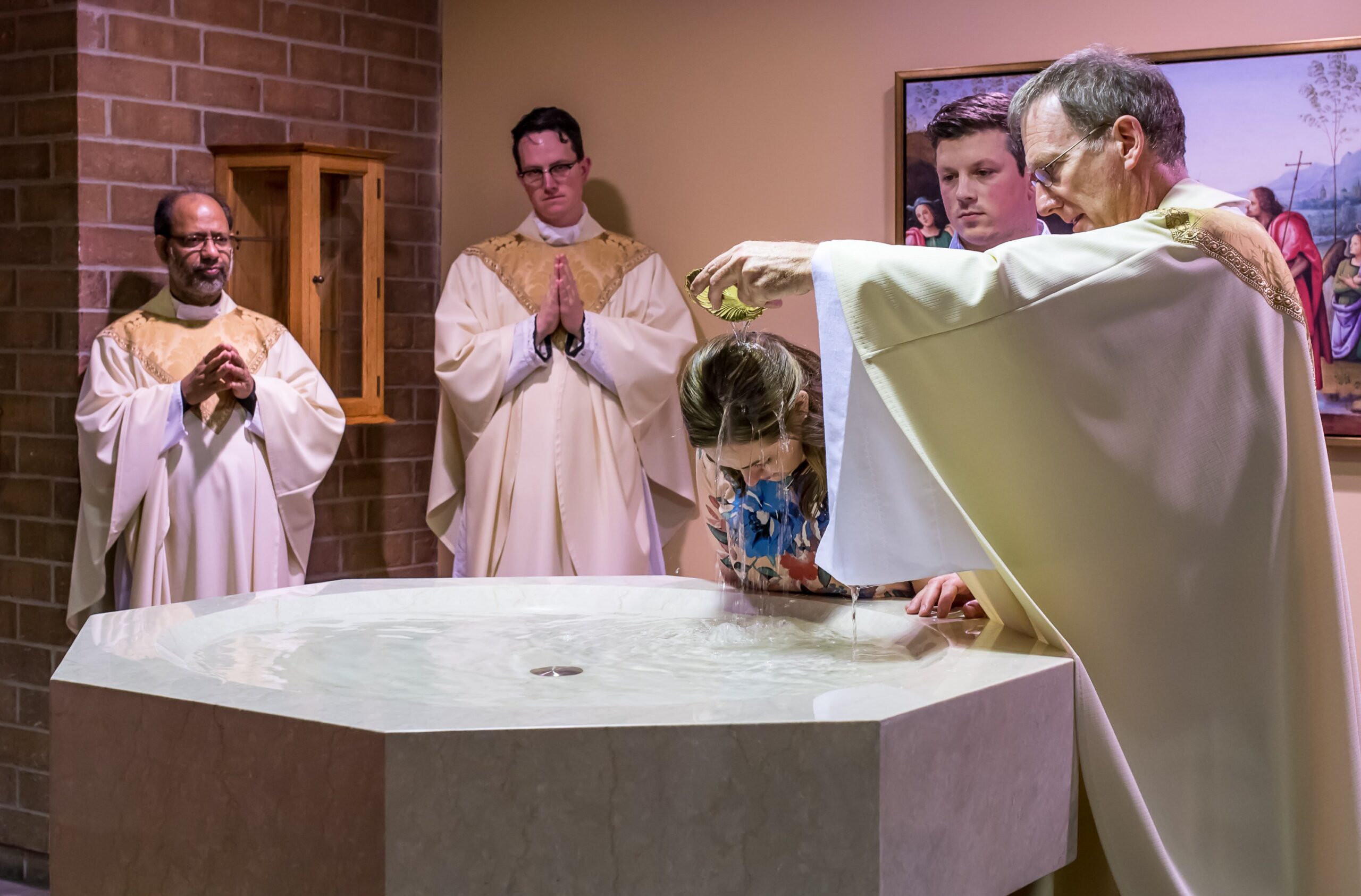
Father Tom Shoemaker baptizes a woman at St. Charles Borromeo Catholic Church in Fort Wayne, Ind., during the Easter Vigil in 2017. Some U.S. dioceses and universities are indicating record numbers of people joining or receiving full initiation into the Church. (OSV News photo Joe Romie, courtesy Today’s Catholic, Diocese of Fort Wayne-South Bend)
(OSV News) — While the religiously unaffiliated are on the rise globally, something curious is also happening: Some dioceses have reported significant upticks in adults preparing to enter the Catholic Church this Easter.
Sherry Anne Weddell, the co-founder and executive director of the Catherine of Siena Institute in Colorado Springs, Colorado, and an expert in Catholic evangelization, said that the “high point” of adult Catholics joining the Catholic Church in the U.S. was in 1999, with 172,000 adult baptisms and receptions.
“And then there was just a steady sort of decline,” she said.
That has since changed.
New increases
“There was significant growth between 2023 and 2024,” she told OSV News. And while the data for 2025 and 2026 have yet to be published, “the numbers that are being reported are getting bigger and bigger.”
The 2024 Official Catholic Directory reported that in 2023, 619,775 people entered the Catholic Church in U.S. Latin-rite dioceses. Of those, 77.6% were infant baptisms, 9.5% were baptisms of minors, 4.8% (29,752) were adult baptisms, and 8.1% (50,490) were receptions into full communion from another Christian tradition, which could include adults or minors.
In 2024, adult baptisms and receptions (adults and minors) increased again to 34,552 and 55,453, respectively, according to the 2025 Official Catholic Directory.
This year, the Archdiocese of Newark, New Jersey, is among dioceses reporting an uptick in Catholic conversions, with 1,701 individuals preparing to join the Church — a 30% increase since 2025, a 48% increase since 2024 and a 72% increase since 2023. Of those, 645 catechumens will celebrate the sacraments of baptism, Confirmation and Eucharist during the Easter Vigil on April 4 –a 14% rise since 2025, a 41% rise since 2024 and a 75% rise since 2023.
Father Armand Mantia, the archdiocese’s director of the Order of Christian Initiation of Adults — the Catholic adult initiation process — says the Church’s lasting stability contributes to the rising numbers.
“In this nebulous world of gray, the Catholic Church has offered some black and white,” he said. “They see in the Catholic Church a consistency in teaching, a consistency in values, a historical provenance and scriptural providence to what we’re doing.”
In Ohio, the Diocese of Cleveland has more than doubled its OCIA “class” since 2023. In Virginia, the Diocese of Richmond is touting a “record” 900 to be baptized at Easter. In Indiana, the Diocese of Fort Wayne-South Bend held its 2026 Rite of Election outside its cathedral — in a larger parish church — to also accommodate growing numbers.
In the Archdiocese of Boston, more than 680 catechumens plan to join the Church at Easter, an increase from last year’s 450, and previous years’ average of 250-300. Boston Archbishop Richard G. Henning “has been saying that there’s some sort of revival,” said Patrick Krisak, the archdiocese’s director of faith formation and missionary discipleship.
Pockets of revival
“There may not be a revival across the country, but there are revivals,” he said. “And at what point do all of those pockets of revival that we’re seeing all over the country add up to a revival?”
Krisak cited liturgy, certainty amid change and moral leadership as possible attractions. There is also old-fashioned rebellion, he said.
“There’s also the sense in which generations like to be countercultural,” he said. “If you’re rebelling against the folks who rebelled against the establishments, then you’re in some sense perhaps turning back to some aspects of the establishment.”
In the Archdiocese of Portland, Oregon, the one of the largest OCIA groups in recent memory attended this year’s Rite of Election, where catechumens present themselves to their local bishop as they begin their final preparations to join the Church.
The rise began in 2023, when the number was about 700. That grew to 1,000 the following year, then 1,200, and this year to 1,700 registered.
Last year, Archbishop Alexander K. Sample told the new converts it was their turn to bring someone to the Church. It appears to have made an impact, Father Randy Hoang, the Portland Archdiocese’s assistant director of the Office of Divine Worship, told OSV News.
“We are witnessing a broader renewal among our people,” he said. “Many are beginning to live what was once a largely private faith more openly in daily public life, and that witness is now bearing fruit.”
In the Archdiocese of Denver, catechumens jumped from 669 in 2022 to 936 in 2024. Andrew McGown, the archdiocesan executive director of mission and evangelization, said the Denver Archdiocese has indeed “seen a statistical increase, but when you average that out around our 120 pastorates, it’s really only three people per parish more than we had three years ago — so it’s not staggeringly larger numbers.”
However, he added: “What I know is happening in our parishes is that we have a considerably larger amount of energy being put into trying to offer programs, initiatives, events that are geared towards those who are not in the community.”
Several of the diocesan representatives who spoke with OSV News noted that their increased OCIA numbers are not attributable to a post-COVID postponement of sacraments, as that time has passed.
Campus revivals
Catholic ministries on college campuses are reflecting growth as well. St. Mary’s Catholic Center at Texas A&M University brought 70 people into the Church this past November, while at the University of Notre Dame, 125 new Catholics — the largest group there in at least 25 years — received the sacraments last Easter. This year, Notre Dame expects to surpass that number with 163 catechumens and candidates.
This past semester, Arizona State University’s Newman Center welcomed 52 students into the Church, and they are expecting 50 more for the 2026 Easter Vigil. The previous record for any year was 39 in 2019. Ben Power, the OCIA coordinator at ASU’s Newman Center, attributes that growth to “relationships and communities that are being built and spread across ASU’s campus.”
Reports of more adults joining the Catholic Church “is true not just in the U.S., but in significant parts of Europe,” Weddell said.
The Archdiocese of Paris will welcome 788 converts this Easter, its largest group ever. The Archdiocese of Westminster, England, reported its highest number of converts since 2011 and a 60% increase from 2025 to 2026. Dioceses in Belgium, Ireland and the Netherlands have also reported increased numbers of people joining the Church in recent years.
In the United States, some 92% of Catholics are “cradle Catholics” — people who say they were raised Catholic and also say they are Catholic when asked about their religion today. The remaining 8% are converts to Catholicism.
“What if, instead of 8 or 9%, we went to 20%?” asked Weddell. “It changes the dynamic.”
“Traditionally, almost all Catholics were cradle Catholics,” she explained. “We could be moving into a new kind of American Catholic culture, in which intentional Catholicism is much more common than inherited Catholicism.”
The Center for Applied Research in the Apostolate, a national, nonprofit research center that conducts social scientific studies about the Catholic Church at Georgetown University, counseled that reports of increased numbers of converts are still at this point anecdotal. The nation’s nearly 200 dioceses and archdioceses will not begin formally reporting 2025 sacramental data until early 2026, and those figures will only be publicly available with the release of the 2026 Official Catholic Directory later this year.
And yet, “There’s this growth in the numbers,” affirmed Weddell, who visits dioceses from coast to coast. “Many of the parishes I’ve talked to say, ‘Yeah, we’re seeing it — in our own small way.'”
Photo by Michael Caterina/University of Notre Dame
Record cohort of students prepare to receive Catholic sacraments through Notre Dame’s OCIA program
76 yearlong and 60 short course participants in the Order of Christian Initiation of Adults process are discerning Catholicism this spring
Notre Dame’s Order of Christian Initiation of Adults (OCIA) class of 2026 has so many participants that they relocated their upcoming Rite of Election to ensure adequate space. With 76 participants in the year-long OCIA course, 60 participants in the spring short course and 27 participants in the fall short course, Notre Dame’s OCIA class of 2026 is the largest in the school’s recorded history.
This year's numbers surpass last year's record-breaking 55 participants who received baptism, first Holy Communion and/or confirmation through Notre Dame’s OCIA process.
Brett Perkins, Campus Ministry’s assistant director for evangelization and religious education, said, “It kind of throws people off … The narrative was always that the Church is dying. What’s all this about? Like, all these young people joining the Church?”
Sunday’s Rite of Election, the ceremony wherein unbaptized participants affirm their intent to be initiated in the Church, was moved from South Bend’s St. Matthew Cathedral to St. Pius X Church in Granger for more space. The need for change reflects a growing number of people joining the Catholic Church this year, both at Notre Dame and in the Fort Wayne-South Bend diocese as a whole.
“The message of Jesus is ever-ancient, ever-new, right? It’s the message that the world always needs, that always points to: you are here for a purpose,” Perkins said. “That is a message that is compelling for every person, for all people, for all places, all times.”
Notre Dame’s OCIA participants come from a variety of religious backgrounds. Some come from Catholic families but have yet to receive all the sacraments, some come from other Christian denominations or faiths, and some had no exposure to Catholicism or other religious traditions prior to arriving at Notre Dame.
“At some point they were introduced to Catholicism. I would say, more often than not, it came through a friendship or relationship,” Perkins said. Perkins said his introduction to the Catholic Church came when a friend from high school invited him to Mass.
“Here at Notre Dame, a lot of times it's the residence hall system, right?” Perkins said. He pointed to roommates, section culture, and “having the dorm chapel there to have an opportunity to experience mass in a non-threatening environment,” as typical entry points for participants.
Mathias Mazzocco, a junior biochemistry major from Los Angeles, joined OCIA this school year to receive his first Holy Communion and confirmation.
“I just felt like it was the right time to do it. And I guess I got a little bit of a push from some of my friends,” he said.
Mazzocco’s friend, who he has lived with since freshman year, is now his sponsor in the OCIA process. OCIA participants are paired with other students with experience practicing Catholicism, who mentor them and sponsor them for the sacrament of Confirmation. They attend Mass together at the Basilica of the Sacred Heart each Sunday, followed by lessons about what Catholics believe and what the sacraments are.
“The overall feeling of deepening my faith has been really nice. And also, just like, getting close to my roommate … is really nice and rewarding,” Mazzocco said.
Darius Colangelo was an OCIA sponsor last year and is now part of a team leading the small groups for catechetical instruction during OCIA. In this role, he leads lessons on topics such as discipleship, the moral life and the Church.
“It really is a unique opportunity, both to guide another or to accompany another person through their growth, and also to grow in your spiritual life and your development,” Colangelo said.
The OCIA process is designed to prepare participants to join the Church by receiving the sacraments of Baptism, First Holy Communion and Confirmation and encourages students to discern the Catholic faith generally. Participants discuss fundamental arguments for belief in God as well as questions or struggles that participants may have with Catholic teachings.
“People generally have a better understanding [of Catholicism] by the end of the process and can even step out in faith and say, you know what, I might still wrestle, but I would rather wrestle within the Church and guided by the grace of the sacraments and a life of prayer,” Perkins said. As a convert to Catholicism, he typically starts the first information session by saying “I was once in your shoes not that long ago.”
Perkins said fellowship is a major focus of the curriculum, and that no one discerning the faith has to do it alone.
“What does it mean to be part of a community of believers, to know that you’re not just doing this on your own ever, that you are doing it with a body of others who are meant to encourage you in the life of faith? And what a beautiful example we have of that within Notre Dame,” he said.
A pivotal moment of the OCIA process is the Easter Vigil Mass on Holy Saturday, where participants receive the sacraments. Perkins recalled the moment last year when Fr. Brian Ching, rector of the Basilica of the Sacred Heart, invited the congregation to welcome the new Catholics and the Basilica burst into applause.
“The veil between heaven and earth is very thin,” Perkins said. “I feel like that’s what heaven is going to be like.”
Before his freshman year at the University of Notre Dame, the only time Alex Huang had ever set foot in a church building was for a piano recital. Now, the first-year student from Minnesota is just months away from becoming Catholic.
Raised by parents who never considered practicing religion due to their upbringing in atheist China, Huang became curious about Catholicism while in high school and is now a part of Notre Dame’s Order of Christian Initiation of Adults (OCIA). He hopes to enter the Catholic Church at the upcoming Easter vigil, and he says that Notre Dame’s Catholic atmosphere is a big reason why he plans on taking the plunge.
“I went to a public high school, where nobody really talked about their religion,” he said. “But when I got to Notre Dame, people would mention their faith all the time, and that was super jarring — not in a negative way, but really interesting and new to me.”
He’s not the only one at the South Bend, Indiana, university who is discerning becoming Catholic. This year, Notre Dame’s OCIA program boasts a record number of participants. In total, 76 students are enrolled, including 42 catechumens, 12 candidates for full communion, and 22 Catholic candidates for confirmation.
The record year is part of a recent trend.
During the 2023 school year, 33 students were enrolled in the program, while in 2024 the number rose to 52. Growth this year has been particularly strong among catechumens, meaning those who have never been baptized, as this year’s group is nearly twice as large as last year’s.
Brett Perkins, assistant director for evangelization and religious education with Notre Dame’s Campus Ministry, is himself a convert to the Catholic faith. He sees the record surge in conversions as indicative of an even broader movement among young people who are turning to religion.
“I think the questions that people are wrestling with and the experiences of life remain the same, but perhaps there’s been a bit more of an awakening to start to pay attention to the longing in the human heart,” he said.
Peers ‘On Fire’ for Faith
According to Perkins, multiple factors are behind this turn toward deeper desires, from the isolation of the COVID-19 pandemic to the impact of online evangelists like Bishop Robert Barron and Father Mike Schmitz.
But at a place like Notre Dame, one factor sticks out above the rest: the witness of faithful peers who are willing to invite non-Catholic students to come and see what their faith is all about.
“In the last couple years [at Notre Dame], I’ve just noticed folks are coming in really, really on fire,” Perkins said. “There’s a willingness to not just be on fire themselves, but also to invite others in.”
Perkins said this witness takes form in many ways, including Catholic students inviting their non-Catholic roommates to Mass in their dorm chapel.
“People start to have those moments of encounter and be like, ‘Wow, I want to learn more,’” he explained. “So a lot of times the aha moment happens before they actually come to me.”
Out of Notre Dame’s nearly 9,000 undergraduate students and more than 4,000 graduate and professional students, more than 80% identify as Catholic. And with chapels in every dorm and even many academic buildings, students can participate in a flourishing sacramental life. Each week, more than 158 Masses are celebrated on campus, and nearly 50 hours of Eucharistic adoration and 19 hours of confession are offered.
Faith also factors into academic life. All students are required to take two courses from the theology department, which boasts more than 800 students who have declared a theology major or minor.
But the thriving Catholic community — despite lingering questions about Notre Dame’s commitment to its Catholic mission — isn’t just a big part of getting non-Catholic students at Notre Dame interested in the faith. The witness of peers is also an integral part of OCIA. Students who are already Catholic can volunteer to sponsor a friend or relative or sign up to be paired with a participant they don’t yet know. Sponsors attend the weekly formation sessions with their catechumens or confirmandi and seek to learn alongside them, while providing a vibrant example for them of what it means to live out the Catholic faith in everyday life.
Clare Hettich, a freshman from Washington, D.C., volunteered to help with OCIA after sensing God calling her to be a sponsor.
“Being at Notre Dame … I’m surrounded by people who take their faith so seriously, and live it out so well, and that constantly makes me want to be like that,” she said. “And so being able to be in that position for someone else, I can really see the value of, simply because I’ve had people serve, even subconsciously, as mentors to me, whether it’s the friend who always invites me to 11 p.m. Rosary or the friend who says such beautiful prayers and makes me want to deepen my prayer life. So I really wanted to be that person for someone else.”
The 2025 Notre Dame OCIA class(Photo: Carmela Sadaya)
Lucas Santiago, a senior at Notre Dame who is a Catholic candidate for confirmation this year, was raised in an agnostic household after being baptized as an infant. But after coming to Notre Dame, he said, his “individually formed moral code felt incomplete for the first time” after seeing the faith of many of his close friends.
He said that witnessing the love and joy of Catholic young people and his exposure to Catholic social teaching left him “in awe” of the radical charity of the Catholic faith and inspired him to embrace it. Now, he continues to delight in the “jubilant spirit” that characterizes his peer community.
“It’s a beautiful thing that my peers and classmates at Notre Dame, people that might only know me in an academic or entirely informal context, have exemplified how another young person may walk with God,” said Santiago. “These counterparts at any other school might view me as a competitor, but at Notre Dame I am the recipient of endless love.”
A Grace-Filled Experience
Notre Dame students who are interested in becoming Catholic have two possibilities for their catechetical formation: the yearlong OCIA process for those who are not baptized and the semester-long “Short Course,” offered twice a year for those who are already baptized as Christians or Catholics, but are awaiting complete initiation into the sacraments of confirmation and the Eucharist.
While both catechetical processes aim to assist discernment of Catholicism, OCIA provides a longer and more comprehensive introduction to the life of discipleship, while the Short Course seeks to clarify and develop the Christian formation that baptized individuals have already received.
Members of OCIA who complete the program will be received into the Catholic Church at the 2026 Easter vigil on April 4, while Short Course participants receive their sacraments at different times at the end of each semester.
For students with no background in Christianity, Perkins explained that the program begins by exploring how the Catholic faith is the answer to their deepest longings.
“In OCIA, we start our first session by not necessarily digging right away into Scripture or into Church teaching, but, rather, we start with human experience … speaking to what exists at the heart of every person, that there is a longing for a relationship with God, and it’s an eternal longing and can only be filled by our eternal, infinite God.”
And for those like Santiago and Huang, it’s clear that God is at work through Notre Dame’s OCIA. According to Santiago, the joyful faith that fills the student body is what makes the program such a success.
“I’m blessed to walk alongside literally thousands of young disciples on my faith journey,” he said, “at least for a little while.”
What kind of figures are dioceses seeing? And what are the baptismal candidates, known as catechumens, saying about their journeys to the Catholic Church?
Around 240 adults are preparing to be baptized in Austria’s dioceses this Easter, up from roughly 130 people in 2024, an 85% year-on-year increase. In the Austrian Church, an adult is defined as anyone over the age of 14.
In the Vienna archdiocese, which has reported rising adult baptisms for almost a decade amid an influx of refugees, 118 adults will be baptized at the Easter Vigil, 50 more than in 2024. A third of the catechumens are under the age of 20.
There were approximately 5 million Catholics in Austria in 2021, slightly more than half the country’s population. In that year, there were more than 3,000 parishes in 11 dioceses.
Daniel Vychityl, who oversees the catechumenate for the archdiocese and the Austrian bishops’ conference, said: “In the past, we primarily had baptism candidates between the ages of 20 and 40, but now the adolescent age group represents the largest group, with the majority of them being Austrian citizens.”
What are catechumens saying?
Bettina Farasin decided to be baptized in 2018, at the age of 44 in the city of Linz. She was scheduled to be baptized as a baby but the ceremony was canceled after the sudden death of her godmother, she told the Austrian Church magazine Grüß Gott.
Throughout her adult life, she intended to be baptized but repeatedly postponed the thought. She became involved in her local church and even put her name forward for a seat on the parish council in 2017, but withdrew it because of her unbaptized status.
She began a year-long preparation for the sacrament with her pastor. “That’s when I got to know my faith in a completely new way. I began to understand the Bible in a new way, but also to see prayers like the Creed with different eyes,” she said.
🇦🇺 Australia
What’s happening?
More than 200 catechumens are preparing to be baptized in the Archdiocese of Melbourne. They were joined in March by 150 candidates — who are already baptized but seeking to become Catholics — at what Archbishop Peter Comensoli described as one of the biggest Rite of Election groups at St. Patrick’s Cathedral.
There were 7 million Catholics in Australia in 2021, more than one quarter of the population. The country had that year 1,353 parishes, in 30 Latin Catholic dioceses, and five Eastern Catholic eparchies.
What are catechumens saying?
This year’s catechumens include a father named Jason, who said that his eight-year-old daughter Ivy asked one day if she could start going to church.
Neither he nor Ivy’s mother came from religious families. But Jason wanted to support his daughter, so they began attending the local Catholic church, where a parishioner suggested he join the RCIA class.
“I feel weird when we miss Mass. We try to go a few times a week,” he said in a report on the Melbourne archdiocese website. “I enjoy going, but I also get enjoyment from seeing my daughter happy.”
🇧🇪 Belgium
What’s happening?
The number of adult baptisms in Belgium is expected to rise to 536 this year, an almost 50% increase from 2024, when there were 362.
Ten years ago, in 2015, there were 180 adult baptisms, meaning the number has almost tripled over the past decade.
The figures suggest more adult baptisms may be occurring in French-speaking parts of the country than in Flemish-speaking regions. But the main source of the baptisms is in the bilingual capital region around Brussels.
In total, there were 8.3 million Catholics in Belgium in 2021, 72% of the national population, in 3,681 parishes in nine dioceses.
What are catechumens saying?
Maëlle Montoisy, a 22-year-old literature student, did not grow up in a church-going family. But she attended a Catholic school and was influenced by her grandfather, a Mass-goer who offered her words of encouragement, she told the website CathoBel.
After her grandfather died in 2021, she entered a dark period, which ended when she spontaneously decided to attend Mass. At the church, she met a woman called Georgette, who will be her godmother.
“She welcomed me with such kindness. She spoke to me about baptism, as if it were obvious. And little by little, I began this journey,” Montoisy said.
🇨🇦 Canada
What’s happening?
More than 600 catechumens are preparing for baptism in the Archdiocese of Vancouver, as a record number of people prepare to become Catholics.
In all of Canada, there were almost 17 million Catholics in 2021, 44% of the national population, spread across almost 4,000 parishes in 60 Latin Catholic dioceses and 15 Eastern Catholic eparchies.
What are catechumens saying?
Sarah Hurley, a catechumen in the Vancouver archdiocese, said the Rite of Election in March was profoundly moving.
“Stepping into Holy Rosary Cathedral for the Rite of Election felt like entering a sacred embrace, its majestic stained-glass windows glowing with divine light,” she said in a report on the archdiocese’s website.
🇫🇷 France
What’s happening?
A record 17,800 catechumens will be baptized at this year’s Easter Vigil in France, including more than 7,400 young people aged 11 to 17.
France is arguably the country that is driving the growing discussion about a Catholic adult baptism “boom.”
In total, there are 49 million Catholics in 2021, 75% of the national population, in more than 13,000 parishes across almost 100 Latin Catholic dioceses and three Eastern Catholic eparchies.
What are catechumens saying?
Sébastien, 51, grew up in an anti-clerical family, but felt a strong sense of a “benevolent presence” in his youth. At the age of 48, the father of three was out walking when he decided to enter a small church near his house.
“That day, I made the decision to open the door, take the plunge and get baptized,” he told Aleteia.
His parents were unhappy at the decision, but he committed himself to learning about and living out the faith, becoming a volunteer at Secours Catholique – Caritas France.
In 2024, his youngest daughter was baptized. He said: “We talked about it together. It’s a coincidence, but in the end not so much…”
🇲🇳 Mongolia
What’s happening?
When Pope Francis visited Mongolia in 2023, the Vatican estimated there were only 1,394 Catholics in the country that is roughly the size of Alaska. While the numbers are small, the Church is on an upward trajectory, thanks in part to adult baptisms.
What are catechumens saying?
Two of Tserenchimed Chuluunbaatar’s daughters were baptized Catholics at the Easter Vigil in 2023. Each week, they would bring home the Sunday Mass booklet containing the Gospel readings, which Chuluunbaatar, a Buddhist, would examine closely.
“I became interested in the Bible, the Church, and the Christian faith,” the retired finance ministry worker said in an interview with UCA News.
When the family attended the papal Mass in Ulaanbaatar, Chuluunbaatar decided he wanted to be a Catholic. He is due to be baptized April 19, alongside his wife and third daughter.
🇳🇱 Netherlands
What’s happening?
It’s hard to find overall figures for adult baptisms in the Netherlands. But in the Diocese of ’s-Hertogenbosch, 42 catechumens are preparing to be baptized.
There were 4.8 million Catholics in the Netherlands in 2021, less than 30% of the population, in 615 parishes across eight Latin Catholic dioceses and one Eastern Catholic diocese.
What are catechumens saying?
Guusje Peters, 26, did not grow up in a religious family, but she felt there was a higher power and wrestled with spiritual questions. Around a year ago, she entered a “dark time,” she told the Katholiek Nieuwsblad.
“I wondered why this was part of his plan, but decided to surrender completely and made a kind of cry for help in prayer,” said Peters, who lives in a village in the Limburg province.
“It was a dark moment, but I will never forget how a ray of sunlight began to light up the room. A certain warmth and peace came over me, and I knew in that moment that I was being called. That longing only grew stronger as time went by.”