Showing posts with label Austria. Show all posts

Tuesday, June 16, 2026

Pope Leo XIV continues Francis' legacy on speaking out about climate crisis


Pope: The environmental crisis is a facet of the socio-economic crisis

In a video message for the Tenth Austrian World Summit, Pope Leo XIV highlights faith, hope and love as themes that can help reflect on the climate crisis, which goes beyond simple environmental matters, but touches on social, ethical and economic issues.

By Isabella H. de Carvalho

In order to effectively respond to the climate crisis, we must address social and ethical issues at the foundation of our society, such as the equal dignity of all human beings and the value of human rights, Pope Leo XIV said in a video message released on Tuesday, June 16.

“The environmental crisis ‘is not an isolated issue, but rather the ecological aspect of the contemporary socio-economic crisis’,” Pope Leo said, quoting his recently published encyclical, Magnifica humanitas, on safeguarding the human person in the time of artificial intelligence.

The Pope underlined how faith, hope and love are three themes that can help guide reflections on how we respond to the environmental crisis.   

The Pope’s video message was addressed to the Tenth Austrian World Summit, an annual conference held in Vienna which aims to offer a platform for solutions and ideas to contrast the climate crisis.

It is taking place on June 16 and is organized by the Schwarznegger Climate Initiative, launched by actor and former Governor of California, Arnold Schwarznegger.

Climate crisis a manifestation of the socio-economic crisis

Pope Leo XIV recalled how in Magnifica humanitas he highlighted the importance of “the equal dignity of all human beings and the value of fundamental human rights, both of which can be adequately ensured through the proper implementation of the principles of the common good, the universal destination of goods, subsidiarity, solidarity and social justice.”

“These essential personal and social matters are intimately connected to the climate crisis, which, as I said, is one manifestation – and a critical one – of the wider socio-economic crisis,” the Pope noted.

“Indeed, unless they are addressed, no technical solutions for protecting the environment will have a chance of achieving their desired end.”

In this regard, he insisted on the need to pay particular attention to the poorest and those most vulnerable to environmental degradation when developing and reflecting on solutions.

Faith helps protect life and nature

Pope Leo XIV pointed out how this multifaceted approach that acknowledges the interconnectedness of various issues affecting our societies is rooted in a faith perspective.  

“Those who believe that our world was created by God and is inherently good are compelled to assume an even greater responsibility to care for creation, since this is the requirement of their faith,” he explained.

“Living our vocation to be protectors of God’s handiwork is essential to a life of virtue,” he continued, citing Pope Francis’ 2015 encyclical, Laudato Si’.

Pope Leo also noted how many different religions understand creation as a divine gift and insist on the sacredness of life, thus “religious faith reinforces the overall desire to protect life and care for nature.”

Hope is a powerful driving force

With regards to hope, Pope Leo recognized that due to challenges and tensions facing the world today, there is “a growing awareness that peace is threatened by a lack of respect for creation, the plundering of natural resources and a progressive decline in the quality of life due to climate change.”

He also noted how in negotiations on climate issues, there is often the “fear of changing course, fear of losing power and fear of uncertain outcomes.”

In this respect, he urged international cooperation, “cohesive and forward-looking multilateralism,” and encouraged overcoming these fears.

The Pope emphasized that religious leaders and communities can play an important role in this, as “the Bible is full of examples of how people’s fears can be overcome by hope.”

“Despite the naysayers or cynics, hope can be a powerful driving force,” the Pope reiterated.

“It is not merely desirable but also genuinely possible that the progress at COP30 can be followed up with a just transition toward societies where the common good takes precedence over profit, and economic models are rooted in solidarity and human dignity.”

However, he noted that this requires wealthier countries to support poorer countries financially, and also to help these states by creating “a new person-centered international financial framework.”

Building a civilization of love

Lastly, Pope Leo XIV focused on the theme of love and the importance of “cultivating a genuine culture of care for our environment, which includes what Pope Francis called ‘civic and political love’.”

“In order to make society more human, more worthy of the human person, love in social life – political, economic and cultural – must be given renewed value, becoming the constant and highest norm for all activity,” which will then help devise larger strategies to counter the climate crisis, Pope Leo said, citing Laudato Si again.

Pope Leo XIV concluded by expressing his hope that the participants in the conference may promote a culture of care and contribute to building a civilization of love.

Friday, October 17, 2025

Pope Leo XIV appoints replacement for Cardinal Schonborn of Vienna, once considered a possible future Pope


Archbishop-designate of Vienna Josef Grünwidl Archbishop-designate of Vienna Josef Grünwidl  

Pope Leo appoints Josef Grünwidl as new Archbishop of Vienna

Pope Leo XIV appoints Josef Grünwidl as the new Metropolitan Archbishop of Vienna, Austria.

Vatican News

The Holy See Press Office announced on Friday that Pope Leo XIV has appointed the former Apostolic Administrator of the Archdiocese of Vienna, Josef Grünwidl, as the new Metropolitan Archbishop of Vienna.

The Archbishop-designate has served for the past nine months as Apostolic Administrator of the Archdiocese following the retirement of Cardinal Christoph Schönborn in January upon reaching the age of 80. The 62-year-old priest now becomes the twelfth Archbishop of Vienna.

“God does not need me perfect, but available”

In a statement released by the Archdiocese of Vienna, Archbishop-designate Grünwidl said he accepted the appointment “after some hesitation,” explaining that a conviction matured in him over recent months:

“God does not need me to be perfect, He wants me to be available. Trusting in those who support me in prayer, and in God’s help, who will uphold, guide, and strengthen me, I gladly accept this task. I look forward to meeting many people, those who already belong to the Church and those who are still searching, to whom I might perhaps be of help along their life’s journey,” he said.

A pastor from the Archdiocese of Vienna

Born in Hollabrunn, Lower Austria, within the Archdiocese of Vienna, Josef Grünwidl studied theology and organ in the Austrian capital and was ordained a priest in 1988 by Cardinal Franz König in St. Stephen’s Cathedral.

Over the years, he has served the Archdiocese in several pastoral and administrative roles, including as Secretary and later Episcopal Vicar under Cardinal Schönborn. Upon the latter’s retirement, he was appointed Apostolic Administrator of the Archdiocese.

Although not widely known beyond diocesan circles, Fr. Grünwidl is recognised as a dedicated pastor with a strong focus on spiritual renewal. The Archdiocese of Vienna, home to around 550,000 Catholics, is the largest in Austria.

Traditionally, the Archbishop of Vienna has been created a cardinal, though this practice was set aside under Pope Francis.

Cardinal Schönborn: “The Archdiocese is in good hands”

Reacting to the announcement, Cardinal Christoph Schönborn, Archbishop Emeritus of Vienna, expressed joy and gratitude for his successor’s appointment:

“For me, today is a deeply moving and joyful day. What could be more beautiful than knowing that our Archdiocese is in good hands! I am especially moved by the palpable joy throughout the diocese over his appointment. In the Eastern Churches, the faithful call out at an ordination: ‘Axios! He is worthy.’ It seems to me that people in the Church have been saying that about Josef Grünwidl for many weeks and months. How wonderful that Pope Leo has now confirmed it.”

Wednesday, June 11, 2025

Pope Leo XVI prays for victims of Austria school shooting


Flowers and candles have been left as a makeshift memorial site outside of the school following the shootingFlowers and candles have been left as a makeshift memorial site outside of the school following the shooting 

Pope Leo prays for the victims of school shooting in Austria

At his General Audience, Pope Leo XIV prays for the victims, families, and those affected by the mass shooting at a high school in Graz, Austria.

By Kielce Gussie

During his Wednesday General Audience, Pope Leo XIV remembered the victims of the school shooting in Graz, Austria on June 10. He offered his prayers for the victims of the tragedy.

“My thoughts are with the families, the teachers, and the students,” the Pope said, asking God to “welcome these children into His peace.”

Early Tuesday morning, a 21-year-old former student opened fire at the Dreierschützengasse high school. 10 people, including one adult, were killed, while dozens more were injured. This is one of the worst outbreaks of violence in Austria’s modern history.


The country has declared three days of national mourning as its Chancellor, Christian Stocker, described it as “a dark day in the history of our country”, an act of “unimaginable violence” and a “national tragedy that has shocked us all.”

Several European leaders have expressed their condolences following the shooting. European Commission president, Ursula von der Leyen, stressed that schools should be "symbols of youth, hope and the future", emphasizing that it is "hard to bear when schools become places of death and violence."

The EU's foreign policy chief, Kaja Kallas, shared her shock at the event and reiterated that "every child should feel safe at school and be able to learn free from fear and violence."

Thursday, April 17, 2025

Adult Catholic Baptisms as we approach Easter are way up; records being set!


Adult baptisms: What’s driving the rise?

Where are adults becoming Catholic this year?

Catholic dioceses across the world are reporting that record numbers of adults are seeking baptism at this year’s Easter Vigil.

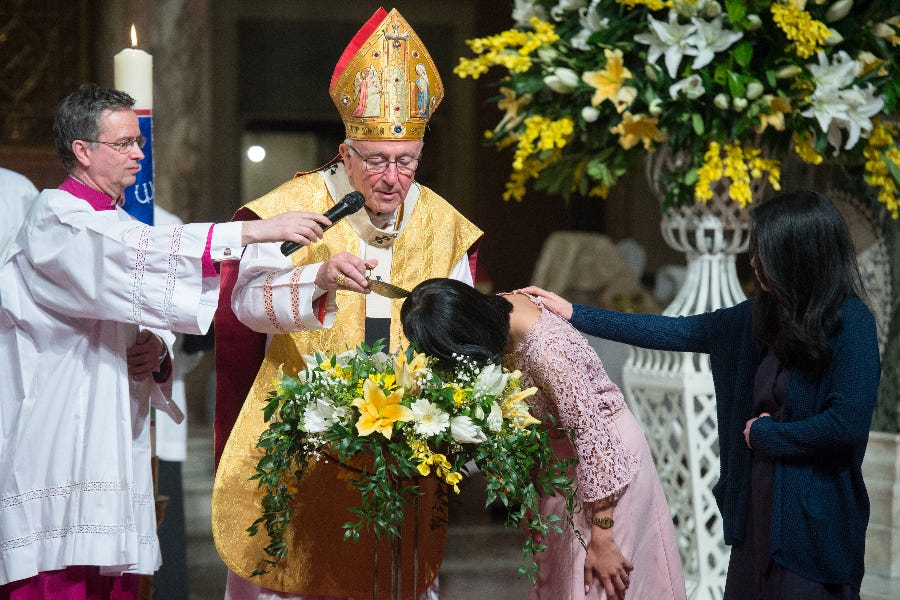
A baptism at the Easter Vigil in Westminster Cathedral, London, England, in 2019. © Mazur/catholicnews.org.uk.

What kind of figures are dioceses seeing? And what are the baptismal candidates, known as catechumens, saying about their journeys to the Catholic Church?

The Pillar takes a country-by-country look.

🇦🇹 Austria

What’s happening?

Around 240 adults are preparing to be baptized in Austria’s dioceses this Easter, up from roughly 130 people in 2024, an 85% year-on-year increase. In the Austrian Church, an adult is defined as anyone over the age of 14.

In the Vienna archdiocese, which has reported rising adult baptisms for almost a decade amid an influx of refugees, 118 adults will be baptized at the Easter Vigil, 50 more than in 2024. A third of the catechumens are under the age of 20.

There were approximately 5 million Catholics in Austria in 2021, slightly more than half the country’s population. In that year, there were more than 3,000 parishes in 11 dioceses.

Daniel Vychityl, who oversees the catechumenate for the archdiocese and the Austrian bishops’ conference, said: “In the past, we primarily had baptism candidates between the ages of 20 and 40, but now the adolescent age group represents the largest group, with the majority of them being Austrian citizens.”

What are catechumens saying?

Bettina Farasin decided to be baptized in 2018, at the age of 44 in the city of Linz. She was scheduled to be baptized as a baby but the ceremony was canceled after the sudden death of her godmother, she told the Austrian Church magazine Grüß Gott.

Throughout her adult life, she intended to be baptized but repeatedly postponed the thought. She became involved in her local church and even put her name forward for a seat on the parish council in 2017, but withdrew it because of her unbaptized status.

She began a year-long preparation for the sacrament with her pastor. “That’s when I got to know my faith in a completely new way. I began to understand the Bible in a new way, but also to see prayers like the Creed with different eyes,” she said.

🇦🇺 Australia

What’s happening?

More than 200 catechumens are preparing to be baptized in the Archdiocese of Melbourne. They were joined in March by 150 candidates — who are already baptized but seeking to become Catholics — at what Archbishop Peter Comensoli described as one of the biggest Rite of Election groups at St. Patrick’s Cathedral.

There were 7 million Catholics in Australia in 2021, more than one quarter of the population. The country had that year 1,353 parishes, in 30 Latin Catholic dioceses, and five Eastern Catholic eparchies.

What are catechumens saying?

This year’s catechumens include a father named Jason, who said that his eight-year-old daughter Ivy asked one day if she could start going to church.

Neither he nor Ivy’s mother came from religious families. But Jason wanted to support his daughter, so they began attending the local Catholic church, where a parishioner suggested he join the RCIA class.

“I feel weird when we miss Mass. We try to go a few times a week,” he said in a report on the Melbourne archdiocese website. “I enjoy going, but I also get enjoyment from seeing my daughter happy.”

🇧🇪 Belgium

What’s happening?

The number of adult baptisms in Belgium is expected to rise to 536 this year, an almost 50% increase from 2024, when there were 362.

Ten years ago, in 2015, there were 180 adult baptisms, meaning the number has almost tripled over the past decade.

There are notable variations in numbers within Belgium’s nine dioceses. The Diocese of Bruges has the fewest this year (14), while the Archdiocese of Mechelen-Brussels (173) has the most, followed by the Diocese of Tournai (136).

The figures suggest more adult baptisms may be occurring in French-speaking parts of the country than in Flemish-speaking regions. But the main source of the baptisms is in the bilingual capital region around Brussels.

In total, there were 8.3 million Catholics in Belgium in 2021, 72% of the national population, in 3,681 parishes in nine dioceses.

What are catechumens saying?

Maëlle Montoisy, a 22-year-old literature student, did not grow up in a church-going family. But she attended a Catholic school and was influenced by her grandfather, a Mass-goer who offered her words of encouragement, she told the website CathoBel.

After her grandfather died in 2021, she entered a dark period, which ended when she spontaneously decided to attend Mass. At the church, she met a woman called Georgette, who will be her godmother.

“She welcomed me with such kindness. She spoke to me about baptism, as if it were obvious. And little by little, I began this journey,” Montoisy said.

🇨🇦 Canada

What’s happening?

More than 600 catechumens are preparing for baptism in the Archdiocese of Vancouver, as a record number of people prepare to become Catholics.

In all of Canada, there were almost 17 million Catholics in 2021, 44% of the national population, spread across almost 4,000 parishes in 60 Latin Catholic dioceses and 15 Eastern Catholic eparchies.

What are catechumens saying?

Sarah Hurley, a catechumen in the Vancouver archdiocese, said the Rite of Election in March was profoundly moving.

“Stepping into Holy Rosary Cathedral for the Rite of Election felt like entering a sacred embrace, its majestic stained-glass windows glowing with divine light,” she said in a report on the archdiocese’s website.

🇫🇷 France

What’s happening?

A record 17,800 catechumens will be baptized at this year’s Easter Vigil in France, including more than 7,400 young people aged 11 to 17.

France is arguably the country that is driving the growing discussion about a Catholic adult baptism “boom.”

In total, there are 49 million Catholics in 2021, 75% of the national population, in more than 13,000 parishes across almost 100 Latin Catholic dioceses and three Eastern Catholic eparchies.

What are catechumens saying?

Sébastien, 51, grew up in an anti-clerical family, but felt a strong sense of a “benevolent presence” in his youth. At the age of 48, the father of three was out walking when he decided to enter a small church near his house.

“That day, I made the decision to open the door, take the plunge and get baptized,” he told Aleteia.

His parents were unhappy at the decision, but he committed himself to learning about and living out the faith, becoming a volunteer at Secours Catholique – Caritas France.

In 2024, his youngest daughter was baptized. He said: “We talked about it together. It’s a coincidence, but in the end not so much…”

🇲🇳 Mongolia

What’s happening?

When Pope Francis visited Mongolia in 2023, the Vatican estimated there were only 1,394 Catholics in the country that is roughly the size of Alaska. While the numbers are small, the Church is on an upward trajectory, thanks in part to adult baptisms.

What are catechumens saying?

Two of Tserenchimed Chuluunbaatar’s daughters were baptized Catholics at the Easter Vigil in 2023. Each week, they would bring home the Sunday Mass booklet containing the Gospel readings, which Chuluunbaatar, a Buddhist, would examine closely.

“I became interested in the Bible, the Church, and the Christian faith,” the retired finance ministry worker said in an interview with UCA News.

When the family attended the papal Mass in Ulaanbaatar, Chuluunbaatar decided he wanted to be a Catholic. He is due to be baptized April 19, alongside his wife and third daughter.

🇳🇱 Netherlands

What’s happening?

It’s hard to find overall figures for adult baptisms in the Netherlands. But in the Diocese of ’s-Hertogenbosch, 42 catechumens are preparing to be baptized.

There were 4.8 million Catholics in the Netherlands in 2021, less than 30% of the population, in 615 parishes across eight Latin Catholic dioceses and one Eastern Catholic diocese.

What are catechumens saying?

Guusje Peters, 26, did not grow up in a religious family, but she felt there was a higher power and wrestled with spiritual questions. Around a year ago, she entered a “dark time,” she told the Katholiek Nieuwsblad.

“I wondered why this was part of his plan, but decided to surrender completely and made a kind of cry for help in prayer,” said Peters, who lives in a village in the Limburg province.

“It was a dark moment, but I will never forget how a ray of sunlight began to light up the room. A certain warmth and peace came over me, and I knew in that moment that I was being called. That longing only grew stronger as time went by.”