Showing posts with label India. Show all posts

Monday, August 18, 2025

Post Angelus Prayers from Pope Leo XIV: Flooding in Asia, peace throughout the world


Rescue and relief operations continue following massive floods in PakistanRescue and relief operations continue following massive floods in Pakistan  (ANSA)

Pope offers prayers for flood victims in Pakistan, Nepal and India

Following the Angelus prayer in Castel Gandolfo, Pope Leo remembers victims and their families after flash floods kill more than 300 people in Pakistan, Nepal and India-administered Kashmir.

By Kielce Gussie

After praying the Angelus in Freedom Square (Piazza della Libertà) in Castel Gandolfo, Pope Leo expressed his closeness to the people in Pakistan, India, and Nepal who have been affected by severe flooding.

The Pope shared his prayers “for the victims and their families, and for all those who are suffering as a result of this calamity.” More than 300 people have been killed in northwest Pakistan, India-administered Kashmir, and Nepal after two days of torrential rains and flash floods.

 In Pakistan, officials report rescue teams have evacuated more than 3,500 tourists trapped in areas hit by the floods since Thursday. Over ten villages in the Nuner region were destroyed by the flooding, and landslides and devastated roads kept workers from reaching communities.


Reiterating his ongoing calls for peace in the world, Pope Leo also expressed his desire that efforts to end wars and promote peace come to fruition and that, “in every negotiation, the common good of peoples may always be given priority.”

Signs of hope

In the midst of the summer months, the Pope said he has received news of different cultural and evangelization initiatives, sometimes organized in places where people vacation. He pointed out how encouraging it is “to see how a passion for the Gospel inspires the creativity and commitment of groups and associations of all ages.”

The Pope used the example of the youth mission that was held recently in Riccione, Italy, and he expressed his gratitude for everyone who helped promote and participate in these types of events.

Thursday, May 22, 2025

Pope Leo XIV issues first promulgation for three new Venerables; on way to Santhood


Bishop Alejandro Labaka Ugarte, one of the newly declared Venerables, was killed by Indigenous people in Ecuador in 1987.Bishop Alejandro Labaka Ugarte, one of the newly declared Venerables, was killed by Indigenous people in Ecuador in 1987. 

Three new Venerables: two missionaries in Ecuador and one Indian bishop

Pope Leo XIV authorizes the promulgation of various decrees for three Servants of God: Colombian Sister Agnese Arango Velásquez, Indian Bishop Matthew Makil, and Spanish Bishop Alessandro Labaka Ugarte.

By Alessandro De Carolis

A woman and two men of peace — this how to describe the lives of the of the three new Venerables whose decrees of recognition were approved on May 22 by Pope Leo XIV during an audience with Cardinal Marcello Semeraro, Prefect of the Dicastery for the Causes of Saints.

Two of them offered their lives in martyrdom for the faith — a violent death in the Ecuadorian rainforest while defending the rights of Indigenous peoples.

A Bishop with a missionary soul

Alejandro Labaka Ugarte, born in 1920, was from Beizama in northern Spain. From a young age, he felt a call to be a missionary. After being ordained a priest in 1945, the superiors of the Capuchin Order — which he had entered in 1937 under the religious name Brother Manuel — sent him to China.

Around ten years later, he and other missionaries were expelled by the Maoist regime. He then went to Ecuador, where he served as a parish priest and held various other roles, including that of apostolic prefect, actively involved in evangelizing the Huaorani people.

In 1984, Brother Manuel was consecrated a bishop and continued his mission among the Indigenous, also establishing contact with the Tagaeri ethnic group. It was a time of intense tension. Oil companies moved through the region like predators, clearing forests in search of black gold.

For Brother Manuel, now Bishop Ugarte — known for his ability to mediate and reconcile — the priority became protecting the rights of the Tagaeri. It was during this mission that he met Sister Inés.

A religious sister among the Indigenous

Sister Inés Arango Velásquez was 40 years old when, in 1977, she took part in the first missionary expedition of the Capuchin Tertiary Sisters of the Holy Family to Aguarico, Ecuador. A native of Colombia, she was born in Medellín in 1937 and entered the congregation in 1955, completing her formation there.

After her perpetual vows, she dedicated herself to teaching and, once in Ecuador, traveled to various communities, eventually becoming a superior. She devoted herself to evangelizing the Huaorani under the guidance of, among others, Brother Manuel. Sister Inés also became deeply aware of the dire situation facing the Tagaeri, who had become targets for oil and logging companies.

Killed in defense of the least

As bishop, Brother Manuel hoped to avoid a violent confrontation with mercenaries from these companies by personally initiating dialogue with the Indigenous people.

He was joined by Sister Inés, and both — fully aware of the risks involved in approaching a tribe known to be hostile to outsiders — were flown by helicopter on the morning of July 21, 1987, to a designated meeting point. The next day, another helicopter arrived to pick them up, but instead found their bodies — pierced with spears and arrows.

For both of them, it was a conscious offering of their lives in fidelity to their mission, as also reflected in the letter Sister Inés had written the day before their departure, which read almost like a last testament. Their deaths left a powerful impact and have contributed to an enduring reputation for holiness that continues to this day.

Bishop and Peacemaker in India

The story of the third Venerable is that of the Indian Matthew Makil, bishop and founder of the Sisters of the Visitation of the Blessed Virgin Mary. Born in 1851 in Manjoor to a well-off Christian family, he became a priest in 1865 and served in parish ministry until he was appointed Vicar General of Kottayam in 1889.

Three years later, he founded a religious congregation whose primary mission was the education of girls. His pastoral ministry was vibrant and dynamic, eventually leading to his appointment as Apostolic Vicar of Changanacherry in 1896.

He actively promoted catechetical formation, school education, the creation of religious organizations and associations, and the fight against poverty, which afflicted much of society at the time. He also encouraged vocations to consecrated life.

Moreover, he did not allow himself to be discouraged by local conflicts, which at times flared up violently, between the “northerners” (who considered themselves descendants of the community founded by Saint Thomas the Apostle) and the “southerners” (who saw themselves as successors of Mesopotamian migrants). Bishop Matthew Makil was guided by his episcopal motto: “God is my hope.”

With his calm and conciliatory manner, he worked tirelessly to bring peace between these two rival communities. His efforts culminated in a proposal submitted to the Holy See in 1911 to divide the Vicariate of Changanacherry into two distinct vicariates: one for the “southerners” and one for the “northerners.”

Pope Pius X accepted the proposal and created the Vicariate of Kottayam for the “southerners,” entrusting its leadership to Bishop Makil, the architect of the initiative.

Bishop Matthew Makil dedicated himself fully to this mission until his death in January 1914, following a brief illness.

Sunday, May 11, 2025

After Regina Caeli Pope Leo XIV prays for peace and an end to war


Pope Leo XIV at his Regina Coeli Pope Leo XIV at his Regina Coeli   (AFP or licensors)

Pope Leo XIV at Regina Coeli: Never again war!

Following his first Regina Coeli, Pope Leo XIV issues an appeal for an end to the conflicts in Ukraine, Gaza, and on the India/Pakistan border.

By Francesca Merlo

Pope Leo XIV appeared on the loggia of St Peter's Basilica for his first ever Regina Coeli address on Sunday the 11th of May. Addressing the faithful gathered in St Peter’s Square and countless others following from around the world he echoed the cry for peace of his predecessor, Pope Francis. 

“In today’s dramatic context of a third world war fought piecemeal ... I too appeal to the powerful of the world by repeating these ever-relevant words: never again war!

A cry for Ukraine and Gaza

He recalled, first, “the immense tragedy of the Second World War", which came to an end 80 years ago, on 8 May, "after causing 60 million deaths.” 

Pope Leo then turned to the modern wars plaguing the world today:  “I carry in my heart the suffering of the beloved Ukrainian people,” he said, urging that "every effort be made to reach a true, just, and lasting peace as soon as possible".

"May all prisoners be freed, and may the children be returned to their families", he said.


He then turned to the ongoing humanitarian catastrophe in the Gaza Strip. “I am deeply pained by what is happening,” he said. “Let the fighting cease immediately, let humanitarian aid be provided to the exhausted civilian population, and may all hostages be released".

Hope and a heartfelt appeal

With a sense of hope, Pope Leo XIV then welcomed the recent announcement of a ceasefire between India and Pakistan. “I hope that, through the upcoming negotiations, a lasting agreement may soon be reached,” he said.

However, he continued, “how many other conflicts are there in the world?” 

Finally, Pope Leo entrusted his "heartfelt appeal" to Mary Queen of Peace, "so that she may present it to the Lord Jesus and obtain for us the miracle of peace.”

Monday, May 13, 2024

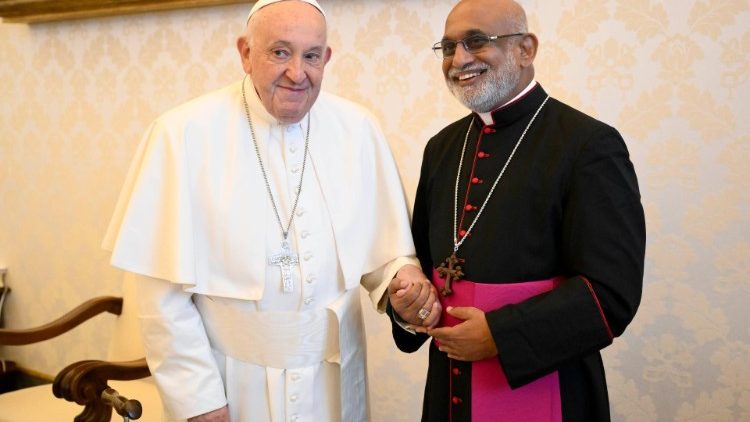
Pope Francis meets with the leadership of the Syro-Malabar faithful

Pope Francis earlier today with His Beatitude Mar Raphael Thattil, Major Archbishop of Ernakulam-AngamalyPope Francis earlier today with His Beatitude Mar Raphael Thattil, Major Archbishop of Ernakulam-Angamaly  (VATICAN MEDIA Divisione Foto)

Pope to Syro-Malabar faithful: Unity is a duty

Meeting with the head Syro-Malabar Catholic Church, which has been divided for a number of years by a fierce liturgical dispute, Pope Francis emphasises the importance of obedience to ecclesiastical authorities.

By Joseph Tulloch

Pope Francis met on Monday morning with Major Archbishop Raphael Thattil, the head of Kerala’s Syro-Malabar Catholic Church.

The Pope’s address to Archbishop Thattil ranged over a number of topics, from the ancient history of the Church in Kerala to the liturgical dispute which has been raging there for a number of years.

An ancient history

Pope Francis began his address by reflecting on the ancient faith of the Syro-Malabar Church.

“The faithful of your beloved Church”, he said, “are known not only in India, but throughout the whole world, for the ‘vigour’ of their faith and piety.”

Referring to the fact that, for many years, Western missionaries attempted to force Kerala’s Christians to conform to European traditions, Pope Francis said that “some members of the faith” committed “unfortunate acts against you”, because of their “insensitivity” to the history of India’s ancient churches.

The Syro-Malabar Church, the Pope added, is particularly important today, in times where it is common to “sever the roots connecting us to the past.”

“The Christian East”, he said, “allows us to draw from ancient and ever new sources of spirituality; these become fresh springs that bring vitality to the Church.” 


Unity and obedience

Referring to the ongoing liturgical controversy, the Pope said that he had “recently sent letters and a video message to the faithful, warning them of the dangerous temptation to focus on one detail.”

This danger, he said, comes from “a self-referentiality, which leads to listening to no other way of thinking but one’s own.”

And it is here, the Pope warned, that “the devil creeps in”, aiming to undermine Jesus’ desire that we, his disciples, “be one” (John 17.2).

“For this reason,” Pope Francis stressed, “guarding unity is not a pious exhortation but a duty.”

And, he added, “showing a grave lack of respect for the Blessed Sacrament …by arguing about the details of how to celebrate the Eucharist, the pinnacle of [Jesus’] presence among us, is incompatible with the Christian faith."

The path toward unity

“Let us work with determination to protect communion”, Pope Francis urged, and “pray tirelessly” that those who refused to accept the Church’s rulings on the liturgical issues “may realize that they are part of a larger family that loves them and waits for them.”

“Let us meet and discuss without fear,” the Pope said, but “above all, let us pray, so that the light of the Spirit, which reconciles differences and brings tensions back into unity, may resolve disputes.”

“There is one certainty”, the Pope emphasised: “pride, recriminations and envy do not come from the Lord and never lead to concord and peace.”

Conclusion


Pope Francis brought his address to an end with a reflection on the encounter of St Thomas – who had doubted the resurrection –  with the Risen Jesus.

Jesus, the Pope recalled, showed himself to Thomas, and invited him to inspect the wounds he had received while on the cross.

“What amazement must have seized the Apostle Thomas as he contemplated them and saw his doubts and fears vanish before the greatness of God! It is an amazement that generates hope, an amazement that prompted him to go out, to cross new borders and to become your father in faith. Let us cultivate this amazement of faith, which enables us to overcome every obstacle!”

You can read the full text of the Pope's address here

Thursday, December 7, 2023

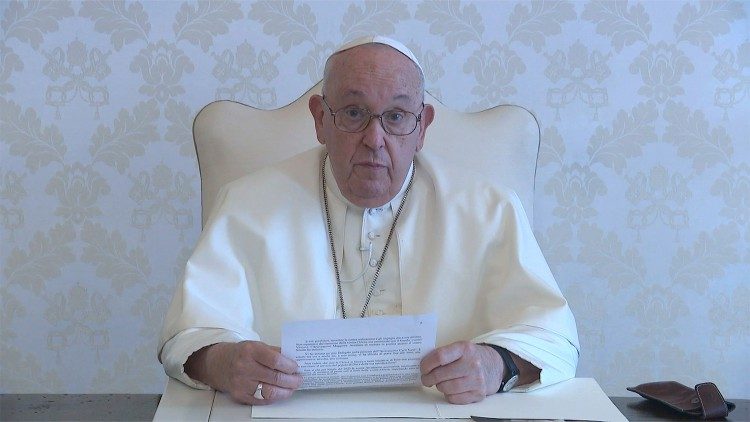
Pope Francis trying to keep unity in the Syro-Malabar Church in India


Pope Francis delivers a video-message to the faithful of Syro-Malabar Archeparchy of Ernakulam-AngamalyPope Francis delivers a video-message to the faithful of Syro-Malabar Archeparchy of Ernakulam-Angamaly 

Pope to Syro-Malabar faithful in Ernakulam: Don’t become a sect

In a video message to the Syro-Malabar Archeparchy of Ernakulam-Angamaly, Pope Francis denounces agitation surrounding the Liturgy and launches an appeal for unity.

By Christopher Wells

In the face of a long-simmering dispute over the liturgy, Pope Francis is calling on the faithful of the Syro-Malabar Archeparchy of Ernakulam to conform to the decisions of the Holy Synod or risk being declared outside of communion with the Church.

The Syro-Malabar Church is the second largest of the Eastern churches in union with Rome, numbering some 4.25 million faithful. The Archeparchy of Ernakulam-Angamaly is the primatial see of the Syro-Malabar Church and home of the Major Archbishop.
 

The Archeparchy has been the centre of an ongoing conflict concerning the way the Holy Eucharist is celebrated. A compromise liturgical practice was endorsed and imposed by the Holy Synod – the highest ecclesial authority in the Syro-Malabar Church. Although the Synod’s decision concerning the Eucharistic liturgy, or “Qurbana”, was received by the other dioceses within the Church, the Major Archeparchy has largely refused to conform, leading to conflict and at times even violence, as the Pope notes.

However, in his video message, Pope Francis indicates that there are other, worldly reasons for opposition, having nothing to do with the liturgy.

'Remain in the Catholic Church'

In his video message, the Pope assures the Syro-Malabar faithful in the Archeparchy that he has personally studied the issues involved, noting that he has written to them several times in the past. However, as not everyone has read those letters, the Pope says he is now addressing the faithful “in a slightly unusual way, so that no one may have any more doubts what the Pope thinks.”

Pope Francis goes on to make a forceful appeal: “In the name of the Lord, for the spiritual good of your Church, of our Church, I ask you to heal this rupture. It is your Church, it is our Church. Re-establish communion, remain in the Catholic Church!”

In particular, he calls on priests to remember their ordination and the promises they made at the time, calling on them not to separate themselves from the Church, but to walk together with the Synod, with their Bishops, and with the Major Archbishop by implementing the liturgical decisions of the Synod by Christmas, 2023.

“I ask you to be careful,” the Pope says. “Be careful that the devil does not lead you to transform yourselves into a sect.”

Sanctions possible

He pleads with them not to force “the competent ecclesiastic authority” to recognize they have left the Church because they are “no longer in communion” with their Pastors and with the Successor of St Peter, the Pope. If that should happen, he warns, “with great sorrow, sanctions would be incurred.”

“I do not want to reach that stage,” the Pope says.

Pope Francis concludes his message by calling on the faithful of the Archeparchy, priests and people, to celebrate the Qurbana “in communion according to the directions of the Synod,” and to commemorate the Major Archbishop in their liturgies.

“Please do not continue to wound the Body of Christ!” the Pope says in conclusion. “Do not separate yourselves from it! And even though there have been some grievances against you, forgive them with generosity. May the Eucharist be the model of your unity. Do not shatter the Body of Christ which is the Church, so as not to eat and drink judgment upon yourselves.”