In Hurricane Helene’s Wake, Priests Offer Mass by Candlelight as Catholic Parishes Become Lifelines
Such a storm is uncommon for the region, but Good Samaritans and the Church are lending a hand in the devastating aftermath.

A load of supplies is blessed by chaplain Father Christopher Brock at Bishop McGuinness High School in Kernersville, North Carolina. (photo: Courtesy of the Catholic News Herald/Diocese of Charlotte)
Among the hardest-hit communities in the wake of Hurricane Helene are those in the Diocese of Charlotte in western North Carolina, where more than half of the more than 200 deaths recorded so far occurred, with fast-moving water wiping away communities and leaving residents homeless and at risk.
Many residents remain isolated without electricity, water, email or phone communication and other vital supplies and services, and some still have no contact with loved ones in the hardest-hit regions.

The flooding has devastated the western portion of North Carolina.(Photo: Courtesy of the Diocese of Charlotte and the Catholic News Herald)
The diocese is playing a leading role in recovery efforts, both in providing basic necessities and for pastoral needs.
Father Patrick Cahill, pastor of St. Eugene parish in the historic town of Asheville, said early Friday morning, Sept. 27, was the worst for the storm.
“The rain wouldn’t let up, holy cow!” he told the Register. From midnight onward, “We had 12 straight hours of pouring rain. It was unbelievable to see the volume of water pouring off our rectory house and down the hills, as drains clogged with debris.”
Howling winds followed. As he drove to the parish church (about a mile away) last Friday evening, he said it was a challenge to navigate fallen trees and downed power lines.
A week later, power and water is still off at the church, he said, but “Good Samaritans” have since descended on the parish to clean up. One parishioner drowned, and many parishioners’ homes are damaged. He said his permanent deacon’s house was “crushed” by trees. Had the deacon and his wife been home at the time, they, too, might have become fatalities.
Father Cahill noted that local hospitals were “overrun” with injured victims; and he knew of one parishioner, a nurse practitioner, who worked a 24-hour hospital shift in the immediate aftermath of the storm. He added that as he and a fellow priest were waiting for utilities to be turned back on, they were living off bottled water and tap water from a bathtub they’d filled before the storm hit.
Shelter From the Storm
Claudia Graham is business manager of St. Margaret Mary Church in Swannanoa, which was “ground zero” of storm damage in North Carolina. She lives 6 miles from the church; she and her husband took shelter in their basement as winds of more than 100 mph battered the mountain community.
The next morning, she went to the church amid widespread destruction that was “mind-boggling,” she told the Register. Of greatest concern was the extensive damage to the community’s water and sewer system.
Although a large cherry tree fell atop the church building, damage to the parish was not deemed as serious. Water and power is not yet back on, and cellphone service is irregular. The parish is still attempting to locate parishioners.

St. Margaret Mary Catholic Church in Swannanoa remains closed and without electricity after a large oak tree fell on the 88-year-old church building during Tropical Storm Helene Sept. 27. However, parishioners have turned the church into a central distribution point for aid supplies to residents in need, with a daily supply line from Charlotte bringing truckloads of relief supplies from the Diocese of Charlotte's Pastoral Center to the church. Swannanoa, which sits alongside the Swannanoa River, has been one of the worst affected communities.(Photo: Gabriel Swinney for the Catholic News Herald/Diocese of Charlotte)
Catholic Charities appeared quickly on site, with two truckloads of emergency supplies, with a third truck on standby for when storage space can be acquired.
“It is hard to express all the good that has already occurred amongst so much damage and suffering,” Graham said. “The Diocese of Charlotte has been incredible. I am doing what good I can through our parish; I think that is why God has put me here.”
Father Joshua Johnson of St. Edmund Campion parish in Flat Rock noted that his parish was undamaged, but “our roads are flooded out and their concrete and asphalt have been washed away.”
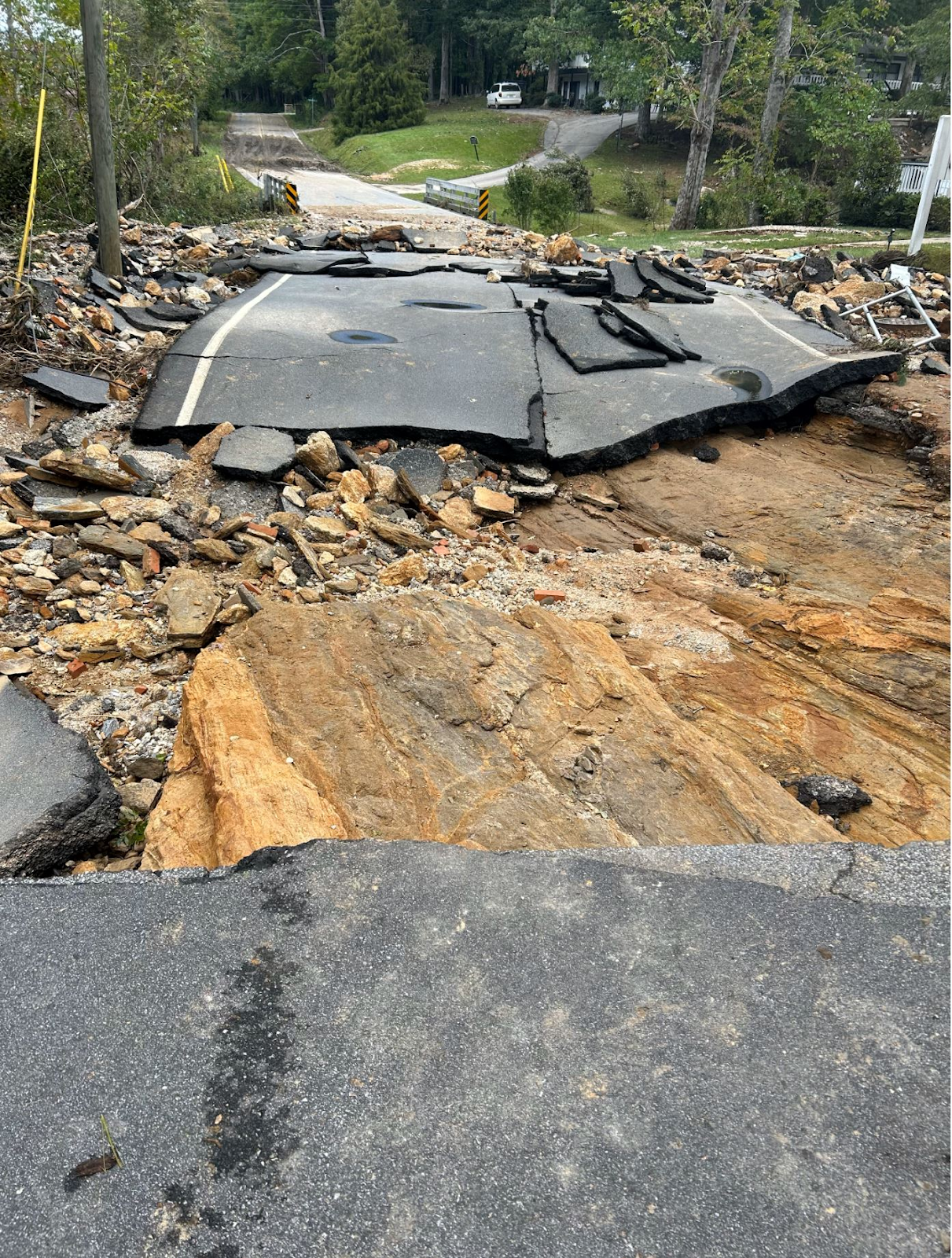
N.C. road washed away.(Photo: Father Joshua Johnson)
Trees fell on the homes of three parishioners, and six feet of water flooded the interior of a fourth home.
Father Johnson is one of multiple priests being called on to go to the harder hit areas to provide Mass and the sacraments, this weekend celebrating Mass for St. Margaret Mary, as well as assisting with emergency resources. He has been celebrating Mass by candlelight, due to the lack of electrical power.
44 Parishes Severely Affected
Father Shawn O’Neal, pastor of Sacred Heart Church in Brevard, said some of his parishioners were flooded out of their homes and that there was one death of a parishioner’s relative during clean-up efforts. The parish provided temporary shelter, as well as hot meals, to the homeless.
Father Patrick Winslow, vicar general and chancellor of the Diocese of Charlotte, noted that 44 of the diocese’s 93 parishes were in severely affected areas. And, while damage to diocesan structures has been minor, “our parishioners have experienced a great deal of devastation from the flooding. With the water rising and flowing hard, it created a lot of destructive force and power,” he told the Register. “Many of our people are without homes and automobiles, communication, potable water and basic supplies.”
He noted such a storm was uncommon for western North Carolina and that “many of our towns are in valleys surrounded by mountains so they were hit by large volumes of runoff.”
The Catholic Charities team of the Diocese of Charlotte immediately sprung to action to connect with victims, he said, starting by compiling lists of needed items.
“Within 24 hours we were loading trucks and getting them to places where we knew we could reach,” said Father Winslow.
Donations of cash and supplies began coming in from surrounding communities, and distribution sites, such as Immaculata School and Immaculate Conception Church in the hard-hit community of Hendersonville, became distribution sites for supplies.

The diocese has also been active in providing for the spiritual needs of parishioners, Father Winslow added, “as our priests are imbedded in the affected areas and are doing what they can to help parishioners put their lives back together.”
Charlotte Bishop Michael Martin noted that he was moved by the suffering of so many within the diocese and promised that the Church would do what it could long term to help people rebuild their lives.
Touring the affected areas, he commented, “Along with Catholic Charities providing for the material needs of the people, I think the most important thing the Church can do is be with these people as they are suffering.”
Father Winslow added, “While the hurricane has been devastating, it’s been impressive and inspiring to see neighbors coming together to help one another.”
HOW YOU CAN HELP
Bishop Martin welcomes donations for victims of Hurricane Helene: giving.classy.org/campaign/624511/donate.
Also help via Catholic Charities USA: Hurricane Helene Response - Catholic Charities USA.