Showing posts with label Archdiocese of St. Louis. Show all posts

Friday, June 26, 2026

The September Beatification of Venerable Fulton Sheen is going to draw quite a crowd


Sheen beatification tickets defray ‘substantial costs’ of inviting thousands, says bishop


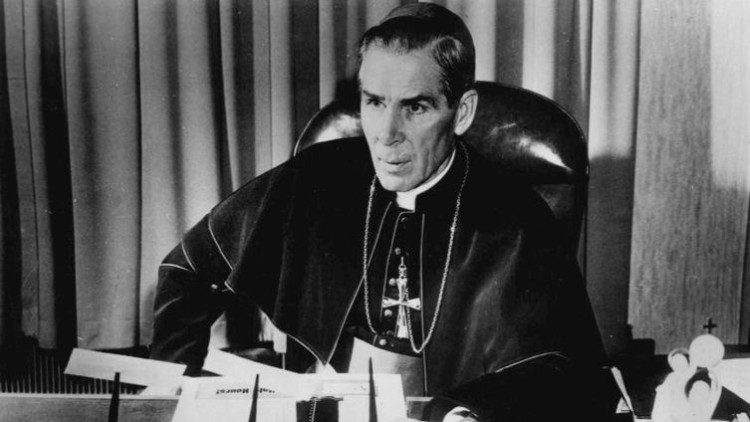
Venerable Fulton J. Sheen, pictured in an undated photo, is remembered as one of the most influential and innovative evangelists in American history. Tickets for the Sept. 24, 2026, beatification of Venerable Sheen in St. Louis were snapped up quickly on the first day, June 23. (OSV News file photo)


Tickets to the September 2026 beatification of Venerable Fulton J. Sheen are quickly being snapped up, with thousands claimed when they became available June 23.

The $15-$25 admission price is due to the “substantial costs” in planning and holding the event at a national-level venue, Bishop Louis Tylka of Peoria, Illinois, told OSV News.

The popular, scholarly Archbishop Sheen – a 20th-century pioneer of Catholic media – will be beatified Sept. 24 at The Dome at America’s Center in St. Louis. The 1.7 million-square-foot structure, which features more than 67,000 seats excluding the floor section, hosted St. John Paul II for a 1999 papal Mass that at the time was the largest indoor gathering held in the U.S., according to the venue’s website.

More recently, the sporting and convention venue has been dubbed “The Battle dome,” since it’s the home field for the United Football League’s St. Louis Battle hawks.

Bishop Tylka – whose diocese has oversight of Archbishop Sheen’s sainthood cause – explained that The Dome, located in the Archdiocese of St. Louis, was chosen for the beatification to enable as many of the faithful to share in the occasion.

“We could have done this event in our cathedral, where there would have been 800 people,” the bishop told OSV News June 23. “But we’re trying to maximize people’s participation. We want people to be there, and to do all of that, there are certainly significant costs that we are taking on.”

The Dome’s daily rental fees top six figures, and while Bishop Tylka did not share an exact number, the Battle hawks paid $100,000 per game to play at the venue in 2023.

But, as Bishop Tylka pointed out, “all that (rental fee) does is open the doors – it doesn’t cover any of the cost to actually operate” an event at The Dome.

Audiovisual, electrical, public safety, insurance, medical, cleaning and concession services are among those required for Dome events, with each item adding to the bottom line.

The Dome notes in its most recently available technical overview that “most of the skilled service work to build and support an event is done by local tradesmen and laborers from a variety of local unions,” including those representing carpenters, decorators, electricians, projectionists and stagehands.

While Bishop Tylka said the production company had “given us a discount,” The Dome notes that an approved audiovisual contractor “will hire the appropriate local union labor for audio visual work.”

Among the unions with which The Dome contracts is Stagehands Local 6 of IATSE (the International Alliance of Theatrical Stage Employees, Moving Picture Technicians, Artists and Allied Crafts of the United States, Its Territories and Canada).

As of June 10, Local 6 rates for riggers, who install and move staging, ranged from more than $36 to more than $47 per hour – with a minimum four-hour guarantee, double-time for overnight hours (midnight to 7 a.m.) and time-and-a-half after eight hours or 40 hours in a week with the same employer.

Bishop Tylka said beatification event organizers are “trying to, in many different ways, defray those costs by getting sponsorships.”

He said that one way of lessening the financial burden is “obviously” through venue-required ticketing – although that process itself entails its own set of costs.

“The Dome contracts with Ticketmaster,” said Bishop Tylka, referencing the global ticket management firm.

And Ticketmaster, part of Live Nation Entertainment, levies “a number of fees,” said Bishop Tylka.

On its website, Ticketmaster notes that the face value, or base price, of a ticket is set by the event organizer, factoring in production and venue costs as well as interest in the event. The listed price reflects the face value as well as service fees, which help cover costs incurred by the venue and Ticketmaster, including credit card processing fees. A facility charge may also be added, although Ticketmaster does not keep that portion.

Bishop Tylka noted that the beatification price tier is structured to allow reduced rates for seminarians and school groups, with one donor covering the cost of tickets for most consecrated religious.

“A person who’s willing to pay $25 for a ticket helps us to be able to offset the cost of inviting seminarians, religious and school groups,” he said.

But he cautioned, the “very generous gift” that has so far paid for consecrated religious attendees, “doesn’t guarantee that it’s covered every religious who’s coming.”

Bishop Tylka stressed that the ticketing fees were not equivalent to “paying” to attend a liturgy, a practice strictly forbidden by canon law, the Church’s main administrative code.

Ticketing for the event is required because of the realities of “crowd control, security and the expenses of putting on an event, whether it’s a beatification Mass for (Archbishop) Fulton Sheen or a football game in the stadium.”

“All those things have to be accounted for,” said Bishop Tylka. “And they’re just not free.”

Thursday, April 23, 2026

Preparations well underway for the Beatification of Archbishop Fulton Sheen


Diocese of Peoria releases schedule of pilgrimage events for Sheen beatification


Venerable Archbishop Fulton Sheen, pictured in an undated photo, is remembered as one of the most influential and innovative evangelists in American history. The Diocese of Peoria has released a schedule of events surrounding Sheen's Sept. 24, 2026, beatification in St. Louis. (OSV News file photo)


(OSV News) — Ahead of Archbishop Fulton J. Sheen’s Sept. 24 beatification, the Diocese of Peoria, Illinois, recently released a schedule of events, inviting those who plan to travel to The Dome at America’s Center in St. Louis, Missouri, for the beatification to “go deeper” and “transform your trip into a sacred journey.”

“The Sheen Pilgrimage is a spiritual experience centered around prayer, reflection, and celebration,” the diocese said. “Beginning in Peoria, IL, on September 15, this pilgrimage includes the anniversary of Sheen’s ordination, the historic Beatification Mass, and culminates in celebratory Masses and the Sheen Award Gala.”

The schedule begins with a nine-day novena of holy hours at 7 p.m. every evening at the Cathedral of St. Mary of the Immaculate Conception in Peoria from Sept. 15-23 and a Sunday, Sept. 20 Anniversary Mass of Sheen’s Ordination at the cathedral at 3 p.m., which requires tickets.

The festivities will continue in St. Louis with Vespers at the Cathedral Basilica of St. Louis at 5 p.m. on Sept. 23, also requiring tickets.

Sheen beatification day-of festivities

On the day of the beatification, there will be an expo for attendees at The Dome at America’s Center from 8 a.m. to 6 p.m., adoration and confession available at 9 a.m., and a pre-Mass show at 10 a.m.

“With anticipation of a great number of people wanting to participate, we chose (The Dome) because of availability, being indoors, and the close proximity to the Diocese of Peoria,” Bishop Tylka said March 25 when details of the beatification were announced.

Following the 2 p.m. Beatification Mass, there will be veneration of a relic of Sheen from 4 to 6 p.m.

Masses of Thanksgiving and various parish talks will take place in the Diocese of Peoria on Sept. 25, and the Sheen Award Gala, a ticketed event, will get underway in Peoria Civic Center at 6 p.m. that evening.

Masses of Thanksgiving, including a Byzantine Rite Mass of Thanksgiving, will also be celebrated at the Cathedral of St. Mary in Peoria on Sept. 26.

The diocese has more information and tickets for the events that require them at celebratesheen.com.

“Whether you come for a day or the entire week,” the diocese said, “this is an opportunity to walk in the footsteps of a remarkable spiritual leader and grow in faith alongside pilgrims from around the world.”

Thursday, March 26, 2026

Beatification date & details released for Venerable Fulton J. Sheen


Venerable Fulton SheenVenerable Fulton Sheen 

Venerable Fulton Sheen to be beatified in St. Louis on 24 September

The late American Archbishop Fulton J. Sheen will be beatified at a Mass presided over by Cardinal Luis Antonio Tagle on September 24, 2026, in St. Louis, Missouri, according to the Dicastery for the Causes of Saints.

By Deborah Castellano Lubov and Robin Gomes

Venerable Fulton J. Sheen of the United States is set to be beatified on Thursday, September 24, 2026, in St. Louis, Missouri. 

Cardinal Luis Antonio Tagle, Pro-Prefect of the Dicastery for Evangelization, will preside at the beatification Mass, representing Pope Leo XIV.

After his heroic virtue was recognized, Fulton Sheen was declared Venerable in 2012 by Pope Benedict XVI. In 2019, Pope Francis authorized a decree recognizing a miracle through his intercession.

This recognition cleared Archbishop Sheen for beatification, after which he will have the title "Blessed."

The future Blessed Fulton Sheen was known for his dynamic preaching, especially on television and radio.

Born to an Irish family in El Paso, Illinois, on May 8, 1895, Sheen discovered his call to the priesthood at the age of 24 and was ordained a priest in 1919.

He pursued higher studies at the Catholic University of America in Washington (US), the Catholic University of Leuven (Belgium), and the Pontifical University of St. Thomas Aquinas in Rome. 

He returned to the U.S. in 1926 and began teaching at the Catholic University of America, a position he held until 1950. Sheen served as the Bishop of Rochester, New York, from 1951 to 1969, and Pope Paul VI later appointed him as the Titular Archbishop of Newport, Wales, in 1969. 

A gifted teacher and speaker, Sheen’s homilies were much appreciated. In 1930, he began participating in the Sunday radio program entitled “The Catholic Hour," which reached an estimated four million listeners at the height of its popularity.

In 1951, he began hosting a weekly television series, “Life is Worth Living," on matters of faith that attracted some 30 million viewers.    

He died in New York at the age of 84, on December 9, 1979.

Tuesday, July 1, 2025

Naming of a new Archbishop for Mobile, Alabama


Pope accepts resignation of Archbishop Rodi, names St. Louis auxiliary as successor


St. Louis Auxiliary Bishop Mark S. Rivituso is pictured in a file photo. On July 1, 2025, Pope Leo XIV accepted the resignation of Archbishop Thomas J. Rodi of Mobile, Ala., and appointed Bishop Rivituso as his successor. (OSV News photo/Lisa Johnston, courtesy St. Louis Review)

(OSV News) — The Archdiocese of Mobile, Alabama, will welcome a new shepherd, as Pope Leo XIV has accepted the resignation of Archbishop Thomas J. Rodi and appointed Auxiliary Bishop Mark S. Rivituso of St. Louis as his successor.

The resignation and appointment were announced in Washington July 1 by Cardinal Christophe Pierre, the apostolic nuncio to the U.S.

Archbishop Rodi, 76, had submitted his resignation to the pope in March 2024 upon reaching his 75th birthday, as required by canon law. 

The archbishop, who has served in his current see for more than 17 years, will continue as apostolic administrator of the Mobile Archdiocese until the installation of Archbishop Rivituso, expected to take place within about two months. The date and location of the installation Mass have not yet been finalized.

Archbishop Rodi hailed the appointment of his successor, saying in a July 1 statement he was “most grateful to the Holy Father for sending us this outstanding bishop.”

The 63-year-old Archbishop Rivituso, a St. Louis native and the sixth of eight children, has ministered extensively throughout that archdiocese and has served as its vicar general since 2011.

A graduate of Cardinal Glennon College and Kenrick Seminary, both in St. Louis, he earned a licentiate in canon and civil law from St. Paul University in Ottawa, Ontario.

His call to priesthood was an early one, marked by a devotion to the Blessed Sacrament, before which he prayed daily while a student at St. Mary’s High School. His family regularly attended Eucharistic Holy Hours and also practiced devotion to Our Lady of Perpetual Help. On Holy Thursday, they paid visits to the Blessed Sacrament at various Catholic churches.

His 1988 priestly ordination in St. Louis foreshadowed a future connection to Mobile: The late Archbishop John L. May, who ordained him, had led the Alabama archdiocese prior to his St. Louis appointment.

Archbishop Rivituso was a confessor for the Little Sisters of the Poor as well as a chaplain for the Veterans Administration in St. Louis. In addition, he has long experience in prison and death-row ministry and has advocated for the end of capital punishment in Missouri.

“The late Pope Francis really taught me about making sure that we’re mindful of those who are on the peripheries,” he said in an interview published July 1 by the St. Louis Review, the newspaper of the Archdiocese of St. Louis. “I feel like that’s always something that’s going to be important in my heart and ministry. The church is so blessed to be involved in the works of compassion, and I think that’s where we truly live what Jesus has called us to do about living his works of mercy.”

Wednesday, May 31, 2023

Archdiocese of St. Louis reorganizes, merges and cuts parishes


St. Louis Archdiocese Reorganization Will Cut Parishes From 178 to 134

In the end, this leaves the archdiocese with 44 fewer parishes than it has now. Some of these changes will be implemented as soon as August, but the plan will not be completed until 2026.


A new plan approved in the Archdiocese of St. Louis will reduce the number of parishes from 178 to 134 amid concerns about a lack of priests and shrinking Mass attendance, Archbishop Mitchell Rozanski announced over the weekend.

The plan, called “All Things New,” closes 35 churches, merges their parishes into neighboring parishes, and merges 15 other parishes into five new parishes. The plan also creates a new parish for the Spanish-speaking community in St. Charles County. In the end, this leaves the archdiocese with 44 fewer parishes than it has now.

Some of these changes will be implemented as soon as August, but the plan will not be completed until 2026.

“As your archbishop, I have the duty to provide for the pastoral care of all people in the archdiocese,”  Archbishop Rozanski said in a video announcing the changes. “‘All Things New’ has called us to ask ourselves what our parishes, ministries, and institutions need to look like in order to effectively share the faith that is sustainable for our children and generations to come.”

The archdiocese covers the city of St. Louis and 10 surrounding counties.

One of the reasons for reducing the number of parishes is poor Mass attendance. The archbishop said that about 5,000 Catholics are either leaving or not reengaging with the Church after high school or college annually. 

“Over the past decade, we’ve also seen fewer people attending Mass,” Archbishop Rozanski said. “Our numbers should be growing. We have more baptisms than funerals. Nearly 1,000 people enter the Church each year. But in 2021, the number of Catholics in the Archdiocese of St. Louis dipped below 500,000 for the first time since the 1960s.”

Archbishop Rozanski also noted that many Catholics have moved out of the city and into the surrounding counties, but the parish lines have yet been changed to reflect that. He noted that, in one example, there are 10 priests for about 18,000 Catholics in North County, but there are only three priests serving 18,000 Catholics in one parish in St. Charles County. The changes seek to make these ratios more proportional. 

“We find ourselves with too few priests in large parishes and a disproportionate number of priests in small parishes,” the archbishop said. 

Another problem Archbishop Rozanski noted was the priest shortage. According to projections from the archdiocese, there would be more parishes than priests by 2025 if the archdiocese failed to make any changes. He said that 41% of active or retired priests are older than age 70.

Before making the changes, the archdiocese held 350 listening sessions, with at least one in each of the 178 current parishes. It also considered feedback from 70,000 Catholics in the archdiocese who participated in a survey. Feedback was also solicited from 18,000 school parents, staff, teachers, donors and community partners. The archdiocese also held focus groups and talked with civil and business leaders.

Archbishop Rozanski said the feedback helped structure the final plan, which was approved by the All Things New Planning Committee. The committee included priests, deacons, parish life coordinators, lay leaders, and religious within the archdiocese. In addition to considering the feedback, they also looked into financial data and other information.

The plan makes changes to how the archdiocese uses resources, which the archbishop said puts pastoral services closer to the people and parishes to foster collaboration across parish boundaries. He said the changes will help the archdiocese more effectively go into the community and bring Christ to people. 

“I pray this first phase of work will equip us to build new, creative models of ministry together,” Archbishop Rozanski said. 

Some Catholics in the archdiocese have been critical of the changes because of the extent to which they will shake up parishes. More than 3,000 Catholics in the archdiocese signed a petition that asked the archbishop to halt the plan about two months ago. 

The petition criticized the structure of the survey and claimed it only allowed the faithful to answer predetermined questions, without being allowed to address specific situations in their own parish. It also claimed the process would cause mistrust in Church leadership, which could drive Catholics away. 

In his announcement, Archbishop Rozanski acknowledged “the profound impact a parish community can have on us and how these good and faithful institutions have formed our families.” He said he wished the changes were not necessary but also maintained optimism.

Monday, April 10, 2023

Plan to merge parishes in St. Louis gets opposition


St. Louis Catholics petition archbishop to halt diocese-wide parish merger plan


A group of more than 3,000 Catholics in the Archdiocese of St. Louis sent a letter to Archbishop Mitchell Rozanski last week asking him to halt plans to merge numerous parishes in the coming years.

Robert Onder, a former Missouri state senator and founding member of St. Gianna Parish in Wentzville, Missouri, is acting as procurator, or representative under canon law, for the 3,100 Catholics who signed a mandate calling for the planning process to stop. There are approximately 484,000 Catholics in the archdiocese. 

“After prayerful study of the past and current plan, we do not see how the pastoral plan will improve the pastoral care of the faithful, encourage vocations, increase the evangelizing mission of the Church, revitalize parishes or bring advantage to the Church,” the March 27 letter signed by Onder reads. 

In his letter, sent on behalf of the organization “Save Our St. Louis Parishes,” Onder claims the group views the surveys given to Catholics as part of the planning process as too generic for an archdiocese as geographically and demographically diverse as St. Louis. He also says that grouping parishes into shared pastorates “should not be done without careful planning, proper catechesis related to the situation, and gradualism lest souls be lost.” He says he and the other signees worry that Catholics will be driven away from the Church by the planned changes made to parishes. 

Onder calls for the suspension of the planning process and asks Rozanski to enter into a “collaborative dialogue with us,” noting that he has attempted to contact Rozanski several times and not received a response. 

A representative of Save Our St. Louis Parishes was not available for an interview with CNA before press time. 

What’s going on in St. Louis?

The Archdiocese of St. Louis, the largest and oldest in Missouri, is in the midst of a major pastoral planning initiative dubbed “All Things New,” announced last May. An as-yet undetermined number of the current 178 parishes in the archdiocese will close or merge in the next three years in an effort the archdiocese says will better use its resources for evangelization. The most recent iteration of the plan calls for merging and expanding of parish boundaries, creating overall fewer — and much larger — congregations. 

The consolidation process, branded as “All Things New,” which is being administered by the Pennsylvania-based Catholic Leadership Institute (CLI), is very similar to ones undertaken by CLI in recent years in other major midwestern archdioceses, such as Pittsburgh and Cincinnati

The second round of draft models released in February shows many current parishes coming together into “pastorates,” either as separate parishes that share priests or as one new, merged parish. Under canon law, a diocesan bishop has the authority to alter parishes, but only for a just reason specific to each parish. Concern for souls must be the principal motivation for modifying a parish.

The archdiocese hosted more than 340 “listening sessions” during an eight-week period in the fall of 2022 to present the current models for mergers and closures to the people, and to solicit feedback. The archdiocese says it will announce the final plans for parish consolidations and closings next month, on Pentecost Sunday in May. 

Clergy trends unsustainable

Father Chris Martin, a St. Louis native who is overseeing the All Things New process, told CNA late last year that the initiative is being undertaken from a “relative place of strength, instead of desperation,” in response to well-documented demographic changes and projections. 

Numerous factors, including increasing suburbanization and rising crime, have led in recent years to an exodus of people from the city’s historic inner core, where the greatest number of large, historic parishes were clustered. Catholics have been moving gradually west for several decades, away from the city center along the Missouri River and toward the suburbs, leaving parishes in the more urban areas with smaller Catholic populations from which to draw. Overall, in 2021, the number of Catholics in the Archdiocese of St. Louis dipped below 500,000 for the first time since the 1960s.

Another reason for the process, Martin says, is a priest shortage on the horizon. The archdiocese is not currently starved for priests — in fact, it has a better priest-to-parishioner ratio than the national average and one of the highest in the country for a diocese its size. According to the CARA research center at Georgetown University, the ratio for the country as a whole is one diocesan priest for every 2,096 Catholics. In St. Louis, that ratio is one diocesan priest for every 1,630 Catholics. And that doesn’t include the strong presence of religious priests active in the archdiocese, such as those belonging to the Dominican, Jesuit, and Benedictine orders.

That said, the current trajectory of St. Louis’ diocesan priest population is not sustainable long-term, Martin said. The average St. Louis diocesan priest is in his mid-60s, and priests are retiring and passing away at a greater rate than new men are being ordained — this is true of religious priests, too, he noted. (The archdiocese told CNA that the “standard age” for priestly retirement in St. Louis remains 75 years old and has not been lowered.)

Martin also stressed a distinction: Just because there are currently enough archdiocesan priests to provide pastoral care for all the people in St. Louis, that doesn’t mean they have enough priests to care for all the parishes that currently exist. Already, Martin said, the priest population in St. Louis is stretched thin because of the high number of parishes that must be maintained. If one priest has to call in sick or is otherwise indisposed, it can be a challenge to get his assignments covered because almost every other priest is already taking care of his own parish. 

The number of parishes will likely exceed the number of priests by 2026, according to archdiocesan projections. Barring a massive increase in vocations, the number of priests in St. Louis will begin to decline, eventually to an untenable number. “Doing nothing” in the face of these demographic changes, Martin said, “would be irresponsible.” 

Martin, a former vocations director for the diocese, said while he wholeheartedly supports a financial investment in priestly vocations, a change in culture is what is really needed, not just in St. Louis but everywhere. 

“God is still calling enough priests to serve his people,” he asserted, but cultural barriers often stand in the way. He said when he worked in vocations, he observed that most young people don’t pursue vocations because they were never personally invited, or in some cases because their parents forbade it. 

“It’s not about throwing resources at vocations. It’s really about developing a culture of vocations in our parishes and in our families, where it’s really something that moms and dads sincerely pray for and talk to their children about, what God may be calling them to in life,” Martin said.

Tuesday, January 3, 2023

Thousands of mostly college age Catholics gather in St. Louis to adore Jesus in the Blessed Sacrament


Foretaste Of Heaven: SEEK23 Conference To Draw Thousands


By Kiki Hayden

(OSV News) — Thousands of Catholics are converging on St. Louis from Jan. 2 to Jan. 6 to adore Jesus Christ in the Blessed Sacrament, listen to talks about important topics and celebrate their faith at the SEEK23 Conference.

The annual SEEK conferences, hosted by the Fellowship of Catholic University Students (FOCUS), are for anyone interested in deepening their faith and spreading the Gospel — whether on college campuses or in their home parish. Due to the COVID-19 pandemic, this year is the first in-person national conference since 2019.

Many past attendees are looking forward again to this year’s SEEK conference.

“I grew up a cradle Catholic,” Javier Lugo, a 26-year-old FOCUS missionary at the University of Miami, told OSV News. “The faith was very, very important to me.”

When Lugo transferred from Keiser University Latin American Campus in Nicaragua to the University of Southern California as a sophomore, he “wanted to prioritize my faith,” he said. Lugo had heard about SEEK, and a campus missionary helped him get a scholarship to attend so finances would not be an impediment.

Growing up, Lugo said he had attended many “retiros” (retreats) — but nothing like the 2017 SEEK conference.

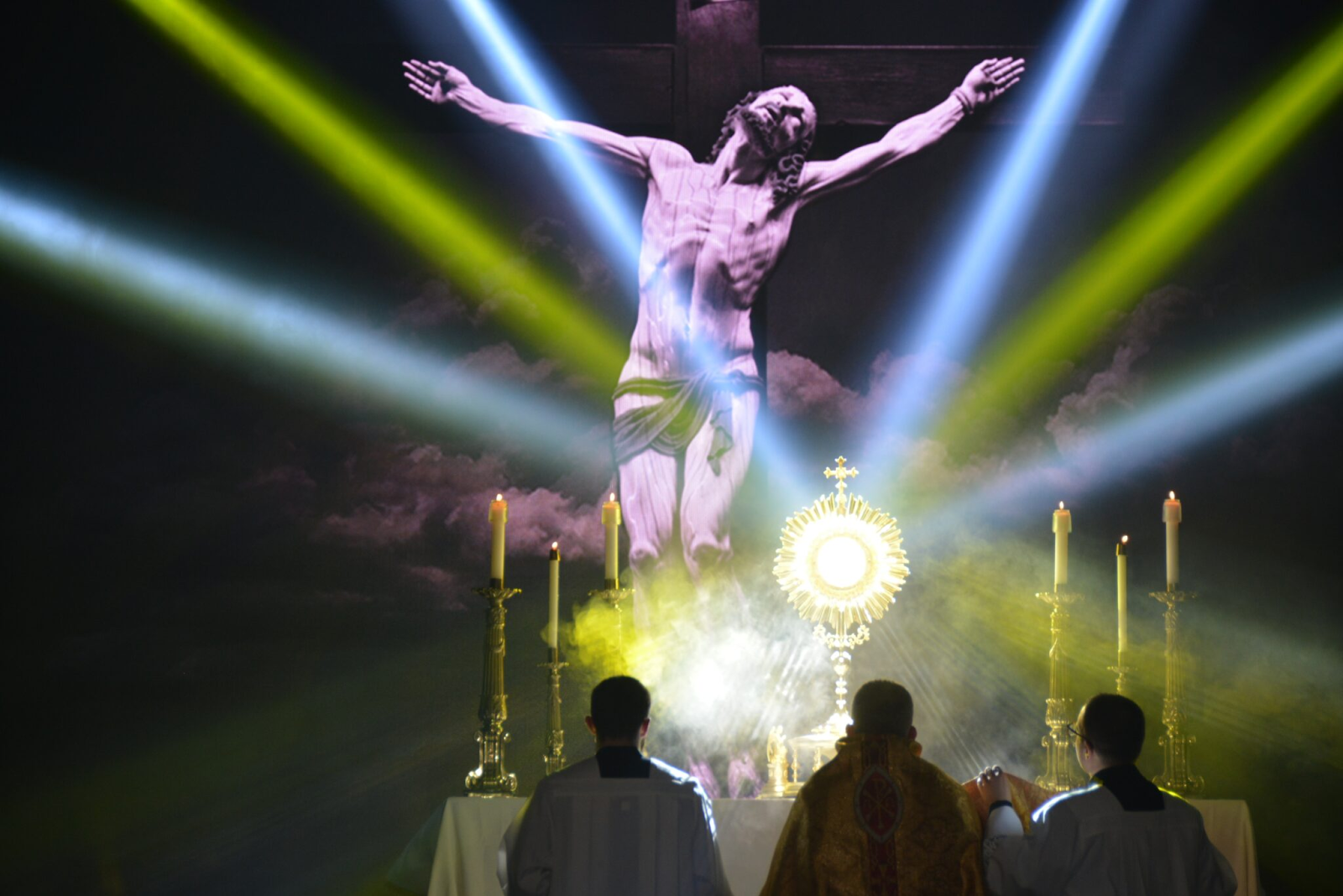
“A conference of this size is like a ‘retiro’ times a thousand,” he explained. With a smile, he recalled the Eucharistic adoration night — thousands of people praying on their knees and praising the Lord, as fragrant incense billowed through spotlights pointing to the monstrance on the altar — and how in that moment with Jesus in the Eucharist he felt “loved and wanted.”

“I attended one [SEEK conference] as a student, two big ones as a missionary, and then two online,” he said. This year, Lugo and the other University of Miami FOCUS missionaries will be accompanying about 45 students to SEEK23. Lugo is praying for his students and fellow missionaries to have “an open heart” that will lead to “the courage to say yes to whatever is next in their spiritual journeys.”

As freshmen in college at the University of South Alabama in Mobile, twins Lauren and Kelley Hartman also attended SEEK for the first time in 2017. They told OSV News they have attended every year since.

Like Lugo, the Hartmans were deeply moved by experiencing adoration at SEEK. “I’ve never been in a room with so many people in adoration before … I can’t even stretch my legs out,” said Kelley Hartman, “but I know that I’m seen and known by God.”

Now 24, both Lauren and Kelley Hartman will attend SEEK23 as FOCUS missionaries. Kelley Hartman, who evangelizes at Louisiana State University in Baton Rouge, will accompany about 140 students and the other LSU FOCUS missionaries. Lauren Hartman will accompany her fellow FOCUS missionaries from Murray State University in Kentucky with about 50 students. “I’m praying that the talks … apply very deeply to what they’re going through,” said Lauren Hartman.

Both Hartman sisters emphasized that their students are “made for community.” Kelley Hartman described how FOCUS missionaries provide spiritual support beyond the SEEK conferences: “Almost equally as transformative as going to the actual conference was having a missionary be able to affirm the things that happened and being able to walk with us.”

The Hartmans will be joined by one of their sisters and by their parents, because SEEK23 is not just for college students, and FOCUS missionaries serve in parishes as evangelizers beyond the college experience.

Now in her 12th year as a FOCUS missionary, Martha Griswold currently serves at Our Lady of the Valley Catholic Church in Windsor, Colorado. Griswold, 34, continues her mission “walking with parishioners instead of college students … helping the little way of evangelization to be interiorized and lived.”

This year, she is accompanying several parishioners to SEEK23 on the “Making Missionary Disciples” track. Griswold looks forward to talks that are “meant to build up parishioners to feel confident in leading other parishioners, in either small groups or in whatever capacity they are serving in leadership at their parish.”

A few weeks later, her parish will host an online “SEEK Where You Are” conference, showing videos of the keynote speakers from SEEK23.

“This SEEK Where You Are is going to be the best yet,” said Griswold. “The keynotes are very intentionally a narrative re-presenting the Gospel to parishioners and then sending them out on mission.”

SEEK23 aims to engage anyone open to learning more about Jesus Christ’s Great Commission. In addition to the many talks in English, SEEK23 includes several talks in Spanish, such as a session about Our Lady of Guadalupe and the new evangelization. Although the five-day conference begins Jan. 2, registration for single-day attendance is open until the evening of Jan. 5. Already, more than 15,000 people have registered.

For those unable to attend the in-person conference, FOCUS offers an online version of SEEK23 called “SEEK Where You Are,” which is available for individuals, small groups or parishes after the in-person conference — as well as a live Lenten Bible Study — such as the one being held at Our Lady of the Valley.

“We are thrilled to offer this post-SEEK salvation history study,” FOCUS founder Curtis Martin said in a news release. “SEEK is not designed to be a typical conference, but rather an iconic experience on a journey to mission.”

SEEK23’s Jan. 4 Eucharistic adoration night expects to gather thousands of Catholics. Among them will be priests, religious, FOCUS missionaries, college students and parishioners — and, of course, Jesus Christ, truly present and among them in the Eucharist.

Adoration night at SEEK is “one of the closest foretastes of heaven,” said Griswold. “It’s about tens of thousands of people all together worshipping Christ as He walks among us.”

Kiki Hayden is an OSV News correspondent who writes from Texas.

Wednesday, August 26, 2020

A new Archbishop installed in St. Louis

Archbishop Rozanski installed to lead Archdiocese of St. Louis


ARCHBISHOP MITCHELL T. ROZANSKI
Archbishop Robert J. Carlson of St. Louis shakes hands with the new spiritual leader of the Archdiocese of St. Louis, Archbishop Mitchell T. Rozanski Aug. 25, 2020, during his installation Mass at the Cathedral Basilica of Saint Louis. (CNS photo/Lisa Johnston, St. Louis Review)


ST. LOUIS (CNS) — As he was installed as the new spiritual leader of the Archdiocese of St. Louis, Archbishop Mitchell T. Rozanski urged people to recall the words of Jesus to love one another in the face of social upheavals caused by the coronavirus pandemic, systemic racism and declining civil discourse.
Archbishop Rozanski told the nearly 500 people in attendance at the Cathedral Basilica of St. Louis Aug 25 that the iconic Gateway Arch in the city was a tangible symbol of the “Gateway to the West” as he spoke of the early inhabitants of the area who sought a better life and place to raise their families.
The same kind of hope is needed in the world today, the 10th archbishop of St. Louis said.
Archbishop Rozanski, 62, said people must be asking themselves where God is in the turmoil. “We need only to look at the words of Jesus in today’s Gospel: ‘Love one another as I have loved you,'” he continued.
“In the midst of a pandemic, a societal reckoning on the life issue of race relations an atrophied civic discourse — and yes, the often-sinful polemics we now face within our church — loving one another seems to be a tough thing to do these days. Yet, my friends, we are called to be a people of hope.”
“This ‘Gateway City’ provides us a rich imagery, for in order for us to live out this fundamental command to love one another it must be carried out in action. We ourselves must be gateways, not gatekeepers; gateways to healing, to evangelization, to mercy, to compassion; gateways to listening with the ears of Jesus.”
Among those attending the nearly two-hour Mass on the feast of St. Louis were his predecessor, retired Archbishop Robert J. Carlson, Cardinal Justin F. Rigali, who served as archbishop of St. Louis from 1994 to 2003, more than two dozen bishops, and many priests, permanent deacons, consecrated religious and laity.
Msgr. Dennis Kuruppassery, representing Archbishop Christophe Pierre, apostolic nuncio to the United States, read the apostolic letter from Pope Francis announcing Archbishop Rozanski’s appointment to St. Louis and relieving him of his responsibilities as bishop of the Diocese of Springfield, Massachusetts.
Msgr. Kuruppassery recalled the words of Pope Francis, who, when blessing the palliums earlier this year for the new archbishops, emphasized the themes of unity and prophecy. He said what the church requires is pastors who show the miracle of God’s love and offer their lives for others.
Archbishop Rozanski moved across the sanctuary as he displayed the apostolic letter to the entire congregation.
The archbishop received the pallium, a woolen band that the heads of archdioceses wear around their shoulders over their Mass vestments. It is given to an archbishop by the pope as a sign of their unity with the pontiff in ministry to the Catholic faithful. The presentation marked the first time a recent archbishop of St. Louis has received the pallium in the city.
He then was escorted to the bishop’s chair, or cathedra, where the archbishop presides at Mass and other celebrations at the cathedral basilica.
There was a brief exchange with Archbishop Carlson, who handed him the crosier, the pastoral staff that symbolizes the responsibility of leading all to Christ. The crosier originally belonged to Cardinal John J. Glennon, who served the archdiocese from 1903 to 1946, and has been presented to each archbishop since.
In his homily, Archbishop Rozanski said he was reminded of how the Jesus built the church on the rock of Peter’s faith.
“And so as a Catholic, even more as a pastor, I pledge my own fidelity, and unity and that of God’s people in this ‘Rome of the West’ to Peter’s successor among us, without whom we cannot know the Lord who sent him, the Lord who seeks to send us,” he said.
After receiving the “surprising news” of his appointment to St. Louis, he recalled, the next person he spoke with was Archbishop Carlson, whom he thanked for his service to St. Louis, and described him as “a shepherd truly dedicated to the Lord Jesus and his people.” The congregation responded with loud applause.
Archbishop Rozanski’s younger brothers, Kenneth and Albert, and two of his nephews, Kyle, 21, and Dalton, 15, flew from the Baltimore area to attend the Mass. The archbishop’s parents, Alfred and Jean, watched the Mass from their home in Baltimore.
The visit to St. Louis was the first for Archbishop Rozanski’s family. His brothers described how their older brother was charged with watching over them when their parents were not at home. “We used to be pretty good at playing practical jokes on one another,” said Albert Rozanski, who is six years younger than the archbishop.
They described their older brother as “very dedicated.”
“He loves what he does,” Albert Rozanski said. “I don’t know how he does it. His battery is always going. You never hear him complain or talk bad about anybody. He truly loves what he does. He is looking forward to this new experience.”