Showing posts with label Bishop Louis Tylka. Show all posts

Tuesday, October 6, 2026

Pope Leo XIV receives relic of Blessed Fulton Sheen


Pope Leo Receives Relic of Blessed Fulton Sheen

The meeting brought together the first American-born Pope and one of the country’s best-known Catholic evangelists, both with deep roots in Illinois.


Pope Leo XIV receives a relic of Blessed Fulton Sheen from Bishop Louis Tylka on Oct. 5, 2026 during a private audience at the Vatican. (Photo: CNS photo/Vatican Media)


Pope Leo XIV received a relic of Blessed Fulton J. Sheen from leaders of the Diocese of Peoria, marking a poignant moment between the Catholic Church’s first American-born Pope and one of the nation’s most iconic modern evangelists.

Bishop Louis Tylka of Peoria, Illinois, accompanied by Msgr. Jason Gray, executive director of the Archbishop Fulton J. Sheen Foundation, met with the Holy Father in a private audience Oct. 5. 

The audience followed the long-awaited beatification of Archbishop Sheen, a pioneer of Catholic radio and television whose cause for sainthood was championed by his home diocese in central Illinois. The encounter carried added significance given that both Pope Leo XIV and Blessed Fulton Sheen trace their roots to the state of Illinois.

Following the audience, Bishop Tylka highlighted the deep spiritual connection and Church tradition tied to the gift.

“It was a profound joy and privilege to meet with our Holy Father, Pope Leo XIV, and to present him with a relic of Blessed Fulton J. Sheen on behalf of the Diocese of Peoria and all those who have prayed for and supported Archbishop Sheen’s cause,” Bishop Tylka said. 

“There is a beautiful tradition in the Catholic Church of presenting the Holy Father with the relics of the saints and blesseds, and this particular moment carried special meaning for me. Pope Leo XIV has spoken of Archbishop Sheen on several occasions and has expressed his appreciation for Archbishop Sheen’s extraordinary witness of faith, his ability to proclaim the Gospel through the means of communication available in his time, and his missionary heart. In the days surrounding the beatification, the Holy Father again pointed to Archbishop Sheen as an example of finding new ways to spread the Gospel.”

Msgr. Gray underscored the historic resonance of placing the relic of the Illinois-born preacher into the hands of an American Pope.

“I am deeply grateful for the Holy Father’s interest in Blessed Fulton Sheen and for his support that allowed us to celebrate this long-awaited beatification,” Msgr. Gray said.

“To place a relic of this son of the Diocese of Peoria into the hands of the first American pope, both of whom are from Illinois, was an especially moving moment. My hope is that this relic will serve as a reminder of who Fulton Sheen was and of the mission, he embraced so completely: to bring Jesus Christ to the world. The Holy Father’s own interest in Archbishop Sheen reminds us that his witness continues to speak to the Church today and challenges all of us to proclaim the Gospel with the same conviction and joy.”

The presentation of the relic stands as a lasting symbol of Blessed Fulton Sheen’s legacy as a master communicator, whose impact continues to resonate across the universal Church from his native Illinois to the Vatican.

Thursday, September 24, 2026

He was a "master of modern media"; the soon to be beatified Fulton J. Sheen


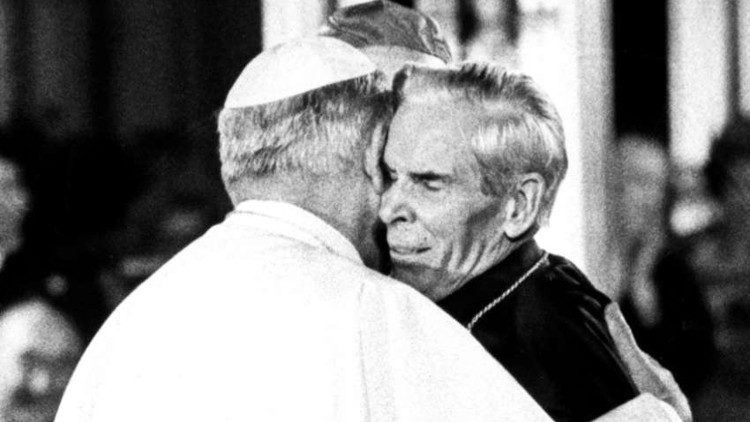
In 1979, Pope John Paul II embraced Archbishop Sheen at St. Patrick's Cathedral in New York CityIn 1979, Pope John Paul II embraced Archbishop Sheen at St. Patrick's Cathedral in New York City 

Archbishop Fulton Sheen: A 'master of modern media'

Amid the noise of our media-driven world, Bishop Louis Tylka of Peoria, Illinois, reflects on what Archbishop Fulton Sheen called “the most important conversation in a human life”—the one that takes place “in the depths of the heart.”

By Bishop Louis Tylka*

We live in an age of extraordinary communication. The devices we carry give us access to more information than previous generations could have imagined. At almost any moment, from almost anywhere in the world, we can reach another person, receive breaking news, and watch events unfold thousands of miles away.

And yet, for all this connection, many people today feel profoundly disconnected.

We are surrounded by voices and struggle to hear one another. We consume an endless stream of information, opinions and images, yet find ourselves searching for meaning. Technology promises community, but can create echo chambers in which we hear only those who already think as we do. Furthermore, without physical human interaction, the communal sense created leaves a person hungering for genuine connections. Instead of drawing us together, our methods of communication can deepen division, anxiety and loneliness.

Archbishop Fulton J. Sheen understood that the most important conversation in a human life takes place in the depths of the heart. It is one reason his voice remains so compelling today.

In 1951, Sheen was appointed Auxiliary Bishop of the Archdiocese of New York   (© Fred Palumbo, Library of Congress)

Archbishop Sheen was a master of modern media in his own era. He understood radio and television and used them with remarkable effectiveness. He entered millions of homes through The Catholic Hour and Life Is Worth Living. Standing before the cameras with his blackboard and episcopal regalia, he spoke about God, human nature, love, suffering, freedom, marriage, temptation and eternity.

What distinguished Archbishop Sheen was more than his command of these new media; it was that he knew what he wanted to communicate. He believed that beneath our ambitions, fears, distractions and sins is a human heart made for God. He observed that “nothing ever happens in the world that does not happen first inside human hearts.” That conviction ran throughout his preaching and writing.

For Archbishop Sheen, the interior life was not an escape from the world. It was where the Christian learned how to enter the world truthfully. This is an important distinction for our time. The digital world constantly invites us outward: What is happening? What is trending? What are people saying? Who agrees with me? Who is against me? What should I fear? What should I desire next? The Gospel asks different questions: Who am I before God? Whom am I called to love? Where do I need conversion? What is Christ asking of me? These questions require something increasingly difficult to find: silence.

Archbishop Sheen’s public ministry was rooted in this kind of interior encounter with Christ. For decades, he maintained the practice of a daily Holy Hour before the Blessed Sacrament. The man who spoke to millions first learned to be silent before God.

There is something deeply instructive in that for all of us, particularly those entrusted with communicating the Gospel today. Before we speak, we must listen. Before we post, we must pray. Before we seek to influence others, we must allow Christ to convert our own hearts. Archbishop Sheen understood that evangelization is more than the transmission of religious information. It is an invitation into a relationship with Jesus Christ and, through Him, with one another.

As Bishop of Peoria, I am profoundly grateful that the Church will soon number Archbishop Sheen among the Blessed. On September 24, 2026, he will be beatified in St. Louis, Missouri in an extraordinary moment of grace for our local Church, for the Church in the United States and, I believe, for the universal Church.

Earlier this year, Pope Leo XIV beautifully described Archbishop Sheen as “a light of faith, hope, and love” whose radio and television ministry touched millions with the hope of the Gospel. The Holy Father added a remarkable personal testimony: “I myself am a witness of his evangelization when I was growing up.” That testimony reminds us that we do not always know where a word spoken in faith will travel or what fruit it may bear.

Decades after Sheen stood before a television camera, his voice continues to reach new generations. His talks now circulate through digital platforms that did not exist during his lifetime. Young people encounter him online and discover that a bishop who died in 1979 somehow understands their questions about happiness, loneliness, identity, love and God. Why? Because technology has changed, but the human heart has not. Our deepest hunger remains the same.

The Church must learn to evangelize in the digital world. We should creatively use every worthy means available to proclaim Jesus Christ. Archbishop Sheen himself would surely encourage us to do so. But his witness also offers a necessary caution: We must never become so fascinated with the means of communication that we forget the purpose of communicating.

Our task is not to generate more content in an already noisy world. Our task is to help people encounter Christ — and through Christ, to encounter one another as brothers and sisters. Sometimes that encounter begins when the noise stops, the screen goes dark and a person becomes quiet enough to hear the voice of God speaking within the heart.

Archbishop Fulton Sheen understood that. Our world needs to rediscover it.

* The Most Reverend Louis Tylka is Bishop of Peoria, Illinois. Archbishop Fulton J. Sheen will be beatified September 24, 2026, in St. Louis, Missouri. More information is available at CelebrateSheen.com.

Friday, June 26, 2026

The September Beatification of Venerable Fulton Sheen is going to draw quite a crowd


Sheen beatification tickets defray ‘substantial costs’ of inviting thousands, says bishop


Venerable Fulton J. Sheen, pictured in an undated photo, is remembered as one of the most influential and innovative evangelists in American history. Tickets for the Sept. 24, 2026, beatification of Venerable Sheen in St. Louis were snapped up quickly on the first day, June 23. (OSV News file photo)


Tickets to the September 2026 beatification of Venerable Fulton J. Sheen are quickly being snapped up, with thousands claimed when they became available June 23.

The $15-$25 admission price is due to the “substantial costs” in planning and holding the event at a national-level venue, Bishop Louis Tylka of Peoria, Illinois, told OSV News.

The popular, scholarly Archbishop Sheen – a 20th-century pioneer of Catholic media – will be beatified Sept. 24 at The Dome at America’s Center in St. Louis. The 1.7 million-square-foot structure, which features more than 67,000 seats excluding the floor section, hosted St. John Paul II for a 1999 papal Mass that at the time was the largest indoor gathering held in the U.S., according to the venue’s website.

More recently, the sporting and convention venue has been dubbed “The Battle dome,” since it’s the home field for the United Football League’s St. Louis Battle hawks.

Bishop Tylka – whose diocese has oversight of Archbishop Sheen’s sainthood cause – explained that The Dome, located in the Archdiocese of St. Louis, was chosen for the beatification to enable as many of the faithful to share in the occasion.

“We could have done this event in our cathedral, where there would have been 800 people,” the bishop told OSV News June 23. “But we’re trying to maximize people’s participation. We want people to be there, and to do all of that, there are certainly significant costs that we are taking on.”

The Dome’s daily rental fees top six figures, and while Bishop Tylka did not share an exact number, the Battle hawks paid $100,000 per game to play at the venue in 2023.

But, as Bishop Tylka pointed out, “all that (rental fee) does is open the doors – it doesn’t cover any of the cost to actually operate” an event at The Dome.

Audiovisual, electrical, public safety, insurance, medical, cleaning and concession services are among those required for Dome events, with each item adding to the bottom line.

The Dome notes in its most recently available technical overview that “most of the skilled service work to build and support an event is done by local tradesmen and laborers from a variety of local unions,” including those representing carpenters, decorators, electricians, projectionists and stagehands.

While Bishop Tylka said the production company had “given us a discount,” The Dome notes that an approved audiovisual contractor “will hire the appropriate local union labor for audio visual work.”

Among the unions with which The Dome contracts is Stagehands Local 6 of IATSE (the International Alliance of Theatrical Stage Employees, Moving Picture Technicians, Artists and Allied Crafts of the United States, Its Territories and Canada).

As of June 10, Local 6 rates for riggers, who install and move staging, ranged from more than $36 to more than $47 per hour – with a minimum four-hour guarantee, double-time for overnight hours (midnight to 7 a.m.) and time-and-a-half after eight hours or 40 hours in a week with the same employer.

Bishop Tylka said beatification event organizers are “trying to, in many different ways, defray those costs by getting sponsorships.”

He said that one way of lessening the financial burden is “obviously” through venue-required ticketing – although that process itself entails its own set of costs.

“The Dome contracts with Ticketmaster,” said Bishop Tylka, referencing the global ticket management firm.

And Ticketmaster, part of Live Nation Entertainment, levies “a number of fees,” said Bishop Tylka.

On its website, Ticketmaster notes that the face value, or base price, of a ticket is set by the event organizer, factoring in production and venue costs as well as interest in the event. The listed price reflects the face value as well as service fees, which help cover costs incurred by the venue and Ticketmaster, including credit card processing fees. A facility charge may also be added, although Ticketmaster does not keep that portion.

Bishop Tylka noted that the beatification price tier is structured to allow reduced rates for seminarians and school groups, with one donor covering the cost of tickets for most consecrated religious.

“A person who’s willing to pay $25 for a ticket helps us to be able to offset the cost of inviting seminarians, religious and school groups,” he said.

But he cautioned, the “very generous gift” that has so far paid for consecrated religious attendees, “doesn’t guarantee that it’s covered every religious who’s coming.”

Bishop Tylka stressed that the ticketing fees were not equivalent to “paying” to attend a liturgy, a practice strictly forbidden by canon law, the Church’s main administrative code.

Ticketing for the event is required because of the realities of “crowd control, security and the expenses of putting on an event, whether it’s a beatification Mass for (Archbishop) Fulton Sheen or a football game in the stadium.”

“All those things have to be accounted for,” said Bishop Tylka. “And they’re just not free.”