Showing posts with label Archbishop Wilton Gregory. Show all posts

Sunday, January 14, 2024

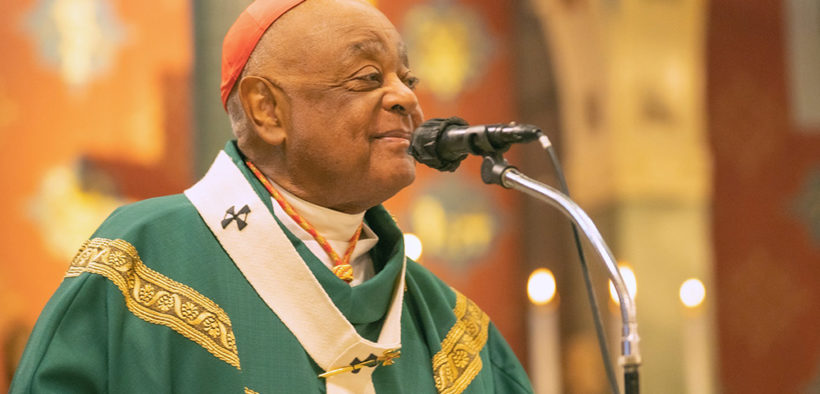
Cardinal Gregory participates in prayer service in honor of Dr. MLK, Jr.


At ecumenical service, Cardinal Gregory honors Dr. King as ‘champion of civil and human rights’

JAN 13, 2024

The Rev. Dr. Martin Luther King Jr. was “a man of faith and conviction of heart” who called all people to recognize that “we are all made in the image of God, deserving of respect and dignity no matter the color of our skin or any other factor,” Washington Cardinal Wilton Gregory said at a Jan. 13 ecumenical gathering to honor the late civil rights leader.

“It is clear that in Dr. King’s Christian witness to the world, he used God’s Word to move and change the heart of our nation, and indeed the entire world,” the cardinal said.

Cardinal Gregory was one of several interfaith leaders who gathered at Turner Memorial AME Church in Hyattsville, Maryland for what the cardinal said was a time to “pause our schedules and to simply be together to pray and reflect on the enduring legacy of the Rev. Dr. Martin Luther King.” The Martin Luther King Jr. Ecumenical Service was sponsored by the Prince George’s Leadership Action Network.

The cardinal offered a prayer and made remarks during a brief reflection on Dr. King, whom he said “has an incredibly special place in our hearts.”

Calling Dr. King a “champion of civil and human rights for all people,” Cardinal Gregory said the late civil rights leader began his efforts with African Americans who “fought to live their God-given humanity in spite of open, daily hostility, hatred and intentional obstruction of equal opportunities.”

In his prayer, Cardinal Gregory mentioned “those who lived before us – particularly those who suffered indescribable cruelty, imposed poverty, segregation, rejection and pain.”

“We honor them and thank you for their witness that later made the witness of Dr. Martin Luther King Jr. possible,” Cardinal Gregory prayed.

On Aug. 28, 1963, Dr. King was among the leaders who organized a March on Washington for Jobs and Freedom. The march included a rally on the steps of the Lincoln Memorial that was opened with an invocation by Archbishop Patrick O’Boyle, then the Catholic archbishop of Washington.

“That hot August day was a coming together – much like what we do annually on the King holiday weekend. That day, crowds at the Lincoln Memorial stood together against inequalities in employment and political and social injustices of all kinds,” Cardinal Gregory said in his remarks at the ecumenical gathering.

It was at that rally at the Lincoln Memorial that Dr. King delivered his now-famous “I Have a Dream” speech.

In that speech, Dr. King spoke of his dream where “my four little children will one day live in a nation where they will not be judged by the color of their skin but by the content of their character. I have a dream that one day … little Black boys and Black girls will be able to join hands with little white boys and white girls as sisters and brothers.”

Cardinal Gregory lamented that “in several ways, we still march today … although it looks a bit different, there tragically still is a battle against injustices that plague Black Americans and other Americans as well as world citizens from all social classes and circumstances.”

Dr. King was assassinated almost 56 years ago. In late March 1968, he traveled to Memphis, Tenn., to support Black sanitation public works employees who were on strike seeking higher wages and better working conditions. On April 4 of that year, Dr. King — standing on the balcony of his room at the Lorraine Motel — was mortally wounded by a gunshot fired by James Earl Ray. He was taken to St. Joseph Hospital, where after emergency surgery he was pronounced dead. He was 39 years old.

Cardinal Gregory has a long association with the late civil rights leader. Cardinal Gregory previously served from 2004 to 2019 as the archbishop of Atlanta, Dr. King’s birthplace. He has preached in Atlanta’s Ebenezer Baptist Church, where both Dr. King and his father preached, and in 2006, he was inducted into the Martin Luther King Board of Preachers at Morehouse College in Atlanta. In 2019, then-Archbishop Gregory was appointed by Pope Francis to become the archbishop of Washington, and the next year, the pope named him as a cardinal, making Cardinal Gregory became the first African American cardinal.

Dr. Martin Luther King’s “contribution to this country is legendary and well-deserving of recognition - not just on the occasion of our national observance of his birth, but each time we gather as a people united across races, languages, religious traditions and ethnic cultures,” Cardinal Gregory said.

The Martin Luther King Jr. Day federal holiday was signed into law by then-President Ronald Reagan in 1983, and first observed three years later. It is celebrated each year on the third Monday of January, close to Dr. King’s Jan. 15 birthday. This year the holiday falls on Dr. King’s actual birthday. Born in 1929, the late civil rights leader would have been 95 this year.

The Prince George’s Leadership Action Network (PLAN), which sponsored the gathering at Turner Memorial AME Church to honor Dr. King, is a community organization developing leaders in congregations to act together to work against poverty and work for the common good in Prince George’s County.

The organization has more than 20 institutional members, mainly faith congregations, including the following Catholic parishes in Prince George’s County: St Jerome in Hyattsville, St. Matthias the Apostle in Lanham, St. Mary in Landover Hills, and St. Mark the Evangelist in Hyattsville. Father Scott Hahn, pastor of St. Jerome’s, serves as co-chair of the organization, and participated in the Jan. 13 celebration.

“At PLAN, we are living our commitment to address the root causes of economic injustice and all types of discrimination that unfortunately are still far too present in our modern-day society,” Cardinal Gregory said. “As a society, we must continue the work of Dr. King … Whenever any community is interrupted and violated with inequality, violence and mistreatment, our own communities – in fact, the entire human family – also is impacted.”

He added that PLAN continues to do the work of Dr. King in ensuring “every member of our human family can freely live their life with respect and dignity as a child of the Creator.”

Since 2019 PLAN has received financial support from the Catholic Campaign for Human Development (CCHD). 

CCHD is the national anti-poverty program of the U.S. Catholic Bishops.  Through the support of Catholics throughout the country – including the annual special collection each May in The Roman Catholic Archdiocese of Washington – CCHD works to break the cycle of poverty by helping people affected by poverty participate in decisions that affect their lives, families, and communities.

The cardinal reminded those at the gathering is that “each of us is called to love our neighbor – and love includes working for justice and peace.”

“We cannot stand by and let our communities be violated. Our faith requires us to address it,” Cardinal Gregory said. “As our faith drives us to do, we work for change and progress by being present and accompanying our people.”

During the celebration, PLAN recognized Cardinal Gregory, the CCHD and the social justice ministry of The Roman Catholic Archdiocese of Washington for supporting the work of the organization.

At the ecumenical gathering, a Scripture reflection was given by Rev. Dr. Henry P. Davis III, the pastor of First Baptist Church of Highland Park. Rev. Frankey D. Grayton, the pastor of Southern Friendship Missionary Baptist Church in Temple, offered the call to worship at the beginning of the prayer service. Also speaking were Rev. Dr. D.K. Kearney, the pastor of Turner Memorial AME Church that hosted the gathering, and Rev. Victor Kirk, the pastor of Sharon Bible Fellowship Church in Lanham. Rev. Dr. Nathanial B. Thomas, the pastor of Forestville New Redeemer Baptist Church, offered a closing prayer and the call to faith in action.

In the prayer he offered at the celebration, Cardinal Gregory asked God for His “continued guidance of every member and for the work of PLAN as we aim to follow the good example of the life of your servant, our brother, the Rev. Dr. Martin Luther King. Jr.”

Thursday, July 13, 2023

The National Convention of the Knights of Peter Claver begins in New Orleans

 Knights of Peter Claver to Convene in New Orleans This Wee

  • Knights of Peter Claver to Convene in New Orleans This Week
    July 11, 2023
    by Knights of Peter Claver
    The world’s only Catholic lay fraternal order open to membership by men, women, and youth will make history this week as it convenes in New Orleans for its 107th National Convention, which will be the first national gathering of all 6 divisions of the organization in its 114-year history. The organization operates under the leadership of Supreme Knight/CEO Dr. Christopher Pichon; Supreme Lady Micaela J. Le Blanc; and Executive Director Grant Jones. 

    In addition to awarding tens of thousands of dollars in charitable grants and scholarship awards, the gathering will include:
    • Wilton Cardinal Gregory and Most Revs. Gregory Aymond, Joseph N. Perry, Jaime Soto, and William A. Wack celebrate the Convention Mass, Sunday, July 16th; 10:00 am
    • Four of the youngest Black priests in the country will also present / participate in the convention:
      • Revs. Aver Daniel, Ajani Gibson, Daniel Green, and Joshua Johnson
    • 10+ local choirs / performers are scheduled to perform at the Irene T. Green Performing Arts Extravaganza benefiting religious vocations support on Friday, July 14th at 7:00 pm
    • New Orleans’ own, Troy Sawyer, will entertain guests with his musical stylings at the Annual St. Peter Claver Foundation Gala for Education on Sunday, July 16th at 7:00 pm
    • Donated items and financial contributions will be collected at the annual “KPCLA National Baby Shower and Silent Auction” in benefit of the New Orleans Family Justice Center, a local nonprofit dedicated to ending domestic and family violence, child abuse, sexual assault, stalking, and human trafficking.
    • Additional charitable activities include a Junior Division School Supply Drive and a Bingo for Charity benefiting a local New Orleans Charity
    • Dr. Corey Hebert, MD will present and host a question-and-answer session on Sickle Cell Anemia
    • Dr. Ansel Augustine, D.Min. will team up with Rev. Joshua Johnson to host a prayer / conversation with the Junior Knights and Junior Daughters (members aged 7 – 18) on “Being a Young Christian in 2023,” Thursday, July 13th; 7:30 pm
    • Award banquets will also be held on Saturday, July 15th and Monday, July 17th honoring the charitable service and leadership of members and units from across the country
    • Dr. David W. Robinson-Morris, Ph.D. will lead an engaging “Black Catholic Listening and Dreaming Session” at the inaugural Members Luncheon on Monday, July 17th at 12 Noon
    • On Tuesday, July 18th attendees and guests will get to unwind and enjoy the 2023 Convention Dance featuring local DJ Chris Stylez
    All events and activities will take place at the Sheraton Hotel, 500 Canal St.  New Orleans, LA 70130.

    Sponsors for this year’s National Conventions include AARP, Xavier University of Louisiana, FADICA Catholic Philanthropy Network, and Emmaus Medical Inc. More information about the gathering can be foudn online at https://kofpc.org/national_conventions_and_concl.php.

    Founded November 7, 1909 in Mobile, Alabama, the Knights of Peter Claver and Ladies Auxiliary is the world’s oldest and largest historically Black Catholic fraternal lay order.  The National Headquarters is in New Orleans.

Wednesday, February 22, 2023

Two new Bishops for Washington DC; ordained on Mardi Gras Day


Two new auxiliary bishops ordained for Washington


Following ancient Church tradition and greeted by the applause of family and friends, Bishops Juan R. Esposito-Garcia and Evelio Menjivar-Ayala were ordained to the Order of Bishops Feb. 21 as auxiliary bishops of The Roman Catholic Archdiocese during a Mass at the Cathedral of St. Matthew the Apostle.

Hundreds of people – including families of the new bishops who traveled from other countries, Catholics from across the archdiocese, representatives of other faiths, and civic leaders – filled the cathedral to attend the more than two-hour bilingual liturgy where the new bishops promised to “proclaim with fidelity and constancy the Gospel of Jesus Christ” and to “always be kind and sympathetic to the poor, immigrants and with all those in need.”

“A bishop seeks to reconcile sinners especially those who may often be thought of as outside of the embrace of the Church,” Cardinal Wilton Gregory said during the Mass. “Above all, a bishop draws people to Christ in the Eucharist – there you must preach and inspire people to long for the Lord who is present to us in Word and in Sacrament.”

Cardinal Gregory was the principal consecrator of the new bishops and the main celebrant of the Mass. Co-consecrators were the auxiliary bishops of The Roman Catholic Archdiocese of Washington: Bishop Mario E. Dorsonville, who will be installed next month as the bishop of the Diocese of Houma-Thibodaux, Louisiana; and Bishop Roy E. Campbell Jr.

“The Church in the Archdiocese of Washington rejoices with you on this joyful day for you and for all of us,” Cardinal Gregory told the new bishops.

Bishop Esposito, 49, most recently served as an official in the Dicastery for Bishops at the Vatican. Bishop Menjivar, 52, is currently pastor of St. Mary Parish in Landover Hills, Maryland. Pope Francis on Dec. 19 appointed the two priests of The Roman Catholic Archdiocese of Washington as auxiliary bishops for the archdiocese.

Bishop Esposito was born Jan. 10, 1974, in San Luis, Argentina. He earned a Licentiate in Canon Law and a Doctorate in Canon Law from The Catholic University of America in Washington D.C. He was ordained to the priesthood on June 14, 2008, and was named a monsignor in 2020. 

“Juan, you have spent years studying the law – both civil and canonical. Your recent service to the Holy See has provided you with a clear perspective of the importance of balancing and applying justice and mercy in the care of Christ’s people,” Cardinal Gregory told the new bishop during the Mass. “Your priestly heart has been shaped and formed as you helped Pope Francis to find, to identify and to select praiseworthy candidates for the episcopacy. Now, based upon your history, you must begin to practice those very same virtues within this local Church.”


Bishop Menjivar was born Aug. 14, 1970, in Chalatenango, El Salvador. He came to the United States with his brother as a teenager, because of violence and unrest in his home country, while his family remained in El Salvador. He is now a U.S. citizen. He attended St. John Vianney College Seminary in Miami, Florida and the Pontifical North American College in Rome, and earned a master’s degree in theology from  the Pontifical University of St. Thomas Aquinas in Rome. He was ordained to the priesthood on May 29, 2004.

He is believed to be the first Salvadoran to be named a bishop in the United States of America. The Roman Catholic Archdiocese of Washington is home to one of the largest Salvadoran communities in the United States.

“Evelio, you became a manual laborer as you adapted to your new home in the United States of America… You know very well the countless gifts that our immigrant brothers and sisters continue to bring to our nation as hard workers in many different occupations,” Cardinal Gregory told Bishop Menjivar. “Jesus was known as a common laborer... He never lost that understanding of the dignity of hard work and neither must you. People will be more inclined to listen to and to believe you when they know that you understand the struggles and the trials that they themselves endure.”

Cardinal Gregory told Bishops Esposito and Menjivar that they must “constantly comfort and encourage all the faithful of the Church to deepen their love for Christ.”

“A bishop’s heart must be open to everyone – the young, the old, the sick, the immigrant, but most especially the poor,” the cardinal said. “Like Christ Jesus Himself, we must strive to welcome all with gentleness of spirit and love.”

The cardinal also outlined three obligations of a bishop: to govern in such a way as to “bring God’s people together in safety and in the sure hope of living within a community of love;” to teach the faith focusing “on Christ and invite our people to come to know and love Him through our teaching;” and to sanctify the faithful “when we pray with them, when we celebrate the sacraments with them, and when we bless them in those countless moments of great joy and deep sorrow.”

Among the clergy at the Mass were Cardinal Donald Wuerl, the archbishop emeritus of Washington who retired in 2018; Boston Cardinal Seán O’Malley; El Salvadoran Cardinal Gregorio Rosa Chávez; Archbishop Timothy Broglio of the Archdiocese for the Military Services, USA and president of the U.S. Conference of Catholic Bishops; more than 20 bishops and archbishops and nearly 200 priests.

The Mass was livestreamed via the Internet and more than 470 people watched from across the country and as far away as Uganda, Argentina, El Salvador and Honduras.

Expressing thanks to the families of the new bishops and those following the Mass via the Internet, Cardinal Gregory said, “I offer a word of profound gratitude (to them) for helping you to discover and to love Christ Jesus. In truth, today would never have dawned if you had not first found faith within your homes and around your family tables.”

Family members of the new bishops served as lectors and gift bearers at the Mass.

Prior to the episcopal ordinations, the congregation invoked the intercession of the Holy Spirit and Archbishop Christophe Pierre, the papal nuncio to the United States, read the individual papal mandates in which Pope Francis appointed his “beloved sons” Bishops Esposito and Menjivar as auxiliary bishops of Washington.

The new bishops “would be close collaborators of Cardinal Gregory,” Archbishop Pierre said prior to reading the letters from Pope Francis, and added that “there is a special joy today for the members of this local Church.”

When asked to give their consent to the appointment of their new auxiliary bishops, the faithful in St. Matthew’s Cathedral responded with a long and hearty ovation. The new bishops then processed through the cathedral, showing their papal mandates to those assembled there.

Prior to the rite of ordination, Cardinal Gregory asked the bishops-elect if they would “care for God's holy people and guide them on the path of salvation with a father's love.” Bishop Esposito and Bishop Menjivar promised that they would do so.

The episcopal ordinations of the new bishops included prayers, chanting of the Litany of Supplication, the laying on of hands and anointing with chrism.

“Grant, O Father, knower of all hearts, that these your servants whom you have chosen for the episcopate may nourish your holy flock and may without reproach exercise before you the High Priesthood, serving you night and day; that they may unceasingly cause your face to shine upon us and offer the gifts of your holy Church,” Cardinal Gregory prayed.

As part of their episcopal ordinations, Bishops Esposito and Menjivar received the symbols of their office – the Book of the Gospels, which represents their responsibility to preach “with all patience and sound teaching;” a ring, signifying their fidelity to the Church; a miter that represents the “unfading crown of glory” they will seek by serving Christ; and crozier (pastoral staff) representing their role as spiritual shepherds.

After Communion, the new bishops walked through the cathedral, holding their shepherd’s staffs and blessing their families, friends and the members of the Church of Washington who came to celebrate their new auxiliary bishops.

Speaking at the end of Mass in English, Spanish and Italian, Bishop Esposito referred to Pope Francis’s remarks during his September 2015 visit to the United States. The pope, in a meeting with U.S. bishops at St. Matthew’s Cathedral, said he would spiritually be at the side of the bishops as they comfort the lonely, lead the lost, console the broken-hearted, teach the faith or offer forgiveness.

“They are a beautiful, profound and detailed description of the pastoral ministry of every bishop and, indeed, of every priest. They describe a life and ministry consecrated, dedicated, entirely to serve others: to serve the People of God and, in so doing, to serve Christ and his Church,” Bishop Esposito said. “With these thoughts in mind and with a very humble heart, I express my deepest gratitude to the Holy Father and to Cardinal Gregory for this new opportunity to continue to serve everyone in our beautiful Archdiocese of Washington.” 

In his English and Spanish remarks at the end of Mass, Bishop Menjivar also recalled the words of Pope Francis during a Holy Thursday 2014 liturgy in which the pope said a priest is anointed to baptize, confirm, heal, sanctify, bless, comfort and evangelize the faithful.

“The beautiful celebration of the Holy Eucharist which we have celebrated has been the most eloquent way of giving thanks to the Lord for all the good He has done for me, for us, my family and for our local and universal Church,” the new bishop said. “I am very conscious of my poverty and unworthiness. At the same time, I am conscious that this call and this anointing is not about me. It is about you. It is about others.”

Bishop Menjivar also thanked Pope Francis “for calling me to this beautiful ministry;” Cardinal Gregory “for your trust and affection, for accepting me as your collaborator;” and Archbishop Pierre “for all the work that he does for the good of the Church as Apostolic Nuncio in the United States.”

Tuesday, February 7, 2023

Cardinal Wilton Gregory encourages black Catholics during Mass in honor of Black History Month


Gregory: World needs African Americans’ ‘strength of character’; it ‘resides within the souls of our people’


WASHINGTON (OSV News) — Celebrating a Feb. 5 Mass in honor of Black History Month, Washington Cardinal Wilton D. Gregory urged “ordinary people of color” to “vastly improve our world with an understanding of the strength of character that resides within the souls of our people.”

Referring to the day’s Gospel reading from Matthew (5:13-16) in which Jesus refers to his disciples as the salt of the earth and the light of the world, Cardinal Gregory said, “We are chosen by none other than the Lord, the light of the world himself; we have no choice but to be an example to the world.”

“Many have suffered martyrdom as the price of their witness and those who do become salt and light may become the subject of ridicule,” the cardinal said. “But we need ordinary faith-filled people like yourselves to allow your lights to shine — however small … to illuminate the darkness of this world.”

He reminded those at the Mass that “you are exactly the ones Christ called to be light in the world – not because of the great things you have done, but the generous things that you do.”

“Our task — not just in African American Month, but every day — is to respond in generous and loving ways to the needs of this world,” Cardinal Gregory said. “That’s your job. It comes from none other than Christ himself. You are the salt of the earth, you are the light of the world. There is no getting around it.”

Cardinal Gregory was the principal celebrant of the annual Mass, which he called a “rousing and wonderful celebration.” It was offered at Holy Comforter-St. Cyprian Church in Washington and sponsored by the Archdiocese of Washington’s Office of Cultural Diversity and Outreach.

Several hundred people attended the Mass, which Cardinal Gregory said was “our largest gathering for Black History Month in a couple of years.”

Concelebrants included Washington Auxiliary Bishop Roy E. Campbell Jr.; Msgr. Charles Pope, pastor of Holy Comforter-Saint Cyprian Parish; Father Michael Bryant, the longtime Catholic chaplain at the D.C. Detention Center; Franciscan Father Lalo Jara, program director of the archdiocese’s Office of Cultural Diversity and Outreach; Father Robert Boxie, Catholic chaplain at Howard University; and Father Patrick Aboagye, who is in residence at Holy Comforter-St. Cyprian Parish.

“They are here out of affection and great devotion to the African American community,” Cardinal Gregory said of the bishop and priests concelebrating the Mass.

Black History Month traces its roots to 1926 when noted historian Carter G. Woodson and the Rev. Jesse E. Moorland established Negro History Week to highlight the achievements of African Americans and others of African descent. The second week of February was chosen to coincide with the birthdays of President Abraham Lincoln and abolitionist and author Frederick Douglass.

By the 1960s, Negro History Week had expanded to Black History Month on college campuses across the country. In 1976, President Gerald Ford officially recognized February as Black History Month to “honor the too-often neglected accomplishments of Black Americans in every area of endeavor throughout our history.”

“African American History Month is not just about the past. It’s not just about the great things that were done 50 years ago, 100 years ago, 200 years ago,” Cardinal Gregory said. “It’s about the future and what light will we shed to a world that is too gloomy and too covered with shadows.”

Cardinal Gregory pointed out that there is a movement in the U.S. Congress to remove an exemption to the 13th Amendment to the Constitution that still exists that says if any former slaves are caught and convicted of a crime, they could be put back into slavery.

Urging the faithful to work for the removal of that exemption, Cardinal Gregory said, “None of us should ever be forced, no matter what we have done, back into slavery — not just slavery with chains, but slavery of sin, slavery of fear, slavery of hatred.”

“We are called to be free men and women,” he stressed.

During the Mass, prayers also were offered for six African American Catholics who are candidates for sainthood sainthood candidates.

Three of the six have the title of “Venerable”: Father Augustus Tolton, the first publicly known Black Catholic priest in the United States; Sister Henriette Delille, who founded the Congregation of the Sisters of the Holy Family; and Pierre Toussaint, a formerly enslaved philanthropist who supported many Catholic charitable works. And three have the title “Servant of God”: Mother Mary Lange, the foundress and first superior general of the Oblate Sisters of Providence; Julia Greeley, who after her emancipation from enslavement joined the Secular Franciscan Order and promoted devotion to the Sacred Heart of Jesus; and Sister Thea Bowman, a Franciscan Sisters of Perpetual Adoration, who was a noted educator and evangelist. Raised in a Methodist home, she became a Catholic at age 9 with her Methodist parents’ permission.

The “Servant of God” title is given to a sainthood candidate when a canonization cause is officially opened. “Venerable” is the declaration of the person’s heroic virtues. In general, one miracle attributed to the intercession of a sainthood candidate is needed for beatification and a second such miracle is needed for canonization.

“May their extraordinary lives of faith, hope and love soon be recognized by the universal Church so that this, and subsequent generations may be inspired to imitate their heroic virtue,” the congregation prayed.

Monday, December 19, 2022

Two new Bishops for Washington DC


Cardinal Gregory’s statement on the appointment of our new Auxiliary Bishops

WASHINGTON, D.C. – Cardinal Wilton Gregory, the archbishop of The Roman Catholic Archdiocese of Washington, has issued the following statement:

“Today our Holy Father, Pope Francis, has blessed the Archdiocese of Washington with the appointment of Bishop-Elect Juan Esposito-Garcia and Bishop-Elect Evelio Menjivar-Ayala as our new Auxiliary Bishops. They have been selected from a zealous and generous local presbyterate, and now they are appointed as bishops to serve all of Christ’s flock in this local Church. They represent the goodness of all of our people, and both will dedicate themselves tirelessly to the promotion of the Gospel and the mission of Christ in serving with me and all of our clergy and faithful.”

Tuesday, November 15, 2022

Say it ain't so: Two huge events held in conjunction with march for Life cancelled by Archdiocese of Washington DC


Archdiocese of Washington cancels Youth Rally, Mass for Life held at March for Life events


Joe Bukuras

The Archdiocese of Washington, D.C., announced that its annual Youth Rally and Mass for Life, which both typically take place in conjunction with the national March for Life in Washington D.C., have been canceled.

“After a consultation process that involved dialogue with other dioceses, ministry leaders, and the partners who assist the archdiocese in hosting the annual rally and Mass, The Roman Catholic Archdiocese of Washington has decided not to move forward with hosting the larger multi-diocese rally,” a statement from the Archdiocese of Washington says.

The announcement comes about five months following the Supreme Court’s decision to overturn Roe v. Wade, the 1973 landmark case that legalized abortion nationwide. The annual March for Life, which is now in its 50th year, began in opposition to Roe.

“During this consultation process, we heard from many dioceses who shared that they are turning their efforts to their state’s March for Life now that Roe v. Wade has been overturned,” the statement says.

“We certainly support their local work and pray for their success,” the statement says.

According to the statement, the Youth Rally and Mass for Life had been held for over 25 years. According to the archdiocese’s youth ministry website, the Youth Rally aims to “encourage the youth participating in the national March for Life in their witness as disciples of Christ and promoters of the Gospel of Life.”

The Youth Rally is the archdiocese’s largest annual event, according to the website.

Last year, the Holy See granted a plenary indulgence for any Masses that were held in the archdiocese during the March for Life, the website says.

“As difficult a decision as it was to cancel, we encourage groups traveling to Washington, D.C., to participate in the National March for Life at the National Mall and to attend the Vigil Mass at The Basilica of the National Shrine of the Immaculate Conception,” the statement says.

“Wilton Cardinal Gregory, archbishop of The Roman Catholic Archdiocese of Washington, would like to express his deepest gratitude for the support and participation of archdiocesan youth and young people who traveled to Washington, D.C., over these past 25 years,” the statement says.

Youth from the Archdiocese of Washington are still invited for a Mass of Celebration and Thanksgiving at the Cathedral of St. Matthew the Apostle Jan. 20, 2023, the statement says.

Friday, October 21, 2022

Cardinal Wilton Gregory speaks out against racism, injustice


Washington Cardinal Wilton D. Gregory, third from right, speaks during the “Faith Leaders for Racial Justice” lecture series at Fairfield University in Connecticut Oct. 13, 2022. (CNS photo/Handout, Fairfield University via Catholic Standard)


Cardinal Gregory stresses need for believers to fight against racism


By 

WASHINGTON (CNS) — Catholics, and all people of faith, must engage in the “critically important work” of fighting injustice, racism and other societal ills that prevent people from living in peace, Washington Cardinal Wilton D. Gregory said in an Oct. 13 address at Fairfield University in Connecticut.

In his lecture — as the inaugural speaker in the Jesuit-run university’s “Faith Leaders for Racial Justice” series — the cardinal pointed out that while the Catholic Church “has been at the forefront of racial reconciliation and racial justice for many years … we have not overcome all obstacles of injustice even within the church herself.”

He also said it is “fitting that we, as a church, discuss the important topic of racism within the context of our faith” and stressed that to overcome the sin of racism, parishes and ministries must be places of genuine hospitality and welcome.

The cardinal said the faithful “are called to model Christ in our society in every way we can,” and can be guided to do so by following Catholic social teaching, which he called “an incredibly valuable part of our faith.”

He lamented what he called “a unique and tense time in our history,” adding: “We are bombarded with the negative heaviness of it all as it becomes painfully clear that we are not caring for our neighbor … We see these things happening all around us and know that we cannot sit by and just let them continue.”

He also criticized what he called a “breakdown in civility and respect (that) is threatening our unity and hampering our ability to address the myriad of issues we are facing — such as institutional racism, police brutality, gun violence and respect for the dignity of every human life, especially the most vulnerable.”

“Our ability to communicate and speak honestly with one another to engage in meaningful and healthy conversation is diminishing, and it is costing us our well-being,” he said. “As people of faith and faith leaders, it is our responsibility to address … all inequalities we see — as we pray, work and always promote peace in a world full of hostility and conflict.”

Cardinal Gregory urged the faithful to familiarize themselves with Pope Francis’ encyclical letter, “Fratelli Tutti: On Fraternity and Social Friendship,” issued in 2020 as a call for the world to reject racism and war and strive toward global fraternity and solidarity.

He also suggested a careful review of the U.S. bishops’ pastoral letter, “Open Wide Our Hearts: The Enduring Call to Love,” against racism.

He stressed that racism can be defeated if believers “experience ongoing conversion to live the Gospel message and work for justice. When our brothers and sisters are treated unjustly because of their country of origin or subjected to structural racism due to the color of their skin or discriminated against because of a disability or anything else — we are called to proclaim the Gospel message,” he said.

“We are on a journey as a human family, and I have great hope that we will experience racial reconciliation in our ongoing conversion through honest and respectful dialogue,” he added. “With this and our rededicated commitment to progress, led by our devotion to prayer and active work to end racism and division, we will get there.”

Wednesday, October 19, 2022

Catholic Project study reveals Priests trust in Bishops has eroded


Study reveals priests’ trust in bishops has eroded


A new study released today by the Catholic Project at the Catholic University of America reveals a deep crisis in priests’ confidence in the leadership of the U.S. bishops. Overall, only 24% of priests across America express confidence in the “leadership and decision-making” of the bishops.

The new research initiative, titled the National Study of Catholic Priests, is based on 3,516 responses from 10,000 diocesan and religious priests. Stephen White, director of the Catholic Project told Our Sunday Visitor: “The goal of this study is to better understand how our priests are doing.” “In particular,” White continued, “we wanted to better understand how the abuse crisis, and the Church’s response to that crisis, has affected trust between priests and bishops.”

In an early letter of support for the project, Cardinal Wilton Gregory of Washington and Cardinal Timothy Dolan of New York write, “[The study] is an ambitious project with the goal of ascertaining the overall well-being of the American presbyterate with a particular emphasis on how the two decades since the Dallas Charter have affected relationships and trust between priests and bishops.”

Perhaps surprisingly, overall priests report remarkable well-being. Using the Harvard Flourishing Index — a comprehensive quantitative measurement index — the study found that on average, priests scored 82 out of 100. This average, the study reports, is “relatively high in comparison to the general population.” One priest said in an interview conducted by the study, “I feel remarkably fulfilled in my life as a priest. I mean, just being able to minister to people, being able to love them. Being able to be Christ for them. It’s just, it’s such a beautiful life.” Despite finding “ample evidence” of “challenges and stress,” only 4% of priests report considering departing from ministry.

One of the most significant findings of the study is the disparity of burnout indicators between diocesan and religious priests. “Our study finds that 45% of priests report at least one symptom of ministry burnout, which is unevenly distributed between diocesan (50%) and religious (33%) priests, and only 9% exhibit severe burnout,” an initial report says.

The study found another disparity between religious and diocesan priests: trust in leadership. While 67% of religious priests express confidence in their major superior, fewer than half (49%) of diocesan priests express trust in their own diocesan bishop. This factor of trust significantly impacts priests’ well-being. The study found that “An erosion of trust between a priest and his bishop is associated with an 11.5% reduction in that priest’s level of well-being.”

According to the new survey, 90% of priests “see their dioceses as having a strong culture of child safety and protection.” Since the adoption of the Dallas Charter, the 2002 national policy implemented by the U.S. bishops for the protection of minors, a culture of fear has grown among priests. In the present climate, the study found that “82% of priests regularly fear being falsely accused of sexual abuse.”

Furthermore, in the case of a false accusation, only 36% of diocesan priests report that they would be provided with sufficient resources by the diocese to defend themselves in court. Only 51% of diocesan priests believe they would have the support of their diocesan bishop in such a case. Again the discrepancy between religious and diocesan priests is significant, since 85% of religious priests believe they would be given sufficient resources for legal defense and 86% report that they believe they would have the support of their major superior.

Going forward, the study concludes by proposing three significant steps to improve priests’ trust in the bishops. First, priests report desiring a father figure, rather than an administrator. While 70% of bishops reported seeing themselves as a father to their priests, only 28% of priests report they consider their bishop a father. Second, priests desire great transparency around processes like making assignments and the review process for allegations of abuse. And finally, priests desire to see bishops held accountable in order to rebuild trust with priests and laity alike.

“Every Catholic I know, from the lay faithful to the bishops, wants to support our priests,” says White. “To do that well, we need to better understand both how priests are flourishing and how they are struggling. My hope for this study is that it will help do just that.”

Tuesday, July 26, 2022

More fallout from the Latin Mass ban issued for Washington DC


DC parish rues Latin Mass ban, warns of financial and membership losses


NEW YORK – The community at St. Mary Mother of God appealed to Cardinal Wilton Gregory during an archdiocesan synod listening session not to ban the Traditional Latin Mass at the parish, mainly because it would mean potentially losing about half of the parishioners.

That appeal failed. The listening sessions concluded in May, and Gregory announced July 22 that the Traditional Latin Mass would be restricted in the archdiocese to three non-parochial churches. The plan goes into effect on September 21.

For St. Mary’s, the change will be more than simply replacing a Mass in the Old Rite with a Mass in the New Rite. Parish vitality – in both the pews and community – is now a question mark, and closure isn’t out of the realm of possibility.

“The problem is that the cardinal’s decision hurts our parish life, and if we’re talking about encounter and the great work of our parishioners and volunteers, both in the extraordinary and ordinary form, it hurts everybody,” said Sylvester Giustino, who attends both Masses at the parish and serves on its finance council.

“It’s rather sad and unfortunate that decision was made, and it’s going to be a major blow to the work that we do in the community,” he told Crux.

The present St. Mary’s church was built in 1890 and has served downtown Washington, D.C. ever since. Currently, it serves three distinct communities. It has about 200 Traditional Latin Mass parishioners, 120 parishioners who attend Mass in the ordinary form in English, and about 100 Chinese parishioners who are ministered to autonomously.

Losing those 200 Traditional Latin Mass parishioners will put parish finances at least $130,000 in the red and “crush” its volunteer base, according to a letter written to Gregory from St. Mary’s pastor, Father Vincent De Rosa, and obtained by Crux. De Rosa declined a Crux request for comment on Gregory’s decision.

Patrick Lally, who’s been a Traditional Latin Mass parishioner at St. Mary’s since 1989 and also serves on the parish finance council, told Crux that $130,000 is a “conservative” estimate for how much the parish stands to lose.

“We’ve built a thriving parish, but it’s taken two or three decades to do that,” Lally said. “As downtown has grown and improved, as our parish has really evangelized and attracted a much younger set of worshippers, the interesting part is that these are all wonderful things, but the core of the parish that has really been devoted to it financially is the Latin Mass community.”

De Rosa spoke publicly about Gregory’s decision for the first time in a homily on July 24. He referred to “holes in the narrative that we’ve been given” which, he said, are “causing anxiety among our people.” He emphasized after each example there very well may be a good explanation, but added, if so, he hasn’t heard it.

De Rosa cited the synod process as one of those examples.

He called Pope Francis’s desire for synodality “a good thing,” but noted that even though the St. Mary’s community shared “constructive, honest input” with Gregory and others from the archdiocese, and that a synthesis report found value in the multiplicity of methods to worship – including the Traditional Latin Mass – the decision was still made.

“This is all true, the goodness of the Holy Father’s desire and the results of our synod here, and yet, despite all of that goodness, in that sharing, and so on, there’s going to be a pretty radical shift and it leaves the people of God to wonder why. What is the point of synodality if the fruits of a conversation don’t bend anything even in the slightest degree?” De Rosa asked.

“There might be a very good explanation for that,” De Rosa continued. “There very well might be, but we’ve not been given that, and that is a hole in the truth narrative, which must beg the question from the people of God, what did we do? Is synodality even worthwhile? I think it is, but I can understand how that question rises up.”

In the 25-minute homily, De Rosa also called it “unjust” that none of the people involved in this decision ever visited the St. Mary’s Traditional Latin Mass parishioners. De Rosa requested that Gregory visit the parish in the spring, and was told by Father Anthony Lickteig, the episcopal vicar for clergy, that “the Cardinal will not be able to visit St. Mary’s at this time due to his schedule,” according to a copy of the email obtained by Crux.

“There might be a very real reason for that,” De Rosa said of the exchange in his homily. “I know he’s a very busy man, but it begs questions in the minds of our people and leaves a hole in the truth narrative that puts the people in a very hard place.”

De Rosa further highlighted that the Traditional Latin Mass community at St. Mary has always been in union with the church “because only from that union comes the credibility that we need to be true prophets in the world.”

“Therefore, it begs the question what is going on.” he said. “And again, there may be good reasons, but I don’t know them and haven’t been given them.”

The archdiocese did not immediately respond to a Crux request for comment on the implications of the Traditional Latin Mass decision for St. Mary’s.

Monsignor Charles Pope, whom Gregory appointed as a delegate “in the pastoral care” of the newly designated Traditional Latin Mass communities, told Crux that he hopes “the diocese will do some things to help, but it’s going to be difficult and I certainly regret that.”

“I’m heartbroken for [St. Mary’s] and I’m hoping they can pull through financially and be able to stay open,” Pope said, noting that he was a choir director and organist at the parish in the early 1980s, and to this day considers it his home parish.

De Rosa said in his homily, and Pope verified to Crux, that they plan to meet very soon to discuss the future. De Rosa also expressed a desire to work with Gregory’s office as well to try and keep as much of the parish alive through educational and cultural opportunities throughout the week.

To the parishioners in the pews on July 24, De Rosa dispelled a few premises some of them shared about why they cannot be fed at the ordinary form, or that the ordinary form cannot be reverent.

“I want to invite you to work with me so that we can max out all of the beauty we can squeeze out of the stones of this place, so that not only will your lives continue to be filled with grace and with the sacraments, but also so that we can speak to our brothers and sisters who have never had the opportunity to experience that in the ordinary form … and be an evangelical force for them,” De Rosa proclaimed. “This is one of the ways that we make lemonade out of a lemon.”

Lally, for one, said that even after he can no longer celebrate the Traditional Latin Mass at St. Mary’s – so long as they’re open – he wants to be a part of the parish, including through his position on the finance council, parish leadership, volunteering and community outings, and “inane little things” he does for the 132-year-old church like maintain its clock.

“I won’t cease doing any of that, but I won’t be going to Mass there, and, by the way, how bizarre is that?” Lally said.