Showing posts with label Archbishop Caccia. Show all posts

Thursday, August 6, 2026

Review of the 144th Supreme Convention of the Knights of Columbus held August 4th thru 6th


By living for ‘God’s purposes,’ Knights care for his people, archbishop tells convention


Denver Archbishop James R. Golka concelebrates Mass Aug. 4, 2026, at the 144th Supreme Convention of the Knights of Columbus in Denver. (OSV News photo/André Escaleira Jr., Denver Catholic)

DENVER (OSV News) — In a moving display of the Catholic Church’s unity, thousands of Knights of Columbus from around the world gathered in Denver for their 144th Supreme Convention Aug. 4-6.

With some members and their families traveling from as far as the Philippines, South Korea, Ukraine, Poland, Latvia, Lithuania and Spain to attend, the convention sought to focus on Pope Leo XIV’s unifying episcopal motto: “In the One, we are one.”

Coming together in the order’s principles of charity, unity, fraternity and patriotism, the gathering represented the Knights’ commitment to spreading the Gospel and building up Christ’s Church, even to the ends of the earth.

The convention opened Aug. 4 with a special Mass celebrated by Denver Archbishop James R. Golka, along with dozens of bishops and hundreds of priests concelebrating and deacons assisting.

Archbishop Golka a fourth-degree Knight

For the archbishop, the liturgy was personal: He is a fourth-degree Knight; his six brothers are Knights; and his late father, Robert, was a Knight, too. In fact, in 2021, the year Archbishop Golka was named bishop of Colorado Springs, his family was named Family of the Year by the Knights of Columbus Nebraska State Council.

“The Knights of Columbus exists to help our men grow in their faith, and they sure did for my dad,” Archbishop Golka said in his homily.

Recounting his own journey of faith and vocation, the archbishop highlighted God’s providence in each of our lives and in the Knights of Columbus’s work.

Facing a $252 car repair while in seminary, a young Jim Golka didn’t know where to turn except to God. After a quick, simple prayer, he checked his seminary mailbox to find a letter from the Knights of Columbus in Ogallala, Nebraska — a council he’d never visited. They had hosted a pancake breakfast and decided to split the proceeds between him and another seminarian. Archbishop Golka’s share? $253.

‘Listen to God’s will for you’

“If you listen to God’s will for you and say yes, God will absolutely take care of you, amen? And he’ll even give you an extra dollar for a cup of coffee,” he said with a chuckle. “And God wants the Knights of Columbus to help him care for his children. God wants the Knights of Columbus to help carry out God’s purposes. God wants the Knights of Columbus to live for God and God’s purposes, not ours. And when we do that, we care for the people of God.”

Archbishop Gabriele G. Caccia, the papal nuncio to the United States, opened an afternoon session with words of reflection on the Knights of Columbus’ mission in this apostolic age.

He also introduced a special video message from Pope Leo, who urged the Knights to be living witnesses of unity and charity in a world often marked by division. Reflecting on the convention theme, he said Christian unity must be actively nurtured through humble dialogue and bridge-building in families, parishes and communities.

Pope Leo also praised the order’s longstanding charitable work, highlighting its support for unborn children, expectant mothers, persecuted Christians, trafficking victims and others in need. The pope thanked the Knights for their service and imparted his apostolic blessing to members and their families.

Supreme Knight’s annual report

Supreme Knight Patrick Kelly of the Knights of Columbus then took to the dais to deliver his annual report, a comprehensive summary of the worldwide activity of the Knights of Columbus over the past year.

Amid a lengthy litany of the Knights’ good works was a profound commitment to charity, service and love of neighbor — with over 48 million hours of volunteer service and more than $200 million given to charity worldwide, a new record for the organization. That charity was made possible, in part, due to a near record-high number of new Knights, with 105,000 men being welcomed into the order worldwide — many of them men under 35.

The number of new Knights, Kelly said, is rivaled only by the post-World War II boom of new membership.

“Just as Christ came to serve, we devote our lives to serving others, especially the vulnerable,” Kelly said. “All of our charity reflects the love of God. It’s a charity that evangelizes.”

Supreme Knight Patrick E. Kelly delivers his annual report Aug. 4, 2026, at the 144th Supreme Convention of the Knights of Columbus in Denver. (OSV News photo/André Escaleira Jr., Denver Catholic)

Knights’ charity takes many forms

That charity took many forms: wheelchairs and warm coats to those in need; emergency response to the horrific shooting during a school Mass at Annunciation Church in Minneapolis and the natural disasters in Venezuela and Hawaii; support for persecuted and war-torn communities in the Holy Land, Ukraine, Benin and Nigeria; religious liberty advocacy; aid for wounded warriors; and partnerships with the Special Olympics and pro-life clinics.

“We are not just another charitable organization. We are not a social club,” Kelly emphasized. “We are a global brotherhood of Catholic leaders — and we are united in Jesus Christ. He is the source of our strength. And as we reflect on the past year, we give all the glory to God.”

That charity, both Archbishop Golka and Kelly emphasized, flows from communion with God — Father, Son and Holy Spirit. Apart from him, all charitable works come to nothing.

“We could be busy about many, many good activities, but if they have not been planted by God, they’re going to fail,” the archbishop said in his homily. “We can have good intentions, but if it’s not God’s plan, it’s going to fail, so what must we do before we do anything? Listen to God, beg God for clarity on what is his plan.”

Calling all to become experts in listening to God

Emphasizing that God already has a plan for the Knights of Columbus, for individuals, families and marriages, Archbishop Golka exhorted those gathered to become experts in listening to God.

“My brothers and sisters, whenever I look at Jesus to find out his plan, he is never anxious. He is never afraid. He’s excited to show us who he is,” the archbishop said. “So let us open our ears and our hearts and our eyes so we can know better his plan for you, for our life, for the Knights of Columbus, for the entire world, so that God can get his world back through our humble service.”

To bolster Knights’ faith and help them better hear the voice of God, the Knights of Columbus launched Cor, a small-group program meant “to give young men exactly what they are looking for — a community centered in Jesus Christ.”

In addition, Kelly announced a new video retreat in partnership with ACTS XXIX and a new video series in partnership with Denver-based Christ in the City, with reflection and practical tips to serve the homeless.

‘Rising to meet the moment’

In these ways, Kelly said, the Knights of Columbus “are rising to meet this moment,” in which interest in the Catholic Church has grown sharply, with some parishes and dioceses seeing record-high numbers of converts.

Baltimore Archbishop William E. Lori, supreme chaplain of the Knights of Columbus, speaks Aug. 4, 2026, at the 144th Supreme Convention of the Knights of Columbus in Denver. (OSV News photo/André Escaleira Jr., Denver Catholic)

“These converts are searching for compelling answers. They are fleeing the isolation and incoherence that define our time,” Kelly explained. “They need real friendship and real connection — and they are finding it in the Catholic Church.”

Kelly concluded his report by lifting up Kendrick Castillo as a perfect exemplar of this youthful zeal for faith and service. Castillo, 18, jumped in front of a gunman at the Highlands Ranch STEM School in suburban Denver, giving his life to save the lives of his classmates when he was fatally shot May 7, 2019.

Known for his service to the community through the Knights of Columbus, Castillo had always desired to join the order but had only just become old enough at the time of his death. So, in 2019, the Knights of Columbus posthumously welcomed him.  The Diocese of Colorado Springs continues to review his life for a potential cause of canonization.

“We will always look up to your son, our brother Knight, Kendrick Castillo!” Kelly promised, turning to John and Maria Castillo, Kendrick’s parents, who were present in the audience.

Thursday, June 11, 2026

Here is a recap of the June 10th session of the USCCB spring plenary meeting in Orlando


Child protection, sainthood causes, World Youth Day on US bishops’ spring meeting agenda


Bishop Daniel J. Felton of Duluth, Minn., speaks during an episcopal consultation on the sainthood cause of Msgr. Joseph Francis Buh during a June 10, 2026, session of the annual spring meeting of the U.S. Conference of Catholic Bishops in Orlando, Fla. Msgr. Buh was a missionary priest who served Northeastern Minnesota and his cause was first opened in 2023. (OSV News photo/Bob Roller)

ORLANDO, Fla. (OSV News) — Headlining the June 10 public session of the U.S. bishops’ spring plenary in Orlando were addresses by the president of the U.S. Conference of Catholic Bishops and the new apostolic nuncio to the United States, along with a preliminary presentation on proposed updates to the bishops’ landmark document on protection policies for children and minors.

A highlight in the afternoon was a report on World Youth Day 2027, accompanied by a gift of traditional Asian paper fans for each bishop from South Korea — whose capital, Seoul, will host the international event.

In a morning presentation, Bishop Barry C. Knestout of Richmond, Virginia, chairman of the USCCB’s Committee on the Protection of Children and Young People, said the bishops are reviewing proposed updates to the “Charter for the Protection of Children and Young People,” seeking to define key terms while balancing care for victim-survivors with accused clergy’s right to a presumption of innocence until proven otherwise.

The suggested changes would keep the charter focused “exclusively” on clergy abuse of minors, with a new document being developed to address abuse involving vulnerable adults, Bishop Knestout said. Voting on the agenda item was scheduled for June 11.

Glossary of terms in response to diocesan requests

He said the revised text includes a glossary of terms in response to diocesan requests, and — drawing on canon law — the integration of "the right of an accused to the presumption of innocence.” 

Following the presentation, Archbishop Shawn McKnight of Kansas City, Kansas — citing several factors and calling for a “more synodal approach” — asked if it would be possible to suspend the vote on the revisions pending further consultation among presbyteral councils and diocesan review boards.

At the start of the public session, Msgr. Michael J.K. Fuller, the USCCB’s general secretary, read a message from the U.S. bishops to Pope Leo XIV thanking him for his new encyclical “Magnifica Humanitas” and for shining “the light of the Gospel and the tradition of the Church on the new opportunities and challenges posed by the rise” of artificial intelligence and “emerging technologies.”

The bishop said the pope’s teaching is a timely reminder that human life and dignity must remain at the center of technological development. Marking the first year of Pope Leo’s pontificate, they prayed that he would continue to be a guiding light for both the Church and the wider world.

Archbishop Paul S. Coakley of Oklahoma City gave his first address to the body of bishops as USCCB president, having been elected during the conference’s annual fall meeting in November 2025. 

Church must ‘create hope in Christ’

The Church must “put out into the deep” and “create hope in Christ,” he said. He told the bishops he was “especially pleased to recognize the impact” of the USCCB’s special message on migration, released during the conference’s November 2025 plenary assembly amid the Trump administration’s hardline crackdown on immigration, which has seen sweeping mass detentions and deportations.

The USCCB message “demonstrated our united concern as pastors for the dignity of every person, especially our migrant brothers and sisters,” said Archbishop Coakley.  Archbishop Gabriele G. Caccia gave his inaugural address to the bishops as nuncio to the U.S.  He was named to his new post in March, after having previously served as the Holy See’s permanent observer to the United Nations.

Bishops’ mission as missionary disciples

In his remarks, he highlighted the consecration of the U.S. Church to the Sacred Heart of Jesus, urged the bishops to fulfill their mission as missionary disciples by welcoming immigrants in their midst, and reminded his brother bishops he is there for them, especially in moments when their responsibilities as episcopal shepherds leads them to feel isolated.

“My service here is one of listening, trust, and shared discernment within the Church that we are all serving together,” Archbishop Caccia said.

In the late afternoon, as chairman of the USCCB’s Committee on Laity, Marriage, Family Life and Youth, Bishop Edward J. Burns of Dallas gave a report on World Youth Day 2027, which is to take place Aug. 3-8 in Seoul, and he introduced Auxiliary Bishop Paul Kyung Sang Lee of Seoul, general coordinator for WYD 2027, who brought traditional Asian folding fans as a gift to the bishops.

Bishop Burns said some 10,000 to 15,000 young pilgrims will travel to South Korea, a number he said would be comparable to the U.S. presence at WYD in Brazil (2013) and in Panama (2019).

Church of Korea began in hands of laypeople

Bishop Lee said he hopes all U.S. bishops will inspire young people of their dioceses to participate in the global event. The bishop detailed how the Catholic Church of Korea began in the hands of the laypeople, became strengthened by the blood of 10,000-plus martyrs, and served as a sanctuary for democracy and human rights.

“I have a simple hope that by the end of this presentation, Seoul will feel a little less far away,” Bishop Lee said. After the Korean War (1950-1953), he said, “Korea was one of the poorest countries of the world. In 80 years, Korea moved from devastation to renewal. The hardships did not have the final world. Hope can renew and heal a nation.”  Bishop Lee also spoke about three special WYD events that are to take place with Pope Leo XIV — a meeting with people facing hardships, interreligious dialogue, and prayers for world peace.

World Youth Day promises to be a “powerful opportunity” for young people from across the globe to witness how “God’s love never ceases, regardless of circumstances,” the bishop said, adding that three special events with Pope Leo XIV are planned — a meeting with people facing hardships, interreligious dialogue and prayers for world peace.

Catholic scientist and provost of Dartmouth

The bishops also heard from mathematical biologist Santiago Schnell, a Catholic scientist and provost of Dartmouth University. He was invited to speak June 10 by Bishop Kevin C. Rhoades of Fort Wayne-South Bend, Indiana, USCCB secretary and chair of its Committee on Priorities and Plans.

The talk anticipated the bishops’ discussion of the 25th anniversary of the USCCB’s implementation of “Ex Corde Ecclesia,” St. John Paul II’s apostolic constitution on Catholic universities.

The Catholic imagination needs to be reawakened in academic life to nurture leaders who can become “voices for the Catholic Church,” Schnell advised the nation’s bishops.

During his presentation, Schnell — formerly dean of the University of Notre Dame’s College of Science — warned that Catholics were, as his presentation title asserted, “educated, yet absent” from American intellectual life.

Need to educate Catholic to become leaders

“The Catholic paradox is that we have a massive infrastructure of higher education with average outcomes,” said Schnell. “We are not educating sufficient Catholics in our Catholic higher educational system. And we’re not educating them, actually, to become leaders.”

The bishops also heard a preliminary presentation on portions of two texts for consideration: a new edition of the Lectionary for Mass, which provides the Scripture readings and psalm for each day’s liturgy; and the 2025 Roman Missal-Liturgy of the Hours Supplement.

In a voice vote they showed support for the local advancement of two separate American canonization causes: Bishop Daniel J. Felton of Duluth, Minnesota, gave a presentation on the cause opened in his diocese for pioneer missionary priest Msgr. Joseph Buh and Archbishop Thomas G. Wenski of Miami presented the cause of entrepreneur-turned-evangelist John Rick Miller.

The consultation of a body of bishops — at either the regional or national level — is required by Church legislation governing the canonization process as a cause gets underway.

Julie Asher is senior editor for OSV News. Contributing to this story were Gina Christian, Jean Gonzalez and Michael R. Heinlein.

Saturday, March 7, 2026

Pope Leo appoints a new Nuncio to the United States


Archbishop Gabriele CacciaArchbishop Gabriele Caccia 

Pope appoints Archbishop Gabriele Caccia as Apostolic Nuncio to the U.S.

Pope Leo appoints Archbishop Gabriele Caccia - Permanent Observer of the Holy See to the United Nations since 2019 - as Apostolic Nuncio to the United States. In a statement, Archbishop Caccia highlights this new role as a “mission at the service of communion and peace.”

Vatican News

Pope Leo appointed Archbishop Gabriele Caccia as Apostolic Nuncio to the United States on Saturday, March 7, 2026. Since 2019, he had been serving as Permanent Observer of the Holy See to the United Nations in New York. He succeeds Cardinal Christophe Pierre, who had turned 80-years-old on January 30: the Pope accepted his resignation upon reaching the age limit.

Archbishop Caccia said he was “honored and deeply humbled by the decision of the Holy Father” to appoint him as nuncio “to the Country and the Church” where the Pope was born and raised.

“I receive this mission with both joy and a sense of trepidation,” he underlined, while highlighting that this is a “mission at the service of communion and peace” and that it begins in the year in which the United States celebrates the 250th anniversary of its founding.

Archbishop Caccia also said he feels “encouraged by the warmth and openness” he has received from the local Church, the people and the institutions of the U.S., which he has come to know during his years of service at the United Nations in New York.  

Archbishop Caccia was born in Milan on February 24, 1958. Ordained a priest in 1983 by Cardinal Carlo Maria Martini, he served at the parish of San Giovanni Bosco in Milan until 1986. He was then sent to the Pontifical Ecclesiastical Academy in Rome. He then obtained a Doctorate in Theology and a Licentiate in Canon Law from the Pontifical Gregorian University.

He joined the Diplomatic Service of the Holy See in 1991 and was assigned to the Papal Representation in Tanzania. In 1993, he was called to serve in the Section for General Affairs of the Secretariat of State, in the Secretariat of the Substitute. In 2002, he was appointed Assessor for General Affairs of the Secretariat of State.

In July 2009, Pope Benedict XVI appointed him Apostolic Nuncio to Lebanon and Archbishop-Titular Bishop of Sepino. He received the episcopal ordination from the Pope himself on September 12 of that year.

In 2017, Pope Francis nominated him Apostolic Nuncio to the Philippines and then in 2019 as Permanent Observer of the Holy See to the United Nations.


Saturday, May 24, 2025

Pope Leo XIV comes out strongly against rearmament and weapons that indiscriminately kill and wound innocent civilians


INDIA-PAKISTAN-KASHMIR-UNRESTEditorial

Holy See opposes rearmament, calls for respect of humanitarian law

Our Editorial Director reflects on the Holy See’s intervention at the UN, drawing on the words of Pope Leo XIV, noting that concrete steps are urgently needed to protect civilians in armed conflicts and to disarm the world.

By Andrea Tornielli

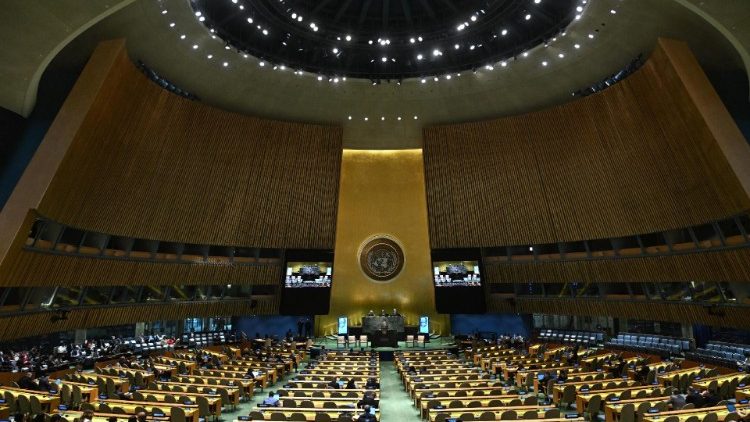
“The Holy See considers it essential to put an end to the use of indiscriminate weapons, landmines and cluster munitions, and to stop the deployment of explosive weapons in populated areas. This together with the cessation of arms production and stockpiling constitute concrete and urgent steps towards a better protection of civilians” in armed conflicts, said Archbishop Gabriele Caccia, Permanent Observer of the Holy See to the UN, speaking on 22 May at the Security Council’s open debate on the protection of civilians.

“The Holy See” said Archbishop Caccia, “while deeply concerned about the increasing number and intensity of armed conflicts across the world, which continue to inflict profound and disproportionate suffering on civilian populations, underscores the urgent need for compliance with international humanitarian law, in particular the Geneva Conventions and their Additional Protocols.”

These are words whose truth and urgency are there for all to see: the tragedy unfolding in Gaza, to the detriment of the entire civilian population, has no justification. Just as there can be no justification for the attacks on civilians in Ukraine and other parts of the world, where the many forgotten wars are being fought.

“The deliberate targeting of civilians, including women, children, and humanitarian personnel; the destruction of essential infrastructure such as hospitals, schools, and places of worship; and the denial of humanitarian access to those in urgent need are of great concern,” he continued. “While these violations are an immense human tragedy, they also represent a grave affront to the foundations of international security.”

On Friday, 23 May, Pope Leo XIV received the presidency of the Commission of the Bishops’ Conferences of the European Union (COMECE). There were no public speeches, but the bishops who attended reported that the Pontiff “expressed his fear that a greater focus on arms spending would be at the expense of support for the most needy and fragile.”

Earlier, receiving representatives of other Churches and ecclesial communities and other religions on 19 May, Pope Leo had said: “In a world wounded by violence and conflict, each of the communities represented here brings its own contribution of wisdom, compassion and commitment to the good of humanity and the preservation of our common home. I am convinced that if we are in agreement, and free from ideological and political conditioning, we can be effective in saying ‘no’ to war and ‘yes’ to peace; ‘no’ to the arms race and ‘yes’ to disarmament; ‘no’ to an economy that impoverishes peoples and the Earth and ‘yes’ to integral development.”

These are words to remember and repeat today, on the tenth anniversary of the social encyclical Laudato si', in the face of a world rushing to rearm itself, taking away resources that could be used to fight hunger and poverty.

Tuesday, April 30, 2024

The Holy See addresses the worldly lies about birth control


The  United Nations Headquarters in New YorkThe United Nations Headquarters in New York  (ANSA)

Holy See: ‘Birth control is not the key to sustainable development’

As the U.N. marks the thirtieth anniversary of the Cairo International Conference on Population and Development (ICPD) this year, Archbishop Gabriele Caccia reiterates that promoting birth control policies does not help eradicate world poverty and promote sustainable development.

By Lisa Zengarini

Nearly thirty years have passed since the International Conference on Population and Development (ICPD) in Cairo, Egypt, which transformed the global approach to population and development issues, and defined a bold agenda for sustainable development.

The Cairo Programme of Action 

The conference was held in the Egyptian capital from 5-13 September 1994 gathering some 20,000 delegates, and resulted in the adoption of a landmark Programme of Action (PoA), which  affirmed that inclusive sustainable development is not possible without prioritizing human rights, and addressing inequalities as well as the needs, of individual women and men.

Its ambitious goals, included the eradication of extreme poverty and hunger, the achievement of universal primary education, the promotion of gender equality and empowerment of women, the reduction of child mortality, and the improvement of  maternal health.  

The UN 2030 Agenda

Since then, there have been significant advancements in development, notably with the adoption in 2015  of the U.N. Sustainable Development Goals (SDG), to eliminate poverty, achieve gender equality, and secure the health and well-being of all people. The 17 global goals, known as Agenda 2030, call for collective effort across a wide range of areas – including environmental action, public health, human rights, education, and much more – to usher in a new era of development around the world.

Eradication of poverty facing new challenges

Thirty years on, however, growing inequalities, prolonged crises and a retreat from multilateralism threaten the legacy of that landmark achievement, and progress is at risk of stagnation or even reversal.

“It is evident that numerous challenges persist, especially in the pursuit of the eradication of poverty”, noted Archbishop Gabriele Caccia the Holy See’s Permanent Observer to the United Nations on Wednesday.

Birth control and abortion don't help stem poverty 

Speaking at an event organized in New York to mark the anniversary, the Vatican Observer lamented that over the past three decades, the implementation of the ICPD Programme of Action (PoA) has become “increasingly narrow in focus,” with a “consequent shift away from addressing development issues.”

Archbishop Caccia referred specifically to the ongoing emphasis given by the United Nations’ agencies to birth control policies, including abortion, as a means to stem poverty and promote development, which has been a contentious issue since the Cairo Conference.

“The discussions have regressed with many attempting to frame population as an issue to be ‘solved’. This is clear in the push for abortion under the guise of politically correct language, making it the focus of ICPD and the implementation of its PoA”

“This is not just a harmful misunderstanding of the PoA, but of development in a wider sense”, he said. “It also leads to the erosion of respect for the sanctity of human life and the inalienable dignity of the human person.”

Population control is not the key to sustainable development

Concluding, Archbishop Caccia once again rejected the “notion that population control is the key to sustainable development.” Instead, he said “it is essential to guarantee that all men, women and children are afforded the opportunity to actualize their full potential.”

The Holy See has engaged extensively in United Nations negotiations on issues concerning sexual and reproductive health rights as they have emerged and evolved in a dynamic global agenda over the past three decades and has said that suggesting that reproductive health includes a right to abortion explicitly violates the language of the ICPD, and defies moral and legal standards.