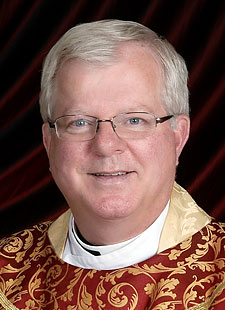
reflections, updates and homilies from Deacon Mike Talbot inspired by the following words from my ordination: Receive the Gospel of Christ whose herald you have become. Believe what you read, teach what you believe and practice what you teach...
Showing posts with label Diocese of Shreveport. Show all posts
Showing posts with label Diocese of Shreveport. Show all posts
Upon the news that Pope Leo has appointed the Most Reverend Michael A. Saporito, currently Auxiliary Bishop of Newark, the new Bishop of Metuchen, and accepted the resignation of Bishop Francis Malone of the Diocese of Shreveport, Archbishop Checchio extends his prayerful congratulations and gratitude to God for His unending love of His Bride, the Church.
"God is so good in providing a wonderful bishop for the dedicated people, clergy and religious of Metuchen. Bishop Saparito is well prepared for this ministry through his many pastoral experiences in the Archdiocese of Newark and he loves New Jersey! May our Blessed Mother and St. Francis of Assisi come to his aid as he takes up the shepherding of the Church of Metuchen which I still pray for daily and love.
Today, we also congratulate Bishop Malone on his retirement and thank him for his episcopal ministry here in Louisiana. I join with the good people of the Shreveport Diocese in fervently praying to the Holy Spirit for a new good shepherd for that lovely portion of God’s vineyard. We also thank Bishop Marshall of Alexandria for temporarily taking on the role of apostolic administrator and assure him of our support and prayers."
Pope Leo XIV Accepts Resignation of Bishop Francis I. Malone of the Diocese of Shreveport;
Appoints Bishop Robert W. Marshall, Jr. as Apostolic Administrator
September 15, 2026
Pope Leo XIV has accepted the resignation of the Most Reverend Francis I. Malone, 76, from the pastoral governance of the Diocese of Shreveport. At the same time, he has appointed Most Reverend Robert W. Marshall of Alexandria as the Apostolic Administrator of the Diocese of Shreveport to serve until the appointment and installation of the new bishop.
The resignation and appointment were publicized in Washington, D.C., on September 15, 2026, by Archbishop Gabriele Caccia, apostolic nuncio to the United States.
Cannes to show documentary on Louisiana priests on path to sainthood
NEW YORK – Last January when Chris Charles Scott directed a documentary about five French priests that cared for the sick through the 1873 yellow fever epidemic in Shreveport, Louisiana, he never expected that it would have a spot in this year’s Cannes World Film Festival.
The expectation, Scott said, was a regional and Catholic audience. Although now that the documentary’s reach has extended far beyond those boundaries in both secular and sacred spaces, he recognizes the timing of its November premier was pivotal.
People identified with making a personal sacrifice in a pandemic situation.
“We were [filming] smack dab in the middle of our own pandemic and seeing how we are in hopefully the last stages of this disease; a lot of people’s priorities were realigned; a lot of people’s paths were reshaped and I think that’s why people resonate with this story,” Scott told Crux. “This is a timeless tale of what God’s people do when bad things happen.”
The documentary, “The Five Priests,” is the culmination of years of work by three Shreveport Catholics to spread the story of the five priest’s sacrifice and get them on the path to sainthood. The five priests – Fathers Jean Pierre, Isidore A. Quémerais, Jean-Marie Biler, Louis Gergaud and François Le Vézouët – became Servants of God in December 2020.
“The Five Priests” documentary poster.
As history tells it, between late August to mid-November of 1873 Shreveport lost a quarter of its population to yellow fever. The mosquito-borne disease causes fever, nausea, and muscle pains and can lead to liver and kidney failure.
While many people fled Shreveport for safety, Pierre and Quémerais, who were assigned to the northern Louisiana city, stayed to care for the victims. Biler, who was a chaplain at a local convent, also stayed in the city. Pierre and Quémerais contracted yellow fever and died. When Biler came down with the illness, he contacted Gergaud – a priest from a nearby town – who arrived in time to give Biler last rites. However, Gergaud, too, quickly succumbed to the virus. Hearing about the desperate situation, Le Vézouët then left Natchitoches – then the seat of the diocese – to travel to Shreveport and minister to the sick and dying. He also, quickly contracted the disease and died.
The five priests are all from Brittany, France. They were recruited to come to the United States by Bishop Auguste Marie Martin, the founding bishop of what is now the Diocese of Shreveport.
“It is a parallel with the conditions of the world today,” Cheryl White, history professor at Louisiana State University Shreveport told Crux. “Five priests who made a decision to lay down their lives in an epidemic for strangers, and here we are living in a global pandemic, trying to look for examples of human virtue.”
White has done extensive research of the priests over the past four years alongside Father Peter Mangum, the rector at the Cathedral of St. John Berchmans in Shreveport, and local historian Ryan Smith. Their research culminated in the documentary, and a book, Shreveport Martyrs of 1873: The Surest Path to Heaven, that was released in October 2021.
White received an email from Cannes with the news of the documentary’s official selection on Jan. 5. The festival takes place in May. It won best documentary feature in the Europe Film Festival. It’s a finalist in the Texas Film Festival. The Roma Prisma Independent Film Festival and the Christian Film Festival have also named the documentary an official selection.
“The most exciting part about it for me is not the creative aspect, but the fact that it affirms for me the universality of the story of these five priests,” White said.
Apostolic Nuncio to the United States Archbishop Christophe Pierre, Bishop Francis Malone of Shreveport and Mangum are the clergy featured in the documentary. Pierre, who wrote the foreword for the book, is from Brittany, France, and has long championed the five priests’ cause.
White and Smith are also featured in the documentary, as is Shreveport Mayor Adrian Perkins, a city native who sees an importance in sharing this story as a community leader in a difficult time.
“Everybody can take away the fact that during a pandemic, or during any crisis for that matter, we are so much stronger when we come together and think about others,” Perkins told Crux. “If we think about others, at the end of the day we’re all going to be so much better off.”
In a similar sense Scott said it was important for them to lean into the human suffering that took place during the 1873 yellow fever epidemic to really highlight the sacrifice the five priests made. Showing that dichotomy between the horror of the disease and the greatness of their sacrifice, he said, compelled people because deep down “we all have that capacity to serve.”
The next step for the five priests is to be declared Venerable after an investigation at the Vatican. It is the first sainthood cause from northern Louisiana. In the meantime, White, Mangum and Smith will continue sharing the story. They’re in the process of adding French subtitles to the documentary, which they’ll then share on a trip over there after Easter.
“I don’t know what comes next but I know it’ll be spectacular; it’ll be great,” Smith said. “I think this is going to carry on for some time, maybe intermittently, but it’s here to stay. These guys will be venerable I have no doubt about that.”
NEW YORK — After Father Peter Mangum anointed a 98-year-old woman who had COVID-19, he couldn’t help but think of five French priests who sacrificed their lives to care for the sick through a yellow fever epidemic in the late nineteenth century.
“When I walk into the room I’m totally scrubbed up, mask, face shield. There she was sitting in a lazy boy chair and she offers me her hand. I’ve been told not to touch her but of course I reach down, took her hand and anointed her,” Mangum told Crux.
“When I left and went back to the rectory, I was struck by the fact that I had no way to give a free offering of my life in the situation. I had no fear I was going to die or catch whatever,” he continued.
The Shreveport priest then thought of Fathers Jean Pierre, Jean Marie Biler, François Le Vézouët, Isidore Quémerais and Louis Marie Gergaud – the French priests who came to Louisiana during the 1873 yellow fever epidemic.
“These (five priests) knew they were going to die,” Mangum said.
In May, Bishop Francis Malone of Shreveport wrote a letter to the Vatican to formally begin the process of making them Servants of God – the first step in the canonization process.
Between late August to mid-November of 1873 Shreveport, Louisiana lost a quarter of its population to yellow fever.
The mosquito-borne disease causes fever, nausea, and muscle pains and can lead to liver and kidney failure.
While people fled Shreveport for safety, Pierre and Quémerais, who were assigned to the northern Louisiana city, stayed to care for the victims. Biler, who was chaplain to a local convent, also stayed in the city. Pierre and Quémerais contracted yellow fever and died. When Biler came down with the illness, he contacted Gergaud – a priest from a nearby town – who arrived in time to give Biler last rites. However, Gergaud, too, quickly succumbed to the virus. Hearing about the desperate situation, Le Vézouët then left Natchitoches – then the seat of the diocese – to travel to Shreveport and minister to the sick and dying. He, too, quickly contracted the disease and died.
“The fact that not a single one of them hesitated to stay in an epidemic area where they believed it was person to person transmittable while other people were leaving, the story is above and beyond normal human experience,” said Cheryl White, history professor at Louisiana State University Shreveport in an interview with Crux. “It is a willing offering of their lives.”
White, Mangum and local historian Ryan Smith have done extensive research on the priests over the past five years. The culmination of that work is a book titled The Surest Path to Heaven: Shreveport Martyrs of 1873 with a forward by Archbishop Christophe Pierre, the Apostolic Nuncio to the United States.
Pierre is from Brittany, the same region of France as the five priests. They were recruited to come to the United States by Bishop Auguste Marie Martin, the founding bishop of what is now the Diocese of Shreveport.
Pierre has prayed at the priests’ tombs in a visit to Shreveport and recognizes the sacrifice they all made. He also recognizes their significance during the COVID-19 crisis.
“Given the challenges that we face in the current pandemic, I believe that the sacrifices of these giants in the faith have a special significance for our time,” Pierre wrote. “As a Frenchman and a fellow Brittany priest, I am particularly proud of them and all who have chosen freely to leave their homeland in generous response to their missionary calling.”
White and Smith recognize the parallels between the yellow fever epidemic and the COVID-19 pandemic. However, they also see vast differences in the sacrifice these five priests made.
White points to the medical equipment of the 21st century that the priests didn’t have to keep them safe.
“They had potentially decades more to give to the church and different communities, but this was their calling, and they knew it,” Smith told Crux. “Our current pandemic has heroes, and many of them, but this was something where their days were numbered and they knew they must go.”
The timeline of the story is of particular interest to White. She said there must’ve been divine intervention involved because each priest lived long enough for the next to arrive. Therefore, the city of Shreveport was never left without the sacraments.
Although the story of the five priests is not well known nationwide, it’s been celebrated in Shreveport for nearly 150 years. The French clerics are honored in the stained-glass windows of the Holy Trinity Church in downtown Shreveport and the city’s Pierre Avenue is named after the city’s founding pastor.
Pope Francis has appointed the Reverend Monsignor Francis Malone as Bishop-elect of Shreveport.
Monsignor Malone is a priest of the Diocese of Little Rock and currently serves as Chancellor for Ecclesial Affairs and Pastor of Christ the King Church in Little Rock. The appointment was publicized today in Washington, D.C, by Archbishop Christophe Pierre, apostolic nuncio to the United States.
Bishop-elect Malone was born on September 1, 1950, in Philadelphia, PA. He was ordained a priest for the Diocese of Little Rock on May 21, 1977. He holds a Bachelor of Arts in History (1973), and Masters in Divinity (1977), and Education (1977) from the University of Dallas, TX, and a Licentiate of Canon Law (J.C.L.) from The Catholic University of America (1989).
Assignments after ordination include Associate Pastor, St. Michael Church, West Memphis & Sacred Heart of Jesus Church, Crawfordville (1977-1980); Associate Pastor, Our Lady of the Holy Souls, Little Rock & Pastor, Holy Cross Church, Sheridan (1980-1981).
Bishop-elect Malone has also served as Associate Pastor St. Patrick Church, North Little Rock (1981-1983); Associate Pastor, St. Vincent de Paul Church, Rogers & Priest in Charge, St. John Church, Huntsville (1983-1984); Associate Pastor, Immaculate Conception Church, North Little Rock (1984-1985). He also served as Pastor, St. Mary of the Mount Church, Horseshoe Bend & St. Michael Church, Cherokee Village (1985-1987); Rector, Cathedral of St. Andrew, Little Rock (1989-1996); Pastor, Immaculate Conception Church, North Little Rock & St. Anne Church, North Little Rock (1996-2001); and Pastor, Christ the King Church, Little Rock (2001-Present).
Other appointments include: Faculty, Mount St. Mary Academy, Little Rock (1980-1983), Clergy Personnel Board (1983), Chaplain, Rogers Memorial Hospital, Rogers (1983), Moderator of Cursillo (1989), Chancellor & Vice Officialis (1990-2002), Presbyteral Council (1991-Present), College of Consultors (1992-Present), Clergy Personnel Board (1993-Present), Clergy Welfare Board (1994-Present), Managing Editor of Arkansas Catholic Newspaper & Director of Communications (1995), Theological Consultant to Arkansas Catholic Newspaper (1997), Judge, Court of Second Instance, Province of Oklahoma City (2002), Vicar General (2002-2006), and Chancellor of Ecclesial Affairs (2008-Present).
Bishop-elect Malone has received the following ecclesial honors: Prelate of Honor with the title of Monsignor (1998), Knight Holy Sepulchre (2002) and Protonotary Apostolic (2010).
The Diocese of Shreveport is in the state of Louisiana and has a total population of 812,200, of which 41,335 are Catholic.
Bishop Michael Duca, who has served the Roman Catholic Diocese of Shreveport for the past 10 years, will be the new bishop of the Diocese of Baton Rouge, it was announced Tuesday.
Duca is being appointed to replace Baton Rouge Bishop Robert Muench, who is retiring at the age of 75.
"I was completely surprised by this appointment, and while I am sad to leave the good people of the Diocese of Shreveport, I accepted the appointment without reservation as I see this as the will of God in my life," Duca said according to prepared remarks released by the Baton Rouge Diocese.
Duca thanked Pope Francis for the appointment and Muench for welcoming him.
Duca was ordained and installed as the second bishop of the Diocese of Shreveport on May 19, 2008.
Prior to his appointment in Shreveport, Duca served as rector at Holy Trinity Seminary in Dallas from 1996 to 2008.
Duca's installation as the bishop of Baton Rouge is tentatively scheduled for Aug. 24.
“Join us in praying for Bishop Duca in his next appointment as Bishop of Baton Rouge, and in prayer for the Diocese of Shreveport, our Holy Father, and the shepherd he will appoint as the next Bishop of the Diocese of Shreveport,” a post on the Diocese of Shreveport's Facebook page stated Tuesday morning.
There will be a press conference at 10 a.m. in Baton Rouge today and a press conference Wednesday in Shreveport, according to the Diocese of Shreveport.
As HB 1, which is essentially the Louisiana government's budget, moves through the legislative process, the Louisiana Conference of Catholic Bishops has been monitoring it closely and speaking on the issues that will impact our ministries throughout the state. Yesterday (May 7) representatives of our ministries testified in front of the Senate Finance Committee about the catastrophic impact HB 1 would have to some of our most vulnerable populations. The budget in its current form could eliminate nursing home services as well as programs that provide mental health services to veterans and substance abuse support and rehabilitation. It would also have a devastating impact on the Catholic Charities Archdiocese of New Orleans PACE program and to nonpublic school funding. In light of what passage of HB 1 would mean to those we serve, we are encouraging you to contact your State Senators and strongly urge them to work towards a compromise that would allow these programs to stay in place. Allowing a budget like this to pass is irresponsible and puts undue stress and burden on our senior citizens and others who rely on this funding for care and quality of life.