Friday, September 25, 2026

Pope Leo XIV celebrates Vespers at Notre Dame Cathedral in Paris, France


Where light meets heaven: Pope Leo XIV at Notre-Dame

In the iconic Parisian Cathedral flooded with light, Pope Leo XIV celebrates Vespers with the French Church calling it, like Notre Dame, to be reborn, to bring light out of the darkness of ashes.

By Isabella H. de Carvalho - Paris

Light inundated Notre-Dame as Pope Leo XIV celebrated vespers in Paris' beloved Cathedral.

It felt like a fitting celebration for the restored and renewed basilica, a place of worship and iconic symbol of the “Ville Lumière“, badly damaged by fire on 15 April 2019.

On that day, dramatic images and videos of the cathedral engulfed in flames, and of people praying in the streets as the fire consumed the building, spread around the world through social media and news outlets.

Today, the French Church has come together again. This time to rejoice, as the Pope visited the Cathedral and celebrated Vespers, almost two years after its reopening in December 2024, following a long and meticulous restoration process.

As the sun shone through the stained-glass windows, colorful patterns moved slowly across the walls. Meanwhile, an organ played and the choir sang while the bishops, priests, consecrated men and women, seminarians, and other members of the French Church solemnly prayed together with the Successor of Peter.

Before the Vespers, Pope Leo venerated a relic of the crown of thorns, which was placed on Christ’s head during his Passion. A symbol of his suffering and sacrifice before his Resurrection.

“We are gathered for Evening Prayer in this place which, more than any other, has invited the people of Paris for centuries to lift their eyes towards heaven,” Pope Leo said in his homily.

At the time of the fire, he continued, “we also watched anxiously, conscious of how powerless humans are in the face of the unforeseen.“

“In that tragic moment we came to realize that Notre-Dame is more than a monument. The collective effort to rebuild it, and the splendour of the result reveal that the heart of a people beats here, and that here we stand at the living center of a civilization, where past and future embrace, where heaven and earth meet.”

Read the full text of the Pope's homily

The Pope ended his homily by encouraging the Church in France to be “living stones of a Church that hopes and does not fear the future.“ This Cathedral, he said, “has been reborn so that you too may be reborn with it in a new impetus towards holiness and daily mission.”

Bring God’s love to all, he said to those present, a love which has the power to change lives and hearts and heal the deepest of wounds: to bring light out of the darkness of ashes.

“Let us lift our eyes towards the fourteenth-century statue of the Virgin and Child, which was untouched by the fire and now shines, once again, before us.”

Pope Leo XIV: his first public appearance in France


Pope: May France remain a champion of peace and multilateralism

In his first public address in France, Pope Leo XIV upholds the Catholic Church’s contribution to French society and encourages the country to work for a peace that is unarmed and disarming.

By Devin Watkins

Pope Leo XIV met privately with French President Emmanuel Macron at the Élysée Palace on Friday morning, just after his arrival in Paris for his four-day Apostolic Journey to France.

The Pope then addressed the authorities, civil society, and diplomatic corps, recalling his own French heritage and assuring the nation of his prayers.

He recalled that France has served as a cultural, artistic, and spiritual beacon for Europe and the world for centuries.

“The many brilliant French scholars who were also faithful Catholics demonstrates clearly how the sciences and the arts, literature, and philosophy can contribute to the good of humanity when they are directed toward the pursuit of beauty, goodness and truth, that the world may have life,” said the Pope.

He expressed appreciation for the mastery shown by French architects and artists in rebuilding the Cathedral of Notre-Dame after the 2019 fire.

Calling it an “impressive technical achievement,” the Pope said the reconstruction of Notre-Dame showed that something considered irreparably destroyed can be reborn through mutual cooperation.

Pope Leo said France bears deep Christian roots and the nation’s soul draws from Christianity “a rich spiritual, cultural, intellectual, artistic, and missionary élan (spirit).”

In 16th-century humanism, French philosophers united the ancient Greek and Roman heritage with the Christian faith and promoted the recognition of human rights based on the nature of the human person, especially religious freedom.

Pointing to France’s national motto, he said liberty, equality, and fraternity “refer to universal ethical imperatives that also find in the Gospel message an inexhaustible source of inspiration and fulfillment.”

Pope Leo then noted his focus in Magnifica Humanitas on artificial intelligence, saying respect for human dignity and our fundamental rights and freedoms must keep pace with societal change and technological progress.

“If we are to avoid losing our humanity amid a ‘paradise of machines’ invading and conditioning our daily lives,” he said, “there is an urgent need for education in ethical discernment and the capacity to acknowledge the moral good.”

Turning to France’s “rich and varied social fabric,” the Pope praised the efforts of Catholic men and women who continue to care for the welfare of the poor and underprivileged.

The Church, he added, seeks to be “the living face of God’s own mercy and compassion,” recalling the charitable legacy of St. Vincent de Paul.

Pope Leo XIV noted that our modern sensibilities seek to eliminate every form of suffering, saying this tendency often “brings the risk of self-delusion.”

“When science and technology are not guided by a deeper wisdom,” he said, “they can offer immediate solutions that apparently address people’s wishes and their pain, but can seriously divert them from the greater good to which they aspire.”

Mutual respect and the protection of every human life is a duty borne by every person, he said, noting that it begins with conversion of heart and mind and requires selfless commitment to the good of others.

Pope Leo encouraged Christians to engage in public service guided by the light of faith, noting that authentic secularity does not exclude religion but values it as an “educational resource.”

He thanked France for its support for education and humanitarian work in the Middle East, especially an initiative to help finance over 260 schools and universities.

The Pope recalled the ongoing effects of conflict and the scourge of war in land of the Prince of Peace’s birth.

“We cannot remain indifferent in the face of their pain, which offends human dignity and cries out to God for justice,” he said.

Pope Leo also called for nuclear weapons to be banned and for justice and right reason to prevail, since peace “is not a balance of power” but is rather built each day through dialogue and justice.

In conclusion, Pope Leo XIV urged the French Republic to “remain a tireless champion of peace and multilateralism”.

“May France, faithful to its traditional values, work for a peace that is unarmed and disarming, and responsibly offer its unique contribution to that goal,” he said. “May your liberty grow in constant concern for the common good.”

Pope Leo XIV begins his journey to France with a presser on the papal plane


Pope Leo XIV greets journalists aboard the papal plane bound for ParisPope Leo XIV greets journalists aboard the papal plane bound for Paris  (@Vatican Media)

Pope aboard papal plane: ‘I travel to France to proclaim Christ’s peace’

Aboard the papal flight to Paris beginning his Apostolic Journey to France, Pope Leo XIV highlights the importance for peace in today’s world, apologizes for not having been able to return with journalists to Rome on his previous Journey to Spain, and answers questions and exchanges jokes with the press.

By Isabella H. de Carvalho – Aboard papal plane

“Buongiorno a tutti! Bonjour! Good morning! As we say in English, welcome on board! Happy to see you all this morning, happy to greet you,” Pope Leo XIV said on the flight headed to France, as he begins his fifth international Apostolic Journey from September 25 to 28, which will bring him to Paris, Lourdes, and Metz.

“I, above all, am travelling to France, as to anywhere else in the world, as a follower of Jesus Christ wanting to proclaim peace, the peace of Christ throughout the world. It is a message which at this time, as we all know, is particularly important,” the Pope said to journalists travelling with him.

He thanked them for their work and noted that this Journey will touch on “a number of very important topics.”

More than 80 journalists from over 10 countries filled the airplane seats which had a head seat cover with the Pope’s coat of arms embroidered, along with the logo of ITA Airways, the Italian carrier operating the flight.

Members of the press were armed with notebooks, phones, laptops, photo cameras, and other equipment, as they got ready to relay to viewers, listeners and readers across the world everything about the Pope’s journey.

Across the aisles one could hear a myriad of languages: Spanish, English, Portuguese, Italian, French, of course, and many more.

The Pope took this opportunity to “apologize personally” for the fact that on his last Apostolic Journey to Spain in June 2026, due to a technical issue on the papal plane, the journalists returned to Rome on a separate flight from the Pope and thus the usual inflight press conference could not be held.

“I know,” he said, that this incident “left a number of you unhappy with the fact that we could not have the flight back together, back to Rome,” the Pope acknowledged.

Exchanges with the press

The Pope then greeted every journalist present individually, and many took the opportunity to exchange jokes, ask questions, or offer gifts.

Asked by a CNN reporter about his fellow colleagues who had issues accessing the White House in recent weeks, the Pope responded that he was “very happy that here you are all welcome and good coverage, I think, is very important and that we have it all the way around, for everyone.”

A New York Times journalist asked the Pope about the development of AI to which he answered: "Our Vatican Commission, in fact, is in contact with many of the leaders in the AI world, and we are continuing, if you will, the dialogue that I hope to have begun or continued in the encyclical. And I think from their perspective, many of them, they're very much open to looking for ways of making sure that AI does not displace or ultimately destroy humanity, but rather than be a tool for human beings. Good things are beginning at least."

Another American journalist for the National Catholic Reporter asked the Pope if he will support his alma mater, Villanova University, in an upcoming basketball game to be held in Rome against Notre Dame. “They tell me that the people coming to the match, 90% are from Villanova and 10% Notre Dame, so the voice of the people of God will be very strong on the Villanova side,” the Pope replied.

A reporter from OSV News, an American publication, asked the Pope about the beatification of Archbishop Fulton Sheen and what he meant to the Pope personally.

"We watched him as a family, and it was a way of spending some time together as a family with the truth, the teachings that he shared in such a enthusiastic, lively way, especially considering that day and age watching on TV, this Catholic bishop, who was originally from Illinois," said the Pope. "The message that he had was something that really came home to people. I think it helped us as a family, for example."

In response to questions about his fluency in French, the Pope answered he has been practicing a little bit, but specified he is not using Duolingo anymore, as had been reported in certain media outlets.

A journalist working for the Spanish radio COPE gave the Pope a cross made out of the wood from the wildfires that devastated the Western Mediterranean country this summer. Around 300,000 hectares burned in Spain this year according to the European Forest Fire Information System. The cross contains charred remains collected near the Chapel of Our Lady of La Nueva in Getafe, Madrid, one of the few churches spared by the flames.

“In the face of natural disasters, we must show responsibility and care for our common home,” the Pope said. Above all, he added, we must “pray”, explaining that this is the first thing he does when faced with such tragedies. 

A Venezuelan photojournalist gave him a book with 74 letters from survivors from the earthquake that devastated the nation in June and caused over 6,000 deaths.

Another Spanish journalist asked him about the migration crisis in Ceuta, the Spanish enclave in northern Africa, to which he answered that he has followed the issue since the beginning and that responses need to be found in order to avoid this emergency. “It was really a humanitarian crisis,” he said.

Thursday, September 24, 2026

Saint of the Day for Friday


St. Vincent Strambi


Feastday: September 25
Patron: Diocese of Macerata-Tolentino
Birth: 1745
Death: 1824


Vincent Strambi was the son of a druggist, and was born on January 1 at Civitavecchia, Italy. He resisted his parents' wish that he become a diocesan priest, and though he studied at the diocesan seminary and was ordained in 1767, he joined the Passionists in 1768 after attending a retreat given by St. Paul of the Cross. Vincent became a professor of theology, was made provincial in 1781, and in 1801, was appointed bishop of Macera and Tolentino. He was expelled from his See when he refused to take an oath of alliance to Napoleon in 1808 but returned in 1813 with the downfall of Napoleon. When Napoleon escaped from Elba, Murat made Macerta his headquarters, and when his troops were defeated by the Austrians, Vincent dissuaded him from sacking and destroying the town. He imposed reform in his See that caused threats to his life, labored for his people during a typhus epidemic, and resigned his See on the death of Pope Pius VII to become one of the advisers of his old friend Pope Leo XII in Rome. Vincent died on January 1 and was canonized by Pope Pius XII in 1950. His feast day is September 25.

The Vatican has the investigation of Bishop Michael Duca of Baton Rouge concerning accusation against diocesan priest


Investigation of Baton Rouge Bishop Submitted to Vatican

It’s not clear when the Vatican will decide or whether the Vatican will reveal the results.


St. Joseph Cathedral in the city of Baton Rouge, Louisiana. (photo: William Silver / Shutterstock)


Matthew McDonald

The interview phase of the Vatican’s investigation into how Baton Rouge Bishop Michael Duca handled an accusation of sexual misconduct by a priest has ended and the material has been sent to Rome, a witness told the Register.

Luke Zumo, who filed the complaint that triggered the investigation, said he received an email message Monday, Sept. 21, from New Orleans Archbishop James Checchio saying that the prelate has completed his report and sent it to the Vatican’s Dicastery for Bishops. The archbishop was responding to an email message Zumo sent late last week requesting an update, Zumo said.

A spokesman for the Archdiocese of New Orleans declined comment Tuesday afternoon. A spokesman for the Diocese of Baton Rouge contacted Monday night did not immediately respond to a request for comment.

Zumo told the Register that investigators from out of state working under the archbishop came to Baton Rouge to conduct interviews at least twice — once in June and again in July.

Zumo filed the complaint on Feb. 19, about seven months ago.

According to Zumo, Archbishop Checchio received a letter from the Vatican authorizing an investigation of Bishop Duca on May 4, which is about four and a half months ago.

Zumo noted that’s longer than the 90 days envisioned by Vatican guidelines.

“But it also means that it happened, and it’s going to a final step. I’m thankful for that,” Zumo told the Register.

Zumo made the complaint against Bishop Duca under Vos Estis Lux Mundi, an apostolic letter issued by Pope Francis in May 2019 that established a process for investigating bishops in sexual-abuse cases, including how bishops handle complaints about clerics under their jurisdiction. The document suggests 90 days for an investigation but allows for a longer term at the outset and for extensions for what it calls “just reasons.”

It’s unclear how long the Vatican will take to render a decision and whether that decision will become public.

Complaint About Priest’s Conduct

The investigation stems from a purported incident from nearly a year ago.

A man in his mid-60s has said that on Sept. 27, 2025, Father Charbel Jamhoury, a Maronite priest who at the time was pastor of St. Isidore the Farmer in Baker, Louisiana, used an early-morning Saturday meeting at the otherwise-deserted parish office to make sexual advances on the man and also stated that he missed having oral sex with boys.

The priest has denied the accusations.

As the Register reported in May and in June of this year, the purported victim says he informed the Diocese of Baton Rouge about the incident in early October 2025.

But the purported victim and Zumo, a longtime friend, have told the Register that the bishop was hard to reach and slow to respond.

The bishop put the pastor on leave in late December 2025 and removed him as pastor in early February 2026. Zumo said the bishop acted only under pressure, after Zumo contacted law enforcement, and that parishioners didn’t learn of the accusations against the priest until about four months after the diocese first received the purported victim’s complaint.

The diocese issued a statement Feb. 10 saying that Bishop Duca engaged in “extensive conversation with all parties involved” and considered interviews conducted by a private investigator hired by the diocese and by law enforcement as well as a “full health assessment” of Father Jamhoury before removing him as pastor.

The written statement acknowledged that “many members of the community have been frustrated due to the length of this process and perceived silence,” but said that “due diligence in such matters is necessary to protect the interests of both the claimant and the priest.”

The purported victim has told the Register that Bishop Duca informed him in mid-May 2026 that Father Jamhoury, who is originally from Lebanon, left the United States.

Bishop Duca, 74, is about eight and a half months from turning 75 (in June 2027), which is the normal retirement age for a bishop, though the pope can extend a bishop’s time in office.

Results?

As metropolitan archbishop of New Orleans, Archbishop Checchio under Vos Estis is the ordinary investigator of bishops in the Ecclesiastical Province of New Orleans, which includes the Diocese of Baton Rouge.

Zumo said that he has asked Archbishop Checchio whether he will learn what the Vatican decides to do.

He noted that Vos Estis says: “In compliance with the instructions of the competent Dicastery, the Metropolitan, upon request, shall inform the person who has alleged an offence, or his/her legal representatives, of the outcome of the investigation.”

Zumo told the Register he has asked Archbishop Checchio about that passage in the document.

“He shared with me in a professional and candid way that he’s under obedience to the Vatican and that he’ll only reveal to me what the Dicastery for Bishops allows him to reveal,” Zumo said.

“Because of that, I’m trying to spiritually and emotionally prepare myself to receive whatever outcome is shared or not shared with us as God’s will,” he said.

Zumo told the Register he appreciates his interactions with the archbishop.

Zumo said, “Archbishop Checchio really has been incredibly responsive and personable throughout, each time I have reached out to him. And that has been a comfort and an encouragement through a difficult process

The now Blessed Fulton J Sheen helped America accept Catholics


How Fulton Sheen paved the way for American acceptance of Catholics


Publications featuring the late Archbishop Fulton Sheen are displayed among other artifacts and memorabilia at the Sheen Museum on July 15, 2026, in Peoria, Ill. (AP/Jessie Wardarski)


by Joseph Connor

September 24, 2026

When Auxiliary Bishop Fulton Sheen's television program "Life Is Worth Living" debuted on the Dumont network on Feb. 12, 1952, it faced a tough road ahead. How many people would watch a middle-aged priest in traditional clerical garb deliver a half-hour homily at 8 p.m. on a Tuesday evening — especially when they could watch comedian Milton Berle's wildly popular show instead?

Despite the long odds, Sheen's show succeeded. It ran until 1957 and was eventually broadcast on more than 100 stations, attracting millions of viewers. 

Sheen became so popular that he was featured on the cover of Time magazine and was so charismatic that he won an Emmy as television's most outstanding personality, besting Lucille Ball, Edward R. Murrow and Arthur Godfrey. One writer even invented a word to describe Sheen: televangelist.

The accolades, however, were only part of the story. Non-Catholics made up much of Sheen's audience, and for many of them, he was the first priest they had ever listened to. In a country historically skeptical of Catholicism, his down-to-earth homilies showed that Catholics were just as American as anyone else. 

Less than a decade later, the country narrowly elected its first Catholic president. Is it then an exaggeration to suggest that without Fulton J. Sheen paving the way, there might not have been a President John F. Kennedy?

Born in 1895, Sheen was ordained in Peoria, Illinois, in 1919. He made his name as a teacher, homilist and author. He began hosting a radio program called "The Catholic Hour" in 1930, but by the early 1950s, television had eclipsed radio. Sheen saw the new medium as a way to reach a wider audience and, in his words, "help my sponsor, the good Lord."

Sheen's television program had no frills. The set was a book-lined study with a blackboard. He used no notes or cue cards and spoke for 28 minutes without commercial interruption. This simplicity, said New York Herald-Tribune television critic John Crosby, demonstrated that "a great teacher doesn't need film clips, dramatization, panels of experts, diagrams, charts or fancy lighting. He needs only himself."

It was Sheen's appearance and bearing that first caught viewers' attention. His eyes were described as "penetrating, almost hypnotic" and like "deep coals." His voice was "vibrantly expressive," and he seemed to be speaking directly to each viewer — which was no accident, as he imagined his program "as just a tête-à-tête with people in their own home." 

The substance of the show, Time noted, was "not dogma, but a mixture of common sense, logic and Christian ethics" that resonated with people of all faiths as he discussed topics like love, freedom, pleasure and peace.

In the 1960 presidential campaign, religion loomed large because no Catholic had ever been elected president. The only Catholic to ever even run, New York Gov. Al Smith, had been soundly defeated in 1928 amid a torrent of bigotry that cast the election as a crusade to "keep popery out of the White House."

Kennedy faced more of the same in a country whose population was still less than 25% Catholic. His critics insisted that if Kennedy were elected, the pope would dictate government policy because, as one non-Catholic organization phrased it, "we honestly doubt that a Roman Catholic President could or would fully resist the pressures of ecclesiastical hierarchy." 

Kennedy vehemently disagreed. "I do not speak for my church on public matters, and the church does not speak for me," he said in an address to ministers in Houston two months before the election.

When the votes were counted in November, Kennedy had eked out a win with a margin of only 112,000 votes out of the 68 million ballots cast. Sheen's impact on the 1960 election cannot be quantified, but with such a razor-thin victory, it's fair to infer that the television priest who had reached the hearts of millions of viewers had some effect. 

As journalist John L. Allen Jr., then Vatican correspondent for National Catholic Reporter, aptly noted in 2009 on the 30th anniversary of Sheen's death, Sheen "clinched the deal with the general public, showing that you could be completely Catholic and completely American." 

When Sheen is beatified in St. Louis this week, his role in gaining greater acceptance for Catholicism in the American public square should not be forgotten.

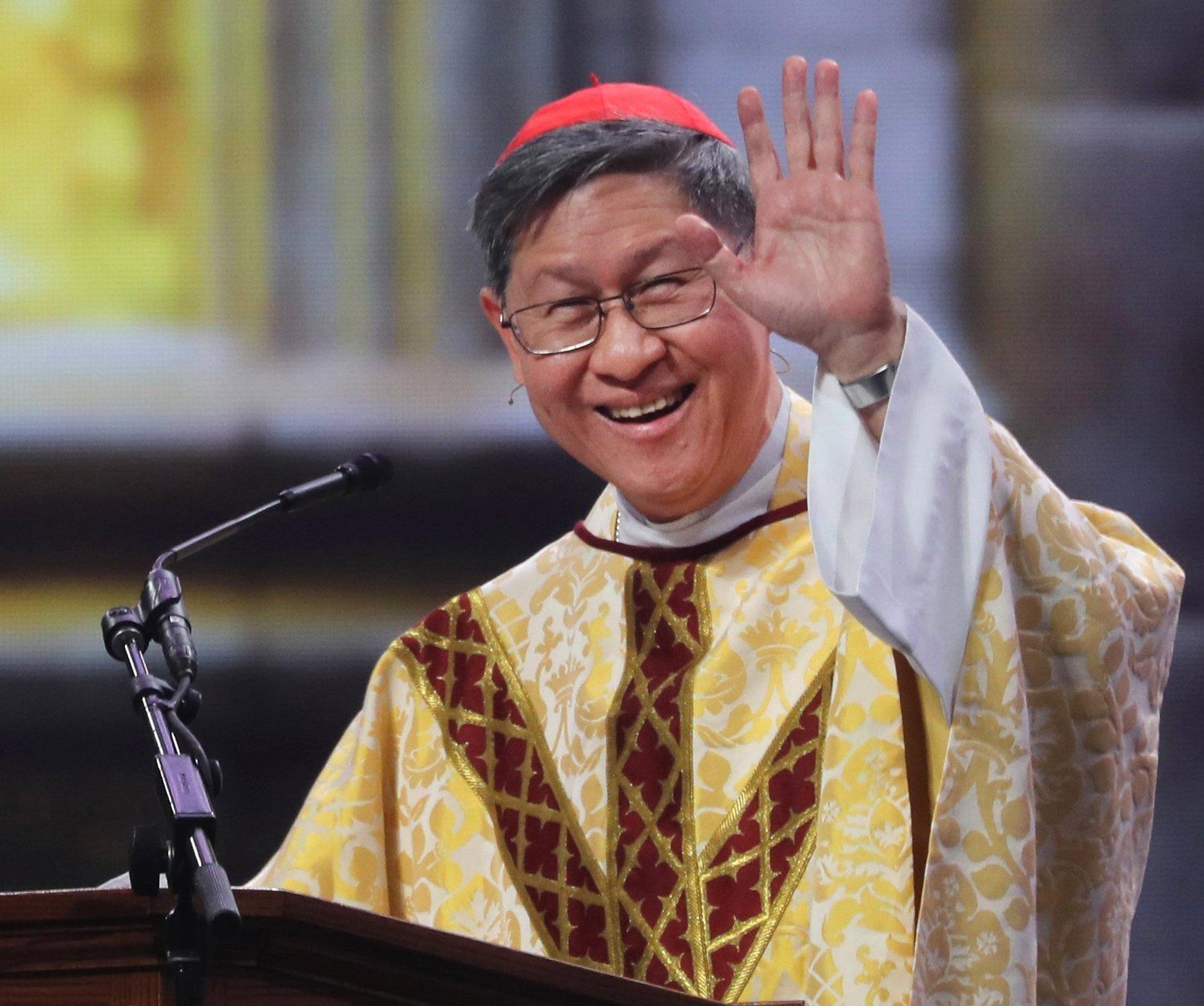
Ahead of today's Beatification in St. Louis for Fulton J. Sheen, Cardinal Tagle holds Mass in Sheen's home diocese of Peoria


Cardinal Tagle encourages faithful to adopt Archbishop Sheen’s virtues as beatification nears

 22, 2026

(OSV News) — The grace of the beatification of Archbishop Fulton J. Sheen comes with corresponding responsibility for Catholics in his home diocese of Peoria, Illinois, Cardinal Luis Antonio Tagle told Catholics there during Mass Sept. 22.

“This is a grace for all of us here, but also a heavy responsibility,” he said in his homily in Peoria’s Cathedral of St. Mary of the Immaculate Conception, where Archbishop Sheen’s remains are entombed. “From now on, when people learn that you are from Peoria, they will say, ‘Oh, are you as missionary oriented as Bishop Fulton Sheen? Are you deeply entrenched in the Word of God, like the Blessed Fulton Sheen?'”

He said, with a laugh, that he hoped that they would not deny being from Peoria, but rather answer, “Yes, I am from Peoria, and this is a blessing from the Lord.”


Beatification preparation

Cardinal Tagle celebrated the morning Mass at Peoria’s cathedral while visiting the central Illinois city of 113,000 to venerate the relics of Archbishop Sheen, who will be beatified Sept. 24. Serving as Pope Leo XIV’s papal delegate, the cardinal will preside over the beatification Mass in St. Louis, about 170 miles southwest.

Cardinal Tagle, 69, serves as a pro-prefect for the Holy See’s Dicastery for Evangelization, leading its Section for the First Evangelization and New Particular Churches, and is the archbishop emeritus of his native Manila. He is an alumnus of The Catholic University of America in Washington and in 2024 served as the Holy See’s envoy to the 10th National Eucharistic Congress in Indianapolis.

In the homily, he joked that Catholics from Peoria should not taunt the faithful from nearby Chicago, asking them, “Has Chicago produced a blessed? Oh, no? … Poor Chicago.”

Cardinal Tagle pointed to the Mass’ first reading from Proverbs 21:1-6, which reminds the faithful that “to do what is right and just is more acceptable to the Lord than sacrifice.”

“The heart of a wise person is in the hands of the Lord, and his heart allows the Lord to direct its destiny,” he said, “and when the heart is guided by the Word of the Lord, it will be just … The Lord is more pleased with the heart that is open to his will, that’s attentive to his promptings and is ready to act on his inspiration.”


A ‘heart that listens’ 

Cardinal Tagle underscored the importance of listening by relating it to the need for understanding between married couples, consecrated religious men and women and their superiors, and priests to their bishops.

“All of us expect to be listened to,” he said, but listening to one another “is at the heart of being a wise person and a follower of the Lord.”

The liturgy’s Gospel reading from Luke 8:19-21 recounted Jesus saying, “My mother and my brothers are those who hear the word of God and act on it.”

Cardinal Tagle said the reading showed that “heart that listens” in Mary, who was both Jesus’ mother and disciple. “She must have said, ‘My son recognizes that I became the worthy dwelling place, his dwelling place, because I listened to the word of God’ and after listening, made herself available.”

The obedient heart

A listening heart, the cardinal continued, also reflects the humanity of the Christian. “Pope Leo has been directing all of us to our being persons,” he said, alluding to “Magifica Humanitas,” his recent encyclical on humanity and artificial intelligence. “We are not machines. We are not gadgets. We are persons with hearts.

“Where is your heart?” he continued. “Does it still beat? Does it still hear? Does it still see? Is it still obedient? If it is a truly human heart, then it is capable of relating with God and doing what God says.”

The cardinal encouraged the congregation to follow the example of Mary and Archbishop Sheen in obedience to God. Then, when they say they are from Peoria, he said, people not only associate them with the birthplace of Archbishop Sheen, but with a place where, “like Fulton Sheen, you all listen to the word of God and act on it.”

“Then Peoria becomes part of the wider family, the wider family of God, and Jesus will be pleased,” he said.


Evening Holy Hour

At the end of Mass, Cardinal Tagle recognized the Filipino Catholics present at the Mass and briefly addressed them in their native language. He then greeted the full congregation on behalf of Pope Leo.

“When I go back to Rome, I will surely report to him about the beatification and will tell him about this Mass and your presence at this Mass,” he said.

He also noted the Holy Hour that he planned to attend later that evening, which is the penultimate Holy Hour in a nine-day series leading up to beatification.

Archbishop Sheen famously adopted a daily Holy Hour as part of his own spiritual practice while in formation for the priesthood at St. Paul Seminary from 1917-1919, and he maintained the practice through his life.

Archbishop Sheen was ordained in 1919 as a priest of the Diocese of Peoria. He taught philosophy at The Catholic University of America and rose to fame first through his radio show “The Catholic Hour” and then TV show “Life is Worth Living.” He meanwhile served as national director for the Society of the Propagation of the Faith, an arm of the Holy See now part of the Pontifical Mission Societies, supporting the Church’s evangelization and humanitarian relief efforts around the world. He was an auxiliary bishop of the Archdiocese of New York before serving as bishop of Rochester, New York, from 1966 to 1969. Upon his retirement, Pope Paul VI gave him the title “archbishop.” He continued to preach and give retreats and died at age 85 in 1979.


Maria Wiering is senior managing editor of OSV News.

He was a "master of modern media"; the soon to be beatified Fulton J. Sheen


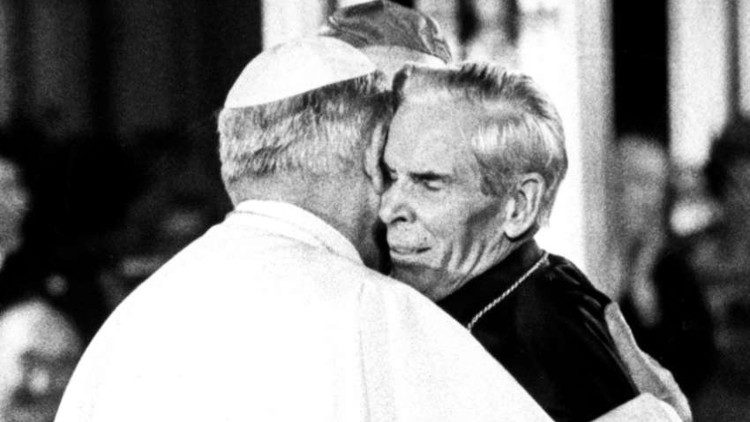
In 1979, Pope John Paul II embraced Archbishop Sheen at St. Patrick's Cathedral in New York CityIn 1979, Pope John Paul II embraced Archbishop Sheen at St. Patrick's Cathedral in New York City 

Archbishop Fulton Sheen: A 'master of modern media'

Amid the noise of our media-driven world, Bishop Louis Tylka of Peoria, Illinois, reflects on what Archbishop Fulton Sheen called “the most important conversation in a human life”—the one that takes place “in the depths of the heart.”

By Bishop Louis Tylka*

We live in an age of extraordinary communication. The devices we carry give us access to more information than previous generations could have imagined. At almost any moment, from almost anywhere in the world, we can reach another person, receive breaking news, and watch events unfold thousands of miles away.

And yet, for all this connection, many people today feel profoundly disconnected.

We are surrounded by voices and struggle to hear one another. We consume an endless stream of information, opinions and images, yet find ourselves searching for meaning. Technology promises community, but can create echo chambers in which we hear only those who already think as we do. Furthermore, without physical human interaction, the communal sense created leaves a person hungering for genuine connections. Instead of drawing us together, our methods of communication can deepen division, anxiety and loneliness.

Archbishop Fulton J. Sheen understood that the most important conversation in a human life takes place in the depths of the heart. It is one reason his voice remains so compelling today.

In 1951, Sheen was appointed Auxiliary Bishop of the Archdiocese of New York   (© Fred Palumbo, Library of Congress)

Archbishop Sheen was a master of modern media in his own era. He understood radio and television and used them with remarkable effectiveness. He entered millions of homes through The Catholic Hour and Life Is Worth Living. Standing before the cameras with his blackboard and episcopal regalia, he spoke about God, human nature, love, suffering, freedom, marriage, temptation and eternity.

What distinguished Archbishop Sheen was more than his command of these new media; it was that he knew what he wanted to communicate. He believed that beneath our ambitions, fears, distractions and sins is a human heart made for God. He observed that “nothing ever happens in the world that does not happen first inside human hearts.” That conviction ran throughout his preaching and writing.

For Archbishop Sheen, the interior life was not an escape from the world. It was where the Christian learned how to enter the world truthfully. This is an important distinction for our time. The digital world constantly invites us outward: What is happening? What is trending? What are people saying? Who agrees with me? Who is against me? What should I fear? What should I desire next? The Gospel asks different questions: Who am I before God? Whom am I called to love? Where do I need conversion? What is Christ asking of me? These questions require something increasingly difficult to find: silence.

Archbishop Sheen’s public ministry was rooted in this kind of interior encounter with Christ. For decades, he maintained the practice of a daily Holy Hour before the Blessed Sacrament. The man who spoke to millions first learned to be silent before God.

There is something deeply instructive in that for all of us, particularly those entrusted with communicating the Gospel today. Before we speak, we must listen. Before we post, we must pray. Before we seek to influence others, we must allow Christ to convert our own hearts. Archbishop Sheen understood that evangelization is more than the transmission of religious information. It is an invitation into a relationship with Jesus Christ and, through Him, with one another.

As Bishop of Peoria, I am profoundly grateful that the Church will soon number Archbishop Sheen among the Blessed. On September 24, 2026, he will be beatified in St. Louis, Missouri in an extraordinary moment of grace for our local Church, for the Church in the United States and, I believe, for the universal Church.

Earlier this year, Pope Leo XIV beautifully described Archbishop Sheen as “a light of faith, hope, and love” whose radio and television ministry touched millions with the hope of the Gospel. The Holy Father added a remarkable personal testimony: “I myself am a witness of his evangelization when I was growing up.” That testimony reminds us that we do not always know where a word spoken in faith will travel or what fruit it may bear.

Decades after Sheen stood before a television camera, his voice continues to reach new generations. His talks now circulate through digital platforms that did not exist during his lifetime. Young people encounter him online and discover that a bishop who died in 1979 somehow understands their questions about happiness, loneliness, identity, love and God. Why? Because technology has changed, but the human heart has not. Our deepest hunger remains the same.

The Church must learn to evangelize in the digital world. We should creatively use every worthy means available to proclaim Jesus Christ. Archbishop Sheen himself would surely encourage us to do so. But his witness also offers a necessary caution: We must never become so fascinated with the means of communication that we forget the purpose of communicating.

Our task is not to generate more content in an already noisy world. Our task is to help people encounter Christ — and through Christ, to encounter one another as brothers and sisters. Sometimes that encounter begins when the noise stops, the screen goes dark and a person becomes quiet enough to hear the voice of God speaking within the heart.

Archbishop Fulton Sheen understood that. Our world needs to rediscover it.

* The Most Reverend Louis Tylka is Bishop of Peoria, Illinois. Archbishop Fulton J. Sheen will be beatified September 24, 2026, in St. Louis, Missouri. More information is available at CelebrateSheen.com.