Pope to Jesuits: Roles for women in the Vatican are changing
By Salvatore Cernuzio
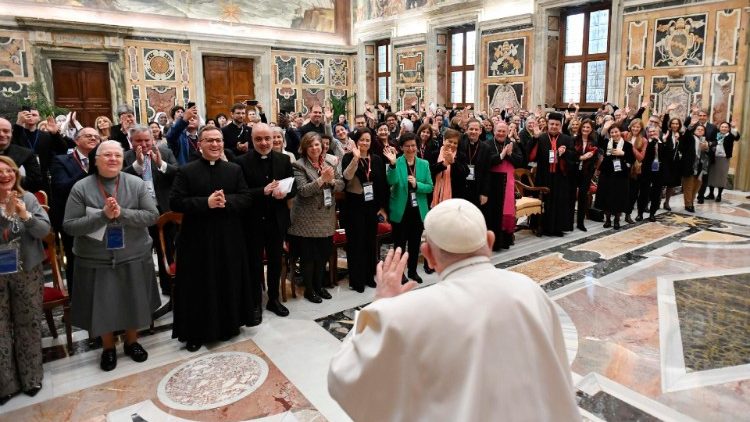
The theme of women and their role in the Church, which came up several times during the September 26-29 trip to Luxembourg and Belgium, was also central in Pope Francis' conversation with the 150 Jesuits he met in Brussels.
As in every apostolic journey, the took time for a private meeting with the members of the Society of Jesus. The encounter was sandwiched between a visit to the campus of the Université Catholique in Louvain and a surprise stop at the Brussels Expo Hall with 6,000 young people gathered for a vigil.
The meeting with the Jesuit brethren not only from Belgium, but also from Luxembourg and the Netherlands, took place in the Collège Saint-Michel. It was a private meeting, interspersed with questions and answers on topics related to the mission of the Society of Jesus today or on current events in the world and the Church – from secularization to inculturation, from the Synod to migration – and also with a song sung with guitar accompaniment at the opening by the superior of the Region of the Netherlands, Father Marc Desmet.
Following the usual custom, La Civiltà Cattolica has published the full text of the dialogue, in an article signed by Father Antonio Spadaro, which emphasizes its “spontaneity” and “immediacy.”
‘The Church is woman’
“The Church is woman,” Pope Francis responded to a Jesuit's question about “the difficulty of giving women a more just and adequate place in the Church.” “I see women blessed with charisms, and I do not want to limit the discussion of women’s role in the Church to the topic of ministry,” the pope clarified. “In general, he says, “masculinism and feminism are ‘market’ themes.”
The Pope emphasized that at this point in time, he is trying “more and more to bring women into the Vatican with roles of higher and higher responsibility.”
“Things are changing,” he continued. “You can see and feel it.”
Women in the Vatican
The pope recalled that the Deputy governor of the Governorate is a woman (Sister Raffaella Petrini), that the Dicastery for Integral Human Development “also has a woman as its deputy” (Sister Alessandra Smerilli), and that in the “‘team’ for the appointment of bishops” there are three women (Petrini, then Sister Yvonne Reungoat and Maria Lia Zervino, appointed in 2022 as members of the Dicastery for Bishops). “Since they are in charge of selecting candidates, things are much better,” he said, adding, “They are acute in their judgments.”
Even in the Dicastery for Consecrated Life “the deputy is a woman” (Sister Simona Brambilla, secretary) and in the Council for the Economy the deputy coordinator is a woman, Charlotte Kreuter-Kirchhoof.
“Women, in short, are entering the Vatican in roles of high responsibility: we will continue on this path. Things are working better than before,” the Pope assured his listeners.
In this context, the Pope also recalled an anecdote with the president of the European Commission, Ursula von der Leyen: “We were talking about a specific problem, and I asked her, ‘But how do you handle these kinds of problems?’ She replied, ‘The same way all of us mothers do.’ Her answer gave me much to think about.”
Migrants need to be integrated
During the encounter, the Pope then addressed the issue of migration, which needs to be studied properly.
Once again, he listed the four verbs with which to articulate action for migrants: welcome, accompany, promote, integrate. If this is missing, it becomes a “serious” problem. “A migrant who is not integrated ends badly, but so does the society in which the migrant lives,” the Pope warned, recalling the 2016 attack in Belgium itself, at Zaventem airport, which cost the lives of 16 people at the hands of two terrorists affiliated with ISIS. “hat tragedy was also the result of a lack of integration.”
He added, “The Church must take seriously the work with migrants.”
An aging Europe
Coupled with this Pope Francis reiterated “one thing that is close to my heart,” the fact that “Europe has no more children, it is aging. It needs migrants in order for life to be renewed. It has now become a question of survival.”
The community more important than the priest
Not only few children, but also few vocations. The topic was raised by a religious: “How do you see the future of parish communities without priests?”
“The community is more important than the priest,” the pope responded. “The priest is a servant of the community.”
He cited the example of women religious who take on leadership roles in some parts of the world, such as the Peruvian congregation of nuns who have “their own specific mission” of going “to those situations where there is no priest. They do everything: they preach, they baptize... If a priest is eventually sent, then they go somewhere else.”
‘The Jesuit should not be afraid of anything’
Speaking of mission, the pope, looking at the context of Belgium – which is among the most secularized countries in Europe – urged members of the order of St. Ignatius not to be afraid. “the Jesuit should not be afraid of anything,” he said. “He is a man in tension between two forms of courage: courage to seek God in prayer and courage to go to the frontiers.”
As “masters” the pope points to Father Matteo Ricci, Father Roberto De Nobili, and other great missionaries who “even frightened some in the Church by their courageous action” but “set out the limits of inculturation.”
This limit must be sought in “discernment,” he said. “And it is discerned by praying.” Jesuit prayer, the Pope said, “developed in borderline, difficult situations, at the limits. This is the beautiful thing about our spirituality, taking risks.”
New forms of paganism
About the “complex phenomenon” of secularization, Pope Francis speaks of “forms of paganism”: “We do not need a statue of a pagan god to talk about paganism: the very environment, the air we breathe is a gaseous pagan god! And we must preach to this culture in terms of witness, service and faith. And from within we must do it with prayer.”
Service, he said, makes dialogue “fruitful,” but dialogue is often hindered by “strong clericalism” in the Church. “Where there is clericalism there is no service,” he continued, adding a warning, “For goodness’ sake, never confuse evangelization with proselytising!”
Intellectual apostolate
“The intellectual apostolate,” is also “important,” the said, and a part of the vocation of Jesuits who “must be present in the academia, research, and also in communication.”
“Let’s be clear,” Pope Francis said. “When the General Congregations of the Society of Jesus say to insert oneself in the lives of people and in history, it does not mean ‘making a carnival,’ but inserting oneself in even the most institutional contexts, I would like to say, with some ‘rigidity,’ in the good sense of the word. One should not always seek informality.”
Synodality, a grace
One question concerned synodality, the focus of the Synod underway at the Vatican. “Synodality is not easy, no, and sometimes this is because there are authority figures that do not bring out the dialogue aspect,” the pope said. “A pastor can make decisions by himself, but he can make them with his council. So can a bishop, and so can the pope.”
Pope Francis said he is confident that with the Synod “things will be clarified precisely by the synodal method.” He said, “Synodality in the Church is a grace! Authority is carried out in synodality.”
Causes of beatification
Finally, Pope Francis confirmed that the cause of Father Pedro Arrupe, the Spanish-born Jesuit superior general from 1965 to 1983, who has been proclaimed a Servant of God, is “open.”
“The problem is the revision of his writings,” the Pope said, explaining, that Arrupe “wrote so much, and the analysis of his texts takes time.
Regarding the cause of Henri De Lubac, another “great Jesuit,” the Pope said he does not know whether or not his cause has been introduced.
Speaking with his confreres, Pope Francis revealed what he would later announce publicly at the Mass in Brussels; namely, the initiation of the cause of King Baudouin: “I did it myself, the Pope said, “because it seems to me that we are moving in that direction here.”
A transcription of the Pope’s conversation with Jesuits during his visit to Brussels can be found at the website of La Civiltà Cattolica.