Showing posts with label women ministries. Show all posts

Tuesday, January 7, 2025

Pope Francis appoints first women ever to lead a Vatican Dicastery


Pope Francis names first ever woman to lead Vatican department


Consolata Missionary Sr. Simona Brambilla was appointed prefect of the Dicastery for Institutes of Consecrated Life and Societies of Apostolic Life, on Jan. 6. She is pictured here speaking at a news conference at the Vatican March 14, 2024, about study groups authorized by Pope Francis to examine issues raised at the synod on synodality. (CNS/Lola Gomez)


Pope Francis on Jan. 6 appointed the first ever female to lead a Vatican department, continuing an ongoing trend of this pontificate to place more women in leadership in the Catholic Church. 

Consolata Missionary Sr. Simona Brambilla will serve as prefect of the Dicastery for Institutes of Consecrated Life and Societies of Apostolic Life, the Vatican office that works with religious orders and their members.

The announcement comes three years after Francis formally overhauled the Vatican's constitution allowing for women and laity to offices of the Roman Curia. 

The appointment also comes at the conclusion of the pope's global synod process, which acknowledged that "women continue to encounter obstacles in obtaining a fuller recognition … in all the various areas of the church's life."  Even so, critics have countered that there are still too few concrete efforts to promote women in positions in authority in church life. 

Brambilla, 59, is an Italian-born missionary and nurse who previously served in Mozambique. She also holds a doctorate in psychology from Rome's Gregorian University. 

In 2023, she was appointed as the department's secretary, marking the first time in Vatican history that a woman was named the number two official of the curia. Previously, she had served as an external member of the department. 

Also appointed on Jan. 6 was Salesian Cardinal Ángel Fernández Artime, 65, who will serve as the pro-prefect of the dicastery, the office's number two official. The office oversees nearly 700,000 consecrated women and men from religious orders around the globe. 

In her new role, Brambilla will now top a growing number of women that Francis has elevated to high ranking posts in the Vatican. Included in that number are Emilce Cuda, secretary of the Pontifical Commission for Latin America; Salesian Sr. Alessandra Smerilli, secretary of the Dicastery for Promoting Integral Human Development; and Xaviere Sr. Nathalie Becquart, who is the under-secretary of the Vatican's synod office. 

In the immediate wake of Brambilla's appointment, Becquart — who has become one of the most visible public faces of the synod — took to social media to celebrate the announcement: "Wonderful news!," she wrote. 

Monday, December 16, 2024

One U.S. Bishop/Diocese began installing women acolytes


Bishop Stowe blesses 3 women in ceremony recognizing lay ministry roles


Bishop John Stowe of Lexington, Kentucky, blesses three women acolytes during Mass Nov. 24 at the Cathedral of Christ the King in Lexington. (Courtesy of Maureen C Guarnieri Yeager)


Brian Fraga

Nearly four years since Pope Francis changed canon law to allow women to be installed as lectors and acolytes, some dioceses are now moving ahead with ceremonies to formally recognize women in those instituted lay ministries.

"I waited long enough to get any direction from the USCCB," Bishop John Stowe said, referring to the U.S. Conference of Catholic Bishops, which has yet to promulgate new guidelines and norms on the expanded lay ministries.

Stowe installed three women as acolytes during Mass on Nov. 24 at the Cathedral of Christ the King in his Diocese of Lexington, Kentucky. Following his homily, Stowe imparted a blessing onto the acolytes, who typically assist priests in distributing Communion and preparing the altar during Mass.

"It was a nice day to recognize the ministry that these women have already accomplished," Stowe told National Catholic Reporter. "I would have liked to have done it sooner."

Diane Zekind, one of the acolytes blessed by the bishop, said it was fulfilling to be recognized for a ministry that she has been performing at her parish, St. Clare Church in Berea, Kentucky, for 14 years.

"It was an awesome moment," Zekind told NCR. "I think it was a great way to set an example for others to be involved with liturgical ministries, that women can serve in a number of areas, and how others should be involved with it."

At least one other diocese has installed women as lectors and acolytes in the absence of guidance from the U.S. bishops.

On Aug. 27, the San Antonio Archdiocese held a special Mass at Our Lady's Chapel in Assumption Seminary to install five women in those ministries. The women had completed formation training through the archdiocese's Lay Ministry Institute.

"Your role is crucial in helping the community encounter Christ," San Antonio Archbishop Gustavo García-Siller said during his homily in which he emphasized the importance of those ministerial roles in the life of the local church.

"Through your proclamation of the Scriptures and your service at the altar, you will make the presence of Christ known, inviting the faithful to a deeper communion with Him," the archbishop said.

Though the pope allowed for women to be formally installed as acolytes and lectors with his motu proprio letter Spiritus Domini in January 2021, most dioceses have been waiting for the U.S. bishops' conference to update its norms to reflect the changes in canon law.

At their plenary meeting in June, the U.S. Catholic bishops voted to establish a task force that will create a new national directory of instituted ministry that would encompass norms, guidelines and best practices for the expanded ministries of lector, acolyte and catechist. Francis, in a separate document issued motu proprio (meaning on his own initiative) in 2021, also established catechist as a new lay ministry.

Military Services Archbishop Timothy Broglio, president of the U.S. bishops' conference, said at the June plenary that the bishops' task force would consider "practical" matters, such as qualities that instituted lay ministers should possess and whether those ministries require a set minimum age or duration, as well as how those ministries would relate to the roles that pastors serve in a parish, among other considerations.

In addition, Broglio and other prelates said the national directory will need to reflect the updated or expanded theological vision of lay instituted ministry, which Francis said in his 2021 apostolic letter had undergone a "doctrinal development" in recent years.

Opening up the ministries of lector and acolyte to women, Francis wrote in Spiritu Domini, reflected a reality that "certain ministries instituted by the Church are based on the common condition of being baptized and the royal priesthood received in the Sacrament of Baptism."

That development, the pope wrote, followed recommendations from several assemblies of the Synod of Bishops to deepen the subject of lay ministry doctrinally, "so that it may respond to the nature of the aforementioned charisms and the needs of the times."

In a letter accompanying Spiritu Domini that he wrote to the then-prefect of the Vatican's Congregation for the Doctrine of the Faith, Francis said it would be the role of national bishop's conferences to consider criteria for who in their communities could serve as lectors and acolytes.

The U.S. bishops' task force on creating the new national directory of instituted ministries will be led by Auxiliary Bishop Michael Woost of Cleveland, Broglio announced at the bishops' November plenary meeting in Baltimore. Broglio did not articulate a timeline for when he expects the directory to be complete.

Stowe, a former member of the bishops' conference Administrative Committee, said he asked "on multiple occasions" in recent years why the conference had not yet adopted new norms for the instituted lay ministries. Stowe told NCR he "never got an answer to that question."

"It just seemed to me that we were waiting too long, and there were people here who I felt were already qualified for this role," Stowe said. "I thought it was time to have women installed in some kind of a ministry that would be visible in the sanctuary."

The women who were installed as acolytes in the Lexington Diocese completed a new diocesan training program that Stowe said was made available to people who had already been serving their parishes in various liturgical ministries.

"This is to give some sense of permanence to the ministries that they're doing, which they do officially in the name of the church," he said.

Zekind, who has served as an acolyte in various liturgical ceremonies — including weddings, funerals, confirmation and installation Masses — said she not only enjoys serving in her ministry but added that it has enriched her own personal faith.

"You're involved in the Mass, you're interacting with the priest, and I think it just brings a little bit more involvement with receiving the Eucharist," she said.

Tuesday, December 3, 2024

Council of Cardinals has December meeting with Pope Francis


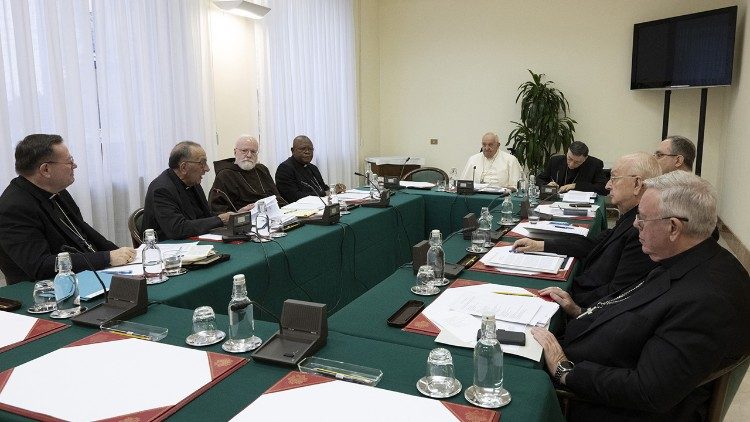
The 3 December 2024 meeting of the "C9" Council for Cardinals with Pope FrancisThe 3 December 2024 meeting of the "C9" Council for Cardinals with Pope Francis 

C9 focuses on collegiality, role of women, nuncios, and world crises

At the December session of the Council of Cardinals (C9), held on 2nd and 3rd December at the Casa Santa Marta in the presence of Pope Francis, several current issues concerning the Church and the world were discussed, as also discussed at the recent Synod. The meetings also provided an opportunity to reflect on the situation in the various countries represented by the Cardinals, “to share concerns and hopes about the ongoing reality of conflict and crisis.”

Vatican News

Collegiality in the Church, the role of women, the recent Synod, the implementation of the Apostolic Constitution Praedicate Evangelium in diocesan Curias, the role of nuncios, concerns and hopes for the global reality amid crises and conflicts marked the varied topics addressed during the December session of the Council of Cardinals, known as the C9, the working group composed of nine cardinals that assists and advises Pope Francis.

Collegiality in the Church

The meeting marked the final gathering for 2024, following the ones in February, April, and June, taking place on Monday 2nd and Tuesday 3rd December at the Casa Santa Marta, in the presence of the Pope, the Cardinals of the Council, and the Secretary. As reported by the Holy See Press Office, “various topics were discussed during the session’s meetings,” starting with Cardinal Marcello Semeraro, Prefect of the Dicastery for the Causes of Saints, “on collegiality in the Church, specifically the relationship between particular churches and ecclesial assemblies, followed by a common conversation on the recently concluded Synod.”

The role of women and service of nuncios

Additionally, during the meetings, “the role of women in the Church was explored, seeking a synthesis of the issues raised over the past four sessions of the Council of Cardinals. Finally – the statement continues – time was dedicated to studying and implementing the principles and criteria of the Apostolic Constitution Praedicate Evangelium in diocesan Curias, and to the topic 'The role of Papal Representatives in a synodal missionary perspective', in conversation with Cardinal Oswald Gracias, Archbishop of Bombay, President of the relevant study group.”

Reflection on the Church and world

“As always,” the Vatican Press Office reports, “the Council marked an opportunity for a comprehensive reflection on the reality of the Church and the world in the various areas represented by the Cardinals, to share concerns and hopes regarding the ongoing conditions of conflict and crisis.”

The next session of the Council of Cardinals is scheduled for April 2025.


Friday, July 19, 2024

What is the real deal on a women's diaconate?


‘No, but…’: Despite papal denial, dialogue on women diaconate continues


Pope Francis and his international Council of Cardinals continue their discussion of women's role in the church at the Vatican Feb. 3, 2024. (CNS photo/Vatican Media)


VATICAN CITY (CNS) — When Pope Francis was once asked if a girl could ever grow up to become a deacon or join the clergy of the Catholic Church, he responded with a clear “no.”

Nonetheless, conversations about the role of women in the church and their ministerial functions are still being held at the highest levels of the Vatican.

Months before he rejected the possibility of women deacons during a May interview with “60 Minutes” on CBS, the pope invited a Salesian sister, a consecrated virgin and a woman Anglican bishop into a discussion on women in the church with his Council of Cardinals, commonly known as the C9.

It was the second meeting of the council, an international group of cardinal advisors to the pope, dedicated to discussing the role of women in the church. The pope and his council have held a total of four meetings with women experts — in December, February, April and June — to continue conversations on the role of women in the church.

While information on the meetings is typically limited to a list of discussed topics distributed by the Vatican, talks from the December council meeting were published February in a book, titled “Smaschilizzare La Chiesa?” (“De-masculinize the Church?), and the speeches of the three women and responses of two cardinals from the February session were published in a book — “Donne E Ministri Nella Chiesa Sinodale” (“Women and Ministries in the Synodal Church”) — released July 11.

In its foreword, Pope Francis wrote that the participation of the three theologians at the C9 meeting fell in line with the synodal process, which is “a process of discernment (that) starts in reality and experience.”

He said that just as the modern age has been marked by a draw toward “clear and refined” ideas, “the Church too has sometimes fallen into the trap of considering loyalty to ideas to be more important than attention to reality,” and listening to the joys and suffering of women in the church “is certainly a way to open us up to reality.”

Insisting on the need to speak openly and frankly about the possibility of admitting women to the diaconate, Salesian Sister Linda Pocher, a professor of Christology and Mariology at Rome’s Pontifical Faculty of Educational Sciences “Auxilium,” explained in her speech that the justifications for reserving ordained ministry to men “are weak, and it is important to recognize and be aware of it.”

Biblically, she noted that the calling of the 12 apostles cannot be equated with the institution of priestly or episcopal orders as they are understood today. Theological justifications for excluding women from holy orders were founded on the idea that women were incapable of holding positions in the public sphere by their nature — an idea, she said, that became “unacceptable” after the feminist movements of the 20th century lifted women into previously inaccessible positions.

Additionally, Sister Pocher said that papal rejections of admitting women to ordained ministry cannot be used as a justification for maintaining the practice since there are numerous historical instances of popes altering positions held by their predecessors.

In his response to the speeches, however, Cardinal Seán P. O’Malley of Boston said that “in the continuous and unchanging tradition of the church, priestly ordination is reserved for men,” adding that church leadership should find ways to open more ministries to women since male-only ordained ministry “will not change.”

The cardinal said that the practice of only ordaining men to the priesthood “absolutely does not mean that men are in some way superior to women,” and while women must be able to fully contribute to the church “we cannot allow ourselves to make mistakes acting hastily or without a full consideration of the possible consequences of these changes.”

He added that a greater development of the priestly dimension in the life of all baptized people is needed and that women need to occupy more leadership positions in the Vatican, in archdioceses, dioceses and parishes around the world.

Anglican Bishop Jo Bailey Wells, deputy secretary-general of the Anglican Communion, recounted in her presentation the path toward and following the 1978 Lambeth Conference which gave each Anglican church the authority to decide whether to ordain women. As part of the theological rationale for the decision she cited the idea that God created all of humanity with the capacity to lead and govern whereas women’s subordination to men only comes after humanity’s fall from God’s grace.

Cardinal Jean-Claude Hollerich of Luxembourg responded to the reality of Anglican ordained ministry by saying it is “not entirely adaptable to Catholic ordained ministry.”

“In the Catholic Church we have a unity of doctrine and a unity of the episcopal college, in communion with the bishop of Rome, which represented the universal Church,” he said, noting the division that arises between Anglican parishes that recognize women as ordained ministers and those that do not — particularly in recognizing the authority of women bishops.

He also said that ordaining women could hinder the warming relations between the Catholic and Orthodox churches.

Yet, “Do these doubts mean the ordination of women should be completely excluded?” the cardinal asked. “I am not sure,” he said, but added that it seems unlikely the church could answer such a question now or in the near future.

Cardinal Hollerich, who is also relator general of the Synod of Bishops on synodality, asked whether the synodal path being taken by the church to recognize the baptismal dignity of its members and in which “ordained ministry becomes true service” could already “reduce the frustration of many women.”

The synod on synodality, which will hold its second assembly at the Vatican in October, will not address the question of admitting women to diaconal ministry, but the working document for the assembly affirmed that “theological reflection should continue” on the matter and noted that a dedicated body is studying the question.

Cardinal Mario Grech, who is secretary-general of the Synod of Bishops but not a member of the C9, said at a news conference July 9 that it is “not a contradiction” for the pope to reject the possibility of women deacons while advancing theological study on the issue.

“According to the information that we have today, it is a ‘no'” on expanding the diaconate to women, he said, “but at the same time the Holy Father has said that reflection, deeper theological study, should continue.”

Tuesday, July 9, 2024

Vatican releases the Instrmentum Laboris for October 2024 session on the Synod on Synodality


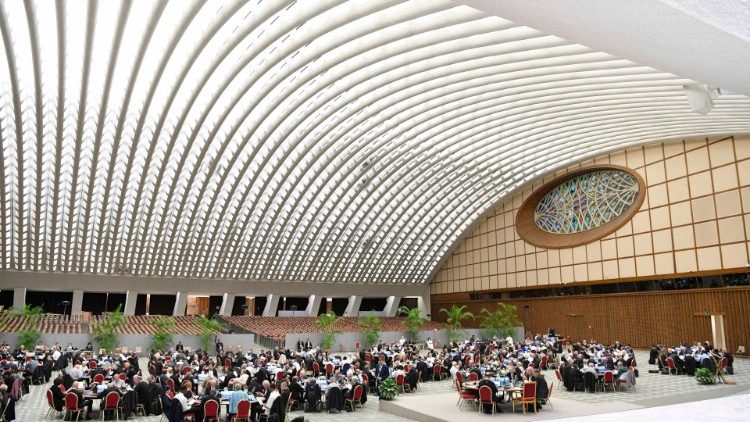
The first assembly of the synodThe first assembly of the synod  (Vatican Media)

Emphasis on women and accountability in document for second Synod session

The Holy See Press Office releases the 'Instrumentum Laboris', the text that will guide the work of the second session of the XVI Ordinary General Assembly of the Synod in October. Among the focuses of the document are the need for transparency and accountability, and the role of women in the Church.

By Isabella Piro

How to be a missionary synodal Church? That’s the question at the heart of the Instrumentum laboris (IL) for the upcoming session of the Synod of Bishops, which will take place from October 2 to 27.

It will be the second session of the XVI Ordinary General Assembly, following the one in 2023. The IL – published today, Tuesday, July 9, and presented at the Holy See Press Office – does not offer any "pre-packaged answers" but rather "indications and proposals".

These regard how the Church, as a whole, can respond "to the need to be 'synodal in mission'". That is, to be a Church closer to people, less bureaucratic, where all the baptized are – within their different ministries and roles – co-responsible and participants in its life.

The five parts of the document

The document is structured in five sections: introduction, foundations, and three central parts.

The introduction recalls the journey traveled so far and highlights the milestones already reached, such as the widespread use of the synodal methodology of the Spiritual Conversation.

The foundations (nn. 1-18) then dwell on the understanding of synodality, seen as a path of conversion and reform. In a world marked by divisions and conflicts, it is emphasized, the Church is called to be a sign of unity, an instrument of reconciliation and listening for all, especially for the poor, the marginalized, and the minorities excluded from power.

Valuing women in the Church

The foundations also give ample space (nn. 13-18) to reflection on the role of women in all areas of the Church's life, highlighting "the need to give fuller recognition" to their charisms and vocation.

"God chose women as the first witnesses and heralds of the Resurrection," recalls the IL; therefore, "by virtue of Baptism, they enjoy full equality, receive the same outpouring of gifts from the Spirit, and are called to the service of Christ's mission.."

Participation and responsibility

In some cultures, the IL notes, "the presence of machismo remains strong"; therefore, the second synodal session calls for "a wider participation of women in the processes of ecclesial discernment and all stages of decision-making processes” along with "wider access to positions of responsibility in Dioceses and ecclesiastical institutions," as well as in seminaries, institutes, theological faculties, and "an increase in the number of women judges in all canonical processes."

The suggestions also concern consecrated women. It stressed the need for “greater recognition and support" for their life and charisms, along with "their employment in positions of responsibility."

Theological reflection on female diaconate continues

As for the admission of women to the diaconal ministry, the IL reports that it is requested by "some local Churches," while others "reiterate their opposition" (n. 17).

The theme, it is noted, "will not be the subject of the work" next October, and therefore it is right that "the theological reflection should continue." In any case, the IL’s reflection on the role of women "highlights the desire to strengthen all the ministries exercised by the laity (men and women)”, and it also notes the request for "adequately trained lay men and women to contribute to preaching the Word of God, including during the celebration of the Eucharist." (n. 18).

Part I - Relationships with God, among brothers and sisters, and among the Churches

After the introduction and the foundations, the IL focuses on relationships (nn. 22-50) that allow the Church to be synodal in mission: that is, relationships with God the Father, among brothers and sisters, and among the Churches.

Charisms, ministries, and ordained ministries are therefore essential in a world and for a world that, amid many contradictions, seeks justice, peace, and hope.

From local Churches, the voice of young people also emerges, who request a Church not of structures, nor of bureaucracy, but founded on relationships that are lived and animated by dynamics and paths.

From this point of view, the October Assembly will be able to analyze the proposal to create new ministries, such as that of "listening and accompaniment."

Part II – Formative paths and community discernment

These relationships should then be developed in a Christian manner along paths (nn. 51-79) of formation and "community discernment," which allows the Churches to make appropriate decisions, articulating responsibility and participation of all.

The IL affirms that there is a “school of synodality” in the intertwining of generations. All, “the weak and the strong, children, young and old” have “much to receive and much to give." (n. 55).

The importance of accountability

"A synodal Church requires both a culture and practice of transparency and accountability," reads the IL, "which are essential to fostering the mutual trust necessary for walking together and exercising co-responsibility for the sake of the common mission" (n. 73).

The working document emphasizes that today "the demand for transparency and accountability in and by the Church has come about as a result of the loss of credibility due to financial scandals and, even more so, sexual abuse and other abuses of minors and vulnerable persons. The lack of transparency and accountability fuels clericalism". (n. 75).

Evaluation structures needed

Accountability and transparency, insists the IL, also affect "pastoral plans, methods of evangelisation, and how the Church respects the dignity of the human person, for example, regarding the working conditions within its institutions." (n. 76).

Hence, “structures and forms of regular evaluation of how ministerial responsibilities of all kinds are exercised emerge as necessary" (n. 77).

The Church should guarantee, explains the IL, the publication of an annual report both on the management of assets and resources, and on the execution of missions, including " an illustration of the initiatives undertaken in the area of safeguarding (protection of minors and vulnerable persons)" (n. 79).

Part III – Places of ecumenical and interreligious dialogue

The IL then analyzes (nn. 80-108) the places where relationships and paths take shape.

Inviting us to overcome a static vision of ecclesial experiences, the working document recognizes their plurality. It is in this context that the great themes of ecumenical, interreligious, and cultural dialogue are placed.

In this context, too, we find the search for forms of exercise of the Petrine ministry open to the "new situation" of the ecumenical journey (nn. 102 and 107).

Pilgrims of hope

The Instrumentum laboris concludes with an invitation to continue the journey as "pilgrims of hope” in view of the Jubilee of 2025 (n. 112).

Wednesday, February 7, 2024

Pope Francis recent interview discusses Fiducia Supplicans, role of women in the church and more


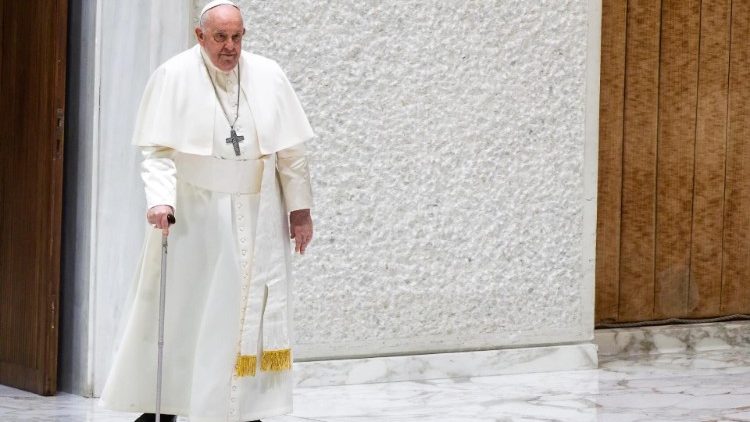
Pope FrancisPope Francis  (ANSA)

Pope Francis: 'Welcome' is at the heart of 'Fiducia supplicans'

Pope Francis has granted an interview to Italian weekly 'Credere,' in which he discusses the recently-issued Vatican document 'Fiducia Supplicans', ecclesial movements, and the role of women in the Church.

By Salvatore Cernuzio

"Everyone, everyone," Pope Francis said in Lisbon at the 2023 World Youth Day in August, and repeated on numerous other occasions to reiterate the principle of welcome at the heart of the Church's pastoral mission. Likewise, he said it to describe spontaneous blessings of individuals who are in so-called 'irregular' relationships, including homosexual ones, as taken into account by the Vatican's doctrinal document Fiducia Supplicans which was issued in December.

Pope Francis also, in his interview with the Italian weekly magazine Credere, a periodical of the San Paolo Group, which will be published in tomorrow's 8 February issue, returned to the theme of such blessings, which have generated various reactions and controversies, and repeated what he had already mentioned in his audience with the Dicastery for the Doctrine of the Faith that drafted the declaration.

"I do not bless a 'homosexual marriage', I bless two people who love each other and I also ask them to pray for me," the Pontiff explained in his conversation with Credere's editor Don Vincenzo Vitale.

"Always in confessions, when these situations arrive, homosexual people, remarried people, I always pray and bless. The blessing is not to be denied to anyone. Everyone, everyone. Mind you, I am talking about people: those who are capable of receiving Baptism."

"The gravest sins," the Pope adds, "are those that disguise themselves with a more 'angelic' appearance. No one is scandalised if I give a blessing to an entrepreneur who perhaps exploits people: and this is a very serious sin. Whereas they are scandalised if I give it to a homosexual.... This is hypocrisy! We must all respect each other. Everyone! The heart of the document is welcome."

Movements

In the interview with the weekly magazine, which celebrates ten years since its foundation, born precisely on the occasion of Jorge Mario Bergoglio's election in 2013, the Pope retraces the years of his pontificate between personal sharings, such as his dialogues with the elderly or his memories in Buenos Aires, or other pertinent topics, including the Jubilee, "an event of grace" in view of which it is necessary to "rediscover the value and the need for prayer."

The Pope also spoke of the ecclesial movements and the involvement of young people in pastoral experiences such as those in developing or Latin American countries, where people are spoken to in "simple" language.

"There are also 'sophisticated' realities, and movements, the Pope says, that are rather "refined."

These movements, he says, "tend to form an ecclesiola ('a little church'), of people who feel superior. This is not the holy faithful people of God. The people of God is made up of believers who know they are sinners and go ahead. I do not hold it against movements, which do so much good."

"The movement," explained the Holy Father, "is good when it inserts you into the real Church, but if they are selective, if they detach you from the Church, if they lead you to think that you are a special Christian, this is not Christian."

Women's presence important, not ministeriality

The Pope's response on the role of women is also clear, in light of the constant appeals to restore a "female face" to the Church or, the most recent one, to "unmask" the Church. Pope Francis reiterates the difference between the Petrine principle and the Marian principle: "The Church is woman, She is bride. Peter is not woman, he is not bride."

"The Church-bride is more important than Peter-minister!" he said.

He then adds that "opening up work in the Curia to women is important," emphasising how women "help the ministry." He urged everyone to look at the small villages where there is no priest and nuns run parishes, baptise, give Communion, do funerals. "It is not the ministeriality of women that is the most important thing, instead the presence of women is fundamental," the Pope concludes.

New future appointments in the Roman Curia

Looking at the Roman Curia where several female appointments have taken place over the years, the Pope says, "Now there are several women and there will be more, because they do better than us men in certain positions."

Pope Francis cites Sr Raffaella Petrini, Secretary of the Vatican Governorate, "the women who are in the Dicastery to elect bishops" (who include Sr. Petrini, Sr Yvonne Reungoat, former superior general of the Salesians, and Maria Lía Zervino, President of the UMOFC), Sr Alessandra Smerilli, Secretary of the Dicastery for Integral Human Development, and others.

"These are all posts that need women," he said.

Finally, when asked if he realises that he has initiated "an epochal change" from this point of view, the Pope replied, 'No, really! They tell me, yes.... I go ahead as I can."

Tuesday, February 6, 2024

A female Bishop of the Anglican Church addresses the Council of Cardinals at the Vatican


Female Anglican Bishop Addresses Pope Francis’ Council of Cardinals

Rev. Jo Bailey Wells, as well as Salesian Sister Linda Pocher and consecrated virgin Goiliva Di Berardino of Italy, presented remarks on the subject of women in the Catholic Church.


VATICAN CITY — A female Anglican bishop who has campaigned for “gender equality” addressed the Council of Cardinals on Monday as part of a session dedicated to deepening a reflection "on the role of women in the Church.” 

Rev. Jo Bailey Wells, who is deputy secretary general of the Anglican Communion, was one of the first generation of women to be ordained a vicar in the Church of England in 1995. Married to an Anglican clergyman with two children, she has also served as chaplain to the Archbishop of Canterbury.

The Anglican bishop, who in the past has praised “gender history” for highlighting how “institutions are gendered and how institutions gender individuals,” also addressed an interreligious meeting attended by Pope Francis in Kazakhstan in October 2022 when she reportedly said “gender equality is part of God’s plans.” 

The Council of Cardinals, also called the “C9,” is a group of nine cardinals Pope Francis established in 2013 to advise him on Church reform and governance. One of its main tasks, to advise the Pope on reforming the Roman Curia, led to the 2022 apostolic constitution Praedicate Evangelium (Preach the Gospel)It has also often brought in guest speakers to address the Pope and cardinals on key themes. 

Vatican spokesman Matteo Bruno said on Monday that as well as Bailey Wells, Salesian Sister Linda Pocher, a professor of Christology and Mariology at Rome’s Pontifical Faculty of Educational Sciences’ “Auxilium,” and Goiliva Di Berardino, a consecrated virgin and liturgist from the Diocese of Verona, Italy, shared interventions on the subject of women in the Church.

The Vatican has not released information on today’s discussions nor published the texts of any presentations made at the meeting, but it comes after the issue of women priests and deacons became a particular focus of the first assembly of the Synod on Synodality last October. 

Sister Linda, who has addressed the C9 on previous occasions on the same theme, said in a Dec. 16 interview with Vida Nueva that “the truth is that women have always been active and present in the Church. However, in almost all contexts, more or less aggressive forms of machismo or clericalism continue to be found.” 

Sister Linda is an advocate of the “Marian Principle” in the Church, a theory originally deriving from the 20th-century theologian Hans Urs von Balthasar, who hoped to have the primacy of the Catholic Church accepted by all Christian denominations on the basis of the integration of the Petrine ministry into Marian mysticism. 

“The merit of reflecting on the ‘Marian principle’ is to help the ecclesiastical hierarchy to remember that the Church is not only an institution (‘Petrine principle’), but also mysticism, spirituality, love,” Sister Linda said.  

Synod delegates were divided over the theme of women deacons but agreed to continue theological study of the possibility of a female diaconate, and for the results of such a study to be shared at the next session of the Synod on Synodality, to be held this coming October.

Pope Francis has often chosen to stress the feminine dimension of the Church, recently calling for more women in ecclesiastical governing positions, and telling members of the International Theological Commission last November to “demasculinize the Church.’” 

At the previous C9 meeting in December when the subject of women in the Church was also discussed, the cardinals concluded there was a “need to listen, also and above all in the individual Christian communities, to the feminine aspect of the Church, so that the processes of reflection and decision-making can enjoy the irreplaceable contribution of women.”


Cardinals Ambongo and Lacroix

Among the nine cardinal members present at the meeting which runs until Wednesday is Cardinal Fridolin Ambongo Besungu of Kinshasa. The cardinal led a Jan. 11 response from all the bishops’ conferences of Africa to the Vatican declaration Fiducia Supplicans (Supplicating Trust), which said the blessing of same-sex couples proposed in the document would not be allowed in Africa and that such unions are “contrary to the will of God.” 

The statement, which said the declaration had “caused a shockwave” across the continent, was written after Cardinal Ambongo flew to Rome to discuss the fallout with Cardinal Victor Manuel Fernández, the Vatican’s doctrinal chief and main author of the document, and Pope Francis. 

Cardinal Ambongo said in a later, Jan. 25 interview, that Fiducia Supplicans “brought discredit to the synod, to synodality,” adding that the declaration was made to appear as a “fruit of the synod, when it had nothing to do with the synod.” It came at a time when, as Jonathan Liedl reports in a Feb. 1 Register article, African Catholics are ready to make their voices heard in the wider Church as Western culture becomes increasingly dominated by secular ideologies. 

Other members of the C9 are Cardinals Pietro Parolin, Vatican secretary of state; Fernando Vérgez Alzaga, president of the Pontifical Commission for Vatican City State and the Governorate of Vatican City State; Oswald Gracias, archbishop of Bombay; Seán O'Malley, archbishop of Boston; Juan José Omella Omella, archbishop of Barcelona; Jean-Claude Hollerich, archbishop of Luxembourg; and Sérgio da Rocha, archbishop of San Salvador de Bahia. The secretary is Bishop Marco Mellino, titular bishop of Cresima, in North Africa.

Also present at Monday’s meeting was Cardinal Gérald Lacroix of Québec, who was recently accused of inappropriately touching a 17-year-old girl on two occasions in the 1980s. In a video message released on Jan. 30, he said he would “temporarily withdraw from activities in my diocese.” The cardinal “categorically denies” the allegations and said that “my soul and my conscience are at peace when it comes to those accusations.”