Showing posts with label soccer. Show all posts

Tuesday, June 2, 2026

Catholic Dioceses across USA plan special outreach as the FIFA World Cup begins


US dioceses see World Cup as opportunity for pastoral outreach, global encounter
 June 1, 2026

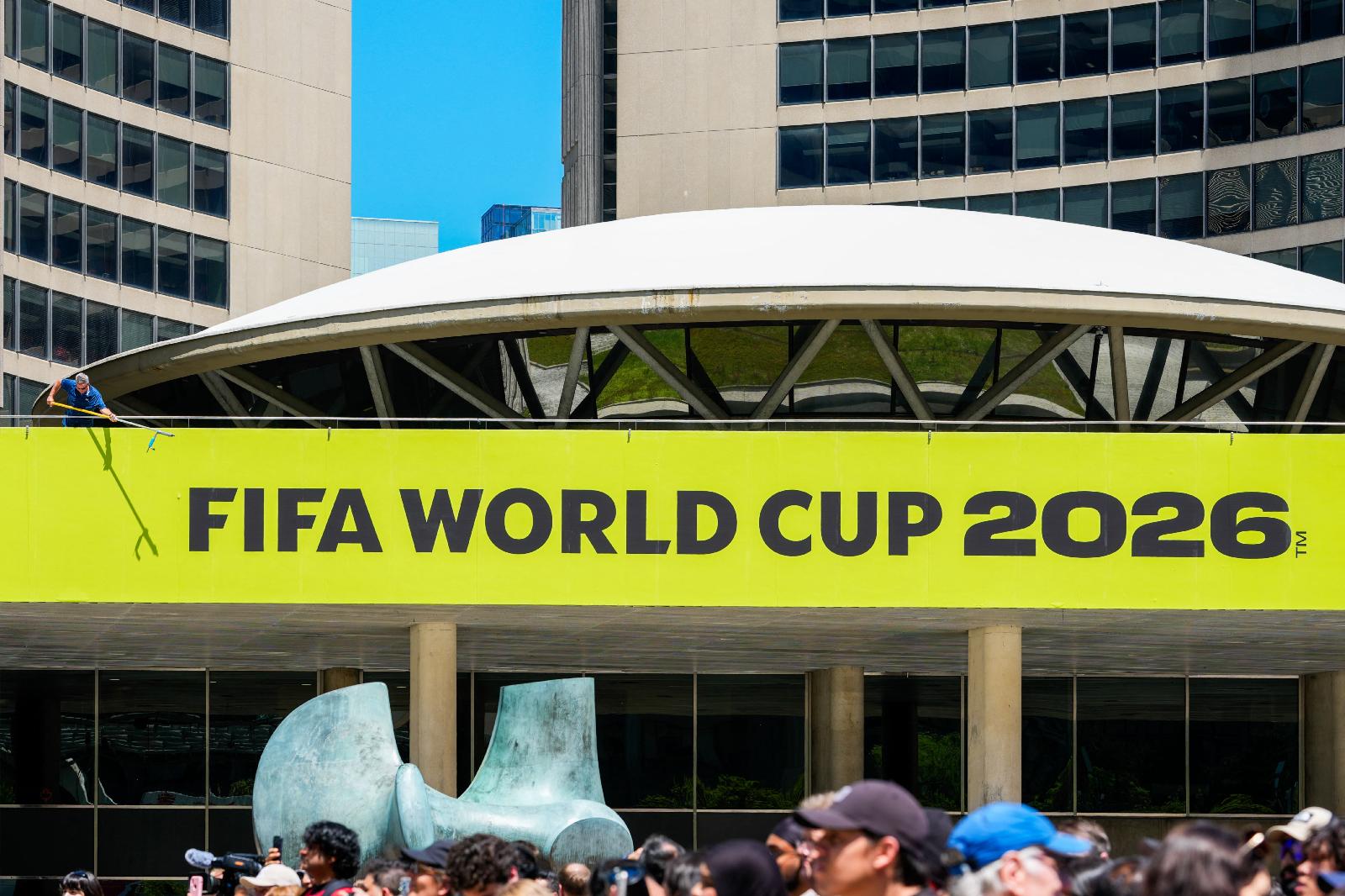
(OSV News) — As the 2026 FIFA World Cup approaches, Catholic dioceses across the United States are preparing for what many see as both a pastoral opportunity and an unprecedented moment of global encounter.

The tournament — set to be played across the United States, Canada and Mexico — will be the largest in FIFA history, featuring 48 teams and 104 matches.

In the United States, 11 host cities will stage games from June 11 to July 19, with the championship scheduled for July 19 at MetLife Stadium in East Rutherford, New Jersey, which sits just across the Hudson River from New York City.

The 11 U.S. host cities: Atlanta, Boston, Dallas, Houston, Kansas City in Missouri and Kansas, Los Angeles, Miami, Philadelphia, the San Francisco Bay Area, Seattle and the New York/New Jersey metro area.


Across these cities, Catholic leaders are already preparing for the convergence of international visitors, local parish life and public witness.

Kansas City World Cup outreach efforts bridge state lines

In Kansas City, a coordinated effort known as OneKC Catholic — a joint initiative of the Archdiocese of Kansas City in Kansas and the Diocese of Kansas City-St. Joseph — has been created to prepare for the influx.

According to its overview, OneKC Catholic is “an effort of evangelization, hospitality, and charity aimed at welcoming visiting Catholics to the KC metro area.”

It adds: “Whether you are visiting, passing through or considering making the Kansas City area your home, our Catholic parishes are ready to welcome you.”

The initiative includes coordinated parish listings, multilingual resources, and collaboration with Catholic Charities on hospitality and planning during the tournament. A kickoff Mass is planned with Bishop James V. Johnston of Kansas City-St. Joseph and Archbishop W. Shawn McKnight of Kansas City in Kansas.

Catholic Atlanta initiatives for World Cup include outreach, hospitality, public safety

In Atlanta, the archdiocese has also begun preparations that combine outreach, hospitality and public safety awareness.

Maureen Smith, chief communications officer for the Archdiocese of Atlanta, told OSV News that the city initiated early coordination with the Church.

“The City of Atlanta approached one of our pastors early in the planning process to let him know about training for faith leaders in how to recognize and respond to human trafficking,” Smith said. “Experts in human trafficking tell us there is always an increase in activity during large sporting events, so we felt like this was an appropriate and important place to start with our own planning.”

Smith also described a broader effort to welcome international visitors through parish engagement.

“We also wanted to offer a welcome to fans and teams who are coming to Atlanta for the World Cup matches,” she said. “We sponsored a contest for a Catholic artist to design a two-inch sticker welcoming guests. We will provide stickers to the parishes and encourage them to get photos of fans with their stickers at church.”

Parishes will also promote Masses in multiple languages, including Portuguese, Haitian Creole, and Spanish, with social media outreach to help visitors locate worship opportunities.

Pastoral and hospitality outreach occurring across the U.S.

Other host cities are developing their own pastoral and hospitality responses.

In Houston, an official World Cup 2026 resource page created by the Archdiocese of Galveston-Houston offers access to Mass, confession and Eucharistic adoration in the city, along with a parish locator tool to assist international visitors. Local ministries are also preparing hospitality and fellowship outreach during the tournament.

In Seattle, Catholic leaders have coordinated pastoral care initiatives focused on travelers and migrants, alongside public prayer efforts for peace during a period of global tension involving some participating nations.

In San Francisco’s host region, Mission Santa Clara on the campus of Santa Clara University has been highlighted as a Catholic focal point tied to the tournament’s presence in the Bay Area.

In Miami, Catholic communities are preparing for a large influx of international visitors, with emphasis on multilingual access to the sacraments and parish hospitality. The archdiocese has also noted the Catholic heritage connected to the World Cup’s origins, including FIFA founder Jules Rimet, a devout Catholic who envisioned the tournament as a means of fostering international fraternity.

In Dallas, Catholic institutions such as the University of Dallas and parish networks are preparing volunteer participation in tournament-related roles, including FIFA-linked programs such as player escort opportunities.

In Philadelphia, preparations include awareness that World Cup matches will coincide with the 250th anniversary of the United States on July 4, adding a unique national and civic dimension to the city’s hosting role.

In Boston, Catholic communities are preparing for international visitors through parish outreach and hospitality coordination tied to the expected influx of fans.

In Los Angeles, SoFi Stadium will host multiple matches, including games featuring the United States team. Local Catholic communities are preparing for large-scale visitor engagement and multilingual pastoral outreach.

A universal Church response

Underlying many of these efforts is a shared theological reflection on universality.

The Catholic tradition itself is rooted in the word katholikos, meaning “universal” or “according to the whole.”

That meaning resonates strongly in the episcopal motto of Pope Leo XIV: “In Illo uno unum” (“In the One, we are one”), drawn from St. Augustine’s exposition on Psalm 127.

Augustine’s reflection — “although we Christians are many, in the one Christ we are one” — has often been cited in discussions of global gatherings marked by cultural and national diversity.

In that sense, Catholic leaders note, the World Cup becomes more than a sporting event. It becomes a lived image of encounter: nations gathered, languages interwoven, cultures present in one shared space.

For Catholic communities across those 11 cities, the weeks ahead represent both preparation and invitation — preparation for the practical demands of hosting the world, and invitation to live out a vision of hospitality rooted in faith.

As OneKC Catholic’s mission states, the goal is simple: that visitors “feel known, welcomed, and connected.”

In that spirit, dioceses across the United States are approaching the World Cup not only as an international event, but as a moment of encounter — between Church and world, between local parish and global visitor, and, for many, between hospitality and grace.

Tuesday, November 15, 2022

Pope Francis loves soccer especially the 2022 Match for Peace


Pope thanks 'Match for Peace' players for offering outstretched hand


Pope thanks 'Match for Peace' players for offering outstretched hand

As Pope Francis met with soccer players ahead of a match in Rome's Olympic Stadium, the Pope's silversmith and friend, Adrian Pallarols, who designed the trophy for the 2022 Match for Peace, speaks about the significance of this year's event.

By Deborah Castellano Lubov

The third edition of the 2022 Match for Peace, organized by the Pontifical Foundation Scholas Occurrentes, took place on Monday evening at Rome's Olympic Stadium, with the support and blessing of Pope Francis.

Ahead of the match, the Pope greeted the world-renowned soccer players, organizers and their families, in the Vatican's Paul VI Hall.

The game, with the motto "We Play for Peace," features the participation of many important figures in the world of football, and follows the first two matches, held on 1 September 2014 and 12 October 2016.

This year's edition pays homage to football giant Diego Maradona, who participated in both of the previous Matches for Peace, leading the 'Scholas squad.' Maradona passed away in November 2020.

The Holy Father thanked the athletes for sowing seeds of peace in a world marked by war.

Peace, the Pope said, is the fruit of gestures like theirs, namely "of closeness, friendship, the outstretched hand, always," and "not with the stone in your hand to throw it."

These "seeds of peace," he said, may be small, but "are capable of changing the world."

“Thank you for this that you do, for today's game, because you say, 'We want peace," in a world that always looks for wars and destruction.”

Close Friendship

Adrian Pallarols, a close friend of Pope Francis, and frequently known as the Pope's silversmith, made the trophy for the Match and spoke with Vatican News. 

Pope Francis married Adrian and his wife, and baptized their children. The seventh-generation silversmith used to meet with the Archbishop of Buenos Aires regularly, and discuss theology and art over milk and cookies prepared by nuns.

They met in 2002 during the restoration of the Cathedral of Buenos Aires, and in 2005, they created a chalice together, which they would gift to then-Pope Benedict XVI.

Mr. Pallarols had made the trophy for the Match for Peace in the past, and created the chalice used by the Pope during the 2015 Mass he celebrated in New York in Madison Square Garden.

Match for Peace

In the interview, Mr. Pallarols noted how this encounter, where renowned soccer players are playing for free in order to promote peace, has great significance.

"The meaning of this encounter is to help raise money for the poor, to take care of the children that Pope Francis always calls to help, to get together, to see what you can do for others, what you what you can provide, and what you can do, to get a better life."

Expressing his joy for the Pope's closeness to the encounter, he remembered that the day's events began in the Vatican's Paul VI Hall on Monday afternoon, where the Holy Father received soccer players and those involved.

"The Holy Father introduced the small sculpture I made of a silver olive tree."

The silver olive tree, Mr. Pallarols said, is "a symbol," showing that "planting and taking care of a plant" lays the roots for "a project of life."

The Sculpture and Maradona            

The sculpture, he explained, has a small plate in the back, which the Pope and others have signed, to remember and celebrate global soccer champion Diego Armando Maradona.

"This will be the first game without him. He was one of the greatest supporters," Mr. Pallarols remembered.

"Everyone signed this work, to make a homage," he said.

Joining together for free, for the good

Monday's match was broadcast on Italian television.

The players who joined the event were Ronaldinho, Buffon, Caniggia, Ciro Ferrara, Diego Maradona Jr., Hristo Stoickov, Nicolas Burdisso, Martin Demichelis, Daniel Osvaldo, Eric Abidal, Henrikh Mjitaryán, Diego Perroti, Ciro Immobile, Vincent Candela, Antonio Di Natale, Zaccardo, Vincenzo Iaquinta, Ivan Rakitic , Legrottaglie, Roman Weidenfeller, Zé Maria, Ricardo López Felipe, Simone Perrota, Fabio Cannavaro, Paulo Futre, Bruno Alves, Roberto Tucu Pereyra, Pablo Zavaleta, Mirsolav Klose, Shota Arveladze (Ruso), Hugo Almeida, Robert Pires, Gökan Inler, Fabio Galante, Antonio Benarribo, Alejand Chori, Dominguez, Sebastien Frey, Zambrotta (entrenador).

Since its inception, Scholas, now a Pontifical Foundation, has become a worldwide network of schools that share assets, with common objectives and special attention to those most in need. Scholas Occurrentes’ roots are to be found in educational projects created for children in impoverished areas in the city of Buenos Aires, at the initiative of the then-Cardinal Jorge Mario Bergoglio, now Pope Francis.

Sunday, July 15, 2018

More World Cup Catholic connections this one from France

Wow Football Star Antoine Greizmann who Helped France Win the World Cup says "By influence, I bathe in religion since childhood...."

Antoine Griezmann started his career with Atlético Madrid and then the Team de France but also his faith.   Team France won the World Cup 2018 against Croatia with his help. Antoine was born on March 21, 1991 in Mâcon, France. Early in his career he was rejected by teams in France due to his small size. "By influence, I bathe in religion since childhood.... I continue, punctually, to light candles in the churches..."said Griezmann. Like some of his teammates his tattoos express faith; he has a tattoo of Jesus above a Christ the Redeemer statue, but also a set of rosary beads Rosary of the Virgin Mary, to whom he explains his mother often refers. His mother is a fervent Catholic. "I feed on all beliefs," said Griezmann. Antoine married his wife Erika Choperena from Spain in 2017. They have one daughter, named Mia, whom they recently baptized.   His sister, Maud, was miraculously freed from the Bataclan attack in France. Antoine Griezmann did not fail to thank "the one who is above ...". 

As Croatia battles France this morning for the World Cup, we learn that the whole thing has it's roots in Catholicism

The Catholic roots of the World Cup


Spectators at St. John’s Catholic Club in Kansas City, Kansas, celebrate Croatia’s win over Russia. Leaven photo by Jay Soldner.
by Jill Ragar Esfeld
Special to The Leaven
The 21st FIFA World Cup is the most watched event in the history of sports.
With 3.2 billion people tuning in, it outpaces even the Olympics.
As you cheer for your favorite team over the next week, it might be nice to know that this world-renowned tournament is rooted in the precepts of the Catholic faith.
It all started in 1891 when Pope Leo XIII issued what is considered the first major encyclical on social justice entitled Rerum Novarum.
A commentary on the inequality that existed in Europe as a result of the Industrial Revolution; the document specifically focused on the deplorable treatment of the working class.
Jules Rimet, a devout Catholic in France at the time, was so moved by the pope’s words he helped form an organization to provide social and medical aid for the poor.
He was only 17.
Rimet went on to serve in the First World War and came home with a global view of the disparity that existed between nations.
Still an ardent Catholic, he longed for a way to promote peace.
One thing Rimet recognized from his world travels was a phenomenon that seemed to cross the boundaries of culture, race and society — sports.
He saw sports as a universal interest that didn’t require participants to share language or politics; and he had a dream of uniting nations by organizing a world-wide sports competition.
A founding member of the Fédération Internationale de Football Association (FIFA), Rimet returned from the war to become its president in 1921.
Under his leadership, FIFA proposed a world championship for national soccer teams.
In 1930 the first World Cup was held in Uruguay; and Rimet traveled to the event with the World Cup trophy in his bag.
The tournament has been held every four years since then, except in 1942 and 1946, because of the Second World War.
You can see the fruit of Rimet’s efforts in our own country today where so many nationalities co-exist, and people from all walks of life gather to cheer on World Cup teams from various countries.
Last Sunday Croatia fans filled St. John’s Catholic Club in Kansas City, Kansas, to watch Croatia defeat Russia.
They’ll gather again this Wednesday to see Croatia battle England.
Rimet would be happy to see these Catholic fans celebrating together in a country far away from the land of their heritage.
He’d also be pleased with the first-ever Vatican document on sports released last month, “Giving the Best of Yourself.”
In the section titled “The Church is at home in sport” it states:
Sport is a context in which to concretely experience the invitation to be an outgoing Church, not to build walls and borders, but squares and field hospitals. More than many other platforms, sport brings together the downtrodden, the marginalized, the immigrant, the native, the rich, the powerful and the poor around a shared interest and at times in a common space. 
In a letter responding to the document Pope Francis said, “We can see the value of sports as a place of unity and encounter between people.
“We reach great results, in sports as in life, together, as a team.” 
Jules Rimet served as FIFA president for 33 years.
In 1956, the year he died, he was nominated for the Nobel Peace prize because of his part in instituting the World Cup tournament.

Friday, July 13, 2018

The Catholic Roots of World Cup Soccer Final

France vs. Croatia: A Catholic World Cup breakdown


FIFA World Cup 2018. Credit: Fauzan Saari/unsplash.
.- On Sunday, France and Croatia will square off on the soccer pitch for the 2018 FIFA World Cup Championship. While most U.S. Catholics are only casual soccer fans, many will join more than 3 billion people around the world who are expected to watch the game.
What team will U.S. Catholics root for as two historically Catholic countries face off?
If you’re still undecided, perhaps a comparison of the Catholic life, history, and culture of France and Croatia would be helpful:
Catholic roots
Croatia:
During the time Jesus lived in Palestine, Croatia, along with the rest of the Balkan Peninsula, was a part of the Roman Empire- most of it a part of the Roman province of Dalmatia.
Located along the Adriatic Sea, Dalmatia, which was also sometimes referred to as Illyricum, an older Greek name, was home to Roman subjects and their religions from across the Empire. At the time Jesus lived, there was a Jewish population in the region. Some members of the Jewish community became Christians during the earliest periods of Christian evangelization.
Scripture records that Titus, a disciple of St. Paul, travelled to Dalmatia, and he might have died there. The region is mentioned in St. Paul’s Second Letter to Timothy.
Some old traditions hold that St. Paul might have gone to Dalmatia too, since he wrote in the Letter to the Romans about visiting “Illyricum,” but he probably was referring to a part of Greece close to modern-day Albania.
The Croatian people, who migrated to the Dalmatian region in the 6th century, probably followed tribal religions until natives to the region, along with Byzantine and Benedictine missionaries, some from France, converted them to Catholicism. By the 9th century, Croats could be considered a Christian people, and, by the end of that century, Croatian nobility had begun pledging their allegiance to the pope.
France:
France is often referred to as the “eldest daughter of the Church,” because of the long and faithful history of the Catholic Church there.
There are many early legends that connect France and New Testament figures. One such legend says that Lazarus, Mary, and Martha were exiled from Israel and travelled by boat to France’s Mediterranean coast. Still another says that Lazarus was the first bishop of Marseille, and that he is buried in Burgundy. Some such legends say that Mary Magdalene is the sister of Lazarus and she made the trip, and then lived for 40 years in a cave in Provence -- France’s famous madeleine cookies are sometimes said to be named for Mary Magdalene.
The earliest non-legendary record of the Church in France begins in the 2nd century, when 48 Catholics, included the Bishop of Lugdunum, were martyred in Lyon, which was then part of the Roman province of Gaul.
Most French people consider King Clovis I to be the founder of France. Clovis converted from paganism, and was baptized on Christmas Day in 496 by Saint Remy. Clovis’ baptism is considered to be the foundational moment of western Christendom.
The point:
Croatia is mentioned in the Bible. While France is the Church’s eldest daughter, any place mentioned in Scripture has a strong claim on ancient Christian roots. This point goes to Croatia.
Saints
Croatia:
Croatia’s patron saint is St. Joseph. You can’t do much better than that. Unless your patron saint is the Blessed Virgin Mary. France’s patron saint is the Blessed Virgin Mary, in addition to several other saints.
St. Jerome was born in the region of Dalmatia. So was St. Marko Krizin, a priest of the Counter-reformation, and St Leopold Mandic, a pious Capuchin missionary. St. Nicholas Tavelic was a Croatian Franciscan, who was martyred in 1391 in Jerusalem after refusing to convert to Islam, along with 3 Franciscan companions.
In 2003, Pope St. John Paul II dedicated a church to the Croatian martyrs, soldiers who were slaughtered by invading Ottoman forces in the 15th century. Hundreds of thousands of other Croats have faced martyrdom and persecution, and died holy deaths in discipleship of Jesus Christ.
France:
St. Joan of Arc. St. John Vianney. St. Therese of Lisieux. St. Remy. St. Denis. St. Peter Faber. St. Isaac Jogues. St. Louis IX of France. St. Vincent de Paul. I’m really just getting warmed up. This category is going to France.
The point:
In its long history, Croatia has presumably given the Church many holy men and women, but many of them remain unknown. Over the centuries, the holy people of central European countries have not gained as much attention as those from western Europe. This is unfortunate. But France has a lot of saints. A lot. France gets the point.
Cathedrals
Croatia:
The Cathedral of the Assumption of the Blessed Virgin Mary is stunning. Beautiful. A gothic-style cathedral built in the 1200s, and restored in the 1880s. There are barricades around the cathedral that were built in the 1400s to hold back Ottoman invaders. Those same barricades held back the Ottomans in another invasion attempt 200 years later. Zagreb’s cathedral has also survived an earthquake. It’s a gem for the entire Church.
France:
The cathedral at Chartres is considered to be the highpoint of Gothic art and architecture. Its stained glass is world famous. It has been imitated around the world. Built in the late twelfth century, it has been restored several times. During World War II, an American colonel snuck behind German lines to ensure it was not being occupied by the Germans. His heroism ensured that the building was not bombed by the Allies.
The point:
Chartres is famous. Zagreb’s cathedral should be more famous. One is considered the high-point of European architecture. The other held back hordes of Ottoman invaders. People hate that soccer has ties, but this is a soccer story, and this category is a tie.
The Score: Croatia 1, France 1.
So what team will Catholics root for? The Church’s "eldest daughter," or the team whose coach loves the rosary?
Game on.