Showing posts with label Croatia. Show all posts

Wednesday, December 30, 2020

Pope Francis asks prayers for Croatia


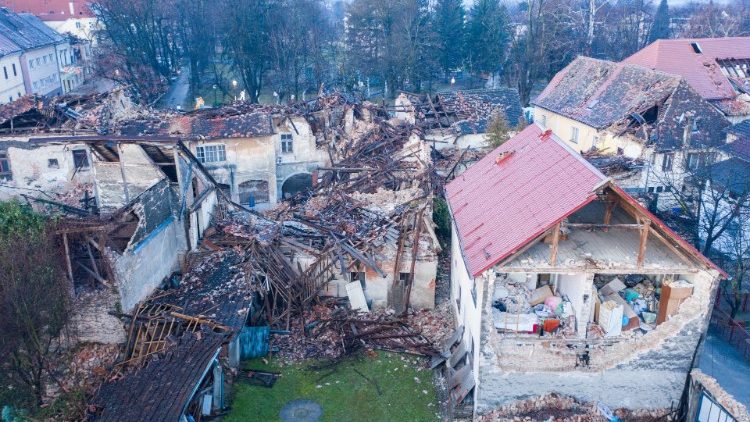
Damaged buildings in Petrinja, CroatiaDamaged buildings in Petrinja, Croatia 

Pope Francis appeals for help for quake-struck Croatia

Pope Francis has expressed his closeness to Croatians affected by two earthquakes that have killed at least seven people and wreaked extensive damage and has appealed to the international community to step in and help.

By Vatican News staff writer

Pope Francis said he is praying for the victims of an earthquake that struck central Croatia on Tuesday, killing seven people, injuring more than 20 and causing extensive damage.

Speaking during the weekly General Audience, the Pope said “I express my closeness to the wounded and to those who have been affected by the quake and I pray in particular for those who have lost their lives and for their families.”
 

Tuesday’s 6.4 magnitude earthquake was the second to strike the area in two days. Tremors were felt in Croatia’s capital Zagreb and as far away as Austria's capital Vienna. Slovenia shut its only nuclear power plant as a precaution.

Appeal

“I hope that the country’s leaders, helped by the international community,” Pope Francis continued, “might be able to quickly alleviate the suffering of the dear population.”

The worst hit towns appear to be those of Petrinja, Glina, Sisak and Zazina. The area is still in the throes of aftershocks and officials say rescue efforts continue.

Prime Minister Andrej Plenkovic, who rushed to Petrinja, said: "The army is here to help. We will have to move some people from Petrinja because it is unsafe to be here."

Donation from Italian Bishops' Conference

Meanwhile, the presidency of the Italian Bishops' Conference (CEI) has donated 500,000 euro to help victims of the earthquake. The donation comes from the “otto per mille”, or eight parts per thousand fund supported by taxes paid to the Italian state and allocated to the Church.  

The Church’s contribution will be aimed at supply basic necessities, including food, medicine, medical assistance, hygiene and sanitation, and temporary accommodations.  

A statement announcing the donation stated, “The Church in Italy expresses its condolences and closeness to the Croatian population and assures its prayers for the victims, their families and the injured: may the Lord alleviate the suffering of this moment.”

Sunday, July 15, 2018

As Croatia battles France this morning for the World Cup, we learn that the whole thing has it's roots in Catholicism

The Catholic roots of the World Cup


Spectators at St. John’s Catholic Club in Kansas City, Kansas, celebrate Croatia’s win over Russia. Leaven photo by Jay Soldner.
by Jill Ragar Esfeld
Special to The Leaven
The 21st FIFA World Cup is the most watched event in the history of sports.
With 3.2 billion people tuning in, it outpaces even the Olympics.
As you cheer for your favorite team over the next week, it might be nice to know that this world-renowned tournament is rooted in the precepts of the Catholic faith.
It all started in 1891 when Pope Leo XIII issued what is considered the first major encyclical on social justice entitled Rerum Novarum.
A commentary on the inequality that existed in Europe as a result of the Industrial Revolution; the document specifically focused on the deplorable treatment of the working class.
Jules Rimet, a devout Catholic in France at the time, was so moved by the pope’s words he helped form an organization to provide social and medical aid for the poor.
He was only 17.
Rimet went on to serve in the First World War and came home with a global view of the disparity that existed between nations.
Still an ardent Catholic, he longed for a way to promote peace.
One thing Rimet recognized from his world travels was a phenomenon that seemed to cross the boundaries of culture, race and society — sports.
He saw sports as a universal interest that didn’t require participants to share language or politics; and he had a dream of uniting nations by organizing a world-wide sports competition.
A founding member of the Fédération Internationale de Football Association (FIFA), Rimet returned from the war to become its president in 1921.
Under his leadership, FIFA proposed a world championship for national soccer teams.
In 1930 the first World Cup was held in Uruguay; and Rimet traveled to the event with the World Cup trophy in his bag.
The tournament has been held every four years since then, except in 1942 and 1946, because of the Second World War.
You can see the fruit of Rimet’s efforts in our own country today where so many nationalities co-exist, and people from all walks of life gather to cheer on World Cup teams from various countries.
Last Sunday Croatia fans filled St. John’s Catholic Club in Kansas City, Kansas, to watch Croatia defeat Russia.
They’ll gather again this Wednesday to see Croatia battle England.
Rimet would be happy to see these Catholic fans celebrating together in a country far away from the land of their heritage.
He’d also be pleased with the first-ever Vatican document on sports released last month, “Giving the Best of Yourself.”
In the section titled “The Church is at home in sport” it states:
Sport is a context in which to concretely experience the invitation to be an outgoing Church, not to build walls and borders, but squares and field hospitals. More than many other platforms, sport brings together the downtrodden, the marginalized, the immigrant, the native, the rich, the powerful and the poor around a shared interest and at times in a common space. 
In a letter responding to the document Pope Francis said, “We can see the value of sports as a place of unity and encounter between people.
“We reach great results, in sports as in life, together, as a team.” 
Jules Rimet served as FIFA president for 33 years.
In 1956, the year he died, he was nominated for the Nobel Peace prize because of his part in instituting the World Cup tournament.

Friday, July 13, 2018

The Catholic Roots of World Cup Soccer Final

France vs. Croatia: A Catholic World Cup breakdown


FIFA World Cup 2018. Credit: Fauzan Saari/unsplash.
.- On Sunday, France and Croatia will square off on the soccer pitch for the 2018 FIFA World Cup Championship. While most U.S. Catholics are only casual soccer fans, many will join more than 3 billion people around the world who are expected to watch the game.
What team will U.S. Catholics root for as two historically Catholic countries face off?
If you’re still undecided, perhaps a comparison of the Catholic life, history, and culture of France and Croatia would be helpful:
Catholic roots
Croatia:
During the time Jesus lived in Palestine, Croatia, along with the rest of the Balkan Peninsula, was a part of the Roman Empire- most of it a part of the Roman province of Dalmatia.
Located along the Adriatic Sea, Dalmatia, which was also sometimes referred to as Illyricum, an older Greek name, was home to Roman subjects and their religions from across the Empire. At the time Jesus lived, there was a Jewish population in the region. Some members of the Jewish community became Christians during the earliest periods of Christian evangelization.
Scripture records that Titus, a disciple of St. Paul, travelled to Dalmatia, and he might have died there. The region is mentioned in St. Paul’s Second Letter to Timothy.
Some old traditions hold that St. Paul might have gone to Dalmatia too, since he wrote in the Letter to the Romans about visiting “Illyricum,” but he probably was referring to a part of Greece close to modern-day Albania.
The Croatian people, who migrated to the Dalmatian region in the 6th century, probably followed tribal religions until natives to the region, along with Byzantine and Benedictine missionaries, some from France, converted them to Catholicism. By the 9th century, Croats could be considered a Christian people, and, by the end of that century, Croatian nobility had begun pledging their allegiance to the pope.
France:
France is often referred to as the “eldest daughter of the Church,” because of the long and faithful history of the Catholic Church there.
There are many early legends that connect France and New Testament figures. One such legend says that Lazarus, Mary, and Martha were exiled from Israel and travelled by boat to France’s Mediterranean coast. Still another says that Lazarus was the first bishop of Marseille, and that he is buried in Burgundy. Some such legends say that Mary Magdalene is the sister of Lazarus and she made the trip, and then lived for 40 years in a cave in Provence -- France’s famous madeleine cookies are sometimes said to be named for Mary Magdalene.
The earliest non-legendary record of the Church in France begins in the 2nd century, when 48 Catholics, included the Bishop of Lugdunum, were martyred in Lyon, which was then part of the Roman province of Gaul.
Most French people consider King Clovis I to be the founder of France. Clovis converted from paganism, and was baptized on Christmas Day in 496 by Saint Remy. Clovis’ baptism is considered to be the foundational moment of western Christendom.
The point:
Croatia is mentioned in the Bible. While France is the Church’s eldest daughter, any place mentioned in Scripture has a strong claim on ancient Christian roots. This point goes to Croatia.
Saints
Croatia:
Croatia’s patron saint is St. Joseph. You can’t do much better than that. Unless your patron saint is the Blessed Virgin Mary. France’s patron saint is the Blessed Virgin Mary, in addition to several other saints.
St. Jerome was born in the region of Dalmatia. So was St. Marko Krizin, a priest of the Counter-reformation, and St Leopold Mandic, a pious Capuchin missionary. St. Nicholas Tavelic was a Croatian Franciscan, who was martyred in 1391 in Jerusalem after refusing to convert to Islam, along with 3 Franciscan companions.
In 2003, Pope St. John Paul II dedicated a church to the Croatian martyrs, soldiers who were slaughtered by invading Ottoman forces in the 15th century. Hundreds of thousands of other Croats have faced martyrdom and persecution, and died holy deaths in discipleship of Jesus Christ.
France:
St. Joan of Arc. St. John Vianney. St. Therese of Lisieux. St. Remy. St. Denis. St. Peter Faber. St. Isaac Jogues. St. Louis IX of France. St. Vincent de Paul. I’m really just getting warmed up. This category is going to France.
The point:
In its long history, Croatia has presumably given the Church many holy men and women, but many of them remain unknown. Over the centuries, the holy people of central European countries have not gained as much attention as those from western Europe. This is unfortunate. But France has a lot of saints. A lot. France gets the point.
Cathedrals
Croatia:
The Cathedral of the Assumption of the Blessed Virgin Mary is stunning. Beautiful. A gothic-style cathedral built in the 1200s, and restored in the 1880s. There are barricades around the cathedral that were built in the 1400s to hold back Ottoman invaders. Those same barricades held back the Ottomans in another invasion attempt 200 years later. Zagreb’s cathedral has also survived an earthquake. It’s a gem for the entire Church.
France:
The cathedral at Chartres is considered to be the highpoint of Gothic art and architecture. Its stained glass is world famous. It has been imitated around the world. Built in the late twelfth century, it has been restored several times. During World War II, an American colonel snuck behind German lines to ensure it was not being occupied by the Germans. His heroism ensured that the building was not bombed by the Allies.
The point:
Chartres is famous. Zagreb’s cathedral should be more famous. One is considered the high-point of European architecture. The other held back hordes of Ottoman invaders. People hate that soccer has ties, but this is a soccer story, and this category is a tie.
The Score: Croatia 1, France 1.
So what team will Catholics root for? The Church’s "eldest daughter," or the team whose coach loves the rosary?
Game on.