Showing posts with label lectors. Show all posts

Monday, January 23, 2023

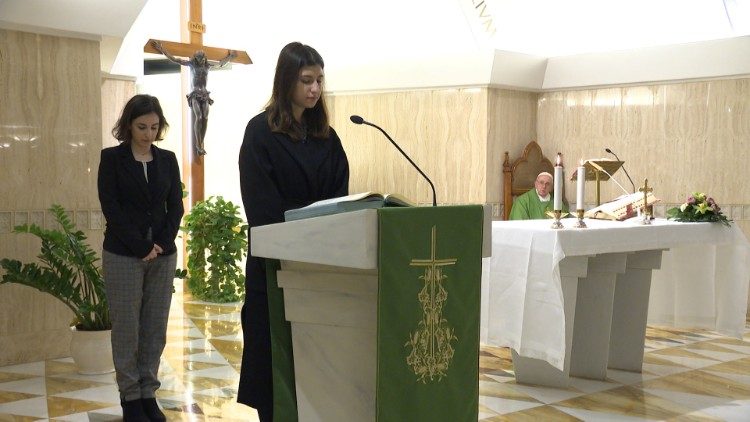
Pope Francis installs 5 women to the ministry of Lector


Installing women as lectors, Pope says Word of God is for all

Elise Ann Allen

|Senior Correspondent


ROME – Pope Francis Sunday celebrated a special Mass marking the Day of the Word of God, during which he conferred the ministry of lector on seven lay people, five of them women, and said the Gospel is intended primarily for the sick and far away.

Francis formally opened the ministry of lector, along with that of acolyte, to women in a 2021 decree. He established the Day of the Word of God on the third Sunday in ordinary time in 2019.

In his homily for the Jan. 22 Mass, the pope noted that Jesus in the scriptures is “always on the move, on his way to others.”

“On no occasion in his public life does he give us the idea that he is a stationary teacher, a professor seated on a chair; on the contrary, we see him as an itinerant and a pilgrim, travelling through towns and villages, encountering faces and their stories,” he said.

In the Gospels, Jesus uses the Word of God to heal and lift people out of darkness, Francis said, insisting that the Word of God is not only destined “for the righteous of Israel, but for all.”

Jesus, he said, wants to reach “those far away, he wants to heal the sick, he wants to save sinners, he wants to gather the lost sheep and lift up those whose hearts are weary and oppressed. Jesus ‘reaches out’ to tell us that God’s mercy is for everyone.”

Since the Word of God is intended for everyone, especially the far away and lost, it must be a priority for the ecclesial community, the pope said, praying that as a church, “may it not happen that we profess a God with an expansive heart, yet become a Church with a closed heart; that we preach salvation for all, yet make the way to receive it impractical.”

Pope Francis said the Word of God is also a call to conversion and noted that Jesus himself tells people in the Gospels to repent because the Kingdom of God is at hand.

“This means that God’s nearness is not inconsequential, his presence does not leave things as they are, it does not advocate a quiet life. On the contrary, his Word shakes us, disturbs us, incites us to change, to conversion,” he said.

Francis told believers that God came into the world to be close to them, and urged them to “recognize his presence, make room for his Word, and you will change your outlook on life.”

Scripture also makes believers who read it heralds of the good news, he said, recalling the Gospel passage in which Jesus called Simon and Andrew to be “fishers of men.”

With this call, they were “No longer just experts in boats, nets and fish, but experts in seeking others,” the pope said, saying, “just as in sailing and fishing they had learned to leave the shore and cast their nets into the deep, in the same way they would become apostles capable of sailing upon the open seas of the world, of going out to meet their brothers and sisters and proclaiming the joy of the Gospel.”

“Today let us also hear the invitation to be fishers of men,” he said, telling faithful that each of them are called by Jesus in person “to proclaim his Word, to bear witness to it in everyday life, to live it in justice and charity, to ‘give it flesh’ by tenderly caring for those who suffer.”

Pope Francis closed by thanking those committed to sharing the Word of God, especially those who serve as lectors and catechists.

After his homily, the pope conferred the ministries of lector and catechist on seven laypeople, telling them they are now “at the service of the faith, which has its roots and foundation in the word of God.”

“It is therefore necessary that, while announcing the word of God to others, you know how to receive it within yourselves with full docility to the Holy Spirit,” he said, telling the new lectors to “meditate on it every day to acquire an ever more lively and penetrating knowledge of it, but above all bear witness with your life to our Savior Jesus Christ.”

Wednesday, August 24, 2022

More ministry reflection centered on instituted ministers and extraordinary ministers


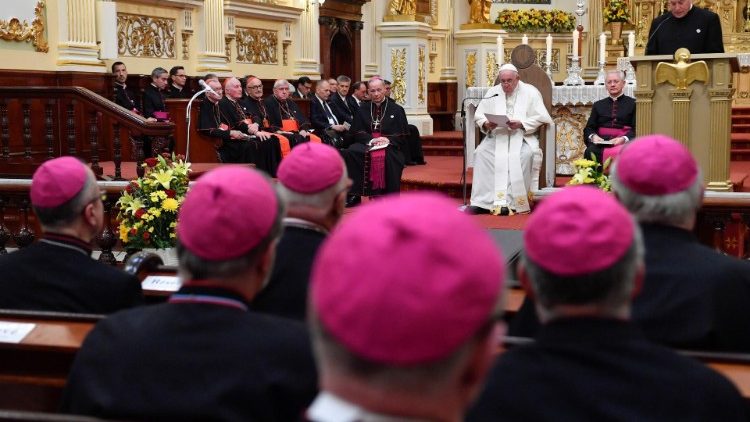
2022.07.28 Viaggio apostolico in Canada - Vespri con i Vescovi, Sacerdoti, Diaconi, Consacrati,  Seminaristi e gli operatori Pastorali presso la Cattedrale di Notre-Dame2022.07.28 Viaggio apostolico in Canada - Vespri con i Vescovi, Sacerdoti, Diaconi, Consacrati, Seminaristi e gli operatori Pastorali presso la Cattedrale di Notre-Dame  (Vatican Media)

Ministries in the Church: Pope calls for a dialogue with Bishops

On the occasion of the 50th anniversary of Pope St. Paul VI's motu proprio "Ministeria quaedam", Pope Francis reflects on the Apostolic Letter’s impact on instituted and extraordinary ministries, and expresses his desire to open a dialogue with Bishops’ Conferences to continue along the path set out fifty years ago.

By Vatican News

Fifty years have passed since Paul VI's motu proprio "Ministeria quaedam" was published.

The Apostolic Letter reformed the “minor orders”, including that of the Lector for ministry of the Word, and that of the Acolyte for the ministry of the Altar. It also established lay ministries.

To mark the occasion, Pope Francis released a message on Wednesday expressing his desire to begin a dialogue with Bishops' Conferences around the world "in order to be able to share the richness of the ministerial experiences that in these fifty years the Church has lived both as instituted ministries (lectors, acolytes and, only recently, catechists) and as extraordinary and de facto ministries."

The purpose, the Pope explains, is to "be able to listen to the voice of the Spirit without stopping the process, being careful not to want to force it by imposing choices that are the fruit of ideological viewpoints."

For this reason, Pope Francis believes that "it is useful to share the experiences of these years, all the more in the spirit of the synodal journey. That experience can offer valuable indications to arrive at a harmonious vision of the question of baptismal ministries and thus continue along our journey."

Pope Paul VI's path and Pope Francis’ Letters

In his message, Pope Francis recalls that Paul VI's Motu Proprio not only renewed the discipline of the minor orders and the subdiaconate, "but offered the Church an important perspective that was able to inspire further progress."

The possibility of the further development of ministries was also discussed during the Synod on the Amazon.

Subsequently, Pope Francis wrote two Apostolic Letters addressing the situation: the first, "Spiritus Domini" published on 10 January 2021, allowed women to participate in the Lectorate and Acolytate ministries.

The second, "Antiquum ministerium" published 10 May, 2021, instituted the ministry of Catechist.

"These two interventions," the Pope explains, "should not be interpreted as replacing the previous doctrine, but as a further development made possible because it is based on the same principles – consistent with the reflection of the Second Vatican Council" that had inspired Paul VI.

Pope Paul VI, following the requests of many Council Fathers, had in fact fifty years ago "granted the Bishops’ Conferences the possibility of asking the Apostolic See for the establishment of those ministries considered necessary or very useful in their regions. Even the ordination prayer for bishops, during the intercessions, indicates among its principal tasks, that of organizing ministries."

Foundations of each ministry

Pope Francis explains that "the issue is of fundamental importance for the life of the Church: in fact, there is no Christian community that does not express ministries."

This is shown in the Letters of St. Paul, where "a widespread ministeriality” is described as “being organized on the basis of two certain foundations”: at the origin of every ministry there is always God who by His Holy Spirit works all things in all," and "the purpose of every ministry is always the common good, the building up of the community."

Every ministry is therefore "a call from God for the good of the community."

Thanks to these two central ideas, the Christian community can organize "the variety of ministries that the Spirit stirs up in relation to its concrete situation."

This organization, the Pope writes, "is not a merely functional fact but is, rather, a careful community discernment in listening to what the Spirit suggests to the Church, in a concrete place and in the present moment of her life."

Thus, "any ministerial structure that arises from this discernment is dynamic, lively, and flexible like the action of the Spirit: it must be rooted in it ever more deeply lest dynamism become confusion, liveliness be reduced to extemporaneous improvisation, flexibility be transformed into arbitrary and ideological adaptations."

‘Realities are more important than ideas’

In his message, Pope Francis continues that "the ecclesiology of communion, the sacramentality of the Church, the complementarity of the common and the ministerial priesthood, and the liturgical visibility of each ministry are the doctrinal principles that, animated by the action of the Spirit, make the variety of ministries harmonious."

The question of baptismal ministries touches on several aspects that "certainly need to be considered: the terminology used to indicate ministries, their doctrinal foundation, the juridical aspects, the distinctions and relationships between individual ministries, their vocational value, the formation paths, the institutive event that empowers the exercise of a ministry, the liturgical dimension of each ministry."

These are complex issues, which, the Pope says, "certainly need to continue to deepen," but without "pretending to define and resolve them in order to then be able to live ministeriality," because acting in this way "most likely we would not be able to go very far."

This is why Pope Francis repeats in his message what was already written in the exhortation "Evangelii gaudium," namely that "realities are greater than ideas" and "a constant dialogue must be established between the two, avoiding that the idea ends up separating itself from reality." The Pope continues by saying that "time is greater than space."

Therefore, "rather than obsessing over immediate results in resolving all tensions and clarifying every aspect – thus running the risk of truncating them – we must go along with the action of the Spirit of the Lord.”

Wednesday, January 19, 2022

Lay ministries to be conferred Sunday in St. Peter's Basilica; catechists, lectors and acolytes


Pope Francis to confer new lay ministries for first time in St. Peter’s Basilica


The Vatican has announced that Pope Francis will confer the ministries of catechist, lector, and acolyte upon lay men and women for the first time in St. Peter’s Basilica on Sunday.

Candidates from three continents will receive the new ministries during the papal Mass for the Sunday of the Word of God on Jan. 23.

Two people from the Amazonian region in Peru will be formally made catechists by the pope, along with other candidates from Brazil, Ghana, Poland, and Spain.

The ministry of lector will be conferred on lay Catholics from South Korea, Pakistan, Ghana, and Italy.

Each of these ministries will be conferred through a rite prepared by the Congregation for Divine Worship and the Discipline of the Sacraments that will be presented for the first time, according to a Vatican communique issued on Jan. 18.

“Before the homily, the candidates will be summoned, called by name and presented to the Church,” it said.

Those called to the ministry of lector will be presented with a Bible, while catechists will be entrusted with a cross.

In this case, it will be a copy of the pastoral cross used by popes St. Paul VI and St. John Paul II.

Pope Francis established the ministry of catechist as an instituted, vocational service within the Catholic Church last May.

The newly instituted ministry is for lay people who have a particular call to serve the Catholic Church as a teacher of the faith. The ministry lasts for the entirety of life, regardless of whether the person is actively carrying out that activity during every part of his or her life.

According to the apostolic letter Antiquum ministerium, a lay person called to be instituted in the ministry of catechist should have “deep faith and human maturity,” be an active participant in the life of the Christian community, and “capable of welcoming others, being generous and living a life of fraternal communion.”

Among the candidates to be inducted into the ministry by Pope Francis this week is the president of the Roman Oratory Center, which was founded by Arnaldo Canepa, who dedicated more than 40 years of his life to the catechetical instruction of children.

The pope changed Church law in January 2021 so that women can be formally instituted to the lay ministries of lector and acolyte.

In the apostolic letter Spiritus Domini, the pope modified the Code of Canon Law, which previously limited the ministries to lay men.

A lector is a person who reads Scripture — other than the Gospel, which is only proclaimed by deacons and priests — to the congregation at Mass.

After abolishing the minor orders, Pope Paul VI wrote that an acolyte was a ministry in the Church with the “duty to take care of the service of the altar, to help the deacon and the priest in liturgical actions, especially in the celebration of the Holy Mass.”

Potential responsibilities for an acolyte include distributing Holy Communion as an extraordinary minister if such ministers are not present, publicly exposing the Eucharist for adoration in extraordinary circumstances, and “the instruction of the other faithful, who, on a temporary basis, help the deacon and the priest in liturgical services by carrying the missal, cross, candles, etc.”

Due to travel restrictions related to the outbreak of the omicron variant of COVID-19, candidates from the Democratic Republic of the Congo and Uganda will not be able to take part in the Mass, as originally planned. Attendance in St. Peter’s Basilica will also be limited to only 2,000 people as a precaution.

The Mass will be broadcast live by EWTN at 9:30 a.m. Rome time (1:30 a.m. MDT).

Tuesday, January 11, 2022

Pope Francis plans to install catechists and lectors at Mass on the Sunday of the Word of God


Pope to install catechists, lectors at Word of God celebration


ROME — At his celebration of Mass for the Sunday of the Word of God Jan. 23, Pope Francis will formally install new catechists and lectors — ministries open to women.

The Pontifical Council for Promoting New Evangelization, which coordinates the annual celebration, said the Mass celebrated by Pope Francis in St. Peter’s Basilica will include “the conferral of the ministries of lector and catechist.”

Pope Francis’s formally instituted the ministry of catechist in May 2021. It followed his decision in January to open the ministries of lector and acolyte to women. While in most dioceses women already served as readers and altar servers at Mass, they were not formally instituted in those services on a stable basis.

Pope Francis often has spoken of the importance of selecting, training and supporting catechists, who are called to lead people to a deeper relationship with Jesus, prepare them to receive the sacraments and educate them in the teachings of the church.

The Sunday of the Word of God, instituted by Pope Francis in 2019, is meant to encourage among all Catholics interest in knowing the sacred Scriptures and their central role in the life of the church and the Christian faith. The theme for the 2022 celebration is “Blessed are those who hear the word of God,” a verse which comes from the Gospel of St. Luke.

The pope is also scheduled to celebrate a prayer service Jan. 25 at Rome’s Basilica of St. Paul Outside the Walls for the conclusion of the Week of Prayer for Christian Unity, according to the Vatican, which released a schedule of papal liturgies for January and February.

According to the schedule, published Jan. 10, he will celebrate the Feb. 2 feast of the Presentation of the Lord — which also marks the Vatican celebration of the World Day for Consecrated Life — with a Mass with consecrated men and women in St. Peter’s Basilica in the evening.

He will also celebrate Mass in the Basilica of Santa Croce in Florence Feb. 27 during his one-day visit there to speak at a meeting of bishops and mayors of the Mediterranean region. That visit also is to include an encounter with refugee families, according to the Italian bishops’ conference.

Wednesday, January 13, 2021

First U.S. Bishop to embrace new women acolytes, etc; he won't be the last


BISHOP WELCOMES CHANGE ON INSTITUTED ACOLYTES AND LECTORS, PLANS TO IMPLEMENT IT ‘AS SOON AS POSSIBLE’


    To my knowledge, this is the first bishop who has announced plans to move forward with the modifications to canon law — allowing both men and women as acolytes and lectors — and the first to speak about establishing a diocesan formation program.

    Details: 

    Women will soon officially act as lectors and acolytes during Roman Catholic Masses, after Pope Francis on Monday changed the church’s law regarding the procedures, according to a statement issued by the Rev. W. Shawn McKnight, bishop of the Catholic Diocese of Jefferson City.

    McKnight said the local diocese will implement the changes as soon as possible. However, it will likely have to wait until after the annual gathering of bishops in November, after bishops have had a chance to set up regulations.

    …”I will begin talking to my people about what this means,” McKnight said. “We will look at what kinds of people (to consider for training). I would have the expectation that someone instituted as a lector would have some proven ministry in catechesis (religious formation).”

    For example, they might begin by looking at people who have taught in Parish Schools of Religion, led Gospel study or shared Catholic principles.

    The diocese posted a full statement on its website Monday:

    Bishop W. Shawn McKnight will be implementing a modification of canon law, announced by Pope Francis today, as soon as possible. The new law allows a formal role for women during Mass, as lectors and acolytes (servers).

    “I am thrilled and grateful for this action by the Holy Father,” Bishop McKnight said. “Women, by virtue of their baptism, just like lay men, have a right and a responsibility to those ministries which the Church has instituted ‘based on the common condition of being baptized and the regal priesthood received in the sacrament of baptism,’” he explained, quoting from the pope’s document, “Spiritus Domini.”

    The modification of Canon 230 §1 does not change the fact that the church reserves the sacrament of holy orders to men. Instead, it recognizes that, since the Second Vatican Council, the Church has made “a clearer distinction between the attributes of what today are called ‘nonordained (or lay) ministries’ and ‘ordained ministries,’” such as deacon, priest and bishop, the pope said.

    Lay women have served as lectors and acolytes at Masses over the years under another canon, which allows them to do so “by temporary designation.” In many dioceses, including Jefferson City, lay men also served as lectors and acolytes “by temporary designation,” as Church teaching developed.

    Canon 230 §1 previously stated, “Lay men who possess the age and qualifications established by decree of the conference of bishops can be admitted on a stable basis through the prescribed liturgical rite to the ministries of lector and acolyte.”

    The updated canon states that “Laity who possess the age and qualifications established by decree of the conference of bishops can be admitted on a stable basis through the prescribed liturgical rite to the ministries of lector and acolyte.”

    “This update ensures that all laity – women and men — are able to use the gifts God has given to them for the good of the Church, exercising appropriate co-responsibility in building up the Church,” Bishop McKnight explained. “We will be able to provide catechesis, training and formation for lay women and men who are called to these ministries, so they can be good stewards of God’s gifts.”

    A diocesan formation program will be established after the US Conference of Catholic Bishops issues its formal decree, as stated in the canon.

    The Diocese of Jefferson City includes 38 counties in central and northeastern Missouri. Approximately 82,000 Catholics live in the diocese, worshipping and serving in 95 parishes.

    Monday, January 11, 2021

    Where the laity are already serving as Instituted acolytes and lectors


    YES, LAY PEOPLE ARE ALREADY BEING INSTALLED AS INSTITUTED LECTORS AND ACOLYTES


      A few people, including some clergy, have expressed dismay or even shock that men (and soon, women) who are not candidates for Holy Orders can become instituted Lectors and Acolytes. (You can read more about what’s prompting this discussion here.)

      But there are many dioceses around the United States that are already doing this.

      Take, for example, this item from Spokane, Washington: 

      On December 12, the feast of Our Lady of Guadalupe, Bishop Thomas Daly installed six laymen as acolytes at the Cathedral of Our Lady of Lourdes….In some cases, laymen not in preparation for holy orders may be installed as acolytes. The six new acolytes are: Dave Gibb, Gene DiRe, Justin Bullock, Dennis Johnson, Thomas Lavagetto and Rick Sparrow. Father Darrin Connall, cathedral rector and vicar general of the diocese, said of the new acolytes: “The men were chosen for their dedication to the cathedral family, and their service at the altar reflects their commitment to service in the wider community.”

      Acolytes differ from altar servers in that acolytes may perform more liturgical functions, such as purifying the eucharistic vessels, and serve as the senior altar server at a Mass. Acolytes must be at least 21 years of age, possess the necessary skills to carry out the ministry and be a member of the Church in good standing.

      The ministry has grown in popularity in Arlington, Texas, where one parish on its website describes what acolytes do:

      He is an Extraordinary Minister of Communion
      He may also perform all the duties of an altar server
      Besides the priest and the deacon, the acolyte is the only person allowed to purify the sacred vessels after communion
      With the pastor’s permission, he may expose the Blessed Sacarament for adoration, but he may not give the blessing with the monstrance
      He may carry the cross during the procession to the altar

      A parish in Lewisville, Texas also posted this item five years ago, seeking candidates:

      Bishop Olson has announced another opportunity for men in our diocese to be instituted as Acolytes. At St. Philip’s they assist with the Purification of the Sacred Vessels used during Mass, distributing Holy Communion and in other assigned ways such as exposing or reposing the Blessed Sacrament before or after Adoration when no Priest or Deacon is available. Because the ministry has its roots in the formation of ordained clergy, the ministry is reserved to men.

      Bishop Olson has expressed his desire that men chosen for this ministry should be experienced sacristans and liturgical ministers. Men must be at least 21 years of age, fully initiated and living an exemplary Christian way of life, with no impediments to sacramental reception, (e.g., if married, one must be in valid union recognized by the Church).

      A mandatory training session will be held in Fort Worth on Saturday, February 20 at St. George Catholic Church, and Acolytes will be formally instituted by the Bishop on either March 30 or April 16.

      Spend some time on Google and you can find more examples. It’s more widespread in some parts of the world than you may think.

      And soon, with women formally joining the ministry, it may become even more common.

      Is this big news from the Vatican or "nothing to see here? The latest Motu Proprio


      A lay woman reads at Mass in the Casa Santa Marta on 4 February 2020A lay woman reads at Mass in the Casa Santa Marta on 4 February 2020 

      Pope Francis: Ministries of lector and acolyte to be open to women

      Pope Francis changes the Code of Canon Law to institutionalize what is already allowed in practice: the access of lay women to the service of the Word and the Altar. The Pope explains his decision in a letter to Cardinal Ladaria.

      By Vatican News

      With a Motu proprio released on Monday, Pope Francis established that from now on the ministries of Lector and Acolyte are to be open to women, in a stable and institutionalized form through a specific mandate.

      There is nothing new about women proclaiming the Word of God during liturgical celebrations or carrying out a service at the altar as altar servers or as Eucharistic ministers. In many communities throughout the world these practices are already authorized by local bishops.

      However, up to this point, this has occurred without a true and proper institutional mandate, as an exception to what Pope St Paul VI had established when, in 1972, even while abolishing the so-called “minor orders”, he decided to maintain that access to these ministries be granted only to men because both were considered to be preparatory to the eventual admission to holy orders.

      Now, in the wake of the discernment which has emerged from the last Synods of Bishops, Pope Francis wanted to formalize and institutionalize the presence of women at the altar.

      Shared baptism

      With the Motu proprio Spiritus Domini, which modifies the first paragraph of Canon 230 of the Code of Canon Law, Pope Francis, therefore, establishes that women can have access to these ministries and that this be recognized through a liturgical act formally instituting them as such.

      Pope Francis specifies that he wanted to welcome recommendations which have emerged from various synodal assemblies, writing that “a doctrinal development has been arrived at in these last years that has brought to light how certain ministries instituted by the Church have as their basis the common condition of being baptized and the royal priesthood received in the Sacrament of Baptism.”

      The Pope, therefore, invites us to recognize that what is under discussion are lay ministries “fundamentally distinct from the ordained ministry that is received through the Sacrament of Holy Orders.”

      The new formulation of the canon reads: “Lay persons who possess the age and qualifications established by decree of the conference of bishops can be admitted on a stable basis through the prescribed liturgical rite to the ministries of lector and acolyte.” The specification “lay men” qualifying the laity and present in the Code until today’s modification, is, therefore, abolished.

      Part of Vatican II renewal

      The Motu proprio is accompanied by a letter addressed to the Prefect of the Congregation of the Doctrine of the Faith, Cardinal Luis Ladaria, in which Pope Francis explains the theological motivations behind his decision.

      The Pope writes that “within the spectrum of renewal traced out by the Second Vatican Council, the urgency is being ever more felt today to rediscover the co-responsibility of all of the baptized in the Church, and the mission of the laity in a particular way.”

      And, citing the Final Document of the Synod for the Pan-Amazon Region, the Pope observes that “regarding the entire Church, in the variety of situations, it is urgent that ministries for men and women be promoted and conferred… It is the Church made up of baptized men and women that we must consolidate, promoting forms of ministry and, above all, an awareness of baptismal dignity.”

      Lay people and evangelization

      In his letter to the Cardinal, after recalling the words of Saint John Paul II that “regarding ordained ministries, the Church does not have the faculty in any way to confer priestly ordination on women,” Pope Francis adds that “regarding non-ordained ministries, it is possible, and today it seems appropriate, to surmount this reservation.”

      The Pope explains that “to offer to lay persons of both sexes the possibility of accessing the ministries of Acolyte and Lector, in virtue of their participation in the priesthood of the baptized, the awareness will grow, through a liturgical act (of institution) as well, of the precious contribution that many lay persons, including women, have been offering for some time to the life and mission of the Church.” He concludes that “the decision to confer these offices even on women, which entails stability, public recognition and a mandate on the part of the bishop, will make more effective everyone’s participation in the work of evangelization.”

      Mutual collaboration

      This provision comes after extensive theological reflection on these ministries.

      Post-conciliar theology has, in fact, recovered the relevance of the ministries of Lector and Acolyte, not only in relation to the ordained priesthood, but also, and above all, in relation to the priesthood of the baptized.

      These ministries are situated within the dynamic of the mutual collaboration that exists between these two priesthoods, and their specifically “lay” nature has become ever more pronounced, in connection with the priesthood exercised by all the baptized in virtue of their baptism.