Showing posts with label justice. Show all posts

Thursday, April 23, 2026

Pope Leo gives detailed press conference on way back to Rome.


Pope: As a pastor, I cannot be in favor of war; too many innocents have died

On the return flight to Rome, Pope Leo XIV speaks to journalists about his mission to proclaim the Gospel to all peoples, recalls child victims of the wars in Iran and Lebanon, condemns the death penalty, and insists on respect for international law.

Vatican News

“Good day, everyone. I hope you are well, that you are ready for another journey. With fully recharged batteries already!”

Pope Leo XIV has concluded his long Apostolic Journey in Africa. Aboard the flight from Malabo—the final stop in Equatorial Guinea—back to Rome, he answered questions from five of the roughly 70 journalists who followed the international visit.

He addressed the issues of war, the US-Iran negotiations, migration, the death penalty, and the blessing of homosexual couples.

The Pope began with a reflection on the experience he had just concluded in four African nations.

Below is a working English transcription and translation of the press conference:

[Pope Leo XIV, in Italian:] When I travel, I speak for myself, but today as Pope, Bishop of Rome, it is above all a pastoral Apostolic Journey to meet, accompany, and get to know the People of God.

Very often the interest expressed is more political: ‘What does the Pope say about this or that issue? Why doesn’t he judge the government in one country or another?’ And there are certainly many things to say. I have spoken about justice, and those issues are there.

But that is not the first word: the journey should be understood above all as an expression of the desire to proclaim the Gospel, to announce the message of Jesus Christ, which is a way of drawing close to the people in their happiness, in the depth of their faith, but also in their suffering.

There, it is clear that very often it is necessary to make comments or to look for ways to encourage people themselves to take responsibility for their lives. It is also important to speak with Heads of State, to encourage a change of mindset or greater openness to thinking about the common good, and to consider issues such as the distribution of a country’s resources. In the talks we had, we did a bit of everything, but above all we saw and met the people with this enthusiasm.

I am very happy with the whole journey, but living, accompanying, and walking with the people of Equatorial Guinea was truly a blessing, with the rain… They were happy with the rain the other day, but above all it was a sign of sharing with the universal Church what we celebrate in our faith.

Ignazio Ingrao (Tg1): Your Holiness, thank you for this journey rich in encounters, stories, and faces. At the peace meeting in Bamenda, Cameroon, you described an upside-down world where a handful of tyrants risk destroying the planet. Peace, you said, must not be invented but welcomed. Negotiations over the Iran conflict are in chaos, with heavy effects on the global economy. Do you hope for regime change in Iran, given that civil society and students also took to the streets in recent months, and there is global concern about the nuclear race? What appeal do you make to the United States, Iran, and Israel to break the deadlock and stop the escalation? And should NATO and Europe be more involved?

[Pope Leo XIV, in Italian:] I would like to begin by saying that we must promote a new attitude and a culture of peace. Very often, when we assess certain situations, the immediate response is that we must go in with violence, with war, with attacks.

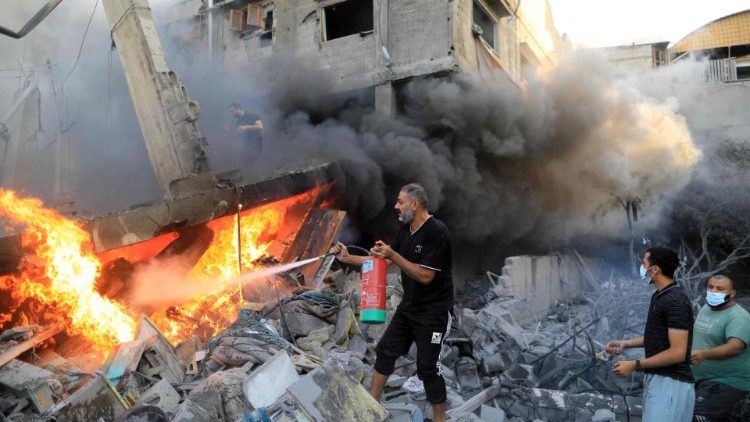
What we have seen is that many innocent people have died. I have just seen a letter from families of children who were killed on the first day of the attack. They speak about how they have lost their children, who died in that event. The issue is not whether there is regime change or not; the issue is how to promote the values we believe in without the death of so many innocent people.

The situation in Iran is clearly very complex. Even the negotiations themselves—one day Iran says yes and the United States says no, and vice versa—and we do not know where things are heading. This chaotic, critical situation for the global economy has been created, but there is also an entire population in Iran of innocent people suffering because of this war. So, on regime change, yes or no: it is not even clear what regime currently exists after the first days of attacks by Israel and the United States on Iran.

Rather, I would encourage the continuation of dialogue for peace, that all sides make every effort to promote peace, remove the threat of war, and respect international law. It is very important that innocent people are protected, as has not happened in several places.

I carry with me a photo of a Muslim child who, during the visit to Lebanon, was waiting there with a sign saying “Welcome Pope Leo.” He has been killed in this final phase of the war. There are many human situations, and I think we must be able to think in these terms.

As a Church—I repeat—as a pastor, I cannot be in favor of war. And I would like to encourage everyone to make efforts to seek answers that come from a culture of peace, not hatred and division.

Eva Fernández (Radio Cope): We are leaving a continent where many people desire and dream of traveling to Europe. Your next trip will be to Spain, where the migration issue is very important, especially in the Canary Islands. You know that migration in Spain generates great debate and polarization; even among Catholics there is no clear position. What can we say to Spaniards, and in particular to Catholics, about immigration? And, if you’ll allow me: the next trip will be to Spain, but we know you also wish to travel to Peru, and perhaps to Argentina and Uruguay, and perhaps also to greet Our Lady of Guadalupe?

[Pope Leo XIV, in Spanish:] The issue of migration is very complex and affects many countries, not only Spain, not only Europe, not only the United States; it is a global phenomenon.

So, my answer begins with a question: what is the Global North doing to help the Global South, or those countries where young people today cannot find a future and therefore dream of moving north? Everyone wants to go north, but often the North has no answers on how to offer them opportunities. Many suffer… The issue of human trafficking is also part of migration.

Personally, I believe that a State has the right to regulate its borders. I am not saying that everyone must be allowed to enter without order, sometimes creating in destination countries situations more unjust than those they left behind. But that said, I ask myself: what are we doing in richer countries to change the situation in poorer countries? Why can we not try, both through state aid and through the investments of large wealthy companies and multinationals, to change the situation in countries like those we visited on this visit?

Africa is often seen by many as a place to extract minerals, to take its wealth for the benefit of other countries. Perhaps globally we should work more to promote greater justice, equality, and development in these African countries so that people do not need to emigrate to other countries, including Spain, and so on.

And another point I would like to make is that, in any case, they are human beings, and we must treat human beings humanely, not treat them worse than animals, as often happens. It is a very big challenge: a country can say it cannot receive more than a certain number of people, but when people arrive, they are human beings and deserve the respect that belongs to every human being because of their dignity.

Q: And the next journeys?

I have a strong desire to visit several countries in Latin America. So far, nothing is confirmed; we will wait and see.

Arthur Herlin (Paris Match): Holy Father, thank you very much in the name of all my French colleagues for that amazing trip. It was wonderful. Holy Father, during this trip, you met leaders among the most authoritarian in the world, right? How can you prevent your presence from lending moral authority to these regimes? Isn't it a kind of let's say, ‘pope-washing’?

[Pope Leo XIV, in English:] Thank you for the question. Certainly, the presence of a Pope with any Head of State can be interpreted in different ways. It can be interpreted and has been interpreted by some as, “Ah, the Pope or the Church is saying it’s okay that they live like that.” And others may say things differently.

I would go back to something I said in my initial remarks about the importance of understanding the primary purpose of the travel that I do, that the Pope does, to visit the people, and of the great value that the system, that the Holy See continues with, at times, great sacrifice, to maintain diplomatic relations with countries throughout the world. And sometimes we have diplomatic relationships with countries that have authoritarian leaders.

We have the opportunity to speak with them on a diplomatic level, on a formal level. We don't always make great proclamations—criticizing, judging, or condemning. But there’s an awful lot of work that goes on behind the scenes to promote justice, to promote humanitarian causes, to look for, at times, situations where there may be political prisoners, and finding a way for them to be freed. Situations of hunger, of sickness, etc.

So the Holy See, by maintaining, if you will, a neutrality and looking for ways to continue our positive diplomatic relationship with so many different countries, we’re actually trying to find a way to apply the Gospel to concrete situations so that the lives of people can be improved.

People will interpret the rest of it as they will, but I think it’s important for us to look for the best way that we can to try and help the people of any given country.

Verena Stefanie Shälter (Ard Rundfunk): Holy Father, congratulations on your first papal trip to the Global South. We saw a lot of enthusiasm and even euphoria; I can imagine that was very moving for you as well. I would like to know how you assess the decision of Cardinal Reinhardt Marx, Archbishop of Munich and Freising, that he gave permission to the blessing of same-sex couples in his diocese, and in light of different cultural and theological perspectives, especially in Africa, how do you intend to preserve the unity of the global Church on that particular matter?

[Pope Leo XIV, in English:] First of all, I think it’s very important to understand that the unity or division of the Church should not revolve around sexual matters. We tend to think that when the Church is talking about morality, that the only issue of morality is sexual. And in reality, I believe there are much greater, more important issues, such as justice, equality, freedom of men and women, freedom of religion, that would all take priority before that particular issue. The Holy See has already spoken to the German bishops.

The Holy See has made it clear that we do not agree with the formalized blessing of couples, in this case, homosexual couples, as you asked, or couples in irregular situations, beyond what was specifically, if you will, allowed for by Pope Francis in saying all people receive blessings.

When a priest gives a blessing at the end of Mass, when the Pope gives a blessing at the end of a large celebration like the one we had today, they are blessings for all people. Francis’ well-known expression ‘Tutti, tutti, tutti’ is an expression of the Church’s belief that all are welcome; all are invited; all are invited to follow Jesus, and all are invited to look for conversion in their lives.

To go beyond that today, I think that the topic can cause more disunity than unity, and that we should look for ways to build our unity upon Jesus Christ and what Jesus Christ teaches. So that’s how I would respond to that question.

Anneliese Taggart (Newsmax TV): Holy Father, thank you very much. You have spoken on this trip about how people hunger and thirst for justice. It was just reported this morning that Iran has executed yet another one of the members of the opposition, and this comes as it has been said that the regime has also publicly hanged multiple other people, as well as murdered thousands of its own people. Do you condemn these actions, and do you have any message to the Iranian regime?

[Pope Leo XIV, in English:]I condemn all actions that are unjust. I condemn the taking of people’s lives. I condemn capital punishment. I believe that human life is to be respected and that all people—from conception to natural [death, ed.]—their lives should be respected and protected.

So when a regime, when a country takes decisions which takes away the lives of other people unjustly, then obviously that is something that should be condemned.

Monday, January 26, 2026

By meeting with the Roman Rota, Pope Leo XIV stresses the important work of the tribunals of the Church


Pope Leo XIV receives officials of the Tribunal of Roman Rota for the inauguration of their judicial yearPope Leo XIV receives officials of the Tribunal of Roman Rota for the inauguration of their judicial year  (@Vatican Media)

Pope to Roman Rota: Justice and charity find harmony in mystery of God

Pope Leo XIV meets officials of the Tribunal of Roman Rota for the inauguration of their judicial year and urges them to safeguard the truth with rigor but without rigidity and to exercise charity without omission.

By Deborah Castellano Lubov

"You are called to safeguard the truth with rigor but without rigidity, and to exercise charity without omission."

Pope Leo XIV made this invitation to the prelate auditors of the Tribunal of Roman Rota in the Vatican on Monday, as he inaugurated its Judicial Year.

The Tribunal of the Roman Rota ordinarily acts as an appellate court of higher instance at the Apostolic See, with the purpose of safeguarding rights within the Church. It fosters unity of jurisprudence and, by virtue of its decisions, provides assistance to lower tribunals.

The Tribunal also includes the Office competent to adjudicate the fact of the non-consummation of marriage and the existence of a just cause for granting dispensations. This Office is also competent to deal with cases of the nullity of sacred ordination, pursuant to the norm of universal and proper law, in accordance with the different cases. It has a collegiate structure and is composed of a certain number of judges of proven doctrine, competence, and experience selected by the Pope from various parts of the world.

Precious service

The Pope began by thanking them for their work, "which is a precious service to the universal judicial function that belongs to the Pope and in which the Lord has called you to share," noting that the expression “Veritatem facientes in caritate” (The truth in love) (Eph 4:15), "can be applied to your daily mission in the administration of justice."

He thanked those present in the audience and everyone working in Church tribunals throughout the world, noting, "The ministry of judge that I have had occasion to exercise enables me to understand your experience more deeply and to appreciate the ecclesial significance of your task."

Pope Leo then returned to a fundamental theme that has been central in the addresses delivered to the Tribunal of the Roman Rota from Pope Pius XII up to Pope Francis, concerning the relationship of their activity "with the truth that is intrinsic to justice."

"On this occasion," the Pope said, "I intend to offer you some reflections on the close bond that exists between the truth of justice and the virtue of charity," clarifying they "are not two opposing principles, nor values to be balanced according to purely pragmatic criteria, but two dimensions intrinsically united, which find their deepest harmony in the very mystery of God, who is Love and Truth."

This correlation, he stated, calls for constant and careful critical discernment, "since, in the exercise of judicial activity, a dialectical tension not infrequently emerges between the demands of objective truth and the concerns of charity."

A delicate balance

"At times," Pope Leo said, "there is the risk that excessive identification with the often-troubled circumstances of the faithful may lead to a dangerous relativization of the truth."

"Indeed, a misguided compassion, even when apparently motivated by pastoral zeal," Pope Leo said, "risks obscuring the necessary dimension of ascertaining the truth that is proper to the judicial office."

"This," he continued, "can occur not only in cases of matrimonial nullity—where it might lead to decisions of a pastoral character lacking a solid objective foundation—but also in any type of proceeding, thereby undermining its rigor and equity."

On the other hand, he cautioned, "there can sometimes be a cold and detached affirmation of the truth that fails to take into account all that love for persons requires, omitting those concerns dictated by respect and mercy, which must be present at every stage of a process."

In considering the relationship between truth and charity, Pope Leo insisted that St. Paul offered "clear guidance" when exhorting in his Letter to the Ephesians that, “Living the truth in love, we should grow in every way into Him who is the head, Christ.” 

"Veritatem facientes in caritate," Pope Leo reiterated, "does not mean merely conforming to a speculative truth, but “doing the truth,” that is, a truth that must illuminate the whole of one’s actions. And this must be done “in charity,” which is the great driving force that leads to the practice of true justice." 

Not a tension between opposing interests, but an instrument for discernment

The process, Pope Leo said, "is not in itself a tension between opposing interests, as is sometimes mistakenly thought, but the indispensable instrument for discerning truth and justice in a given case."

The Pope went on to discuss the adversarial nature of judicial proceedings, and delineated the rigorous elements needed to properly assess these delicate situations and to ascertain appropriately the truth.

"Failure to observe these basic principles of justice—and the fostering of unjustified disparities in the treatment of similar situations—constitutes a serious injury to the juridical dimension of ecclesial communion."

The Pope also addressed the shorter process for the declaration of matrimonial nullity before the diocesan Bishop.

Here, he said, "the apparently manifest nature of the ground of nullity that makes this procedure possible must be assessed with great care, without forgetting that it will be the duly conducted process itself that must confirm the existence of nullity or determine the need to have recourse to the ordinary process."

With all this in mind, the Holy Father underscored, "it therefore proves fundamental that the study and application of canonical matrimonial law continue with scientific seriousness and fidelity to the Magisterium."

Praying that the true wisdom of Christian law must be made manifest, Pope Leo XIV entrusted their work to the intercession of the Blessed Virgin Mary, Speculum iustitiae, "the perfect model of truth in charity."

Saturday, September 20, 2025

Pope Leo XIV at today's Jubilee for Justice


Pope Leo greets pilgrims at the audience for the Jubilee of JusticePope Leo greets pilgrims at the audience for the Jubilee of Justice  (@Vatican Media)

Pope: Justice must be animated by wisdom, love, and mercy

Pope Leo XIV reflects on justice and its function in society at the Jubilee of Justice, inviting participants “to always express to the fullest the exercise of justice in the service of the people, with eyes fixed on God".

By Christopher Wells

Pope Leo XIV today delivered a profound reflection on the concept of justice and its function, in an address to Church and civil legal professionals taking part in the Jubilee for Justice.

Speaking to a large crowd of pilgrims in St Peter’s Square, Pope Leo insisted that justice is °indispensable, both for the orderly development of society and as a cardinal virtue that inspires and guides the conscience of every man and woman.”

Recalling the biblical exhortation to “love justice and avoid evil,” and the traditional definition of justice as “rendering to each one his due,” Pope Leo went on to say that even this form of justice "does not exhaust the profound longing” that is present in every person.

Human dignity and the common good

Justice, Pope Leo explained, unites “the dignity of the person, his or her relationship with others, and the communal dimension of coexistence, with its structures and shared rules".

Pope Leo recalled, too, that justice is “above all, a virtue; that is, a firm and stable disposition that orders our conduct according to reason and faith,” consisting in “the constant and firm will to render to God and our neighbour what is their due.”

Called to 'a higher justice'

Yet, while justice disposes us “to respect the rights of each person” and promote the harmony that preserves the common good, Pope Leo said, the Gospel speaks of “a higher justice … that makes mercy the key of interpretation in relationships", moving one to forgiveness.

“It is the power of forgiveness,” he said, which is “intrinsic to the commandment of love, that emerges as a constitutive element of a justice capable of uniting the supernatural with the human.”

Evangelical justice, the Pope continued, “does not turn away from human justice but questions and reshapes it, challenging it to always go further, because it impels it toward reconciliation.”

The task of not only punishing evil but repairing it, Pope Leo said, is “a demanding task, but not impossible for those … who commit themselves to an irreproachable way of life.”

Then, acknowledging that “growing discriminations” tend toward “the denial of access to justice,” he explained that “true equality is not merely formal equality before the law,” but instead “the possibility granted to all to fulfil their aspirations and see the rights inherent to their dignity guaranteed by a system of shared values".

The demands of justice in the international order

Significantly, Pope Leo noted that the Jubilee “also invites us to reflect on an aspect of justice not always sufficiently emphasized: namely, the reality of so many countries and peoples who ‘hunger and thirst for justice’ because the condition of their lives are so inequitable and inhuman as to be unacceptable.”

He applied to the present state of the world the words of Saint Augustine, “without justice, the State cannot be governed; it is impossible for there to be law in a State where there is no true justice.”

And he emphasized that justice is the virtue that gives to each his due – not only man, but God. Still quoting Augustine, Pope Leo said, “Therefore, that which takes human beings away from God is not true human justice.”

And he concluded, “May the demanding words of Saint Augustine inspire each of us to always express to the fullest the exercise of justice in the service of the people, with eyes fixed on God, so as fully to express justice, right, and the dignity of persons.”

Sunday, August 24, 2025

Don't kill in my name! Victims loved ones fight the death penalty


Sign the appeal: Save Curtis WindomSign the appeal: Save Curtis Windom 

“Don’t kill in my name”: Victim’s appeal to save her father on death row

With less than one week until the scheduled execution of death row inmate Curtis Windom, Deacon George Kain highlights injustices in the US justice system that led to his sentencing, as well as the inhumane practice of capital punishment.

By Francesca Merlo

The death penalty is justified as serving justice for the victims. Its advocates say it brings victims' closure. But so often, the very people capital punishment is supposed to serve say the opposite. Victims’ families come out of execution chambers not feeling healed but empty. “I was told it would make me feel better. Why, instead, do I feel so much worse?” they ask.

What seems to be happening, according to Deacon George Kain, is that the states carrying out executions are using victims as scapegoats to justify a bloody, legalised murder – one that, just as every other murder, does no good to anyone.

On the 28th of August 2025, in just a few days, Florida is scheduled to execute Curtis Windom, a Black man who has spent 33 years on death row. He grew up in poverty, lives with intellectual disabilities, and has long shown signs of brain damage. His legal defence was riddled with failures. The Florida Supreme Court itself acknowledged that his lawyer chose not to present evidence of his mental illness or brain damage, for fear it might complicate the case. As a result, jurors never heard crucial mitigating evidence. And the jury that sentenced him to death did so by an 8 - 4 majority, a verdict that would not stand in most other states, or in the eyes of the US Supreme Court, which has said capital sentences should be unanimous.

The victims speak

What makes Windom’s case especially striking is that the victims for whom the state claims to act are asking for clemency. Windom’s daughter – whose mother was killed in the crime – was an infant at the time. Now an adult, she has built a relationship with her father and wants him spared.

“If we say that we’re doing this for the victims,” Kain reflects, “and the victims are now saying they don’t want this done, then what are we really doing? Are we really saying it’s for the victims, or are we just carrying out our bloodthirsty desire for vengeance and revenge?”

Far from offering peace, executions often re-traumatise families. Kain recalls his years as a probation officer and a researcher: From the very first day, victims are promised closure – that they’ll feel better once the killer is executed. But I’ve met family members who watched executions, and they walked out saying: I don’t feel better. I feel worse. Don’t kill for me, because all this does is prolong my agony.

In Windom’s case, this re-traumatisation is happening in real time. His daughter, now grown, pleads for his life, but the state insists on executing him in her name. “The system claims to act for victims,” Kain says, “but in reality, it ignores them when they ask for mercy.”


Curtis Windom with his daughter, Curtisia

A contradiction

Florida has carried out more executions this year than any other state. Its governor, Ron DeSantis, identifies as a pro-life Catholic.

“There was a time in history when the Church tolerated capital punishment,” explains Deacon Kain, “not as revenge, but as protection of society from a dangerous aggressor. But that time has passed. Today we can secure people in prison for life. We no longer need executions. Our last three popes have said so clearly. Pope Francis even changed the Catechism to declare the death penalty inadmissible.”

For Kain, the Catholic position is rooted in one principle: dignity. “We are all more than the worst thing we’ve ever done. Every person has a God-given dignity that cannot be taken away.” To him, the persistence of the death penalty alongside a pro-life ethic represents a contradiction that is impossible to reconcile.

A broken system

Windom’s story is one among many marked by failures: inadequate defence, racial bias, and non-unanimous verdicts. Florida’s new law lowering the threshold for a death sentence from unanimous jury verdicts to an 8–4 majority is, Kain argues, “a red flag for justice itself.”

His appeals raised other troubling facts: that a key prosecution witness had a pending felony charge the jury never knew about; that Florida did not require capital defence lawyers at the time to meet the standards now in place; that the families of victims themselves asked for mercy at a 2013 clemency hearing. Each of these was dismissed by the courts as “untimely” or “procedurally barred.” In the end, judges declared they were “confident in the outcome” and refused to entertain even a petition for rehearing.

The injustice is compounded by haste. Windom’s lawyers were given just five days after the Governor signed his death warrant to file motions, despite restrictions on prison visits and difficulties securing expert testimony. The courts insisted this was not a violation of due process. For Kain, this expendience is deliberate – designed to prevent society from pausing long enough to see the flaws.

It also places the United States in sharp contrast with other Western democracies, almost all of which have abolished the death penalty. “It undermines America’s credibility when it speaks about human rights abroad,” he says.

A personal journey

Kain himself once stood firmly in favour of capital punishment. “I was a Catholic who believed in the death penalty,” he recalls. “I thought I was protecting victims. But what really shook me was when I listened to victims’ families. The overwhelming majority told me the death penalty only made their pain worse. That’s when I realised I was not helping them – I was compounding their suffering.”

That testimony, along with his faith, transformed him.

A life of witness

Since his conversion, Kain has made the abolition of the death penalty part of his vocation. Before his ordination, he testified in state legislatures; worked with the Community of Sant’Egidio in Rome, and spoke at conferences in Italy, Japan, the Philippines, and Norway. Each year, he travels to Rome for the Community’s November 30th “Cities for Life” gathering against the death penalty.

Now a deacon in the Diocese of Bridgeport, he continues that mission in his ministry. He preaches about cases like Windom’s, linking them to the Gospel call to mercy and reconciliation. “I am not surprised,” he says, “that I find myself in Florida at this moment, called again to stand against an execution. It’s not an accident. It’s a blessing – and a responsibility.”


George Kain (centre) along with Brother Dale Recinella (L) death row chaplain in Florida and Carlo Santoro (R) from the Community of Sant'Egidio


Justice, mercy, and life

For Kain, the lesson of Curtis Windom’s case is not just about one man, but about the very meaning of justice.

“It wasn’t justice that the offender killed,” he says, “and it’s not justice that the offender is killed. In God’s great economy, we all have an obligation to one another – to pray for victims, yes, but also to pray for those who kill. Justice is not vengeance. Justice is rooted in mercy.”

Windom’s daughter is pleading for her father’s life. She wants to continue a relationship with him. Yet the state of Florida is determined to extinguish that life – not in the name of justice, but despite it. “If we truly listen to victims, if we truly respect human dignity,” Kain concludes, “we will see that executions do not serve life. They diminish it.”

Wednesday, May 15, 2024

Pope Francis pens preface for book: Justice and Peace will embrace


UN MESE DI GUERRA, DALL'ATTACCO DI HAMAS ALL'ONDA ANTISEMITA

Pope: 'Peace is made with our hands not just by the powerful'

Pope Francis pens the preface of the book "Justice and peace will embrace", a collection of reflections published ahead of his pastoral visit to the Italian city of Verona, in which he reaffirms that we are all called to be artisans of peace in our daily life.

By Salvatore Cernuzio and Lisa Zengarini

“Peace is made with our hands”. It is not only built by the powerful "with their choices and their international treaties,” we too can build peace, "in our homes, in the family, among neighbours, in our workplaces, in the neighbourhoods where we live".

Pope Francis offered that reminder in the preface to a new book collecting texts and reflections on the relationship between justice and peace.

Titled “La pace e la giustizia si baceranno” ("Justice and peace will embrace "), the book, was released on Wednesday by the Vatican Publishing House LEV and L'Arena, ahead of his pastoral visit to the  northern Italian city of Verona , on May 18 , which will have justice and peace as its focus.

The close link between justice and peace

“If justice is lacking, peace is threatened; without peace, justice is compromised”, the Pope writes. “It is more true than ever that justice, understood as the virtue of giving what is owed to God and others, is closely linked to peace, in the most authentic and proper sense of the Hebrew word ‘shalom’”. A term that indicates "not so much the absence of war but the fullness of life and prosperity".

Selfishness engenders conflict

Peace makes justice possible, first among the "victims" of every conflict, just as "peace becomes a precondition for a just society". However, the Pope notes that both of these two dimensions of humanity have "a price" to pay:  "fighting one's own selfishness", that is, "putting what is ‘mine’ before what is ‘ours’".

All selfishness "is unjust"  and "when it becomes a system in our personal and social life, it opens the doors to conflict, because, Pope Franci explains, in order to defend our interests (or those we presume to be such),  “we are ready to do anything, even to oppress our neighbour, who from being a neighbour becomes an adversary and therefore an enemy to be humiliated, knocked down and defeated."

The teachings of Fr. Romano Guardini

In this regard, the Pope cites the unequivocal words of "a great Veronese citizen" who grew up in Germany, Fr. Romano Guardini: "Freedom does not consist in following personal or political will, but what is required by the nature of being".

Fr. Guardini's educational action and philosophical-spiritual reflections were "a beacon in a particularly dark time," that of Germany in the 1930s and 1940s, "subjugated by the terrible yoke of the Nazi regime".

The Pope recalls how some members of the White Rose, the group of young Germans who denounced Nazism in Munich, "were nourished by Guardini's philosophical and religious writings."  “From those readings,”  he notes, ”arose the nonviolent action of those boys and girls who, by writing clandestine leaflets distributed in the city, tried to awaken people's consciences, numbed by Hitler's totalitarianism. And they paid their choice of conscience and freedom with their lives."

The story of Fr. Mercante and the private Dallasega

That dark chapter of the history of Europe brings to the Pope's mind the memory of the sacrifice of the Veronese priest Fr.  Domenico Mercante and of private Leonardo Dallasega, a Wehrmacht soldier native to  Val di Non, in the Trentino region. Their story dating back to April 1945, is worth telling because it joined together justice and peace “in a double personal sacrifice."

In that turbulent time at the end of the Second World War, private Dalla Sega was forcibly incorporated into a group of German paratroopers fleeing towards the north as they entered Val d'Illasi, in the province of Verona and on the border with the Trentino region. Having reached Giazza, the last village in the Val d'Illasi, the soldiers, after a skirmish with Italian partisans, took Fr. Domenico Mercante as a hostage.

The  46 year-old parish priest who had ministered in the village for less than two years was known for his actions to protect the civilian population during the Nazi-fascist occupation. The soldiers wanted to use him as a human shield  to cross the  mountains, reaching Trentino and thus heading towards Brenner, to save themselves from possible reprisals.

Having reached the town of Cerè-San Martino, an officer ordered Dalla Sega to kill the priest. But, according to an eyewitness,  Dalla Sega replied: "I am Catholic, father of four children, they cannot shoot a priest!".

Both the priest and the soldier were executed. Fr.  Domenico's body was brought back to Giazza after a few days. The one from Dallasega was found with a crucifix, a rosary and a picture of his wife in his hand.

Only many years later he was recognized: for decades that conscience-objecting German soldier had remained nameless. The story was investigated, documented and reported by the Veronese priest Fr. Luigi Fraccari, involved in Germany since 1943 alongside the Italian Military Internees (IMI) and with the Apostolic Nuncio of the time Archbishop Cesare Orsenigo.

Giving our lives for others, even at the cost of our own

It was a “tragic incident,” Pope Francis notes in the preface, in which, however, "we find the profound meaning of Christian sacrifice: giving one's life for others, even at the cost of one's own".  It is "the mystery of Christ's Easter: violence and death are defeated by love and the gift of self".

“Maybe,” the Pope continues, “we will not be forced to shed blood to profess our faith, as happens still  today in many parts of the world for many of our Christian brothers, but it is in the small things that we are called to bear witness to the strength peace of the cross of Christ and the new life that is born from it: a gesture of forgiveness towards those who have offended us, putting up with unjust slander, helping a marginalized person".

Choices of peace and justice to build a new world

Peace is built with small gestures words and habits, Pope Francis further explains: “We can build peace by helping a migrant who is begging on the street, by visiting an elderly person who is alone and has no one to talk to, by multiplying gestures of care and respect towards our poor planet Earth, so mistreated by our exploitative selfishness, welcoming every unborn child who comes into the world, a gesture which was an authentic act of peace for Saint Mother Teresa ".

Against the backdrop of a "piecemeal" world war, there are therefore "small pieces of peace" which "if welded together, build a great peace".  “In these daily and easily attainable choices of peace and justice, the Pope concludes. we can sow the beginning of a new world,”, “where death will not have the last word and life will flourish for everyone”.