Showing posts with label tribunal. Show all posts

Saturday, March 14, 2026

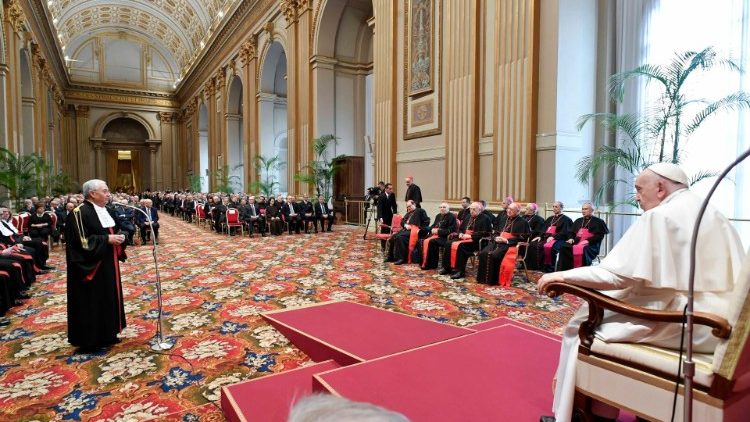
Pope Leo XIV officially opens the judicial year at Vatican Tribunal


Pope Leo XIV inaugurates the judicial year of the Vatican TribunalPope Leo XIV inaugurates the judicial year of the Vatican Tribunal  (@VATICAN MEDIA)

Pope: Justice in the Church is ministry in service of people of God

Pope Leo XIV opens the judicial year of the Vatican Tribunal, and recalls the deep bond between justice, charity, and societal stability.

By Devin Watkins

At the opening ceremony of the Judicial Year of the Vatican City State, Pope Leo XIV expressed his gratitude for the “discreet and quiet” work of the judicial system.

In his first address to the Vatican judiciary, the Pope noted that authentic justice cannot be based simply on positive law, but must rather be understood as the “exercise of an ordered form of charity”.

Drawing heavily on the teachings of St. Augustine, Pope Leo said justice is a cardinal virtue that lies at the heart of personal and communal life.

“When love is rightly ordered—when God is placed at the center and one’s neighbor is recognized in their dignity—then the whole of personal and social life regains its proper orientation,” he said.

The order of love, he added, gives rise to the order of justice, since authentic love is never arbitrary or disordered, but recognizes the truth of relationships and the dignity of every person.

“Theological wisdom has expressed this relationship with the affirmation that caritas perfecta, perfecta iustitia est (‘perfect charity is perfect justice’), because in the fullness of charity justice finds its most authentic fulfillment,” he said.

Justice requires us to respect the rights of every person, leaving space in ordered relationships for the highest fruit of love to be born.

“Justice, when exercised with balance and fidelity to the truth, becomes one of the firmest factors of unity in the community,” he said. “It does not divide; rather, it strengthens the bonds that unite persons and helps to build that mutual trust which makes ordered coexistence possible.”


Turning to the role of justice and law in Vatican City State, Pope Leo XIV said the judicial process contributes to upholding the credibility of institutions, beyond merely resolving disputes.

The conditions required to fulfill this task, he added, include observance of procedural guarantees, judicial impartiality, right to defense, and reasonable duration of proceedings.

Quoting St. Augustine, the Pope said, “Without justice, one cannot administer the State; it is impossible for there to be law in a State in which there is no true justice.”

By carefully examining the facts of each case, the Vatican judiciary fulfills its ecclesial mission to serve the people of God, since every proceeding and judgement must reflect the “search for truth which lies at the heart of the Church’s life.”

Pope Leo XIV concluded his address to members of the Vatican judiciary by recalling that authentic justice provides a factor of stability and trust within society.

“May justice always be illumined by truth and accompanied by mercy, since both find their fullness in Christ,” he said. “Law, thus applied with uprightness and ecclesial spirit, becomes a precious instrument for building communion and strengthening the unity of the people of God.”

Monday, January 26, 2026

By meeting with the Roman Rota, Pope Leo XIV stresses the important work of the tribunals of the Church


Pope Leo XIV receives officials of the Tribunal of Roman Rota for the inauguration of their judicial yearPope Leo XIV receives officials of the Tribunal of Roman Rota for the inauguration of their judicial year  (@Vatican Media)

Pope to Roman Rota: Justice and charity find harmony in mystery of God

Pope Leo XIV meets officials of the Tribunal of Roman Rota for the inauguration of their judicial year and urges them to safeguard the truth with rigor but without rigidity and to exercise charity without omission.

By Deborah Castellano Lubov

"You are called to safeguard the truth with rigor but without rigidity, and to exercise charity without omission."

Pope Leo XIV made this invitation to the prelate auditors of the Tribunal of Roman Rota in the Vatican on Monday, as he inaugurated its Judicial Year.

The Tribunal of the Roman Rota ordinarily acts as an appellate court of higher instance at the Apostolic See, with the purpose of safeguarding rights within the Church. It fosters unity of jurisprudence and, by virtue of its decisions, provides assistance to lower tribunals.

The Tribunal also includes the Office competent to adjudicate the fact of the non-consummation of marriage and the existence of a just cause for granting dispensations. This Office is also competent to deal with cases of the nullity of sacred ordination, pursuant to the norm of universal and proper law, in accordance with the different cases. It has a collegiate structure and is composed of a certain number of judges of proven doctrine, competence, and experience selected by the Pope from various parts of the world.

Precious service

The Pope began by thanking them for their work, "which is a precious service to the universal judicial function that belongs to the Pope and in which the Lord has called you to share," noting that the expression “Veritatem facientes in caritate” (The truth in love) (Eph 4:15), "can be applied to your daily mission in the administration of justice."

He thanked those present in the audience and everyone working in Church tribunals throughout the world, noting, "The ministry of judge that I have had occasion to exercise enables me to understand your experience more deeply and to appreciate the ecclesial significance of your task."

Pope Leo then returned to a fundamental theme that has been central in the addresses delivered to the Tribunal of the Roman Rota from Pope Pius XII up to Pope Francis, concerning the relationship of their activity "with the truth that is intrinsic to justice."

"On this occasion," the Pope said, "I intend to offer you some reflections on the close bond that exists between the truth of justice and the virtue of charity," clarifying they "are not two opposing principles, nor values to be balanced according to purely pragmatic criteria, but two dimensions intrinsically united, which find their deepest harmony in the very mystery of God, who is Love and Truth."

This correlation, he stated, calls for constant and careful critical discernment, "since, in the exercise of judicial activity, a dialectical tension not infrequently emerges between the demands of objective truth and the concerns of charity."

A delicate balance

"At times," Pope Leo said, "there is the risk that excessive identification with the often-troubled circumstances of the faithful may lead to a dangerous relativization of the truth."

"Indeed, a misguided compassion, even when apparently motivated by pastoral zeal," Pope Leo said, "risks obscuring the necessary dimension of ascertaining the truth that is proper to the judicial office."

"This," he continued, "can occur not only in cases of matrimonial nullity—where it might lead to decisions of a pastoral character lacking a solid objective foundation—but also in any type of proceeding, thereby undermining its rigor and equity."

On the other hand, he cautioned, "there can sometimes be a cold and detached affirmation of the truth that fails to take into account all that love for persons requires, omitting those concerns dictated by respect and mercy, which must be present at every stage of a process."

In considering the relationship between truth and charity, Pope Leo insisted that St. Paul offered "clear guidance" when exhorting in his Letter to the Ephesians that, “Living the truth in love, we should grow in every way into Him who is the head, Christ.” 

"Veritatem facientes in caritate," Pope Leo reiterated, "does not mean merely conforming to a speculative truth, but “doing the truth,” that is, a truth that must illuminate the whole of one’s actions. And this must be done “in charity,” which is the great driving force that leads to the practice of true justice." 

Not a tension between opposing interests, but an instrument for discernment

The process, Pope Leo said, "is not in itself a tension between opposing interests, as is sometimes mistakenly thought, but the indispensable instrument for discerning truth and justice in a given case."

The Pope went on to discuss the adversarial nature of judicial proceedings, and delineated the rigorous elements needed to properly assess these delicate situations and to ascertain appropriately the truth.

"Failure to observe these basic principles of justice—and the fostering of unjustified disparities in the treatment of similar situations—constitutes a serious injury to the juridical dimension of ecclesial communion."

The Pope also addressed the shorter process for the declaration of matrimonial nullity before the diocesan Bishop.

Here, he said, "the apparently manifest nature of the ground of nullity that makes this procedure possible must be assessed with great care, without forgetting that it will be the duly conducted process itself that must confirm the existence of nullity or determine the need to have recourse to the ordinary process."

With all this in mind, the Holy Father underscored, "it therefore proves fundamental that the study and application of canonical matrimonial law continue with scientific seriousness and fidelity to the Magisterium."

Praying that the true wisdom of Christian law must be made manifest, Pope Leo XIV entrusted their work to the intercession of the Blessed Virgin Mary, Speculum iustitiae, "the perfect model of truth in charity."

Saturday, March 2, 2024

Pope opens judicial year for the tribunal of Vatican City


Pope Francis at the inauguration of the 95th Judicial Year in the VaticanPope Francis at the inauguration of the 95th Judicial Year in the Vatican  (Vatican Media)

Pope opens Vatican judicial year: Doing justice requires the virtue of courage

Addressing officials of the Tribunal of Vatican City State at the inauguration of its 95th judicial year, Pope Francis reminds them that the administration of justice requires the virtue of courage and humility in pursuing the truth and even in facing criticism.

By Lisa Zengarini

In his address delivered on Saturday to mark the inauguration of the 95th Judicial Year in the Vatican City State, Pope Francis focused on the virtue of courage needed to administer justice.

A “healthy audacity” that does not aim at self-promotion

He started by recalling that for Christians this virtue is not only a particular quality of heroic individuals but rather, “a trait that is given and enhanced in encountering Christ, as a fruit of the action of the Holy Spirit that anyone can receive if we invoke Him.” It is expressed particularly in “the ability to act with patience and perseverance, rejecting internal and external pressures that hinder the accomplishment of good.”

Without this “healthy audacity”, that “does not aim at self-promotion, but at solidarity” with the weaker in society, he noted, there is a risk of “neglecting many small and large injustices.”

Justice is always an act of charity

As we admire the courage of all those  men and women who suffer war or human rights violations in the world, including many persecuted Christians , the Pope remarked  that we are all called  "to commit ourselves to the future of our children, to safeguard the common home, to take on our professional responsibilities.”  This  is particularly true for the administration of justice: In fact, along with the prudence, charity, temperance, “the task of judging requires the virtues of fortitude and courage, without which wisdom risks remaining sterile.”

Courage in pursuing the truth

Pope Francis went on to recall recalled that in the jurisdictional function, courage is needed, in the first place, to thoroughly ascertain the truth, “remembering that doing justice is always an act of charity, an opportunity for fraternal correction aimed at helping the other recognize his mistake.” This – he stressed - is all the more true when particularly serious and scandalous behaviours emerge and must be sanctioned, “especially when they occur within the Christian community.”

Courage to ensure due process 

The same courage, the Pope continued , is needed “while striving to ensure the proper conduct of proceedings and facing criticism.”  The best response to outside criticism, he told the Vatican magistrates,  “is diligent silence and the seriousness of commitment to work, which allow our Tribunals to administer justice with authority and impartiality, ensuring due process while respecting the peculiarities of the Vatican legal system.”

“The strength of institutions and firmness in the administration of justice are demonstrated by the serenity of judgment, the independence, and impartiality of those called upon, at various stages of the process, to judge.”

The courage of prayer for discernment in doing justice

Finally, Pope Francis recalled the courage of prayer to implore that the “light of the Holy Spirit always illuminates the discernment necessary to reach a just verdict.” Prayer, he said, should never be considered “a waste of time” for their work.  

“Discernment is done "on one's knees," imploring the gift of the Holy Spirit, so that decisions can be made that are in the direction of the good of individuals and the entire ecclesial community. And for this too, courage and strength of spirit are needed.”

Among those attending the inauguration of the new Judicial Year were the President the Vice President of the Tribunal, and the Promoter of Justice, as well as the Presidents of the Courts of Appeal and Cassation. Also present were some representatives of Italian civil authorities.