Showing posts with label just war. Show all posts

Wednesday, July 22, 2026

The evolution of Just War Doctrine from Pius XII to Leo XIV

 THE JUST WAR AND THE RECENT POPES


The Catholic Church now completely rejects “just war” theory, declaring all armed conflict outdated in favor of disarmed diplomacy.


AI-generated illustration depicting six recent popes above St. Peter’s Basilica in Vatican City.

The category of the “just war”—born with Augustine, systematized by Aquinas—was, for centuries, the Christian conscience’s attempt to subject violence to moral criteria.

The magisterium of the recent popes has progressively eroded its ground, down to Leo XIV’s explicit move beyond it.

The turn begins in the atomic era. Pius XII restricted the licit recourse to arms to defense alone. As early as 1944, in his Christmas radio message, in fact, he had declared “now out of date” the theory of war as “an apt and proportionate means of solving international conflicts.” It was “out of date” in Pius XII and “outdated” in Leo XIV: the same word nearly eighty years apart.

John XXIII, in “Pacem in Terris” (1963), declared it alienum a ratione—foreign to reason—to imagine that, in the nuclear age, war could serve as an instrument of justice.

The Council, in “Gaudium et Spes,” called for war to be evaluated “with an entirely new attitude” and condemned total war as a crime against God and against man himself.

John Paul II carried this line down into history: his “never again war” rang out against the Gulf War and, later, against the intervention in Iraq, while “Centesimus Annus” had already called war a “self-destruction of mankind.”

Benedict XVI, more sober in tone, had staked out the position while still a cardinal: asked about the war in Iraq (in an interview with Zenit, on May 2, 2003), he observed that modern weapons strike far beyond combatants, and that therefore “today we should be asking ourselves if it is still licit to admit the very existence of a ‘just war.”

With Francis, the doubt becomes a verdict. In “Fratelli Tutti” (No. 258), he writes that it is “very difficult” to invoke rational criteria elaborated in other centuries to speak of a possible “just war,” and he closes with an imperative: “Never again war!”

From “Pacem in Terris” to “Magnifica Humanitas,” the Church has never ceased to recognize the right to self-defense; it has ceased to lend war the comfort of an adjective.

In a footnote, he adds that Augustine “forged a concept of ‘just war’ that we no longer uphold.”

This is not merely the diagnosis of a “world war fought piecemeal”; it is doctrinal development: at Hiroshima, in 2019, he declared immoral not only the use but the very possession of nuclear weapons.

And to Patriarch Kirill, in March of 2022, with Ukraine under invasion, he said that one can no longer speak, as was once done, of “holy war” or “just war.”

Leo XIV takes a further step. In the encyclical “Magnifica Humanitas,” he denounces a “paradigm shift”: the rehabilitation of war as an ordinary instrument of international politics, even as the ethical principles that once limited its use erode.

In this context, he writes, “without prejudice to the right to legitimate defense in the strictest sense,” that the theory of the just war, “too often used to justify any kind of war,” is “now outdated.”  Humanity has more effective instruments at its disposal: dialogue, diplomacy, forgiveness.

And he extends the argument to the newest frontier—artificial intelligence applied to weapons, which removes the lethal decision from the reach of conscience. His programmatic formula, proclaimed from the loggia on the day of his election, is a peace that is “disarmed and disarming.”

Not a rupture but maturation: Tradition deepening its self-understanding. From “Pacem in Terris” to “Magnifica Humanitas,” the Church has never ceased to recognize the right to self-defense; it has ceased to lend war the comfort of an adjective.

Wednesday, April 29, 2026

Even prominent U.S. Catholic Church can't agree on just war doctrine


Views vary among prominent U.S. Catholic clergy on ‘just war’ pronouncements

One of the U.S. Church’s most prominent public figures contends that it’s not the role of the Church’s leaders to make a final determination about whether a particular war is just or not.


Father Gerald Murray (left) and Bishop Robert Barron. | Credit: “The World Over with Raymond Arroyo”/Screenshot; Daniel Ibañez/EWTN News


Ken Oliver-Méndez
April 28, 2026 at 1:39 PM ET

While various leading U.S. prelates have taken the position that the U.S. war with Iran fails to meet the Churchʼs classic just war criteria, opinion on the matter is not unanimous.

In recent days, one of the countryʼs most prominent bishops in the public arena, Bishop Robert Barron of Winona-Rochester, Minnesota, contended that itʼs not even the role of the Churchʼs leaders to make a final determination about whether a particular war is just or not.

“The role of the Church,” Barron wrote in an X post on April 20, “is to call for peace and to urge that any conflict be strictly circumscribed by the moral constraints of the just war criteria,” which is outlined in the Catechism of the Catholic Church (No. 2309).

However, he continued, “it is not the role of the Church to evaluate whether a particular war is just or unjust.” To buttress his argument, Barron cited the catechism’s explicit “just war” doctrine teaching (No. 2309) that “the evaluation of these conditions for moral legitimacy belongs to the prudential judgment of those who have responsibility for the common good.”

“So, is the war in question truly the last resort?” Barron asked, referencing just war criteria. “Is there really a balance between the good to be attained and the destruction caused by the war? Are combatants and noncombatants being properly distinguished in the waging of the conflict? Do the belligerents have right intention? Is there a reasonable hope of success? The posing of those questions — indeed the insistence upon their moral relevance — belongs rightly to the Church, but the answering of them belongs to the civil authorities,” he concluded.

Meanwhile, other clergy with significant public influence, such as Archdiocese of New York priest Father Gerald Murray, a former U.S. Navy chaplain, hold outright that the U.S. military action against Iran does qualify as a just war.

In an extensive appraisal of the situation in the light of just war teaching, Murray wrote in The Free Press that “the justice of the United States attack on Iran is confirmed by the Iranian regime’s admissions.”

Murray cited U.S. negotiator Steve Witkoff, who revealed that in the days just prior to the outbreak of the war “both Iranian negotiators said to us [Witkoff and fellow U.S. negotiator Jared Kushner] directly with, you know, no shame, that they controlled 460 kilograms of 60% [enriched uranium] and they’re aware that that could make 11 nuclear bombs, and that was the beginning of their negotiating stance.” The Iranian negotiators told their U.S. counterparts, Witkoff continued, that “they had the inalienable right to enrich all their nuclear fuel that they possessed.”

“A nuclear-armed Iran with ballistic missiles is an imminent threat to the United States, Israel, and many other countries,” Murray said.

“The advanced state of uranium enrichment meant that the United States and Israel faced an imminent threat. The clear intent of the Iranian regime to build nuclear weapons has not changed. Given that, it was just for the United States and Israel to attack Iran in order to eliminate the nuclear threat,” Murray affirmed, calling the joint military action “an act of protection, rather than aggression, under just war theory.”

Murray also pointed out that the negotiations that preceded the attack on Iran “show the length to which the United States was willing to go to avoid war — evidence that the strike was a last resort.”

Furthermore, he noted that when Witkoff and Kushner told the Iranian negotiators that the United States would provide non-weapons-grade uranium to Iran for 10 years if it stopped pursuing nuclear weapons, they were rebuffed by the Iranians.

“They rejected that, which told us at that very moment that they had no notion of doing anything other than retaining enrichment for the purpose of weaponizing,” Witkoff recounted.

“I do believe this is a just war precisely because of the nature of the threat that a nuclear-armed Iran poses to the United States, Israel, and its allies,” Murray said in a separate interview. “The just war criteria, in my opinion, does not require that we first absorb a nuclear attack before we can actually then respond to try to destroy their nuclear weapons.”

The U.S. and Israel attacked Iran in late February but have been in a ceasefire since April 8, which President Donald Trump extended indefinitely amid negotiations. No side has agreed to long-term peace.

Pope Leo XIV criticized the war and urged peace while Vatican Secretary of State Cardinal Pietro Parolin said the attack “does not seem to meet the conditions” of just war. 

On April 23, Leo doubled down on his opposition to war, saying he encourages “the continuation of dialogue for peace” amid the ceasefire negotiations. 

“As a pastor, I cannot be in favor of war, and I would like to encourage everyone to make every effort to seek responses that come from a culture of peace and not of hatred,” the Holy Father said.

Sunday, April 12, 2026

Washington DC Cardinal McElroy calls war in Iran morally illegitimate and not a just war


Iranian resident stands outside damaged home Iranian resident stands outside damaged home   (AFP or licensors)

Cardinal McElroy: War in Iran 'morally illegitimate;' Let's pray ceasefire holds

During his Vigil Mass for Peace, Cardinal Robert McElroy, Archbishop of Washington D.C., says that under Catholic just war principles, the initiation of the war in Iran and any continuation of it is "morally illegitimate" and calls on faithful to "pray that the ceasefire holds and that it leads to a substantive foundation for the emergence of peace in the Middle East."

By Deborah Castellano Lubov

“We desperately ask our God, the Prince of Peace, to open the minds and hearts of all those in positions of power to look beyond their own interests and see in its fullness the well-being of all those ensnared in this bitter and needless conflict.”

Cardinal Robert McElroy, Archbishop of Washington, made this plea during the Vigil Mass for Peace he celebrated Saturday evening at the Cathedral of St. Matthew the Apostle in the U.S. capital. Hours earlier in Rome, Pope Leo led his Prayer Vigil for Peace in the World.

In his reflection, the Pope appealed to leaders of nations to stop and sit at the table of dialogue and mediation, "not at the table where rearmament is planned and deadly actions are decided!" He also insisted that the Church will always advance in calling for peace "even when rejecting the logic of war may lead to misunderstanding and scorn," and will always instill "obedience to God rather than any human authority."

Welcoming the Pope's invitation, the Cardinal held a Mass for peace and began his homily by reflecting on the peace the Lord brings us through His Resurrection, which offers "the only essential compass that we need for our lives on this Earth,” as well as a responsibility as disciples of the Lord “to be peacemakers in the world in which we live.”

We are called, first and foremost, to be builders of peace within our own hearts and souls, in our families, and among nations.

He said this last responsibility of being builders of peace among nations, “rejecting the pathway of war that lures us toward the ending of civilizations and the pursuit of domination rather than true peace” is what now weighs most heavily upon us.

In the midst of an immoral war

“For we are in the midst of an immoral war. We entered this war not out of necessity but rather out of choice. We failed to ardently pursue the pathway of negotiation to its end before turning to war.”

He said we had no clear intention but were instead darting from unconditional surrender to regime change to the degradation of conventional weapons to the removal of nuclear materials.

“And we blinded ourselves to the cascade of global destructiveness that would likely flow from our attacks – the expansion of the war far beyond Iran, the disruption of the world economy, and the loss of life.

“Each of these policy failures,” the Cardinal stated, “equally a moral failure which under Catholic just war principles renders both the initiation of this war and any continuation of it morally illegitimate."

He recalled Pope Leo’s insistence that the only pathway Catholic teaching allows at this moment is the permanent cessation of hostilities and vigorous steps to build up the conditions for a lasting peace.

As the Holy Father points out, Cardinal McElroy continued, the conversion of hearts and souls is the only true pathway to just and lasting peace, a conversion that casts aside our weapons and begins with reconciliation first.

Thus, the Archbishop of Washington stressed the importance of their gathering in prayer.

Must advocate for peace

“We pray that the ceasefire holds and that it leads to a substantive foundation for the emergence of peace in the Middle East. We are aware of the barbaric nature of the Iranian regime, and the enormous destruction U.S. and Israeli bombing has visited on Iran."

Thus, Cardinal McElroy said we must pray even harder. "We desperately ask our God, the Prince of Peace, to open the minds and hearts of all those in positions of power to look beyond their own interests and see in its fullness the well-being of all those ensnared in this bitter and needless conflict.”

He told those present that as they leave the church this night, they must move beyond prayer.

“As citizens and believers in this democracy that we cherish so deeply, we must advocate for peace with our representatives and leaders. It is not enough to say we have prayed. We must also act. For it is very possible that the negotiations will fail because of recalcitrance on one or both sides, and our president will move to reenter this immoral war.”

“At that critical juncture, as disciples of Jesus Christ called to be peacemakers in the world,” Cardinal McElroy concluded, “we must answer vocally and in unison: No. Not in our name. Not at this moment. Not with our country.”

Friday, July 5, 2024

Israel upset with Catholic leaders who question if the actions against Hamas qualify for "just war"


Israeli embassy attacks Catholic leaders in the Holy Land for comments on Gaza massacre


JULIO 04, 2024 17:56VALENTINA DI GIORGIO


(ZENIT News / Rome, 07.04.2024).- In a strong rebuke, the Israeli Embassy to the Holy See has condemned a recent statement by Catholic leaders in the Holy Land, which suggested that Israel’s current military actions in Gaza do not meet the criteria of a «just war.» On June 30, the Holy Land Commission for Justice and Peace, under the auspices of the Assembly of Catholic Ordinaries of the Holy Land, released a statement questioning the proportionality and justice of Israel’s actions in Gaza. The commission, led by Cardinal Pierbattista Pizzaballa, Latin Patriarch of Jerusalem, highlighted the high civilian death toll as evidence of unjust conduct by Israel. «As Catholics in the Holy Land who share Pope Francis’s vision for a peaceful world, we are appalled that political actors in Israel and abroad are using the theory of ‘just war’ to legitimize ongoing violence in Gaza,» the statement read. «This theory is being misused to justify the killing of tens of thousands of people, our friends, and our neighbors.» The statement argued that diplomatic avenues had not been fully explored before the resort to military force and criticized the rationale that prolonged conflict could save future Israeli lives at the expense of present Palestinian lives. «Prioritizing hypothetical future security over the lives of living human beings being killed every day is unacceptable,» the leaders asserted. In response, the Israeli Embassy in the Vatican issued a statement on July 2, denouncing the commission’s remarks as «religious pretexts and linguistic tricks» that effectively undermine Israel’s right to self-defense. The embassy emphasized that Israel’s objective since the conflict’s inception was to end Hamas’s control over Gaza and prevent future atrocities akin to those committed on October 7, 2023.


The embassy’s response also challenged the portrayal of the conflict as «the war in Gaza» and rejected claims of disproportionate violence, calling such critiques «a false symmetry that reflects bias and one-sidedness.» They underscored the danger posed by Hamas militants embedding themselves within civilian areas, complicating the situation for non-combatants. The Catholic Church’s Catechism states that for a war to be justified, «the use of arms must not produce evils and disorders graver than the evil to be eliminated» (n. 2309). Pope Francis himself has expressed skepticism about the concept of just war, calling war fundamentally a «lack of dialogue.» A Vatican official recently indicated that the concept of just war is «under review.» This is not the first clash between the Israeli Embassy and Catholic leaders over statements about the conflict. In December 2023, Ambassador Raphael Schutz accused Cardinal Pizzaballa of making inflammatory remarks after he stated that two Christian women in Gaza were deliberately killed by Israeli Defense Forces (IDF). Pope Francis condemned the killings as «terrorism» during his Angelus address on December 17. Furthermore, in May, the embassy criticized comments made by a Yemeni Nobel laureate at a Vatican conference, who accused Israel of committing «genocide» in Gaza. Ambassador Schutz, while dismissing these statements, reassured that such declarations «should not impact bilateral relations,» emphasizing that they did not represent the Vatican’s official stance.


Friday, June 7, 2019

Pope Francis issues message on 75th anniversary of D-Day, the Normandy Invasion

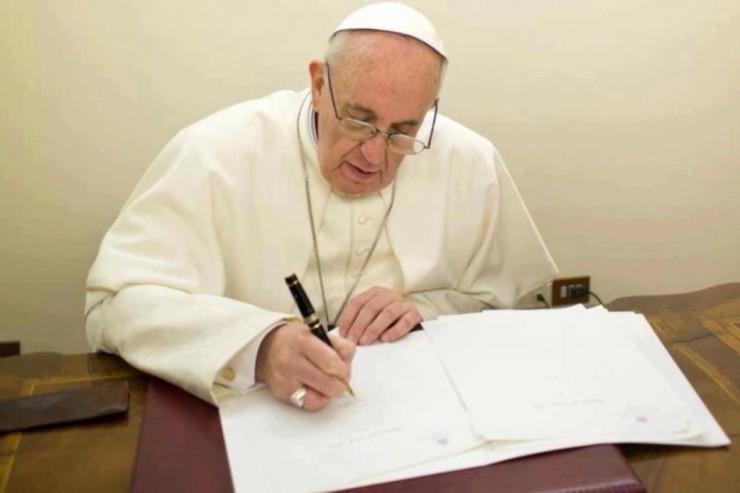
Pope writing a letter

Pope’s Message of Peace and Homage for 75th Anniversary of the Normandy Landings (Full Text)

Cardinal Marc Ouellet, Prefect of the Congregation for Bishops, Reads Message During Celebrations in Course in France

On the occasion of the 75th anniversary of the Normandy landings (June 6, 1944), Pope Francis paid homage to “all the soldiers that, coming from several countries, including France, had the courage to commit themselves and give their life for freedom and peace.”
In a message read by Cardinal Marc Ouellet, Prefect of the Congregation for Bishops, in the course of the celebrations in France, the Pope encourages Christians, “with believers of other religions and men of good will, to promote a veritable universal fraternity, fostering a culture of encounter and dialogue, attentive to the little ones and the poor.”
Recalling in his message those that ”on the German side, fought in obedience to a regime animated by a deadly ideology,” the Pontiff expresses “the wish that this commemoration will enable all generations, in Europe and in the world, to reaffirm forcefully that peace is founded on respect for each person, regardless of his history, on respect of the law and of the common good, of the creation that was entrusted to us and the moral richness transmitted by past generations.”
The Canadian Cardinal presided over an ecumenical ceremony on June 6, 2019, in the presence of British Prime Minister Theresa May, in the Cathedral of Bayeux, the first French city liberated.
* * *
Pope Francis’ Message
Monsignor Jean-Claude Boulanger
Bishop of Bayeux-Lisieux
On the occasion of the celebrations organized for the 75th anniversary of the Normandy landings, I assure you of my spiritual closeness and of my prayer, addressing a warm greeting to you, as well as to the Bishops, the representatives of the different Christian Confessions and of other religions, and all the persons that will take part in them.
We know that the landings on June 6, 1944, right here in Normandy, were decisive in the fight against the Nazi barbarity and enabled to open the way, at the end of this War, bruised Europe and the world so profoundly. Therefore, I remember with gratitude all the soldiers that, coming from several countries, including France, had the courage to commit themselves and to give their life for freedom and peace. I entrust them to the infinitely merciful love of the Lord, as well as the millions of victims of this War, not forgetting those that, on the German side, fought in obedience to a regime animated by a deadly ideology.
I express the wish that this commemoration will enable all generations, in Europe and in the world, to reaffirm forcefully that “peace is founded on respect for each person, regardless of his history, on respect of the law and of the common good, of the creation entrusted to us and of the moral richness transmitted by the past generations.” And I ask the Lord to help Christians of all Confessions, with believers of other religions and men of good will, to promote a veritable universal fraternity, fostering a culture of encounter and of dialogue, attentive to the little ones and the poor.
With this hope, I accord to you wholeheartedly the Apostolic Blessing, as well as to the Bishops present and to the faithful of your diocese, and I call for God’s blessing on all the participants in these celebrations.
Franciscus PP.
From the Vatican, May 31, 2019

Friday, August 11, 2017

Would a preemptive attack on North Korea meet the Catholic teaching on Just War?

The Just War
  • ST. THOMAS AQUINAS
I reply that it must be said that, in order that a war may be just, three things are necessary.


aquinas7652.jpg
Saint Thomas Aquinas, O.P.
1225-1274

In the first place, the authority of the prince, by whose order the war is undertaken; for it does not belong to a private individual to make war, because, in order to obtain justice, he can have recourse to the judgment of his superior. Neither does it belong to a private individual to summon a multitude of people together as must be done to engage in war. But, since the care of the State is confided to Princes, it is to them that it belongs to defend the city, the kingdom or province which is subject to their authority. Just as it is permissible for them to defend these, by the material sword, against those who trouble them from within, by punishing the evil-doers according to the word of the Apostle: "The prince beareth not the sword in vain for he is the minister of God to execute His vengeance against him who doeth evil" (Romans xiii: 4), so, in like manner, it is to them that it belongs to bear the sword in combats for the defence of the State against external enemies. Also, the Psalmist says to princes: "Snatch the poor and deliver the needy out of the hands of the sinner" (Psalm lxxxi: 4). This is what makes St. Augustine say (Contra Faustum, XXII, 75): "The natural order, which would have peace amongst men, requires that the decision and power to declare war should belong to princes."
In the second place, there must be a just cause; that is to say, those attacked must have, by a fault, deserved to be attacked. This is what makes St. Augustine say in Book VI, Question 16, of Questions on Joshua: "Just wars are usually defined as those which avenge injuries, when the nation or city against which warlike action is to be directed has neglected either to punish wrongs committed by its own citizens or to restore what has been unjustly taken by it. Further, that kind of war is undoubtedly just which God Himself ordains."
In the third place, it is necessary that the intention of those who fight should be right; that is to say, that they propose to themselves a good to be effected or an evil to be avoided. This is what made St. Augustine say in the book De Verbis Domini: "With the true servants of God wars themselves are pacific, not being undertaken through cupidity or cruelty, but through the love of peace, with the object of repressing the wicked and encouraging the good." Consequently, it may happen that, although the war has been declared by the legitimate authority and for a just cause it may nevertheless be rendered illicit by the perversity of the intention of him who makes it. "For," says St. Augustine (Contra Faustum, I, XXII, Chap. 74), "what is blamed in war? Is it the death of those who must die sooner or later, but who give up their lives to bring peace by overcoming guilty men? To blame this is the cry of cowards, not of religious people. The desire for harming, the cruelty of avenging, an unruly and implacable animosity, the rage of rebellion, the lust of domination and the like-these are the things which are to be blamed in war."
To the second argument (viz. that war is a sin, as being "contrary to a divine precept") it must be replied that these precepts, as St. Augustine says (De Serm. Domini in monte, I, 34), ought always to be observed in relation to the disposition of the soul; that is to say, that man ought always to be ready, if necessary, not to resist or not to defend himself. But sometimes we must act otherwise for the common good, and even for the good of those against whom we fight. This it is that causes St. Augustine to say, in the Fifth Epistle Ad Marcellinum: "There are many things that must be done against the will of those whom one ought to correct with a beneficent severity."
To the third argument the reply is, that those who wage wars justly have peace as the object of their intention, and so they are not opposed to peace, but only to that evil peace which the Lord did not come on earth to bring (St. Matthew x: 34). Hence Augustine says (Ep. ad Bonifacium, CLXXXIX) : "For peace is not sought in order to the kindling of war, but war is waged in order that peace may be obtained. Therefore, even in waging war, cherish the spirit of the peacemaker, that, by conquering those whom you attack, you may lead them back to the advantages of peace . . . ."
To the fourth argument the reply is that manly exercises in warlike feats of arms are not all forbidden but those which are inordinate and perilous, and end in slaying or plundering. In olden times warlike exercises presented no such danger and hence they were called exercises of arms or bloodless wars.

Tuesday, April 5, 2016

Rethinking "just war" at the Vatican

Vatican to host first-ever conference to reevaluate just war theory, justifications for violence

 | 
Rome
The Vatican will be hosting a first of its kind conference next week to reexamine the Catholic church's long-held teachings on just war theory, bringing some 80 experts engaged in global nonviolent struggles to Rome with the aim of developing a new moral framework that rejects ethical justifications for war.
Participants say the conference -- to be cohosted by the Pontifical Council for Justice and Peace and the global Catholic peace network Pax Christi International April 11-13 -- may recommend displacing the centuries-old just war theory as the main Catholic response to violence.
They also express hope that Pope Francis might take up their conversations by deciding to focus his next encyclical letter, the highest form of teaching for a pontiff, on issues of Catholic peacemaking.
Terrence Rynne, a U.S. theologian who will be attending the event, said he considers it "phenomenally important."
"Coming out of it, Pope Francis might see his way clear to articulate a fresh vision of peacemaking to the church," said Rynne, who helped found Marquette University's Center for Peacemaking. "That would be wonderful."
NCR-on-tapSeattle.jpgAttention, Seattle! NCR on Tap is coming to your city April 5. Join editor Dennis Coday and others for an evening of fun! Learn more.
Just war theory is a tradition that uses a series of criteria to evaluate whether use of violence can be considered morally justifiable. First referred to by fourth century bishop St. Augustine of Hippo, it was later articulated in depth by 13th century theologian St. Thomas Aquinas and is today outlined by four conditions in the formal Catechism of the Catholic Church.
A number of theologians have criticized continued use of the theory in modern times, due to the powerful capabilities of modern weapons and evidence of the effectiveness of nonviolent campaigns in response to unjust aggression.
The Catechism currently outlines as one criteria for moral justification of war that "the use of arms must not produce evils and disorders graver than the evil to be eliminated" and notes that "the power of modern means of destruction weighs very heavily in evaluating this condition."
Conference organizers say in a note to participants about the April event that just war teaching "can no longer claim center stage as the Christian approach to war and peace."
"After more than 1,500 years and repeated use of the just war criteria to sanction war rather than to prevent war, the Catholic Church, like many other Christian communities, is rereading the text of Jesus' life and re-appropriating the Christian vocation of pro-active peacemaking," they state.
"Emphasizing the need to work for a just peace, the Church is moving away from the acceptability of calling war 'just,'" they continue. "While clear ethical criteria are necessary for addressing egregious attacks or threats in a violent world, moral theologians and ethicists should no longer refer to such criteria as the 'just war theory,' because that language undermines the moral imperative to develop tools and capacity for nonviolent conflict."
As part of their goals for the conference, organizers state they seek a "new articulation of Catholic teaching on war and peace, including explicit rejection of 'just war' language."
They state that they want "an alternative ethical framework for engaging acute conflict and atrocities by developing the themes and practices of nonviolent conflict transformation and just peace."
April's conference will be the first to be cohosted by the Vatican's pontifical council and Pax Christi, an international Catholic coalition akin to Amnesty International that maintains separate national groups in many countries.
Started in 1945 by a French laywoman and a French bishop in the aftermath of the Second World War, Pax Christi has long sought to address the root causes of conflict and advocate for nonviolent solutions.
The conference is being organized around four sessions allowing participants to dialogue and share experiences with one another. The only scheduled talk at the event is to be given by Cardinal Peter Turkson, the head of the pontifical council.
The four sessions are given the themes: Experiences of Nonviolence, Jesus' Way of Nonviolence, Nonviolence and Just Peace, and Moving Beyond Unending War.
Each of the sessions is being led by experts in the separate topic areas, including: Rose Marie Berger, an editor at Sojourners magazine and social justice activist; Fr. John Dear, a former Jesuit known internationally for his writings and civil disobedience actions; Maria Stephan, a senior policy fellow at the U.S. Institute of Peace; and Lisa Sowle Cahill, a theologian at Boston College.
Rynne said that the participants are hoping their discussions will allow them to draft some sort of document summarizing their sessions. The organizers' note to participants says they hope to create an "action plan for promotion of Catholic teaching on war and peace, violence and nonviolence."
Rynne said that participants are coming from many places, including: Chile, Sri Lanka, South Sudan, Tanzania, Kenya, Palestine and Burundi.
"It's a dream that I've had for a long time that the church would embrace peacemaking as its central manta, and not have the just war theory be settled teaching the way it has been for so many centuries," said the theologian.
"If people understood they had this powerful method of non-violent action that has been demonstrably proven again and again, we would begin to move away" from just war theory, he said.
[Joshua J. McElwee is NCR Vatican correspondent. His email address is jmcelwee@ncronline.org. Follow him on Twitter: @joshjmac.]