Showing posts with label fraternity. Show all posts

Saturday, November 1, 2025

Pope Leo shares thoughts, prayers before today's Angelus for All Saints Day


Displaced Sudanese gather and sit in makeshift tents after fleeing Al-Fashir city in DarfurDisplaced Sudanese gather and sit in makeshift tents after fleeing Al-Fashir city in Darfur 

Pope: In a wartorn world, may we become builders of fraternity

Before the recitation of the Angelus in Saint Peter’s Square, Pope Leo XIV recalled the “great celebration” to which the human family is destined—so different from the tragedies it endures because of present injustices. He also greeted the Delegation of the Church of England, in Rome for the proclamation of Saint John Henry Newman as a Doctor of the Church.

By Edoardo Giribaldi

Before leading the recitation of the Angelus, Pope Leo XIV recalled how the mystery of the communion of saints is a living memory that "we breathe in deeply today" and brings to mind the great celebration for which humanity is destined. Yet, as we await it, this hope is stifled by the conflicts and injustices of the present time—challenges that the human family is called to face by becoming builders of fraternity.

On the Solemnity of All Saints, speaking before the recitation of the Angelus in Saint Peter’s Square, Pope Leo drew a parallel between the joyful realities of the future and the urgent issues of the present. Today’s Solemnity directs our gaze toward the “future reality” of heaven—a joy shared with God, present in all, "recognizing and admiring the multifaceted beauty of faces, all different and all resembling the face of Christ.” This vision, he said, stands in sharp and painful contrast with the current tragedies of the world, whose healing the Pope entrusted to the intercession of the Blessed Virgin Mary and all the Saints.

Greetings to the Delegation of the Church of England

Before leading the Marian prayer, the Pope welcomed and greeted the Delegation of the Church of England, led by the Archbishop of York, Stephen Cottrell. Their presence, he said, rekindled the “joy” shared just a few days ago during the “historic prayer meeting” with King Charles III of England in the Sistine Chapel. He expressed his hope that the newly proclaimed Doctor of the Church, Saint John Henry Newman, would “accompany Christians on their journey towards full union.”

Solidarity of the “Race of the Saints”

Finally, the Pope greeted the young participants of the Race of the Saints marathon, an event that unites "sport and solidarity with the most disadvantaged children.” Now in its seventeenth edition and promoted by Missioni Don Bosco, the race winds through the heart of Rome’s historic center. This year, on the occasion of the Jubilee, the route holds special significance, linking the four Papal Basilicas of the Eternal City.

Tuesday, January 24, 2023

Together - in fraternity and solidarity to address multiple world crises


2020.09.07 famiglia/mani/solidarietàLIVING BEYOND THE CRISIS

Pope: World needs togetherness to address current multiple crises

Pope Francis sends a message to participants in the Fifth International Conference for World Balance organized in Cuba under the auspices of UNESCO, reiterating that the current multiple crises facing the world today can only be addressed together in fraternity and solidarity.

By Lisa Zengarini

In a time of global political and social crises, our interconnected world needs more than ever today “to build bridges that can help us find viable solutions together that do not exclude anyone”.

The Conference

Pope Francis reiterated this stance in a message addressed on Tuesday to participants at the Fifth International Conference for World Balance, gathered in La Habana, Cuba,  from 24-28 January to discuss the current pressing international issues and challenges threatening world peace in the wake of the COVID-19 pandemic.

The conference brings together, every three years, world thinkers, political and religious leaders, journalists, educators, writers, and, scientists, to discuss issues of peace and social justice.

It is convened by the “José Martí Project for World Solidarity”, a Cuban think-tank named after the Cuban thinker and national hero José Martí, which has been organizing the event since 2003 under the auspices of the UNESCO and other international organizations. This year’s event commemorates the 170th birth of José Martí reflecting on his legacy today.

Listening to others and learning from our elders

In his message Pope Francis insists that changes to the current world situation can be achieved only though dialogue and fraternity and “listening to others”.

He further remarks that the ability to improve our world also comes from learning from those who came before us. Recalling the respect José Martí had for another Cuban patriot that preceded him, Venerable Father Félix Varela, Pope Francis notes that his admiration for the Cuban priest’s courage in denouncing injustice and his meek respect for others “shows the importance of not denying our roots, which allow us to learn from our elders”.

“Our roots lead us to learn from the faith (of our elders), the coherence of life that this faith imposed on them, and from their dedication to people that it is nothing else than the Lord's commandment to love us as He has loved us.”

Current interconnected crisis can only be addressed together

Pope Francis therefore reiterates the need to “restore the word ‘together’ to a central place”. It is “together in fraternity and solidarity – he says, citing his Message for this Year’s World Day for Peace - , that we build peace, ensure justice and emerge from the greatest disasters”, as shown by “heroic” efforts made by all those people who worked tirelessly to help everyone emerge from COVID-19 crisis.

“This – the Pope concludes - is the key to recovering the balance that gives your meeting its name, because only together we can address the several moral, social, political and economic crises we are enduring  and that are all interconnected”.

Friday, March 11, 2022

Bishops of Scandinavia express "fraternal concern" for the German church and their synodal path


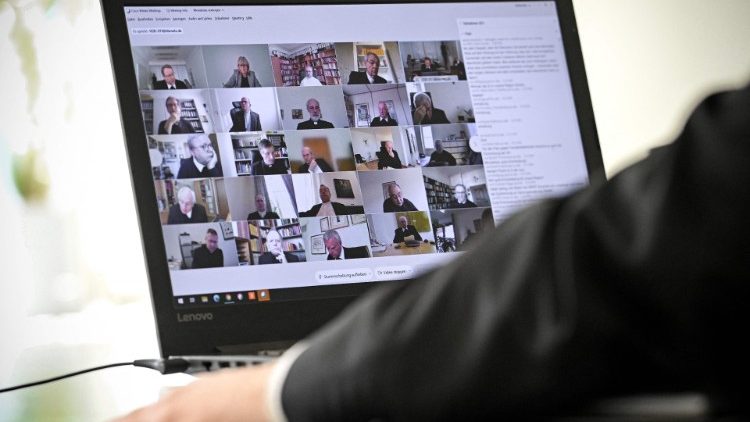
German Bishops gather online for a video conference in February 2021German Bishops gather online for a video conference in February 2021 

Nordic Bishops ‘concerned’ about German Church’s synodal path

The Bishops of Scandinavia send an open letter to the Bishops’ Conference of Germany, and express their ‘fraternal concern’ over the direction and content of the German Church’s synodal process.

By Devin Watkins

As the worldwide Church continues along the path toward the Synod of Bishops in 2023, representatives of the Church in Scandinavian countries have reached out to the Bishops of Germany to express their concern over the local synodal journey.

The Nordic Bishops sent those concerns to the President of the German Bishops’ Conference, Bishop Georg Bätzing, in an open letter at the conclusion of their Spring Plenary Assembly.

The Synod of Bishops, focusing on the theme of synodality, is currently in the diocesan phase of a 2-year journey which will conclude with a month-long meeting of Bishops in Rome in October 2023.

Strong bonds between German and Nordic Churches

The 8 Bishops from Sweden, Denmark, Norway, Finland, and Iceland noted the long-running ties between their Dioceses and Germany. They expressed their gratitude for the “strong bonds” uniting them, including the many German priest, bishops, and nuns who have served in Nordic countries following the Protestant Reformation.

At the same time, the Nordic Bishops said German Bishops risk reducing the Church to a visible communion at the expense of the “sacramental mystery.”

“The orientation, method and content of the Synodal Path of the Church in Germany fill us with worry.”

Concern for German Church direction

Bishop Erik Varden of Trondheim, in Norway, told Vatican News’ Charlotta Smeds that the Nordic Bishops felt called to offer their thoughts on the direction the German Church is taking with the Synod on synodality.

“We simply wanted to express our anxiety and conviction that in order to make ourselves receptive to a newness of grace and a newness of life in the Church, what is needed is not simply deliberations and countless conversations, or majority votes, but also a rediscovery of the profound sacramental mystery of the Church,” said Bishop Varden.

Church both pilgrim people and mystical body

In their statement, the Nordic Bishops said they are worried the Church in Germany is focusing excessively on the image of the pilgrim People of God, almost at the expense of other theological conceptions of the Church, such as the Church as “corpus mysticum, as Bride of Christ, and as mediatrix of graces.”

Bishop Varden said the synodal path cannot forget that “the Church is not only the People of God on pilgrimage—which needs to be organized sensibly and needs an organized route map—but is also the mystical body and the Bride of Christ.”

The statement recalled that the Church is also a “mystery of communion: communion of humankind with the Triune God; communion among the faithful; communion of all the particular Churches with the Successor of Peter.”

Defending Catholic theology against spirit of the world

The Nordic Bishops pointed out that true reforms in the Church have always “set out from Catholic teaching founded on divine Revelation and authentic Tradition.”

Reform, they added, must always defend Catholic teaching and never “capitulate to the Zeitgeist” (‘spirit of the age’ – an 18th-century philosophical idea typically associated with Georg Hegel).

The Bishops called on the German Church to not focus only on structural change and thereby turn the Church into “a project, the object of our agency."

Rather, the Nordic Bishops said the Church’s life must be “rooted in Christ”.

“Only if we live out of the fullness of [Christ’s] revelation shall we measure up to this vocation. We can hardly expect a new fullness of Catholic vitality to follow from impoverishment of the content of our faith.”

Rich legacy for real renewal

Bishop Varden noted that the German Church has a “rich legacy of sanctity, of intelligent reflection, of tremendous contributions to theology, and pastoral charity”.

That legacy, he added, gives the German Church all the resources needed to “effect a real renewal.”

The Scandinavian Bishops’ letter to their German brothers, concluded Bishop Varden, was “a statement of solidarity but also of some fraternal concern.”

Friday, February 4, 2022

Pope Francis on Human Fraternity


Pope Francis: ‘Embrace human fraternity to stop endless destruction’

Pope Francis releases a video message to mark the 2nd International Day of Human Fraternity, and urges all people to trod the difficult path of fraternity in order to overcome the prejudices and conflicts that divide humanity.

By Devin Watkins

The International Day of Human Fraternity was set up by the UN General Assembly to commemorate the signing of the Document on Human Fraternity for World Peace and Living Together by Pope Francis and the Grand Imam of Al-Azhar, Ahmed Al-Tayyeb, in Abu Dhabi on 4 February 2019.

Pope Francis sent a video message on Friday as the world marked the second Day dedicated to this historic event. Fraternity, said the Pope, can act as a “bulwark against hatred, violence, and injustice”.

He thanked the many people and organizations—especially Sheikh Mohammed bin Zayed, Crown Prince of Abu Dhabi, and the Higher Committee for Human Fraternity—for the many initiatives which seek to implement the Document’s values.

“Fraternity is one of the fundamental and universal values that ought to undergird relationships between peoples, so that the suffering or disadvantaged do not feel excluded and forgotten, but accepted and supported as part of the one human family. We are brothers and sisters!”

Worshiping God, loving neighbour

Pope Francis said all people, regardless of religion or creed, are called to promote a “culture of peace” that welcomes all, while encouraging development and solidarity.

Throughout his message, the Pope repeated the affirmation that “we all live under the same heaven” and that we are all God’s children, no matter the colour of our skin or social class.

He said every person has a role to play in making the world a better place, by helping others raise “their eyes and prayers to heaven.”

“Let us raise our eyes to heaven, because whoever worships God with a sincere heart also loves his or her neighbour. Fraternity makes us open to the Father of all and enables us to see others as our brothers or sisters, to share life, to support one another and to love and come to know others.”

‘Unity in diversity’

As the world faces the Covid-19 pandemic, he said, we must remember that we are not saved alone. Rather, we must extend our hands “to celebrate our unity in diversity—unity, not uniformity,” said the Pope.

“The time of fraternity has arrived,” he added, so we should strive to “live in solidarity with one another.”

He also lamented the many little wars—a “third world war being fought piecemeal”—that destroy lives, force children to endure hunger, and suppress educational opportunities.

“Now is not a time for indifference: either we are brothers and sisters, or everything falls apart.”

We must not be indifferent to each other’s sufferings, said the Pope. The common heritage of Christians, Muslims, and Jews in God’s promise to Abraham joins us and helps us live “a fraternity as vast and bright as the stars of heaven.”

‘Anchor of salvation for humanity’

Pope Francis again greeted his “dear brother”, the Grand Imam, and acknowledged that the path of fraternity is “long and challenging” yet it is “the anchor of salvation for humanity.”

“Let us counter the many threatening signs, times of darkness and mindsets of conflict with the sign of fraternity that, in accepting others and respecting their identity, invites them to a shared journey,” he said.

Every person should be respected in their own identity and personality, added the Pope.

And he concluded by thanking everyone who believes that the world can live in harmony, since we are all “creatures of God: brothers and sisters.”

“I encourage everyone to be committed to the cause of peace and to respond concretely to the problems and needs of the least, the poor and the defenseless,” said Pope Francis. “Our resolve is to walk side by side, ‘brothers and sisters all’, in order to be effective artisans of peace and justice, in the harmony of differences and with respect for the identity of each.”

Monday, January 10, 2022

Pope Francis: builder of bridges


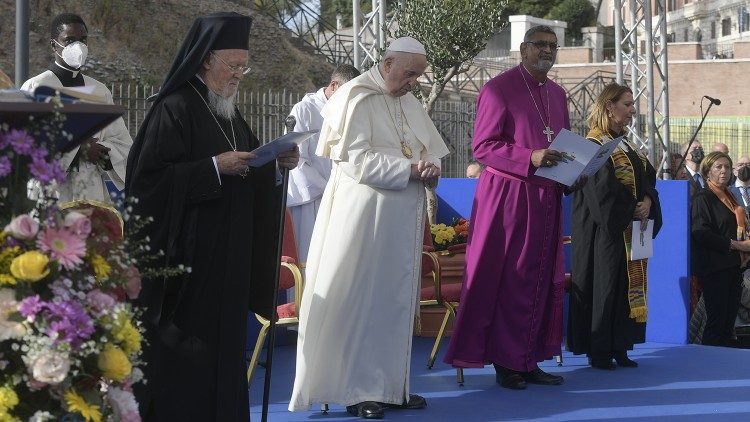
Prayer and encounter for peace at the Colosseum - "Peoples as Brothers, Future Earth: Religions and Cultures in Dialogue" (7 October 2021) Prayer and encounter for peace at the Colosseum - "Peoples as Brothers, Future Earth: Religions and Cultures in Dialogue" (7 October 2021)  

Pope Francis, building bridges in the name of fraternity

In his address to the diplomatic corps accredited to the Holy See, Pope Francis reiterated the Church’s impartial passion for humanity, especially wounded or humiliated humanity. The Pope’s commitment to building bridges between different people, cultures, and religions is increasingly emerging as a distinctive feature of his pontificate.

By Alessandro Gisotti

Pontiff: 'Builder of bridges.' If there is one feature that has become increasingly clear in the course of nearly nine years of Pope Francis’ pontificate, it is precisely the tireless commitment of the Successor of Peter to building bridges in order to unite where there is division, to cross those visible and sometimes invisible barriers of separation that prevent encounter.

Bridges between peoples and cultures, bridges between religious and political leaders that the Pope has worked to build with an intensity and a sense of urgency that has increased the more he has seen walls erected which, after the end of the Cold War and the division of the world into two blocs, were thought — perhaps a little too optimistically — to be relegated to the history books.

Today, this passionate and unbiased commitment is almost unanimously recognised by the international community, as demonstrated by requests for the mediation and intervention of the Pope and the Holy See in so many crises of our time.

Dialogue and cooperation

Even in Monday's speech to the Diplomatic Corps (a sort of Urbi et Orbi address on the state of health of the planet), Pope Francis reiterated that dialogue and cooperation between peoples are stages along a path we cannot avoid if we really want to prepare a future of hope for future generations.

“We should be unafraid,” he said in a key passage of his speech, “to make room for peace in our lives by cultivating dialogue and fraternity among one another.”

A space that needs an integral and not fragmented vision — as dramatically demonstrated by the pandemic, another central theme in the audience with the ambassadors accredited to the Holy See. In the eyes of the Church — “expert in humanity,” as Paul VI emphasises in Populorum Progressio — peace and development, the environment, and rights are interconnected. Everything fits together. The Church has humanity at heart and nothing else because, in the words of John Paul II, “man is the way of the Church.”

Creativity of love

It is a love for humanity — especially for women and men who are wounded, discarded, humiliated — to which Pope Francis bears witness with words and gestures, following in the footsteps of his predecessors and developing their Magisterium with that “creativity of love” that is a task ideally entrusted to each and every one of us.

Even in 2021, despite the immense difficulties generated by the pandemic, Pope Francis has continued to erect arches and establish pillars, to lay stones to reinforce the road. He is not only initiating processes (to borrow a formula dear to him), but also building bridges. Certainly, not all of them can be completed; but this is no reason to give up.

As Pope Francis reassures us, “blessed are the builders of peace,” even if the fruits of their work will be harvested by others, and in times that we cannot now foresee.

Journey toward fraternity

The “impossible” journey to Iraq is perhaps the most extraordinary example of this effort by the Pope, and not only of the past year. It was a trip that many had advised against, but which proved to be a powerful, prophetic message in favour of peace and fraternity.

This last — “fraternity” — for its part has become almost on the other hand, is almost the second name on the “identity card” of Pope Francis’ pontificate.

The Pope of Fratelli tutti — who in Mosul was able to affirm that “Fraternity is more durable than fratricide” — reminds us that on that bridge, called humanity, we must all take steps in order to encounter one another. And we must do so above all in order to meet those who are furthest away —because however distant they may be from us, they are still our brothers.

Monday, February 8, 2021

Pope Francis preaches fraternity to Vatican Diplomatic Corps


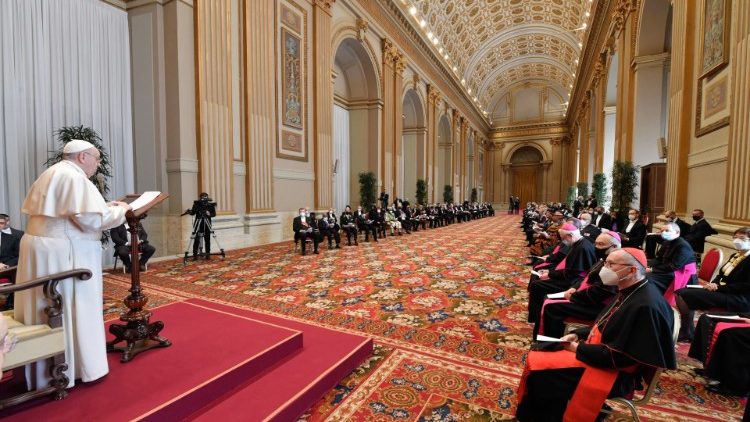
Pope Francis addressing members of the diplomatic corps on 8 February 2021Pope Francis addressing members of the diplomatic corps on 8 February 2021  (ANSA)

Pope to diplomats: Fraternity, the true remedy to crises and divisions

Pope Francis on Monday addressed members of the diplomatic corps accredited to the Holy See for the annual exchange of New Year greetings. In the state-of-the-world address, he reviewed the multiple crises affecting various parts of world, including those caused by the pandemic, and said that fraternity and hope can help overcome them.

By Robin Gomes

In his traditional encounter with the ambassadors to the Holy See, Pope Francis reflected on the numerous crises unleashed by the pandemic, and on other problems affecting the world, stressing that the fraternity is the true cure for them. 

However, the most serious of them, he said, is “the crisis of human relationships, as the expression of a general anthropological crisis, dealing with the very conception of the human person and his or her transcendent dignity”. “I am convinced that fraternity is the true cure for the pandemic and the many evils that have affected us. Along with vaccines, fraternity and hope are, as it were, the medicine we need in today’s world,” the Pope said.

Pope Francis met the ambassadors in the Hall of Benediction in St. Peter’s Basilica, maintaining health protocols. The traditional meeting, originally scheduled for January 25, had to be postponed because of the Pope’s sciatica pain. 

Despite the social distancing demanded by the Covid-19 pandemic, the Holy Father noted, their meeting “is meant to be a sign of hope . . . closeness and mutual support to which the family of nations should aspire”.  And in this spirit, he said, he was making his upcoming visit to Iraq in March.

The Holy Father then reviewed some of the crises provoked or laid bare by the pandemic and examined the opportunities they offer to build a more humane, just, supportive and peaceful world. 

Health crisis

The pandemic, the Pope said, has brought humanity face-to-face with two unavoidable dimensions of human existence: sickness and death. They remind us of the value of every individual human life and its dignity, from conception in the womb until its natural end. He lamented that a growing number of legal systems seem to be moving away from their inalienable duty to protect human life at every one of its phases.

The pandemic has reminded us of the right of each human being to dignified care, and that “each human person is an end in himself or herself, and never simply a means to be valued only for his or her usefulness”. “If we deprive the weakest among us of the right to life,” he asked, “how can we effectively guarantee respect for every other right?” He urged political and government leaders to work above all to ensure universal access to basic healthcare, medicines and treatment, pointing out that “concern for profit should not be guiding a field as sensitive as that of healthcare”. He called for an equitable distribution of the vaccines, based not on purely economic criteria but on the needs of all, especially of peoples most in need. In this regard, he urged that access to vaccines must be accompanied by responsible personal behaviour aimed at halting the spread of the virus, employing the necessary measures of prevention. 

Environmental crisis

The pandemic, the Pope continued, has also demonstrated once again that the earth itself is fragile and in need of care. The ecological crisis caused by the indiscriminate exploitation of natural resources, he pointed out, is much more complex and enduring, and requires shared long-term solutions. The impact of climate change, such as extreme weather events of flooding and drought, and malnutrition or respiratory disease, entail consequences that persist for a considerable time.

While stressing the need for international cooperation to overcome these crises of our common home, Pope Francis hopes that the November United Nations Climate Change Conference (COP26), will effectively address the consequences of climate change. 

In this regard, he recalled the repercussions of climate change on several regions of the world. Numerous small islands in the Pacific Ocean are in danger of gradually disappearing; while floods in Southeast Asia, especially in Vietnam and the Philippines, have caused many deaths and destroyed livelihoods; and increased temperatures have caused devastating fires in Australia and California.

In Africa, Burkina Faso, Mali and Niger faced acute food insecurity last year with millions suffering from hunger. In South Sudan, where there is a risk of famine with over one million undrenourished children, the Pope urged the country’s authorities to overcome misunderstandings and pursue political dialogue for the sake of full national reconciliation.

Economic and social crises

The restrictions on freedom of movement imposed by governments to contain the spread of the coronavirus, the Pope said, have especially harmed medium-sized and small businesses, adversely affecting employment and consequently the life of families and entire sectors of society, especially those that are most fragile. This economic crisis, he noted, has highlighted another illness of our time: that of an economy based on the exploitation and waste of both people and natural resources. What is needed is an economy that is “at the service of men and women, not vice versa”, an economy that “brings life, not death, one that is inclusive and not exclusive, humane and not dehumanizing, one that cares for the environment and does not despoil it”.

Victims of isolation and closed borders

The pandemic, the Pope continued, has particularly hit those in the informal job sector, with many of them exposed to exploitation through illegal or forced labour, prostitution and various criminal activities, including human trafficking. Economic stability, the Pope said, must be ensured for all, so as to avoid the scourge of exploitation and to combat usury, corruption and other injustices. With longer hours before computers and other media due to the isolation, the poor and unemployed are rendered more vulnerable to cybercrime, including fraud, trafficking in persons, prostitution and child pornography. 

Pope Francis also noted that the closing of borders due to the pandemic, combined with the economic crisis, have also aggravated a number of humanitarian emergencies, such as those in Sudan, sub-Saharan Africa, Mozambique, Yemen and Syria. With regard to economic sanctions on countries, he said, they affect mainly the more vulnerable segments of the population rather than political leaders. He hoped that they will be relaxed with an improved flow of humanitarian aid.

He hoped, too, that the current crisis be an occasion for forgiving, or at least reducing, the debt that burdens poorer countries and prevents their recovery and development.

Migrants and refugees

Speaking about the increased number of migrants and their worsening conditions last year because of closed borders, Pope Francis calls for addressing the root causes that force people to migrate and supporting the countries that host them. 

The Holy Father also noted the dramatic increase in the number of refugees and called for renewed commitment to protect them, together with internally displaced persons and the many vulnerable people forced to flee from persecution, violence, conflicts and wars.  In the central region of the Sahel, he noted, the number of internally displaced persons has increased twentyfold.

Crisis of politics

Pope Francis also noted that political crises have worsened in some countries during the pandemic, such as in Myanmar.  While expressing his closeness to the people of the nation, he lamented that that “the path to democracy undertaken in recent years was brusquely interrupted” by the recent coup. He hoped that the detained political leaders “will be promptly released as a sign of encouragement for a sincere dialogue aimed at the good of the country”.

“The democratic process,” he said, “calls for pursuing the path of inclusive, peaceful, constructive and respectful dialogue among all the components of civil society in every city and nation.” This crisis of politics and of democratic values, he pointed out, is also on the international level, with repercussions on the entire multilateral system. But he also noted encouraging signs such as  progress in the prohibition of nuclear weapons and in arms reduction. 

In this context, the Pope wished that 2021 be the year of the end of the Syrian conflict, of the resumption of direct dialogue between Israelis and Palestinians, of stability in Lebanon and of peace in Libya. He expressed concern over the situation in the Central African Republic and in Latin America in general, where, he said, political and social tensions are rooted in profound inequalities, injustices and poverty that offend the dignity of persons. He also expressed concern over tensions in the Korean Peninsula and the South Caucasus.

Terrorism

Pope Francis also expressed concern over the scourge of terrorism, whose attacks, he said, have intensified in the last 20 years, with Sub-Saharan Africa and Asia as well as Europe experiencing it. He particularly regretted attacks on places of worship and reminded authorities of their duty to protect places of worship and defend freedom of thought, conscience and religion. 

Crisis of human relationships

However, Pope Francis pointed out that of all these crises, the most serious is one of “human relationships, as the expression of a general anthropological crisis, dealing with the very conception of the human person and his or her transcendent dignity”.

The isolation and often loneliness due to the pandemic, he said, have brought out the need of every individual for human relationships. With schools and universities shifting to online educational platforms, a marked disparity in educational and technological opportunities has appeared, with many students falling behind in the natural process of schooling. Calling it a “sort of ‘educational catastrophe’”, he called for a renewed commitment to an education that engages society at every level, because education is a natural antidote to the individualistic culture and indifference.

Marriage and family life, the Pope noted, have also been affected, with many experiencing domestic violence. The pandemic has also had adverse effects on fundamental freedoms, including religious freedom, with restrictions in public worship and in the educational and charitable activities of faith communities. “Even as we seek ways to protect human lives from the spread of the virus, the Pope said, “we cannot view the spiritual and moral dimension of the human person as less important than physical health.”