Showing posts with label economics. Show all posts

Tuesday, January 21, 2025

Catholics and the 2nd Trump Presidency; what to expect


What Can Catholics Expect From Trump 2.0?

Looking ahead, as Donald Trump returns to the White House.


Donald Trump’s election as the 47th president of the United States last November has been dubbed the greatest comeback in American political history.

Consider the state of Trump’s political fortunes four short Januarys ago. Following a bitter defeat in 2020 and the ensuing riot at the U.S. Capitol, Trump was denounced by many, including in his own party.

But in the proceeding years, Trump regained the trust of voters while fending off a highly coordinated opposition. He even literally dodged a bullet. And on Jan. 6, his opponent, Vice President Kamala Harris, ratified his victory. Talk about a comeback.


JD Vance

Age: 40

Office: Vice President

Fast facts: JD Vance, the second Catholic vice president in the nation’s history, converted to the Catholic faith in August 2019, citing the works of St. Augustine and French philosopher René Girard as instrumental to his conversion. Vance is often associated with the “post-liberal” movement in Catholicism, which seeks to align public policy with Catholic social teaching. He has been a vocal advocate for substantially increasing the child tax credit, negotiating an end to the war in Ukraine, and revitalizing U.S. manufacturing.

Marco Rubio

Age: 53

Office: Secretary of State

Fast facts: Marco Rubio’s disarmingly open faith journey has seen him leave and return to the Catholic Church twice. Known as a rock-ribbed “peace through strength” conservative on foreign policy, Rubio’s aptitude for diplomacy was apparent during the highly publicized ebbs and flows in his public relationship with Donald Trump. Those talents will be tested as he forges American foreign policy in an era of widespread war and geopolitical change. He is set to become the nation’s first Latino to hold the office.

Elise Stefanik

Age: 40

Office: Ambassador to the United Nations

Fast facts: U.S. Rep. Elise Stefanik, R-N.Y., saw her political star rise during congressional hearings in early 2024, during which Stefanik grilled the presidents of Harvard University and the University of Pennsylvania over antisemitism on campus. Both resigned following their encounter. Stefanik, a cradle Catholic who rarely speaks about her faith life, will press for American interests at the U.N., where she will pursue “peace through strength leadership on the world stage.”

Sean Duffy

Age: 53

Office: Secretary of Transportation

Fast facts: Former Wisconsin representative and Fox Business host Sean Duffy, who burst on the public scene in the 1990s on The Real World: Boston, is a practicing and outspoken Catholic. His faith and commitment to his large family was cited as key to his resignation from Congress in 2019, despite remaining a popular figure in Wisconsin. Duffy has vowed to prioritize “excellence, competence, competitiveness and beauty when rebuilding America’s highways, tunnels, bridges and airports.”

John Ratcliffe

Age: 59

Office: Director of the Central Intelligence Agency

Fast facts: John Ratcliffe briefly served as the director of national intelligence during Trump’s first term and is a former congressman. “John Ratcliffe has always been a warrior for truth and honesty with the American public,” Donald Trump said in a statement. Ratcliffe has been strongly critical of Chinese officials and Iran. He also criticized the Biden administration for not providing more intelligence and military aid to Israel, as Catholic News Agency reported.

Abortion and Wokeism

Trump’s vow to erase all vestiges of “wokeism” — which is, roughly speaking, the worldview that prioritizes mutable identity characteristics over biology and divides all individuals into the categories of “oppressor” or “oppressed” — has been widely publicized. This desire has been seen as instrumental in his selection of current Fox News personality Pete Hegseth, a former Army officer, to become the next secretary of defense, for instance.

However, his campaign’s weakened position on the defense of life, which included vice-presidential pick JD Vance’s public support for the availability of abortion pills and his and Vance’s promotion of in-vitro fertilization, as well as his ongoing battles with leaders in the pro-life community over the past year, have largely gone unreported by the mainstream press.

Trump’s waffling over whether to personally vote against Amendment 4 in Florida that would have overturned the state’s six-week abortion ban, further dismayed his pro-life supporters.

The rifts remain larger and the wounds fresher than many realize.

“President Trump is not a pro-life candidate,” Live Action founder Lila Rose said during the campaign. Rose ended up voting for Trump over Kamala Harris.

Eliminate “wokeness.” Part of Trump’s plan to battle “wokeness” is to sign bills or issue executive orders that enforce the biological understanding of sex and gender, outlawing “gender-affirming care” for minors, and withholding federal funds for institutions that actively promote progressive ideologies. “On Day One, I will revoke Joe Biden’s cruel policies on so-called ‘gender-affirming care,’ a process that includes giving kids puberty blockers, mutating their physical appearance, and ultimately performing surgery on minor children,” he said in a video released shortly after his election win. He also vowed to pass a law prohibiting “gender-reassignment surgery” in all 50 states, which would render any hospital or health provider that participates in “chemical or physical mutilation of minor youth” as falling short of federal health and safety standards. As such, they would no longer be eligible for Medicaid and Medicare.

Abortion flip-flop. Trump’s position on abortion as he enters his second term is ambiguous. While he has reaffirmed his personal dislike of abortion, particularly late-term abortion, he has maintained numerous positions that rankle the pro-life community. These include his support for exceptions and accessibility of IVF in every state and his stated refusal to sign a national abortion ban in favor of state’s rights. “I’m not signing a ban, and there is no reason to sign the ban because we’ve gotten what everyone wanted,” Trump said in September in reference to his previous administration’s role in overturning Roe v. Wade and Doe. v. Bolton and returning the abortion issue to the states.


Economy

U.S. voters gave President Donald Trump high marks for his performance on the economy in his first term. At the outset of the COVID-19 pandemic in January 2020, Gallup found that 63% of Americans approved of Trump’s handling of the economy and that Trump received considerably higher grades on the economy from voters than both his predecessor, former President Barack Obama, and his successor, Joe Biden. Trump’s pledge to pursue “America First” economic policies that would lower inflation, raise wages and create jobs was largely credited with catapulting him to victory in November. The policies he has vowed to enact to those ends fall broadly into four categories.

Trade. The centerpiece of Trump’s economic platform is his plan to place a 10% tariff on most imports and 60% or more on Chinese goods. By doing this he aims to increase federal revenues, which would allow the government to reduce income taxes. This, he believes, would ultimately boost the U.S. manufacturing sector by reducing our reliance on foreign goods and restore trade balance with China. Additionally, Trump has threatened Mexico and Canada with 25% tariffs to gain leverage in negotiations over immigration and drug trafficking. Trump has also threatened to penalize companies that move jobs overseas, which could come in the form of tariffs. Critics of the plan, a cohort that includes leading economists from Catholic institutions and economic conservatives, argue that tariffs will only cause consumer prices to spike further and invite global retaliation.

Taxation. Trump plans to extend the tax cuts he signed into law in 2017, which are set to expire in 2025. He has stated a desire to lower the corporate tax rate from 21% to 15% for companies that manufacture in the U.S., lower individual income-tax brackets, and increase the estate-tax exemption. Additionally, in moves that will draw support from the economically progressive left, Trump has vowed to eliminate federal income taxes on tips, Social Security benefits and overtime pay.

Energy. One of Trump’s most common refrains at rallies is his desire for America to “drill, baby, drill!” He has promised to make America’s energy costs the lowest of any industrialized nation by reducing or removing regulations on the energy sector, scrapping the “Green New Deal,” which he calls the “Green New Scam,” and approving new drilling permits offshore and on federal lands.

DOGE. Trump has tapped Elon Musk and entrepreneur Vivek Ramaswamy to lead the newly minted Department of Government Efficiency (DOGE), with the stated goal of finding $2 trillion in government savings. The department will endeavor to identify government waste, oversee layoffs and even shut down entire government agencies.


Foreign Policy

Even before taking his second oath of office, President Trump has been active in shaping U.S. foreign policy. Numerous world leaders have made the trip to Trump’s Florida estate, Mar-a-Lago, and his reception at the reopening of Notre Dame Cathedral in Paris had all the trappings of a presidential visit.

Trump has also availed himself of the bully pulpit of the presidency by proposing that Denmark sell Greenland to the U.S., teasing the acquisition of Canada as the 51st state (he has appeared to take particular delight in referring to former Canadian Prime Minister Justin Trudeau as “Governor Trudeau”), and threatening to assume control of the Panama Canal from Panama.

It is unclear how these expansionist designs fit within the “America First” foreign policy Trump campaigned on, which promised to bring the war in Ukraine to a swift end, increase economic pressure on China, and expand the Abraham Accords to further normalize relations between Israel and Arab states in the Middle East.

Expand the map. Trump’s stated ambition for territorial expansion has taken many off guard, and there is debate regarding his level of seriousness. His open musing about annexing Canada has been widely interpreted as elaborate “trolling” of America’s neighbor to the north. But his targeting of Greenland and the Panama Canal appear to be more serious and strategically sound.

Negotiate peace in Ukraine. Bringing a swift end to the killing in Ukraine is a rare area of agreement between Trump and the Vatican. Trump has repeatedly promised to forge a negotiated peace between Russia and Ukraine. “I would tell Zelenskyy, no more [military aid]. You’ve got to make a deal. I would tell Putin, if you don’t make a deal, we’re going to give [Zelenskyy] a lot,” he said on a Fox News interview. “I will have that settled in 24 hours.”

Increase economic pressure on China. While Trump has signaled ambiguity regarding his willingness to use the U.S. military to defend Taiwan from Chinese aggression, Trump has been vocal about turning up the pressure on China through economic coercion, intensifying efforts against Chinese espionage and imposing restrictions on Chinese ownership of American assets, including farmland and technology.

Expand the Abraham Accords. Trump has signaled a desire to build upon the Abraham Accords, a series of agreements that normalized diplomatic relations between Israel and several Arab states, which he helped negotiate during his first term. Jared Kushner, Trump’s son-in-law and chief negotiator in the Middle East, has said that Saudi Arabia’s inclusion would be a key component of the expansion in hopes of achieving lasting peace and prosperity in the Arab Gulf states.


Immigration

Fixing the broken immigration system of the United States was one of the major issues around which Donald Trump built his 2024 presidential campaign, and signs point to it being the focal point of his next administration.

Trump has vowed to act swiftly — and in ways that could conflict with teachings of the Catholic Church.

Adding to the perception that Trump has a mandate to act boldly on immigration, a newly released AP poll finds that nearly half of Americans say it should be a top priority for the new administration, the highest of any issue by double figures.

Reports indicate that Trump could declare a national emergency on immigration, which would allow his administration, led by his director of U.S. Immigration and Customs Enforcement (ICE) Tom Homan, a Catholic, to bypass congressional appropriations and divert funds from the Department of Defense to tackle the issue.

Ending Birthright Citizenship. Trump has vowed to eliminate the practice of conferring automatic citizenship for individuals born within U.S. territory irrespective of the legal status of their parents. He claims that birthright citizenship acts as a magnet for illegal immigration and has vowed to make restrictions through executive orders. Opponents, including the U.S. Conference of Catholic Bishops (USCCB), believe the move would threaten human dignity and create a permanent “underclass” of stateless children. “The Church opposes the repeal of birthright citizenship because it would render innocent children stateless, depriving them of the ability to thrive in their communities and reach their full potential,” the USCCB website reads. Experts maintain that executive actions restricting birthright citizenship will be immediately challenged in court, setting up a Supreme Court decision on the matter.

Mass Deportations. Trump and his team have promised to launch the largest deportation program in U.S. history. The Pew Research Center estimates that 11 million unauthorized immigrants currently reside within the U.S., while Trump’s vice president, JD Vance, believes the number is closer to 25 million. Trump believes that mass deportations will benefit American workers by freeing up jobs and driving up wages. Homan has vowed to target “the worst first” by prioritizing criminals and national security threats. Cardinal Robert McElroy, the new archbishop of Washington, has said that “having a wider indiscriminate massive deportation across the country would be something that would be incompatible with Catholic doctrine.”

Finishing the Border Wall. Throughout the campaign, both Trump and his Democratic Party opponent Kamala Harris promised to continue the border-wall project that began during Trump’s first term, signaling a shift in political will for the project. Harris had previously called the wall a “vanity project” that was “un-American.” Construction of the border wall was halted by Biden in 2021, and materials have been waiting — and rusting — at the border ever since.

Saturday, January 18, 2025

Vatican based editorial on the upcoming Presidency of Donald Trump


The President's motorcade waits outside the White House in Washington D.C.The President's motorcade waits outside the White House in Washington D.C. 

Donald Trump and the America to Come

An editorial in L’Osservatore Romano reflects on the most urgent challenges awaiting the new U.S. president just hours before the inauguration ceremony. For the occupant of the White House, it will be crucial to work on overcoming the polarizations that have marked American political life for years. The “disunited” States of America would indeed pose a grave threat to an already fractured and fragmented world.

By Alessandro Gisotti

No, history did not “end” with the fall of the Berlin Wall and the dissolution of the Soviet Union. What was once an illusion held by some political scientists and politicians at the end of the last century has proven dramatically wrong.

In fact, as early as the dawn of the 21st century, this became clear with the "unthinkable" event of the terrorist attack on the Twin Towers, which served as a grim awakening for those who imagined an era of global stability marked by liberal economics.

In the more than 30 years since that historic day when the Wall fell—taking with it one of the most oppressive totalitarian systems in history—humanity has experienced an ever-growing number of conflicts that have evolved from local to regional crises, culminating in what Pope Francis has prophetically termed the “Third World War fought piecemeal.” History, therefore, is far from over.

Over this quarter-century, a period the Pope describes as marking a “change of era” more than “an era of change,” the economic, political, and military forces of the world’s great powers have been reshaped.

Today, we live in a multipolar world, making the pursuit of agreements—particularly in times of crisis—more complex and less straightforward. Yet, this is the world we live in, and the principle of realism requires all leaders (especially those with the most power) to recognize that the great challenges of our time demand new paradigms and creativity that reject the mindset of “this is how it’s always been done.”

It is within this historical context that, on Monday, Donald Trump will be sworn in for the second time to defend the Constitution of the United States and serve the American people.

As has been widely noted, this event has many unprecedented aspects and is met with both hope and concern, as no one overlooks the enduring influence of the United States on international political and economic dynamics, even in a world without a single superpower.

President-elect Trump has repeatedly stated his commitment to ending the war in Ukraine and has pledged that under his presidency, the U.S. will not engage in any new conflicts. It remains to be seen what stance he will take toward international organizations.

Immigration, the environment, and economic development (increasingly driven by technology) are among the key issues on which the 47th occupant of the White House will be closely scrutinized, not only by the American people but also by the international community.

Historically, the United States has excelled when it has opened itself to the world (after all, the United Nations is essentially “an American invention”) and, together with its allies, built a system that—with the limitations of any human endeavor—has ensured freedom, economic development, and progress in human rights. This has happened under both Republican and Democratic presidents. An America turned inward would therefore be a “contradiction.”

President Trump is called to work to overcome the divisions and polarizations that have defined American political life for years and that saw in the assault on the Capitol on January 6, 2021 one of the saddest days in national history. This is undoubtedly a difficult task but a necessary one for the new administration. The “disunited” States of America would pose a grave threat to an already fractured and fragmented world.

Ten years ago, Pope Francis—the first Pope from the Americas—addressed the United States Congress with a speech highlighting the founding values of the American nation. Revisiting this speech could be useful also for President Donald Trump and Vice President J.D. Vance.

That address, widely applauded across party lines at Capitol Hill, identified four great Americans as guiding stars who, even in turbulent times, can help chart the course for those entrusted with political responsibility.

“A nation,” concluded Pope Francis, “can be considered great when it defends liberty as Lincoln did, when it fosters a culture which enables people to ‘dream’ of full rights for all their brothers and sisters, as Martin Luther King sought to do; when it strives for justice and the cause of the oppressed, as Dorothy Day did by her tireless work, the fruit of a faith which becomes dialogue and sows peace in the contemplative style of Thomas Merton.”

These are the values that made America great and that the world still needs today.

Wednesday, January 17, 2024

Pope Francis talks economics and development needing a moral compass


Sign of the World Economic Forum in DavosSign of the World Economic Forum in Davos  (AFP or licensors)

Pope to Davos Economic Forum: Development needs a moral compass

In a message to the 2024 World Economic Forum in Davos, Pope Francis urges business and world leaders to ensure that economic development benefits everyone and remains tied to solidarity.

By Devin Watkins

Titans of global business and politics are rubbing shoulders this week in Davos, Switzerland, under the theme: “Rebuilding Trust.”

To remind world leaders of their duty toward all of humanity, Pope Francis sent a message to the 2024 World Economic Forum, which was read out on Tuesday by Cardinal Peter Turkson and released on Wednesday.

In his message, the Pope said the greatest challenge facing humanity is to ensure peaceful coexistence and integral development for everyone.

“It is my hope,” he said, “that the participants in this year’s Forum will be mindful of the moral responsibility that each of us has in the fight against poverty, the attainment of an integral development for all our brothers and sisters, and the quest for a peaceful coexistence among peoples.”

Choppy global waters

Pope Francis noted that the Davos event takes place this year in “a very troubling climate of international instability.”

The Forum, he added, offers the chance for world leaders to explore innovative ways to build a better world, and he urged them to find ways to foster “social cohesion, fraternity, and reconciliation” among all people.

The Pope lamented the wars and prolonged conflicts that are lacerating parts of the world, many of which are wreaking death and destruction among civilians.

“The peace for which the peoples of our world yearn cannot be other than the fruit of justice,” he said. “Consequently, it calls for more than simply setting aside the instruments of war; it demands addressing the injustices that are the root causes of conflict.”

Rising inequality

Referring to the causes of conflict, the Pope pointed to the prevalence of hunger and the exploitation of natural resources, even as some parts of the world waste food and a select few get rich off of extractive industries.

He also condemned the “widespread exploitation of men, women, and children forced to work for low wages and deprived of real prospects for personal development and professional growth.”

“How is it possible,” he wondered, “that in today’s world people are still dying of hunger, being exploited, condemned to illiteracy, lacking basic medical care, and left without shelter?”

Moral compass to guide globalization

Globalization has a profoundly moral dimension, said Pope Francis, adding that development requires a moral compass to guide discussions that shape the future of the international community.

He invited businesses and states to work together to promote “far-sighted and ethically sound models of globalization”.

Development, said the Pope, “must entail subordinating the pursuit of power and individual gain, be it political or economic, to the common good of our human family, giving priority to the poor, the needy and those in the most vulnerable situations.”

Development spread to all

Finally, Pope Francis called for business leaders and politicians to prioritize the equitable distribution of progress, so that people who are economically disadvantaged may reap the benefits of global growth.

“Authentic development must be global, shared by all nations, and in every part of the world, or it will regress even in areas marked hitherto by constant progress.”

Thursday, June 1, 2023

Pope Francis urges entrepreneurs to look to the Gospels for business guidance


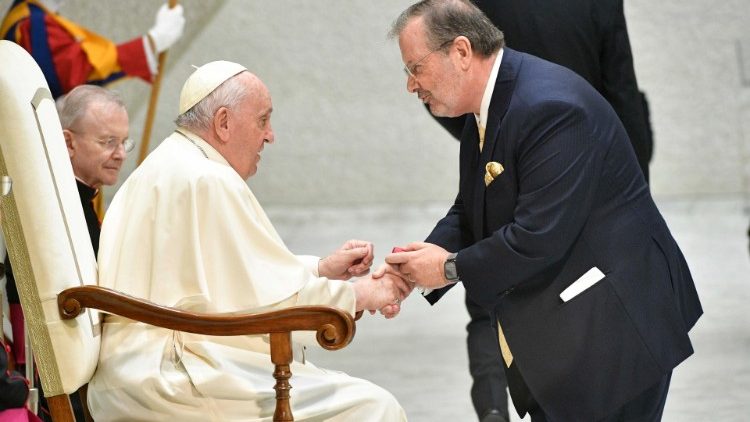
Pope Francis with Latin American business leadersPope Francis with Latin American business leaders  (Vatican Media)

Pope: Entrepreneurs must build business models on culture of encounter

Pope Francis meets with members of the Latin American Business Council, and urges entrepreneurs to look to the Gospel to find hope and direction in their business endeavors.

By Devin Watkins

“Work must be founded on a culture of encounter… which encourages people to seek the common good.”

Pope Francis offered that guidance to businessmen and women from across Latin America on Thursday.

The Pope was meeting in the Vatican with participants in the annual Assembly of the Business Council of the Latin America.

Confronting common problems

In his address, the Holy Father urged entrepreneurs to build a network guided by the Gospel and founded on hope.

He noted that the annual Assembly addressed themes such as migration, climate change, and integral human development, adding that these problems can be found in all other parts of the globe.

“Your exchange of ideas can help you join forces to deal together with problems which are currently common to the entire human family,” he said.

Creating culture of encounter

Pope Francis said a business model that imbibes a culture of encounter can push aside any shadows that creep into the workplace, including an excessive drive for profit which seeks to enslave workers.

“A culture of encounter,” he noted, “expresses the search for the common good, and thus contributes to dispel shadows.”

The values of a culture that respects others, said the Pope, are then translated into countless daily sacrifices and efforts to help others grow.

He urged the Latin American entrepreneurs to offer ongoing formation and education for their workers, in order to “avoid conflicts and the pain of redundancies” since every worker represents a family with concrete financial needs.

Daily service on behalf of others

The Pope invited the businessmen and women to look to the first disciples of Jesus, who were fishermen.

He said they learned how to plough the rough seas of their own times to spread the Christian message, something from which he said modern entrepreneurs can learn.

“The service you carry out is not abstract,” he said, “but directed at every person, which makes it necessary to work together, without stepping over anyone or leaving anyone behind.”

Pope Francis said the choice to hold the Assembly in Rome offered participants the opportunity to encounter firsthand the many apostles buried in the Eternal City, including St. Peter.

“Here we encounter the tracks of the numerous disciples of the Lord of all times who transformed their surroundings in the light of the Gospel by offering their daily witness,” he said.

Guiding compass of the Gospel

In conclusion, the Pope said Christian business leaders enjoy the guiding “compass” of the Gospel and the gift of hope.

“Therefore, we are able to navigate correctly,” he said, “trusting that God will guide us and accompany us along our journey.”

Friday, October 21, 2022

Pope urges business leaders to work for a new economy to serve the common good


Participants of the World Congress of UNIAPAC Participants of the World Congress of UNIAPAC   (Vatican Media)

Pope to business leaders: Use gifts to promote common good

In his address to business leaders and entrepreneurs gathered for the 27th World Congress of UNIAPAC, an international union of business executives, Pope Francis urges members to use their God-given gifts to work towards a more caring and inclusive economy.

By Sophie Peeters

Addressing participants of the 27th World Congress of UNIAPAC on Friday, Pope Francis urged business leaders to always remember that success in business is a “gift from God.”

Their talents as businessmen, the Pope noted, should be directed toward helping those most in need and towards impacting change.

Change however does require courage, the courage to “discern the divine grace in our lives,” the Pope noted.

UNIAPAC is an international organization composed of business people from around the world. Its mission is to advocate “for an economy based on the respect and dignity of the person,” while promoting the “sense of Common Good.”

A ‘new economy' for the common good

The Pope began his address with a prayer that the days spent together on the occasion of their World Congress may help them “remain conscious of God’s grace and wisdom” in their lives, in their homes and in their businesses and in their daily interactions.

Reflecting on the theme for UNIAPAC’s 27th World Congress “Creating a new economy for the common good,  the Pope said this phrase is especially relevant today, as too often economy is unexclusive, dehumanizing and destroys the environment

“Everyone has the right to participate in economic life and the duty to contribute, each according to his own capacity, to the progress of his own country and to that of the entire human family … This is a duty in solidarity and justice, but it is also the best way to bring economic progress to all of humanity.”

Therefore, Pope Francis suggested a “new economy” that is inclusive of all, fostering the development and dignity of each person.

Each of their profession of business leaders and entrepreneurs, the Pope noted, must be used as “leaven” to ensure that development reaches everyone, especially “the most marginalized and in greatest need” in order to contribute toward integral human development.

Work as a means of dignity

During the global COVID-19 pandemic, the Pope noted how essential and low-skilled services workers assured life was sustained during lockdowns, delivering goods and services so desperately needed.

Helping and including those set on the margins of society, including migrant and refugee workers who often perform the most dangerous and “degrading” tasks, through financial assistance should be addressed in order to give them “a dignified life through work,” the Pope stressed.

Work in and of itself, the Pope said, is not only a commercial exchange between employer and employee but rather is “an expression of our creation in the image and likeness of God, the worker”.

This connection between our image and likeness of God and work should also be integrated into an economy of care; care of its workers and its working conditions.

“Work that cares, that contributes to the restoration of full human dignity, will help to ensure a sustainable future for future generations. And this dimension of care involves, first and foremost, the workers.”

Looking toward the future

Recalling the recent “Economy of Francesco” event held in Assisi the 22-24 September, where one thousand young economists from around the world gathered to reflect on a “new economy”, the Pope mentioned major points from the gathering in his address.

Young people, he noted, are too often excluded; their creative enthusiasm can and should be used to develop this new economy of “the Gospel.”

The Pope highlighted a few major points from the pact signed by the young people in Assisi, including providing an economy “of peace and not of war”; “an economy that cares for creation”; “an economy at the service of the human person”; “an economy where care replaces rejection and indifference”; “an economy that leaves no one behind.”

Concluding his address, Pope Francis said “perhaps billions” of young people are struggling to access formal economic systems or even having their first paid jobs.

The Pope therefore urged the business leaders and entrepreneurs to “consider a new alliance with young people” to shape this “new economy” aimed at the common good.

Monday, October 17, 2022

Pope Francis calls for a global economy that benefits the poor and marginalized


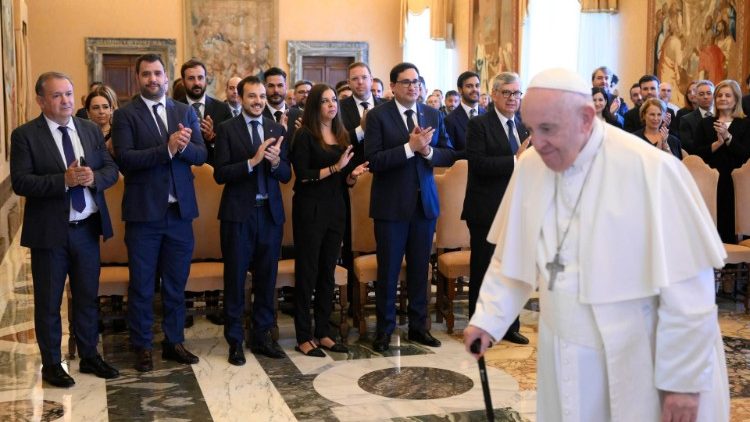
Pope Francis meets with a group of entrepreneurs from SpainPope Francis meets with a group of entrepreneurs from Spain  (VATICAN MEDIA Divisione Foto)

Pope calls for transformation of economy for the common good

Pope Francis meets with a group of entrepreneurs from Spain, and highlights the importance of transforming the global economy, so that everyone can benefit from it, especially the poor and marginalised.

By Francesca Merlo

Addressing a group of entrepreneurs from Spain in the Vatican's Consistory Hall, Pope Francis welcomed and greeted them, describing their presence as "a sign of hope".

During the audience with the "Confederación Española de Asociaciones de Jóvenes Empresarios" and the "Confederación de Empresarios de Galicias", he noted that we are living in an era with "well-known economic and social imbalances", adding that there is an urgent need to propose an adequate economy to help solve the major problems we are experiencing worldwide.

The Holy Father went on to express three ideas he considers relevant for their journey as entrepreneurs.

Be prophets

The first consideration he offered was "prophecy". Pope Francis explains that in the Bible, "the prophet is one who speaks on behalf of God, who conveys His message, through which they bring about change in the context in which they live."

In today's complex context, characterised by war and the environmental crisis, Pope Francis noted that "it is up to you to develop your service, let us say, as prophets who proclaim and build the common home, respecting all forms of life, caring for the good of all and promoting peace. Without prophecy, the economy, and all human action in general, is blind."

Work on your spiritual health

The second idea, Pope Francis continued, "relates to caring for one's relationship with God."

He explained that "just as the earth, when it is well cultivated and cared for" this relationship "bears abundant fruit". In this way, when we cultivate spiritual health and when we have a well-cared-for relationship with the Lord, "we begin to bear much good fruit."

Bearing that in mind, the Pope stressed that "the heroism that the world needs from you today can only be sustainable if you have strong roots."

Economic conversion will be possible when we experience a conversion of the heart, he added, as then, we will be able to "reverse the prejudicial actions that are preparing a bleak future for the new generations."

Do everything with love

The third and final thought "concerns work and poverty", said the Pope.

Upholding Saint Francis of Assisi as an example, Pope Francis reminded those present that all he did was done with the love he felt for the poor and with his austere way of life.

"With the values of work and poverty, which imply a complete trust in God and not in things, an economy can be created that reconciles the members of the different stages of production, without them despising each other, without creating more injustice or experiencing cold indifference," explained the Pope.

On the other hand, he stressed, "this does not mean that you love extreme poverty, which, on the contrary, must be combated, and to this end you have good tools, such as the possibility of creating jobs, and thus contribute to giving dignity to your neighbour."

Create an economy at the service of each human being

Bringing his discourse to a close, Pope Francis encouraged the entrepreneurs present to "continue to creatively transform the face of the economy, so that it may be more attentive to ethical principle" as well as to "not forget that its activity is at the service of the human being, not just of the few, but of all, especially the poor."

Finally, the Holy Father entrusted all those present to the protection of the Blessed Virgin Mary and St Joseph, who took care of the family and the home "with a parental heart".