Showing posts with label March for Life. Show all posts

Friday, January 23, 2026

Before they march today, they prayed & worshipped last night; March for Life 2026


Vigil for Life summons Catholics to be apostles of ‘a civilization of love’


WASHINGTON (OSV News) — While continuing to work to change laws to protect the unborn and support pregnant women in need, “we need to redouble our efforts to continue building, in the words of St. John Paul II, ‘a culture of life and a civilization of love,'” Bishop James D. Conley of Lincoln, Nebraska, said Jan. 22. 

“We need to continue to pray and work to change hearts,” he said in his homily at the opening Mass of the annual National Prayer Vigil for Life Jan. 22-23, preceding the March for Life, which takes place Jan. 23 this year.

Jan. 22 is also observed by Catholics in the U.S. as the Day of Prayer for the Legal Protection of Unborn Children. The date recalls the U.S. Supreme Court‘s Jan. 22, 1973, decisions in Roe v. Wade and Doe v. Bolton, which legalized abortion nationwide as a constitutional right until the 2022 Dobbs v. Jackson Women’s Health Organization decision.

Young people gather for Mass and prayer vigil ahead of March for Life

“As it has often been said that in the end, ‘The measure of a society is how well it treats its weakest members,'” Bishop Conley said. “Only God can change hearts, but we know that God listens and answers the prayers of his people.

The bishop had a special message for the hundreds of young people — from grade school to high school to college — in the congregation of about 6,500, who filled to overflowing the Upper Church of the Basilica of the National Shrine of the Immaculate Conception in Washington.

 “My dear young people, you are the pro-life generation,” he said. “I have said to young people in my diocese, young people of your generation, that I firmly believe that 50 years from now, when my generation will have gone to God, your grandchildren will ask you, ‘Is it true that when you were my age, they put children to death in the womb?'” 

“Our goal is not only to make abortion illegal. Our goal is to make abortion unthinkable!” he said.

Nuncio shares March for Life message from Pope Leo XIV

Bishop Conley, the principal celebrant, thanked Bishop Daniel E. Thomas of Toledo, Ohio, chairman of the U.S. Conference of Catholic Bishops’ Committee on Pro-Life Activities, for inviting him to say the Mass. The concelebrants included three cardinals, 21 bishops and 133 priests. 

The three cardinals were Cardinal Robert E. McElroy of Washington, Cardinal Christophe Pierre, apostolic nuncio to the United States, and Cardinal Seán P. O’Malley, retired archbishop of Boston, who was scheduled to be the celebrant and homilist of the closing Mass of the vigil the following morning.

In his words of welcome, Cardinal McElroy thanked the thousands of pilgrims, “especially the young people,” who traveled “far and wide,” to come to pray and witness to the dignity of human life from conception to natural death.

Cardinal Pierre read a message from Pope Leo XIV to this year’s March for Life participants. The pope expressed his “heartfelt appreciation” to march participants and his deep gratitude for their “eloquent public witness.”

Quoting his Jan. 9 address to Holy See-accredited diplomats, the pope assured the marchers “of my spiritual closeness as you gather for this eloquent public witness to affirm that ‘the protection of the right to life constitutes the indispensable foundation of every other human right.'”

Right to life “condition for all other human rights”

In his homily, Bishop Conley referenced that papal address to the diplomats, “confirming the importance of abortion as the preeminent priority” and emphasizing that the right to life “the condition for all other human rights.”

“The U.S. bishops also teach that abortion is the preeminent issue of our day for several reasons,” the bishop said, including the fact that it is “a direct and intentional destruction of human life at its most fundamental level.”

“The sheer number of lives lost through abortion, more than a million each year, is catastrophic,” he added. “Imagine if there were over a million murders each year through gun violence? Would we tolerate that?”

Bishop Conley said that the bishops also teach there are other very “grave threats to the life and dignity of the human person, including euthanasia, gun violence, terrorism, the death penalty, and human trafficking.”

“There is also the redefinition of marriage and gender, threats to religious freedom at home and abroad, lack of justice for the poor, the suffering of migrants and refugees, wars and famines around the world, racism, the need for greater access to healthcare and education, care for our common home, and more” he said, quoting the introductory note of the U.S. bishops’ document “Forming Consciences for Catholic Citizenship.”

“But our brothers and sisters in the womb are the most vulnerable and voiceless victims,” Bishop Conley emphasized. “In most other cases of injustice, those who are threatened can speak out for themselves and have at least some powers to defend themselves, some form of advocacy.”

He hailed the fact that the Supreme Court, in its 2022 Dobbs decision, overturned Roe and returned the issue of abortion to lawmakers. He praised voters in his own state of Nebraska for passing a ballot initiative on Nov. 5, 2024, to amend the state constitution to ban elective abortions in the second and third trimesters.

But he lamented the fact that “there are still over a million abortions each year in our country — mostly through chemical and non surgical means.”

Church must serve women, welcome life

Bishop Conley said that “no matter what happens politically, we — as Catholics — must always be here to lovingly serve women and to help them welcome new life,” and one way the Church does that is through the Walking with Moms in Need initiative, through which participating Catholic parishes around the country provide services, support “and accompaniment to vulnerable pregnant and parenting mothers.”

The Church also “does not abandon those who have chosen abortion,” he said. “As pastors, we witness firsthand the wounds women and men endure after ending the life of their child,” he said and pointed to Project Rachel Ministry and its post-abortion outreach.

Bishop Conley said that he has been coming to “this Vigil Mass and to the March for Life, off and on, ever since my days in the seminary, just up the road at Mount St. Mary’s Seminary in Emmitsburg, Maryland.”

“Each year it’s like a shot in the arm to be with so many of you,” he continued, “particularly you young people, who share a passion and joy for the gift of life and who want to build a ‘culture of life and civilization of love,’ where babies are protected in their mother’s womb, and women are, loved and cared for when they find themselves faced with very difficult and life-changing decisions.”

Cardinal: Life, every person is a gift

The closing Mass at the basilica early Jan. 23 served as a send-off for those heading across town to the March for Life. In his homily, Cardinal O’Malley, the principal celebrant, called it “a joy and a privilege to gather on this new day to give thanks for life and to March for Life.” 

“This is a pilgrimage for life and it begins with prayer here in Mary’s shrine,” said the cardinal, who, with the exception of the COVID limitations in 2021, has been to every March for Life since the first one in 1974. 

“We’re here today to proclaim life is a gift. It’s a precious gift from a loving God,” he continued. “Together we can protect and nurture that gift of life; we must look for opportunities to be apostles of life building a civilization of love and ethic of care.”

He said that “if we aspire to overcome abortion in our world, we must commit ourselves to helping mothers especially those with a difficult pregnancy and challenging circumstances,” with programs such as Walking with Moms in Need initiative and Project Rachel, echoing Bishop Conley in his opening Mass homily.

Jesus Christ came into the world “as a baby so that we might have life and have it abundantly,” Cardinal O’Malley said. “Life abundant is life sustained by grace. The antidote to abortion is love, love manifest in community, compassion and solidarity.

“Life is a gift. Every person is a gift. Every person counts. All are important. Your mission is to work so that no child will be left behind, every baby will be welcomed, loved, cared for, nurtured and protected. Thank God for the gift of life, thank God for love, thank God for you.”

Julie Asher is senior editor for OSV News.

TODAY is the MARCH FOR LIFE in Washington, DC; Pope Leo XIV sends his encouragement and support


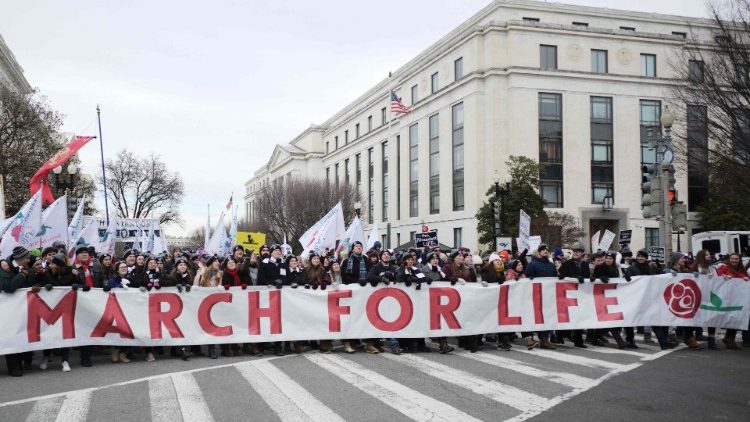
Annual March for Life in Washington D.C. in 2022Annual March for Life in Washington D.C. in 2022  (AFP or licensors)

Pope to US March for Life: Healthy societies protect human life

Pope Leo XIV sends a message to participants in the 2026 March for Life in Washington, D.C., encouraging young people “to continue striving to ensure that life is respected in all of its stages.”

By Kielce Gussie

Extending a warm greeting to the thousands set to participate in the 2026 March for Life in Washington, D.C., in the United States, Pope Leo XIV assured them all of his spiritual closeness in a message.

He added his heartfelt appreciation for this “eloquent public witness to affirm that ‘the protection of the right to life constitutes the indispensable foundation of every other human right’.”

Referring to his address to members of the Diplomatic Corps Accredited to the Holy See early this month, the Pope outlined what a healthy and truly progressive society looks like— “it safeguards the sanctity of human life and works actively to promote it.”


With this in mind, he encouraged young people in particular to continue working to ensure that life is respected and protected in all its stages “through appropriate efforts at every level of society, including dialogue with civil and political leaders.”

Pope Leo prayed that Jesus will accompany all those who peacefully march on behalf of the unborn. “By advocating for them”, he said, “please know that you are fulfilling the Lord’s command to serve him in the least of our brothers and sisters.”

Closing his message, the Pope entrusted all the participants, and all who support them through prayer and sacrifice, to Mary Immaculate—the Patroness of the United States of America.

52 years of the March

The first March for Life took place in January 1974—solemnly marking the one-year anniversary of the United States’ Supreme Court decision to legalize abortion. Its goal: lobby Congressional leadership to find a legislative solution to the ruling Roe v. Wade.

50 years later, the Supreme Court overturned Roe v. Wade with the historic Dobbs v. Jackson Women’s Health Organization case. This gave states more freedom to enact pro-life laws.

March for Life participants at the United States Capitol in 2023

With this, the focus of the March for Life has shifted. “The goal of the national March for Life is to not only change laws at the state and federal level, but to change the culture to ultimately make abortion unthinkable,” according to the March’s official website.

Friday, October 17, 2025

Trump administration proposes more access to IVF; this popular decision is problematic for Catholic Church teaching


Trump rolls out policy proposal to increase access to in vitro fertilization


U.S. President Donald Trump makes announcements on fertility treatment coverage in the Oval Office at the White House in Washington Oct. 16, 2025. (OSV News photo/Jonathan Ernst, Reuters)

WASHINGTON (OSV News) — President Donald Trump announced Oct. 16 a policy proposal to increase access to in vitro fertilization, including issuing guidance urging employers to offer fertility benefits directly to their employees.

Trump previously campaigned on requiring the government or insurance companies to pay for IVF, which is a form of fertility treatment opposed by the Catholic Church on the grounds that it often involves the destruction of human embryos, among other moral and ethical concerns.

“In the Trump administration, we want to make it easier for all couples to have babies, raise children and start the families they always dreamed about,” Trump said in comments at the White House. 

Trump also announced what he called a deal to lower the cost of Gonal-F, a fertility medication used in IVF cycles.

Access to in vitro fertilization supported by Trump

As a candidate for president in 2024, Trump pledged his administration would protect access to IVF but would have either the government or insurance companies cover the costly treatment. His pledge came after a ruling by the Alabama Supreme Court that found that frozen embryos qualified as children under the state law’s wrongful death law. The legal ruling, while limited in scope, aligned more with the position the Catholic Church has staked out against the legalization of IVF. Alabama lawmakers later enacted legal protections for IVF.

“I’m asking all employers to make these new fertility benefit options available to their employees immediately,” Trump said. “The initiatives I’ve just announced are the boldest and most significant actions ever taken by any president to bring the miracle of life into more American homes.”

In February, Trump signed an executive order that aimed “to ensure reliable access to IVF treatment, including by easing unnecessary statutory or regulatory burdens to make IVF treatment drastically more affordable.” That order sought policy recommendations within 90 days, a deadline that passed months prior to Trump’s Oct. 16 announcement, previously raising questions about whether he would follow through on his campaign pledge. 

Comments on the policy proposal

In a statement, the March for Life said the organization “appreciates that President Trump has heard and is responding to so many Americans who dream of becoming parents.” 

“The desire for parenthood is natural and good. Children are a blessing. Life is a gift. The White House’s announcement today is rooted in these core truths,” the statement said. “Here’s what else we know to be true: every human life is precious – no matter the circumstances. We continue to encourage any federal government policymaking surrounding IVF to prioritize protecting human life in its earliest stages and to fully align with basic standards of medical ethics.”

It added, “We welcome the Administration’s commitment to making groundbreaking advancements in restorative reproductive medicine more accessible and available to American women. RRM aims to resolve rather than ignore underlying medical issues, increasing health and wellness while also restoring fertility, and responding to the beautiful desire for children while avoiding any collateral loss of human life.”

In comments at the White House event, Health and Human Services Secretary Robert F. Kennedy Jr., a Catholic and member of the Kennedy political family, said Trump was “doing God’s work” by “giving millions of Americans a chance to have babies.”

Asked by a reporter about those who have religious objections to IVF, Trump replied, “I don’t know about the views of that. I’m just looking to do something because — pro-life, I think this is very pro-life. This is — you can’t get more pro-life than this.”

Church teaching opposes in vitro fertilization

But IVF is among the fertility treatments to which the Catholic Church objects in its teaching. The 1987 document from the Congregation (now Dicastery) for the Doctrine of the Faith known as “Donum Vitae” or “The Gift of Life,” states the church opposes IVF and related practices, including gestational surrogacy, in part because “the connection between in vitro fertilization and the voluntary destruction of human embryos occurs too often.”

Issued by then-Cardinal Joseph Ratzinger, the future Pope Benedict XVI, the teaching named the “right to life and physical integrity from the moment of conception until death” and “the child’s right to be conceived, brought into the world and brought up by his parents” as behind the church’s moral objections to those practices.

It emphasized, “The political authority consequently cannot give approval to the calling of human beings into existence through procedures which would expose them to those very grave risks noted previously.”

“The possible recognition by positive law and the political authorities of techniques of artificial transmission of life and the experimentation connected with it would widen the breach already opened by the legalization of abortion,” it added.

According to data from the Centers for Disease Control and Prevention, approximately 238,126 patients underwent IVF treatment in 2021, resulting in 112,088 clinical pregnancies and 91,906 live births

Tuesday, November 26, 2024

Prayer Vigil for Life set for January 24-25


U.S. bishops announce Prayer Vigil

for Life to take place Jan. 23-24


By

s


WASHINGTON (OSV News) — The annual Prayer Vigil for Life will take place Jan. 23-24, 2025, the U.S. bishops’ conference announced Nov. 22.

The event is hosted each January by the U.S. Conference of Catholic Bishops’ Pro-Life Secretariat, the Basilica of the National Shrine of the Immaculate Conception in Washington and The Catholic University of America’s Office of Campus Ministry. It takes place on the eve of the March for Life, an annual protest of the 1973 Roe v. Wade decision by the U.S. Supreme Court, which was overturned in 2022.

The 52nd National March for Life will take place Jan. 24, 2025.

“I enthusiastically invite Catholics from all around the country to join me in-person or virtually, in praying for an end to abortion and building up a culture of life,” said Bishop Daniel E. Thomas of Toledo, Ohio, chairman of the USCCB’s Committee on Pro-Life Activities, in the USCCB’s statement announcing the dates.

Since the high court’s Dobbs v. Jackson Women’s Health Organization decision in 2022 overturned nearly a half-century of its own precedent that held abortion to be a constitutional right, individual states have moved to either restrict abortion or expand access to it.

“Together, we must pray to change hearts and build a culture of life as we advocate for the most vulnerable,” Bishop Thomas said. “I look forward to opening our Vigil with Holy Mass together with many other bishops, hundreds of priests, consecrated religious, seminarians, and many thousands of pilgrims.”

At the vigil, the Jan 23 opening mass will take place in the basilica’s Great Upper Church from 5-7 p.m., with Bishop Thomas as the principal celebrant and homilist. A Eucharistic procession and the National Holy Hour for Life will follow the Mass. The vigil’s closing Mass will be celebrated by Bishop Robert J. Brennan of Brooklyn.

The event will be broadcast on Catholic networks and livestreamed on the basilica’s website at www.nationalshrine.org/mass. More information about the schedule can be found on the USCCB’s website, www.usccb.org, and more information about on-site attendance at the basilica is at its website.

Monday, April 15, 2024

Despite the changing tide, Polish faithful March for Life


Participants in the March for Life in Warsaw (photo: Karol Darmoros)Participants in the March for Life in Warsaw (photo: Karol Darmoros) 

Poland: Thousands join National March for Life in Warsaw

Thousands of people express their support for the lives of unborn children and their opposition to expanding access to abortion, as they took part in Poland’s National March for Life on Sunday.

By Karol Darmoros – Warsaw

The Polish Bishops’ Conference promoted the National March for Life in Warsaw on Sunday, 14 April, which was held under the motto “Long Live Poland”.

The event offered an expression of affirmation for life but also opposition to draft laws aimed at expanding access to abortion and thereby reducing protection for unborn children.

Ahead of the event, the President of the Polish Bishop’s Conference, Archbishop Tadeusz Wojda, urged Polish Catholics to dedicate the day to prayer in defense of life.

Affirming life

The meaning of the motto for this year's National March for Life was discussed by its spokesperson, Lidia Sankowska-Grabczuk.

"Our march is an affirmation of life, an affirmation of the family, an affirmation of all the basic rights of every human being,” she told Vatican News. “But at the same time, in the face of this revolution that is moving like a battering ram, which wants to limit the rights of parents and the rights of people to life, we are also marching in a strong sign of defiance to contain the demographic collapse and this wild rush for Europe (...) This is an important day for our country. At our march, everyone has the right to speak."

Protecting unborn children

At the start of the demonstration in Warsaw, the heartbeat of an unborn baby whose mother came to the march could be heard from the loudspeakers.

"We will not surrender, no matter what happens in the Polish Parliament. We will stand firm until the rights of unborn children are guaranteed," declared Boguslaw Kiernicki, President of the St. Benedict Foundation, which organized the march.

The march in defense of life brought together thousands of people from all over Poland who came to Warsaw.

"We're here to show that life matters, that every child is a gift, and that even though this means giving up some things, we see what treasure kids are. We know that they are potential future scientists and doctors. We don't know how many diseases could have been cured and how many medicines could have been created if the children who were not born had been born," according to Ewa Liszkowska, who came with her husband Tomasz and their five children from Poznań, speaking to Vatican News.

Caring for women after childbirth

Teresa Janowska from the Gaudium Vitae Association in Gdynia emphasized the importance of caring for pregnant women and providing care for them after delivery.

"We also assist women after childbirth, even before the state steps in with assistance,” said Ms. Janowska. “The Church circles are often falsely accused of not being interested in and supporting women who decide to give birth. We contradict this.”

The National March for Life was preceded by Masses celebrated at two Warsaw cathedrals – St. John the Baptist Archcathedral and the Warsaw-Praga Cathedral of St. Michael the Archangel and St. Florian.

A similar march for life was also held on the same day in the northwestern Polish city of Szczecin.

Friday, January 19, 2024

March for Life Prayer Vigil draws large crowd at the national Basilica


2024 March for Life prayer vigil: ‘We must bring light to the darkest corners’


At this year’s March for Life vigil Mass in Washington, D.C., Arlington Bishop Michael Burbidge called on those gathered in the packed Basilica of the National Shrine of the Immaculate Conception to “bring light to the darkest corners.”

The evening vigil and Mass took place almost two years after the fall of Roe v. Wade, the 1973 landmark Supreme Court case that legalized abortion nationwide. Since then, the battle over the unborn has been largely focused on state initiatives, and the pro-life movement has suffered several defeats at the ballot box.

Burbidge, who serves as chairman of the U.S. bishops’ Pro-Life Committee, said that while it is necessary to be “strategic” in states “where there are victories to be won,” “we must not lose hope” in states where abortion rights have been enshrined into law.

“Like Jesus, it is not enough to reserve our message for those who will readily receive it and to pursue victories only in those places where we are likely to win. We must persist in those places where our message is rejected. We must bring light to the darkest corners,” he said.

The upper church, which holds 6,000 people, was standing room only as pro-lifers from across the nation filled several of the side chapels on a frigid January night. 

People of all ages and walks of life — young children, high schoolers, the elderly, dozens of nuns, priests, seminarians, bishops, and cardinals — filled the basilica’s pews the night before the 51st National March for Life. 

In his homily, Burbidge, the principal celebrant of the Mass, noted Jesus’ words to his disciples in the Gospel reading from Matthew: “Behold I am with you always, until the end of the age” (Mt 28:20).

He said that Jesus spoke those words after he was resurrected and the work of redemption was completed. 

“It seems, for a moment, that the story is over. But it’s not. The work of spreading the Gospel, of sharing the gift of redemption, has only just begun,” he said.

“The perfection we so long for, Jesus subtly reminds his followers, will not be ours until the end of the age,” he said. “Even as we work to bring God’s goodness and justice here and now, we will be frustrated. Our best-laid plans will sometimes fail. The good works we accomplish will not always last.” 

“Our victories here on earth are fragile,” he said.

The overturning of Roe v. Wade, he said, was just such a fragile victory. He said it was “a moment of relief, a moment of new life, an exodus from the oppression under which we lived for 50 years.”

“If the past year and a half has taught us anything, it is this: Dobbs is not the end. It is a victory — a tremendous victory — but not a decisive one,” he said.

Burbidge added that the unborn are still in danger; mothers are still being harmed; and couples, children, and families are still in need of “resources, support, and love.”

He said that the pro-life movement “suffered a particularly difficult loss for unborn life” after the Dobbs decision when several states enshrined abortion rights with “radical amendments” to their constitutions.

Burbidge also pointed to “Catholic politicians and intellectuals” who “tragically continue to publicly endorse abortion as though it is a right and advocate for pro-abortion policies.”

He then took aim at the Biden administration’s pro-abortion policies.

“The current administration has removed safety protocols on the distribution of abortion pills, endangering women’s health and making vulnerable women more susceptible to coercion and abuse,” he said.

Burbidge said that money is “flooding” in to help abortion activists “tell falsehoods, to deceive people, and to portray anyone who stands up for life as irrational, radical, and intolerant,” adding that they are “supported by the media and public relations strategists.”

Burbidge said that “we must find new ways” of communicating the truth without compromise. The truth must be communicated even in the “darkest places, through service and always with Christ at the center,” he said.

“All of human life is sacred. The right to life is absolutely fundamental. No one has a right to directly take the life of another. No one has a right to devalue another,” he said.

“More than anything,” Burbidge said, “we must continue to serve, as the theme for the 2024 March for Life reminds us: With every mother, for every child.”

Burbidge pointed to the work of pregnancy resource centers as being “at the center of our mission.”

“We must fortify those efforts and ensure that those who choose life have a home, an income, food, clothing, and provisions for their children. We must help mothers and fathers through the challenges of pregnancy and welcoming a new life,” he said.

Sean McKeown and Thiago Mesquita, two seminarians who traveled by train from Boston on Thursday morning, told CNA they were inspired by Burbidge’s homily and the size of the crowd. 

“It’s definitely motivating for tomorrow to go out into the streets and march. Seeing all the people here today definitely felt like we have a lot of people that are supporting this cause,” McKeown said.

“It’s just once a year, so for me, it’s like everybody is working throughout the year to prepare for this powerful and big moment for the Church in the U.S. And I just felt like that’s my place, that I can rest and think of life, think of the importance of each person,” Mesquita said.

Two students from nearby Catholic University of America, sophomore Millie Bamsy and senior Mary Grace Raddell, told CNA that they appreciated Burbidge’s call to action.

“I love that people are here because I think that it brings us all together and it helps to remind us of our mission and that we’re all in it together,” Raddell said. 

Bamsy said that she plans to live in Washington, D.C., after graduation and wants to do what she can to help support families and struggling mothers with unexpected pregnancies. 

Another young person who traveled a long way for the march was 15-year-old James Hays from Dallas.

Hays, who came with ​​Cistercian Preparatory School outside of Dallas, said that the March for Life is “just a great experience to come and meet with other people who share the same values that I do.”

“I really look forward to that,” he said.

Before the Mass, the apostolic nuncio to the U.S., Cardinal Christophe Pierre, shared a message from Pope Francis to attendees of the March for Life. 

The message, signed by Vatican Secretary of State Cardinal Pietro Parolin, said that Pope Francis “extends warm greetings and the assurance of his prayers to the many thousands of people from throughout the United States gathered for the annual March for Life.”

“In expressing heartfelt gratitude for this eloquent witness to the inviolable right to life of every person, he trusts that almighty God will strengthen the commitment of all, especially the young, to build a culture in which each member of the human family, in particular the most innocent and vulnerable, is welcomed as a brother or sister,” the statement said.

“In this regard, His Holiness encourages everyone to persevere in efforts to safeguard our heavenly father’s gift of life through adequate legal measures enacted at the local, national, and international levels,” Pierre read.

“For when the dignity and sanctity of human life is valued and protected, society as a whole is strengthened in fraternal solidarity, mutual respect, and social charity. To all participating in the March for Life and to those who support them for their prayers and sacrifices,” the message said.