Showing posts with label Cardinal O'Malley. Show all posts

Friday, January 23, 2026

Before they march today, they prayed & worshipped last night; March for Life 2026


Vigil for Life summons Catholics to be apostles of ‘a civilization of love’


WASHINGTON (OSV News) — While continuing to work to change laws to protect the unborn and support pregnant women in need, “we need to redouble our efforts to continue building, in the words of St. John Paul II, ‘a culture of life and a civilization of love,'” Bishop James D. Conley of Lincoln, Nebraska, said Jan. 22. 

“We need to continue to pray and work to change hearts,” he said in his homily at the opening Mass of the annual National Prayer Vigil for Life Jan. 22-23, preceding the March for Life, which takes place Jan. 23 this year.

Jan. 22 is also observed by Catholics in the U.S. as the Day of Prayer for the Legal Protection of Unborn Children. The date recalls the U.S. Supreme Court‘s Jan. 22, 1973, decisions in Roe v. Wade and Doe v. Bolton, which legalized abortion nationwide as a constitutional right until the 2022 Dobbs v. Jackson Women’s Health Organization decision.

Young people gather for Mass and prayer vigil ahead of March for Life

“As it has often been said that in the end, ‘The measure of a society is how well it treats its weakest members,'” Bishop Conley said. “Only God can change hearts, but we know that God listens and answers the prayers of his people.

The bishop had a special message for the hundreds of young people — from grade school to high school to college — in the congregation of about 6,500, who filled to overflowing the Upper Church of the Basilica of the National Shrine of the Immaculate Conception in Washington.

 “My dear young people, you are the pro-life generation,” he said. “I have said to young people in my diocese, young people of your generation, that I firmly believe that 50 years from now, when my generation will have gone to God, your grandchildren will ask you, ‘Is it true that when you were my age, they put children to death in the womb?'” 

“Our goal is not only to make abortion illegal. Our goal is to make abortion unthinkable!” he said.

Nuncio shares March for Life message from Pope Leo XIV

Bishop Conley, the principal celebrant, thanked Bishop Daniel E. Thomas of Toledo, Ohio, chairman of the U.S. Conference of Catholic Bishops’ Committee on Pro-Life Activities, for inviting him to say the Mass. The concelebrants included three cardinals, 21 bishops and 133 priests. 

The three cardinals were Cardinal Robert E. McElroy of Washington, Cardinal Christophe Pierre, apostolic nuncio to the United States, and Cardinal Seán P. O’Malley, retired archbishop of Boston, who was scheduled to be the celebrant and homilist of the closing Mass of the vigil the following morning.

In his words of welcome, Cardinal McElroy thanked the thousands of pilgrims, “especially the young people,” who traveled “far and wide,” to come to pray and witness to the dignity of human life from conception to natural death.

Cardinal Pierre read a message from Pope Leo XIV to this year’s March for Life participants. The pope expressed his “heartfelt appreciation” to march participants and his deep gratitude for their “eloquent public witness.”

Quoting his Jan. 9 address to Holy See-accredited diplomats, the pope assured the marchers “of my spiritual closeness as you gather for this eloquent public witness to affirm that ‘the protection of the right to life constitutes the indispensable foundation of every other human right.'”

Right to life “condition for all other human rights”

In his homily, Bishop Conley referenced that papal address to the diplomats, “confirming the importance of abortion as the preeminent priority” and emphasizing that the right to life “the condition for all other human rights.”

“The U.S. bishops also teach that abortion is the preeminent issue of our day for several reasons,” the bishop said, including the fact that it is “a direct and intentional destruction of human life at its most fundamental level.”

“The sheer number of lives lost through abortion, more than a million each year, is catastrophic,” he added. “Imagine if there were over a million murders each year through gun violence? Would we tolerate that?”

Bishop Conley said that the bishops also teach there are other very “grave threats to the life and dignity of the human person, including euthanasia, gun violence, terrorism, the death penalty, and human trafficking.”

“There is also the redefinition of marriage and gender, threats to religious freedom at home and abroad, lack of justice for the poor, the suffering of migrants and refugees, wars and famines around the world, racism, the need for greater access to healthcare and education, care for our common home, and more” he said, quoting the introductory note of the U.S. bishops’ document “Forming Consciences for Catholic Citizenship.”

“But our brothers and sisters in the womb are the most vulnerable and voiceless victims,” Bishop Conley emphasized. “In most other cases of injustice, those who are threatened can speak out for themselves and have at least some powers to defend themselves, some form of advocacy.”

He hailed the fact that the Supreme Court, in its 2022 Dobbs decision, overturned Roe and returned the issue of abortion to lawmakers. He praised voters in his own state of Nebraska for passing a ballot initiative on Nov. 5, 2024, to amend the state constitution to ban elective abortions in the second and third trimesters.

But he lamented the fact that “there are still over a million abortions each year in our country — mostly through chemical and non surgical means.”

Church must serve women, welcome life

Bishop Conley said that “no matter what happens politically, we — as Catholics — must always be here to lovingly serve women and to help them welcome new life,” and one way the Church does that is through the Walking with Moms in Need initiative, through which participating Catholic parishes around the country provide services, support “and accompaniment to vulnerable pregnant and parenting mothers.”

The Church also “does not abandon those who have chosen abortion,” he said. “As pastors, we witness firsthand the wounds women and men endure after ending the life of their child,” he said and pointed to Project Rachel Ministry and its post-abortion outreach.

Bishop Conley said that he has been coming to “this Vigil Mass and to the March for Life, off and on, ever since my days in the seminary, just up the road at Mount St. Mary’s Seminary in Emmitsburg, Maryland.”

“Each year it’s like a shot in the arm to be with so many of you,” he continued, “particularly you young people, who share a passion and joy for the gift of life and who want to build a ‘culture of life and civilization of love,’ where babies are protected in their mother’s womb, and women are, loved and cared for when they find themselves faced with very difficult and life-changing decisions.”

Cardinal: Life, every person is a gift

The closing Mass at the basilica early Jan. 23 served as a send-off for those heading across town to the March for Life. In his homily, Cardinal O’Malley, the principal celebrant, called it “a joy and a privilege to gather on this new day to give thanks for life and to March for Life.” 

“This is a pilgrimage for life and it begins with prayer here in Mary’s shrine,” said the cardinal, who, with the exception of the COVID limitations in 2021, has been to every March for Life since the first one in 1974. 

“We’re here today to proclaim life is a gift. It’s a precious gift from a loving God,” he continued. “Together we can protect and nurture that gift of life; we must look for opportunities to be apostles of life building a civilization of love and ethic of care.”

He said that “if we aspire to overcome abortion in our world, we must commit ourselves to helping mothers especially those with a difficult pregnancy and challenging circumstances,” with programs such as Walking with Moms in Need initiative and Project Rachel, echoing Bishop Conley in his opening Mass homily.

Jesus Christ came into the world “as a baby so that we might have life and have it abundantly,” Cardinal O’Malley said. “Life abundant is life sustained by grace. The antidote to abortion is love, love manifest in community, compassion and solidarity.

“Life is a gift. Every person is a gift. Every person counts. All are important. Your mission is to work so that no child will be left behind, every baby will be welcomed, loved, cared for, nurtured and protected. Thank God for the gift of life, thank God for love, thank God for you.”

Julie Asher is senior editor for OSV News.

Saturday, July 5, 2025

French Bishop named to replace Cardinal O'Malley as head of the Commission for the Protection of Minors


Archbishop Thibault Verny with Pope Leo XIV Archbishop Thibault Verny with Pope Leo XIV  

Pope names French bishop Thibault Verny as new president of the Pontifical Commission for the Protection of Minors

Pope Leo appoints Thibault Verny, Archbishop of Chambéry and Bishop of Maurienne and Tarentaise to succeed Cardinal Seán Patrick O’Malley as the president of the Pontifical Commission for the Protection of Minors. In France, Archbishop Verny was responsible for the fight against child abuse within the Episcopal Conference.

By Jean Charles Putzolu

Archbishop Thibault Verny is the new president of the Pontifical Commission for the Protection of Minors. He will put his French experience at the service of the universal Church, while retaining his diocesan responsibilities. He was President of the Council for the Prevention and Fight against Paedophilia within the Episcopal Conference of his own country until last June, when he passed the baton to Bishop Gérard Le Stang of Amiens, who was elected to that position during the last plenary assembly.

First in the Archdiocese of Paris and then within the Conference of Bishops of France, Archbishop Verny has been actively involved in the fight against abuse in the Church, dedicating himself to listening to and accompanying victims, as well as to the necessary interaction with civil and judicial authorities. He sees his appointment as a form of recognition of the work carried out by the French Church with the establishment of the CIASE (Independent Commission on Sexual Abuse in the Church), leading to the publication of the report by its president Jean Marc Sauvé, and the establishment of the INIRR, a body for reparation and compensation.

In this interview with Vatican Media, the Archbishop says he intends to continue the work of his predecessor, the American Capuchin Cardinal Seán Patrick O’Malley, with whom he has collaborated on several occasions, to establish a culture of protection for vulnerable people.


Vatican Media: Archbishop Verny, you are taking over as president of the Pontifical Commission for the Protection of Minors, established by Pope Francis in March 2014. Pope Leo XIV chose you to succeed Cardinal O’Malley, who recently turned 80. How do you feel about the appointment?

Archbishop Verny: Three words came to my mind and heart. First of all, the word “humility” in the face of the importance and gravity of the mission and the challenges that come with it. Then the word “gratitude”, towards our Holy Father, Leo XIV, for the trust he has shown in me; gratitude, of course, also towards Cardinal O’Malley, with whom I had the opportunity to collaborate in the Pontifical Commission, and for all his work. The third word is “determination” to continue and deepen this work.

Q. You have experience within the Bishops’ Conference on this sensitive issue. Now you will be able to put it to good use for the universal Church...

A. In France, my mission, first in the Archdiocese of Paris and then in the Bishops’ Conference, allowed me to listen to the victims and accompany them on their journey. It was a decisive experience. I also had the opportunity to work with representatives of civil society, particularly in the field of justice, with whom we were able to develop working protocols that allowed us to establish a methodology. It is also significant to be able to work with the civil authorities, in addition, of course, to all the dioceses of France.
 

Q. What do you think will be the priorities of the Pontifical Commission and your priorities for the universal Church?

A. First of all, I think of the members of the Commission for the Protection of Minors and all those who work there. I am moved to be able to continue to further develop this work with the team and all of its members.

The priorities will be to continue the work already presented in the annual report, the initiatives in countries that need them, and through the “Memorare” project to support the Churches in welcoming and accompanying victims. The guidelines will be published shortly. They provide guidance for the accompaniment and protection of minors.

Another point that I think is important will be to be able to network the initiatives. Too often, individual countries work on their own. Instead, it is necessary to be able to support each other and share what is being done.

Q. How important is it to work with victims and accompany them?

A. The Pontifical Commission does not have the task of replacing local structures and Episcopal Conferences. It is a matter of raising awareness among the various episcopates, religious orders and congregations in different countries about listening to and accompanying victims in a specific way.

Within the Pontifical Commission for the Protection of Minors, it is essential that there are victims and their parents and families who bring their irreplaceable experience. It seems to me that we must continue to implement a mindset, a culture, within the Churches to spread the protection of minors and ensure that it becomes natural, both in the Church and in families and also in society.

Q. What is your assessment of the work of the Pontifical Commission as you have seen it from your diocese; and, in particular, in the climate of hostility, or at least mistrust, on the part of some sectors of public opinion, which the Commission itself and the Church have had to face?

A. I don’t think the term “hostility” is necessarily appropriate. I would rather say “demand”. The demand on the Church with regard to its mission, its place in society, and the expectation of a truly exemplary Church, capable of caring for vulnerable people and in particular minors. There is this element of humility that the Church must have, the recognition of the truth in order to look to the future.

As for all the work done by the Pontifical Commission since its creation, it must continue to take root both in the Roman context, that of the Curia; and in that of the Episcopal Conferences and religious congregations. And the annual report contributes to this.

Q. At one point, one might have thought that trust had been lost between the faithful, or some of them, and the representatives of the Church. Has the work of reconciliation been done today? Is it necessary to continue along this path?

A. I remain cautious. Trust is not achieved by decree. It is earned and built day by day. There is a temptation to want to talk about something else, to want to turn the page. However, the work of truth and accompaniment of victims must continue. The protection of minors remains and will always be a topical issue. This is the condition for the Gospel to be heard and believed.

Friday, November 1, 2024

The new Archbishop of Boston is installed


New Boston archbishop challenges flock to develop ‘deeply personal’ relationship with God


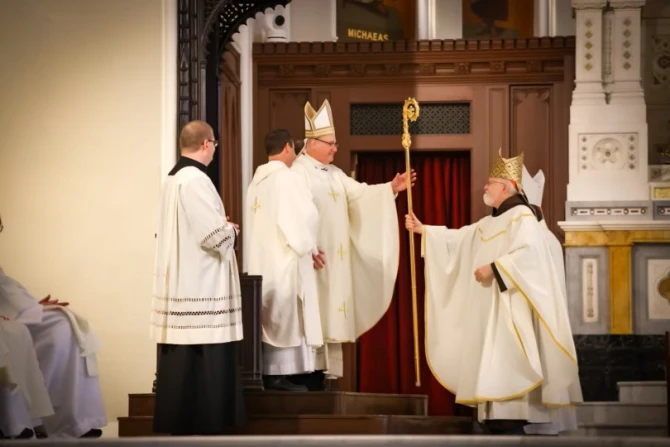
New Boston Archbishop Richard Henning and outgoing archbishop Cardinal Cardinal Seán O’Malley during a packed two-hour-plus installation Mass at Boston’s Cathedral of the Holy Cross on Oct. 31, 2024. | Credit: Andrzej Skonieczny

Newly installed Boston Archbishop Richard Henning challenged people of the archdiocese Thursday to commit to a relationship with God even when it hurts, saying that’s what God does for them.

“He gives us the precious gift, the gift of his own heart: his Son,” Henning said Oct. 31 during a packed two-hour-plus installation Mass at Boston’s Cathedral of the Holy Cross.

Henning, 60, originally from Long Island, New York, and most recently bishop of Providence, Rhode Island, replaced Cardinal Seán O’Malley, who had led the Archdiocese of Boston since 2003.

As the 10th bishop and sixth archbishop of Boston, he is the first head of the diocese to come from New York, which he noted often leads to a question.

Ever since he was announced as Boston’s next archbishop in August, Henning said, “people have been asking me about me — all kinds of questions, about my opinions, my personality traits, and history. The most common question I’ve received in the last few months boils down to something like this: ‘Have you ever been, and are you now, or will you ever be, a Red Sox fan?’”

The congregants laughed. Then Henning added: “Now, while that may be a very important question here in Boston, along with all those other ones, it seems to me that the most important thing that you, the people of this archdiocese, need to know about me is that I believe.”

Earlier, Cardinal Christophe Pierre, the apostolic nuncio to the United States, presented Henning with his letter of appointment from Pope Francis, and, following tradition, Henning walked around the cathedral displaying it to the congregants.

After that, O’Malley and Pierre escorted Henning to the bishop’s chair to the left of the altar, which he sat in, thus taking formal possession of the archdiocese, which is one of four created in 1808.

O’Malley, who widely steadied the archdiocese after the disastrous departure of Cardinal Bernard Law, received a standing ovation at the beginning of the Mass after being praised by Pierre. He got another one near the end of Mass, when Henning told O’Malley he detected “mixed feelings” among Catholics in Boston at the changing of the guard “because of the magnitude of your ministry.”

New spiritual father

The procession of several hundred priests into the cathedral was more joyful than solemn. Outside, to the right of the main entrance, musicians from the Neocatechumenal Way sang rousing songs of praise, backed by eight guitars, a ukulele, two bongos, and a shofar, the ram’s horn used in Jewish religious ceremonies. As priests neared the music, many smiled and some sang along as they made their way up the steps into the building.

Sean Gibney, 47, of Burlington, Massachusetts, who coordinated the group, acknowledged that it’s an unusual way to welcome a new archbishop.

“Now it is. But it wasn’t always. It was always the people who welcomed their shepherd,” Gibney told CNA, noting that in the early Church people chose bishops by acclamation.

“So we find it a totally normal thing. He’s a shepherd, because we’re sheep,” Gibney said, referring to Henning. “We feel in a way that the faith demands that we have to go and welcome. He’s sent in the name of the Lord Jesus Christ.”

David Enrique, 24, of East Boston, who sang and played guitar, was asked what the installation of Henning means to him and why he came.

“For me, we have a new father,” Enrique said. “Cardinal Seán has been our father for the last 21 years, and I came to welcome my new father — my new spiritual father and our shepherd.”

God is love

Acknowledging the presence of many cultures within the archdiocese, the first reading was in Spanish, with the second reading in Haitian Creole. Prayers of the Faithful were in English, Spanish, Haitian Creole, and Vietnamese.

About half the cathedral was occupied by priests in white vestments, a turnout that Henning said “overwhelmed” him. Some, he noted, were from his home diocese of Rockville Centre on Long Island, with many from the Archdiocese of Boston.


Archbishop Richard Henning by the altar during his Oct. 31, 2024, installation Mass at Boston’s Cathedral of the Holy Cross. Credit: Andrzej Skonieczny


After the chanting of the Gospel reading from John 17, Henning spoke for 21 minutes, with no notes.

He challenged listeners to develop a “deeply personal” relationship with God, a relationship, he noted, that comes with demands on both sides.

“God is love, and God summons us to love. And not in a ’70s love song kind of love,” Henning said. “This is a love that sweats and bleeds and dies.”

Using Pope Francis’ image of the Catholic Church as a “field hospital,” Henning expanded on the visual, saying: “But there’s only one doctor in the field hospital, and that is Jesus Christ. The rest of us are patients in need of healing.”

Right ordering is necessary for a fruitful relationship with God, he said.

“Whenever human beings think they are gods, everyone else has to be slaves,” Henning said. “This God makes us free.”

He quoted Dietrich Bonhoeffer, the German Lutheran pastor and anti-Nazi dissident, about what Bonhoeffer called “the cost of discipleship.”

“Faith is not just a list of beliefs. It’s not just a feeling. It’s a whole life,” Henning said.

When O’Malley took over the archdiocese in 2003, the see was vacant, because Law had resigned in disgrace in December 2002, 11 months after the archdiocese’s priest sex abuse scandal exploded.

About a dozen protesters held signs outside the cathedral before Thursday’s Mass, criticizing both archbishops and the Church over priest sex abuse.

Henning acknowledged continuing pain.

“This Church of Boston, it is in a very real sense a wounded Church, because of a failure to act compassionately — the sins against the innocent,” Henning said.

He noted that the Church has made efforts “to protect the vulnerable” in recent decades.

“But still we feel the weight of those wounds,” Henning said. “And we owe a debt of gratitude to victim-survivors who tell their stories, for they help to protect new generations by their courage.”

Tuesday, October 29, 2024

Cardinal O'Malley calls for both healing and justice on protecting minors from abuse


Card. O’Malley on abuse: “There cannot be healing without justice"

With the release of their Pilot Annual Report, the President of the Pontifical Commission for the Protection of Minors highlights the Church’s concern with pairing justice with healing and also the need to educate people on “how common these crimes are in our world.”

By Christopher Wells

The Pontifical Commission for the Protection of Minors’ Pilot Annual Report stresses the Church’s role in educating people on the crime of abuse. The Commission’s President says the Church will be performing a community service if she “can do a good job of getting” her “household in order.”

He highlights a concern of the Church must be providing justice for survivors. The President argues in cases where the statute of limitations has been reached, the Church has an even “greater responsibility to become involved in the administration of justice.”

Recognizing that there is still work to be done, Cardinal O’Malley expresses his hope the report can be a source of consolation. “We still have a long way to go,” he says, “but we have begun.”

Below, please find the full transcript of the interview with Cardinal Seán Patrick O’Malley:

Vatican News: Your Eminence, thank you for joining us this morning. As you prepare to release the first annual report on safeguarding, can you give us an overview? A big part of that is an account of the ten years of the Commission. Is that part of the legacy of the Commission going forward?

Cardinal O’Malley: Well, I think it’s a very important moment for us. This is actually sort of the third iteration of the renewal of membership in the Commission since the beginning. And of course, the first iteration was very challenging because we were a group of about 20 volunteers, very small staff, and with the whole world as our target group. Certainly, the Holy Father placed great trust in us, and we have had extraordinary members on the Commission, just when you think about it. And so many experts from all over the world, a number of victims, parents of victims, some of them have been rather public about their history and their experiences. Others have been more discreet. But they have made an incredible contribution to the life of the Commission.

And, at first, those who were enthused about the Commission thought we were going to the panacea and solve all the problems of safeguarding in the Church. And of course, with those kinds of unrealistic expectations. We came in for a lot of criticism that we didn’t fulfill all of their dreams immediately.

On the other hand, there was a group that was saying, well, this has been dealt with. We don’t need a commission, and you’re nothing but troublemakers. And so, there’s been many challenges.

But as I say, the people who have served on the Commission have been a very independent lot.

And for a Vatican commission, I think it’s one of the few where we, you know, it’s always been at least half, sometimes majority women. We have some who are not members of our Church, members of other religions, people from all over the world with very, very different experiences. But what they have in common is their passion for safeguarding and their desire to listen to the victims and to somehow be their voice within the Church.

Vatican News: I want to ask one specific question about the report. There will be lots of questions and a lot of development in the days and weeks to come. The Church seems to focus a great deal on safeguarding and this of course is the priority making sure that this doesn’t happen again as much as possible. When it does happen, dealing with it and addressing those things. But the report also mentions issues of justice and reparation. Can you talk a little bit about what the report says about that and what the Church is doing in those areas?

Cardinal O’Malley: Certainly, although the responsibility of our Commission is more the safeguarding piece of it, but the Church must be very concerned about justice. And that’s sort of the responsibility of the Dicastery for the Doctrine of the Faith, since these cases were assigned there by Pope Benedict; and also in the local dioceses, have the responsibility to sort out the legal aspects of these cases and to cooperate with the civil governments.

And so, the justice element there is very important. Sometimes these cases go way back beyond statute of limitations. And in which case the Church has an even greater obligation, I would say, to become involved in the administration of justice, where the state is not going to carry on investigations or prosecutions or anything like that. And that’s why, in my mind, the review boards have been such an important part of finding out the truth and dealing with it in a just way.

But there cannot be healing unless there is justice. People don’t want to just hear nice phrases or see documents if they have been unjustly wronged and harmed. They have a right to be heard and to feel that the Church is going to make reparations for the evil that has been done to them.

Vatican News: You’ve kind of alluded to the fact that perhaps some in the Church are not enthusiastic about the work that you do. We see sometimes the Commission will make suggestions about best practices or about what can be done for victims. And perhaps people in the Church simply don’t listen to you. I know you don’t have a direct competence for ensuring compliance, but what can the Church do to make sure that leaders are accepting what you’re suggesting for them?

Cardinal O’Malley: Well, we’re trying to educate people. I think this is one of the biggest tasks of the Church, to give a very broad education about safeguarding and the need for it. A lot of people are very unaware of how common these crimes are in our world and our society. And so, it’s my hope that if the Church can do a good job of getting our household in order, that that will be a service to the greater community.

And we’ve seen that in the States in many ways. Many other churches and organizations have come to us and, and said, well, you have come up with these policies and had this experience. Can you share that with us? And we have. But I think unless people are made aware of the widespread existence of abuse and then become committed to how we’re going to respond to this and make sure that it doesn’t happen again.

And it’s like my Jewish friends talk about the Holocaust. They said, if you don’t remember what happened, you’re putting us in danger of this happening again. And so, it’s very important that we keep this before people’s minds. This is not something just from the distant past. It’s a commitment to protect children and young people in the present and going forward.

Vatican News: And briefly, in a word, what does the Report have to say to victims and to faithful Catholics who are still concerned about how the Church is responding to abuse?

Cardinal O’Malley: I’m hoping that the very breadth of the document will be a consolation to them. I know some people are expecting some kind of an exposé type. That’s not what this is about. This is about sort of measuring what is being done to promote a culture of safeguarding in the whole world, and some of these countries are very under-resourced.

My own community has missions in Papua New Guinea. I have been there. The people’s life is a very simple life. There are 500 different languages. There’s much poverty, much illiteracy. And there, the Church is talking about safeguarding and all over the world. And when the bishops are coming to Rome for their ad limina visit, we’re asking them to report on: how are the guidelines working for you? Where are you implementing them? Where are the areas where you’re not doing what needs to be done? What are the results?

And so, this conversation is taking place all over the world. And the focus of the Commission has particularly been the global South, where it’s been slower to become involved in this ministry of safeguarding. But where I think we’ve made a lot of progress, and the bishops and the people there are anxious to learn more and to become involved in training people in safeguarding and teaching them about the importance of accountability, transparency, ministerial codes of conduct and screening for seminarians, novices and teachers and leadership in the Church.

So, this is taking place all over the world now. And a few years ago, that would not have been the case.

I hope that people will find consolation in that. We still have a long way to go, but we have begun.

Cardinal Seán Patrick O’Malley was born in Lakewood, Ohio, U.S.A and is a professed as a Capuchin Franciscan. He served as the Archbishop of Boston from 2003 until August 2024 and he became the President of the Pontifical Commission for the Protection of Minors in 2014.

This transcript has been edited for clarity.