Showing posts with label Roe v Wade. Show all posts

Friday, January 23, 2026

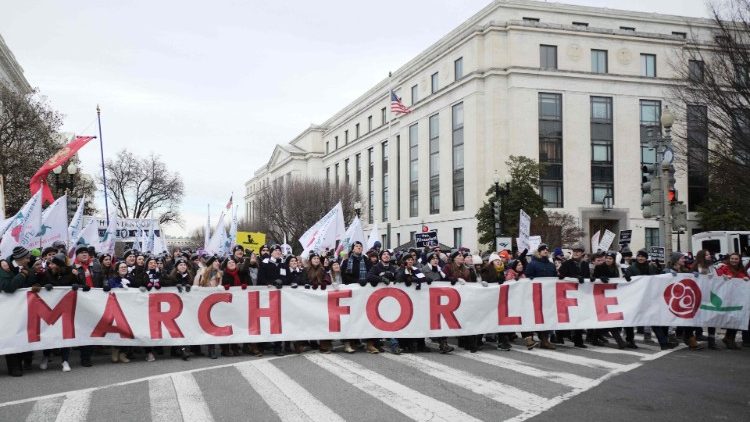
TODAY is the MARCH FOR LIFE in Washington, DC; Pope Leo XIV sends his encouragement and support


Annual March for Life in Washington D.C. in 2022Annual March for Life in Washington D.C. in 2022  (AFP or licensors)

Pope to US March for Life: Healthy societies protect human life

Pope Leo XIV sends a message to participants in the 2026 March for Life in Washington, D.C., encouraging young people “to continue striving to ensure that life is respected in all of its stages.”

By Kielce Gussie

Extending a warm greeting to the thousands set to participate in the 2026 March for Life in Washington, D.C., in the United States, Pope Leo XIV assured them all of his spiritual closeness in a message.

He added his heartfelt appreciation for this “eloquent public witness to affirm that ‘the protection of the right to life constitutes the indispensable foundation of every other human right’.”

Referring to his address to members of the Diplomatic Corps Accredited to the Holy See early this month, the Pope outlined what a healthy and truly progressive society looks like— “it safeguards the sanctity of human life and works actively to promote it.”


With this in mind, he encouraged young people in particular to continue working to ensure that life is respected and protected in all its stages “through appropriate efforts at every level of society, including dialogue with civil and political leaders.”

Pope Leo prayed that Jesus will accompany all those who peacefully march on behalf of the unborn. “By advocating for them”, he said, “please know that you are fulfilling the Lord’s command to serve him in the least of our brothers and sisters.”

Closing his message, the Pope entrusted all the participants, and all who support them through prayer and sacrifice, to Mary Immaculate—the Patroness of the United States of America.

52 years of the March

The first March for Life took place in January 1974—solemnly marking the one-year anniversary of the United States’ Supreme Court decision to legalize abortion. Its goal: lobby Congressional leadership to find a legislative solution to the ruling Roe v. Wade.

50 years later, the Supreme Court overturned Roe v. Wade with the historic Dobbs v. Jackson Women’s Health Organization case. This gave states more freedom to enact pro-life laws.

March for Life participants at the United States Capitol in 2023

With this, the focus of the March for Life has shifted. “The goal of the national March for Life is to not only change laws at the state and federal level, but to change the culture to ultimately make abortion unthinkable,” according to the March’s official website.

Friday, December 6, 2024

Abortions down slightly after Roe v Wade overturned


CDC: Abortions declined slightly following reversal of Roe v. Wade


By Kate QuiƱones for CNA


Pro-life activist Matthew Engelthaler places signs in front of Camelback Family Planning, an abortion clinic in Phoenix, on April 18, 2024. / Credit: FREDERIC J. BROWN/AFP via Getty Images


CNA Staff, Dec 5, 2024

CDC: Abortions declined slightly following reversal of Roe v. Wade

Abortions decreased by 2% from 2021 to 2022 — the year Roe v. Wade was overturned — according to the latest data from the Centers for Disease Control and Prevention. There were a recorded 622,000 abortions in 2021 from 46 reporting states and Washington, D.C., dropping to 609,000 in 2022, according to the report.

The CDC compiles data that is voluntarily reported by states’ central health agencies. The 2022 report includes 46 states as well as Washington, D.C., and New York City. California, Maryland, New Hampshire, and New Jersey did not provide data for the 2022 report.

According to the report, the abortion rate — the number of abortions per 1,000 women in a population — declined by 3%. The abortion ratio — the relative number of pregnancies that end in abortion compared with live birth — also declined slightly, by 2%.

The report found that almost 4 out of 5 abortions were performed at or before nine weeks’ gestation, while about 6% of abortions were between 14 and 20 weeks’ gestation. About 92% of abortions happened at or before 13 weeks of gestation.

The CDC found that more than 70% of abortions were chemical abortions. The high percentage of chemical abortions is similar to the CDC’s report from 2021, though chemical abortions have increased markedly in past decades. Missouri had a low rate of abortions, at 0.1 abortions per 1,000 women aged 15–44, while New Mexico had 28.8 abortions per 1,000 women.

In 2022, women in their 20s accounted for more than half of abortions, according to reporting areas. Black women accounted for the highest percentage of abortions according to reported ethnicity data, at almost 40%, while white women accounted for the second-highest percentage, at almost 32%. Nearly 90% of women who had abortions were unmarried.

Pro-life hero remembered

Monsignor Philip Reilly (1934–2024), a major figure in shaping the modern pro-life movement, died on Nov. 30 at the age of 90. Reilly was one of the first organizers of the annual March for Life in Washington, D.C.

Testimonials in the wake of his death hailed Reilly as an “unsung hero,” a “spiritual father,” and a pro-life mentor. He mentored the founders of 40 Days for Life and the Pro-life Action League as well as the Franciscan Friars of the Renewal and the Sisters of Life.

Reilly was initially involved in political advocacy against abortion — even blocking entrances to abortion clinics — but ultimately took another approach, founding in 1989 the Helpers of God’s Precious Infants. Based in New York, the worldwide apostolate organizes prayer vigils outside of abortion clinics, pledging peaceful prayer for the salvation of souls. The vigils usually begin with an early morning Mass followed by a procession from the church to the local abortion clinic.

Reilly’s funeral Mass will be held on Monday, Dec. 9, at 11 a.m., and he will be buried at St. John Cemetery in Queens, New York. A more detailed account of his life and influence can be found in the book “Pro-Life Champion: The Untold Story of Monsignor Philip J. Reilly and His Helpers of God’s Precious Infants” by Frederick W. Marks.

For an archival EWTN interview with Reilly, see here.

Idaho’s abortion trafficking law partially revived

On Dec. 2, a federal appeals court ruled in favor of Idaho’s law against trafficking minors out of state to obtain abortions. The abortion trafficking law makes it illegal to harbor or transport a minor to get an out-of-state abortion without parental consent. The San Francisco-based 9th U.S. Circuit Court of Appeals partially approved the law but blocked a part of the law that prevented “recruiting” minors.

Two abortion rights groups challenged the law shortly after it passed in 2023, saying it violated the right to free speech and could prevent them from counseling minors seeking abortion. Circuit Judge M. Margaret McKeown ruled that “harboring” and “transporting” weren’t considered speech, and the law was partially approved.

A part of the law banning “recruiting” of minors to get out-of-state abortions was ruled as a violation of free speech. Abortions in Idaho are allowed only when the mother’s life is at risk, her physical health is substantially threatened, or if the pregnancy was from rape or incest. Abortion trafficking is punishable by two to five years in prison.

Arizona’s abortion law paused as lawsuit ensues

Arizona is temporarily pausing its 15-week abortion restriction pending an ongoing lawsuit that followed Arizona’s ballot measure that enshrined a right to abortion in the state constitution.

Arizona abortion providers filed the lawsuit on Tuesday in Maricopa County Superior Court. The abortion providers argued that the 15-week abortion law is unconstitutional. Arizona Attorney General Kris Mayes agreed that the state will not enforce the law as the lawsuit plays out, meaning that abortion providers will be able to perform abortions after 15 weeks of pregnancy.

Arizona’s ballot measure provided constitutionally for a “fundamental right to abortion.” The measure says the state cannot restrict abortion until the point of “viability” at approximately 24 weeks of pregnancy, unless it has a compelling reason and does so in the least restrictive way possible

Thursday, November 21, 2024

Another Pro-Life setback thanks to activist judges


Judge strikes down Wyoming abortion laws,

including abortion pill ban


The dome of the Wyoming Capitol in Cheyenne is pictured May 6, 2021. A Wyoming judge ruled Nov. 18 that two state laws restricting abortion -- including one banning chemical or medication abortions -- violated the state's constitution and could not be enforced. (OSV News photo/Nathan Layne, Reuters)


(OSV News) — A Wyoming judge ruled Nov. 18 that two state laws restricting abortion — including one banning chemical or medication abortions — violated the state’s constitution and could not be enforced.

Judge Melissa Owens of Teton County District Court wrote in her ruling that the laws, one restricting most abortions in the state and another specifically prohibiting the use of an abortion-inducing drug, “impede the fundamental right to make health care decisions for an entire class of people, pregnant women.”

“The Court concludes that the Abortion Statutes suspend a woman’s right to make her own health care decisions during the entire term of a pregnancy and are not reasonable or necessary to protect the health and general welfare of the people,” Owens wrote.

Wyoming enacted a near-total abortion ban in March 2023, as well as a preexisting ban that took effect after the U.S. Supreme Court’s Dobbs ruling in 2022, which overturned its previous abortion precedent in Roe v. Wade.

This ruling marks the third time Owens has blocked the state’s abortion laws. It responded to a lawsuit against the state brought by Wellspring Health Access in Casper, the state’s only abortion clinic, as well as an organization that helps women access abortions, two OB-GYNs who provide abortions; and two women who say the laws have harmed them.

The ruling said the laws ran afoul of a 2012 amendment the state adopted in its constitution in protest of then-President Barack Obama’s signature health law, the Affordable Care Act. The amendment states that adults have a right to make their own health care decisions. Owens’ ruling found that while lawmakers did not define health care in that amendment, she could not find evidence that abortion would not be included in its plain meaning.

Wyoming Gov. Mark Gordon, a Republican, called the ruling “frustrating” in a statement to The Cheyenne Post, but argued “this is just one of the steps in the judicial process,” and indicated there would be an appeal.

“I remain committed to defending the constitutionality of this law and the sanctity of life,” he said.

The Wyoming Democratic Party applauded the ruling in a statement to the same newspaper, arguing, “women in Wyoming have reclaimed their most basic human right — the right to control their own bodies.”

“Judge Owens’ decision affirms what we’ve been saying all along: abortion is healthcare, and women, just like men, are constitutionally guaranteed the right to make their own healthcare decisions,” the statement said.

The Catholic Church teaches that all human life is sacred from conception to natural death, and therefore opposes direct abortion. After the Dobbs decision, church officials in the United States have reiterated the church’s concern for both mother and child. They have called to strengthen available support for those living in poverty or other causes that can push women toward having an abortion.

Tuesday, July 9, 2024

Republicans still claim to be Pro-Life despite yanking the right to life plank from the party platform


Republicans remove ‘right to life’ plank from party platform


Marjorie Dannenfelser, president of Susan B. Anthony Pro-Life America, praised the platform, saying it demonstrates that the Republican Party “remains strongly pro-life at the national level.” | Credit: Screenshot/EWTN News in Dept

The 2024 Republican National Convention’s platform committee voted on Monday to adopt new language regarding abortion, removing a “right to life” plank and a call for a national law protecting unborn life from the party platform.

The platform is an aspirational document that is drafted and approved by party delegates during election years. It is meant to outline the party’s policy goals for the coming years.

While previous versions of the document said that unborn children have a “fundamental right to life which cannot be infringed” and called for a constitutional amendment to guarantee that right, this year’s platform uses much more moderate language and emphasizes the role of states in protecting life.

It reads: “We proudly stand for families and life. We believe that the 14th Amendment to the Constitution of the United States guarantees that no person can be denied life or liberty without due process, and that the states are, therefore, free to pass laws protecting those rights.”


The platform goes on to laud the overturn of Roe v. Wade and then express support for prenatal care, birth control, and in vitro fertilization (IVF).

“After 51 years, because of us, that power has been given to the states and to a vote of the people. We will oppose late-term abortion, while supporting mothers and policies that advance prenatal care, access to birth control, and IVF,” the new document reads.  

The draft, which according to the Washington Post was approved in an 84-18 vote, was written by former President Donald Trump’s campaign and adopted at his urging. 

The Trump campaign celebrated the platform’s passage in a Monday statement in which they said it “articulates his [Trump’s] vision to Make America Great Again in a way that is concise and digestible for every voter.”

Since April, the presumptive 2024 Republican presidential nominee has consistently signaled his desire to keep abortion exclusively a state issue. During a televised debate last month with President Joe Biden, he asserted that the 2021 Dobbs v. Jackson Supreme Court decision that reversed Roe v. Wade means that abortion is now up to the states.

Leading pro-life Republicans have echoed this sentiment, with Florida Sen. Marco Rubio saying in a Sunday CNN interview that “our platform has to reflect our nominee and our nominee’s position actually happens to be one grounded in reality … His position on this has been the reality that you can’t pass a federal law [protecting unborn life] even if we wanted to.”

The reaction from the pro-life community, meanwhile, was mixed.

Marjorie Dannenfelser, president of Susan B. Anthony Pro-Life America, praised the platform, saying it demonstrates that the Republican Party “remains strongly pro-life at the national level.”

Kristi Hamrick, a representative for Students for Life Action, told CNA that while “not perfect” the platform represents “two very big wins” for the pro-life movement: acknowledging that the 14th Amendment protects all life, including unborn life, and condemning late-term abortion.

Hamrick said that she has been working with the Trump campaign and delegates to the Republican National Convention to stress the importance of the Republican Party prioritizing the protection of unborn life.

Even with a reduced legislative focus, Hamrick said there is a lot of important work a future Trump administration could do for the pro-life movement including reversing “a lot of weaponized federal policy” that she said is “prejudiced in favor of abortion.”

“If we detangled and cut out the cancer of abortion and abortion-related programming from our federal budgets, we can have a healthier budget and a life-affirming budget.” If Republicans were to achieve those wins under a Trump administration, Hamrick said it would constitute “a very vibrant and vigorous term.”

Monday, June 24, 2024

U.S. Bishops mark the 2nd anniversary of Dobbs, and the ending of Roe v. Wade


U.S. bishops commemorate 2nd anniversary of Dobbs ruling


The scene outside the U.S. Supreme Court in Washington, D.C., after the court released its decision in the Dobbs abortion case on June 24, 2022. Pro-abortion demonstrators gradually made up a decided majority of the crowd as the day wore on. | Credit: Katie Yoder/CNA


Gigi Duncan

The chairman of the U.S. Catholic bishops’ pro-life committee has released a statement commemorating the second anniversary of the overturning of Roe v. Wade.

Bishop Michael Burbidge of Arlington, Virginia, as chairman of the United States Conference of Catholic Bishops’ Committee on Pro-Life Activities, reflected on the challenges faced by the pro-life movement since the historic decision.

“On June 24, 2024, we celebrate the second anniversary of the Supreme Court’s decision in Dobbs v. Jackson Women’s Health Organization, ending the tragic reign of Roe v. Wade,” he said.

“It is a day for thanksgiving to God for answering our prayers and blessing the many years of hard work. This anniversary calls us to reflect on where we have been and where we are going,” Burbidge said.

He then noted recent defeats and upcoming challenges in the fight to protect life in the womb.

“Kansas, Michigan, and Ohio drastically expanded access to abortion,” he said. 

“This fall, as many as 10 additional states will have abortion referenda on their ballots, allowing voters to enshrine ‘abortion rights’ and override existing pro-life safeguards,” Burbidge noted.

Burbidge urged Catholics “to engage their elected officials on all issues endangering life.”

Burbidge then went on to reflect on the power of the Eucharist to transform the current culture, stating that he “cannot help but think the Holy Spirit has inspired our National Eucharistic Revival for such a time as this. Christ’s real presence in the Eucharist has the power to transform our own hearts and the heart of our culture.”

Amid these reflections, Burbidge acknowledged the ongoing commitment of various advocacy groups that assist women facing unexpected and difficult pregnancies. Initiatives such as Walking with Moms in Need exemplify the Church’s dedication to providing comprehensive “material, emotional, and spiritual support,” he said.

Furthermore, Burbidge recognized efforts such as Project Rachel and Respect Life Prayer and Action, which offer assistance to individuals affected by abortion and encourage proactive engagement in legislative processes.

“Jesus reminds us,” Burbidge cited, “’I have come so that they may have life and have it more abundantly’ (Jn 10:10). Let us unite in safeguarding the fight of life in all its stages and circumstances.”

This year, a unique convergence of historical milestones not only brings attention to the second anniversary of the Dobbs ruling but also the first National Eucharistic Congress of its kind in more than 80 years.

In recognizing this, Burbidge concluded his statement by inspiring all to “draw strength from our communion in the body and blood of Christ our savior” during this significant time.

Wednesday, June 5, 2024

U S Senate debates the post Roe v Wade reality of abortion and various state laws and restrictions


Lawmakers Spar Over Women’s Health Care

 In Senate Hearing On State Abortion Laws


WASHINGTON (OSV News) — The Senate June 4 held a hearing on the impact of post-Dobbs abortion restrictions, with lawmakers alternately criticizing or defending them with respect to women’s health care concerns.

Following the Supreme Court’s Dobbs v. Jackson Women’s Health Organization decision in June 2022 that overturned prior rulings by the high court making abortion access a constitutional right, individual states have moved to either restrict abortion or expand access to it.

The Senate Committee on Health, Education, Labor and Pensions, chaired by Sen. Bernie Sanders, I-Vt., held the hearing titled “The Assault on Women’s Freedoms: How Abortion Bans Have Created a Health Care Nightmare Across America.”

Sanders delegated the hearing to Sen. Patty Murray, D-Wash., arguing it should be overseen by a woman. In her opening remarks, Murray argued, “Today, we take a close accounting of the trauma Republicans are inflicting on women and families across our country, and the damage they are doing to basic reproductive health care through their horrific anti-abortion crusade.”

“No woman — no one — should be dragged through pregnancy against their will,” she said. “But right now in America, more than a third of women of reproductive age live in states where they essentially don’t have the choice to end a pregnancy if they need to.”

Murray blamed Republicans, calling the abortion restrictions both “extreme” and “cruel,” accusing Republicans of sending women the message “you don’t control your body — we do.”

But Sen. Bill Cassidy, R-La., a pro-life physician, argued that Democrats called the hearing to “raise abortion to such a high profile.”

“This is partisan politics being played out in this committee hearing,” Cassidy said, arguing that a doctor treating a pregnant woman must consider both patients.

“There is no law in any state preventing doctors from treating women going through a miscarriage or ectopic pregnancy or preventing them from saving the life of a mother,” he argued. “That is called health care. That is not an abortion.”

“I am open to a tough conversation,” Cassidy added. “But it must be held with respect for the mother and the defenseless and voiceless unborn child behind me. This is too personal for so many Americans.”

The Catholic Church teaches that all human life is sacred from conception to natural death, opposing direct abortion as an act of violence that takes the life of the unborn child.

After the Dobbs decision, church officials in the United States have reiterated the church’s concern for both mother and child, and called to strengthen available support for those living in poverty or other causes that can push women toward having an abortion.

Witnesses at the hearing included Madysyn Anderson, who said she was unable to undergo an abortion near her home in Texas due to state restrictions there, as well abortion providers Drs. Nisha Verma and Allison Linton, and Destiny Lopez, acting co-CEO of the Guttmacher Institute.

Pro-life witnesses included Dr. Christina Francis, a board-certified OB-GYN and CEO of the American Association of Pro-Life Obstetricians and Gynecologists, and Melissa Ohden, who is an abortion survivor and the founder and CEO of The Abortion Survivors Network.

Linton argued against state abortion restrictions and claimed their exceptions are often unclear.

“On one hand, we risk medical malpractice and harming a patient if we don’t act soon enough,” she said. “And on the other, we risk criminal prosecution if a prosecutor feels that we acted too early.”

At one point in the hearing, Murray sparred with Francis over her association’s opposition to abortion and whether she supported access to the drug Plan B or contraceptive devices like IUDs.

But Francis argued that the abortion restrictions are not behind issues with women’s health care.

“Pro-life laws have not created a women’s healthcare nightmare,” she said. “The idea that induced abortion is the only way women can be successful or healthy has.”

Tuesday, April 9, 2024

After a strong Pro-Life Presidency, candidate Trump does some flip-flopping on abortion


Trump Says Abortion Restrictions Should Be Left to the States

After months of mixed signals, Donald Trump said that whatever states decide “must be the law of the land,” adding that he was “strongly in favor of exceptions for rape, incest and life of the mother.”


Former President Donald J. Trump said in a video statement on Monday that abortion rights should be left up to the states, remarks that came after months of mixed signals on an issue that he and his advisers have worried could cost him dearly in the election.

Mr. Trump said his view was that the states should decide through legislation, and that “whatever they decide must be the law of the land, and in this case, the law of the state.” But he added that he was “strongly in favor of exceptions for rape, incest and life of the mother.”

“Many states will be different, many will have a different number of weeks or some will have more conservative than others, and that’s what they will be,” Mr. Trump said in the video, which he posted on his Truth Social website.

“At the end of the day, it’s all about will of the people,” he added. “That’s where we are right now and that’s what we want — the will of the people.”

Mr. Trump’s comments came as Democrats, who saw their voting base energized against Republicans in 2022 after the repeal of Roe v. Wade, have attacked the former president at every turn on the issue of abortion.

Mr. Trump, who has been trying to balance his desire to please the conservative base with his attempts to avoid alienating swing voters, faced blowback after The New York Times reported in February that he had said privately that he liked the idea of a 16-week national ban. He then talked about such a ban publicly, and the backlash continued. So Mr. Trump’s advisers tried to find a way for him to avoid a more specific position at a time when Republicans across the country are struggling with how to address abortion.

Since the Supreme Court overturned Roe, anti-abortion groups have called for a national ban, which would face steep odds in the House and Senate. Mr. Trump did not refer to a national ban in his remarks, but his comments about leaving the matter to the states suggested that he was trying to avoid being pulled deeper into the issue.

But politically, Mr. Trump’s announcement that abortion should be left to the states will allow Democrats to tag him with some of the strictest abortion laws in the country, including a six-week ban in Florida that he has said was a “terrible mistake.”

In a statement, President Biden accused Mr. Trump, who appointed three conservative Supreme Court justices who were pivotal in overturning Roe, of fostering “cruelty” and “chaos” surrounding abortion in the wake of the decision. He added that Mr. Trump’s position was effectively an endorsement of states that had passed tougher abortion restrictions, including six-week bans.

He also contended that Mr. Trump, despite his statement, would be likely to back a federal abortion ban if he won in November. “If Donald Trump is elected and the MAGA Republicans in Congress put a national abortion ban on the Resolute Desk, Trump will sign it into law,” Mr. Biden said.

By contrast, Mr. Trump’s remarks drew blistering criticism from his former vice president, Mike Pence, a staunch conservative whose presence on the 2016 presidential ticket was vital in giving Mr. Trump, a billionaire former abortion rights supporter, credibility with evangelicals.

“President Trump’s retreat on the Right to Life is a slap in the face to the millions of pro-life Americans who voted for him in 2016 and 2020,” Mr. Pence wrote on X, formerly known as Twitter, adding, “However much our Republican nominee or other candidates seek to marginalize the cause of life, I know pro-life Americans will never relent until we see the sanctity of life restored to the center of American law in every state in this country.”

And Senator Lindsey Graham of South Carolina, who unlike Mr. Pence remains a Trump ally, also broke with the former president.

“I respectfully disagree with President Trump’s statement that abortion is a states’ rights issue,” he said in a statement, adding, “I will continue to advocate that there should be a national minimum standard limiting abortion at 15 weeks.”

Mr. Trump spent hours on Monday afternoon lashing out at Mr. Graham and other Republican allies who had offered relatively tame criticism of his move.

“Many Good Republicans lost Elections because of this Issue, and people like Lindsey Graham, that are unrelenting, are handing Democrats their dream of the House, Senate, and perhaps even the Presidency,” he wrote on social media.

In the video, Mr. Trump said he was “proudly the person responsible” for overturning Roe and eliminating the constitutional right to abortion after almost 50 years. Mr. Trump falsely claimed that “all legal scholars, both sides, wanted and in fact demanded” that Roe should be ended.

He then falsely claimed that Democrats wanted babies “executed after birth.”

For months, Mr. Trump has debated with advisers what he should say about abortion to stop Democrats from using the issue against him in November, as they did so successfully to outperform expectations against Republicans in the 2022 midterms.

Some anti-abortion activists had pushed Mr. Trump to support a federal abortion ban at 15 weeks, to set a minimum national standard and to block later-term abortions in Democratic-controlled states.

As recently as February, Mr. Trump had privately told advisers he liked the idea of a 16-week national abortion ban with three exceptions, in cases of rape or incest, or to save the life of the mother, according to two people with direct knowledge of his deliberations. He made those comments as he was trying to fend off his last significant primary rival, Nikki Haley, in her home state, South Carolina.

He told his aides he wanted to wait until the Republican presidential primary contest was over to publicly discuss his views, because he didn’t want to alienate social conservatives before he wrapped up the nomination, the two people said.

Mr. Trump, who has approached abortion transactionally — and has spoken about it clumsily — since beginning his political career in 2015, told aides he liked the idea of a 16-week federal ban on abortion because it was a round number.

“Know what I like about 16?” Mr. Trump told one of these people, who was given anonymity to describe a private conversation. “It’s even. It’s four months.”

The Trump campaign called the reporting “fake news” at the time, but Mr. Trump then publicly made clear he was considering supporting a 15-week ban, and his advisers issued statements saying he would come up with a national consensus.

Democrats immediately seized on the report of Mr. Trump’s plans, saying that Mr. Trump favored a national abortion ban. The blowback played a role in his decision to back away from announcing a national limit, according to people who spoke with Mr. Trump afterward. Some campaign advisers tried to distance Mr. Trump from the Times report about what he had been saying privately.

Mr. Trump’s statement on Monday disappointed some conservatives who were hoping for more restrictive efforts nationally.

“We are deeply disappointed in President Trump’s position,” said Marjorie Dannenfelser, the president of the anti-abortion group Susan B. Anthony Pro-Life America. “Unborn children and their mothers deserve national protections and national advocacy from the brutality of the abortion industry. The Dobbs decision clearly allows both states and Congress to act.”

She added, “Saying the issue is ‘back to the states’ cedes the national debate to the Democrats.”

Others were more supportive of Mr. Trump, however. Carol Tobias, the president of the group National Right to Life, said that thanks to him, “the American people and their elected representatives on the state and federal levels now have greater authority to determine abortion policy and pass meaningful protections for unborn children and their mothers.”

Late into adulthood, Mr. Trump described himself as “very pro-choice” before announcing that he was “pro-life” as he considered running for the Republican nomination in 2011. In the 2016 election, he secured evangelical support by promising to choose his Supreme Court justices from a list of conservative judges who would be expected to favor overturning Roe.

But after the Supreme Court did what Mr. Trump engineered it to do, in June 2022, he told advisers the abortion issue could hurt Republicans badly in that year’s midterm elections. By the time the results were coming in — underwhelming for Republicans — Mr. Trump was privately discussing the issue as if he were a television pundit, claiming credit for being right about how abortion would cost Republicans politically.

Mr. Trump was scathing in his private assessments of Republicans who he thought were overly “harsh” in their positions on abortion, according to advisers. He often criticized two failed G.O.P. candidates for governor — Doug Mastriano in Pennsylvania and Tudor Dixon in Michigan — for being too hard-line on abortion and for not supporting sufficient exceptions.

Still, even as Mr. Trump has avoided taking a clear public position on abortion, he often proudly highlights his role in appointing the Supreme Court justices who ultimately allowed Roe to be overturned.

And at a Christian media convention in February, even as he avoided uttering the word abortion, Mr. Trump told attendees that he “took historic action to protect the unborn.” He also demonized Democrats on the issue, making the exaggerated claim that liberals support policies that would “kill the unborn in the sixth and seventh and eighth and ninth months, even after birth” and falsely claiming that the Biden administration had “hunted down” anti-abortion activists.

Anti-abortion activists are hopeful that Mr. Trump will be as willing to allow them to shape policy in a second administration as he often did when he became president in 2017.

“You must follow your heart on this issue,” Mr. Trump said in his video. “But remember, you must also win elections to restore our culture and, in fact, to save our country, which is currently and very sadly a nation in decline.”