Showing posts with label Ecuador. Show all posts

Saturday, August 12, 2023

Pope Francis calls for peace in Ecuador


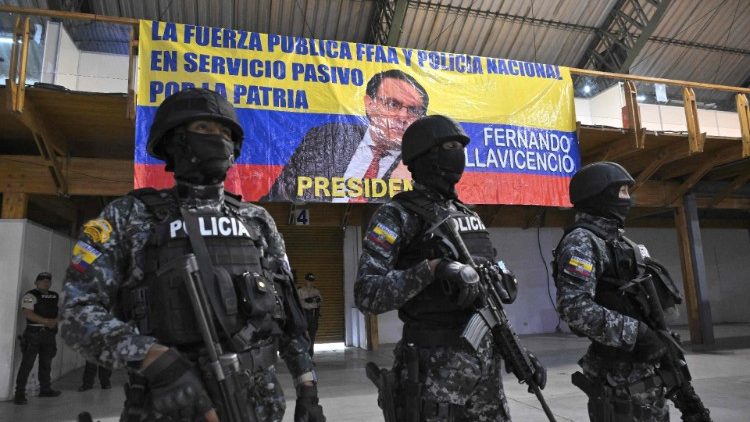
An election poster with Fernando VillavicencioAn election poster with Fernando Villavicencio  (AFP or licensors)

Pope Francis condemns 'unjustifiable violence' in Ecuador

In a telegram of condolence over the murder of Ecuadoran presidential candidate Fernando Villavicencio, Pope Francis expresses his sorrow and calls on the nation's political leaders and citizens to unite in favour of peace.

By Vatican News staff reporter

Pope Francis has appealed on the political forces and citizens of Ecuador to unite "in a common effort for peace".

The Pope sent a telegram, signed by Cardinal Pietro Parolin, the Vatican Secretary of State, to Archbishop Alfredo José Espinoza Mateus of Quito, on Saturday.

He expressed his sorrow over the assassination of the country's presidential candidate Fernando Villavicencio, while condemning "the unjustifiable violence" that causes suffering.

A united effort for peace

The Pope then offered his condolences to the Archbishop, to the family of the deceased "and to all the beloved people of Ecuador," inviting "citizens and political forces to unite in a common effort for peace".

Entrusting Fernando Villavicencio's repose to the "maternal intercession of Our Lady of El Quinche," the Pope offered his apostolic blessing "as a sign of faith and hope in the Risen Christ."

The murder of Villavicencio

Fernando Villavicencio, a journalist and centrist candidate for president of Ecuador, was gunned down on 9 August in the capital Quito at the end of an election rally.

He had spoken out strongly against the power of gangs and cartels, and his murder has been claimed by local organized crime.

Sunday, March 19, 2023

Pope prays for earthquake victims in Ecuador and Peru


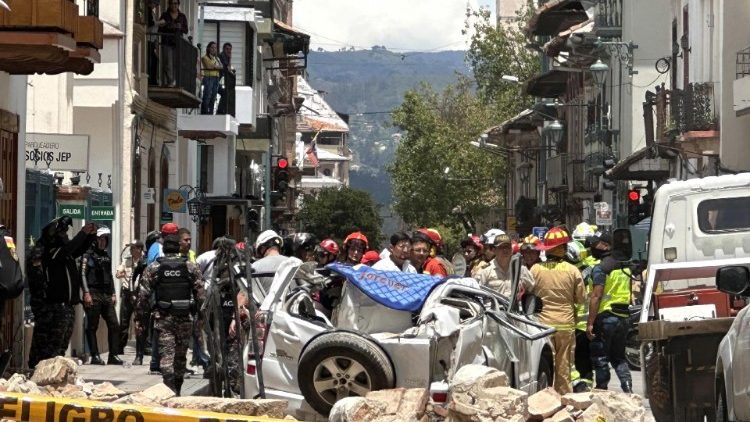
at least 16 dead after 6.5 magnitude earthquake hits Ecuador and Peruat least 16 dead after 6.5 magnitude earthquake hits Ecuador and Peru  (ANSA)

Pope close to quake-struck Ecuador

Pope Francis expresses closeness to those affected by a powerful earthquake in Ecuador and prays for the victims. During the Angelus he also asks for prayers for war-ton Ukraine and greets dads celebrating "Fathers' Day".

By Linda Bordoni

Pope Francis said he is praying for the victims of a strong earthquake that shook southern Ecuador and northern Peru on Saturday night.

The 6.8 magnitude quake has killed at least 16 people and left others trapped under rubble. An estimated 381 people were injured in the quake.

Speaking during the Angelus address on Sunday, the Pope said he is close to the people of Ecuador and he assured his prayers for all those who have died or are injured.

The Saturday night quake also brought down homes and buildings from coastal areas to the highlands.

Observers note the buildings that crumbled, were overwhelmingly inhabited by poor people and were old and did not meet building standards in the earthquake-prone country.

The tremor, centered just off the Pacific Coast, was about 80 kilometers south of Guayaquil, Ecuador's second-largest city.

Ecuador's emergency response agency reported that several people remain trapped under rubble.

Ecuador is particularly prone to earthquakes. In 2016, a quake centered farther north on the Pacific Coast in a more sparsely populated area of the country killed more than 600 people. In Peru, the earthquake was felt from its northern border with Ecuador to the central Pacific coast.

Authorities in Peru reported one death and said homes were destroyed and the old walls of an Army barracks collapsed in Tumbes.

Prayers for Ukraine

And as has become a tradition during his Angelus addresses and during the weekly General Audiences, Pope Francis turned his thoughts to war-torn Ukraine and reminded all men and women of goodwill to join in prayer for the tormented nation,.

"Let's not forget to pray for the martyred Ukrainian people that continue to suffer for the crimes of war," he said.

Father's Day

Finally, having noted the many different national flags in St. Peter's Square representing groups of pilgrims and visitors from all over the world, the Pope said: "Today we greet all fathers":

“May they find in St. Joseph the model, the support, the comfort to live their fatherhood well.”

All together, for fathers, he concluded, let us pray to the Father: "Our Father who art in heaven..."

Monday, April 18, 2016

More sad and breaking news from EWTN: the death of a nun who was the voice of a children's show character and 5 postulants in Ecuador earthquake

'Sister Clare Crockett, 33, of the Servant Sisters of the Home of the Mother in Ecuador was killed Saturday, April 16, in an earthquake. Please keep Sister, her family, and her community in your prayers. EWTN viewers know Sister as the voice of "Lucy" in the children's series, "Hi Lucy," which aired for many years on the Network.'

'Sister Clare Crockett, 33, of the Servant Sisters of the Home of the Mother in Ecuador was killed Saturday, April 16, in an earthquake. Please keep Sister, her family, and her community in your prayers. EWTN viewers know Sister as the voice of "Lucy" in the children's series, "Hi Lucy," which aired for many years on the Network.'

'Mayra, a postulant of the Servant Sisters of the Home of the Mother in Ecuador, was killed Saturday, April 16, in an earthquake. Please join us in praying for ths young girl as well as for her family and her community.'
+6
EWTN added 9 new photos.
 
Sister Clare was a young nun who was the voice of "Lucy" in the children's series "Hi Lucy" that aired on EWTN for many years. On Saturday, April 16, Sister Cla...re and five postulants -- Jazmina, Mayra, María Augusta, Valeria, and Catalina -- from the Servant Sisters of the Home of the Mother in Ecuador -- were killed in an earthquake. Below is Sister Clare's wonderful vocation story as well as a link to a news story on the tragedy. We ask you to join us in prayer for all who lost their lives, for their families, and for their religious communities. http://www.catholicherald.co.uk/…/northern-irish-nun-kill…/…
Testimony of Sr. Clare Crockett
Religious Name: Sister Clare Maria of the Trinity and the Heart of Mary
Date of Entrance into the Servant Sisters: August 11, 2001
Age at Entrance: 18 years old
City and Country of Origin: Derry, Northern Ireland
Date of Perpetual Vows: September 8, 2010
Current Community: Playa Prieta (Ecuador)
I grew up in a Catholic family. I’m from a small part of the world called Derry, which is in the North of Ireland. A place where, when I was growing up, “Catholic” and “Protestant” were political terms. Just because you grew up in a Catholic family, it did not necessarily mean that you attended Mass or had any formation about the Catholic faith, no. The Catholics who wanted a united Ireland killed the Protestants, and the Protestants who didn’t want a united Ireland killed the Catholics. That was what being Catholic meant to me. God played no part in my life. In a society where hatred prevailed, there was no room for God.
Ever since I was little, I always wanted to be an actress. When I was around fifteen, I joined an acting agency and had a manager. I was a presenter for some television programs, I wrote plays, did a lot of stage acting, won awards and when I was eighteen I had a small part in a movie.
I liked to party a lot. My weekends, since I was sixteen/seventeen, consisted in getting drunk with my friends. I wasted all my money on alcohol and cigarettes. One day one of my friends called me. “Clare”, she said, “do you want to go on a free trip to Spain?” Free trip to Spain, I thought, ten days of partying in sunny Spain – of course I wanted to go! She told me that all the people who were going were going to meet together the next week. The next week came, and I went to the house where we were going to meet. I walked into a room and it was filled with people around the age of forty and fifty and they all had Rosary beads in their hands. “Are you all going on the trip to Spain?” I asked them, almost afraid that they were going to say what they all responded enthusiastically three seconds later “ Yes...we’re going on the pilgrimage”. Yes my dear friends, we were going on a pilgrimage for 10 DAYS! I tried to get out of it, but my name was already on the ticket, so I had to go. I now see that it was Our Lady’s way of bringing me back Home, back to Her and Her Son.
The pilgrimage was during Holy Week in a 16th Century Monastery, not quite what I had imagined when I thought about going to Spain. The Holy Week Encounter that we attended was with a group called the Home of the Mother and I was not a very happy camper. Nevertheless, it was on that pilgrimage that Our Lord gave me the grace to see how He had died for me on the Cross. After I had received that grace, I knew that I had to change. I asked myself: “If He has done this for me what am I doing for Him?”
It’s so easy, when you’re on a retreat or when you “feel” the love of God, to say to Him: “I’ll do whatever You want me to do,” but when you “come down from the mountain” it’s not that easy. The sisters had invited me to go with them and other girls on a pilgrimage to Italy. I went and despite the very superficial attitude that I had during the pilgrimage, Our Lord spoke very clearly to me. He wanted me to live like the sisters in poverty, chastity, and obedience. I automatically told Him that that was impossible for me. I said: “I can’t be a nun! I can’t leave drinking, cigarettes, partying, my career, and my family.” If Jesus asks us to do something He also gives us the strength and the grace to do it, there is no doubt about that. Without His help I would not have been able to do what I had to do to respond to His call and follow Him.
After I knew what He was calling me to do, the Lord gave me another big grace when I was filming a movie in England. I saw that even though it seemed that I had everything, in reality I had nothing. I felt a great emptiness as I sat on top on my bed in the hotel room. All that I had ever wanted I seemed to be achieving and I wasn’t happy. I knew that I would only be truly happy by doing what God wanted of me. Our Lord showed me that my wild lifestyle deeply hurt His Sacred Heart. I knew that I had to leave everything and follow Him. I knew with great clarity that He was asking me to trust in Him, to put my life in His Hands and to have faith.
I am now very happily consecrated in the Servant Sisters of the Home of the Mother. It never ceases to amaze me how Our Lord works in the souls, how He can totally transform one’s life and capture one’s heart. I thank God for the patience that He has had with me, and still has!!!! I do not ask Him why He has chosen me, I just accept it. I depend totally on Him and Our Blessed Mother and I ask them to give me the grace to be whatever they want me to be.

Wednesday, July 8, 2015

Pope Francis in Ecuador teaches on solidarity & subsidiarity

Pope in Ecuador Urges Translating Love for Family Into Love for Society

Reflects: If only we could view our political opponents or neighbors in the same way we view our children or our spouse, mother or father!

Ecuador, (ZENIT.org) Kathleen Naab               


Pope Francis addressed the civil society of Ecuador this evening with the closeness and spontaneity of a family member, saying that since the mayor had given him the keys of the city of Quito, he felt that he was "at home."
He then went on to speak of three social values or principles, saying that they must be taught at home: gratuitousness (you have received freely; you must give freely), solidarity and subsidiarity.
The Pope’s remarks came following greetings from three Ecuadorian leaders and a performance by a choir for people with Down syndrome or disabilities. One of those who greeted the Pope was an 85-year-old woman who explained that she had been working as a catechist for 60 years.
Francis began his address lightheartedly asking pardon for not facing the audience fully, since the light for the podium came from the side and he said he needed light because, "I don’t see well."
In his address, he encouraged his listeners to extend the care given to family to the whole of society.
"Our society benefits when each person and social group feels truly at home. In a family, parents, grandparents and children feel at home; no one is excluded. If someone has a problem, even a serious one, even if he brought it upon himself, the rest of the family comes to his assistance; they support him. His problems are theirs. Should it not be the same in society?"
In this context, the Pope departed from his prepared text to say that an image came to his mind, scenes he had seen in Buenos Aires, of women forming long lines to see their sons or husbands in prison. Though these men had "behaved badly," he said, "they were still part of the home," the Holy Father reflected, saying that these women teach a great lesson.
"If only we could view our political opponents or neighbors in the same way we view our children or our spouse, mother or father! Do we love our society? Do we love our country, the community which we are trying to build? Do we love it in the abstract, in theory? Let us love it by our actions more than by our words! In every person, in concrete situations, in our life together, love always leads to communication, never to isolation," he said.
Giving freely
The Pope then spoke about the first of the three values: gratuitousness.
"Parents know that all their children are equally loved, even though each has his or her own character. But when children refuse to share what they have freely received, this relationship breaks down. The love of their parents helps children to overcome their selfishness, to learn to live with others, to yield and be patient," he said.
Again departing from his text, he recounted how he likes to ask children a question: if you have two candies, and a friend arrives, what do you do? He said that generally the answer is that they would give one to the friend. But if the question is that you have one candy and a friend arrives, then the answers range from giving it to the friend, splitting it, or hiding it in a pocket.
"In the wider life of society we come to see that 'gratuitousness' is not something extra, but rather a necessary condition of justice," he emphasized, repeating the words. "Who we are, and what we have, has been given to us so that we can place it at the service of others."
Speaking concretely about the need to protect the Amazon, the Pontiff referenced Laudato Si’, exhorting Ecuador to take a leading role: "Ecuador – together with other countries bordering the Amazon – has an opportunity to become a teacher of integral ecology. We received this world as an inheritance from past generations, but also as a loan from future generations, to whom we will have to return it!"
Responsible one for another
Moving to the principle of solidarity, Francis said, "Out of the family’s experience of fraternity is born solidarity in society, which does not only consist in giving to those in need, but in feeling responsible for one another."
In speaking about solidarity, the Pope again departed from his prepared text to speak about the problem of unemployment among young people. Referring to two groups of people discarded by society — the unborn and the elderly — he proposed, as he has on other occasions, that lack of work for youth is also a form of injustice that must be rectified.
"Hoping in a better future calls for offering real opportunities to people, especially young people, creating employment, and ensuring an economic growth which is shared by all (rather than simply existing on paper, in macroeconomic statistics), and promoting a sustainable development capable of generating a solid and cohesive social fabric," he said.
Finally, in speaking about subsidiarity, the Pope said that every one has to be free and the goodness inherent in others must be recognized.
"Individuals and groups have the right to go their own way, even though they may sometimes make mistakes," he noted.
"Dialogue is needed and is fundamental for arriving at the truth, which cannot be imposed, but sought with a sincere and critical spirit," the Pope added. "In a participatory democracy, each social group, indigenous peoples, Afro-Ecuadorians, women, civic associations and those engaged in public service are all indispensable participants in this dialogue."
The Holy Father said that the site of his visit was an image of this dialogue.
"The walls, patios and cloisters of this city eloquently make this point," he said, "Rooted in elements of Incan and Caranqui culture, beautiful in their proportions and shapes, boldly and strikingly combining different styles, the works of art produced by the 'Quito school' sum up that great dialogue, with its successes and failures, which is Ecuador’s history. Today we see how beautiful it is. If the past was marked by errors and abuses – how can we deny it! – we can say that the amalgamation which resulted radiates such exuberance that we can look to the future with great hope."
The Pope concluded the day with a private visit to the Church of St. Ignatius, just a few-minutes drive from the Church of St. Francis where he gave his address. He spent some 25 minutes in prayer at the church. On Wednesday, he will visit a home for the elderly run by the Missionaries of Charity, and then meet with clergy and religious, before departing for Bolivia at noon.
Tuesday, July 7, 2015

Faithful in Ecuador won't let Pope go to sleep!

Francis to Crowds: Hail Mary, Blessing, ‘Go to Sleep’

For 2nd Night, Large Crowds Shout 'Come Out, Pope,' at His Residence at Apostolic Nuncio in Quito

Ecuador, (ZENIT.org) Deborah Castellano Lubov              


'Go to sleep,' so the 'neighborhood can sleep' is the recommendation Pope Francis has for enthusiastic crowds who have for the past two nights gathered outside the Quito residence of the Apostolic Nuncio, where he is spending the night.
Since Francis has arrived in the Ecuadorian capital during his nine-day, three-country Apostolic Visit to Latin America, July 5-13, the Pope has responded to the many, eager faithful calling for him to come out.
Making a surprise appearance outside the residence, both Sunday and last night, the Holy Father greeted the large, loud crowd, who were singing to welcome him, and to exit and greet them.
"Come out, Pope," they were shouting, sources say.
Eventually, Pope Francis conceded, stepping out of the residence, praying a Hail Mary with them, and telling them once again to "Go to bed," so “the neighborhood can sleep.”
The next stops on the Pope's full agenda are Bolivia tomorrow, for a couple of hours due to the high altitude, and then Paraguay.
In the region which claims about 40 percent of the world's Catholics, the countries the Holy Father is visiting are very Catholic and very poor. According to Pew Research Center, the Catholics in Ecuador make up 79 percent of its population; in Bolivia, 77 percent; in Paraguay, 89 percent.

Monday, July 6, 2015

Pope Francis celebrates Mass for Families in Ecuador

Pope Francis celebrates Mass for families in Guayaquil park


Pope Francis arrives at Samanes Park, Guayaquil - AP

06/07/2015

(Vatican Radio) The family is a ‘domestic Church’ where we learn to love and serve others, to show gratitude not greed, and to ask forgiveness when we have caused harm. That was the theme Pope Francis’ homily at Mass in Ecuador’s main commercial city of Guayaquil, located on the Pacific coast of the South American nation. The Pope travelled to the port city from the capital Quito to celebrate an open air Mass on Monday, the first full day of his pastoral visit to Ecuador, Bolivia and Paraguay.
In his homily, Pope Francis reflected on the Gospel passage of the wedding in Cana, where Mary shows herself concerned for the needs of others and tells her son Jesus that the wine has run out. Wine is a sign of “happiness, love and plenty”, the Pope said, noting that many young, old and lonely people sense that “these are no longer found in their homes”.
The Pope urged his listeners to open their hearts, like Mary, to hear the words of Jesus who came to serve, especially those on the peripheries, the hopeless and the loveless. “Say it until you are convinced of it”, he said, “the best wine is yet to come”.
Please find below the full text of Pope Francis’ prepared homily for Mass in Quayaquil
Homily at the Mass for Families
Samanes Park, Guayaquil, Monday, 6 July 2015
            The Gospel passage which we have just heard is the first momentous sign in the Gospel according to John.  Mary’s maternal concern is seen in her plea to Jesus: “They have no wine”, and Jesus’ reference to “his hour” will be more fully understood later, in the story of his Passion.
            This is good, because it allows us to see Jesus’ eagerness to teach, to accompany, to heal and to give joy, thanks to the words of his Mother: “They have no wine”.
            The wedding at Cana is repeated in every generation, in every family, in every one of us and our efforts to let our hearts find rest in strong, fruitful and joyful love.  Let us make room for Mary, “the Mother” as the evangelist calls her.  Let us journey with her to Cana.
            Mary is attentive in the course of this wedding feast, she is concerned for the needs of the newlyweds.  She is not closed in on herself, worried only about her little world.  Her love makes her “outgoing” towards others.  So she notices that the wine has run out.  Wine is a sign of happiness, love and plenty.  How many of our adulescents and young people sense that these are no longer found in their homes?   How many women, sad and lonely, wonder when love left, when it slipped away from their lives?  How many elderly people feel left out of family celebrations, cast aside and longing each day for a little love?  This lack of “wine” can also be due to unemployment, illness and difficult situations which our families may experience.  Mary is not a “demanding” mother, a mother-in-law who revels in our lack of experience, our mistakes and the things we forget to do.  Mary is a Mother!  She is there, attentive and concerned.
            But Mary approaches Jesus with confidence, Mary prays.  She does not go to the steward, she immediately tells her Son of the newlyweds’ problem.  The response she receives seems disheartening: “What does it have to do with you and me?  My hour has not yet come” (v. 4).  But she nonetheless places the problem in God’s hands.  Her concern to meet the needs of others hastens Jesus’ hour.  Mary was a part of that hour, from the cradle to the cross.  She was able “to turn a stable into a home for Jesus, with poor swaddling clothes and an abundance of love” (Evangelii Gaudium, 286).  She accepted us as her sons and daughters when the sword pierced her heart.  She teaches us to put our families in God’s hands, to pray, to kindle the hope which shows us that our concerns are also God’s concerns.
            Praying always lifts us out of our worries and concerns.  It makes us rise above everything that hurts, upsets or disappoints us, and it puts us in the place of others, in their shoes.  The family is a school where prayer also reminds us that we are not isolated individuals; we are one and we have a neighbour close at hand: he or she is living under the same roof, is a part of our life, and is in need.
            Mary finally acts.  Her words, “Do whatever he tells you” (v. 5), addressed to the attendants, are also an invitation to us to open our hearts to Jesus, who came to serve and not to be served.  Service is the sign of true love.  We learn this especially in the family, where we become servants out of love for one another.  In the heart of the family, no one is rejected.  “In the family we learn how to ask without demanding, to say ‘thank you’ as an expression of genuine gratitude for what we have been given, to control our aggressivity and greed, and to ask forgiveness when we have caused harm.  These simple gestures of heartfelt courtesy help to create a culture of shared life and respect for our surroundings” (Laudato Si’, 213).  The family is the nearest hospital, the first school for the young, the best home for the elderly.  The family constitutes the best “social capital”.  It cannot be replaced by other institutions.  It needs to be helped and strengthened, lest we lose our proper sense of the services which society as a whole provides.  Those services are not a type of alms, but rather a genuine “social debt” with respect to the institution of the family, which contributes so greatly to the common good.
            The family is also a small Church, a “domestic Church” which, along with life, also mediates God’s tenderness and mercy.  In the family, we imbibe faith with our mother’s milk.  When we experience the love of our parents, we feel the closeness of God’s love.
            In the family, miracles are performed with what little we have, with what we are, with what is at hand… many times, it is not ideal, it is not what we dreamt of, nor what “should have been”.  The new wine of the wedding feast of Cana came from the water jars, the jars used for ablutions, we might even say from the place where everyone had left their sins… “Where sin increased, grace abounded all the more” (Rom 5:20).  In our own families and in the greater family to which we all belong, nothing is thrown away, nothing is useless.  Shortly before the opening of the Jubilee Year of Mercy, the Church will celebrate the Ordinary Synod devoted to the family, deepen her spiritual discernment and consider concrete solutions to the many difficult and significant challenges facing families in our time.  I ask you to pray fervently for this intention, so that Christ can take even what might seem to us impure, scandalous or threatening, and turn it – by making it part of his “hour” – into a miracle.
            It all began because “they had no wine”.  It could all be done because a woman – the Virgin Mary – was attentive, left her concerns in God’s hands and acted sensibly and courageously.  But there was more to come: everyone went on to enjoy the finest of wines.  And this is the good news: the finest wines are yet to be tasted; for families, the richest, deepest and most beautiful things are yet to come.  The time is coming when we will taste love daily, when our children will come to appreciate the home we share, and our elderly will be present each day in the joys of life.  The finest of wines will come for every person who stakes everything on love.  And it will come in spite of all the variables and statistics which say otherwise; the best wine is yet to come for those who today feel hopelessly lost.  Say it until you are convinced of it: the best wine is yet to come.  Whisper it to the hopeless and the loveless.  God always seek out the peripheries, those who have run out of wine, those who drink only of discouragement.  Jesus feels their weakness, in order to pour out the best wines for those who, for whatever reason, feel that all their jars have been broken.
            As Mary bids us, let us “do what he tells us” and be thankful that in this, our time and our hour, the new wine, the finest wine, will make us recover the joy of being a family.

Sunday, July 5, 2015

Pope Francis is now in Ecuador

Pope lands in Ecuador, calls nation to continue in Catholic identity

Pope Francis. Credit: Daniel Iba?n?ez/CNA.
.- Landing in Ecuador on Sunday afternoon, Pope Francis began his tri-nation visit to Latin America by stressing the Gospel’s role in fostering respect, dialogue, and care for the vulnerable, while praising the nation’s centuries-old Catholic heritage.

“We can find in the Gospel a key to meeting contemporary challenges, respecting differences, fostering dialogue and full participation, so that the growth in progress and development already registered will ensure a better future for everyone, with particular concern for the most vulnerable of our brothers and sisters.”

“For centuries that faith has shaped the identity of this people and borne much good fruit,” he added.

Speaking of Ecuador’s Catholic heritage, the Pope cited the saints who have been produced by the country, such as St. Mariana de Jesus, St. Miguel Febres, and St. Narcisa de Jesús, as well as Blessed Mercedes de Jesús Molina, beatified in 1985 during St. John Paul II’s visit.

“These, and others like them, lived their faith with intensity and enthusiasm, and by their works of mercy they contributed in a variety of ways to improving the Ecuadorian society of their day.”

Pope Francis made these remarks during a welcoming ceremony at Ecuador’s Quito International airport shortly after his arrival. He spoke to a delegation which included Ecuador’s president, Rafael Correa, government authorities, and his fellow bishops.

The Pope told the delegation that his reason for coming to Ecuador was to be “a witness of God’s mercy and of faith in Jesus Christ.”

Ecuador is the first stop in Pope Francis’ visit to the continent of his birth, which is taking place July 5-13. The journey will also include stops in Bolivia and Paraguay.

Having reflected on the nation’s Catholic heritage, the Pope noted the Christian significance of Ecuador being home to the peak “closest to the sun” of Chimborazo, the point closest on earth nearest to outer space.

“We Christians identify Christ with the sun, and the moon with the Church, the community of the faithful. No one, save Jesus Christ, possesses his or her own light.”

“May the coming days make all of us ever more clearly aware of how close is the sun which ‘dawns upon us from on high’. May each of us be a true reflection of his light and his love.”

Pope Francis expressed his desire “to embrace all of Ecuador,” adding: “May you never lose the ability to protect what is small and simple, to care for your children and your elderly, to have confidence in the young, and to be constantly struck by the nobility of your people and the singular beauty of your country.”

The Pope concluded his address by appealing to “the Sacred Heart of Jesus and the Immaculate Heart of Mary, to which Ecuador has been consecrated.”

Although President Cerrea was present at the welcoming ceremony, the Pope – digressing from the custom – will not officially meet with the Ecuadorean leader until he after his July 6 visit to the sanctuary in Guayaquil, followed by lunch with the Jesuit Community at the Colegio Javier.