Showing posts with label crucifix. Show all posts

Monday, October 19, 2026

The death of a Priest celebrating Mass as large Crucifix crashes down upon him

 CATHOLIC PRIEST DIES UNDER THE WEIGHT OF A FALLING CRUCIFIX


BY THE ASSOCIATED PRESS

A Roman Catholic priest celebrating an evening Mass in southwestern Ecuador has died after a crucifix fell on him during the livestreamed service.

The Archdiocese of Guayaquil, a coastal city 265 kilometers (164 miles) southwest of the capital, Quito, identified the priest as Patricio Sánchez of Perpetuo Socorro Church.

Footage of the service on Saturday night shows a heavy crucifix detaching from the wall above the altar and striking Sánchez on the head as he celebrated Mass. He did not appear to see it falling.

Worshippers cried for help as the social media broadcast continued.

Local authorities have not commented on the incident.

Sánchez belonged to the Congregation of the Most Holy Redeemer, a Roman Catholic religious order founded in 1732 with a presence in 80 countries.

Friday, April 18, 2025

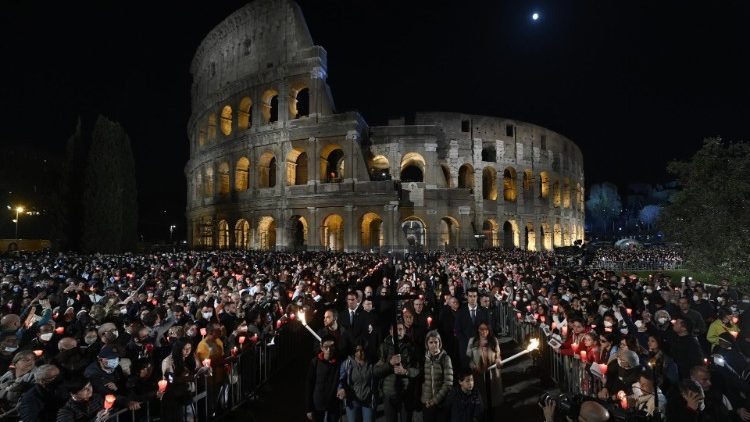
Good Friday Way of the Cross from Rome - Via Crucis


The Stations of the Cross at Rome's ColosseumThe Stations of the Cross at Rome's Colosseum  (Vatican Media)

Pope’s Via Crucis meditations: Embrace God’s economy in a world of algorithms

In his meditations written for the Good Friday Way of the Cross at the Colosseum—presided over this evening, 18 April, by Cardinal Baldo Reina on behalf of Pope Francis—the Holy Father explains that, faced with inhuman economies built on calculation and algorithms, cold logic and implacable interests, the only change of course is to turn to the Savior.

By Tiziana Campisi

A path offered to every human being—a journey inward, a reckoning of conscience, pausing on Christ’s sufferings on the way to Calvary. In his Via Crucis meditations, Pope Francis shows that the Way of the Cross is indeed the descent Jesus undertook “toward this world that God loves” (Station II). It is also “a response, an acceptance of responsibility” by Christ. He who, “nailed to the Cross,” intercedes, placing Himself “between conflicting parties” (Station XI), and carries them to God, for His “cross tears down walls, cancels debts, quashes judgments, establishes reconciliation.” Jesus, “the true Jubilee,” stripped of His garments and revealed even “to those who watch Him die,” looks upon them “as beloved ones entrusted by the Father,” showing His desire to save “all of us, each and every one” (Station X).

God’s economy

Pope Francis invites us to break free from our own schemes and to understand “God’s economy”, which “does not kill, discard or crush.  It is lowly, faithful to the earth”—and to follow the path of Jesus, that of “the Beatitudes,” which “It does not crush, but cultivates, repairs and protects.” (Station III). Yet it is the “divine economy” (Station VII)—so unlike today’s economies “of calculation and algorithms, of cold logic and implacable interests”—on which Francis dwells. For humanity, Christ accepted the cross, and its weight speaks of the breath of the Spirit, “‘who is Lord and gives life” (Station II). We, by contrast, “run out of breath from avoiding responsibility.” But, the Pope urges, “is to stop running away and to remain in the company of those you have given us, in the situations where you have placed us”; only then do we cease “to be prisoners” of ourselves. What truly burdens us are “selfishness” and “indifference.”

The prayer of people on the move

In his introduction to the fourteen Stations, Francis writes that in Jesus’ steps toward Golgotha “our exodus to a new land” is reenacted, for Christ “came to change the world,” and we too must “change direction, see the goodness of His traces.” Thus, “The Stations of the Cross is the prayer of people on the move.  It disrupts our usual routine.” It is a costly way in “this world that calculates everything,” where “gratuitousness comes at a dear price.” Yet “in the gift,” the Pope observes, “everything blossoms anew: a city split into factions and torn by conflict can move towards reconciliation; an arid piety can rediscover the freshness of God’s promises; and a heart of stone can turn into a heart of flesh.”

Human freedom

Jesus’ sentence of death prompts reflection on “dramatic interplay of our individual freedoms” (Station I). From the irrevocable trust with which God places Himself “in our hands,” bringing a “holy restlessness,” marvels can spring forth: “freeing the unjustly accused, discerning the complexities of situations, countering judgments that kill.” Yet we remain “prisoners” of the roles we cling to, afraid of the inconvenience of a change in our life’s direction. Often we let slip the possibility of the Way of the Cross. Christ, “silently before us in every sister and brother exposed to judgment and prejudice,” challenges us—but a thousand reasons (“religious arguments, legal quibbles,” and “the so‑called common sense that avoids involvement in others’ destinies”) drag us to the side of Herod, the priests, Pilate, and the crowd. Still, Jesus does not wash His hands of it; He loves “in silence.” In Station XI, nail‑ridden, He “shows us that in every circumstance there is a choice to be made”—the “amazing reality of our freedom”—as He attends both criminals, letting one’s insults pass and welcoming the other’s plea, even interceding for those who crucify Him: “Father, forgive them; for they do not know what they are doing.”

Falling and rising

At the Third Station, Jesus “falls the first time,” teaching that “the Way of the Cross is traced close to the earth: the mighty withdraw from it, yearning for heaven. Yet heaven hangs low, and we can find it even in our falls.” At His second fall (Station VII), Christ shows us “fall and rise again; fall and rise again,” the human adventure of sin and conversion. “We hesitate, stray, become lost,” yet we also experience joy—“the joy of new beginnings, the joy of rebirth.” Humans are “handcrafted”—unique mixtures of grace and responsibility. Jesus, made “one of us,” did not fear to stumble. We, however, often hide our falls, rejecting the path Christ chose. God’s economy, in which “ninety‑nine matter more than one,” is inhumane: today’s world is built on such logic “of calculation and algorithms, of cold logic and implacable interests.” The “divine economy,” by contrast, “is different.” Turning to Christ, who falls and rises, is “a change of course and a change of pace—a conversion that restores joy and brings us home.”

Like the Cyreneans

In Simon of Cyrene (Station V), returning from the fields, “they laid the cross on him,” illustrating how we can stumble upon God unexpectedly. Though Simon did not ask for the cross, he bore it. Christ’s yoke is “easy, and His burden is light,” and He loves involving us in His work that “which ploughs the earth so that it may be sown anew.” We need that surprising lightness. Without God, toil is in vain; “On the way of the cross, the new Jerusalem is rising.”

Women along the road to Calvary

Stations IV, VI, and VIII highlight women: Mary, Veronica, and the daughters of Jerusalem. Mary’s discipleship is “not a sacrifice but a continuous discovery.” She, “the first disciple,” shows that “In God, words are deeds, promises are realities.” Veronica’s veil bears Christ’s face—the proof of “His decision to love us to the last breath, and even beyond,” for “love is as strong as death.” And the daughters of Jerusalem, moved to weep, are urged to weep “for themselves and their children,” for our wounded coexistence, our broken world calls “for tears that are heartfelt and not merely perfunctory”

Jesus is among those who hope

At Station XIII, Joseph of Arimathea, “a good and righteous man … waiting expectantly for the kingdom of God,” takes Jesus’ body. Christ is “in the hands of someone who continues to hope, one of those who refuse to think that injustice always prevails,” granting “great responsibilities,” emboldening us. Finally, at Station XIV, the Sabbath silence of Holy Saturday: “Teach us how to do nothing at those times when it is asked of us only to wait.  Teach us sensitivity to the seasons of the earth.” Jesus, “laid in the tomb,” shares in our human condition, descending into the depths we fear, teaching rest, anticipation, and preparing all creation for resurrection peace.

Concluding Prayer
“‘Laudato sì, mi’ Signore’—‘Praise be to you, my Lord.’ In Saint Francis of Assisi’s canticle, our common home is a sister who cries out because of the harm we have inflicted on her. ‘Fratelli tutti’—‘Brothers and sisters all,’ the Pope writes, calling us to be marked by the flavour of the Gospel, ‘He loved us,’ wrote Saint Paul, ‘to make us realise that nothing can ever ‘separate us’ from that love.’

We have walked the Stations of the Cross.  We have turned towards the love from which nothing can ever separate us.  Now, as the King sleeps and a great silence descends upon all the earth, let us pray, in the words of Saint Francis, for the gift of heartfelt conversion:

“Most High and glorious God, Cast your light into the darkness of my heart. Grant me right faith, firm hope, perfect charity, and profound humility. Grant me, Lord, wisdom and understanding, so that I may do your true and holy will. Amen.”

Wednesday, September 13, 2023

The Feast of the Exaltation of the Holy Cross


Ordinary Time: September 14th

Feast of the Exaltation of the Holy Cross


MASS READINGS

September 14, 2021 (Readings on USCCB website)

COLLECT PRAYER

O God, who willed that your Only Begotten Son should undergo the Cross to save the human race, grant, we pray, that we, who have known his mystery on earth, may merit the grace of his redemption in heaven. Through our Lord Jesus Christ, your Son, who lives and reigns with you in the unity of the Holy Spirit, God, for ever and ever.

show

RECIPES (8)

show

ACTIVITIES (12)

show

PRAYERS (7)

show

LIBRARY (9)

show

BLOG & PODCASTS (5)


This feast was observed in Rome before the end of the seventh century. It commemorates the recovery of the Holy Cross, which had been placed on Mt. Calvary by St. Helena and preserved in Jerusalem, but then had fallen into the hands of Chosroas, King of the Persians. The precious relic was recovered and returned to Jerusalem by Emperor Heralius in 629.

The lessons from the Breviary tell us that Emperor Heraclius carried the Cross back to Jerusalem on his shoulders. He was clothed with costly garments and with ornaments of precious stones. But at the entrance to Mt. Calvary a strange incident occurred. Try as hard as he would, he could not go forward. Zacharias, the Bishop of Jerusalem, then said to the astonished monarch: "Consider, O Emperor, that with these triumphal ornaments you are far from resembling Jesus carrying His Cross." The Emperor then put on a penitential garb and continued the journey.


Exaltation of the Holy Cross
This day is also called the Triumph of the Cross, Elevation of the Cross, Holy Cross Day, Holy Rood Day, or Roodmas. The liturgy of the Cross is a triumphant liturgy. When Moses lifted up the bronze serpent over the people, it was a foreshadowing of the salvation through Jesus when He was lifted up on the Cross. Our Mother Church sings of the triumph of the Cross, the instrument of our redemption. To follow Christ we must take up His cross, follow Him and become obedient until death, even if it means death on the cross. We identify with Christ on the Cross and become co-redeemers, sharing in His cross.

We made the Sign of the Cross before prayer which helps to fix our minds and hearts to God. After prayer we make the Sign of the Cross to keep close to God. During trials and temptations our strength and protection is the Sign of the Cross. At Baptism we are sealed with the Sign of the Cross, signifying the fullness of redemption and that we belong to Christ. Let us look to the cross frequently, and realize that when we make the Sign of the Cross we give our entire self to God — mind, soul, heart, body, will, thoughts.

O cross, you are the glorious sign of victory.
Through your power may we share in the triumph of Christ Jesus.

Friday, March 17, 2023

On St. Pat's Day we also remember the Saint who buried the body of Jesus

St. Joseph of Arimathea


 The councillor (Lk 23:50) who, after the Crucifixion, requested the body of Christ from Pontius Pilate and provided for a proper burial for Christ. An immensely popular figure in Christian lore, Joseph was termed in the New Testament the "virtuous and righteous man" (Lk 23:50) and the man "who was himself awaiting the kingdom of God" (Mk 15:43). Described as .... . secretly a disciple of Jesus for fear of the Jews, [he] asked Pilate if he could remove the body of Jesus. And Pilate permitted it" (In 19:38). According to the apocryphal Gospel of Nicodemus, he helped establish the community of Lydda. He also was a prominent figure in the legends surrounding the Holy Grail, appearing in Rob­ert de Barron's early thirteenth-century romance Joseph d 'Arirnathea, William of Malmesbury's twelfth-century De Antiquitate Glastoniensis Ecclesiae, and Thomas Mallory's famed Morte D 'Arthur; William of almesbury's tale recounts Joseph's arrival in England with the Holy Grail and the building of the first church on the isle at Glastonbury; the passage on Joseph, however, was added in the thirteenth century.

Friday, August 26, 2022

Papal message to families to pray and gaze upon the Crucifix


Pope Francis with the family of Pedro Maria Guimaraes de MelloPope Francis with the family of Pedro Maria Guimaraes de Mello  (Vatican Media)

Pope to families: 'Never forget prayer, which keeps our faith alive'

Pope Francis tells members of the numerous de Mello family of Portuguese entrepreneurs never to forget prayer, and recalls the power of keeping our gaze fixed on the Crucifix.

By Deborah Castellano Lubov

"Let us not forget prayer, because prayer helps us to keep faith alive; the balm of faith is preserved by often turning our thoughts to the Lord: it can help us so much to look at the image of the crucifix, to stop our gaze there.. It is a beautiful way to pray."

Pope Francis gave this reminder when meeting with the Family of Pedro Maria Guirmaraes de Mello in the Vatican on Friday.

The Mello family is a Christian family of entrepreneurs and as such has over 100 years of history, dedicated to social responsibility, with very strong bonds with the Portuguese Catholic University. The family of 12 siblings employs over a thousand people, as they work to develop their businesses and their collaborators for a better world.

In his remarks, the Pope thanked them for their witness of their love for the Church and for their "pilgrimage to the tomb of St Peter."

"It is faith in Jesus that brought you here and brought you together. It is good to see a family united, and a family strengthened by the gift of faith."

Harmony in families

He expressed his joy to see the family and thinking of families like theirs.

"Seeing your family and thinking of families like yours," the Pope reflected, "I am reminded of Psalm 133: 'How good and how pleasant it is, when brothers dwell together as one! Like fine oil on the head, running down...'"

The oil, he noted, is a beautiful image of union, and of the happiness of being in communion.

"But the oil," he added, "is also an image of the faith that strengthens our bonds and, through the Holy Spirit, makes harmony in families possible - this is important - harmony also in the Church, in the world."


Never run out of 'oil of faith'

"I encourage you," the Pope continued, "never to let the oil of faith run out in your lamps."

In this way, he said, they collaborate with the grace of God that we experience in our encounter with Him.

"We experience the Lord's presence in many circumstances, but especially in the sacraments and meditation on His Word," he said.

Prayer keeps faith alive

Never forget prayer, the Pope insisted.

"Not only does it keep faith alive," he said, "the very act of turning our thoughts to the Lord" can do the faithful so much good.

Keeping our gaze fixed on the Crucifix, the Pope said, "is a beautiful way to pray."

Trust in Lord's goodness

"As a family and as individuals," he said, "I invite you to go forward on your journey of faith, trusting in the goodness of the Lord and in the protection of the Blessed Virgin, whom you venerate with so much love at Fatima. "

Pope Francis concluded by inviting them to join him in praying three Hail Marys and asking them to pray for him.

Saturday, September 14, 2019

Today is the Feast of the Holy Cross

Feast of the Exaltation of the Holy Cross


EXALTATION OF THE HOLY CROSS

(Triumph of the Cross)

This feast celebrates three things: the discovery of the true cross by St. Helena, the dedication of the Basilica and Shrine built on Calvary by her son Emperor Constantine, and the triumph of the cross by which Christ defeated sin and death, winning for us salvation and everlasting beatific life in heaven.

St. Teresa Benedicta of the Cross wrote this meditation on September 14, 1941, less than a year before her death at Auschwitz on August 9, 1942.
“In his Holy Rule, St. Benedict ordained that the fasts for religious begin with the feast of the Exaltation of the Cross. The long-extended Easter joy and the solemn feasts of summer culminating in the crowning of the Queen of Heaven could possibly cause the image of the Crucified to fade in us or to recede, as it remained hidden during the first centuries of Christianity. But when its time came, the cross appeared gleaming in the heavens, prompting the search for the buried and forgotten wood of humiliation that was to be recognized as the sign of salvation, the emblem of faith and the mark of the faithful. Every year, when the church again raises it before us, we are to recall the challenge of the Lord: Anyone who would follow me must take up his [or her] cross…! To take up one’s cross means to go the way of penance and renunciation. For us religious, to follow the Savior means to allow ourselves to be fastened to the cross by the three nails of the holy vows. The Exaltation of the Cross and the renewal of vows belong together.
“The Savior has preceded us on the way of poverty. All the goods in heaven and on earth belonged to him. They presented no danger to him; he could use them and yet keep his heart completely free of them. But he knew that it is scarcely possible for people to have possessions without succumbing to them and being enslaved by them. Therefore, he gave up everything and showed more by his example than by his counsel that only one who possesses nothing possesses everything. His birth in a stable, his flight to Egypt, already indicated that the Son of Man was to have no place to lay his head. Whoever follows him must know that we have no lasting dwelling here. The more deeply we feel this, the more zealous we are in striving for the future, and we rejoice at the thought that our citizenship is in heaven…

“Your will be done! This was the content of the Savior’s life. He came into the world to fulfill the Father’s will, not only to atone for the sin of disobedience through his obedience, but also to lead people back to their destiny by the way of obedience The created will is not destined to be free to exalt itself. It is called to come into unison with the divine will. If it freely submits itself to this unison, then it is permitted in freedom to participate in the perfection of creation. If a free creature declines this unison, it lapses into bondage. The human will continues to retain the possibility of choice, but it is constrained by creatures that pull and pressure it in directions straying from the development of the nature desired by God, and so away from the goal toward which it itself was directed by its original freedom. With the loss of this original freedom, it also loses security in making decisions. It becomes unsteady and wavering, buffeted by doubt and scruples or obdurate in its error. There is no other remedy for this than the following of Christ, the Son of Man, who not only promptly obeyed his heavenly Father, but also subjected himself to people who imposed the Father’s will on him. The obedience enjoined by God releases the enslaved will from the bonds of creatures and leads it back to freedom. Thus, it is also the way to purity of heart.
“No chains of slavery are stronger than those of passion. Under its burden body, soul and spirit lose their strength and health, their clarity and beauty. Just as it is scarcely possible for one impaired by original sin to own things without clinging to them, so there is also the danger that any natural affection may degenerate into passion with all of its devastating consequences. God has provided two remedies for this: marriage and virginity. Virginity is the more radical and precisely therefore probably the easier way. But this is surely not the deepest reason why Christ set us an example of it. Marriage is already a great mystery as the symbol of the bond between Christ and the church and at the same time as its instrument. But virginity is a still deeper mystery. It is not only the symbol and instrument of bridal union with Christ and of the union’s supernatural fruitfulness, but also participates in the union. It originates in the depths of the divine life and leads back to it again. The eternal Father in unconditional love has given his entire being to his Son. And just as unconditionally does the Son give himself back to the Father. The passage of the God Man through temporal life could alter nothing of this complete surrender of Person to Person. He belongs to the Father from eternity to eternity and could not give himself away to any human being. He could only incorporate the persons who wanted to give themselves to him into the unity of his Incarnate Divine Person as members of his Mystical Body and in this way bring them to the Father. This is why he came into the world. This is the divine fertility of his eternal virginity: that he can give souls supernatural life. And the fruitfulness of the virgins who follow the Lamb consists in the ability to assume the divine life in unmitigated strength and undivided surrender and, in union with the divine Head, to pass it on to other souls, so awaking new members for the Head.
“Divine virginity has a characteristic aversion to sin as the contrary of divine holiness. However, this aversion to sin gives rise to an the indomitable love for sinners. Christ has come to tear sinners away from sin and to restore the divine image in defiled souls. He comes as the child of sin; his genealogy and the entire history of the Old Covenant show this and he seeks the company of sinners so as to take all the sins of the world upon himself and carry them away to the infamous wood of the cross, which thereby therefore becomes the sign of his victory. This is precisely why virginal souls do not repulse sinners. The strength of their supernatural purity knows no fear of being sullied. The love of Christ impels them to descend into the darkest night. And no earthly maternal joy resembles the bliss of a soul permitted to enkindle the light of grace in the night of sins. The way to this is the cross. Beneath the cross the Virgin of virgins becomes the Mother of Grace.”

Monday, August 20, 2018

Lizzie Answers explains the Crucifix

What a great change of pace here as Lizzie is spot on for her 2nd consecutive video that is so well done; nice to post something related to the recent bad news.

In this video she explains how she so disliked the crucifix until she came fully around to home in the Church:


https://www.youtube.com/watch?v=tVIaIPOzqLk