Showing posts with label Archdiocese of Quebec. Show all posts

Tuesday, September 15, 2026

Canadian Bishop wants reconciliation with her neighbor, The United States


Amid tensions, Canadian bishop reminds Catholics of US, Canada: 'We are neighbors'

September 15, 2026

by Michael J. O'Loughlin

Elbows Up for Canada protesters gather near The Peace Bridge border crossing in Buffalo, N.Y., April 2, 2025. (AP/Adrian Kraus)

With relations between Canada and the United States fraying due to the U.S. trade war, the president of the Canadian Conference of Catholic Bishops says that despite increased tension, he hopes the two nations can reconcile.

"First of all, we are neighbors," Bishop Pierre Goudreault told NCR in a recent interview. "We have a lot in common and, very recently, the relationship was very good. We hope it will continue."

The 63-year-old bishop of Sainte-Anne-de-la-Pocatière, Quebec, said that Catholics have a special duty to refrain from adding to political polarization and should instead strive to "walk together in a spirit of peace."

Relations between Canada and the United States have deteriorated rapidly since President Donald Trump launched a trade war against Canada in 2025. When talks broke down last fall, even Pope Leo XIV weighed in, offering comments on what he described as "great difficulties" between the two nations. "Two countries that were once considered the closest allies at times have become separated from one another," Leo added.

Bishop Pierre Goudreault of Sainte-Anne-de-la-Pocatière, Quebec (CNS/Vatican Media)


The U.S. and Canada remain locked in a tariff war, with Trump levying 50% tariffs on many Canadian goods in August, and Canada responding with their own tariffs on Sept. 8. 

As recently as 2024, a majority of Canadians viewed the United States in a positive light, but earlier this summer, a Pew Research Center poll found that just 33% of Canadians hold a favorable view of the U.S., down from a recent high of 63% in 2022.

Americans meanwhile hold a much higher view of Canada, with 74% saying last year they had a favorable view of the country.

The pope suggested last year that perhaps lessons from the church's ongoing efforts at synodality could help heal the relationship. That suggestion was given a hearing earlier this month, when Goudreault joined bishops from the United States and Mexico at a special meeting in the Mexican city of Cuernavaca, hosted by Bishop Ramón Castro Castro, president of the Episcopal Conference of Mexico. Bishop Daniel Flores, vice president of the United States Conference of Catholic Bishops, and Bishop Oscar Cantú, chairman of the U.S. bishops' Subcommittee on Hispanic/Latino Affairs, also participated.

Perhaps presciently, the Aug. 30-Sept. 4 meeting was a couple of years in the making, according to Flores, and the bishops discussed a range of issues, including artificial intelligence and evangelization. But much of the meeting was focused on migration, which affects each country in unique ways, Goudreault said.

"For us, the situation of migration is not a problem," he said. "It's persons, and I think we have also to think about their human dignity and how we can welcome them, accompany them."

Catholic bishops in the United States have been critical of Trump's mass deportation efforts, including a recent letter sent to the president from Oklahoma City Archbishop Paul Coakley, president of the U.S. bishops' conference, asking the White House to back off plans to deport "large numbers" of Haitian migrants.

"What good is the immense wealth, prosperity, and influence with which we have been blessed as a nation if not used in service of our humanity?" Coakley asked.

Flores, who in addition to his role at the bishops' conference also leads the border Diocese of Brownsville, Texas, said the meeting in Mexico was an opportunity to learn how the church assists migrants across very different political realities.

"You kind of realize that under very different circumstances in the three countries, the spirit of what the church tries to do to help the vulnerable becomes kind of like the common thread, even though our circumstances are vastly different," Flores told NCR. "And that's very helpful because it really is a source of encouragement to the people on the ground."

Speaking to NCR in Rome, Flores said that the meeting in Mexico serves as "an important sign of the Catholicity of the church," offering a reminder "that the church is supposed to be a witness that you can be different ... but there are certain things, a certain faith, that holds us together, and a common desire to serve our people."

A press release about the meeting said that through dialogue, church leaders hope "to help build bridges, to foster dialogue and to promote a culture of encounter." It continued, "It is not a matter of ignoring differences, but of learning to walk together from what unites us: the dignity of every person, the pursuit of the common good and the mission of proclaiming the Gospel."

As for future collaboration, Goudreault said the bishops sought to find ways to build stronger bonds and perhaps even encourage Catholics in their home countries to help heal some of the political rifts that have become more pronounced in recent years. For starters, he said, it's important not to label entire nations with too broad a brush.

"It's very important not to put everyone in the same bag," Goudreault said. "There's some political decisions that have been made — it doesn't mean that it's all the people who are talking that way."

He said Catholics across North America should focus on what they share in common, including "our faith, our human dignity, and we need today to have people who can witness to that."

"It's possible still to work together, to live in solidarity," he added.

NCR Vatican correspondent Justin McLellan contributed to this story.

Friday, January 26, 2024

Prominent Cardinal accused of clergy sex-abuse


Quebec cardinal, papal advisor named in sex abuse lawsuit


ROME – A Canadian cardinal and key ally of Pope Francis has been named in a class action sexual abuse lawsuit against the Archdiocese of Quebec, with the specific charge being that he inappropriately touched a 17-year-old girl on two occasions in 1987 and 1988.

Cardinal Gérald Lacroix’s name was added to a list of alleged perpetrators in the class action suit in court filings Thursday. The lawsuit was authorized in 2022, and covers anyone who was sexually assaulted by personnel of the Archdiocese of Quebec since 1940.

A spokesperson for Lacroix expressed “shock” over the new charge in comments Thursday.

“Different versions are circulating regarding the allegations against Cardinal Lacroix. We are trying to understand, and we will be able to comment later,” said Valérie Roberge-Dion, a spokesperson for Lacroix.

The class action suit is a civil action seeking monetary damages, and so far neither Ouellet nor Lacroix have been charged with any crime.

Lacroix, 66, a former missionary in Colombia, played a lead in Pope Francis’s 2022 visit to Canada. Last March, he was named by Francis to his Council of Cardinal Advisors, making him one of the pope’s most important advisors on matters of church reform.

During the Synod of Bishops on Synodality in October 2023, Lacroix defended the exercise in comments to reporters, saying that Pope Francis was attempting to promote a more “listening” church. He was among seven participants elected by the synod to oversee its concluding document.

According to attorney Alain Arsenault, who’s leading the class action lawsuit, Lacroix’s alleged victim, who has not been identified, is now in her 50s. She did not come forward previously, he said, out of concern for the reaction of her devout Catholic parents.

Arsenault said there were two alleged assaults, both of which are said to have occurred when the alleged victim accompanied her parents to a Bible study in Quebec. According to Arsenault, the woman charges that Lacroix, who would have been in his early 30s at the time, pulled her into a separate room and groped her, then instructed her not to tell her mother because it would “kill her” to learn what had happened.

Arsenault told reporters that the woman contacted the law firm only after her mother had died in order to join the class action suit.

Overall, the law firm says that 147 people have come forward with allegations of sexual abuse and assault against more than 100 priests and lay personnel of the archdiocese, some of whom are alleged to have multiple victims.

Arsenault said he doesn’t expect the case to go to trial in 2024. Instead, he said, attorneys will spend the year requesting and evaluating documents and also interviewing witnesses, presumably including Lacroix.

A member of the Pius X Secular Institute, which was founded in New Hampshire in 1939, Lacroix was ordained in 1988 and has played several leadership roles inside the community, including serving in Colombia from 1990 to 2000 opening new houses of the institute.

Lacroix was named the Archbishop of Quebec in 2011, replacing Ouellet. Pope Francis designated him as cardinal in January 2014. In addition to serving on the Council of Cardinals, Lacroix is also a member of the Dicastery for Divine Worship and the Discipline of the Sacraments.

Friday, July 29, 2022

Pope meets with indigenous peoples in Quebec before departing to the Arctic circle


Pope: ‘I leave Canada greatly enriched by indigenous peoples’

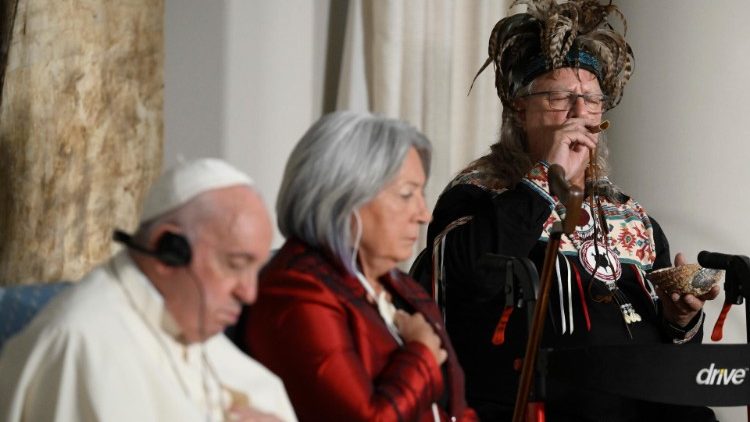
Ahead of his departure from Quebec, Pope Francis meets with a delegation of indigenous peoples to express appreciation for his welcome to Canada, saying that he hopes to have contributed to the path of reconciliation and healing.

By Devin Watkins

“I bear in my heart the incomparable treasure of all those individuals and peoples who have left a mark on me; the faces, smiles and messages that remain with me; the unforgettable stories and natural beauties; the sounds, colors and emotions that touched me deeply.”

Pope Francis offered those heartfelt words of appreciation to the people of Canada, as he prepared to depart from Quebec to make a brief stop in the northernmost city of Iqaluit.

The Pope met Friday morning with a delegation of indigenous people present in Quebec at the Archbishop’s Residence.

In his remarks, the Holy Father recalled the theme of his Apostolic Journey: “Walking Together”.

“The vastness of this land makes us think of the lengthy path of healing and reconciliation that we are facing together.”

‘Pain for wrong inflicted’

Pope Francis recalled that he came to Canada as a pilgrim and as “a friend in order to meet you and to see, hear, learn, and appreciate how the indigenous peoples of this country live.”

“I have come as a brother, to discover firsthand the good and bad fruit borne by members of the local Catholic family in the course of the years,” he said. “I have come in a spirit of penance, to express my heartfelt pain at the wrong inflicted on you by not a few Catholics who supported oppressive and unjust policies in your regard.”

The Pope expressed his hopes that his visit may advance the “search for truth” to help in healing and reconciliation, while sowing “seeds of hope” for future generations.

‘Greatly enriched’

As he prepared to depart Canada later on Friday, Pope Francis said he is returning to Rome “greatly enriched” and that he has felt particularly moved by the “indigenous realities of these lands”.

“I dare say, if you will allow me, that now, in a certain sense, I also feel a part of your family, and for this, I am honored.”

The celebration of the feast of St. Anne was a special highlight, said the Pope, since it offered a reminder to conserve the bond between young and old and “to maintain a healthy and harmonious relationship with all of Creation.”

Weave anew reconciliation

Pope Francis went on to encourage all Canadians—indigenous and non-indigenous alike—to entrust the fruits of his visit to three holy women: St. Anne, the Blessed Virgin Mary, and St. Kateri Tekakwitha.

St. Anne, he said, recalls the gifts of tenderness and protection; Mary points to our pilgrim path to heaven; and, St. Kateri offers an example of exemplary devotion to prayer and work, as well as the “ability to endure many trials with patience and meekness”.

“These women can help us to come together, and start to weave anew a reconciliation that can uphold the rights of the most vulnerable in our midst and look at history without resentment or forgetfulness.”

Journey toward healing

In conclusion, the Pope encouraged the people of Canada to follow the dreams God has planted in their hearts with “meekness and determination” in the footsteps of these holy women.

“May they bless the journey we now share,” he prayed, “and intercede for us and for this great work of healing and reconciliation that is so pleasing to God.”

Thursday, July 28, 2022

Pope Francis at evening Vespers in Quebec


Pope invites Canadian clergy to confront challenges of secularized world

At Vespers in the Notre-Dame de Québec Cathedral on Thursday, Pope Francis invites the Bishops, clergy, religious, and pastoral workers in Canada to overcome the challenges that hinder the proclamation of the joy of faith, and asks forgiveness for the sexual abuse of minors and vulnerable people by some members of the Church.

By Benedict Mayaki, SJ

Pope Francis, on Thursday evening – the fifth day of his Apostolic Journey to Canada – presided at Vespers with Bishops, clergy, consecrated persons, seminarians and pastoral workers at the Basilica of Notre-Dame de Québec.

During his homily at the event, the Holy Father highlighted the significance of meeting at the Cathedral of the Church, whose first bishop, St. François de Laval, opened the Seminary in 1663 and devoted his ministry to the formation of priests.

He pointed out that readings at the vespers speak about elders (presbyters), noting that St. Peter urged them to tend the flock of God willingly, and so, the Church’s pastors are invited “to show that same generosity in tending the flock, in order to manifest Jesus’ concern for everyone and his compassion for the wounds of each.”

Pastors, a sign of Christ

Tending the flock, the Pope said, should be done “with devotion and tender love” – as St. Peter urges - guiding it and not allowing it to go astray, because “we are a sign of Christ.” Pastors should do this willingly, not as a duty, like professional religious personnel or sacred functionaries but “zealously and with the heart of a shepherd.”

The Pope pointed out that the pastors too are “tended” with Christ's merciful love and feel the closeness of God. This, he affirmed, is “the source of the joy of ministry and above all the joy of faith.”

Christian joy

“Christian joy is about the experience of a peace that remains in our hearts, even when we are pelted by trials and afflictions,” the Pope said, “for then we know that we are not alone, but accompanied by a God who is not indifferent to our lot.”

He explained that this is not a “cheap joy” like the world sometimes proposes, or about wealth, comfort and security, rather, “it is a free gift, the certainty of knowing that we are loved, sustained and embraced by Christ in every situation in life.”

“So, let us ask ourselves a question: How are we doing when it comes to joy? Does our Church express the joy of the Gospel? Is there a faith in our communities that can attract by the joy it communicates?”

Threats to joy of faith

Reflecting on the joy of the Gospel in our communities, the Pope pointed at secularization as one of the factors that “threatens the joy of faith and thus risks diminishing it and compromising our lives as Christians.”

He laments that secularization has greatly affected the lifestyle of contemporary men and women, who relegate God to the background. “God seems to have disappeared from the horizon, and his word no longer seems a compass guiding our lives, our basic decisions, our human and social relationships,” the Pope said.


Considering the ambient culture, Pope Francis cautions against falling “prey to pessimism or resentment, passing immediately to negative judgments or a vain nostalgia.” He, rather elaborates two possible views of the world: the “negative view” and the “discerning view.”

Negative v. discerning views

The first view – the negative – is “often born of a faith that feels under attack and thinks of it as a kind of “armour”, defending us against the world,” the Pope said, adding that this view complains that “the world is evil, sin reigns” and risks clothing itself in a “crusading spirit.”

The Pope warns against this, as it is “not Christian” and “not the way of God.” He notes that God detests worldliness and has a positive view of the world, blesses our life and makes himself incarnate in historical situations to “give growth to the seed of the Kingdom in those places where darkness seems to triumph.”

We are called “to have a view similar to that of God, who discerns what is good and persistently seeks it, sees it and nurtures it.  This is no naïve view, but a view that discerns reality,” Pope Francis insists.

Secularization and secularism

To refine our discernment of the secularized world, the Holy Father recommends drawing inspiration from Paul VI who saw secularization as “the effort, in itself just and legitimate and in no way incompatible with faith or religion” to discover the laws governing reality and human life implanted by the Creator. Paul VI also distinguished between secularization and secularism which generates subtle and diverse “new forms of atheism,” including consumer society, pleasure set up as a supreme value, a desire for power and domination, and discrimination of all kinds.

As Church and as shepherds of God’s People and pastoral workers, therefore, the Pope says it is up to us to “make these distinctions” and “make this discernment”, adding that if we yield to the negative view, we risk sending the wrong message – as though the criticism of secularization masks “the nostalgia for a sacralized world, a bygone society in which the Church and her ministers had greater power and social relevance.”

“God does not want us to be slaves, but sons and daughters; he does not want to make decisions for us, or oppress us with a sacral power, exercised in a world governed by religious laws. No! He created us to be free, and he asks us to be mature and responsible persons in life and in society.”

Secularization: a challenge for our pastoral imagination

Secularization, continued the Pope, “demands that we reflect on the changes in society that have influenced the way in which people think about and organize their lives” – not the diminished social relevance of the Church.

Consequently, “secularization represents a challenge for our pastoral imagination,” and “an occasion for restructuring the spiritual life in new forms and for new ways of existing.” Thus, a discerning view “motivates us to develop a new passion for evangelization, to look for new languages and forms of expression, to change certain pastoral priorities and to focus on the essentials.”

Communicating the joy of the faith

Pope Francis goes on to stress the importance of communicating the Gospel and the joy of faith to today’s men and women, insisting that it is a proclamation of “a witness abounding with gratuitous love” that should take shape in “in a personal and ecclesial lifestyle that can rekindle a desire for the Lord, instil hope and radiate trust and credibility.”

Indicating three challenges that can shape prayer and pastoral service, the Pope said that the first is “to make Jesus known,” and return to the initial proclamation, amid the spiritual deserts created by secularism and indifference. He added that we must find new ways to proclaim the Gospel to those who have not yet encountered Christ and this calls “for a pastoral creativity capable of reaching people where they are living, finding opportunities for listening, dialogue and encounter.”

An occasion for conversion

The second challenge -witness- said the Pope, requires us to be credible, as the Gospel is preached effectively “when life itself speaks and reveals the freedom that sets others free, the compassion that asks for nothing in return, the mercy that silently speaks of Christ.”

On this note, the Pope thought of the Church in Canada that has been set on a new path after being hurt by the evil perpetrated by some of its sons and daughters. The Holy Father also spoke of the scandals of sexual abuse of minors and vulnerable people.

“Together with you, I would like once more to ask forgiveness of all the victims. The pain and the shame we feel must become an occasion for conversion: never again! … never again can the Christian community allow itself to be infected by the idea that one culture is superior to others, or that it is legitimate to employ ways of coercing others.”

To defeat the culture of exclusion, Pope Francis advocates that bishops and priests start from themselves and should not feel themselves superior to our brothers and sisters. Likewise, pastoral workers should “understand service as power.”

Fraternity, the third challenge, means the Church will be “a credible witness to the Gospel the more its members embody communion, creating opportunities and situations that enable all those who approach the faith to encounter a welcoming community one capable of listening, entering into dialogue and promoting quality relationships.”

“The Church is called to embody this love without borders, in order to realize the dream that God has for humanity: for us to be brothers and sisters all.”

Pope Francis offers holy Mass in Quebec


Pope at Mass in Canada: ‘Jesus leads us from failure to hope and healing’

Pope Francis celebrates Mass at the Shine of Sainte-Anne-de-Beaupré in eastern Canada, near Quebec, and recalls that Jesus always walks with us to help us move beyond our failures toward hope in God.

By Devin Watkins

At the start of the fifth day of his Apostolic Journey to Canada, Pope Francis presided over Mass in the National Shrine of Sainte-Anne-de-Beaupré, some 30 kilometers east of Quebec.

The Pope traveled by car to the oldest pilgrimage site in North America, which was first built in 1658 to house a miraculous statue of Jesus’ grandmother.

In his homily, Pope Francis reflected on the conclusion of Luke’s Gospel, which recounts the journey of the disciples to Emmaus and their encounter with Jesus, whom they did not initially recognize.

Failure along the way

The Pope said the disciples’ experience began with their distress and sadness at the apparent failure of Jesus’ plan but ended with the birth of a new hope, after Jesus accompanied them as a fellow traveler.

“Whenever our failures lead to an encounter with the Lord, life and hope are reborn and we are able to be reconciled: with ourselves, with our brothers and sisters, and with God.”

Like the disciples, we too can experience failure in our own spiritual journey when our plans fall through, when we give up on our high ideals due to our own inadequacies, or when we feel crushed by our sins.

Pope Francis said the Church community experiences similar setbacks when faced with “the scandal of evil and the violence that led to Calvary.”

Stuck in grief and remorse

The temptation in such moments of doubt and failure is to flee and seek refuge in grief and remorse.

“[Fleeing] is a temptation that comes from the enemy, who threatens our spiritual journey and that of the Church, for he wants us to think that all our failures are now irreversible.”

However, said Pope Francis, the Gospel teaches us that Jesus comes to walk by our side at precisely those moments of failure and teaches us to read events in a new light.

He noted that the Basilica of Sainte-Anne-de-Beaupré has been rebuilt three times, once after a devastating fire. Yet, the faithful of the area kept dreaming and set out again “with courage and creativity”.

Reconciliation and healing in Christ

Jesus, said Pope Francis, opens our eyes to the reality behind our perceived failures by breaking the bread and setting us back on the right path.

“What are we to do, as we endure spiritual and material trials, as we seek the path to a more just and fraternal society, as we strive to recover from our disappointments and weariness, as we hope to be healed of past wounds and to be reconciled with God and with one another?”

The answer lies in Jesus Himself, said the Pope, since He always comes to us to “show us the way to healing and reconciliation.”

Tender maternal love of Mary

Pope Francis encouraged the Church in Canada to look to the Blessed Virgin Mary and the other women of Easter morning who showed the disciples the truth of Jesus’ Resurrection.

“The tender maternal love of so many women can accompany us – as Church – towards new and fruitful times, leaving behind so much barrenness and death, and putting the crucified and risen Jesus back at the centre,” he said.

If we place Jesus back at the centre of our lives and faith, concluded Pope Francis, then we can be reconciled “with God, with others, and with ourselves” and become “instruments of reconciliation and peace within our societies.”

Pope Francis continues visit to Quebec


Pope Francis with the Governor General of Canada and an Indigenous leaderPope Francis with the Governor General of Canada and an Indigenous leader  (Vatican Media)

Pope in Québec to 'foster communion with Canada's Indigenous peoples'

As Pope Francis prepares to pray Vespers with the Bishops, clergy and religious of Canada at the Notre-Dame de Québec Cathedral, Fr. Jimmy Rodrigues, the Cathedral's rector, upholds the Pope’s visit as an important act that will promote communion with the country’s Indigenous peoples.

By Benedict Mayaki, SJ

The second leg of Pope Francis’ ongoing “Penitential Pilgrimage” has brought him to Québec City, where he will remain till Friday when he leaves for Iqaluit.

On Thursday evening, the Holy Father is scheduled to preside at Vespers with the Bishops, clergy, consecrated persons, seminarians and pastoral workers at the Notre Dame de Québec Cathedral.

As the Cathedral prepares to receive the Pope, Fr. Jimmy Rodrigue, Notre Dame’s Rector, shares his thoughts on the Pope’s presence in the country and his message of healing and reconciliation for the Indigenous peoples.

Action accompanied by words

Speaking to Vatican News' Silvonei Protz, Fr. Rodrigue describes the Pope’s visit to the Cathedral of Québec as a “deeply meaningful moment” and “an act which will be accompanied by words.”

The Cathedral’s Rector insists that the words which the Holy Father will speak have to be received with a “careful and deep attitude” in order to further foster communion.

He further stresses that this is the “principal attitude” needed in order to be ready to embrace directions for new creativity in ministry and actions with Canada’s Indigenous peoples.


A sign of communion

Although the Vespers in the Cathedral is primarily for the Bishops, clergy, religious and pastoral workers in Québec, Fr. Rodrigue says that it is also for “the whole Church in Canada.”

Pope Francis is expected to give a homily at the Thursday evening event.

“It will be a sign, a very beautiful sign of communion to receive together, the words of the Holy Father,” Fr. Rodrigue says, adding that he hopes that it will provide “strength to see the future with hope.”

In the priest’s opinion, the Pope’s presence in Canada is essential as it provides him with the opportunity to be more aware of the situation, as regards the sufferings inflicted on Indigenous peoples and the forced assimilation they endured in the residential school system administered also by some local Church institutions in the past.

On Monday, Pope Francis apologized to Canada’s Indigenous peoples, saying that he has come to their land in person to express his closeness to them and to “implore God’s forgiveness, healing and reconciliation.”

Fr. Rodrigue expressed hope that the Pope’s Apostolic Journey will create “better fruits for communion and for welcoming each other.”

Notre Dame of Québec Cathedral

Notre Dame of Québec is the oldest Church in Canada and is recognized as one of the country’s historic monuments.

In 1664, it became the first parochial church north of Mexico and was dedicated to Our Lady of the Immaculate Conception. In 1674, it became a cathedral following the appointment of St. Francis de Laval as the first bishop of Québec City. Two hundred years later, Pope Pius IX elevated it to a Basilica.

The Cathedral houses the tomb of St. François de Laval, a large reliquary of Canada’s Saints and Blesseds, and is adorned with a Holy Door which was installed in 2014 on the 350th Anniversary of Notre-Dame de Québec Parish.