Showing posts with label Bishop Daniel Flores. Show all posts

Tuesday, November 11, 2025

The USCCB elects Archbishop Coakley new President, Bishop Flores new Vice-President


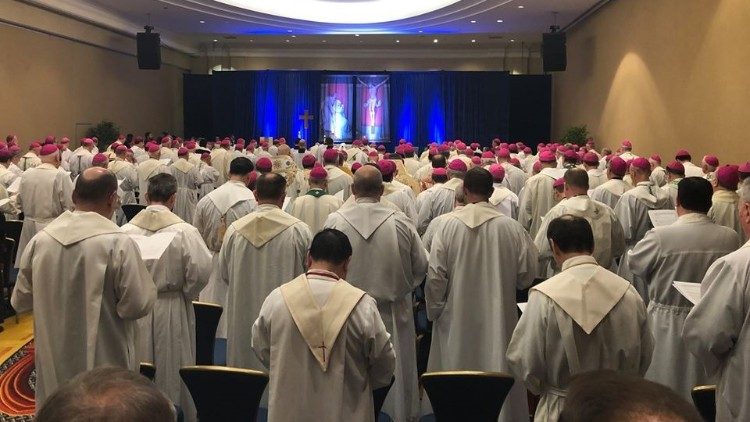
File photo of U.S. bishops in prayerFile photo of U.S. bishops in prayer 

Archbishop Coakley elected new President of U.S. Bishops ‘Conference

Archbishop Paul Coakley is the new president-elect of the United States Conference of Catholic Bishops (USCCB) and Bishop Daniel Flores is its new vice president-elect.

Vatican News

U.S. bishops have elected Archbishop Paul S. Coackley of the Archdiocese of Oklahoma City as the new president-elect of the USCCB.

Gathering in Baltimore for their Plenary Assembly, the U.S. bishops also chose Bishop Daniel Flores of Brownsville, Texas, to serve as the new vice president.

The selection came as Archbishop Timothy Broglio and Archbishop William Lori prepare to step down from their roles at the expiry of their three-year terms in office.

Archbishop Coakley

70-year-old Archbishop Coakley, already held a leadership role in the USCCB, serving as secretary. He was ordained a priest in 1983 for the Diocese of Wichita before being appointed Bishop of Salina in 2004, and later archbishop of Oklahoma City in 2010.

He holds a licentiate in sacred theology.

Bishop Flores

64-year-old Bishop Flores is the former president of the USCCB Committee on Doctrine. He has been a bishop since 2006. He was one of the 12 bishops to serve on the Ordinary Council of the General Secretariat of the Synod on Synodality.

He holds a doctorate in sacred theology and is a former theology professor.

Friday, August 30, 2024

Let's speculate...who could be the next American Cardinal?


America’s Next Cardinal: 6 Bishops Who Could Soon Receive a Red Hat


Pope Francis celebrates Mass with cardinals for the opening of the Synod of Bishops for the Amazon region in St. Peter's Basilica in 2019. (photo: Riccardo De Luca / Shutterstock)


If 2024 turns out like most years of Pope Francis’ decade-long reign, the Catholic Church will soon be getting a new slate of cardinals. 

And if Pope Francis does call his 10th consistory before 2024 ends, it’s reasonable to think that an American could be among those to receive a “red hat.” 

Since becoming pontiff in March 2013, Francis has created new cardinals in every full calendar year of his pontificate except 2021. And with the backstretch of 2024 already upon us, the Vatican rumor mill is already turning about a forthcoming consistory.  

The Italian traditionalist blog Messa in Latino cites “plausible rumors” that Pope Francis will soon announce a consistory set for October’s synod, while ecclesial insiders like Ed Condon are speculating about which Church leaders from around the world could be in line to become cardinals.  

Will a U.S. prelate be among them? With Boston’s Cardinal Seán O’Malley no longer eligible to vote in a papal conclave after turning 80 this past June, the Pope could be looking to add another American cardinal-elector. 

Additionally, at 87 years old, Francis could view a 2024 consistory as one of his last remaining chances to leave his mark on the American episcopacy, a group that is both hugely influential in the universal Church but also seen as somewhat unenthused about some of Francis’ priorities. 

Currently, there are 10 American cardinals among the 124 eligible to vote in a conclave. Pope Francis has created six of them: Cardinals Blase Cupich of Chicago; Joseph Tobin of Newark, New Jersey; Wilton Gregory of Washington, D.C.; Robert McElroy of San Diego; Kevin Farrell, prefect of the Dicastery for Laity, Family, and Life; and Robert Prevost, prefect of the Dicastery for Bishops. 

Of course, given Pope Francis’ documented preference for expanding the geographic makeup of the College of Cardinals, it wouldn’t be surprising if he didn’t add another American. While representation from the Global South has gone up during Francis’ pontificate, the percentage of cardinals from North America has fallen, from 12% in 2013 to 10% as of last September’s conclave.  

But if Pope Francis does add another American, a small batch of U.S. prelates exhibit some of the qualities he typically looks for when he creates cardinals, such as shared ecclesial priorities, collaboration on a papal project of importance, and affiliation with the peripheries. 

Here are six prelates who Pope Francis could pick to become America’s next cardinal. 


Archbishop Jóse Gomez

Archdiocese of Los Angeles 

72 years old 

By conventional standards, no American prelate is more qualified to wear the red than Archbishop Gomez. The Los Angeles prelate leads an archdiocese with more than 5 million Catholics, the largest in the U.S. and one of the largest in the world. His three immediate predecessors in Los Angeles were all named cardinals, and the Mexican native’s personal experience of immigration and leadership on the issue squares nicely with a Francis priority. 

But all of these things have been true of Archbishop Gomez throughout the present pontificate — and yet he has been passed over in all nine consistories convened by Pope Francis.  

The conspicuous fact is part of a broader pattern of the Pope skipping over prelates from traditional “cardinalatial” sees, like Paris and Milan. But in Archbishop Gomez’s case, it’s especially glaring: Pope Francis has not only not made the Los Angeles archbishop a cardinal, but he gave the red hat to the ordinary of one of Archbishop Gomez’s suffragan dioceses, Cardinal McElroy, in 2022. Some have surmised that Archbishop Gomez’s previous leadership of the U.S. Conference of Catholic Bishops (USCCB), or even his ties to Opus Dei, could be behind the papal pass-over. 

But perhaps a consistory at the twilight of Pope Francis’ pontificate will change all of that. While some have speculated that the Pope is using consistories to “stack the conclave,” ensuring that a successor who continues with his reform agenda is elected, it’s also true that Francis has recently made the effort to define himself and his legacy as less disruptive than the common narrative suggests. Perhaps offering the red hat to an American prelate as well-respected as Archbishop Gomez could be one way to do that. 


Archbishop Paul Etienne

Archdiocese of Seattle 

65 years old 

Last summer, Pope Francis tapped Archbishop Etienne as one of his personally nominated delegates to the Synod on Synodality. The only other American prelates to receive that designation, other than Cardinal O’Malley? Cardinals Cupich, Gregory and McElroy — each given the red hat by Francis.  

The Seattle shepherd’s inclusion among the Francis-made American cardinals suggests that he may be in next in line to become one. 

Like Francis’ U.S. cardinal picks, the pastorally minded Archbishop Etienne has emphasized Pope Francis’ priorities in his ministry, speaking out on issues like care for creation and nuclear disarmament

Widely regarded as the “progressive bloc’s” candidate in the 2022 elections for USCCB president, Archbishop Etienne only mustered 37 of 242 votes (15%). Of course, being somewhat of a stand-apart from the U.S. episcopacy is arguably what Pope Francis has typically looked for when picking American cardinals. 

There are certainly other American archbishops who have been elevated by Pope Francis and seem to share his pastoral priorities, such as Archbishops Mitchell Rozanski (St. Louis), Christopher Coyne (Hartford, Connecticut) and Gregory Hartmayer (Atlanta). But the fact that Archbishop Etienne is already thought of in Rome as a peer to Cardinals Cupich, Gregory and McElroy suggests that he may be the most likely candidate to join them in the College of Cardinals.  

And if the next consistory is really set to take place amidst October’s synod session, he’d already be there. 

Bishop Daniel Flores

Diocese of Brownsville, Texas 

62 years old 

Pope Francis has given red hats to prelates who have played a pivotal role in executing initiatives important to the Holy Father, such as Portuguese Cardinal Américo Aguiar, who led World Youth Day 2023 in Lisbon as a then-auxiliary bishop. 

If Francis hews to that criterion again, consider Bishop Flores to be a strong candidate for a red hat. 

As the USCCB’s doctrine head, Bishop Flores has adeptly led the U.S. bishops’ implementation of the various stages of the Synod on Synodality — no easy task, given heightened concerns about the initiative. The Pope already expressed his esteem for Bishop Flores by making him one of only nine “presidential delegates” from across the world at the Rome synod sessions. Who’s to say Francis doesn’t go a step further by naming Bishop Flores to the College of Cardinals? 

But whereas Francis’ other U.S. cardinal picks have been divisive among the local episcopacy, Bishop Flores’ selection would be something of an olive branch between Rome and America. The Texas native is widely respected throughout the U.S. ecclesial landscape and across typical partisan divides.  

And while there are other moderate, Latino prelates who are well-regarded across the U.S. Church (Philadelphia’s Archbishop Nelson Pérez comes to mind), the symbolism of having a “prince of the Church” in the lowly border diocese of Brownsville may be too much for Pope Francis to pass up on. 


Bishop John Stowe, OFM, Conv.,

Diocese of Lexington, Kentucky 

58 years old 

If giving a red hat to someone like Bishop Flores or Archbishop Gomez would be a reconciling move between Rome and the U.S., tapping Bishop Stowe would be the polar opposite: It would be seen as nothing short of a parting shot from Francis to the majority of U.S. bishops and active Catholics.  

It’s hard to think of an American prelate who has been more divisive than Bishop Stowe. He has criticized the National Eucharistic Revival as opposed to synodality and defied his brother bishops by publicly endorsing the Equality Act, pro-LGBTQ legislation that the USCCB opposed due to religious-liberty concerns.  

Bishop Stowe’s critics have been quick to point out ways in which his stances appear to diverge from Pope Francis’ such as his recent approval of a transgender hermit’s vows, which seems to run afoul of recent Vatican guidance critical of gender theory.   

But Pope Francis clearly has a pattern of using his U.S. cardinal picks as a way to chastise the USCCB status quo. And if this is his primary consideration when selecting the next American red hat, as opposed to picking a unifying figure, it’s hard to think of a more fitting candidate than the contentious Bishop Stowe. 


Bishop Mark Seitz

Diocese of El Paso, Texas 

Age 70 

Pope Francis likes to give the red hat to prelates embroiled in conflict as a pledge of papal backing. 

El Paso is certainly not a war zone, but it is in the epicenter of the southern border’s migration crisis. And giving the red hat to Bishop Seitz, a strong voice for justice to migrants, would certainly send a powerful message. Most recently, the El Paso bishop has gone toe-to-toe with the Texas state government over its targeting of Catholic charities ministering to migrants. Perhaps the Pope will conclude that Bishop Seitz will be even more effective with “cardinal” in front of his name. 

What’s more, the Pope is already clearly familiar with Bishop Seitz’s ministry. He gave the Texan blessed rosaries for victims of the 2019 Walmart shooting and their families, called Bishop Seitz after he took part in a prayer vigil against racism in 2020, and praised the El Paso prelate in a May 2024 interview with CBS News, calling him “a great bishop” who “does the impossible to help migrants.” 

Pope Francis clearly thinks highly of Bishop Seitz’s ministry. Giving him the red hat would be the ultimate seal of papal approval. 


Archbishop-Elect Richard Henning

Archdiocese of Boston 

59 years old 

If Pope Francis is looking for a successor to Cardinal O’Malley in a future conclave, why not pick the prelate he already tapped to follow Cardinal O’Malley in Boston?  

Archbishop-elect Henning is intelligent, forward-thinking and mission-driven — all qualities that led Pope Francis to install him as the head of one of the country’s most prominent sees at only 59 years old. Presumably, these same qualities would make the Long Island native and outgoing bishop of Providence, Rhode Island, a valuable cardinal as well.  

And while picking a recently elevated 50-something-year-old with minimal episcopal experience to join the exclusive College of Cardinals may seem dramatic, there’s Pope Francis precedent for it. The Pope gave 58-year-old Spanish Cardinal José Cobo Cano the red hat last September, just months after he had made the former auxiliary bishop the archbishop of Madrid. 

At the same time, Francis moved three other prelates under 60 into major archdioceses last year, including Archbishop Francis Leo of Toronto, and none of them received a red hat at last September’s consistory. So there’s no guarantee that one is coming to Archbishop-elect Henning in Boston. As with so many other things with this pontificate, we’ll just have to wait and see. 

Thursday, May 30, 2024

USCCB releases a report concerning the Synod process in the United States


Synod report for U.S. shows growth, tensions and 'deep desire to rebuild' the body of Christ


Growth, undeniable tensions and "a deep desire to rebuild and strengthen" the body of Christ have emerged as key themes in the latest synod report for the Catholic Church in the U.S.

Released by the U.S. Conference of Catholic Bishops May 28, the "National Synthesis of the People of God in the United States of America for the Interim Stage of the 2021-2024 Synod" summarizes responses from more than 35,000 participants and over 1,000 listening sessions, with 76% of the nation's dioceses and eparchies submitting reports to the U.S. synod team.

In addition, over 350 people met in some 15 listening sessions that focused on church life, social justice and vocations, while U.S. bishops also met for a synod listening session.

Launched by Pope Francis in October 2021, the first session of the 16th Ordinary General Assembly of the Synod of Bishops, organized around the theme "For a Synodal Church: Communion, Participation, Mission," was held Oct. 4-29, 2023, in Rome.

Ahead of the concluding session of the synod, which will take place in Rome in Oct. 2-27, dioceses across the U.S. were asked to hold additional listening sessions during Lent 2024, following a request from the Vatican's Secretariat for the Synod of Bishops. Those responses were incorporated into the newly released synthesis.

"We had to be nimble with the Spirit," U.S. synod team member Alexandra Carroll, who serves as the U.S. bishops' conference communications manager for social mission, told OSV News, adding that even with short notice of the extra sessions, "our diocesan synod leaders took it on and really owned the process."

Fellow synod team members Richard Coll, executive director of the conference's Department of Justice, Peace and Human Development, and the senior adviser for the synod Julia McStravog agreed.

Coll said he was "very, very taken by the commitment that was evident" in the responses to the listening sessions.

"The diocesan directors continue to be very devoted to this path," he told OSV News. "It's a wonderful thing to see, because it is now the third year of this process, but it didn't seem … to me that there was any kind of 'synod fatigue.' People seem to be even more enthusiastic."

"Synodality is really taking root," said McStravog. "People are getting accustomed not only to sharing, but to listening in a deeper way."

In his introduction to the synthesis, Bishop Daniel Flores of Brownsville, Texas — who serves as chairman of the bishops' Committee on Doctrine, and who has shepherded the synodal process in the U.S. — noted that "while no document could cover the full range of topics on the hearts and minds of Catholics" who took part in the listening sessions, the report showed the synodal journey has made progress in the U.S.

Among their insights, many of which were directly quoted in the report, participants expressed "two basic hopes for the church" — that it be both a "safe harbor" and a "fiery communion."

As a "safe harbor," the church can be a place "where the faithful are embraced, sustained and loved," said the synthesis, citing one respondent who observed, "People come when they are broken. … At my parish, I feel I have a family there."

That welcome must be more than "superficial," the report said, pointing to parishes with numerous small communities and prayer groups as being "most successful" in reaching and integrating people from diverse backgrounds. With the church in the U.S. comprising "countless cultural and ethnic groups," the report noted a desire "to promote interculturality, so that there is more unity between cultures that share the same church."

At the same time, respondents described the church as a "fiery communion," with the synodal process digging up a number of tensions within the church.

In particular, a lack of clear communication from church hierarchy and from media, both Catholic and secular, creates confusion and division over what it means to be Catholic — and hinders the church's mission, said synod participants.

That uncertainty can be especially evident when trying to balance welcoming LGBTQ and other marginalized persons while making known the truths of the Catholic faith, said synod participants.

Catholic social teaching was "another area where division was keenly experienced," with "conversations 'on social justice and inclusion … filled with moments of profound pain and generational hurt,'" the report said. "Participants expressed concerns that the church has allowed the ongoing polarization and conflict (in civil society) to lead to a denial of the church's social magisterium in many situations."

The liturgy itself can be a flashpoint for tension, with the celebration of the Mass using the Roman Missal of 1962 (informally known as the "Latin Mass") becoming "a focal point of broader debates about tradition, modernity, and the best ways to nurture faith across the diverse spectrum of Catholic belief and practice," the interim synthesis said.

Another sore spot identified by participants was complacency in many parts of the church, which potentially stands to pave the way for "grave institutional sins such as sexual abuse and racism" — both of which remain "enduring wounds" that "continue to inflict pain today," said the document.

"The trauma and scandal (of the clerical abuse crisis) have had a generational impact," keeping youth and young adults distrustful and desiring an apology "for abuses that happened not to them, but to their parents, grandparents or further generations," the interim synthesis said.

Likewise, the sin of racism, and "the sin of enslaving Black people for the betterment of the church," continue to haunt the church, the report said.

At the same time, the listening sessions revealed a commitment to the importance of evangelization, and the need for catechesis and formation to sustain such witness. Participants also articulated a desire to actively participate in the church's mission, seeking greater co-responsibility for the laity (especially women and young adults) in that task through their "baptismal dignity."

Both clericalism and a lack of vocations to the priesthood and religious life were lamented, as was division among priests, with one priest participant sharing that clergy "need to be better at getting past the bitterness and different theologies and political preferences."

Bishops who attended the listening session also highlighted polarization among priests, with some shepherds likening themselves to "the episcopal referee" among an increasingly diverse clergy, many of whom hail from other countries. The Ukrainian Catholic bishops of the U.S. expressed their gratitude for the positive relationships they enjoyed with the U.S. bishops' conference and the Roman Catholic Church in the U.S., noting that "sometimes the Latin Church in other parts of the world (is) not so accepting and supportive."

The bishops also applauded recent changes in the structure of their biannual meetings, which have facilitated more small group encounters reminding them they are "spiritual brothers and not just ecclesial figures."

On balance, bishops' relations with the Holy See were "generally positive," and although "direct contact with Rome is not very frequent," the report said that the apostolic nuncio, Cardinal Christophe Pierre, has succeeded in "fostering a spirit of communion" and in "facilitating communication with the Holy See." At the same time, the bishops "did express some frustration that communication between bishops and the offices of the Holy See could be better," but described their ad limina visits to Rome — during which they provide the pope with an update on the status of their respective dioceses — as "occasions of fraternity and joy."

The interim synthesis concluded by noting that "a major theme" articulated by participants was "the deepening awareness of how our trust in God expresses itself in relation to our imperfect institutions within the church."

"It was noted by many that the faithful 'should not be embarrassed about recognizing that our church might be a little messy — it's better not to pretend that we are the perfect institution, but that we belong to the perfect and one, true faith,'" said the report.

Carroll, Coll and McStravog told OSV News that the synodal process of listening and dialogue is essential to healing the church's wounds — and that dynamic is for all the faithful, they said.

"Synodality isn't just in Rome or at the USCCB," said Coll. "It's right here. It's with you. It's with all of us."

Thursday, November 16, 2023

USCCB supports call to name St. John Henry Newman a "Doctor of the Church"


U.S. bishops support request for pope to name St. John Henry Newman doctor of the church


BALTIMORE (OSV News) ─ The U.S. bishops voted almost unanimously (with two "no" votes) Nov. 15 to support of a request by the Catholic Bishops' Conference of England and Wales that Pope Francis name St. John Henry Newman, the 19th-century British cardinal, a doctor of the church.

Bishop Daniel E. Flores of Brownsville, Texas, chair of the doctrine committee of the U.S. Conference of Catholic Bishops, presented the question to the body of bishops. A majority of members present and voting was needed to pass the motion.

Bishop Flores said in June the conference received the request from Cardinal Vincent Nichols of Westminster, president of the Bishops' Conference of England and Wales, requesting "that the USCCB send a letter in support of the proposal." He noted that the conferences of the Catholic bishops of Ireland and Scotland also have agreed to support this also have agreed to support this petitionary process.

"The Committee on Doctrine considered this matter back in 2019 and concluded that the writings of St. John Henry Newman are truly eminent and of great relevance for the church today, especially in the areas of the development of doctrine, the moral foundations of education, the primacy of conscience, the role of the laity and the search for the truth, amongst many others," Bishop Flores said. "The committee therefore determined that St. John Henry Newman is indeed worthy of this high honor."

The question received great support from bishops from the floor, including Cardinal Seán P. O'Malley of Boston, Cardinal Daniel N. DiNardo of Galveston-Houston, Bishop Robert E. Barron of Winona-Rochester, Minnesota, and several others.

With the approval of the bishops, a letter will be sent to Pope Francis indicating their support, Bishop Flores said.

Born in London in 1801, John Henry Newman was ordained an Anglican priest in 1825. He later founded the Oxford Movement, which emphasized the Catholic roots of Anglicanism.
After a series of clashes with Anglican bishops made him a virtual outcast from the Church of England, he joined the Catholic Church at age 44 and was ordained a Catholic priest in 1846.

Pope Leo XIII made him a cardinal in 1879 while respecting his wishes not to be ordained a bishop. A theologian and poet, Cardinal Newman died in 1890; his sainthood cause was opened in 1958. Pope Benedict XVI beatified him in Birmingham, England, in 2010.
Pope Francis declared Cardinal Newman a saint Oct. 13, 2019.

If he is eventually declared a doctor of the church -- defined by the church as a saint who, through his or her research, study and writing, has advanced the mission and teaching of Jesus Christ and his church -- he would join 37 men and women who have earned that prestigious title. Most recently, Pope Francis issued a decree declaring St. Irenaeus a doctor of the church in January 2022. Prior to that, St. Gregory of Narek received the title in April 2015, also by Pope Francis.

The original four doctors of the church were St. Ambrose, St. Augustine, St. Gregory the Great and St. Jerome. Four women -- St. Teresa of Avila, St. Catherine of Siena, St. Thérèse of Lisieux and St. Hildegard of Bingen -- hold the title.

At a symposium held on the eve of Cardinal Newman's canonization in 2019, Canadian Cardinal Marc Ouellet made a case for why Newman should be declared a doctor of the church.

"The depth of this man of God and the place he now occupies in Catholicity make us aware of the void his absence would have left if he had not been," Cardinal Ouellet said. The cardinal particularly pointed to the new saint's teaching that "in order to keep its integrality, the faith of the church must adapt its language to the cultural challenges and the dangers of heresy."
Newman's teaching on the development of doctrine held that "although the deposit (of faith) does not change, the church's knowledge of it progresses, deepens and is expressed in a new way, always faithful to the original idea," the cardinal said.

Cardinal Ouellet also spoke about how Cardinal Newman influenced theologians involved in the Second Vatican Council.

Father Ian Ker, author of more than 20 books about St. John Henry Newman, told Catholic News Service in Rome Oct. 12, 2019, "What's especially important for me is this (canonization) enables him to be made a doctor of the church, because I believe he is the doctor par excellence of the post-conciliar period like St. Robert Bellarmine is of the Tridentine period."

Gregory K. Hillis, a professor of theology at Bellarmine University in Louisville, Kentucky, who attended the canonization, agreed, saying that Newman's attempts to "rediscover early Christianity and the wealth it could provide the contemporary church" had a strong impact on Vatican II's attempts "to conserve the whole tradition, not just medieval expressions of it."

"Newman does not fit comfortably into the traditionalist camp nor the progressive camp," he said. "Traditionalists need to remember Newman's willingness to speak up to the hierarchy, his willingness to draw upon more than just medieval sources, and the progressives can learn from the seriousness with which he took the tradition and engaged with it."

Carl Olson, in an essay for OSV's SimplyCatholic.com, said St. John Henry Newman's theological knowledge, his masterful literary abilities and his holiness were three of the many impressive qualities of the man.

"Given Cardinal Newman’s reputation during his lifetime, both for his prodigious intellect and for his personal sanctity, support for his canonization not surprisingly began at his death. An article in America magazine in 1941, along with Pope Pius XII’s support of the 1945 'Centenary of Newman’s Conversion,' played essential roles in moving the process along," he wrote.

During a presentation by then-Cardinal Joseph Ratzinger on the occasion of the first centenary of the death of Cardinal Newman April 28, 1990, the future pope said that "throughout his entire life, Newman was a person converting, a person being transformed, and thus he always remained and became ever more himself."

"The characteristic of the great doctor of the church, it seems to me, is that he teaches not only through his thought and speech but also by his life, because within him, thought and life are interpenetrated and defined. If this is so, then Newman belongs to the great teachers of the church, because he both touches our hearts and enlightens our thinking."

Wednesday, June 21, 2023

English-speaking Bishops weigh-in on the Synod's working document


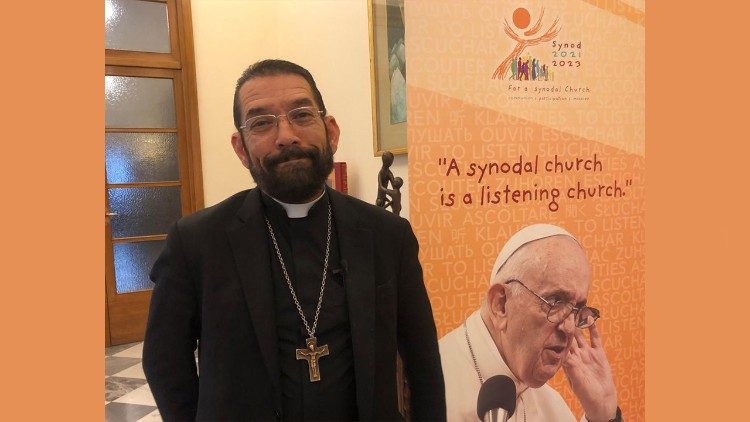
Archive photo: Bishop Daniel Flores of Brownsville, TexasArchive photo: Bishop Daniel Flores of Brownsville, Texas 

English-speaking bishops welcome Synod Working Document

Bishops' conferences from around the world welcomed the publication of the “Instrumentum laboris,” the document that will guide discussions at the upcoming General Assembly of the Synod.

By Christopher Wells

Bishops from Australia, Canada, and the United States were among the many groups that welcomed the publication, on Tuesday, of the Instrumentum laboris for the General Assembly of the Synod, which begins in October 2023.

As Cardinal Mario Grech, the Secretary General of the Synod, noted in his presentation of the document, the Instrumentum laboris is the fruit of the first, listening phase of the Synod, which began in 2021. At the same time, it marks “a point of departure” for the second, universal phase of the Synod, which will be centred on the college of Bishops.

“There is no need to fear that listening to the People of God has compromised the pastoral function of the Bishops,” Cardinal Grech stated in his presentations. “On the contrary, the synodal process has restored a fruitful ministry to the Bishops, both as Pastors of their Churches and as members of the collegial bodies that have been called upon to carry out a careful discernment of the contributions of the consultation.”

Bishops respond

The publication of the Working Document was welcomed in the United States by Bishop Daniel Flores of Brownsville, Texas, who has been shepherding the synodal process in the United States. “The Instrumentum laboris presents the People of God with a remarkable opportunity to reflect on what we have learned thus far about the nature of a synodal Church and how we might embrace that more fully.” He encouraged everyone “to read, pray, and discuss this important document, in light of the insights gained from previous stages in the synodal process.

Archbishop Timothy Costelloe, the President of the Australian Bishops Conference, noted that the publication is “an enormously significant milestone” in the synodal process. “It represents both an invitation and an opportunity,” he said, “to remain engaged in prayer, reflection, and ongoing discernment with all that has emerged so far in what has been an unprecedented worldwide consultation.”

In a statement welcoming the publication of the Instrumentum laboris, the Bishops of Canada noted that the document “is presented as a tool for discernment rather than as a position statement or a solution to particular questions.” They invited all Catholics “to pray for the success of the Synod, which will commence this October, that by listening to the voice of the Holy Spirit the followers of Christ would be led to glorify the Father of us all.”

Monday, June 12, 2023

USCCB to confront issue of gender-affirming care at Catholic Hospitals


US bishops to consider banning transgender care at all American Catholic hospitals


The U.S. Catholic bishops will vote at their spring assembly this week on whether to amend their official directives for American Catholic health care institutions to mandate that Catholic facilities not provide gender-affirming medical treatment to transgender patients.

The vote, scheduled for one of the bishops' two public sessions during their June 15-16 meeting in Orlando, Florida, could mark the beginning of a substantial change in the provision of health care in Catholic hospitals, clinics and facilities across the U.S. 

If approved, the measure would authorize the bishops' doctrine committee to begin the process of revising the Religious and Ethical Directives for Catholic Health Care, which are described as the "authoritative guidance" for U.S. Catholic health care institutions. The revision would change the directives to align with a doctrinal note the bishops released in March, which focused on what the prelates called the "moral limits to technological manipulation of the human body."

The directives, or ERDs, also include the bishops' mandates on issues that include end-of-life care and abortion.

Bishop Daniel Flores of Brownsville, Texas, chairs the Committee on Doctrine for the U.S. Conference of Catholic Bishops. (CNS/Robert Duncan)

Bishop Daniel Flores of Brownsville, Texas, chairs the Committee on Doctrine for the U.S. Conference of Catholic Bishops. (CNS/Robert Duncan)


The ballot item on which the bishops will vote this week, a copy of which was provided to NCR, says the Committee on Doctrine, led by Bishop Daniel Flores of Brownsville, Texas, intends to make minimal changes to the directives, but "is prepared to make those changes necessary for providing clear and useful guidance to Catholic health care services."

The item also says that the committee's "immediate concern" is the directives' Part III, which addresses the relationship between Catholic medical professionals and their patients. However, the ballot item adds that the committee "does not exclude the possibility of proposing minor revisions in other parts" of the directives.

More than 1 in 7 patients in the U.S. is cared for in a Catholic hospital, according to the Catholic Health Association, which is comprised of more than 600 hospitals and 1,600 long-term care and other health facilities. Catholic-affiliated health facilities make up the largest group of nonprofit health care providers in the nation, the association says on its website. 

It's unclear how many Catholic health facilities currently provide gender-confirming medical treatment.

Opinions among Catholic theologians, bioethicists and LGBTQ advocates have been split about the controversial doctrinal note. Some observers, including Massimo Faggioli, a theologian and church historian at Villanova University, said the document's language reflected a cautious approach in an area of moral theology and doctrine that is not yet fully developed.

mount of caution [in the document] that I think should be appreciated, because in past times we had other documents from other bishops that were much more belligerent," said Faggioli, who described the document as "one step in what is largely unknown in terms of Catholic doctrine."

But scholars including M. Therese Lysault, a Loyola University Chicago Stritch School of Medicine theologian who studies and has written about bioethics, criticized the document for reflecting "a striking inability to conduct a basic moral analysis." 

Lysault told NCR that the doctrinal note displayed "next to zero knowledge of, experience with, or expertise in transgender persons and the complexities of Catholic health care, even less compassion or Christian virtue."

Lysault added: "As a moral theologian, I think it's important to note that the Congregation for the Doctrine of the Faith has not yet issued a statement on transgender health care. I would guess that this is due to the fact that the issue is so new and that they are prudently waiting for the scientific and clinical research to advance so that the Church's moral discernment can be properly informed." 

The bishops' health care directives, last revised in the mid-1990s, do not specifically address questions of gender-affirming care for patients who identify as transgender or who are diagnosed with gender dysphoria. 

When the directives were last updated, the doctrine committee says in the upcoming ballot action item, "it was not envisioned that it might be necessary to include specific guidance concerning radical modifications of the human body, such as are frequently advocated today for the treatment of the condition commonly known as gender dysphoria or gender incongruence."

The section that the doctrine committee is looking to amend makes a reference, in Directive 29, to patients having the "right and duty to preserve their bodily and functional integrity." Directive 33 mentions therapeutic procedures in the context of whether their benefits would be proportional to the likelihood of harm or undesirable side effects.

In the introduction to Part III, the bishops say patients in Catholic health care facilities must accept the facility's "public commitment to the Church's understanding of and witness to the dignity of the human person." The introduction also says that the medical professional's relationship with the patient cannot be separated from "the Catholic identity of the health care institution." 

Several Catholic bioethicists, including some who declined to be identified on the record because of the sensitivity of the topic, told NCR that issues of gender-affirming care in Catholic health settings most often deal with whether the institution should address the patient by their preferred name, or to continue providing the patient with previously  prescribed hormonal treatment while in their care.

The March 20 doctrinal note argues that gender-affirming medical treatments — which may include hormonal therapies and surgical procedures — are "injurious to the true flourishing of the human person," and says that Catholic health care services must not perform them. The note added that such interventions "do not respect the fundamental order of the human person as an intrinsic unity of body and soul, with a body that is sexually differentiated." 

The bishops conference said the doctrinal note was developed "in consultation with numerous parties, including medical ethicists, physicians, psychologists, and moral theologians." But several bioethicists who criticized the document told NCR that it did not reflect the evolving science on gender dysphoria nor the insights and lived experiences of transgender people.

John Brehany, executive vice president and director of institutional relations for the National Catholic Bioethics Center, told NCR he thought the March 20 document was "pretty well done."

Brehany said he hopes the bishops will consult his group, a Philadelphia-based nonprofit that advises church leaders on bioethical issues from a more conservative doctrinal perspective, as they prepare to revise the ethical and religious directives. "My hope would be that [the bishops] bring some clarity to a very important and complex issue," he said. 

Cory Mitchell, a professor of bioethics at Loyola University Chicago Stritch School of Medicine, told NCR that most medical professional bodies in the United States see gender-affirming care as evidence-based treatment to mitigate the suffering of people diagnosed with gender dysphoria.

"When dealing with a patient population, from an ethical standpoint, if you can mitigate or ameliorate harm or suffering, you do so," Mitchell said. "That's the story of the good Samaritan. We don't pass by on the other side of the road when we can help and continue Jesus' healing ministry."

However the bishops revise the ethical and religious directives, Mitchell said he hopes the process will reflect the "culture of encounter" that Pope Francis has championed so that "norm-making does not become hurting, sanctioning, or othering" transgender people.