Tuesday, August 30, 2022

Recap of Day 1 meeting with the Cardinals and the Pope


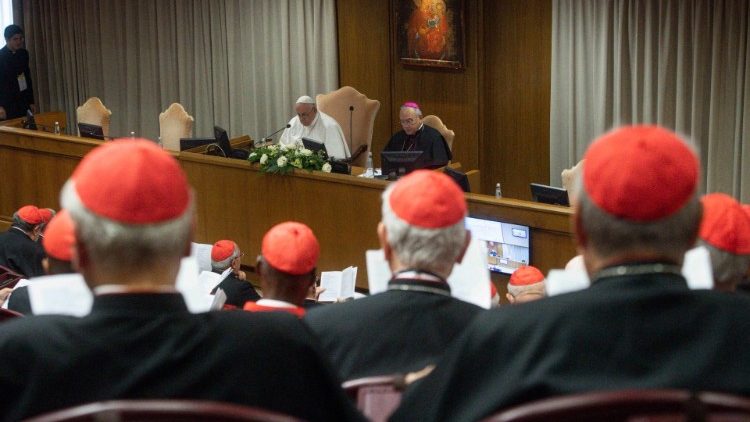
Meeting of the Cardinals with Pope Francis to discuss Praedicate EvangeliumMeeting of the Cardinals with Pope Francis to discuss Praedicate Evangelium  (Vatican Media)

Cardinals discuss importance of Church's communion and outreach

The first day of the two-day meeting of the Cardinals with Pope Francis to reflect on Praedicate Evangelium focuses on the importance of communion in the Church and the missionary calling to witness to God's love for all.

By Vatican News staff reporter

Italian Cardinal Enrico Feroci, parish priest of Santa Maria del Divino Amore (Our Lady of Divine Love) in Castel di Leva, spoke to Vatican News about the first session of the Cardinals' meeting with Pope Francis on Monday, describing the very fraternal atmosphere characterizing it. 

After the opening prayer, Pope Francis offered some brief introductory words inviting everyone to participate and offer their own contribution to the discussions during these two days of reflection on Praedicate Evangelium, the Apostolic Constitution reforming the Roman Curia. 


The cardinals then divided into various language groups, and later met all together again to share their reflections. 

Cardinal Feroci said the cardinals addressed two main themes: that of communion, about witnessing to mutual love between Christians; then the issue concerning the difficulty of today's society to being open to the Gospel message and ways to overcome these challenges.

Cardinal Marcello Semeraro, Prefect of the Dicastery for the Causes of Saints, emphasized to Vatican News the great participation of the cardinals in the meeting with an open and lively dialogue, particularly on the missionary dimension that the new Apostolic Constitution underscores, as well as the need to focus on the proclamation on the greatest commandment, that we should love one another.

Deacon Ordination in the capitol of Louisiana


4 NEW DEACONS FOR BATON ROUGE


Bishop Michael G. Duca ordained the men on Saturday August 13, at St. Joseph Cathedral in Baton Rouge.

The new deacons are: Tram Phan, Randall Waguespack, Edward Hanks and Patrick Witty.

You can find more about them here. 

Congratulations, brothers, and welcome! Ad multos annos! 


>>>Wendy and I were so excited to be at this ordination in Baton Rouge as a long-time friend over over 35 years was ordained to the diaconate.  Deacon Patrick Witty from New Roads received Holy Orders along with 3 other men.  We met Pat through the organization Louisiana Jaycees where he served as the 49th President of the group succeeding yours truly.

Congratulations Pat, your wife Stephanie and the family.

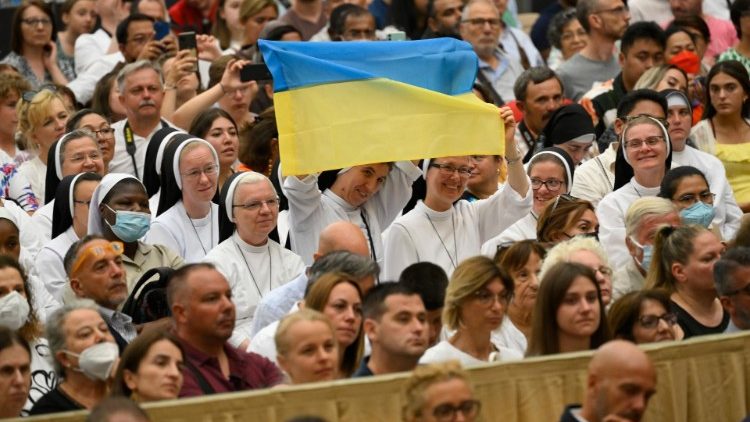
The Holy See clarifies the Pope's defense and support of Ukraine against an unjust war


General Audience, 3 August 2022General Audience, 3 August 2022  (Vatican Media)

Ukraine, the Holy See: Pope defends life rather than taking political positions

In response to polemics that have arisen in recent days concerning the words of Pope Francis, a communiqué from the Holy See cites the Pope’s “numerous” interventions concerning the war, and recalls that he has always condemned the Russian aggression as “morally unjust, unacceptable, barbaric, senseless, repugnant, and sacrilegious.”

By Vatican News

The Pope speaks as a pastor who defends every human life, and not as a politician: that is the correct lens through which to view his numerous interventions concerning the war in Ukraine.

This is the affirmation of a communiqué from the Holy See, released one week after the words of Pope Francis at the Audience of Wednesday, 24 August, and his mention of the attack in which the daughter of Russian political analyst Alexander Dugin lost her life in Russia – words which have provoked controversial reactions at the political and institutional level in Ukraine.

“In the context of the war in Ukraine,” reads the Holy See communiqué, “there are numerous interventions by the Holy Father Francis and his collaborators in this regard. For the most part, they are aimed at inviting pastors and the faithful to prayer, and all people of good will to solidarity and efforts to rebuild peace.”

“On more than one occasion, as in recent days, public discussions have arisen on the political significance to be attributed to such interventions. In this regard, it is reiterated that the Holy Father’s words on this dramatic issue should be interpreted as a voice raised in defence of human life and the values associated with it, and not as a political stance.”

“As for the large-scale war in Ukraine, initiated by the Russian Federation,” the Holy See communiqué concludes, “the Holy Father Francis' interventions are clear and unequivocal in condemning it as morally unjust, unacceptable, barbaric, senseless, repugnant, and sacrilegious.”

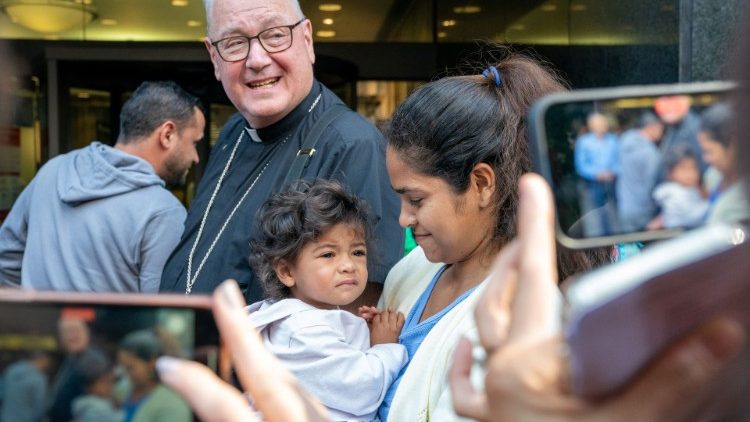
Cardinal Dolan checks in from Rome meeting of Cardinals


Cardinal Timothy Dolan greets migrant families outside of Catholic Charities of New YorkCardinal Timothy Dolan greets migrant families outside of Catholic Charities of New York  (David Dee Delgado)

Cardinal Dolan on Curia Reform meeting: an opportunity to learn from those 'on front lines'

In an interview with Vatican News, Cardinal Timothy Dolan, Archbishop of New York, calls Pope Francis' meeting of the world's Cardinals to study the Roman Curia reform 'extraordinarily uplifting'; and, as the war wages in Ukraine, praises the encounter as an opportunity to learn from the service of those Cardinals on the front lines.

By Deborah Castellano Lubov

As the war wages on in Ukraine, Cardinal Timothy Dolan, Archbishop of New York, says another advantage of this meeting Pope Francis summoned of the world's Cardinals is to be with Cardinals who are on the front lines, to hear about the challenges they face, and to learn from their service.

In an interview with Vatican News on Monday, Cardinal Dolan, who serves as Chair of the Catholic Near East Welfare Association (CNEWA), reflected on the first day of the two-day encounter in the Vatican to discuss reform of the Roman Curia, and specifically highlighted the solidarity of the Cardinals in combating war and helping those in need.

Pope Francis requested that the world's Cardinals should gather in the Vatican on 29-30 August to reflect on the recently-published Apostolic Constitution Praedicate Evangelium on reforming the Roman Curia.


According to UN statistics from July, at least 12 million people have been forced to flee their homes since the outbreak of the war, with at least 5 million fleeing outside Ukraine to bordering nations, and at least 7 million displaced inside the war-torn nation.

Since Russia invaded Ukraine, some 2 million Ukrainians have found welcome in Poland, and numerous others in Hungary, Slovakia, and other bordering nations. Some Ukrainians have started to return to their country.

Listening to Cardinals on 'front lines'

Cardinal Dolan told Vatican News that after his own visit to Ukraine and the bordering nations, that being among the other Cardinals of the Universal Church, and those closest to the conflict, has been particularly meaningful.

"That's another great advantage of being here," the Cardinal said.

"The Cardinals, by their very nature, mirror the Church Universal, the catholicity of the Church. To be with them now, to talk to Cardinal Péter Erdő of Budapest, as they have been so extraordinarily generous and welcoming, to be with Cardinal Stanisław Dziwisz in Krakow, where they have been welcomed by the people of Poland, close to 4 million refugees."

“To be with these Cardinals who are on the front lines and to hear the challenges, but also to see how uplifting it is to be in service and to hear them so grateful for the solicitude of the world. That's very good.”

During an earlier visit to Rome, in April - his first since the outbreak of the pandemic - Cardinal Dolan sat down with Vatican News to discuss his upcoming journey to meet with suffering Ukrainian refugees and bring them, and those welcoming them, aid.

'Extraordinarily uplifting' encounter in the Vatican

On Monday evening, the Cardinal of New York also gave his impressions of the discussions taking place among the Cardinals, and in their small groups, calling it a "beautiful experience."

"It is a beautiful experience of something that is in danger of becoming too theoretical, namely, collegiality, apostolic fraternity, synodality. No, we experience it there," he said.

“We talk as friends, as brothers, with immense charity and deep love for the Church about very practical issues. It has been extraordinarily uplifting.”

He expressed his appreciation for the encounter.

"I'm glad this has taken place. You look forward to it," but, to some extent, he suggested, out of a sense of duty.

"But I said, 'wow', duty is rewarded because this is a very good thing."

Boots on the ground, wishing to help

Cardinal Dolan's visit to Ukraine and border countries earlier this year was because the Archbishop of New York is ex-officio the chairman of the board of CNEWA.

CNEWA was founded a century ago by Pope Pius XI to assist Eastern-rite Catholics, who very often live in persecuted areas and often are under great stress.

There are many Eastern-rite Catholics in the Middle East, India, Ukraine, and in Central and Eastern Europe.

For that occasion, he told Vatican News, "we are very active, having boots on the ground, and wish to bring them alms, the gifts that Catholic people have given us to help these people. We want to just embrace them and say, 'We love you. We have not forgotten about you. We want to pray with you, encourage you and help.'"

Monday, August 29, 2022

Much ado about Shia LaBeouf conversion; Priest offers 9 lessons


9 Lessons from the Conversion of Shia LaBeouf

There’s much we can learn from how God led the troubled actor to repentance and faith.


On Aug. 25, Bishop Robert Barron released a video interview with actor Shia LaBeouf, in which LaBeouf not only announced his conversion to the Catholic faith but rivetingly described the steps of what he calls his “salvific journey.” 

LaBeouf has appeared in 40 movies, four television films, 77 episodes for various shows and three video games. Winner of multiple acting awards, the 36-year-old is most famous for his leading role as Sam Witwicky in the Transformers series.

But astride the fame, he has lived a troubled life. He appeared nude in 10 movies, with most featuring graphic sex scenes, an indication of his loss of shame and self-worth. He battled with alcohol addiction, plagiarized a script, was charged with disorderly conduct, harassment, criminal trespass, public intoxication, obstruction, battery and theft, and was accused by one girlfriend of physical abuse and by another of sexual battery, assault and infliction of emotional distress. 

In the interview with Bishop Barron, LaBeouf confessed, “My life was on fire. I was walking out of hell. … I didn't want to be an actor anymore and my life was a complete mess. I’d hurt a lot of people.” News had come out that “I’ve been abusive to women and have been shooting dogs and I’ve been willingly giving women STDs. It’s disgusting, it’s depraved, and my mother is embarrassed beyond all imagination.” 

It brought him to contemplate suicide. “I had a gun on the table. … I didn’t want to be alive anymore. … [There was] shame like I had never experienced before, the kind of shame where you forget how to breathe.” 

It was at that point that director Abel Ferrara, who was participating with him in a virtual self-help group, asked him, in view of a movie he was preparing to film, whether he had ever heard of Padre Pio. He hadn’t — and because by his point he was “nuclear” and no one wanted to work with him, he thought Ferrara’s question was his “chance to get back on the hustle.” 

To prepare for the role, he needed to learn about the Catholic faith and about the Capuchin order to which St. Pio belonged. He drove to San Lorenzo Seminary in Santa Ynez, California, where he met and was befriended by the Capuchins. 

As an actor who tries to immerse himself in the life of the characters he portrays, he also needed help learning how to convincingly “say” Mass, which was the center of St. Pio’s life. That took him to Christ the King Church in Oakland. So that he would have a better systematic grasp of the Catholic faith, the Capuchins also arranged for him to be catechized by a religious sister. 

Over the course of several months, this intense study, LaBeouf said, “stops being prep for a movie and starts being something that feels beyond all of that.” He began to feel an overwhelming urge to “let go” and “surrender for real” to God, which he did with courage and zeal. He later expressed wonder at the way, when he was at rock bottom, his ego led him to jump at the possibility of a movie role focused on Padre Pio. “It was like somebody tricked me into it,” he said. Now he worships that Trickster.  

There’s much we can learn from his conversion story, especially the elements God used to lead him from a self-described infernal life, from being “really good at attacking Catholicism because it made me feel superior” to being humble enough to repent, believe in and live the Gospel. 

Insofar as there are many today not only following the descending paths LaBeouf trod prior to his conversion, but also many who admire his work and are dumbfounded by his conversion, it’s good for the Church to know what drew him and might draw others. 

LaBeouf was, first, drawn by the way that the Catholic life is “full immersion.” It involves reason, will and feelings. As an actor, he ironically hates anything that feels like acting — his bar mitzvah at 13 felt, he said, like acting — and he refused to fake a Padre Pio accent. He sought integrity and, to his surprise, discovered it in Catholic life. 

Second, he hungered for a sense of connection and found it with the Capuchins. Their welcoming, down-to-earth, sincere fraternity — not to mention their laughter, ice cream and cats — drew him. 

Third, he was captivated by the Mass, especially the traditional Latin Mass, which he needed to learn — and immerse himself in — for the movie. For him, pretending to celebrate it and attending it made him feel that “a secret” was being shared with him. It enveloped him with a sense of the reality of God and the sacred. 

His first experiences of the Mass in English were, he lamented, as if someone was “trying to sell me on an idea,” where the preaching was not fit for the dignity of what the Mass is, but rather was an invitation “to let your hair down right before you’re asking me to fully believe that we’re about to walk through the death of Christ.” When he discovered he had been baptized by an uncle and the Capuchins allowed him to begin receiving Holy Communion, he said he could almost feel the physical effect and regeneration of entering into Christ’s death and resurrection. 

Fourth, he was moved by the fact that great converts preceded him. He spoke of the impact of St. Augustine and St. Francis of Assisi, but mainly of Capuchin Brother Jim Townsend, a con man who murdered his pregnant wife and spent 20 years in prison, but converted and ended up spending 39 years as a Capuchin. He “gave me permission as a sinner,” LaBeouf said, and if after all Townsend had done, such a man could live by faith, there was hope for him, too.  

Fifth, he had to be taught how to pray. Prior, praying felt like “memorizing someone else’s words.” But when a Capuchin brother and Bishop Barron explained how to handle quiet and pass from silence to loving thoughts and loving deeds, everything began to click. 

Sixth, he longed to meet a masculine Jesus. 

“My opinion of Christ at this point,” he said, “felt almost like I was reading about a Buddhist, a very soft, fragile, all-loving, all-listening [man] with no ferocity, no romance.” That impression was reinforced by the “art that I had seen,” which featured “very soft, more feminized” depictions of Jesus. Reading the Gospel, with the guidance of the strong paternal influence of a Capuchin, he came to understand the difference between weakness and meekness, and to grasp how meekness, like Jesus showed throughout his life, is a summit of strength. 

Seventh, he needed to discover a “purpose” in life, what Catholics would ordinarily call a vocation. 

A Capuchin taught him that discernment happens through discovering the talents God has given you and determining how you can use them to help others. LaBeouf thought his sole talent was “bleeding in front of people,” something featured in several of his films. He eventually grasped how appropriate that skill set was in depicting the modern world’s most famous stigmatist! 

Eighth, he had to learn the redemptive meaning of suffering. 

He thought that the suffering he had borne and caused until then was “pointless.” A Capuchin helped him to see how “suffering is actually a gift” — a realization that led LaBeouf even to thank the woman who had accused him of sexual abuse, who he said “saved his life,” through the shame he had to endure as a result of her accusations and the pain he had caused. 

All of these lessons were integrated, ninth, in St. Pio, whom LaBeouf came to know as “one of the most respected, beloved saints who ever graced the earth.” To immerse oneself in his life in the midst of his fellow Capuchins — trying to imitate the way he celebrated Mass, prayed, sought and dispensed God’s mercy, dealt with suffering and rejection, prayed from dawn to dusk, manfully challenged others to holiness, and lived his Capuchin vocation with immense faith, hope and charity — has been for LaBeouf a tremendous school that, likewise, “saved my life.” 

As we give God thanks for LaBeouf’s conversion and pray for his continued growth in the virtues of Catholic life, we similarly pray that his conversion might bring many others to the Catholic faith as well as help everyone in the Church to recognize the enduring attraction of the faith and the practices that make that beauty shine.
Tuesday Saint of the Day


St. Jeanne Jugan


St. Jeanne Jugan, also known as Sister Mary of the Cross, L.S.P. was born on October 25, 1792 in the French region of Brittany during the French Revolution.

Jeanne grew up as the sixth of eight children to Joseph and Marie Jugan surrounded by a lot of religious and political upheavals. Her father became lost at sea when Jeanne was just four-years-old, and her mother struggled to provide for all the Jugan children.

Her mother worked diligently to make sure her children had everything they needed, including secret religious instruction when anti-Catholic persecutions were taking place.

From a young age, Jeanne learned to knit and spin wool and became a shepherdess. Barely able to read or write, Jeanne took a job as a kitchen maid for a noble family when she was 16.

Jeanne accompanied the Viscountess de la Choue when she visited the poor and the sick. As she matured, Jeanne began finding her passion in working with these people and turned down multiple marriage proposals. She told her mother God had other plans for her.

At 25, Jeanne became an Associate of the Congregation of Jesus and Mary, which was founded by St. John Eudes. She spent her time praying and working as a nurse in the town hospital. She stayed at the hospital for many years until her own health issues prevented her from performing her physically demanding tasks.


After leaving her job at the hospital, Jeanne became the servant of a member of the Eudist Third Order for 12 years. While working as a servant, Jeanne and her master found the same Catholic faith in each other and set out to begin teaching catechism to the town's children and caring for the poor.

In 1837, Jeanna and Francoise Aubert rented part of a small cottage and were joined by a 17-year-old orphan, Virgine Tredaniel. Together, they formed a small community of prayer devoted to helping the poor and teaching the catechism.

Two years later, Jeanne was approached by an elderly, blind and partially paralyzed woman named Anne Chauvin. With no one there for the woman, Jeanne carried her to her apartment and took it upon herself to begin caring for her. She let Anne have her bed and Jeanne slept in the attic.

A short time later, Jeanne took in two more old women in need of help and by 1841, she rented another space to house a dozen of elderly people. The next year, she attained an open convent and housed 40 more people.

With approval from her peers, Jeanne began focusing her attention on her new mission - assisting abandoned elderly women. This marked the beginning of the religious congregation known now as The Little Sisters of the Poor.

Jeanne constructed a simple Rule of Life for her new community of women. Each day they went around town requesting food, clothing and money for those in their care. Jeanne's carried on with her new life's work for the next four decades of her life.

More young women started to hear about Jeanne's mission and joined her. Through begging on the streets, Jeanne was able to open four more homes for her needy within those 10 years. By 1850, over 100 women had joined the congregation.

Jeanne was soon forced out of the leadership role, though. The local bishop appointed Abbe Auguste Le Pailleur as Superior General of the congregation. Jeanne was assigned to strictly begging on the streets until she was sent to retire in a life of obscurity for her final 27 years of life.

After The Little Sisters of the Poor communities began expanding throughout France, their work spread to England in 1851 and the United States founded five of their own communities from 1866 to 1871.

By 1879, Jeanne's community had over 2,400 Little Sisters. On March 1, 1879, Pope Leo XIII approved the Constitution for the congregation for seven years.

At the time of Jeanne's death, on August 29, 1879, most of the Little Sisters had no idea Jeanne was the real founder of the congregation. However, Le Pailleur was investigated and dismissed in 1890 and Jeanne became acknowledged once again as the foundress.

St. Jeanne Jugan passed away at the age of 86. She was beatified by Pope John Paul II on October 3, 1982 and canonized by Pope Benedict XVI on October 11, 2009.

During her canonization Pope Benedict XVI expressed, "In the Beatitudes, Jeanne Jugan found the source of the spirit of hospitality and fraternal love, founded on unlimited trust in Providence, which illuminated her whole life."

She is the patron saint of the destitute elderly and her feast day is celebrated on August 30.

First public Mass for Cardinal McElroy


Cardinal McElroy celebrates Mass of Thanksgiving in Rome


Hannah Brockhaus   By Hannah Brockhaus for CNA


Rome, Italy, Aug 28, 2022 / 12:26 pm (CNA).

Cardinal Robert McElroy spoke about Christian humility Sunday, at his first public Mass since he was elevated to the College of Cardinals by Pope Francis.

The Aug. 28 Mass of Thanksgiving was celebrated at St. Patrick’s Church, the American Catholic parish in Rome, Italy. McElroy, 68, is the bishop of San Diego.

“Many people have the wrong notion of what Christian humility is,” McElroy said in his homily. “Humility is not putting ourselves down, it’s not underestimating ourselves, it’s not presenting ourselves as less than we are.”

Christian humility means two things, he said, “Putting aside the pretenses and facades we often put up to try to look better to others than we are. And secondly: challenging, facing, the impulse all of us have to place our own interests ahead of those of others.”

Sunday’s Mass was attended by US Ambassador to the Holy See Joe Donnelly and his wife, Jill Donnelly.

American Cardinals Roger Mahony, Wilton Gregory, Joseph Tobin, Blase Cupich, Edwin O’Brien, and Daniel DiNardo concelebrated the Mass alongside seven US bishops and around 40 priests.

In his homily, Cardinal McElroy spoke about the 2010 movie “Of Gods and Men,” a fictionalized account of the days leading up to the kidnapping and martyrdom of seven Trappist monks in Algeria in 1996.

After debating among themselves about whether to leave their monastery or to stay put despite teh danger, the monks reached a consensus by “putting aside pretenses,” the cardinal said. “So it is with our lives…”

When we live with facades, they become prisons, he said, while “humility calls us to put aside those facades and to be open with people.”

“Humility,” he continued, “calls us to try to challenge that very common human impulse to place our own selves first. It’s a very hard thing to do in practice because it’s so deep in the human heart and soul and spirit.”

“The Gospel challenges us to do precisely this,” he added, “to take account of the rights, the lives … of others, as much as we do of ourselves.”

“That is Christian humility. That is the humility Christ calls us to in the Gospel of today, and that is the humility we should ask God for today and every day,” McElroy said.