Thursday, May 1, 2025

Final propositions from a so-called Amazonian Rite published; these proposals will most likely fail


Amazonian Rite’s proposition will include suggestion for ordination of women deacons and married men
Eduardo Campos Lima


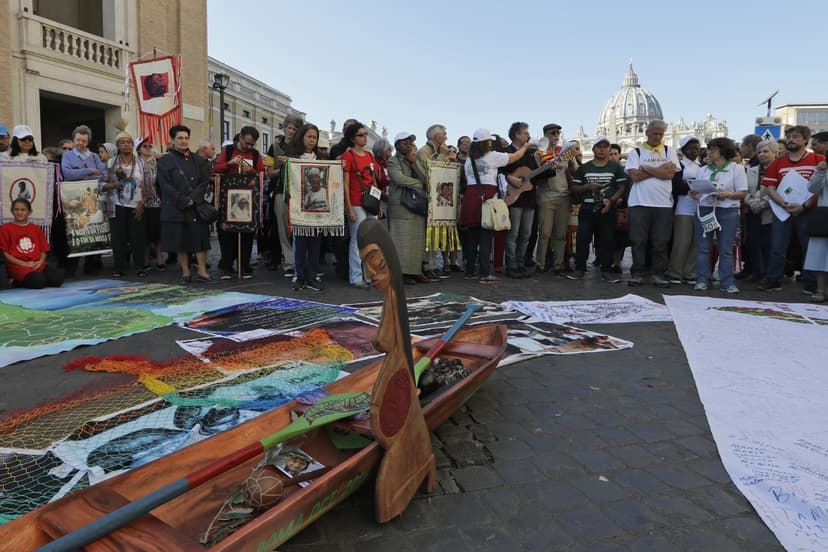
A wooden statue of a prengant woman in front of Amazonian members outside the Vatican on Oct. 19, 2019. (Credit: Andrew Medichini/AP.)


SÃO PAULO – A document released earlier this month showed that the commission in charge of the elaboration of the Amazonian Rite will include in its final proposition a request for the ordination of women deacons.

The text, a seven-page summary of a longer document released in 2024 – which contains most of the suggestions for the new rite and theological debates about them – was published on the website of the Latin American Ecclesial Council on Apr. 5.

It also includes two other controversial ideas that emerged during the preparation of the Synod for the Pan-Amazon region, the ordination of married men who have leadership roles in Amazonian communities, the so-called viri probati, and that priests who left the clergy in order to get married can resume their ministries.

“That text summarizes the landmark document we released last year. The idea is that the dioceses will now revise it, so the commissions can finalize the work within a few months,” Brazilian-born Father Agenor Brighenti, in charge of the commissions’ work, told Crux.

Those propositions appear in the fourth part of the document, which deals with the configuration of the Church in the Amazonian Rite. The text says that “a rite has an underlying ecclesiology” and that the Amazonian Church wants to be a Church “that is integrated to the life and the struggles of the peoples” and that “knows the culture and the history of its peoples,” learning their “languages, chants, instruments, rites, and costumes.”

“In the Amazonian churches, lay people, especially the women, have a preponderant role. […] A church with an Amazonian face requires the stable presence of mature lay leaders, endowed with authority, who know the cultures and the ways of living in community in each location, in order to allow for the development of an ecclesial culture in itself, one that is markedly lay,” the document reads.

The text says that the post-synodal apostolic exhortation Querida Amazonia discusses the need to rethink the profiles of the ministries in each particular church in order to “express the protagonistic role of lay people, especially the women.”

“Among the vital challenges that the Church faces in the Amazon is the impossibility of the communities celebrating the Eucharist every week. That’s why the Amazonian Rite suggests the ordination of viri probati, originated in communitates probatae. It also suggests that the priests who left their ministry to get married can, if they wish, resume their ministry,” the document goes on.

The text says it’s urgent that in the Amazonian Church “ministries are promoted and trusted to women and men in an equitable way.” Men and women must be granted the power to officiate the sacraments, baptizing and celebrating marriages. It must be created an instituted ministry of “female community leader” and women must be ordained deacons.

“For an authentic Amazonian Rite, it’s essential that women can, in a symmetric and complementary way, occupy spaces as preachers and officiants of sacraments, as well as in the organization and the structures of the Church,” the document affirms.

According to Bishop Eugenio Coter of Pando, Bolivia, one of the coordinators of the elaboration of the Amazonian Rite, the commissions haven’t argued for the legitimacy of the ordination of women deacons, given that it’s a matter that it’s up to the universal Church to analyze.

“In part, it corresponds to an acknowledgement of the women’s role in the celebratory spaces. It’s coherent to the logic of the women’s presence in the Amazonian communities. But it’s something that surpasses the Amazonian Ecclesial Conference due to its doctrinal nature,” Coter told Crux.

He recalled that some ecclesial segments objected to the ordination of women deacons arguing that it would be an incentive to a kind of clericalism. He doesn’t agree with such a thesis.

“That corresponds to saying that the sacrament of the order creates a clerical mindset. I don’t think so. It’s a lack of understanding of the sacrament of the order,” Coter argued.

Concerning the viri probati, Coter emphasized that it’s also something typical of the Amazonian context to expect that an authority is a married man and knows how to guide his family.

“The ability to keep a mature and stable relationship is part of the dignity of the authorities, otherwise that leader causes mistrust,” he explained.

Coter recalled that the final document of the Synod for the Pan-Amazon region included a request from the bishops for the ordination of married men.

“It has never been answered. That’s also a subject that surpasses our capabilities. So, we can only hope that Rome can assume it’s valid for the Amazon region,” he said.

Coter said that those community leaders would receive the adequate education in order to be ordained, with no possible differentiation between them and regular celibate presbyters.

“We already have the experience of the Eastern Churches regarding that matter. We don’t hear anybody say that there’s any difference between married priests and the others. We just have to ensure that those men will be theologically and pastorally prepared to guide their communities,” Coter argued.

Those suggestions have provoked controversy in the Vatican since the Synod of the Amazon, in 2019. In regard to the possibility of ordaining women deacons, Pope Francis directly ruled it out in an interview with CBS in May of 2024.

In the opinion of religion sociologist Francisco Borba Ribeiro Neto, a Catholic activist who formerly headed the Pontifical Catholic University of São Paulo’s Center of Faith and Culture, those propositions emerged in the Amazon Synod and were defeated in the universal context of the Church – and now their promoters are trying to insist on them once again.

When it comes to women deacons, Ribeiro Neto argued that it’s a false solution, given that “women in poor communities don’t want to be priests.”

“They have their role and they’re okay with it. It’s much more a need for some nuns and missionaries who are displeased with the subalternity they unjustly face in the Church,” he told Crux.

In Ribeiro Neto’s opinion, it’s unquestionable that there’s a problem in recognizing the value of women inside the Church as an institution.

“But ordaining them is not a solution. It would be almost impossible to ordain all of them and a new problem would emerge, the differences between ordained and non-ordained religious women,” he said.

Ribeiro Neto recalled that Francis has always expressed that priesthood is not an honor, but a humble position of somebody who serves the others.

“If that’s the case, why would anyone struggle to be granted that position? Only because that person sees priesthood as an honor,” he said.

The issue of the viri probati – accompanied with the reintegration of married priests – is an inadequate vision of the matter of celibacy, according to Ribeiro Neto.

“The idea of revoking celibacy has also been defeated in the Church. Nowadays, Catholic communities in general don’t think about it. The cultural context regarding marriage has changed over the past decades and that issue became secondary in the Church,” he said.

The promoters of those ideas know they will not be implemented, Ribeiro Neto argued, but they insist on them anyway in order to position themselves as some kind of moral winners.

“It does not make sense to debate the merit of issues whose conclusions cannot be applied due to the current political conditions. That’s the case,” he said.

With the death of Pope Francis, the chances of those suggestions being approved are even lower, he added.

Largest number of elector-Cardinals for this upcoming Conclave


The red skullcap or zucchetto worn by cardinalsThe red skullcap or zucchetto worn by cardinals  (VATICAN MEDIA Divisione Foto)

Upcoming conclave will be first with more than 120 Cardinal electors

The conclave set to begin on May 7 will be the first to include 133 Cardinal electors, but it is not the first time the College of Cardinals has exceeded the 120 limit.

By Tiziana Campisi and Kielce Gussie

A confirmed 133 Cardinals will participate in the upcoming conclave to elect the next Successor of St. Peter.

Based on a paragraph in the Apostolic Constitution Universi Dominici Gregis (UDG), the limit of voting cardinals is 120—13 fewer than what the College of Cardinals has announced will be participating next week.

However, the number of Cardinals in the College has often exceeded the limit, despite the regulations laid down in UDG.

A tradition in the making?

It was on October 1, 1975 that Pope Paul VI first established the rule that the “maximum number of cardinal electors shall not exceed 120” in the Apostolic Constitution, Romano Pontifici Eligendo. Prior to this, in the consistory of 1969, the College of Cardinals reached 134 electors.

Despite Pope John Paul II confirming the rule limiting the number to 120, recent Popes have created more Cardinals, exceeding this number.

This was the case on four occasions for the Polish Pope: in the Consistory of June 28, 1988 (160 Cardinals, of which 121 were electors and 39 non-electors), February 21, 1998 (165 Cardinals, of which 122 were electors and 43 non-electors), February 21, 2001 (183 Cardinals, of which 136 were electors and 47 non-electors), and October 21, 2003 (194 Cardinals, of which 134 were electors and 60 non-electors).


After Pope John Paul II’s death, the conclave opened on April 18, 2005, with the College of Cardinals consisting of 183 Cardinals—117 electors and 66 non-electors.

Staying under the limit

This continued with Pope Benedict XVI, who exceeded the 120 number of Cardinal electors on two occasions: in the Consistory of November 20, 2010 (203 Cardinals, of which 121 were electors and 82 non-electors), and February 18, 2012 (213 Cardinals, of which 125 were electors and 88 non-electors).

When he resigned in 2013 and with the ensuing conclave, the College of Cardinals consisted of 207 Cardinals—only 117 were electors.

Pope Francis followed suit and made the College number greater than 120 in 10 consistories:

·      February 22, 2014 (218 Cardinals: 122 electors, 96 non-electors)

·      February 14, 2015 (227 Cardinals: 125 electors, 102 non-electors)

·      November 19, 2016 (228 Cardinals: 121 electors, 107 non-electors)

·      June 28, 2017 (225 Cardinals: 121 electors, 104 non-electors)

·      June 28, 2018 (226 Cardinals: 125 electors, 101 non-electors)

·      October 5, 2019 (225 Cardinals: 128 electors, 97 non-electors)

·      November 28, 2020 (229 Cardinals: 128 electors, 101 non-electors)

·      August 27, 2022 (226 Cardinals: 132 electors, 94 non-electors)

·      September 30, 2023 (242 Cardinals: 137 electors, 105 non-electors)

·      December 7, 2024 (253 Cardinals: 140 electors, 113 non-electors)

Exceptions can happen

Despite a history of exceeding the limit, this 2025 conclave will be the first time one will take place with more than 120 Cardinal electors.

The College of Cardinals released a declaration on April 30, recognizing the right of all 133 electors to participate in the upcoming conclave and determining that the legislative provision of UDG had been tacitly dispensed from by Pope Francis when the set limit was surpassed.

Universi Dominic Gregis, article 36 states, “A Cardinal of the Holy Roman Church who has been created and published in a consistory has, by that very fact, the right to elect the Pope.”

The Apostolic Constitution adds that any Cardinal who has not been canonically deposed or has not “renounced the cardinalate with the consent of the Roman Pontiff” may partake in the election of the new Pope of the Catholic Church.

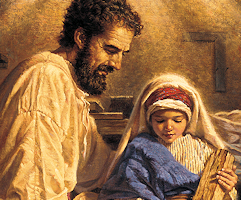
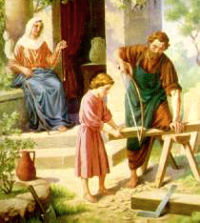
May 1st is the Memorial of St Joseph the Worker

 Move to: Previous Day | Next Day

Easter: May 1st

Thursday of the Second Week of Easter; Opt. Mem. of St. Joseph the Worker


facebook sharing button Share
twitter sharing button Tweet
linkedin sharing button Share
pinterest sharing button Pin
email sharing button Email
sharethis sharing button

Optional Memorial of St. Joseph the Worker: O God, Creator of all things, who laid down for the human race the law of work, graciously grant that by the example of Saint Joseph and under his patronage we may complete the works you set us to do and attain the rewards you promise. Through our Lord Jesus Christ, your Son, who lives and reigns with you in the unity of the Holy Spirit, God, for ever and ever.

show

Recipes (11)

show

Activities (8)

show

Prayers (16)

show

Library (8)

show

Blog & Podcasts (1)


The Optional Memorial of St. Joseph the Worker was established by Pope Pius XII in 1955 in order to Christianize the concept of labor and give to all workmen a model and a protector. By the daily labor in his shop, offered to God with patience and joy, St. Joseph provided for the necessities of his holy spouse and of the Incarnate Son of God, and thus became an example to all laborers. "Workmen and all those laboring in conditions of poverty will have reasons to rejoice rather than grieve, since they have in common with the Holy Family daily preoccupations and cares" (Leo XIII).


St. Joseph the Worker
"May Day" has long been dedicated to labor and the working man. It falls on the first day of the month that is dedicated to the Blessed Virgin Mary. Pope Pius XII expressed the hope that this feast would accentuate the dignity of labor and would bring a spiritual dimension to labor unions. It is eminently fitting that St. Joseph, a working man who became the foster-father of Christ and patron of the universal Church, should be honored on this day.

The texts of the Mass and the Liturgy of the Hours provide a catechetical synthesis of the significance of human labor seen in the light of faith. The Opening Prayer states that God, the creator and ruler of the universe, has called men and women in every age to develop and use their talents for the good of others. The Office of Readings, taken from the document of the Second Vatican Council on the Church in the modern world, develops this idea. In every type of labor, we are obeying the command of God given in Genesis 2:15 and repeated in the responsory for the Office of Readings. The responsory for the Canticle of Zechariah says that "St. Joseph faithfully practiced the carpenter's trade. He is a shining example for all workers." Then, in the second part of the Opening Prayer, we ask that we may do the work that God has asked of us and come to the rewards he has promised. In the Prayer after Communion, we ask: "May our lives manifest your love; may we rejoice forever in your peace."

The liturgy for this feast vindicates the right to work, and this is a message that needs to be heard and heeded in our modern society. In many of the documents issued by Pope John XXIII, Pope Paul VI, the Second Vatican Council and Pope John Paul II, reference is made to the Christian spirit that should permeate one's work, after the example of St. Joseph. In addition to this, there is a special dignity and value to the work done in caring for the family. The Office of Readings contains an excerpt from the Vatican II document on the modern world: "Where men and women, in the course of gaining a livelihood for themselves and their families, offer appropriate service to society, they can be confident that their personal efforts promote the work of the Creator, confer benefits on their fellowmen, and help to realize God's plan in history" (no. 34).
—Excerpted from Saints of the Roman Calendar by Enzo Lodi

Patronage: against doubt and hesitation; against pain; dying people; exiles; expectant mothers; families; fathers; happy and holy death; house hunters; immigrants; interior souls; married people; orphans; people who fight Communism; pioneers; pregnant women; social justice; travelers; unborn children

Vocational: accountants; attorneys; barristers; bursars; cabinetmakers; carpenters; cemetery workers; children; civil engineers; confectioners; craftsmen; educators; emigrants; furniture makers; grave diggers; joiners; laborers; lawyers; solicitors; teachers; wheelwrights; workers; working people

Church: Catholic Church; Oblates of Saint Joseph; protection of the Church; Universal Church; Vatican II

Countries: Americas; Austria; Belgium; Bohemia; Canada; China; Croatia; Croatian people; Indonesia; Korea; Mexico; New France; New World; Papal States; Peru; Philippines; Russia; Vatican City; Viet Nam

See CatholicSaints.info for further listings of patronages for dioceses and cities around the world.

Symbols and Representation: Bible; branch; carpenter's square; carpenter's tools; chalice; cross; hand tools; infant Jesus; ladder; lamb; lily; monstrance; old man holding a lily and a carpenter's tool such as a square; old man holding the infant Jesus; plane; rod

The 6th Novemdiales Mass remembering Pope Francis including the homily of Cardinal Victor Fernandez


Cardinal Fernández gives the homily for the sixth Novemdiales MassCardinal Fernández gives the homily for the sixth Novemdiales Mass  (@Vatican Media)

Cardinal Fernández: Pope Francis was a tireless worker

In his homily for the sixth Novemdiales Mass in memory of Pope Francis, which falls on International Workers’ Day, Cardinal Fernández reflects on the late Pope’s emphasis on the dignity of work.

By Jean-Benoît Harel 

On Thursday 1 May, which is a public holiday in the Vatican as in many countries around the world, the College of Cardinals did not hold a General Congregation to prepare for the conclave.

Many members, however, did gather in St Peter's Basilica for the sixth mass of the Novemdiales, the period of mourning for the late Pope Francis.

The celebration was presided over by Cardinal Victor Manuel Fernández, a good friend of the late Pope’s who served under him as Prefect of the Dicastery for the Doctrine of the Faith.

Fernández began his homily by saying that since his death, Pope Francis had become ‘fully united with Christ’.

Dignity through work

1 May is also International Workers’ Day, stressed the Argentine cardinal, who said that, for the late Pope “work expresses and nourishes the dignity of the human being”.

“It allows us to develop our abilities, it helps us to grow in our relationships, it allows us to feel that we are God's collaborators in caring for and improving this world”, said Cardinal Fernández.

Promoting human dignity means enabling people to “develop all the good they have within them, to earn their living with the gifts God has given them, to develop their abilities”, he added.

The false idea of ‘meritocracy’

Fernández went on to explain Pope Francis’ criticism of meritocracy, which leads to “thinking that only those who succeed in life have merit”.

The Argentinian Cardinal told the story of a man he knew in Buenos Aires who worked between 12 and 15 hours a day, choosing not to see his children in order make enough money to feed them. Once, Cardinal Fernández said, a well-dressed passer-by shouted at him: “Go and work, lazybones”.

"These words struck me as horribly cruel and vain”, said Cardinal Fernández. “But they are also present in other, more elegant speeches”.

In today's world, “it seems that someone who has inherited a lot of property is more worthy than someone who has worked hard all their life without being able to save”, he stressed, before asking: "Don't the weak have the same dignity as us? Do those born with fewer opportunities simply have to survive?"

Pope Francis, a tireless worker

Cardinal Fernández then turned to consider the example of Pope Francis as a worker. “He worked not only in the mornings, with meetings, audiences, celebrations and gatherings, but also all afternoon”, he recalled, adding that, only four days before his death, very weak, he had insisted on visiting a prison.

The Holy Father rarely took any time off. A habit he already had in Buenos Aires, recalled Cardinal Fernandez: “he never went out to restaurants, the theatre, for a walk or to see a film, he never took a full day off”.

For Francis, Fernández continued, “his daily work was his response to God's love”.

Entrusting the Pope to Saint Joseph

The members of the Curia are also workers, Fernández highlighted: “work is also for us, in the Curia, a path of maturation and fulfilment as Christians".

In conclusion, the Argentine cardinal recalled that, whenever Pope Francis was worried, “he would place a piece of paper with a supplication under the icon of Saint Joseph”.

It is to saint, who worked so hard to take care of Mary and Jesus, Cardinal Fernández said, that we now pray: “Let us ask him to embrace our dear Pope Francis in heaven”.