Showing posts with label women ordination. Show all posts

Thursday, May 29, 2025

Some "hot Button" issues upcoming for Pope Leo XIV


Pope Leo XIV will soon have to address the call for women deacons
(RNS) — A report of a study group on women deacons is expected as soon as June, putting the spotlight on the issue of women’s roles in the church once more.


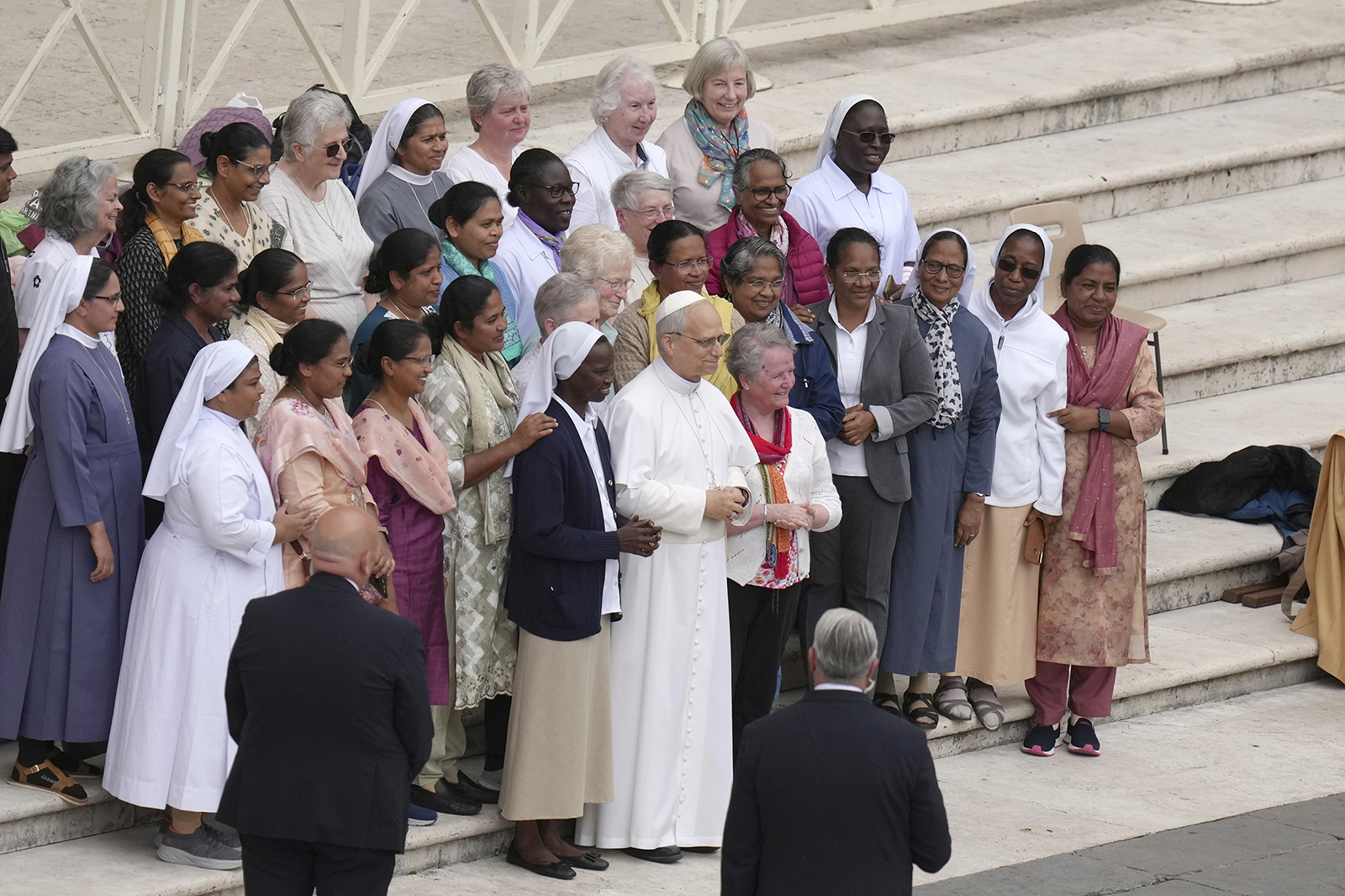
Pope Leo XIV poses with women at the end of his first weekly general audience in St. Peter’s Square at the Vatican, May 21, 2025. (AP Photo/Alessandra Tarantino)


Claire Giangravé

May 27, 2025

VATICAN CITY (RNS) — Like unpaid bills arriving for the inheritor of a house, reports will soon arrive on Pope Leo XIV’s desk offering possible steps to take on some of the most hot-button issues facing the Catholic Church — among them the question of ordaining women as deacons.

The 10 reports are being generated by study groups of theologians and canon lawyers tasked by Pope Francis with discerning a way forward for the church on how it selects its bishops, combats poverty and relates to women and LGBTQ Catholics. These issues threatened to derail the Synod on Synodality, a three-year-long, worldwide series of meetings initiated by Francis in 2021 in which Catholics were invited to enumerate their priorities of the church. Instead, Francis created study groups to report back on the most controversial topics. 

Study Group 5 focused on “some theological and canonical issues around specific ministerial forms,” including whether women should be allowed to serve as deacons — ordained ministers who perform some of the sacraments and preach at Mass, but who do not celebrate the Eucharist, hear confessions or anoint the sick. While Francis ruled out the possibility of ordaining women to be priests in 2024, he said only that the question of women deacons was “not yet mature.”

Some of the groups have asked for an extension until December because of the distractions of Francis’ death and Leo’s election. The synod office did not confirm to RNS whether Study Group 5 asked to postpone its report.

Leo has been a proponent of synodality and reaffirmed his intention to continue the process. But it remains unclear what his plans are for his predecessor’s unresolved legacy.

While attending the synod in 2023, Leo spoke with hesitancy on the possibility of women deacons and seemed to negate the idea that women could be ordained at all, citing the “very significant and long tradition of the church” on the matter. But he recognized the church’s “openness” on the topic, citing the study group tasked with discerning the question. 

On Feb. 21, Leo — then-Cardinal Robert Prevost — gave a talk during the Jubilee of Deacons in Rome, where thousands of deacons came from all over the world to gain forgiveness for their sins and celebrate their ministry. Among the attendees were women who hoped one day to be allowed to fulfill their call to the diaconate.

On that occasion “he did talk about the concern for clericalism,” said Ellie Hidalgo, co-director of Discerning Deacons, a network aimed at informing Catholics about the female diaconate, who was present at the event. But, said Hidalgo, he “went on to say that these are things that he will continue to study, reflect upon, and (he doesn’t) know what the outcome will be.”

Discerning deacons has submitted 29 testimonies from women who feel called to the diaconate to the Vatican’s doctrinal department, which is overseeing the work of Study Group 5. “We need a renewed diaconate that is really focused on mission, on walking with people at the margins, that’s what you’re being formed to do. And that’s the kind of diaconate that we would then want to include women in,” Hidalgo said.

She added that women would “be helping to declericalize the diaconate,” referring to Francis’ long-standing crusade against “clericalism” — an unquestioning reverence for priests that the late pope often pointed to as the root of the church’s woes.

In his 2023 remarks at the synod, then-Cardinal Prevost said, “Clericalizing women does not necessarily solve the problem.” But overall, Leo has a positive track record on promoting women to church leadership, and he became a priest in a heady time, when the demand for women’s ordination echoed powerfully in the church.

In 2022, Francis appointed three women to the Vatican’s Dicastery for Bishops to assist Prevost, then the dicastery’s prefect, in the crucial role of appointing bishops around the world. In one of his first acts as pontiff, Leo appointed a Catholic nun, Sister Tiziana Merletti, to become secretary of the Dicastery for Consecrated Life and Societies of Apostolic Life, overseeing Catholic nuns, monks and brothers. Francis had earlier appointed Sister Simona Brambilla to head the office, making her the first woman to ever lead a Vatican department.

“I think appointing women to Vatican positions, and specifically senior Vatican positions, is an important part of a culture shift. And I hope that Pope Leo is able to continue that shift outside of Rome,” said Kate McElwee, executive director of Women’s Ordination Worldwide.

“What we’ve heard is he’s very open to listening,” McElwee said, adding that “those calls (to the priesthood) women experience haven’t gone away, despite decades of the Catholic Church trying to close the door, diminish them or silence them, and so I hope that our new listening pope is able to really absorb the reality that women are ready and willing to serve the church as ministers.”

McElwee said she hopes the pope will meet with women advocating for the diaconate, but emphasized that the synod’s time for listening must be followed by concrete actions.

But Miriam Duignan, executive director at Wijngaards Institute for Catholic Research, said focusing on Vatican appointments risks being a “smoke screen.” “How women are treated in a local parish is more important to Catholics than maybe some people knowing that there are a few women scattered amongst the majority of men in Rome.”

The Synod on Synodality’s demand for discussion of the female diaconate from parishes around the globe showed that one “cannot still maintain that the campaign for women’s ordination is a white, Western, Northern European, feminist new idea,” Duignan added.

Indeed, said Hidalgo, as a missionary in Peru and later as the head of the Diocese of Chiclayo in the country for a decade before coming to the Vatican in 2023, Leo “would have been meeting women who are doing incredible work, religious sisters and lay women” denouncing illegal mining and deforestation while ministering to the Indigenous communities in the Amazon region.

“There are women saying: ‘Hey, we’re in. We’re already doing the work. We just need a little bit more support from the church and the grace of the sacrament.’ The grace of the diaconate sacrament would really go a long way in strengthening us for mission,” she added.

With its huge area and its shortage of priests, the Amazon region has posed a greater challenge to the male-only diaconate than any other part of the world. Discerning Deacons was created after the Vatican’s 2019 Synod on the Pan-Amazon region, which brought the calls for female leadership to the heart of the church. On April 5, the Latin American Ecclesial Council published a seven-page summary of its proposal for the creation of an Amazonian Rite, which includes the ordination of women deacons and married men.

“For an authentic Amazonian Rite, it’s essential that women can, in a symmetric and complementary way, occupy spaces as preachers and officiants of sacraments, as well as in the organization and the structures of the Church,” the document, which will be sent for approval at the Vatican, reads.

In the 2023 synod interview, Cardinal Prevost seemed to picture a “new understanding or different understanding of leadership, power, authority and service” in the church, in which the perspectives of both men and women are allowed to emerge. The cardinal and canon lawyer who said that may still be formulating his views as Pope Leo XIV, but he will need to have an answer very soon, as women will be knocking at the Vatican’s door once more.

Thursday, May 1, 2025

Final propositions from a so-called Amazonian Rite published; these proposals will most likely fail


Amazonian Rite’s proposition will include suggestion for ordination of women deacons and married men

Eduardo Campos Lima


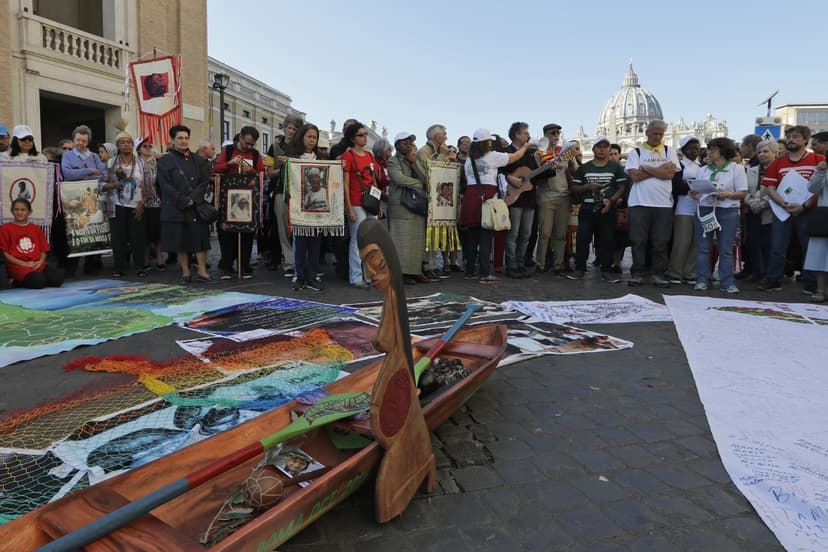
A wooden statue of a prengant woman in front of Amazonian members outside the Vatican on Oct. 19, 2019. (Credit: Andrew Medichini/AP.)


SÃO PAULO – A document released earlier this month showed that the commission in charge of the elaboration of the Amazonian Rite will include in its final proposition a request for the ordination of women deacons.

The text, a seven-page summary of a longer document released in 2024 – which contains most of the suggestions for the new rite and theological debates about them – was published on the website of the Latin American Ecclesial Council on Apr. 5.

It also includes two other controversial ideas that emerged during the preparation of the Synod for the Pan-Amazon region, the ordination of married men who have leadership roles in Amazonian communities, the so-called viri probati, and that priests who left the clergy in order to get married can resume their ministries.

“That text summarizes the landmark document we released last year. The idea is that the dioceses will now revise it, so the commissions can finalize the work within a few months,” Brazilian-born Father Agenor Brighenti, in charge of the commissions’ work, told Crux.

Those propositions appear in the fourth part of the document, which deals with the configuration of the Church in the Amazonian Rite. The text says that “a rite has an underlying ecclesiology” and that the Amazonian Church wants to be a Church “that is integrated to the life and the struggles of the peoples” and that “knows the culture and the history of its peoples,” learning their “languages, chants, instruments, rites, and costumes.”

“In the Amazonian churches, lay people, especially the women, have a preponderant role. […] A church with an Amazonian face requires the stable presence of mature lay leaders, endowed with authority, who know the cultures and the ways of living in community in each location, in order to allow for the development of an ecclesial culture in itself, one that is markedly lay,” the document reads.

The text says that the post-synodal apostolic exhortation Querida Amazonia discusses the need to rethink the profiles of the ministries in each particular church in order to “express the protagonistic role of lay people, especially the women.”

“Among the vital challenges that the Church faces in the Amazon is the impossibility of the communities celebrating the Eucharist every week. That’s why the Amazonian Rite suggests the ordination of viri probati, originated in communitates probatae. It also suggests that the priests who left their ministry to get married can, if they wish, resume their ministry,” the document goes on.

The text says it’s urgent that in the Amazonian Church “ministries are promoted and trusted to women and men in an equitable way.” Men and women must be granted the power to officiate the sacraments, baptizing and celebrating marriages. It must be created an instituted ministry of “female community leader” and women must be ordained deacons.

“For an authentic Amazonian Rite, it’s essential that women can, in a symmetric and complementary way, occupy spaces as preachers and officiants of sacraments, as well as in the organization and the structures of the Church,” the document affirms.

According to Bishop Eugenio Coter of Pando, Bolivia, one of the coordinators of the elaboration of the Amazonian Rite, the commissions haven’t argued for the legitimacy of the ordination of women deacons, given that it’s a matter that it’s up to the universal Church to analyze.

“In part, it corresponds to an acknowledgement of the women’s role in the celebratory spaces. It’s coherent to the logic of the women’s presence in the Amazonian communities. But it’s something that surpasses the Amazonian Ecclesial Conference due to its doctrinal nature,” Coter told Crux.

He recalled that some ecclesial segments objected to the ordination of women deacons arguing that it would be an incentive to a kind of clericalism. He doesn’t agree with such a thesis.

“That corresponds to saying that the sacrament of the order creates a clerical mindset. I don’t think so. It’s a lack of understanding of the sacrament of the order,” Coter argued.

Concerning the viri probati, Coter emphasized that it’s also something typical of the Amazonian context to expect that an authority is a married man and knows how to guide his family.

“The ability to keep a mature and stable relationship is part of the dignity of the authorities, otherwise that leader causes mistrust,” he explained.

Coter recalled that the final document of the Synod for the Pan-Amazon region included a request from the bishops for the ordination of married men.

“It has never been answered. That’s also a subject that surpasses our capabilities. So, we can only hope that Rome can assume it’s valid for the Amazon region,” he said.

Coter said that those community leaders would receive the adequate education in order to be ordained, with no possible differentiation between them and regular celibate presbyters.

“We already have the experience of the Eastern Churches regarding that matter. We don’t hear anybody say that there’s any difference between married priests and the others. We just have to ensure that those men will be theologically and pastorally prepared to guide their communities,” Coter argued.

Those suggestions have provoked controversy in the Vatican since the Synod of the Amazon, in 2019. In regard to the possibility of ordaining women deacons, Pope Francis directly ruled it out in an interview with CBS in May of 2024.

In the opinion of religion sociologist Francisco Borba Ribeiro Neto, a Catholic activist who formerly headed the Pontifical Catholic University of São Paulo’s Center of Faith and Culture, those propositions emerged in the Amazon Synod and were defeated in the universal context of the Church – and now their promoters are trying to insist on them once again.

When it comes to women deacons, Ribeiro Neto argued that it’s a false solution, given that “women in poor communities don’t want to be priests.”

“They have their role and they’re okay with it. It’s much more a need for some nuns and missionaries who are displeased with the subalternity they unjustly face in the Church,” he told Crux.

In Ribeiro Neto’s opinion, it’s unquestionable that there’s a problem in recognizing the value of women inside the Church as an institution.

“But ordaining them is not a solution. It would be almost impossible to ordain all of them and a new problem would emerge, the differences between ordained and non-ordained religious women,” he said.

Ribeiro Neto recalled that Francis has always expressed that priesthood is not an honor, but a humble position of somebody who serves the others.

“If that’s the case, why would anyone struggle to be granted that position? Only because that person sees priesthood as an honor,” he said.

The issue of the viri probati – accompanied with the reintegration of married priests – is an inadequate vision of the matter of celibacy, according to Ribeiro Neto.

“The idea of revoking celibacy has also been defeated in the Church. Nowadays, Catholic communities in general don’t think about it. The cultural context regarding marriage has changed over the past decades and that issue became secondary in the Church,” he said.

The promoters of those ideas know they will not be implemented, Ribeiro Neto argued, but they insist on them anyway in order to position themselves as some kind of moral winners.

“It does not make sense to debate the merit of issues whose conclusions cannot be applied due to the current political conditions. That’s the case,” he said.

With the death of Pope Francis, the chances of those suggestions being approved are even lower, he added.

Friday, November 10, 2023

Book indicates Pope Francis not expecting to ordain women to the diaconate


New book indicates pope unlikely to favor women’s ordination


A newly published book offers insights into Pope Francis’ views on various issues, including whether or not women can be ordained deacons.

The book, originally written in Spanish and recently translated into Italian, is titled, in English, “Pope Francis the Pastor, Disaffections, Reasons and Reflections on His Pontificate.” Written by Argentine journalist Sergio Rubín and Italian journalist Francesca Ambrogetti, these two journalists had co-authored, “The Jesuit,” a biographical book on Jorge Bergoglio before Pope Francis was elected pope.

This topic is especially pertinent after the recently concluded universal phase of the Synod on Synodality in Rome, where questions surrounding the possibility of ordaining women to the diaconate were discussed.


Pope Francis’ position on women in ordained ministry

In the book, Pope Francis discusses the role of women by invoking the Marian and Petrine dimensions. He states, “It is a theological problem. I believe that we amputate the being of the Church if we only consider the priestly ministry.” While the Petrine aspect is often seen as male-centered and ministerial, Francis calls attention to the Marian principle, saying it is “even more important.” He asserts that the Marian dimension represents “femininity in the Church,” clarifying, “Because, I insist, women are more like the Church, which is woman and wife.”

The Petrine dimension, influenced by the apostolic role of St. Peter, refers to the hierarchical, institutional aspects of the Church, including governance and doctrinal authority. Pope John Paul II and Pope Benedict XVI emphasized its role in ensuring unity and fidelity in the Church’s teaching.

Inspired by the Blessed Virgin Mary, the Marian dimension represents the receptive, communal aspects of the Church. Swiss theologian Hans Urs von Balthasar and Pope John Paul II highlight Mary as the model of perfect discipleship and the Church’s orientation towards a loving relationship with God.


Both dimensions are vital: the Petrine provides structure and doctrine, while the Marian contributes lived faith and love. These concepts inform ongoing debates within the Church, including the role of women in ordained ministry.

Why changes are unlikely

These views, expressed in Rubín’s and Ambrogetti’s book align closely with what has been reported in a 2020 interview with the Holy Father in America Magazine, a Jesuit publication. In discussing ordaining women to Holy Orders, Pope Francis asks the rhetorical question, “And why can a woman not enter ordained ministry? It is because the Petrine principle has no place for that.” This seems to suggest that the limits of his Petrine office omit the possibility of ordaining women, mirroring the argument for priestly ordination found in Ordinatio sacerdotalis.

Ordinatio sacerdotalis is an apostolic letter issued by Pope John Paul II in 1994, which definitively states that the Roman Catholic Church does not have the authority to ordain women to the priesthood. The document cites tradition and the example of Jesus Christ, who chose only men as his apostles. This teaching belongs to the “deposit of faith” and is to be definitively held by all the faithful.

Beyond the reasons cited above, two additional reasons indicate Pope Francis is unlikely to change the Church’s stance on ordaining women to Holy Orders, including to the diaconate.

Divine Revelation

Pope Francis has consistently emphasized that any change in the Church’s structure must be grounded in divine revelation. He states in the book, “The problem is that there is no certainty as to whether they are deaconesses or collaborators without sacramental ordination.”

Because the question is fundamentally theological in nature, it concerns Church doctrine and, as a result, must be grounded in divine revelation. As Pope Francis observes, this is the sole criterion for determining the validity of admitting women to the diaconate.

Speaking to the 21st Assembly of the International Union of Women Superiors in 2019 on this very subject, the pope said, “I can’t do a decree of a sacramental nature without having a theological, historical foundation for it.” He continues by saying, “In regard to the diaconate, we must see what was there in the beginning of revelation. If there was something, let it grow and it arrives, but if there was not, if the Lord did not want a sacramental ministry for women, it can’t go forward.” For Pope Francis, reflecting the long theological tradition, it is ultimately about the mind of God as expressed in divine revelation.

Canon law

Very recent additions in Book VI of the Code of Canon Law, additions approved by the Holy Father as supreme legislator of the Church, now criminalize the ordination of women. This section, promulgated June 1, 2021, deals with sanctions, offenses and penalties. Canon 1379 §3 states: “Both the one who tries to confer a sacred order on a woman and the woman who tries to receive it, incurs a penalty of excommunication latae sententiae reserved to the Holy See; the responsible cleric may also be punished by exclusion from the clerical state.”

It should be kept in mind that this addition was approved by Pope Francis during the 2020 Commission on Women and the Diaconate. Because of Canon 1379 §3, it seems quite unlikely that the Holy Father will rule in favor of the ordination of women to the diaconate.

The role of women in the Catholic Church remains a complex issue deeply rooted in theological principles. Although Pope Francis has made strides in including women in administrative and consultative roles, the question of sacramental ordination seems unlikely to change, given current canonical laws and theological understanding. Pope Francis seems to underscore that women have a different but equally important role to play in the Church, based on the Marian dimension, making it less likely that he will admit women to the diaconate.

Wednesday, October 25, 2023

Clarity today from the Pope: women will not be ordained to diaconate; Holy Orders reserved for men


Pope Francis on women deacons: ‘Holy orders is reserved for men’


Pope Francis reaffirmed the impossibility of women becoming priests, or even modern Church deacons, in an interview for a book released Tuesday in Italy.

The question of whether some women in the early Church were “deaconesses” or another kind of collaborator with the bishops is “not irrelevant, because holy orders is reserved for men,” the pope said.

The pope’s answers to questions about women’s roles in the Church were included in a book published in June in Spanish as “El Pastor: Desafíos, razones y reflexiones sobre su pontificado.”

The book, whose title means in English “The Shepherd: Struggles, Reasons, and Thoughts on His Papacy,” was released in Italian on Oct. 24. The Italian edition is titled “Non Sei Solo: Sfide, Risposte, Speranze," or "You Are Not Alone: Challenges, Answers, Hopes."

About the possibility of women deacons, Francis pointed out that the diaconate “is the first degree of holy orders in the Catholic Church, followed by the priesthood and finally the episcopate.”

He said he formed commissions in 2016 and 2020 to study the question further, after a study in the 1980s by the International Theological Commission established that the role of deaconesses in the early Church “was comparable to the benedictions of abbesses.”

In response to a question about why he is “against female priesthood,” Francis told Argentine journalist Sergio Rubin and Italian journalist Francesca Ambrogetti, the authors of the book, that it is “a theological problem.”

“I think we would undermine the essence of the Church if we considered only the priestly ministry, that is, the ministerial way,” he said, pointing out that women mirror Jesus’ bride the Church.

“The fact that the woman does not access ministerial life is not a deprivation, because her place is much more important,” he said. “I think we err in our catechesis in explaining these things, and ultimately we fall back on an administrative criterion that does not work in the long run.”

“On the other hand, with respect to the charism of women, I want to say very clearly that from my personal experience, they have a great ecclesial intuition,” he said.

Asked about women’s ordination bringing “more people closer to the Church” and optional priestly celibacy helping with priest shortages, Pope Francis said he does not share these views.

“Lutherans ordain women, but still few people go to church,” he said. “Their priests can marry, but despite that they can’t grow the number of ministers. The problem is cultural. We should not be naive and think that programmatic changes will bring us the solution.”

“Mere ecclesiastical reforms do not serve to solve underlying issues. Rather, paradigmatic changes are what is needed,” he added, pointing to his 2019 letter to German Catholics for further considerations on the issue.

Tuesday, October 24, 2023

Synod continues discussion on possible ordination for women, I just SMH

 Vatican summit tackles women’s ordination with a nod from Pope Francis

The synod on synodality gets the ball rolling on the question of female clergy, but the final decision will be up to Pope Francis.

VATICAN CITY (RNS) — Discussions about women’s ordination to the priesthood have become livelier in the waning days of the synod on synodality, Pope Francis’ month-long summit to discuss pressing issues facing the church. While there’s a consensus that women’s roles need to be promoted, participants remain divided on how to achieve that goal.

The Vatican’s synod, which started on Oct. 4 and goes until Oct. 29, is the result of a two-year-long process engaging Catholics at every level, from faithful at the local parish to continental leaders. Now, the 364 lay and religious participants present at the synod are poised to address questions ranging from sexual abuse to LGBTQ welcoming to hierarchal structures. Few topics have captured the attention of attendants more than the question of women’s roles in the church.

Participants were encouraged to maintain the confidentiality of the small working group discussions taking place at the synod. But speaking to Religion News Service, attendants said the question of the ordination of women remains fairly evenly split, with some bishops leaning against and religious sisters leading the charge in favor.

In many ways, this synod has seen many firsts for women. For the first time a woman, Sr. Nathalie Becquart, is undersecretary of the synod office at the Vatican. Sister Maria de los Dolores Valencia Gomez, a sister of St. Joseph of Lyon, is the first woman to preside over a synod. In the months leading up to the summit, the resources of the Women’s Ordination Worldwide advocacy group were made available for the first time on the synod website.

A record 54 women are participating, and voting, during the synod. In the past, synod events were exclusively attended by bishops and a few priests who acted as secretaries and writers.

Synod discussions so far have addressed the topics of women’s ordination to the priesthood, the female diaconate and the creation of alternative ministries that would allow women to have an equal representation in the traditionally male dominated institution.

Whereas the pope has shut the door to the female priesthood in the past, Francis recently opened an unprecedented opportunity for debate on the topic. Answering a series of questions, or dubia, sent by conservative prelates regarding the synodal discussions, Francis said there is no “clear and authoritative doctrine” on the question of ordination, and it can be “a subject of study.”

Pope Francis created two commissions to study the possibility of the female diaconate, which would allow women to preach at Mass and perform marriages and baptisms but not celebrate the Eucharist or hear confessions. Opponents fear allowing women to the diaconate would open the door to women being ordained as priests.

Some participants at the synod, and Catholics looking in from the outside, have voiced the possibility of finding alternative roles and ministries for women in the church. They argue that if the church is going to defeat clericalism, a term used to describe the special status held by Catholic clergy, then the solution is not to ordain more people. While synod officers, and the pope, have encouraged synod participants to be creative in the search for solutions to the church’s woes, there have so far been few inspired solutions to the much-needed promotion of women’s roles.

For some synod participants, the solution is already there: allowing women to become priests or deacons. A significant push toward this solution came from the religious sisters within the synod. A “cohort” of nuns favoring female ordination, and especially women deacons, has formed at the synod, said participants. The women, mainly from Latin America and some from Europe, are said to have initially bonded because they could all speak Spanish.

Nuns from Italy to India have come forward in recent years to denounce unfair treatment by male clergy who, they claim, often regard them as nothing more than free labor. Cases of nuns being sexually abused by priests or bishops have also emerged in recent books and reports.

Liberal-minded nuns at the synod have embraced the cause for a women’s diaconate with gusto, participants said, with some pushing the envelope further by asking for the elimination of titles reserved for clergy, such as “your eminence” or “your excellency,” which promote clericalism.

But to some, the idea of women being allowed to become priests remains beyond the pale. One synod participant said he felt “violated” by the idea of women priests, while another Eastern Orthodox attendant voiced surprise at the Western “obsession” with female clergy. The argument that the ordination of women would fill the emptying seminaries of Europe was shot down by representatives from Africa and Asia who take pride in their growing number of priests.

At the tail end of the synod, the question of whether female ordination will make it in the final document remains uncertain, participants said. The goal of this synod is not to come up with solutions, afterall, but to pose questions and foster a feeling of communion. Attendants will likely vote on an amorphous or scaled-down version of the vibrant debates on women’s ordinations that have filled the Vatican halls this month.

For advocates for female ordination who have looked at this event with hope, the result of this first consultation might be disappointing. For conservatives, the final document might be the latest sign of how this pontificate has exposed the church to an unbridled liberal shift. Debates are likely to evolve ahead of the second part of the synod, when participants will meet again in October of 2024.

In the end, it will be Pope Francis who will make the final decision on the matter when he publishes the apostolic exhortation born from the synodal discussions. Francis has so far avoided tackling the complexities of dogma directly, opting for his signature pastoral approach instead.

If gestures speak louder than words under Francis, then his meeting with Sr. Jeannine Gramick on Oct. 17 at the Vatican made a clear statement. The Philadelphia-born nun has called for women to become cardinals and is the founder of New Ways Ministries, a Catholic network promoting the welcome and inclusion of LGBTQ Catholics. In 1999, she was banned from pastoral work by the Vatican’s doctrinal office.

The meeting signaled that the pope is welcoming “not just LGBT people but those who have been shunned by society and the church,” Gramick said in an interview with National Catholic Reporter shortly after the audience.

“I think Pope Francis is trying to get us to move forward, to open our eyes and look to the future and to the changes in the world,” she added.