Showing posts with label West Virginia. Show all posts

Friday, May 1, 2026

USCCB announces Pope Leo's appointment of new West Virginia Bishop


Pope Leo XIV Accepts Resignation of Bishop Mark Brennan of Wheeling-Charleston; Appoints Bishop Evelio Menjivar-Ayala as Successor

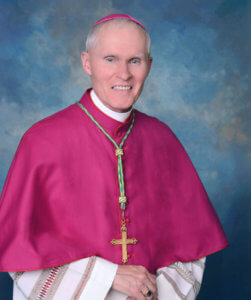
Pope Leo XIV has accepted the resignation of Most Reverend Mark E. Brennan, 79, from the pastoral governance of the Diocese of Wheeling-Charleston, and has appointed Most Reverend Evelio Menjivar-Ayala, currently auxiliary bishop of Washington, as his successor.


WASHINGTON – Pope Leo XIV has accepted the resignation of Most Reverend Mark E. Brennan, 79, from the pastoral governance of the Diocese of Wheeling-Charleston, and has appointed Most Reverend Evelio Menjivar-Ayala, currently auxiliary bishop of Washington, as his successor. 

The resignation and appointment were publicized in Washington, D.C. on May 1, 2026, by Cardinal Christophe Pierre, apostolic nuncio to the United States.

Bishop Menjivar-Ayala’s biography may be found here.

The Diocese of Wheeling-Charleston is comprised of 24,041 square miles in the State of West Virginia.

Tuesday, August 5, 2025

West Virginia Bishop warns Catholics that God will judge if we do not affirm the dignity of all immigrants, regardless of status


West Virginia bishop warns on immigration: ‘The final judge of our actions is God’


Bishop Mark E. Brennan of Wheeling-Charleston, W.Va., is pictured in a 2019 photo at the Cathedral of St. Joseph in Wheeling. Bishop Brennan issued a statement July 31, 2025, addressing the immigration crisis and calling people in his state to "pray for the courage to do the right thing." (OSV News photo/Bob Roller)

OSV News) — Amid the Trump administration’s crackdown on illegal immigration, Bishop Mark E. Brennan of Wheeling-Charleston, West Virginia, is urging the people of his state to “affirm the humanity of all immigrants, regardless of legal status.” But he also called on every person to “pray for the courage to do the right thing,” including those tasked with carrying out the nation’s laws, warning that God will judge each person by their actions. 

The bishop released a July 31 “Statement on the Current Immigration Crisis,” which was posted to the diocese’s Facebook page.

The three-page document comes as the Department of Homeland Security works to fulfill President Donald Trump’s mass deportation campaign promise, with immigration enforcement actions including violent takedowns, increased arrest quotas, third-country deportations and the construction of more migrant detention facilities modeled on the controversial Alligator Alcatraz facility set up in the inhospitable terrain of the Florida Everglades.

“We are a nation built on the backs of men and women who came from other countries, whether freely or in chains,” Bishop Brennan said in his statement. “Now we see our government adopting harsh measures to deport as many immigrants as possible, often without distinguishing between true criminals and law-abiding persons.”

The bishop noted that some had told him they supported efforts to “install order at the southern border” while preventing violent offenders from entering the nation. But he also said they told him that they “didn’t expect this wholesale assault on the majority of immigrants, who work hard, are raising their families and live peacefully in our communities.”

“You expected a laser beam approach, not a floodlight,” said Bishop Brennan.

Catholic Faith Sheds Light on Immigration Crisis

Bishop Brennan said the Catholic faith sheds light on the current immigration crisis. He referenced how the Gospels attest that Mary and Joseph had to flee Israel, their homeland, for Roman-ruled Egypt in order to save Jesus, the newborn savior and son of God, from falling into the murderous hands of King Herod the Great. The bishop also noted Jesus’ own words in Matthew 25 to those he invites to join him in paradise at the Last Judgement: “I was a stranger and you welcomed me.”

“Our Church looks at the person, not his or her legal status, and, following Christ’s teaching and example, reaches out to help the immigrant,” Bishop Brennan continued. “A person is more important than legal status.”

He noted that “even prisoners in jail are fed, clothed and have their health problems addressed, at least in well-run prisons.” The bishop emphasized that the diocese “will continue to advocate for and assist our immigrant brothers and sisters in our parishes and through Catholic Charities.”

Catholic social teaching on immigration balances three interrelated principles — the right of persons to migrate in order to sustain their lives and those of their families, the right of a country to regulate its borders and control immigration, and a nation’s duty to regulate its borders with justice and mercy.

Government Policy Incoherence on Immigration

Bishop Brennan said that entering the U.S. without legal permission is typically a misdemeanor — “a crime but a lesser one, on the level with loitering, public intoxication and shoplifting” — that only becomes a felony following deportation and unauthorized re-entry. 

Bishop Brennan indicated the government’s treatment toward migrants is incoherent. He noted it is expelling “millions of workers upon whom the economy depends,” while breaking up families of immigrants who typically marry younger and have more children than the average American couple, at the very moment the U.S. fertility rate has plunged below population replacement levels. 

He noted his own state is already suffering this population decline. West Virginia is one of 17 states, according to U.S. census data, where deaths now outnumber births. 

“The main problem is that our immigration laws discourage legal immigration,” he said, unless a prospective immigrant is a “celebrity or a person with a special skill our government wants.”

He pointed to the years-long wait experienced by immigrants as they navigate “the complicated and expensive immigration process,” often stymied by U.S. immigration quotas that favor some nations over others.

“Some people simply cannot wait for the legal immigration process to slowly and painfully unfold,” said Bishop Brennan. “They could be killed for their religion or political views or see their children starve to death before they are granted a visa to come here legally; so, they come anyway because they are desperate.”

Both Political Parties ‘Have Failed Us’

The U.N. Refugee Agency noted that by the end of 2024 more than 123 million people worldwide — one in every 67 persons on Earth — had been forced to flee their homes due to persecution, conflict, violence, human rights violations and instability.

According to Pew Research Center, an estimated 11 million migrants were living and working in the U.S. without legal authorization in 2022, the year with the most recent available data, a figure still below the peak of 12.2 million from 2007.

Bishop Brennan said that both of the two U.S. major political parties “have avoided dealing seriously with immigration reform,” and “have benefited by keeping immigration a live issue in their campaigns.”

“Our politicians have failed us,” said Bishop Brennan.

Yet, he said, referencing the biblical story of Cain and Abel, “We are our brother’s and sister’s keepers.”

But he also said people must act on Christian principles, particularly in light of Jesus Christ’s commands in the Gospels to “love your neighbor as yourself” and “do under others as you would have them do unto you.”

To that end, he stressed the importance of prayer, outreach and action in upholding the dignity of immigrants, especially speaking up to counter “grossly inaccurate talk about undocumented immigrants being uniformly criminal.” He also recommended contacting public officials to urge “immigration enforcement to be less cruel and more focused on violent criminals.”

Faithful Urged to Remember History, Pray for Courage

But Bishop Brennan also exhorted the faithful to “remember our history,” including the refusal of many to comply with the nation’s Fugitive Slave Act of 1850. The federal law required local law enforcement to arrest African Americans who had escaped slavery while forbidding U.S. citizens, on pain of ruinous fines (equivalent to $41,000 today) and six months imprisonment, to assist such individuals.


“It is Catholic teaching that an unjust law does not bind in conscience,” said the bishop. “But one must be willing to accept the consequences of civil disobedience. … We must pray for the courage to do the right thing.”


The bishop then said, “I encourage even those whose official duty is to enforce the current administration’s immigration policies to consider whether a specific action is morally justified.


“I recognize that they have sworn to uphold the law. Yet the manner in which a law is enforced matters,” Bishop Brennan said. “Those acting on the government’s behalf cannot escape personal responsibility for an unjust action with the excuse that it was ordered by their superiors. That defense was not allowed during the Nuremberg trials of Nazi war criminals at the end of World War II.”


Bishop Brennan made clear that “what has been reported about excesses in immigration enforcement does not approach the horror of Nazi treatment of prisoners.” Nevertheless, he emphasized, “the principle of personal responsibility for one’s actions remains the same.”

Martyrs Remind All that God, Not Government, is ‘Final Judge’

He acknowledged that “challenging a superior’s unjust or cruel order risks retaliation, so the degree of injustice a government agent perceives in such an order must be weighed against the potential for severe repercussions against the agent.”

“Still,” he said, “we should all keep in mind that the final judge of our actions is God. Our Church would have no martyrs if the highest good was to preserve one’s life. Some things are worth taking a principled stand for.”

Bishop Brennan asked, “How would God judge actions that pull a man away from his wife and children in order to deport him? How would He judge arresting a person just because ‘he looks like an immigrant?’ How does He look at a large, rich nation that turns away the world’s poor and suffering?”

According to the church’s teaching in Catechism of the Catholic Church, “The more prosperous nations are obliged, to the extent they are able, to welcome the foreigner in search of the security and the means of livelihood which he cannot find in his country of origin.”

“Our government’s own inaction is the main reason why many oppressed and struggling people feel obliged to enter our country without legal documents,” said Bishop Brennan. “Now our government is overreacting by trying to force them out. We Catholics must welcome the stranger and feed and clothe him.”


Gina Christian is a multimedia reporter for OSV News. Follow her on X @GinaJesseReina.

Thursday, July 14, 2022

Arrests made in the fire that destroyed a Catholic Church in West Virginia


Two men face felonies in fire that destroyed historic West Virginia chapel

All that remains of St. Colman Church in Dillon, W.Va., on Irish Mountain in Raleigh County, is seen June 27, 2022, after it was found burned to the ground June 26. (CNS photo/courtesy Beaver Volunteer Fire)

By: Colleen Rowan,

Date: July 13, 2022

SHADY SPRING, W.Va. (CNS) — More than two weeks after a 145-year-old Catholic church near Shady Spring was destroyed by fire, law enforcement officials announced July 12 that two suspects were arrested and charged with felonies for a blaze officials confirmed was arson.

St. Colman Church was built on Irish Mountain in the Wheeling-Charleston Diocese in 1877 and has been on the National Register of Historic Places since 1984.

The original families and their descendants are buried at the cemetery that sits at the edge of the forest behind the now charred remains of their beloved church. Masses were celebrated a few times a year at St. Colman usually on Memorial Day Weekend.

Bishop Mark E. Brennan of Wheeling-Charleston praised “the hard work of the West Virginia State Police” in the investigation that led to the arrests of Braxton Allan Miller, 18, of Charleston, and James Dean Elmore, 19, of Beckley, West Virginia.

Miller was charged with arson and conspiracy, both felonies, and Elmore with conspiracy and accessory after the fact, which also are felony charges.

The bishop thanked law enforcement “on behalf of the families who settled Irish Mountain generations ago, the local parishioners who lovingly maintained our historic chapel and cemetery there, and all those who have visited St. Colman over the years.”

In his July 12 statement, Bishop Brennan cited the efforts of Trooper D.L. Daniels in particular and also thanked the State Fire Marshal’s Office for its part in the investigation.

According to WVNS-TV 59, Daniels was dispatched to the church the morning of June 26. He said firefighters at the scene told him the blaze had been set the previous night, but no one called 911 until that morning.

Several area fire stations responded to the call, but “the church had been completely burned to the ground,” Daniels was quoted as saying.

The news outlet reported that Daniels was told by an anonymous caller that his, the caller’s, nephew and a group of friends had been at the church “drinking and partying, and one of the boys had set the church on fire.”

A police dog brought to the scene “indicated that an accelerant was present,” WVNS-TV 59 said.

When the diocese first learned of the fire, Bishop Brennan expressed his sorrow for the Catholic community of the area.

“We are united with them and we sympathize with the loss of this lovely chapel,” he said, hoping the people would not be discouraged. “The spirit of devotion where that church has been for 145 years can continue on that site where many of their ancestors worshipped and where many are buried.”

A June 27 diocesan statement said the diocese was saddened to hear of the devastating fire but was thankful “no one was inside the building when the fire occurred. … The structure is a total loss.”

“The diocese is truly grateful for the response of so many fire departments in the area,” it said, but added that the little whitewashed wooden church “burned quickly and nothing can be saved.”

The cemetery will continue “to be maintained,” it said.

St. Colman was designated a chapel years ago and was part of a cluster of churches under St. Patrick Parish in Hinton, West Virginia.

Divine Word Father Romeo Bacalso, administrator of the cluster, said the loss of St. Colman’s is tragic and overwhelming for the Catholic faithful of the community.

“Our parishioners and I are heartbroken,” Father Bacalso told The Catholic Spirit, the diocesan newspaper. “It’s our treasure of faith. We gather as one family and community at St. Colman … at least twice a year and clean/visit quarterly.”

It was known as “the Little Catholic Church in the Woods,” Art Sanda said of Raleigh County’s beloved chapel.

A member of St. Patrick Parish in Hinton, Sanda has been involved at the little church for more than 20 years, and he said there are discussions underway about a fitting way to memorialize it.

“What was lost can’t be restored, it can’t be replaced,” he said. “At the same time, the feeling is very strong that something has to be done to continue the spirit of St. Colman.”

Over the years, thousands of people have visited St. Colman, said Father Bacalso. “We have dozens of completed guest books full of wonderful comments on the serenity and beauty of St. Colman, the peace and tranquility that it brought to them while taking a moment to reflect and to meditate.”

Visitors were Catholics and non-Catholics alike and locals as well as people from other cities, counties, states and countries, he said.

In recent years, sporadic vandalism has been a problem, the priest said. When that would happen, Sanda and fellow parishioners would make the necessary repairs.

“I have spoken to many who expressed dismay and bewilderment at what has happened,” Sanda said, but they’re also determined “that something worthwhile absolutely must rise from the ashes of St. Colman, some monument that memorializes” it and “keeps alive the pleasure and peace” visitors have found there.

Wednesday, July 24, 2019

A New Bishop and a new start for West Virginia

Bishop Brennen - Courtesy of Archdiocese of Baltimore

Pope Names New Bishop of Wheeling – Charleston (USA)

Bishop Mark Edward Brennan, Until Now, Had Been Titular Bishop of Rusubisir and Auxiliary of Baltimore

Pope Francis has appointed as Bishop of the Diocese of Wheeling-Charleston, in the United States, Mark E. Brennan.
Bishop Mark Edward Brennan, until now, had been titular Bishop of Rusubisir and Auxiliary of Baltimore.
Born on February 6, 1947 in Boston, Massachusetts, in the archdiocese of the same name, he later would attended Saint Anthony’s High School in Washington, DC.
According to his biography published by the Vatican, he later obtained a Baccalaureate from Brown University in Providence, Rhode Island (1969). He attended Christ the King Seminary in Albany in New York (1969-1970) and the Pontifical North American College in Rome where he received the Baccalaureate (1972) and the Master in Arts (1974) in Theology at the Pontifical Gregorian University. Later, he devoted himself to Hispanic Immersion Studies in the Dominican Republic (1985-1986).
Brennan was ordained a priest for the Archdiocese of Washington on May 15, 1976. After ordination, he held the following positions: Parochial Vicar of Our Lady of Mercy Parish in Potomac (1976-1981), of Saint Pius X Parish in Bowie (1981-1985) and of Saint Bartholomew Parish in Bethesda (1986-1988); Pastoral ministry to the Hispanic community of Saint Bartholomew Parish in Bethesda (1988-1989); Director of priestly vocations and priestly programs for the Archdiocese of Washington (1988-1998); Parish administrator of Our Lady’s Parish in Medley’s Neck (1990) and of Saint Andrew Kim Parish in Olney (1990); Pastor of Saint Thomas the Apostle Parish in Bethesda (1998-2003) and of Saint Martin of Tours Parish in Gaithersburg (2003-2017).
He was a Member of the Presbyteral Council (1978-1981 and 2009-2015) and of the College of Consultors (1998-2001 and 2011-2016); Vicar Forerman of the Northwest West Deanery (2002-2005); and Lawyer of the Metropolitan Court of the Archdiocese of Washington (2006).  In 2005 he was appointed Chaplain of His Holiness.
Appointed Titular Bishop of Rusubisir and Auxiliary of Baltimore on 5 December 2016, he was ordained on 19 January 2017. As Auxiliary, he carried out the Eastern Vicar office of three counties and accompanied the Hispanic communities in the archdiocese

Saturday, July 20, 2019

Vatican comes down hard on disgraced West Virginia Bishop

Vatican announces new restrictions on disgraced Bishop Bransfield


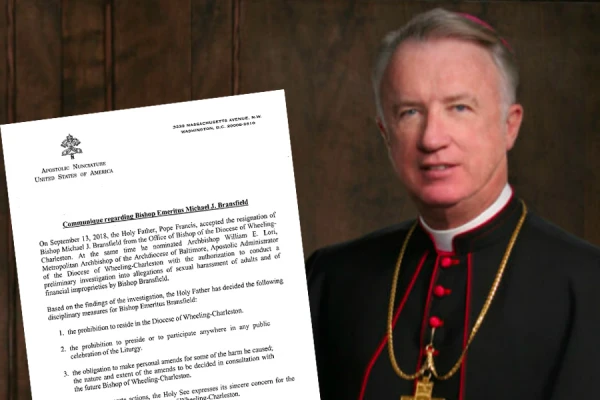
Wheeling, W.V., Jul 19, 2019 / 01:57 pm (CNA).- Bishop Michael J. Bransfield, Bishop emeritus of Wheeling-Charleston, will no longer be allowed to participate in public Masses or live within his former diocese. He must “make personal amends” for the harm he brought to the diocese, Pope Francis announced in a communique released on Friday afternoon.
Bransfield is reported to have sexually harassed, assaulted, and coerced seminarians, priests, and other adults during his time as Bishop of Wheeling-Charleston. He was also found to have given large cash gifts to high-ranking Church leaders, using diocesan funds.
The July 19 Vatican communique, which was published Friday on the Diocese of Wheeling-Charleston’s website, was sent from the Apostolic Nuncio of the United States, Archbishop Christophe Pierre.
Bransfield’s resignation was accepted by Pope Francis on Sept. 13, 2018, five days after Bransfield reached the retirement age of 75.
When Pope Francis accepted Bransfield’s resignation, he appointed Archbishop William E. Lori of Baltimore as the apostolic administrator of the diocese. He also authorized Lori to start an investigation into the allegations made against the retired bishop, which at the time were described as financial abuses and the sexual harassment of adults.
A hotline for the investigation that was set up in September received more than three dozen calls during its first two weeks.
In March, Lori announced that he had restricted Bransfield’s ministry in the Diocese of Wheeling-Charleston as well as in the Archdiocese of Baltimore, and that the Holy See would be conducting an additional evaluation of the investigation. That assessment was released on Friday.
“Pending the assessment of the findings of the Holy See, as Apostolic Administrator of the Diocese of Wheeling-Charleston, I have directed that Bishop Bransfield is not authorized to exercise any priestly or episcopal ministry either within the Diocese of Wheeling-Charleston or within the Archdiocese of Baltimore,” Lori said in a March 11 press release.
The Holy See’s communique expands that restriction, and adds the additional prohibition on living within the diocese. Further, the Vatican wrote that Bransfield has “the obligation to make personal amends for some of the harm he caused.”
Per the release, “the nature and extent of the amends to be decided in consultation with the future Bishop of Wheeling-Charleston.”
After the investigation, Archbishop Lori confirmed that investigators had established a pattern of sexual malfeasance, and serious financial misconduct by Bransfield throughout his time as bishop.
“The investigative report determined that during his tenure as Bishop of Wheeling-Charleston, Bishop Bransfield engaged in a pattern of excessive and inappropriate spending,” Lori said, citing renovations to multiple residences and the misuse of Church funds “for personal benefit on such things as personal travel, dining, liquor, gifts and luxury items.”
Some bishops who received cash gifts from Bransfield pledged to return them.