Showing posts with label Russian Orthodox. Show all posts

Saturday, July 13, 2024

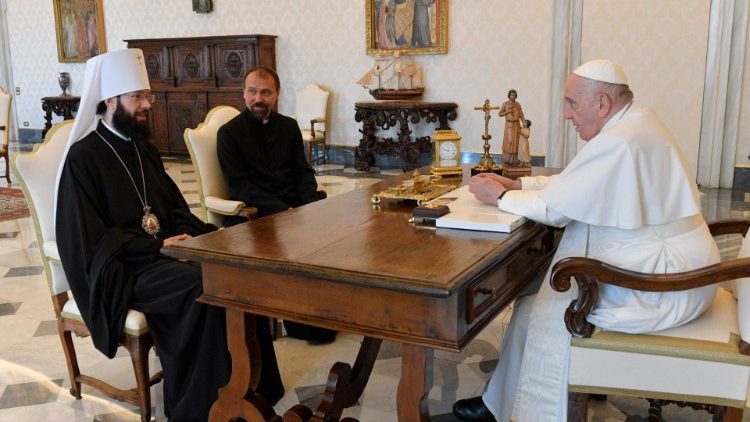
Pope Francis meets with the Metroplitan of the Russian Orthodox Church


File Photo: Metropolitan Antonij of Volokolamsk, head of the Department for External Relations of the Patriarchate of Moscow, visits Pope Francis in the Vatican (5 August 2022)File Photo: Metropolitan Antonij of Volokolamsk, head of the Department for External Relations of the Patriarchate of Moscow, visits Pope Francis in the Vatican (5 August 2022)  (AFP or licensors)

Pope Francis receives Russian Orthodox Metropolitan Antonij

Russian Metropolitan Antonij of Volokolamsk, head of the Department for External Relations of the Patriarchate of Moscow, meets Pope Francis in the Vatican.

By Deborah Castellano Lubov

Amid the Pope's countless appeals for peace in the ongoing war in Ukraine, Pope Francis received Russian Orthodox Metropolitan Antonij of Volokolamsk in the Vatican on Thursday afternoon, according to the Holy See Press Office.

This marks the second visit of Metropolitan Antonij, the head of the Department for External Relations of the Patriarchate of Moscow, in the Vatican, after his 5 August 2022 visit, which was part of the ecumenical contacts between the Pope and the Patriarchate of Moscow.

That encounter had followed a 16 March video conference between Pope Francis and the Russian Orthodox Patriarch Kirill of Moscow, in which the Pope invited all Christians and Christian pastors to work toward peace.

Pope Francis and Metropolitan Antonij also participated in the Seventh Congress of Leaders of World and Traditional Religions in Kazakhstan in September 2022.

Tuesday, May 30, 2023

Orthodox Church of Ukraine moves Christmas to December 25th


In snub to Russia, Ukraine’s Orthodox Church moves Christmas to Dec. 25

Elise Ann Allen


ROME – In a decision seen as an act of defiance towards the Russian Orthodox Church, which also has the effect of promoting closer ties with Roman Catholics and other Western branches of Christianity, the Orthodox Church of Ukraine has decided to move Christmas to Dec. 25.

Traditionally, Ukrainian Christians, the bulk of whom are Orthodox, have celebrated Christmas on Jan. 7, along with other predominantly Orthodox nations, including Russia, which invaded Ukraine in February of last year.

On May 24, the Council of Bishops of the Orthodox Church of Ukraine voted nearly unanimously to switch from the Julian calendar to the Gregorian calendar as regards most major feasts, except for Easter and a handful of other feast days, such as the feast of the Trinity.

In a statement following the Council’s decision, Metropolitan Epiphany, head of the Orthodox Church of Ukraine, said the decision “is not an easy one, we have been coming to it for a long time, gradually, step by step, and we are making it carefully.”

However, Epiphany said the decision was “as necessary as the decision to introduce the Ukrainian language in worship instead of the traditional Slavic language, to introduce an autocephalous structure of the Church’s life instead of centuries of subordination.”

The Ukrainian Greek Catholic Church, one of several Byzantine-rite churches in full communion with Rome, was the first to make the switch to a new calendar in early 2023.

Adherents to Orthodoxy still follow the Julian calendar, while the Catholic Church and most of the world follow the Gregorian calendar, introduced via papal bull Pope Gregory XIII on February 24, going into effect in October 1582 as a modification of, and replacement for, the Julian calendar.

The transition from the Julian calendar without making a change regarding the celebration of Easter is called the “New Julian” calendar, which is already used by many Orthodox churches in Europe.

In Ukraine there are two primary branches of Orthodox, the autocephalous Orthodox Church of Ukraine, and the Ukrainian Orthodox Church of the Moscow Patriarchate – a branch of Orthodoxy in Ukraine that reports to Moscow.

Following their recent vote, as of Sept. 1, which marks the beginning of their new church year, the Orthodox Church of Ukraine (OCU) will celebrate Christmas on Dec. 25, rather than on Jan. 7.

The Orthodox Saint Nicholas Day will now take place on Dec. 6, and the church will join Catholics in celebrating the feast of the Epiphany on Jan. 6.

In a decree announcing their decision, the OCU said they made the decision to switch the date of their observance of Christmas not only because the Julian calendar is of secular origin and “has no sacred significance,” but also because it is associated with Russian Orthodoxy.

“In the modern realities of the existence of the Orthodox Church of Ukraine in Ukrainian society, especially in connection with the aggressive Russian war against Ukraine,” the demand for a change in the calendar increased “significantly,” they said.

For centuries, the traditional Julian calendar “was perceived as one of the main identifiers of Ukrainian church culture. At first, it was a sign of resistance to Latinization, and after the Bolshevik revolution, it was also a sign of resistance to the Soviet system,” they said.

However, the social and cultural context in Ukraine has changed dramatically since then, the OCU’s statement said.

Nowadays, it said, the Julian calendar “is perceived by the majority not so much as connected with ancient Ukrainian traditions, but as connected with Russian church culture. After all, the Orthodox Churches that support the Orthodox Church of Ukraine use the modern calendar, while its opponents, and primarily the Russian Orthodox Church, follow the old calendar.”

“Therefore, the desire to preserve and affirm one’s own, Ukrainian, spiritual identity, protection from the aggression of the ‘Russian world,’ requires a timely decision – to join the majority of Local Orthodox Churches – in introducing into use the New Julian calendar, as more accurate astronomically and ecclesiastically accepted, with the preservation of the traditional Easter,” the statement said.

The outbreak of the Russia-Ukraine war last year has caused a fracture inside the Orthodox world, with several local Russian Orthodox churches opting to break away from the Moscow Patriarchate over Russian Orthodox Patriarch Kirill’s support of the war, requesting to switch jurisdiction to the Ecumenical Patriarchate of Constantinople, led by Patriarch Bartholomew, instead.

Traditionally, the Ecumenical Patriarchate of Constantinople and the Moscow Patriarchate have been at odds, seen as representing two different strains of Orthodoxy, with Moscow accusing the former of being too indulgent of the West and, therefore, of Western secular values.

However, with Russia’s invasion of Ukraine last year, this sentiment has changed among many Orthodox, sparking a significant shift in sentiment among Ukrainian Orthodox, particularly those who are loyal to Moscow.

Last spring, shortly after the war broke out, priests within the Ukrainian Orthodox Church of the Moscow Patriarchate began collecting signatures for a petition to oust Russian Orthodox Patriarch Kirill from his position of leadership over his support for Russia’s invasion of Ukraine.

This follows a similar petition launched at the beginning of the war that was signed by nearly 300 Russian Orthodox priests, including several prominent members of the Russian Orthodox Church, and which urged Kirill to condemn the war, which over a year later, he still has not done.

Ecclesial tensions in Ukraine are also being felt at the political level, as the Ukrainian parliament debates a bill banning all activities of the Moscow Patriarchate in Ukraine.

Despite his frequent condemnations of Russia’s invasion, the leader of the Ukrainian Greek Catholic Church, Major Archbishop Sviatoslav Shevchuk, has condemned the bill, saying it is not only problematic on grounds of religious freedom, but would have the counterproductive effect of turning supporters of Russia into martyrs.

RELATED: Ukraine’s top Catholic frowns on banning Orthodox church loyal to Moscow

The UOC’s statement specified that despite the shift in calendar, parishes that wish to continue following the old Julian calendar for economic or other reasons may do so, but the decision must be approved by a two-thirds majority of community members and it must be “properly documented.”

Wednesday, May 3, 2023

Pope Francis visits with Orthodox Metropolitan at General Audience


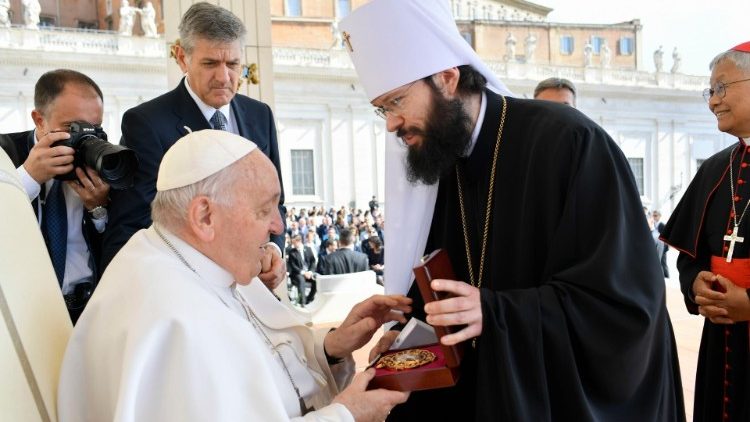
Pope Francis greets Metropolitan Anthony at Wednesday's General AudiencePope Francis greets Metropolitan Anthony at Wednesday's General Audience  (Vatican Media)

Russian Orthodox Metropolitan Anthony greets Pope at audience

Metropolitan Anthony Volokolamsk, the chairman of the Department for External Church Relations of the Moscow Patriarchate, was present in St Peter's Square on Wednesday for the Pope’s General Audience.

By Vatican News staff reporter

Metropolitan Anthony of Volokolamsk, the chairman of the Department for External Church Relations of the Moscow Patriarchate, was present in St Peter's Square on Wednesday during the general audience, seated next to Cardinal Lazarus You Heung-sik, prefect of the Dicastery for the Clergy.

At the conclusion of the audience, the Metropolitan greeted the Pope, pausing to speak cordially for a few moments.

Pope Francis, as he customarily does at these encounters, kissed the panagia, the medallion with an icon of the Mother of God worn by Orthodox metropolitans.

The Pope then gave the metropolitan a medal of his pontificate, while Metropolitan Anthony in return gave him a panagia in a case.

Working visit

On Tuesday, Metropolitan Anthony met in Rome with Archbishop Claudio Gugerotti, prefect of the Dicastery for Eastern Churches.

As reported by the website of the Moscow Patriarchate's Department for External Church Relations, Metropolitan Anthony arrived in Italy on 1 May “with the blessing” of Patriarch Kirill of Moscow “for a brief working visit.”

The notice on the website goes on to say that during the meeting with Archbishop Gugerotti, which took place at the offices of the Dicastery, “a wide range of issues of mutual interest were discussed.”

Saturday, April 29, 2023

Pope Francis meets with Russian Orthodox Patriarch in Budapest


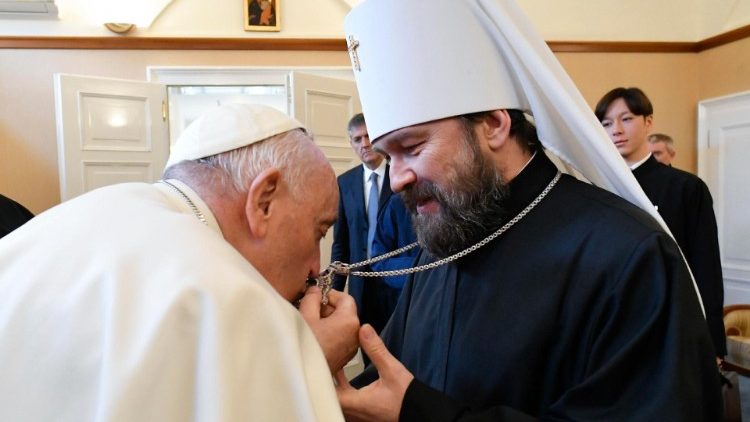
Pope Francis receives Metropolitan Hilarion in the Nunciature in BudapestPope Francis receives Metropolitan Hilarion in the Nunciature in Budapest  (ANSA)

Pope meets with Metropolitan Hilarion in Budapest

Pope Francis holds a “cordial” meeting at the Apostolic Nunciature with the Russian Orthodox Metropolitan Archbishop of Budapest and Hungary, who previously served as the head of the Department of External Relations of the Patriarchate of Moscow.

By Vatican News staff reporter

After his morning appointments on the second day of his visit to Hungary, Pope Francis met privately on Saturday with Archbishop Hilarion, the Metropolitan Archbishop of Budapest and Hungary, in the Apostolic Nunciature where he is staying.

The former Metropolitan of Volokolamsk, Russia, was appointed to this post in June 2022, after serving for thirteen years as head of the Department of External Relations of the Patriarchate of Moscow, and was known informally as Patriarch Kirill's "foreign minister".

A cordial meeting

The possibility of a meeting with Archbishop Hilarion had been anticipated by the Director of the Holy See Press Office, Matteo Bruni, on 21 April, during his briefing on Pope Francis’ Apostolic Journey to Hungary. Mr. Bruni stated, however, that an audience was not a part of the official agenda.

As reported by the Holy See, the audience, which took place with the help of an interpreter, was cordial and lasted about 20 minutes.

The Holy Father greeted the Metropolitan with a hug and kissed his pectoral cross.

Previous meetings

Pope Francis and Hilarion last met on 22 December 2021 in the Vatican. On that occasion, according to the Holy See Press Office, the pair discussed some issues of common concern and their commitment "to seek concrete human and spiritual responses".

The first meeting between Pope Francis and the Russian Orthodox Metropolitan took place on 20 March 2013, the day after the beginning of the Pope's Petrine ministry. It was followed by several other encounters, including the one on the occasion interreligious event “Brother Peoples, Future Land" organized by the Community of Sant'Egidio in Rome on 7 October 2021.

Wednesday, September 28, 2022

Outrageous statements from the Russian Patriarch


Russian Patriarch Kirill Says Dying In Ukraine 'Washes Away All Sins'

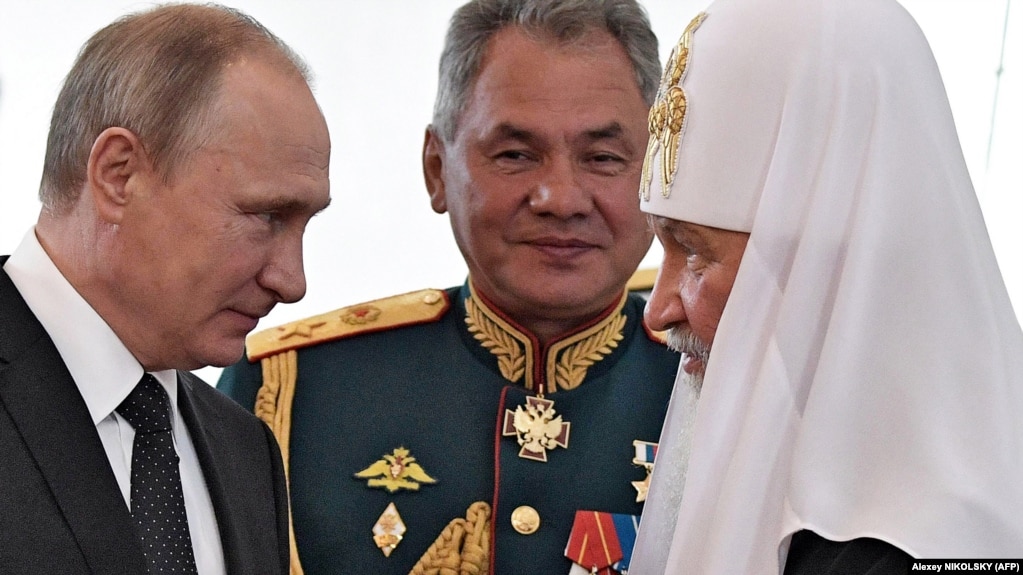
Patriarch Kirill (right) with Russian President Vladimir Putin (left) and Defense Minister Sergei Shoigu. (file photo)

Patriarch Kirill, head of the Russian Orthodox Church, has told his followers that "sacrifice in the course of carrying out your military duty washes away all sins."

The patriarch's comments during his Sunday sermon on September 25 came amid nationwide protests and rising criticism over the Kremlin's recent announcement of a partial mobilization to replenish Russian forces fighting in Ukraine.

Live Briefing: Russia's Invasion Of Ukraine

RFE/RL's Live Briefing gives you all of the latest developments on Russia's ongoing invasion, Kyiv's counteroffensive, Western military aid, global reaction, Russian protests, and the plight of civiliansFor all of RFE/RL's coverage of the war, click here.

Western officials estimate that Russia has suffered 70,000 to 80,000 casualties since it invaded Ukraine in February.

Russian officials have said the draft would focus on reservists and would bring 300,000 fresh troops to the war effort. But Russian media has said the real target is 1 million new troops, and reports that men with no combat experience and beyond draft age are being enlisted has attracted criticism even from pro-Kremlin voices.

Kirill, a prominent supporter of President Vladimir Putin who has "blessed" the war effort and warned by Pope Francis against becoming "Putin's altar boy," has previously claimed that Russians were doing a "heroic deed" by killing Ukrainians, even as he has urged them not to see the Ukrainian people as enemies.

"We know that many today are dying in the fields of internecine battle," Kirill said at a church near Moscow on September 25. "The church is praying that this battle will end as soon as possible, that as few brothers as possible will kill each other in this fratricidal war."

However, he added, "The church realizes that if someone, driven by a sense of duty and the need to honor his oath, stays loyal to his vocation and dies while carrying out his military duty, then he is, without any doubt, doing a deed that is equal to sacrifice."

After Putin announced the military mobilization on September 21, Kirill was quoted by Russian state media as saying that "danger looms over the Ukrainian people," claiming that unidentified forces were trying to turn them from being "part of the holy united Rus into a state hostile to this Rus, hostile to Russia."

Kirill sees Russia's full-scale invasion of Ukraine launched in February as a bulwark against a decadent West and has insisted that "Russia has never attacked anyone."

About 34 percent of Orthodox believers in Ukraine identify with the main Orthodox Church of Ukraine, which in 2019 was officially recognized as separate from the Moscow Patriarchate by Orthodox Christianity's spiritual head, Patriarch Bartholomew of Constantinople.

About 14 percent of Ukraine's Orthodox community are members of Ukraine's Moscow Patriarchate Church, according to a 2020 study.

Following Russia's invasion in February, about 400 parishes of the Orthodox Church of Ukraine that had remained loyal to Kirill cut ties with the Russian Orthodox Church over the patriarch's position on the war.

"Not only did he fail to condemn Russia's military aggression, but he also failed to find words for the suffering of the Ukrainian people," church spokesman Archbishop Kliment said of Kirill's stance in May.

Days later, Kirill said he understood the decision to cut ties amid Moscow's invasion but claimed that the "spirits of malice" were trying to divide the Orthodox people of Russia and Ukraine.

More than 150 Russian Orthodox clerics called for a stop to the war in an open letter on March 1. Kirill was not among those who signed it.

Britain imposed sanctions against Kirill in June as part of a package aimed at punishing Moscow over the war in Ukraine. The measure came shortly after the EU dropped a similar proposal to sanction Kirill following opposition from Russia-friendly bloc member Hungary.

Jen Psaki, who was spokeswoman for the White House at the time, said in May when asked about the possibility of sanctioning Kirill that "no one is safe from our sanctions."

Friday, August 5, 2022

Vatican meeting between the Pope and the Russian Orthodox Metropolitan


Metropolitan Antonij of Volokolamsk with Pope Francis in the VaticanMetropolitan Antonij of Volokolamsk with Pope Francis in the Vatican  (Vatican Media)

Pope Francis meets with Russian Orthodox Metropolitan Antonij

Metropolitan Antonij of Volokolamsk, head of the Department for External Relations of the Patriarchate of Moscow, who succeeds Metropolitan Hilarion, visits the Vatican for the first time, after his appointment in June.

By Vatican News

Russian Orthodox Metropolitan Antonij of Volokolamsk visited the Vatican for the first time on Friday.

The meeting between the head of the Department for External Relations of the Patriarchate of Moscow and Pope Francis is part of the ecumenical contacts between the Pope and the Patriarchate of Moscow, and follows the conversation between Pope Francis and the Orthodox Patriarch of Moscow Kirill, which took place on March 16. 

Metropolitan Antonij of Volokolamsk replaced Metropolitan Hilarion in June as president of the Department of External Affairs of the Moscow Patriarchate.

Metropolitan Hilarion had been sitting next to Patriarch Kirill during the videoconference in March, when the Pope expressed to the Patriarch of Moscow and all Russia his conviction that, regarding the war in Ukraine, the duty of Christians and their pastors is to "do everything " possible "to help peace, to help those who suffer "and to stop the fire” because “those who pay the bill for the war are the people."

Subsequently, on 25 April, Pope Francis sent a letter of good wishes to Patriarch Kirill on the occasion of the Easter of the Catholic and Orthodox Churches that follow the Julian calendar. 

“May the Holy Spirit," the Pope wrote in the letter, "transform our hearts and make us true peacemakers, especially for war-torn Ukraine", while "we feel all the weight of the suffering of our human family, crushed from violence, war and many injustices.”

Thursday, May 5, 2022

Russian Orthodox reacts scolding Pope Francis for his remark, tone against Kirill


Russian Orthodox Church scolds Pope Francis after 'Putin's altar boy' remark


By Guy Faulconbridge

LONDON (Reuters) -The Russian Orthodox Church scolded Pope Francis on Wednesday for using the wrong tone after he urged Patriarch Kirill not to become the Kremlin's "altar boy", cautioning the Vatican that such remarks would hurt dialogue between the churches.

Francis told Italy's Corriere Della Sera newspaper that Kirill, who has given the Ukraine war his backing, "cannot become [President Vladimir] Putin's altar boy".

The Russian Orthodox Church said it was regrettable that a month and a half after Francis and Kirill, the patriarch of Moscow and All Russia, had spoken directly, the pope had adopted such a tone.

"Pope Francis chose an incorrect tone to convey the content of this conversation," the Moscow Patriarchy said, though it did not explicitly mention the "altar boy" comment.

"Such statements are unlikely to contribute to the establishment of a constructive dialogue between the Roman Catholic and Russian Orthodox Churches, which is especially necessary at the present time."

Kirill, 75, a close ally of Putin, sees the war as a bulwark against a West he considers decadent, particularly over the acceptance of homosexuality.

The Russian Orthodox Church is by far the biggest of the churches in the Eastern Orthodox communion, which split with Western Christianity in the Great Schism of 1054. Today it has about 100 million followers within Russia and more outside.

Ukraine has about 30 million Orthodox believers, divided between the Ukrainian Orthodox Church of the Moscow Patriarchate and two other Orthodox Churches, one of which is the autocephalous, or self-governing, Ukrainian Orthodox Church.

Francis, 85, has asked for a meeting in Moscow with Putin about Ukraine but the Kremlin said on Wednesday there was no agreement on this.

Russia and the West frame the conflict in Ukraine very differently.

Moscow calls its actions a "special military operation" to disarm Ukraine and protect it from fascists. Kyiv and its Western backers say the fascism claim is absurd and say Russia is waging an unprovoked war that threatens Ukraine's continued existence as a sovereign, democratic state.

The Moscow Patriarchy quoted Kirill as telling Pope Francis on March 16 that the Western media had failed to accurately report the situation in Ukraine - a frequent Russian complaint.

'DIVIDED FLOCK'

Kirill said the conflict in Ukraine had begun in 2014 when protests toppled a pro-Russian president. Kirill noted what he said was the persecution of Russian speakers in Ukraine's port city of Odesa. Ukraine denies any such persecution.

But Kirill also expressed sorrow over the conflict.

"Of course, this situation is associated with great pain for me. My flock is on both sides of the confrontation, they are mostly Orthodox people," the Patriarchy quoted him as saying.

"How can we foster the pacification of those fighting with the single goal of achieving the consolidation of peace and justice?"

Putin has also cited NATO enlargement to Russia's borders as a reason for the conflict in Ukraine despite what he says were assurances given as the Soviet Union collapsed that the alliance would not expand - an issue Kirill touched on.

"Patriarch Kirill further recalled that at the end of the Soviet era, Russia received an assurance that NATO would not move one inch in the eastern direction," the Moscow Patriarchy said. "However, this promise was broken."

The United States and NATO deny such assurances were given but say countries are free to apply to join an alliance they say is purely defensive and poses no threat to Russia.

(Reporting by ReutersEditing by Gareth Jones)