Showing posts with label Pope Pius VII. Show all posts

Sunday, April 21, 2024

Pope Francis remembers Pope Pius VII


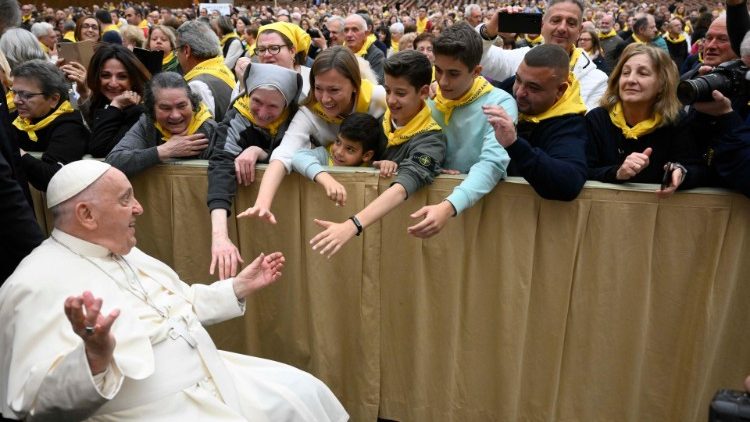
Pope Francis meeting the pilgrims from the Italian Dioceses Cesena-Sarsina, Tivoli, Savona e Imola, on the occasion of the bicentenary of the death of Pope Pius VIIPope Francis meeting the pilgrims from the Italian Dioceses Cesena-Sarsina, Tivoli, Savona e Imola, on the occasion of the bicentenary of the death of Pope Pius VII  (VATICAN MEDIA Divisione Foto)

Pope remembers Pius VII, a man of communion in difficult times

Pope Francis invites Italian pilgrims from the Dioceses of Cesena-Sarsina, Savona, Imola and Tivoli Pope Francis to heed the legacy of the Servant of God Pope Pius VII, a courageous witness of the Gospel in times of struggles and divisions.

By Lisa Zengarini

Pope Francis on Saturday paid tribute to the unwavering faith and dedication to the Church of the Servant of God Pope Pius VII (1742-1823) , who was elected to the Papacy in 1800 in one of the most turbulent years of Europe’s and the Church’s history, marked by the French Revolution and Napoleon's rule.

A Benedictine monk and a renowned theologian, Pius VII, born Barnaba Niccolò Maria Luigi Chiaramonti, is remembered along with his predecessor Pius VI for his unyielding opposition to Napoleon's attempts to subjugate the Church that cost him his arrest and imprisonment in 1809.

“Non debemus, non possumus, non volumus”

Meeting a group of  pilgrims from the Italian Dioceses of Cesena-Sarsina, Savona, Imola and Tivoli as they commemorate the bicentenary of his death, Pope Francis recalled that  Pius VII’s “dedication to God and the Church” remained unshakable even at the moment of  his arrest, when he refused a compromise offered to him saying: “Non debemus, non possumus, non volumus” (“We must not, we cannot, we don’t want”).

Delving into his life, Pope Francis  described how he witnessed to three key values,  which are also essential for our personal and community journeys of faith: communion, testimony and mercy.

A staunch supporter and defender of communion

Pius VII, the Pope said, was “a staunch supporter and defender of communion” in times of fierce struggles and divisions: “With his calm and tenacious perseverance in defending unity”, he was able “to transform the arrogance of those who wanted to isolate him into  opportunities to relaunch a message of dedication and love for the Church, to which God's people responded with enthusiasm. The result – Pope Francis noted - was a community that was materially poorer, but morally more cohesive, strong and credible.”

His example, the Pope remarked, therefore also encourages us today to be builders of unity in the Church, that is “to make communion, encourage reconciliation, promote peace, faithful to the truth in charity!”

“One thing that helps communion a lot is knowing how to speak well. Badmouthing, gossip, instead destroys communion. When you feel compelled to speak badly about someone else, bite your tongue and you will do a great job for the community and unity.”

A courageous announcer of the Gospel

A meek man, Pope Francis continued, Pius VII was also a “courageous announcer of the Gospel”, with his words and with his life. This is testified by the remarks he addressed to the Cardinals electors at the beginning of his pontificate, when he stressed the need to set an example “in humility, in modesty, in patience, in charity and in every priestly duty” to preserve the” authentic dimension of the Church.”  

He lived out this ideal of Christian prophecy throughout his life “with dignity”, in good and bad times, both on a personal and ecclesial level, “even when this led him to clash with the powerful of his time.”

A social reformer

Finally, Pope Francis recalled that, despite the difficulties he faced during the Napoleonic rule, Pius VII paid a particular attention to the needy and carried out far-reaching social reforms that emancipated poor peasants, abolished privileges and the practice of torture.

He showed the same mercy towards his persecutors: “Although he denounced their errors and abuses in no uncertain terms, he tried to keep a channel of dialogue open with them and above all always offered his forgiveness."

Love for truth and willingness to dialogue

Bringing his address to a close,  Pope Francis invited the Italian pilgrims to reflect on the many values  which the memory of this Servant of God recalls to our mind: love for truth, unity, dialogue, attention to the least, forgiveness, the tenacious search for peace :”It will do us good to meditate on them, make them our own and bear witness to them, so that the style of meekness and willingness to sacrifice may grow in us and in our communities,” he concluded.

Friday, October 13, 2023

Pope Francis remembers Pope Pius VII as ambassador of peace


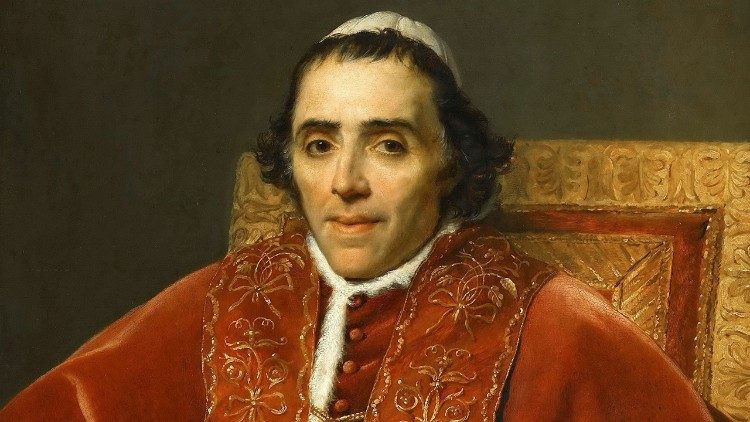
Jacques-Louis-David's portrait of Pope Pius VIIJacques-Louis-David's portrait of Pope Pius VII 

Pope Francis: Pius VII was an 'ambassador of peace'

In a letter marking 200 years since the death of Pope Pius VII, Pope Francis praises his predecessor for the “great wisdom” he displayed in his struggle with the Emperor Napoleon.

By Joseph Tulloch

Pope Pius VII, the 19th-century pontiff best known for his struggle with the Emperor Napoleon, died two hundred years ago this August. 

To mark the occasion, Pope Francis has written a letter to the bishop of Cesena-Sarsina, Pope Pius’ VII diocese of origin.

Relationship with Napoleon

The main theme of the message is Pius VII’s “competence and prudence” in his dealings with Napoleon.

The Italian Pope sought to dialogue with the French Emperor – who had already imprisoned his predecessor – signing a Concordat with him in 1801. Only after Napoleon invaded the Papal States did he retaliate by excommunicating him.

The Emperor took Pope Pius prisoner and transported him to France, but he was freed five years later after Napoleon's military defeat.

Together with his right-hand-man Cardinal Consalvi, he was known for his flexible approach to diplomacy, seeking a middle way between the principles of the French Revolution and the traditions of the papacy.  

In his letter, Pope Francis says that “if we consider the historical period in which Pope Pius VII lived, we cannot but note the great wisdom with which he knew how to be an 'ambassador of peace'.”

“Faced with a contentious political scenario,” the Pope continues, “he did everything he could to not fail in his mission as guardian and guide of the flock” – a task he carried out “according to the spirit of the Beatitudes, which says that peacemakers are children of God.”

Imprisonment

Pope Francis also praises “the evangelical boldness with which [Pope Pius] endured difficult trials during the twenty-three years of his pontificate.”

The Italian Pope’s initially good relationship with Napoleon soon soured, and he was eventually imprisoned. He responded, writes Pope Francis, with “exemplary docility, offering everything to the Lord for the good of the Church.”

It is said that after Napoleon was defeated and imprisoned,  Pope Pius became concerned for his wellbeing, asking his British captors to treat him with lenience.

Pius as Bishop

Pope Francis also has warm words for Pope Pius’ work as a pastor, calling him a man of "humanity and mercy."

Before his election to the papacy, Pius had been the bishop of two dioceses, Tivoli and Imola.

As a pastor, writes Pope Francis, he “distinguished himself by his charisma and goodness of heart".

“In fact, during the years of his episcopal ministry, he did not hesitate to devote himself to the care of the people, dedicating himself to alleviating the many sufferings of those afflicted by precarious conditions."

The Pope concludes his letter by entrusting the faithful of Cesena-Sarsina, the Diocese of Pope Pius' birth, with the task of communicating his life, "so that it might inspire the same passion for the service of others and the building of a harmonious society."