reflections, updates and homilies from Deacon Mike Talbot inspired by the following words from my ordination: Receive the Gospel of Christ whose herald you have become. Believe what you read, teach what you believe and practice what you teach...
Pope to Iraqi youth: Be Christ's light and hope in a wounded world
Pope Leo XIV encourages young Iraqi Christians gathered in Ankawa to become missionaries of faith, love and hope, urging them to be Christ's light and peacemakers in a land marked by conflict and instability.
Vatican News
As young people from across Iraq gather in Ankawa, in the Archeparchy of Erbil, for their annual Youth Meeting from 8 to 11 July, Pope Leo XIV is encouraging them to embrace their vocation as missionaries of hope, urging them to become "Christ's light" in a country that continues to experience the consequences of war and instability.
In a video message to the gathering, dedicated this year to the theme Mission, the Pope reminds participants that they have an indispensable role in the life of the Church today.
"The Church has a vital mission to serve the world by sharing the light of Christ," he says, encouraging the young people to help "shape the Church — and the world — in the years to come."
Recalling a conviction he has expressed previously, Pope Leo emphasizes that "young people are not only the future of the Church, but also the present." And recognizing the difficult reality many Iraqi Christians continue to face, the Pope acknowledges that witnessing to the Gospel is often demanding.
"It is not always easy to be a light in the world," he says. "You are called to radiate this light in a situation that has often been marked by war and instability."
Do not be afraid
Even so, he urges them not to lose heart.
"Do not be afraid! And do not think that you are alone in this task. I am with you; the Church is with you. Place your trust in Jesus," Pope Leo says.
Using the image of light as the guiding thread of his reflection, he highlights three qualities that should shape every Christian disciple: faith, love and hope.
First, he explains, light enables us to see. Faith, therefore, is not simply a response to life's hardships but "the recognition of reality and living in the truth," allowing believers to see the world, others and themselves through God's eyes. He encourages the young people to bear witness through the way they live so that others, too, may discover the truth and meaning they seek.
The Pope then reflects on light as warmth, a sign of God's love. Authentic mission, he says, begins not with activity but with a personal encounter with Christ nurtured through daily prayer and the sacraments, especially Reconciliation and the Eucharist.
Ground your roots in God's love
"Ground your hearts in the solid foundation of God's love for you," he urges. "Discover the heart of Christ, and do not be afraid to build your lives upon him."
Only by remaining rooted in that love, he explains, will they be able to share "the warmth of God's love and the reconciling power of his grace" with those around them.
Finally, Pope Leo XIV presents light as a symbol of growth and hope. In a region longing for reconciliation, he says, young Christians are called to become builders of peace.
"You are particularly called to be peacemakers, to unite those around you, and to instil in others the hope of a future marked by lasting peace."
Although they cannot always control the circumstances in which they live, he reminds them, they can always choose to allow "the peace of Christ to rule" in their hearts, becoming signs of the hope that comes from the Risen Lord.
Concluding his message, Pope Leo entrusts the young people to the maternal care of Mary, Mother of the Church, encouraging them to trust in God's loving plan for their lives.
"Never doubt the goodness of God," he says. "Do not be afraid of the plan the Lord has for each of your lives," recalling the promise of the prophet Jeremiah that God desires "to give you a future with hope."
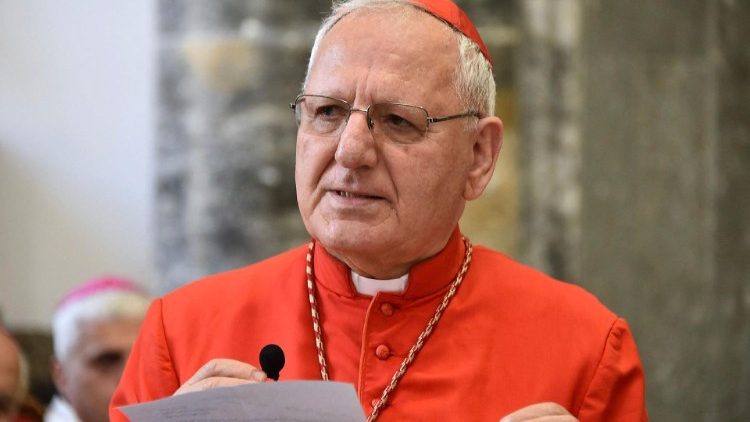
Cardinal Sako resigns as Chaldean Patriarch of Baghdad
Cardinal Louis Raphaël Sako, whose resignation as the Chaldean Patriarch of Baghdad has been accepted by Pope Leo XIV, issues a letter reflecting on his years of his ministry in Iraq, saying he led the Chaldean Catholic Church under extremely difficult circumstances and amid great challenges.
Vatican News
Pope Leo XIV has accepted the resignation submitted by Cardinal Louis Raphaël Sako from the office of Patriarch of Baghdad of the Chaldeans, in accordance with Canon 126 §2 of the Code of Canon Law of the Eastern Churches (CCEO).
Cardinal Sako’s letter
In a letter released on Tuesday, the Cardinal explains that he had considered resigning already two years ago, upon turning 75, had discussed it then with Pope Francis, and had been encouraged by him to remain.
The decision to submit his resignation to Pope Leo XIV—to be able to “dedicate himself quietly to prayer, writing, and simple service”—and to explain it in a letter “to avoid any misunderstanding,” confirms that he was not forced by anyone to do so and requested to resign voluntarily.
“I have led the Chaldean Church under extremely difficult circumstances and amid great challenges,” Cardinal Sako writes. “I have preserved the unity of its institutions and have spared no effort to defend it.”
Likewise, the Cardinal declares that he has acted for “the rights of Iraqis and Christians, taking a stand and maintaining a presence both inside and outside the country.”
A new Patriarch who believes in renewal
The Cardinal recounts that his 13 years of service in Baghdad “have been years of loving pastoral care, accompaniment, and growth,” thanking God “for the grace of love” granted to him, his family, those who have lived with him during the years he served as a priest in Mosul, Bishop in Kirkuk, and Patriarch in Baghdad, and his assistants.
“In these difficult times, I hope that the leadership of the Chaldean Catholic Church will be entrusted to a patriarch who possesses solid theological knowledge, courage, and wisdom,” Cardinal Sako hopes.
He also insists that in the Chaldean See of Baghdad, it is necessary to have “someone who believes in renewal, openness, and dialogue, and who also has a sense of humor.”
The testament
Finally, in the letter, the Cardinal reveals that he wrote his will while still a priest and has renewed it several times, adding that he possesses “about forty million Iraqi dinars, five thousand U.S. dollars, and five thousand euros” collected from “salaries over 52 years of priestly service, in addition to what was obtained from selling the family house in Mosul.”
Cardinal Sako further declares that he does not own a house or a car and that his “true wealth” is his “devoted service and the 45 books and numerous articles” he has published.
Pope to the new nuncio in Iraq: Foster hope and peace
On 26 October in Saint Peter’s Basilica, Pope Leo XIV presided over the Mass with the episcopal ordination of Monsignor Mirosław Stanisław Wachowski, the new papal representative to Iraq. In his homily, the Pope urges him to foster “peaceful coexistence” and to collaborate “constructively” with other religions, in a land “marked by suffering and by the desire for rebirth.”
Vatican News
On Sunday evening of 26 October Pope Leo XIV presided the Mass with the episcopal ordination of now Archbishop Mirosław Stanisław Wachowski, the newly appointed papal nuncio to Iraq.
The Pope urged him to safeguard the sprouts of hope and “encourage peaceful coexistence,” reminding him that Vatican diplomacy “is born of the Gospel and nourished by prayer.” Iraq, he said, is a land “marked by suffering and the desire for rebirth,” yet rich in ancient Christian faith that violence could not extinguish.
Archbishop Wachowski’s episcopal motto, “Gloria Deo Pax Hominibus” was described by the Pope as “a program for life” and the way to let God’s glory shine through peace. He highlighted humility as the first quality of a bishop, like the tax collector in the temple recounted in today's Gospel who acknowledges his sins. The pastor’s humility, the Pope said, comes from knowing he is a servant, not a master.
Drawing on Archbishop Wachowski’s Polish rural roots, the Pope compared the bishop’s role to that of a farmer: to sow with patience, cultivate with respect, and wait with hope. A bishop, he said, “is a guardian, not an owner; a man of prayer, not possession.” Recalling the Archbishop's years in the Vatican diplomatic service in Senegal, Poland, Vienna, and the Secretariat of State, the Pope praised his discretion and faithfulness. Now, he added, this diplomatic gift must become “pastoral fatherhood” and a “witness of hope” in a wounded land.
The Pope stressed that a nuncio represents “a Church that accompanies, consoles, and builds bridges,” not one that defends interests but serves communion. In Iraq’s mosaic of traditions — Chaldean, Syriac, Armenian, Greek, and Latin rite - the nuncio must work to promote unity in charity.
Recalling the apostolic roots of the Church through St. Thomas and his disciples Addai and Mari, the Pope said that even the brutal violence of recent decades “has not extinguished their faith.” Those martyrs, he added, “pray for you, for Iraq, and for the peace of the world.”
Finally, he told the new nuncio: “In Iraq, the people will recognize you not by what you say, but by how you love.” He entrusted his mission to Mary, Queen of Peace, and the Saints of Mesopotamia.
Born in Pisz, Poland (1970), Archbishop Wachowski was ordained in 1996, entered Vatican diplomacy in 2004, and became Undersecretary for Relations with States in 2019. He speaks five languages and now begins his mission as papal nuncio in Iraq.
As Iraq’s Nineveh Plains marks the 10th anniversary of the invasion by the so-called Islamic State (ISIS), the Christian community continues to live with the trauma of the tragic event.
Yet despite the efforts of the Islamist group to eradicate the Christian population, they are slowly rebuilding their presence in the area.
“Words cannot describe what we experienced 10 years ago, ISIS tried to eradicate us, but they failed”, said Syriac Catholic Archbishop Nizar Semaan of Adiabene in Northern Iraq.
“The people here are like olive trees. You can cut them, burn them, but after 10 or 20 years they will continue to give fruit. They tried everything, but we remain, and as a Church we do everything to give a sign of hope,” he said during an online conference organized by the international Catholic charity Aid to the Church in Need (ACN).
Chaldean Archbishop Bashar Warda of Erbil, Bashar Warda told the conference the current threat of a regional conflict involving Israel, Hamas, Lebanon and perhaps even Iran has Christians in the Middle East on edge.
“The tension is high between certain parties, very high, and it gives you the impression that something might happen that you have to be careful about, and be well prepared, but right now we have not seen that conflict become violent,” he said.
Semaan said even though ISIS itself no longer poses a serious threat to the Christian community, religious tensions are still there.
“ISIS didn’t want us here, but it didn’t want the Shias either. The problem with Iraq is that we are trying to create isolated islands for each community, with no common life. This is dangerous. You can live wherever you want, you can be proud of your identity, but don’t close your island to other people,” he said.
“There are two ways to get rid of this mentality: Firstly, we have to focus on education, not only with Christian schools, but we have to put pressure on the government to have a moderate education system to encourage people to respect others. The second way is to have a constitution built on humanity, not on religion. This will help the Christians to stay in Iraq, to get rid of this fear. We are always afraid. Whatever happens around us, Lebanon, Gaza, anywhere, the Christians are always affected,” Semaan said.
Warda told the conference Church leaders in Iraq are trying to end this attitude and said Christians – who have international help – were asked to provide aid to Muslims and the Yezidis in refugee camps.
“After the defeat of ISIS, we established the Pope Francis Scholarship Program, and we asked ACN if we could include Yezidis and Muslims in desperate need. It is my belief that we evangelize by sharing this goodness with the people, by showing them the gospel of solidarity. We let them breathe Christ through the works of kindness that we share with them,” the archbishop said.
The ACN sponsored rebuilding projects, which Warda said had positive results in securing the Christian population.
“In 2014, we had 13,200 families registered, 11,000 of these families stayed; 9,000 of those went back later to Nineveh. This is something to be thankful for. The 2,000 that left must have gone to Jordan, Lebanon and Turkey, and then on to the west,” he said.
Semaan noted that only half the Christians from Qaraqosh, the largest exclusively Christian town in Iraq, stayed after the ISIS occupation.
“Before ISIS we had 50,000 people in Qaraqosh, and now we have maybe 25,000,” he told the conference.
The two archbishops told the conference no matter what the difficulties and hardships the Christians in Iraq faced, their faith and love for the Church were never a matter of dispute.
“When we set up theological courses for the young displaced, to study and reflect on our faith, over 300 people registered. You have to understand that the people are very much attached to the Church, when they have a problem with the police, or a medical situation, they don’t go to the elected officials, or to the political parties, they come to the bishop,” Warda said.
“That is why I encourage you to help the Church pastorally, because if the Church is strong, the community will stay. If the priest leaves, the community will leave. The families stayed when they saw their shepherd with them. Here in Iraq, whatever families experience, they come to the Church, and there are no schedules, people will call at any time, and the priest will respond. You can’t say this is just a spiritual center for mass and prayer, everything is related,” he explained.
Michael Kelly, the Director of Public Affairs for the Irish office of Aid to the Church in Need, said the tenth anniversary of the ISIS invasion of Iraq is “sobering to think about the challenges still facing the Christian community there.”
“While ISIS are gone, the people of Iraq continue to live with the trauma of those dreadful experiences. It is heartening that thousands of Christians have returned to houses in the Nineveh Plains rebuild with the help of Aid to the Church in Need,” he told Crux.
“What is inspiring, is the deep love that the Christians of Iraq have for their Faith and their priests and bishops. The witness of the priests and bishops who are constantly available to their people is truly wonderful – a huge example of pastors with what Pope Francis describes as ‘the smell of the sheep’,” he said.
“When ISIS came, we feared that this would drive Christians from their homeland for good. It is great that about half of those displaced have come back, but it is still important to remember that half of the Christians from the Nineveh Plains have not returned,” Kelly said.
Regina Lynch, Executive President of Aid to the Church in Need International, told Crux that after the ISIS invasion, Christians fled to Iraq’s Kurdistan region, “where they were at least safe, but most of them had nothing to their name.”
“ACN was the first international organization to go to their assistance. Over the following years we helped first to secure the basic needs of the displaced, then housing, and finally the rebuilding of their homes, so that those who wished to return to their towns and villages could do so, once ISIS had been pushed back,” she said.
20th anniversary Iraq war: 'The Church never abandoned its people'
On the 20th anniversary of the outbreak of war in Iraq, the then-apostolic nuncio to the nation recalls his time in Baghdad, where Pope St. John Paul II had sent him as a messenger of peace.
By Marie Duhamel and Linda Bordoni
Cardinal Fernando Filoni says one of the toughest periods of his life was the war in Iraq.
He was speaking to Vatican News exactly 20 years after the outbreak of the conflict in the Middle Eastern country, where he served as apostolic nuncio in the early 2000s, remaining at his post in Baghdad amid bombings and suicide attacks.
Filoni was appointed as the Vatican’s ambassador to Iraq and Jordan in January 2001, and was at the apostolic nunciature in the Iraqi capital during the US invasion which began on 20 March 2003.
“I remember this period as one of the most tough periods of my life.”
“This was the moment,” he said, ”in which not only myself but also the bishops, the priests, the faithful and the people in Iraq, we had the perception of our incapacity to give a different perspective than that of war”.
He recalled that Pope John Paul II spoke often of the conflict and about the possibility of solving it through dialogue.
Pope St John Paul's numerous appeals and initiatives for peace
Pope St John Paul II repeatedly called for peace. When the winds of war were making themselves felt on the horizon, he addressed the diplomatic corps accredited to the Holy See and said "No to war! War is not always inevitable. It is always a defeat for humanity." When war seemed inevitable, he announced a day of prayer and fasting for peace in the Middle East, which was to take place on 5 March 2003 .
Just ten days later, speaking during the Angelus on 16 March, he said: “In the face of the tremendous consequences that an international military operation would have for the population of Iraq and for the balance of the Middle East region, already sorely tried, and for the extremisms that could stem from it, I say to all: There is still time to negotiate; there is still room for peace, it is never too late to come to an understanding and to continue discussions.”
He reminded the United States, England and Spain - without expressly naming them - that "the use of force represents the last recourse, after having exhausted every other peaceful solution, in keeping with the well-known principles of the UN Charter.”
But based on the assumption that Saddam Hussein had "weapons of mass destruction", the US President ordered air strikes over Baghdad, marking the beginning of a military operation "to disarm Iraq, to free its people, and to defend the world from grave danger." US forces toppled Hussen's regime in a matter of weeks and the search for evidence of Iraq's so-called "weapons of mass destruction intensified. The weapons were nowhere to be found.
The US military remained in Iraq for 8 years. During that time some 4,600 US soldiers and 270,000 Iraqis, mostly civilians, were killed.
Pope John Paul II's prophetic words regarding "the extremists that could stem from [the war]" proved dramatically true, and insecurity spiralled, fuelling insurgency. Historians believe that this helped spawn the Islamic State (ISIS) terror group and created a battleground where civil war could take place.
Islamic State also exploited sectarian tensions following the invasion to entrench itself in both Iraq and Syria, causing the US to send troops back to Iraq three years after first withdrawing from the country.
Twenty years later, no one knows with certainty how many people have been killed and wounded in Iraq since the 2003 US invasion. However, we know that between 275,000 and 306,000 civilians have died from direct war-related violence caused by the U.S., its allies, the Iraqi military and police, and opposition forces from the time of the invasion through October 2019. Despite more than $100 billion committed to aiding and reconstructing Iraq, many parts of the country still suffer from lack of access to clean drinking water and housing.
Accepting the inevitable
What was "really terrible," the former apostolic nuncio said about the days following the outbreak of war, was not having the opportunity to foster dialogue and promoting peace, and he remembered how they were forced “just to accept - fatally – the war.”
"We tried to live this moment witnessing the faith, and our solidarity with the people", Filoni continued, showing that it was possible to “do something” in a situation of war.
The Church stays, despite it all
His presence, he said, was intended as a witness that the Church would never abandon a situation where things were difficult, where war was ongoing.
An apostolic nuncio, he explained, is not just like an ambassador whose mandate is to foster bilateral relations or business interests: “We are there for solidarity, to assure peace, to defend rights, to be close to Christians, to Catholics, to dialogue [with the other parties]".
“If this is the real reason for our presence, if there is a war, we cannot leave.”
As Church, he continued, we believe that “we must show ourselves as a part of the people there. We are inserted in the reality.”
So, he added, his team experienced the same difficulties and sorrows as the people of Iraq, of the Christians, the Catholics, the minorities: “this was, I think, a very positive aspect in the difficulty of the war.”
Iraq underwent a profound change as power changed hands, and Christians were deeply affected. During the period of Saddam Hussein, he noted, "the Church was respected."
The Cardinal explained that in Iraq at the start of the millennium, most Christians were Chaldeans, and then there were the Orthodox. He said the Latin-rite Church was very small, and there were also other minorities, all of whom were respected.
He noted that although it was a Muslim country and Christians did not enjoy religious freedom, they had freedom of religion, meaning that missionary activities were prohibited but they were free to practice their faith, and were respected in their diversity and identity.
Uncertainty and questions
The question often discussed with the bishops, Cardinal Filoni continued, was what Iraq would look like after the war. “What kind of attitude would we assume in case Saddam Hussein’s regime came to an end?”
They took it slowly, “step by step”, he said, but always defending the right of the people, the Iraqi people to be free, and the right of the Church to continue to be there for the people.
“We defended the right of the Church to be here because it's part of the life of the Iraqi people.”
When the power shifted from the minority Sunnis to the Shiites, he said, many questions were asked about being able to keep the same guarantees of freedoms. “ We had to adapt "to this uncertain moment and go step by step.”
“We suffered a lot because, after the end of the regime of Saddam Hussein, the first to be attacked by [fundamentalist] groups were Christians and Catholics,” he said.
“Churches were destroyed, and there were many martyrs.”
The Churches were suffering due to incertitude, Filoni continued, and Church representatives were unable to appeal to those in power: firstly, because the groups didn't respect any law, and secondly, because the State and government had no capacity to defend their citizens. He noted that the government itself came under attack many times, “so it could not defend us against others.”
We had to find ways, he said, to “defend at least those who were going to Mass, so near the churches there were fences”, and security to check those who were coming in and to be sure that no one could be harmed in the churches.
“There were very difficult moments.”
Slowly, Cardinal Filoni said, things improved, “although the churches are still watched by soldiers and police, but the situation has evolved for the better “, especially after the visit of Pope Francis.”
“I think the situation of better understanding is on the way.”
Christian exodus from the country
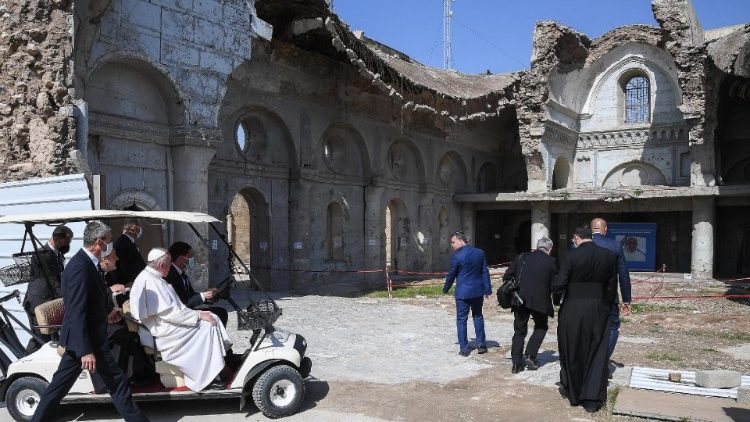
Cardinal Filoni said Pope Francis’s visit to Iraq from 5 to 8 March 2021 was much more than a simple visit: “It was a pilgrimage to Iraq, not to for the holy sites of Abraham and many other prophets who lived there, but also a pilgrimage for the many martyrs” both inside and outside the Church, because thousands of Iraqi people, including Muslims, “suffered a lot”.
It was a pilgrimage, the former apostolic nuncio said, that Pope St John Paul II had wanted to undertake, and it was a sign of hope for the future for Christians.
“If the Pope came here, we may still have hope for the future.”
A new reality, he said, is in the building day by day, although he does not have much hope that those who left will ever go back.
Security is improving, Filoni remarked: some shrines and churches have been rebuilt, and some areas are stable, but the Christian presence in the country is more than halved.
“We have to think that at least half of the Christian population is no more in Iraq.”