Showing posts with label Fr. James Martin. Show all posts

Tuesday, September 2, 2025

Pope Leo XIV meets with Fr. James Martin, SJ


Pope Leo XIV meets Father James Martin at the Vatican


Father James Martin, SJ. | Credit: Flickr by Shawn (CC BY-NC 2.0)


Hannah Brockhaus

By Hannah Brockhaus

Pope Leo XIV met in a private audience with Jesuit Father James Martin at the Vatican on Monday.

Martin, who is in Rome to lead a jubilee pilgrimage for his LGBTQ ministry, Outreach, also had one-on-one audiences with Pope Francis on at least two occasions.

The Vatican does not customarily comment on papal audiences with individuals, and the Holy See Press Office did not immediately respond to a request for information about the meeting.

Responding to a request for comment from CNA, Martin wrote: “I was honored and grateful to meet with the Holy Father this morning in an audience in the Apostolic Palace and heard the same message I heard from Pope Francis on LGBTQ people, which is one of openness and welcome: ‘Todos, todos, todos.’ I found the pope serene, joyful, and encouraging.”

The Jesuit priest, an author and editor at large at America Media, is the founder of Outreach, which describes itself as an “LGBTQ Catholic resource” operating under the auspices of America Media.

Writing on X on Aug. 29, Martin said he is in Rome until Sept. 8 to lead an Outreach pilgrimage with 40 people for the 2025 Jubilee of Hope.

Martin’s ministry to people with same-sex attraction and gender dysphoria has been criticized by some Catholics, who say his approach minimizes or even conflicts with the Church’s teaching on sexual morality. He has also been criticized for promoting initiatives that some say affirm same-sex orientation as an identity.

The priest was also supportive of Pope Francis’ 2023 declaration Fiducia Supplicans, which allows priests to offer private, nonliturgical blessings to same-sex couples.

Despite the controversy over Martin’s ministry, Pope Francis encouraged it both in private meetings with Martin and in letters.

In 2021, Martin published a handwritten note he had received from Francis in which the pope thanked him for his “ability to be close to people” and also told him “to continue this way.”

Francis in 2022 also sent a written response to a letter from Martin with three questions about the Catholic Church and the LGBT community. 

After his first meeting with Francis, in 2019, Martin wrote on Twitter (now X), that he “felt encouraged, consoled, and inspired by the Holy Father today.” The Jesuit priest also met one-on-one with Pope Francis in 2022.

Pope Francis also personally nominated Martin to participate in the Synod on Synodality assemblies held at the Vatican in 2023 and 2024.

Martin is the author of “Building a Bridge: How the Catholic Church and the LGBT Community Can Enter into a Relationship of Respect, Compassion, and Sensitivity” and frequently speaks on issues pertaining to homosexuality and Catholicism.

Martin is one of 21 consultors for the Dicastery for Communication. He was nominated in 2017.

Thursday, August 1, 2024

Pope Francis sends greetings to a ministry for LGBTQ Catholics run by Fr. James Martin, SJ


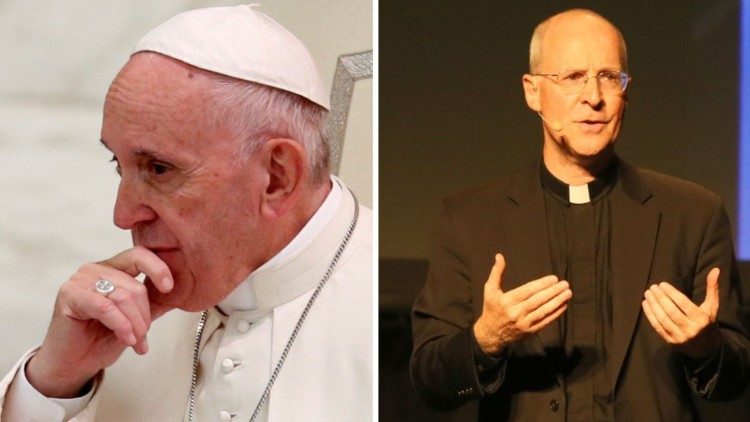
Photo collage of Pope Francis and Fr. James Martin, SJPhoto collage of Pope Francis and Fr. James Martin, SJ 

Pope Francis sends greetings to participants in “Outreach” conference

Replying to a message from Fr. James Martin, who carries out his mission among the LGBTQ community in the United States, Pope Francis says he is spiritually united with those participating in the meeting at Georgetown University from August 2 to 4.

By Vatican News

Pope Francis greeted Jesuit Father James Martin on the occasion of the “Outreach” Conference for LGBTQ Catholics, taking place at Georgetown University in Washington, DC, on August 2–4. Cardinal Wilton Gregory, Archbishop of Washington, is due to celebrate Mass for participants.

Fr. Martin, who carries out his apostolate among the LGBTQ community, wrote to the Pope, asking if he would like to send his greetings to the conference.

Pope Francis sent a brief response, which was released on Thursday, saying he was pleased by the fact that Cardinal Gregory would be celebrating Mass for them.

The Pope said he is “united in prayer” with those participating in the conference: “May Jesus bless you and the Holy Virgin care for you.”

This is the fourth time that Pope Francis has sent his regards to an “Outreach” event.

On other occasions, the Pope has invited the Jesuit priest, whom he has named a Consultor of the Dicastery for Communication (Vatican News’ parent organization), to transmit God’s “style” of closeness, mercy, and affection to the LGBTQ community.


Wednesday, June 5, 2024

Pope Francis mending fences after using an off-color remark for "gay"


After gay gaffe, Pope Francis attempts to mend fences

Elise Ann Allen


ROME – After Pope Francis sparked a wave of controversy for using an off-color gay slur, he now appears to be attempting to mend fences, offering reassurances to a homosexual man turned away from seminary and writing the preface to a book by a prominent LGBTQ+ activist priest.

On June 4, the Italian version of Jesuit Father James Martin’s book, “Come forth: The promise of Jesus’s Greatest Miracle,” was published, including a preface written by Pope Francis.

The book, published in English in September 2023, offers an extended reflection and analysis of the biblical account of Jesus raising his friend Lazarus from the dead, and telling him to come out of the cave where he had been buried.

Martin, editor at large for America Magazine and famous for his support of the Catholic LGBTQ+ community,  explores various aspects of the passage and the figure of Lazarus in art and culture, focusing on the story as an example of how God’s presence can transform people and offer them new life.

In the preface, Pope Francis hailed Martin’s book as “always fascinating and never predictable,” saying Martin was able to make “the biblical text come alive.”

Stressing the importance of reading the bible daily, Francis said God speaks through scripture, a fact he said “should give us a little jolt each and every day.”

As he has in the past, he urged believers to carry a version of the Gospel with them, either in a pocket or handbag, or on a smartphone, as a source of reflection for the ups and downs of every day.

“Actions like these will help us grasp the extent to which Scripture is a living body, an open book, a vibrant witness to a God that is not dead and buried on the dusty shelves of history,” the pope said.

Francis said the book brings readers directly into the story of one of Jesus’s closes friends and stressed that each and every person is a friend of Jesus.

Sometimes people are “dead” in figurative sense “on account of our sins, our failings and infidelities, the despondency that discourages us and crushes our spirits,” he said, saying Jesus is not afraid “to get close to us – even when we ‘reek’ like a dead body that’s been buried for three days.”

Jesus, he said, is not afraid of sin or death, but rather waits “outside the closed door of our hearts, that door that only opens from within, that we lock with a double bolt whenever we think God could never forgive us.

Pope Francis said Martin’s book illustrates how believers can “practically feel the profound meaning of what Jesus does when He finds Himself before a dead man who is really dead, whose body gives off a nasty odor – a metaphor of the moral rot that sin produces in our souls.”

“Jesus isn’t scared of coming close to sinners – to any sinner, even the most brazen and undaunted,” the pope said. Rather, Jesus’s only concern, he said, is that “no one goes missing, that none are deprived of the possibility of feeling the loving embrace of His Father.”

According to Italian media, Pope Francis also apparently recently responded to a young man named Lorenzo Michele Noè Caruso, 22, who said he was rejected from the seminary for being gay.

Pope Francis caused a wave of controversy after a report was published in Italian blog Dagospia saying the pontiff had used a distasteful slur for homosexuals during a recent session with members of the Italian Bishops Conference (CEI).

During the May 20 closed-door meeting, Francis apparently spoke of homosexuality in seminary life, saying there was too much frociaggine in seminaries, loosely meaning “faggotry.”

The comment was leaked to the press and generated immediate backlash against the pope, including from some who were shocked to hear that the pope famous for the quip, “Who am I to judge?” and who has been seen as a champion of LGBTQ+ inclusion in the Catholic Church, apparently used such crude terms.

The Vatican released a mild apology May 28, saying the pope reiterated his stance that “in the Church there is space for everyone, for everyone! No one is useless, no one is superfluous, there is space for all. Just as we are, everyone.”

“The pope never intended to offend or express himself in homophobic terms, and he apologizes to those who felt offended by the use of a term, as reported by others,” the statement said.

According to Italian newspaper Il Messaggero, after hearing the pope’s remark, Caruso wrote a 3-page email to the pontiff explaining his own story, and how he was bitter at being turned away from the seminary and disappointed by the pope’s remark.

Caruso apparently told the pope that he and many others like him “live on the margins of the Church, often forced to hide because they are excluded from the community or forced to pay the high price of rejection for their sincerity.”

He spoke of his work as a catechist, the deep call he had felt to the priesthood, and his disappointment at being rejected over the fact that he was gay.

Referring to the ongoing Synod on Synodality, during which the inclusion of LGBTQ+ Catholics has been a major talking point, Caruso reportedly said he trusts the process as “a turning point to walk together under the light of Christ, where no one is rejected and everyone is an expression of God’s plan for our Church.”

Caruso also asked that Italian bishops review “the ban on admission to the seminary of homosexual people,” saying many young people “feel lost in a Church that often seems to be tied to a toxic and elective clericalism, where only some deserve to be welcomed and where others are excluded as false Christians.”

Pope Francis apparently wrote a handwritten letter that was scanned and attached to an email responding to Caruso’s own email on June 1.

According to Il Messaggero, the pope thanked Caruso for reaching out, saying he was struck by the phrase, “toxic and elective clericalism.’”

“It’s true! You know that clericalism is a plague? It’s an ugly ‘worldliness’ and as a great theologian said, ‘worldliness is the worst that can happen to the Church, even worse than the era of concubinary popes,’” he said, referring to the writings of Swiss theologian Hans Urs von Balthasar.

Francis reiterated his position that “Jesus calls everyone, everyone,” telling Caruso, “go forward with your vocation. I pray for you, please do it for me (I need it).”

Tuesday, June 4, 2024

Pope Francis endorses book by Jesuit Priest James Martin


Cover of "Come Forth" by James MartinCover of "Come Forth" by James Martin 

Pope: Jesus didn’t just talk about eternal life, He gave it to us

Pope Francis pens the preface to the Italian version of the book "Come Forth: The Raising of Lazarus and the Promise of Jesus’s Greatest Miracle" by American Jesuit Father James Martin, in which he reminds us that Jesus didn’t just talk about eternal life; He gave it to us.

By Pope Francis

Father James Martin, the author of many other books that I know and appreciate, deserves our gratitude for this new text devoted to what he calls “Jesus’s greatest miracle”: the resurrection of Lazarus. There are many reasons to thank him, closely tied to the way Come Forth unfolds. It’s always fascinating, and never predictable.

First and foremost, Father James makes the biblical text come alive. He analyzes it with the eyes and erudition of a diverse set of writers who have probed this passage deeply, capturing their many facets, emphases, and interpretations. But his reading is always “loving,” never detached, nor coldly scientific. Father James has the perspective of a person who has fallen in love with the Word of God. As I read the careful arguments and exegeses of the biblical scholars he cites, it made me wonder how often we manage to approach Scripture with the “hunger” of a person who knows that that word really is the Word of God.

The fact that God “speaks” should give us a little jolt each and every day. The Bible truly is the nourishment we need to handle our lives. It’s the “love letter” that God has sent—since long ago—to men and women living in every time and place. Treasuring the Word, loving the Bible, carrying it with us every day, with a little book of the Gospel in our pockets, maybe even pulling it up on our smartphones when we have an important meeting, or a difficult encounter, or a moment of unease… actions like these will help us grasp the extent to which Scripture is a living body, an open book, a vibrant witness to a God that is not dead and buried on the dusty shelves of history. Instead, Scripture journeys with us always, even today—and it walks with you, too, who are now opening this book, perhaps intrigued by this well-known story whose deep, full meaning has nevertheless not been understood by everyone. 

What’s more, these pages contain one of the truths of Christianity that always stays current, and that remains fruitful. The Gospel is concrete, and eternal; it has just as much to do with our inner being and our interior life as it does with history and daily life. Jesus didn’t just talk about eternal life; He gave it to us. He didn’t just say “I am the resurrection”; He also resurrected Lazarus, who’d been dead for three days.

Christian faith is the ever-present co-mingling of the eternal and the contingent, of heaven and earth, of the divine and the human—never one without the other. If our faith were just “earthly,” what would distinguish it from any well-intentioned philosophy, or well-structured ideology, or well-developed mode of thought? That remains simply that—a theory detached from the times, and from history? If Christianity were just concerned with the “after,” or with eternity alone, this would be a betrayal of the choice that God carried out once and for all, casting His lot with all of humanity. The Lord did not ‘pretend’ to incarnate. He chose to enter human history, so that the history of men and women might take the form of the Kingdom of God, the time and place where peace sprouts, hope becomes substantial, and love brings life.

All of us, then, are Lazarus. Rooting himself firmly in the Ignatian tradition, Father Martin brings us directly into the story of this friend of Jesus. We’re His friends, too—“dead” as we sometimes are on account of our sins, our failings and infidelities, the despondency that discourages us and crushes our spirits. Jesus is hardly afraid to get close to us—even when we “reek” like a dead body that’s been buried for three days.

No, Jesus isn’t afraid of our death, or our sin. He waits just outside the closed door of our hearts, that door that only opens from within, that we lock with a double bolt whenever we think God could never forgive us. But as we read James Martin’s detailed analysis, we can practically feel the profound meaning of what Jesus does when He finds Himself before a dead man who is really dead, whose body gives off a nasty odor—a metaphor of the moral rot that sin produces in our souls. Jesus isn’t scared of coming close to sinners—to any sinner, even the most brazen and undaunted. He has one single preoccupation: that no one goes missing, that none are deprived of the possibility of feeling the loving embrace of His Father.

It’s interesting that even a well-known contemporary novelist like Cormac McCarthy, who died in 2023, lingered over the question of what the “work of God” might be. One of the characters in Cities of the Plain (1998) says: “He believed in God even if he was doubtful of men’s claims to know God’s mind. But that a God unable to forgive was no God at all.” That’s exactly right: God’s “job” is to forgive.

Reading Father James Martin’s book also made me remember a line by Alberto Maggi, an Italian Bible scholar. He wrote about the raising of Lazarus like this: “What Jesus teaches us with this miracle is not so much that the dead rise, but that the living do not die!” What a wonderful insight, and what a paradox! Of course, the dead rise, but how true it is to recall that we the living never die! Yes, death does come, not just for us, but for our families and those dear to us—for everyone, really.

We see so much death all around, unjust and painful death, death caused by war, by violence, by Cain’s abuse of power toward Abel. But we men and women are destined for eternity. All of us are. Each of us is a “half-line” or “ray,” to borrow a concept from geometry: we each have a starting point—our birth on this planet—but our lives all point toward the infinite. Yes, that’s right, toward infinity! What Scripture calls “eternal life” is the life that awaits us after death. It’s the life we can already touch right here and right now, as long as we dwell not in the egoism that saddens us but in the love that widens, that dilates our hearts. We are made for eternity.

The resurrection of Lazarus—whom we know is our friend, thanks to this book by James Martin—reminds us of that fact, and bears witness to it.

Francis, Vatican City, March 11, 2024

This is the preface to Lazzaro Vieni Fuori, by James Martin, SJ, published by Libreria Editrice Vaticana (LEV), the Italian-language translation of Come Forth (HarperOne). Pope Francis’s preface was translated into English by Griffin Oleynick, Ph.D.

Saturday, January 28, 2023

Papal clarification every sexual act outside of marriage is a sin


Pope sends letter to Fr. James Martin on homosexuality and sin

Pope Francis pens a letter to Jesuit Fr. James Martin explaining his recent comments in an interview with AP that “being homosexual is not a crime”, saying he was referring to Catholic doctrine that teaches that every sexual act outside of marriage is a sin.

By Vatican News

“I was simply referring to Catholic moral teaching, which says that every sexual act outside of marriage is a sin.”

Pope Francis penned those words in response to a letter from Father James Martin, SJ, who carries out his apostolate among the LGBTQ community in the United States.

The American Jesuit had written to the Holy Father following his recent interview with the Associated Press.

The Pope's handwritten response in Spanish was posted on Father Martin's website, along with a translation in English.

Clarification

It was already clear from the context of the interview that the Pope had spoken of homosexuality, meaning in that case "homosexual acts" and not homosexuality itself.

In his letter, Pope Francis reiterated that his position is that of the Catechism of the Catholic Church, as he had already said in his first interview with reporters on the flight back from Brazil in 2013 ("If a person is gay and seeks God and has good will, who am I to judge?").

Responding to Fr. Martin, the Pope stressed that, regarding sin, “one must also consider the circumstances, which may decrease or eliminate fault.”

“I should have said ‘It is a sin, as is any sexual act outside of marriage’,” added the Pope. “This is to speak of ‘the matter’ of sin, but we know well that Catholic morality not only takes into consideration the matter, but also evaluates freedom and intention; and this, for every kind of sin.”

Prayers

Pope Francis went on in his letter to repeat that being homosexual is not a crime.

“I would tell whoever wants to criminalize homosexuality that they are wrong,” he wrote. “In a televised interview, where we spoke with natural and conversational language, it is understandable that there would not be such precise definitions.”

There are over 50 countries that hold out the possibility of legal sentences for homosexual people and some of these nations even employ the death penalty.

The Pope concluded his letter by assuring Fr. Martin that he prays for him and his work with the LGBTQ community.

“Please do the same for me,” he said.

Tuesday, November 15, 2022

Fr. James Martin in the spotlight at Vatican's Communications plenary assembly


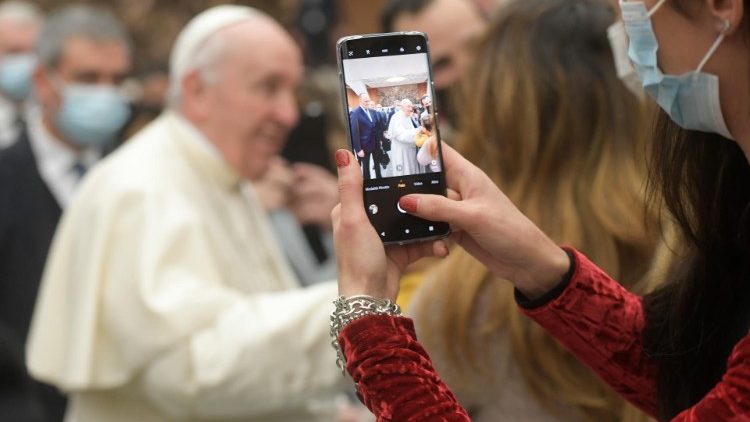
A woman records a video of the Pope at an audience with the Dicastery for CommunicationA woman records a video of the Pope at an audience with the Dicastery for Communication  (Vatican Media)

Fr James Martin: When sharing Gospel, meet people where they are

In Rome for the Dicastery for Communication’s recent plenary assembly, Jesuit Fr. James Martin says Catholic communicators today needs to focus always on the person of Jesus and endeavour to reach others where they are in life using the best media languages possible.

By Vatican News staff reporter

Visiting the media production facilities along with the management, members and consultors of the Vatican's Dicastery for Communication, of which Vatican News is part, American-born Fr. James Martin, SJ, shared his experience and ideas on how the Church can communicate more effectively, reaching believers and non-believers with the Gospel message. 

Fr. Martin is Editor At Large at America Media based in New York, a leading provider of editorial content on the Catholic Church, faith and culture, with a variety of publications, including America Magazine.

Inclusive and truthful communication

Pope Francis addressed the group on Saturday, and in his prepared text underscored the responsibility of communicators.

He encouraged media professionals to always seek the truth, to combat hate speech and to give voice to those who have no voice. The Pope underscored that the voice of God must resonate in their work. 

In his off-the-cuff remarks, the Pope noted the presence in the audience of Fr. Martin and recalled his book, "Learning to Pray: A Guide for Everyone" encouraging everyone to read it.

The Pope pointed out that being a communicator means "to go forward, to journey, to take risks...with the conviction that I am sharing my life with my...Christian and human values." He also reiterated that "the communicator must always take risks, must always be on the road, always engaging with life." 

Sharing the Gospel today

During his visit to the headquarters of Vatican News, Fr. Martin spoke about the discussions at the plenary, looking at how best to communicate the Gospel in the modern era.

At its most basic level, all communication should focus on the person of Jesus, he said, since there can be tendency especially today to get lost in internal political questions and debates that can detract from sharing the core message of the Gospel.

"It's the focus on the person of Jesus" that matters most and in this way can lead people to deepen or renew their faith. This effort can help us rise above what can be partisan differences, he stressed.

Meet people where they are

In terms of reaching believers and non-believers alike through the media, Fr. Martin said, "it's meeting people where they are," just as Jesus did in throughout His ministry.

This means going physically where people are to meet them, over and above where it most often happens today in digital media, via Facebook or Twitter. 

The second point he stressed is to use common, understandable languages to dialogue and engage with others, whether the spoken word or the media languages that have created new cultures of human interaction.

He recalled how Jesus "spoke in the language of fishermen, even though he was a carpenter," using "very simple terms and the parables and the stories."

So too, in different ways, Catholic media engage in social media speaking people's languages, he said. "And I think if we do that, meet people where they are and speak in their language, we can't go wrong."

Foster a culture of encounter

Fr. Martin also offers pastoral ministry to the LGBTQ community in the US, and has received encouragement from Pope Francis in this outreach to help Catholics foster a “culture of encounter” that bring everyone closer together, enriching us in our differences.

He met again with Pope Francis in a private audience during his visit to Rome last week, and said they discussed LGBTQ Catholics. Fr. Martin said the Pope encouraged him in this ministry, as the Pope has done so personally to other groups and individuals providing pastoral service to that community within the Church. 

Fr. Martin said, "we've come a very long way...I think people are more and more welcoming to LGBTQ Catholics as they come to know them as human beings. And for Pope Francis, it's all about making sure everyone feels welcome in the Church."