Showing posts with label Caritas. Show all posts

Wednesday, September 2, 2026

Over 1,00 dead, thousands more missing; situation in Nepal grim


Death toll climbs above 1,000 as rescue efforts continue in Nepal

Nirmala Carvalho


Displaced young residents resting at a school that was converted into a temporary shelter in Bidur, located in Nepal’s Nuwakot district, following catastrophic flash floods in late August 2026. (AP Photo/Rajesh Kumar Singh)


Rescue teams continued their increasingly frantic work to locate survivors in the wake of catastrophic flash flooding at the Nepal-China border last week, as the death toll climbed above a thousand and the number of missing reached nearly four thousand.

Nepal’s disaster agency reported 1,003 confirmed fatalities and 3,916 people missing, with 583 foreign nationals included in the number. China said 16 people were dead and 546 were missing as of Tuesday, 261 foreigners among them.

Rescue efforts are hampered on both sides of the border by ongoing landslides and wrecked infrastructure making access to remote areas difficult and often impossible.

The senior churchman in Nepal, Fr. Silas Bogati, told Crux Now on Tuesday that Caritas Nepal is participating in relief efforts.

“We have been receiving international assistance, and India has already sent a planeload of relief material,” Bogati said.

Pope Leo XIV has made repeated appeals for international solidarity, and the president of the Indian bishops’ conference urged the faithful of his country to generous response.

RELATED: India’s bishops call for solidarity with neighbors as scope of Nepal-China disaster grows

Nepal had been reluctant to accept international assistance initially but reversed its decision in fairly short order under intense diplomatic pressure from countries with foreign nationals among the missing.

“We are coordinating closely with the government and with various agencies so assistance can reach the places where the disaster has caused the greatest suffering,” said Bogati, who led Caritas Nepal for 11 years before becoming apostolic administrator.

RELATED: Nepal’s senior Church leader describes harrowing situation in wake of disaster

Bogati described difficult conditions in the temporary camps already prepared for the displaced, saying relief materials including food items and non-food items – hygiene kits and other essential supplies – are largely waiting to be delivered.

“It will take a few days to streamline all of this,” Bogati said.

In the meantime, he said people “have been evacuated and are being cared for,” though he noted “there are also places that are difficult to reach because of damaged roads.”

“In some areas,” he said, “helicopters are being used to deliver relief to people who cannot otherwise be reached.”

Authorities in Nepal said close to 12 thousand people have been rescued so far, but the sheer scale of the Wednesday disaster – triggered by the disintegration and collapse of a Himalayan glacier near the headwaters of a major river system – continues to be daunting.

“The immediate priority has been to rescue people, provide shelter and ensure that basic necessities reach them,” Bogati told Crux Now.

“As coordination improves and supplies reach the camps,” he said, “these conditions should also improve.”


Thursday, July 9, 2026

Thanks to Caritas, once again it is the Catholic Church with the largest outreach to earthquake-stricken Venezuela


Members of Caritas Venezuela on the ground coordinating relief operationsMembers of Caritas Venezuela on the ground coordinating relief operations 

Caritas Venezuela: 14,700 tons of humanitarian aid received

The organization has published its first official bulletin, providing figures and data on relief efforts carried out between 25 June and 6 July. A nationwide and international mobilization has enabled assistance to reach up to 40,000 people affected by the earthquake.

By Giovanni Zavatta 

Around 14,700 tons of humanitarian aid have reached Venezuela following the devastating earthquakes that struck the country's north on 24 June. Of that total, 9,000 tons have already been distributed, while 5,700 tons remain in warehouses, ready for the next phases of the relief operation.

According to the first official bulletin released by Caritas Venezuela—Tras el temblor, el amor ("After the Tremor, Love")—the response has also included the delivery of 73,356 units of medical supplies and medicines through 26 collection points across Greater Caracas and La Guaira, as well as 8,000 comprehensive relief kits, 5,000 food packages, 3,000 hygiene kits, and 1,000 kits for emergency response teams.

The report provides a detailed account of the humanitarian operation carried out during the twelve days from 25 June to 6 July in response to the magnitude 7.2 and 7.5 earthquakes. It outlines a relief effort that combined the large-scale distribution of aid with a rigorous system for tracking every shipment. The dossier includes detailed statistics, a breakdown of assistance by sector, a map of operations across the country, and photographic documentation of the response.

More than 8,000 families receive comprehensive assistance

From the first hours after the disaster—which has so far claimed more than 3,800 confirmed lives—Caritas Venezuela activated its diocesan and parish network to assist the hardest-hit communities, including La Guaira, the Capital District of Caracas, and several regions in central and western Venezuela.

Water accounted for the largest share of the aid distributed, totaling 4,031 tons, followed by 3,247 tons of food. More than 8,000 families received comprehensive assistance, representing an estimated 32,000 to 40,000 people. Overall, around 730,000 food rations have been distributed.


An army of 3,360 volunteers

Caritas describes its volunteers as the "heart" of the emergency response. On average, 280 of the organization's 3,360 registered volunteers take part in relief operations each day, each contributing around seven and a half hours of service, for a combined total of 2,100 volunteer hours daily in support of affected families.

Their work has been reinforced by volunteer teams from Puerto Rico and Chile. The wider Caritas network—from the United States to Latin America and the Caribbean, and from Spain to Germany—has also deployed specialists to work alongside local teams in areas including water and sanitation, risk management, nutrition, and shelter.

Caritas Italiana remains in close contact with Caritas Venezuela and immediately launched a fundraising campaign to support the emergency response. As previously announced, the Italian Bishops' Conference has allocated an initial €500,000 to finance urgent relief efforts.

Aid distribution guided by transparency

Caritas Venezuela stresses that every shipment of humanitarian assistance is documented through numbered and signed delivery records, together with transfer logs, ensuring full traceability throughout the operation.

The organization has also urged donors to channel contributions exclusively through its official platforms and to be wary of unverified accounts.

The bulletin notes that the resources mobilized so far cover only the initial emergency phase, while recovery and reconstruction will require sustained solidarity over the longer term.

The dossier also includes testimonies from local bishops, who have remained close to affected communities through an intensive pastoral presence and direct support for those suffering in the wake of the disaster.


Caritas Venezuela aid distribution (© Caritas Venezuela)

Monday, May 4, 2026

Pope Leo XIV has audience with Catholic Charities USA; care for the poor is an integral part of the Christian life


File photo of Pope Leo XIVFile photo of Pope Leo XIV  (@Vatican Media)

Pope: Care for poor difficult but ‘integral part of Christian life’

As he meets with members of Catholic Charities, Pope Leo XIV encourages the American Caritas-affiliate never to succumb to discouragement despite challenges, noting that care for the poor is an integral part of authentic Christian life.

By Devin Watkins

Pope Leo XIV met on Monday with members of the Board of Directors of Catholic Charities USA, the American member of Caritas Internationalis, the Church’s charitable outfit.

In his address, the Pope recognized that personal and institutional difficulties often confront those who seek to proclaim the Gospel through caring for the poor and most in need.

“These include finding sufficient resources, demonstrating to others that this type of service is an integral part of authentic Christian living, and not giving way to discouragement, particularly when we meet those whom we cannot help in the way that we would like,” he said.

Pope Leo noted that Catholic Charities USA is “by no means immune from these challenges.”

“Yet, it is precisely when we are confronted with such obstacles that we must learn to hear Jesus’ voice saying to us once more, ‘I am with you always!’” he said.

In late March 2026, the US government cut funding to a program run by the Archdiocese of Miami, which provided services for unaccompanied minors for decades.

Operation “Pedro Pan” had helped the Office of Refugee Resettlement place children in foster care and reunite them with family members since 1960.


Pope Leo XIV meets with the Board of Directors of Catholic Charities USA (@VATICAN MEDIA)

The Pope went on to encourage the “worthy efforts” of Catholic Charities USA to carry on the Lord’s “ministry of compassion, especially to the least among us.”

“In doing so, you seek to find solutions to inhumane situations, alleviate the suffering of individuals and families, and relieve the burden of those who are weighed down by hardship and strife,” he said. “In all of these circumstances, it must be the charity of Christ that compels you in your daily work.”

Catholic Charities USA includes over 170 diocesan agencies and is one of the largest social services organizations in the United States.

Pope Leo recalled that love for neighbor offers tangible proof of a Christian’s authentic love for God.

Catholic charitable workers, said Pope Leo, must be driven by “the desire to bring to others material aid with the love of the heart of Jesus, for it is in that love that they will find genuine rest and their dignity be respected.”

As they assist the less fortunate through practical assistance, he added, Catholic Charities comes into contact with the flesh of Christ.

In conclusion, Pope Leo XIV encouraged the Board of Directors to recognize that Christ’s Resurrection “makes all things new” and allow the organization’s work to be guided by the hope of Easter.

“I offer good wishes for your noble mission and assure you and all of your colleagues of a remembrance in my prayers.”

Tuesday, November 11, 2025

Upcoming Papal visit to Turkey, celebrating the Council of Nicaea, reviving Vatican II


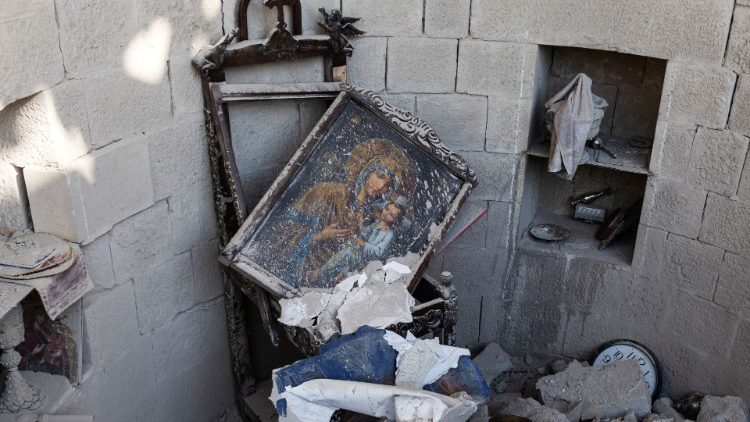
One of the churches in Turkey affected by the 2023 earthquake One of the churches in Turkey affected by the 2023 earthquake  

Pope’s Türkiye visit an opportunity to “revive" the spirit of Vatican II

Bishop Paolo Bizzeti, former Apostolic Vicar of Anatolia, speaks to Vatican News about the Pope’s upcoming apostolic journey to Türkiye, a “mosaic” of different religious communities.

By Daniele Piccini

“In the months after the earthquake, we worked side by side, breaking down old walls of division and showing that the deepest form of interreligious dialogue, as Pope Francis used to say, is the dialogue of life, especially in service to the poor."

Bishop Paolo Bizzeti, who served as president of Caritas Türkiye from 2019 until just a few days ago, still cherishes that interreligious collaboration as one of the most meaningful experiences of his many years in the country.

The bishop, who was Latin Apostolic Vicar of Anatolia from 2015 to 2024, knows the region well.

In an interview with Vatican News, he shared his reflections and hopes ahead of Pope Leo XIV’s upcoming apostolic journey to Türkiye — a visit that will take him to Ankara, Istanbul, and İznik, once known as Nicaea, for the 1700th anniversary of the first Ecumenical Council.

Vatican News: From 27 to 30 November, Pope Leo XIV will make his first apostolic journey. He will go to Türkiye, where Christians are a small minority. In your opinion, what significance does this visit have for them?

Bishop Paolo Bizzeti: To visit the flock in person and bring the closeness of the Good Shepherd — that is the purpose of these papal journeys. Türkiye is an immensely important country, not only because of its past — Christianity as we know it was born in Antioch, on the Orontes, in modern-day Türkiye — but also because of the vitality of Christian life today. Türkiye is a kind of laboratory, where even the Latin Church must be present, actively and humbly.

Q: The Pope will also mark the anniversary of the Council of Nicaea.

A: The Pope’s visit is also a major ecumenical opportunity, and the anniversary of Nicaea will help revive the spirit that animated the Council Fathers: expressing faith in new terms and categories, and seeking what unites, as Pope Saint John XXIII urged. That is a task we must always begin anew.

Q: What kind of religious landscape will Pope Leo encounter upon his arrival?

A: Türkiye is a mosaic. There’s political Islam, traditional religious Islam, the mystical Sufi current, the Alevi movement, agnosticism, or a sort of deism for many — and then, of course, significant Christian minorities. Catholic pastoral work is severely limited, however, by laws and customs that make it difficult to build chapels, youth centers, or cultural venues. Everything happens within a few parishes, established a century ago under the Treaty of Lausanne. 

Q: On 6 February 2023, an earthquake measuring 7.8 on the Richter scale struck the border areas between Syria and Türkiye, causing, according to reports, over 50,000 casualties. Caritas Türkiye's response, despite enormous difficulties, was massive, committed and effective. What was the experience like?

A: The real death toll is believed to have been far higher, and hundreds of thousands were displaced. It was an immense tragedy that revealed our human frailty, and its effects still weigh heavily on the poorest communities. For us at Caritas, it was a trial that forced us to grow quickly — not without difficulties and mistakes. But we were very happy to have made our contribution, to have collaborated with local and national relief organizations, and to have been summoned and officially thanked in Ankara. We were recognized, something that had never happened before, as an organization that helps people selflessly, without distinction. As Catholics, we are proud to have made our small contribution, putting to good use the aid that arrived generously from the four corners of the earth.

Q: Does the work of Caritas Türkiye, which helps both Muslims and Christians without discrimination, have a positive effect on relations between the two religious groups?

A: In the months after the earthquake, we worked side by side, breaking down old walls of division and showing that the deepest form of interreligious dialogue, as Pope Francis used to say, is the dialogue of life, especially in service to the poor.

Q: What effect do you think the Pope's apostolic visit will have on those who work for Caritas Türkiye?

A: For all Caritas workers, it will be a beautiful occasion to feel part of the People of God — united in service and in care for the most vulnerable, as Christians always have been, following Jesus, the servant of all.

Saturday, August 16, 2025

Great anticipation in Albano ahead of visit by Pope Leo XIV


The Shrine of Santa Maria della Rotunda, in Albano Laziale, where on August 17 the Pope celebrates Holy Mass with the poor assisted by the diocesan Caritas. 

Rector of Shrine in Albano elated to welcome Pope Leo XIV

Ahead of Pope Leo XIV's imminent visit to Shrine of Santa Maria della Rotonda in Albano to celebrate Mass with the poor, the Shrine's Rector Father Adriano Gibellini, shares the atmosphere of anticipation ahead of the Pope’s arrival and recalls the roots of an ancient place associated with protection from the plague, refugees during World War II, and the current presence of immigrants who entrust themselves to the Blessed Mother.

By Antonella Palermo and Deborah Castellano Lubov


The Diocese of Albano is buzzing with preparations to welcome Pope Leo XIV, who returns here to spend time with the most vulnerable.


On August 17, he will celebrate Mass in the Shrine of Santa Maria della Rotonda, a deeply venerated place by the residents of this Lazio town.


Caritas, together with the Liturgical Office, will lead the celebration.


Leading the Offertory procession will be a Peruvian family welcomed by the "Cardinal Pizzardo" House, a safe haven established by the Diocese in 1993, primarily for families in difficulty, especially political refugees.


Speaking to Vatican Media's Antonella Palermo, the rector of the Shrine, Father Adriano Gibellini, shares the atmosphere of anticipation ahead of the Pope’s arrival.


Father Adriano, what is the history of the Shrine of Santa Maria della Rotonda?


It’s important to highlight that the Pope chose the heart of the Diocese for this meeting—the oldest religious building still standing. The temple was built in 94 A.D. Originally, it was a nymphaeum of Emperor Domitian’s villa, later converted into a thermal bath for the soldiers of the Second Parthian Legion. However, tradition tells us that by the 8th century, this building had already become a point of reference for the Christians of the early Albano community. Tradition holds that an icon of the Virgin was brought from Greece and placed in this temple. From 1060, with the consecration of the temple, we are certain that it was officially used for Christian worship.


The people of Albano have always shown great devotion to this image of the Madonna, particularly in the 1800s—a difficult time socially and because of damage from earthquakes and storms in the Castelli region, compounded by outbreaks of the plague. The Madonna became the focal point for the prayers of the Albano people. In 1867, the Bishop of Albano, the Servant of God Cardinal Alfieri, made a solemn vow: if the city were spared from the plague, her intercession would be celebrated every first Sunday of August. And so it was—within a week, the cholera outbreak ended. Sadly, the bishop himself died of the disease shortly after.


Read also

Pope Leo returns to Castel Gandolfo for Assumption holiday weekend

13/08/2025

Pope Leo returns to Castel Gandolfo for Assumption holiday weekend

What does the presence of Pope Leo XIV here signify?


From that moment on, the Shrine became a place to turn to in times of hardship, where people seek the Virgin’s intercession with greater urgency. With this visit from Pope Leo, we wish to renew our devotion to her—she who has always protected us and given us the hope that assures us the Lord never leaves us alone.


As for preparations, the Holy Father’s return has caught us somewhat by surprise. He had already visited Albano on July 20 and is now returning so soon. We are preparing everything to give him a worthy, beautiful, and above all warm welcome. In these days, many people are coming forward, asking how they can participate in this moment of grace for our community. Through the Pope’s presence, we also see the Church’s care for each of us—for the lonely and the poor especially. We will pray for a blessing on all the faithful who, over the years, have frequented the Shrine and who are now ill or homebound.


What significance does it hold today for the Church to be like a womb welcoming the most fragile?


Often, loneliness, indifference, and marginalization make us feel that authentic human relationships no longer exist. The Church, once again, becomes a mother and teacher, not necessarily to replace what's missing but to set an example of how to love the human person in their full dignity—physically and morally. For those who are alone or abandoned, the Church becomes that maternal womb that welcomes and heals.


One cannot help but think of those who, beyond poverty, suffer from the violence of war across the world. Albano itself experienced the most intense Allied bombing during World War II…


Indeed, a painful chapter in Albano's history. On February 10, 1944, about 700 people had taken refuge in the Papal Villas, including many women and children, as the men were away at war. The maternal embrace of the Church manifested through the hospitality and foresight of Pope Pius XII, who welcomed the refugees into the gardens and even inside the Apostolic Palace.


Reflecting on this history means once again feeling the Church’s closeness in times of hardship. Our Shrine also became a refuge during that time. The image of the Madonna with the Child now bears two golden crowns above her head, offered by the families who survived that bombing. There's an inscription behind the crown invoking peace from the Mother, Queen of Peace, upon the city and the world. That too is a reason for us to hope and to pray—that the Virgin's intercession may help those suffering, especially in war and hunger.


The Shrine was restored for the 2000 Jubilee. Now, 25 years later, during another Jubilee, what reflections can you offer for this time of inner renewal?


Today, the Shrine is located in the historical center of the city and surrounded by many immigrant families. As in many historic centers, older homes left behind by the elderly are now inhabited by people from other countries. It's heartening to see the respect these families show toward the Shrine and the Madonna, especially during the festivals. The Shrine has become a reference point for them. I often see them enter, even just to admire the architecture, or to gaze at the face of the Virgin—as if they are contemplating the serene face of their own mothers left behind in distant lands.


Liturgically speaking, is there anything in particular you’d like to highlight about Sunday’s celebration?


Certainly, Caritas volunteers will take part in the liturgy. A particular detail is that the first gift in the Offertory procession will be presented to the Pope by a Peruvian family that has found shelter in our House in Torvaianica. They will receive the comfort and blessing of his closeness. Other gifts will be presented by volunteers from various parish Caritas groups.


How are you personally experiencing the anticipation of Pope Leo XIV's visit? What has stood out to you in these first months of his pontificate?


What has struck me most is the simplicity and warmth with which he relates to people. I’ve had the opportunity to meet him twice already this month, including during his visit to the cathedral on July 20. He is incredibly cordial, empathetic, and attentive. What makes me happiest about relating with him is this attentiveness—he knows how to say a small word that warms your heart. I believe Pope Leo will be a shepherd who draws close to each of us with great simplicity and empathy.


Read also

Caritas Albano: Our poor will be the first to dine with the Pope

12/08/2025

Caritas Albano: Our poor will be the first to dine with the Pope

It is also said that your Shrine is somehow tied to the Augustinian charism…


Tradition tells us that in the year 768, a group of Augustinian nuns brought the icon of the Madonna from Greece. However, we don’t have official documentation confirming this until 1060, which is when we know for sure that Marian devotion began here.


In such a time plagued by conflicts, what strength does prayer offer?


Prayer is the only weapon we have to counter human weapons. It helps us not only feel close to the Lord but also, through the Virgin’s intercession, to obtain what is truly in our hearts. In liturgical prayers, we often say we offer our prayers to the Lord "beyond what our hope can imagine." Prayer is the royal road that leads us to the heart of God—who is our hope—and from Him, we will receive all that we desire.