Showing posts with label Cardinal Pedro Barreto. Show all posts

Tuesday, June 4, 2024

Pope Francis meets church officials from the Amazon


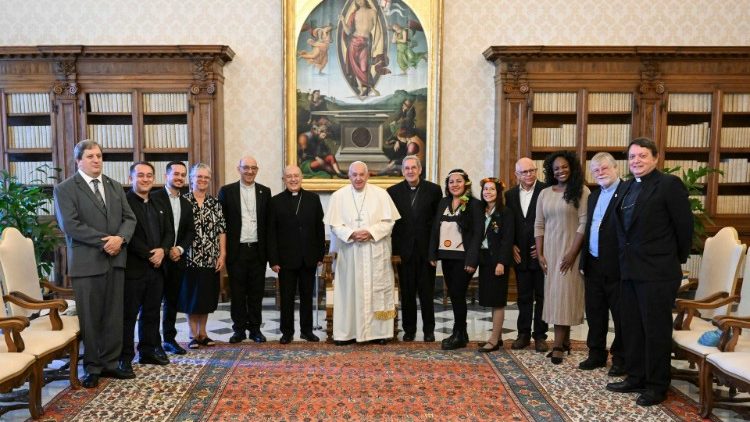
Pope Francis with the delegations from CEAMA and REPAMPope Francis with the delegations from CEAMA and REPAM  (Vatican Media)

New Paths: Pope meets with church officials from Amazon

Cardinal Pedro Barreto, president of the Ecclesial Conference of the Amazon, shares with the Pope the fruits of the synodal journey in the region.

By Johan Pacheco

“The Amazon recognises Pope Francis as the ‘grandfather’. That is what they call him, the grandfather, and for the native peoples, the grandfather is the wise person, the person who guides, the person who has no other interest than to be able to serve and encourage life."

That's according to Cardinal Pedro Barreto, President of the Ecclesial Conference of the Amazon (CEAMA).

He was speaking in an interview with Vatican Radio-Vatican News after meeting with the Holy Father on the morning of 3 June.

The meeting was attended jointly by members of CEAMA and the Pan-Amazonian Ecclesial Network (REPAM). Cardinal Barreto explained that they are two separate organisations: the former juridical, while the network comprises the territory of Amazonia.

“We have offered the Pope the progress we have made in recent years, after the Synod on the Amazon that was held five years ago, in 2019. And we have seen how the Ecclesial Conference of the Amazon is a mature fruit of this synodal process that has been followed throughout the Amazon,” said Cardinal Barreto.

During the meeting, they were able to express to the Pope their concern over the murder of environmental activists; and the exploitation of natural resources, “illegal mining, which makes the urgency of the situation ever greater due to the effects of climate change.”

The president of CEAMA shared that Pope Francis “thanked them for the work that the Church is doing throughout the Amazon biome and told us to continue working together, also because the synodal experience in the Amazon is like a model experience of what life in the Universal Church can be like.”

“We are living an ecclesial kairos, a propitious time for the renewal of the Church in the Amazon; and from the Amazon we are also offering the Universal Church a new path, as was requested for the Amazon Synod: ‘New paths for the Church.’ All together, all the baptised, men and women, are part of the people of God who are on pilgrimage in history with the consolations and caresses of God, but also with the anguish and tears of many brothers and sisters,” the Cardinal said, looking to the future of the missionary and synodal work in Amazonia.

And with the Jubilee of 2025 in mind, Cardinal Barreto pointed out that “the Jubilee of Hope is also closely linked to this synodal spirituality. There is already a beginning of signs of enthusiasm and this enthusiasm is being transformed into hope. But hope is being put into action, joint action.”

On Tuesday 4 June, the Acts of the Special Assembly of the Synod of Bishops for the Pan-Amazon Region will be released. “New paths for the Church and for an integral ecology” will also be presented at the Sheikh Zayed Centre at the FAO headquarters in Rome.

Later this week, on Friday, a congress on the synodal journey of the Church in the Amazon, will be held at at the Pontifical Gregorian University. The congress is sponsored by REPAM and CEAMA.


Interview with Pedro Cardinal Barreto
President of the Ecclesial Conference of the Amazon


What was your experience of the audience with Pope Francis?  

We have had a meeting of the CEAMA presidency with the particiapation of the presidency of the Pan-Amazonian Ecclesial Network. There are two organisms: one, CEAMA, is juridical, the other is a territorial network in the Amazon. And today we have had the great joy of meeting with the Holy Father, Pope Francis, to thank him for all the support he has been giving us. There were representatives of the native peoples, the vice-presidents of REPAM and CEAMA, religious men and women, lay people, bishops. I have brought greetings from all over the Amazon. The Pope encouraged us, he gave us a lot of encouragement to continue walking together in this synodal process.

What were the most important points that you shared with the Pope about this synodal process and what were the fruits of the meetings held there with CEAMA?

First of all, we shared with the Pope the progress we have made in recent years, after the Synod on the Amazon that was held five years ago, in 2019.

And we have seen how the Ecclesial Conference of the Amazon is a mature fruit of this synodal process that has been followed throughout the Amazon.

The Amazon covers more than 7 million square kilometres, 9 countries, 105 dioceses – that is, we are talking about more than 130 bishops; and we are also very, very concerned about the situation, I would say, of abuse of environmental defenders, with some murders; but also, and in a very special way, with the irrational exploitation of natural resources, deforestation, illegal mining, which means that the urgency is increasing due to the effects of climate change.

Regarding this concern, for the person, certainly also deforestation, but also illegal mining, in which the people, the communities are most affected: What have you been doing concerning this issue?

The Church’s evangelizing mission is caring for life. Caring for the natural environment is, I would say, a natural part of our mission. To proclaim the Gospel of Jesus Christ is also to proclaim the rights of people. And also the quality of life that they should have with the air, water and soil. But definitely the Church in the Amazon, through the Pan-Amazonian Ecclesial Network is very attentive, they are the roots of what the Church is doing and that is through the Pan-Amazonian Ecclesial Network. CEAMA, which is the canonically-approved Ecclesial Conference of the Amazon, already has legal status at a judicial level in the various countries. In this sense, we are taking up these proposals that the final document of the Synod on the Amazon has offered us and we are putting them into practice. And this is the report that we have given to Pope Francis.

And what was Pope Francis' message to encourage you?

Basically, Pope Francis welcomed us, as he has always done, with great affection, he welcomed each one of us. We were thirteen people in total and each one of us brought a small gift, a letter from the Amazon that they recognise in Pope Francis as their “grandfather.” That is what they call him, the grandfather, and for the native peoples, the grandfather is the wise person, the person who guides, the person who has no other interest than to be able to serve and encourage life.

Secondly, he thanked the Church for the work it is doing throughout the Amazon biome and told us to continue working together, because the synodal experience in the Amazon is like a model experience of what life in the Universal Church can be like. And this has come out very strongly in the Synthesis Report of the first session of the Synod on Synodality, in which it expressly indicates in number 1G that the fruit of the synodal process in the Amazon region is the creation of the Ecclesial Conference of the Amazon, the first in the history of the Church, where all baptized men and women, lay people, native peoples, priests, religious, and bishops share the same faith and the same vision of announcing Jesus Christ in the Amazon region.

Your Eminence, during these days, apart from the Pope's visit, do you have a working agenda of activities to present this report in other institutions?

Yes, we have taken advantage of this presence here in Rome to be in contact with various dicasteries: the Dicastery of Evangelisation, which Pope Francis presides over and Cardinal Tagle is there, as is Archbishop Fisichella; and we will also be visiting the Dicastery of Bishops, the Dicastery for Integral Human Development, and the Dicastery of Consecrated Life, because the great majority of pastoral agents are religious, mainly religious women and men, especially religious women.

And so we are going to continue with these visits; and we will finish on Friday afternoon with a very important event to invite those entities of the Church that are partners in this synodal process because we are celebrating eleven years of the synodal journey of the Pan-Amazonian Ecclesial Network, five years from the Synod on the Amazon, and four years since the creation of this first and unprecedented Ecclesial Conference of the Amazon.

It is a gift for the Church, for the Amazon, that the Church accompanies these people and all the movements that live there. How do you see the future for CEAMA, for REPAM, and for all the institutions that work together? What do you hope for the future?

First of all, I believe that we must always be grateful to the many missionaries who have been present in the Amazon biome since the 16th century. And we have to recognise that we are heirs to the great pastoral richness that they have achieved.

Secondly, we are living an ecclesial kairos, a propitious time for the renewal of the Church in the Amazon, and from the Amazon we are also offering the Universal Church a new path, as was requested for the Amazon Synod: “New paths for the Church.” All together, all baptised men and women are part of the people of God who are on a pilgrimage through history with the consolations and caresses of God, but also with the anguish and tears of many brothers and sisters.

In this sense, I hope that we will continue to walk together and that the Synod on Synodality will not only take up this synodal experience from the Amazon, but will also promote the participation of all baptised men and women in the mission of the Church, in families, in society, in politics, in the economy, and also, logically, within our Church.

In the presentation of the report on the synod, you encourage us, as the Church in the Amazon, to live it, to walk together, but we would also like to ask you how you are preparing to live the Jubilee of Hope?

Yes, the Jubilee of Hope is also closely linked to this synodal spirituality. There is already a beginning of signs of enthusiasm and this enthusiasm is being transformed into hope. But hope is being put into action, joint action. And this is a small seedling, we could say, that is emerging; so the Jubilee of hope that Pope Francis has called for next year is certainly already showing some signs.

I am convinced that the year 2025 will be for all of us a wonderful experience of gathering this hope put into action. God walks with us, God is not mistaken in calling us, and therefore He calls us all to walk together, the more we walk toghether as brothers, as “Fratelli tutti” and he tells us: praising God, caring for nature and above all, living this joy of a God with us in the person of Jesus Christ with the special intercession of our Mother the Blessed Virgin.

Tuesday, October 29, 2019

Post Synod interview with Cardinal Barreto

Cardinal Barreto Accompanied Pope Francis At The Opening Of The Amazonian Synod © Vatican Media

‘At No Time Was Celibacy Called Into Question’ Says Cardinal Pedro Barreto

Exclusive Interview with the President Delegate of the Synod

“At no time was celibacy called into question,” stressed Cardinal Pedro Barreto. “Let this be very clear: celibacy is a gift of God for the Church and it’s going to be kept.”
Peruvian Cardinal Pedro Barreto Jimeno, President Delegate of the Special Synod of Bishops for the Pan-Amazonian Region, Vice-President Pan-Amazonian Ecclesial Network and Archbishop of Huancayo, clarified this in an exclusive interview with Zenit.
“What has been talked about is the possibility that married persons be able to receive Priestly Ordination — they are two different things,” continued the Jesuit.
Proposed in point 11 of the Synod’s Final Document — point that received the least consensus in the voting — is “to ordain as priests suitable and recognized men of the community, who have a fruitful Permanent Diaconate and receive appropriate formation for the Presbyterate, being able to have a legitimately constituted and stable family, to support the life of the Christian community through preaching of the Word and the celebration of the Sacraments in the most remote areas of the Amazonian region.”
“The Vatican, the Basilica, with Saint Peter’s tomb has been ‘Amazonianized.’” Cardinal Barreto was moved by the image of Pope Francis, next to the tomb of the Apostle Peter, surrounded by Amazonian Indians, with their own clothing and walking together to Paul VI Hall. “I had the privilege of being very close to the Pope and of seeing these faces, which ‘Amazonianized’ us,” he said.
The Pope “Goes Ahead”
On Monday, October 28, 2019, a day after the closing of the Synod for the Amazonian Region, Cardinal Barreto offered a talk/discussion at the headquarters of the Foreign Press Association in Italy, located in the center of Rome.
In a conversation with journalists, the Peruvian Synodal Father said: “In general we Bishops, Catholics had the impression of pushing the Church and the Pope a bit . . . of pushing him on new paths, but we realized that the Pope is far ahead of us. He is driving the renewal of the Church. ‘We don’t want patches, we want new wine in new wineskins.” This is what he insists upon. “
Ecological Sin
This formulation of the ecological sin “is the expression of what we say in the creed of our faith,” shared the President Delegate of the Special Amazonian Synod. “I believe in God the Father, Creator of Heaven and earth.” “What happens is that we always say it without realizing it, and if God is Creator of Heaven and earth, we have to take care of what God has given us. Therefore, this formulation has now been opened but, deep down, it’s something that was inherent, although we weren’t conscious of this ecological sin.”
The Cardinal clarified that “ecology is harmony”: “Harmony with other brothers and sisters, and harmony with nature,” and he warned: ”when this harmonious relationship is broken it’s a sin. Sin is to sever the relationship with God, to sever the relationship with brothers and to sever the relationship with nature.”
Amazonian Rite
Cardinal Barreto explained that there was a proposal on the Amazonian Region: “We have to see some rites that express the cultures — not the culture, — but the cultures in the whole of Amazonia. This is a process that, since her beginning, the Catholic Church has made an effort to respond to different socio-cultural realms.”
The Archbishop of Huancayo commented: “there is an effort to respect the cultures, but also to offer the joy of the Gospel to all creatures. “Go out to the whole world,” says Jesus.” Thus, the Cardinal assured, what the Pope said “referring to the organizational part, is the creation of a semi-Episcopal Conference, he did not say a siu iuris church.”
Women in the Church
“If women cease to do what they are doing, the Church wouldn’t exist, and it wouldn’t exist because the Virgin Mary, a woman, is at the base.” Therefore, explained the Jesuit, “the visibility of women is also almost similar to the visibility of the native populations in the whole of our Continent, not only in Amazonia.”
“The topic was touched upon, but Pope Francis himself felt that perhaps it wasn’t touched upon in great depth, no?” he added. “The testimonies of indigenous women in the Hall speak to us in fact of very great strength and contribution. We have to continue working on that.” The Cardinal expressed his “gratitude and recognition of ,” as the Pope pointed out.
Amazonian Figures
“I personally, and many of us were hurt by the lack of respect in Rome of some groups that didn’t have the most minimal sense of good behavior. To come in, steal and hurl those images into the river was a slap, given the intolerance they manifested.”
“I believe that there is here something that this Synod teaches us which is respect for the cultures, and the universal Catholic Church must be God’s answer to each of the cultures with their rites, and to proclaim the Gospel from .” (. . . )”Jesus, the Son of God, was incarnate in a culture, and He assumed that culture, the religious women of the culture, the icons that were there, but with a critical attitude.”
Here is a translation of the exclusive interview that Cardinal Pedro Barreto Jimeno granted to Zenit.
* * *
–Q: You already knew well the reality of the Amazonian peoples before coming to Rome for the Synod. What have you learned over these days, taking part in the Synodal Special Assembly?
–Cardinal Barreto: First, a discovery of human persons, especially of the Amazonian Indians. In this year and a half — almost two years — of preparation, there has been much participation by the Indians. I was surprised how, after two days of being rather calm, listening, they began to talk, not only from their mind but also from their heart and, above all, with great determination. I took part in this conversion that they had, because they have converted to humanity, and the Catholic Church, through Pope Francis, has made very, very significant gestures to manifest clearly that we are all in one family.
–Q: Proposed in the Report of the Italian Minor Circle A, was that the subject of celibacy be studied in an Ordinary Synod, with universal openness. What is your opinion on this?
–Cardinal Barreto: In fact, it must be specified that at no time, in no Circle, was celibacy called into question. This must be very clear: celibacy is a gift of God for the Church and it’s going to be kept. What has been spoken about is the possibility that married persons might receive Priestly Ordination; they are two different things. However, the most significant of this synodal experience was to put ourselves in an attitude of listening, in this case, to Amazonia and its peoples, to listen also to nature and to God’s creation, and to listen to God. This is a process we are initiating. The previous ones — I took part in one of them — were more thematic, so there was theological, doctrinal reflection . . . this one . This was a Synod — the first in the history of the Church — which was concerned with a territory, a region, but at the same time, with those that live in the region. In regard to the subject of Priestly Ordination to married men Deacons, it was said that it could be studied, but we focused on the Pan-Amazonian Region.
–Q: Perceived, on reading the Document, is the desire to give impetus and responsibility to the Indian leaders themselves, to the Amazonian communities themselves, so that they begin to build. What challenges do you think they face?
–Cardinal Barreto: First, respect of their dignity as persons. They are not taken into account in decisions, for example, of investment. People enter the territory because, in reality, the owners of the land are the Brazilian states. So, for centuries the Indians have lived in a territory and suddenly, a company arrives and destroys everything. This is the first great challenge: respect for the human person’s dignity.
The territory is in the second place. The Indians do not own the territory, so they are living at the expense of these governmental decisions that must be taken into account in a State of Law, but the territory is one of the aspects that is definitively a challenge.
And the third great challenge is the challenge that exists within the Church, which is how to evangelize a territory that has 7.5 million square kilometers. For instance, it is said that Italy has 302,000 square kilometers, compared with the 7 million square kilometers of Amazonia. If on one hand, we know very well from Theological Doctrine that the Eucharist builds, constructs the Church, there are communities that for one year or two or more, don’t have the celebration of the Eucharist. Therefore, why not answer this spiritual clamor, also for the celebration of the Eucharist, to consolidate the Christian community. This is one of the challenges.
–Q: How is the institution of new ecclesial ministries in the Pan-Amazonian Region going to be developed henceforth? What is the process the Church will have to follow?
–Cardinal Barreto: Yes, it’s logical that in a process of renewal and response to new situations, there must be new pathways, such as the topic Pope Francis proposed, but it’s important to realize that a Synod isn’t a Parliament. We, Bishops, who took part don’t represent the country; we represent this Episcopal College whose mission is to accompany the native populations and those that are taking part in the Synod.
And another thing that is very important is that the Document is not a definitive document, it’s only a document of proposals, with motivation, but the decision will be Pope Francis’. It is he who makes the decisions, but he does so exercising also that synodal attitude that he wanted of listening to the Synodal Fathers and placing himself also in the sense of the faith that is present in the people, because we, who took part, have received in this year and a half of preparation, many fundamental teachings from the native peoples and from those that live in the Amazonian region.
A special commission had been established to put these guidelines into practice and we hope — the Pope said it — that, possibly, before the end of the year, we will have his Apostolic Exhortation. With this Exhortation, the Pope picks up the proposals but, now, puts us on the path of commitment, and a very clear commitment at that.
–Q: Is the feminine diaconate necessary in the Amazonian Region?
–Cardinal Barreto: My own experience is that in the Archbishopric of Huancayo, in the Andes, I am not in Amazonia directly, there are women religious, in very remote areas, which a priest cannot reach, and they baptize, they are present in religious marriages, they take part in the liturgy, in Communion, in practice they are already Deaconesses, and people perceive it very well. Now, in regard to the Sunday “para-liturgy,” they do the homily and sometimes, no matter how much they explain to the people that it’s not a Eucharistic Celebration, the simple people say: “We are happy, Monsignor, because these little mothers celebrate a beautiful Mass,” no matter how much one explains to them . . . So, in practice, it’s already happening.
–Q: At the end of the Synod the creation was announced of a Post-Synodal Commission, made up of 13 members.
–Cardinal Barreto: The procedure of the Synod, of all Synods, is to appoint 13 or 14 members, chosen by the Assembly itself, to put the guidelines into practice; it is a Pontifical Council. The Pope appoints the members of this Council.
However, in addition, requested was an organization of the bishops, of the Indians around the Pan-Amazonian Ecclesial Network; the two things are different.
Then, the majority of us who are in this Council, elected by the Assembly, are the same ones who are working in the Pan-Amazonian Network. And, in this connection, it must be very clear to us that we are beginning a process of rapprochement between the Holy See and the Latin American Episcopal Council.
REPAM is attached to the presidency of the Latin America Episcopal Council. REPAM’s President is Cardinal Claudio Hummes, and I am the Vice-President, by the mandate of CELAM’s Assembly, and I am CELAM’s representative in REPAM.
–Q: What competence will the Amazonian Socio-Pastoral Observatory have, proposed in point 85 of the Final Document?
–Cardinal Barreto: Speaking now of this Council, which is the Pan-Amazonian Ecclesial Network, it will have a Commission of Bishops, who represent all the countries of the Amazonian Basin, which are nine countries. However, Cardinal Claudio Hummes and I will be the President and Vice-President respectively, but there is also going to be a Commission of Amazonian indigenous leaders and also of people that live in Amazonia, but who were not born there, although they belong to a community, as there are over 30 million people living in the Amazonian territory, and it’s very important to take them into account in the evangelizing process that Amazonian Church has as mission.
So this Pan-Amazonian Ecclesial Network will put more emphasis on the training of the Indians, which has already been given, but not in a formal way.