Showing posts with label Cardinal Hollerich. Show all posts

Sunday, December 14, 2025

On Saturday in Spain & France, over 100 martyrs are beatified


The beatification Mass at Notre Dame in ParisThe beatification Mass at Notre Dame in Paris 

50 Catholics martyred by the Nazis beatified in France

Three different groups of martyrs, nearly 200 in total, are beatified in celebrations in the Cathedrals of Jaen, Spain, and Notre Dame in Paris.

By Pierfrancesco Loreto

On Saturday, 13 December, two Masses were celebrated respectively in the Cathedral of Jaen in Spain and at Notre Dame Cathedral in Paris for the beatification of Venerable Servants of God, men and women who gave their lives to remain faithful to Christ in times of persecution.

In the first instance, 124 martyrs of the Spanish Civil War were beatified in a celebration presided over by Cardinal Marcello Semeraro, Prefect of the Dicastery for the Causes of Saints.

As the Jaen Diocese itself recalls, these people made the ultimate sacrifice "for the love of Christ", and their example continues today to encourage the faith of the whole community.

Choosing the 124 martyrs has involved a research process that dates back to the 1990s and early 2000s. The object of the inquiries was to show that, in fact, they were killed solely on account of their faith, “and not for other motives,” the Delegate for the Cause of the Saints, Andres Najera, said.

"In a violent and aggressive world, with a lack of respect for ideologies and beliefs, the 124 [Servants of God] made a difference by affirming that violence is not the solution; the answer comes from forgiveness, and this is the lesson that the Gospel gives us. The world needs goodness", he added.

The Venerable Servants of God of the diocese of Jaén were killed in various places and at different times during the Spanish Civil War, which featured elements of cruel anti-Catholic persecution.


Artwork depicting the martyrs of Jaen


Two different groups of Martyrs beatified in Jaen

The beatifications celebrated in Spain concerned the martyrdom of diocesan priest Manuel Izquierdo Izquierdo and 58 companions; and the martyrdom of his colleague Antonio Montañés Chiquero and 64 associates, all killed between 1936 and 1937. The two groups were the subject of separate “causes” for canonization.

Revolutionaries moved by anti-religious and anti-Christian sentiments massacred numerous priests, religious, and laypeople, and looted churches and places of worship. The guerrillas' odium fidei, hatred of the faith, driven by atheistic propaganda, was amply demonstrated by the general violence against the Church, towards its ministers and many of its faithful.

The militia established a climate of persecution against all those who professed to be members of the Catholic Church, be they priests, consecrated persons, or lay people.

The leader of the martyrs of Jaén, Don Manuel Izquierdo Izquierdo, was particularly affected by the mistreatment and torture inflicted by the persecutors, and so was Don Manuel Valdivia Chica, whose hands were cut off before his death.

Despite the danger, the priests chose not to leave the parishes where they carried out their ministry to stay close to their congregation. Some of the priests, including Don Antonio Montañes Chiquero, asked to be killed last so that they could hear the confessions of the others and help them die a holy death.

The celebration in Paris for the French Blesseds

Later on Saturday, in the Cathedral of Notre-Dame in Paris, Cardinal Jean-Claude Hollerich, Archbishop of Luxembourg, presided at the Mass of beatification of Raymond Cayré, diocesan priest; Gérard-Martin Cendrier, religious of the Order of Friars Minor; Roger Vallée, seminarian; Jean Mestre, layman, and 46 of their companions.

This Mass of collective beatification was the most important of its kind held in France.

The majority of these Catholics came from the Young Christian Workers (JOC) and died primarily in concentration camps where they had been sent because of their apostolate, an activity prohibited by the Hitler regime.

They were part of the "Mission Saint Paul", a form of clandestine chaplaincy set up by French bishops to provide spiritual assistance to young people requisitioned for the Compulsory Labor Service (STO), which involved between 600,000 and 650,000 workers.

That scheme was introduced on 16 February 1943 by the Vichy Regime to send a large number of French citizens to work in Germany and fill the places of Germans engaged at the front.

Many priests, religious and lay people belonging to Catholic associations covertly followed French workers sent to German territory to provide them with moral and spiritual support. As a result, they were arrested for subversive activity against the Third Reich, tortured and put to death mainly in the concentration camps of Buchenwald, Mauthausen, Dachau or Neuengamme.

Most died there, while others lost their lives due to the suffering they endured.

Tuesday, October 15, 2024

At the Synod: Cardinal Hollerich discusses places and cultures


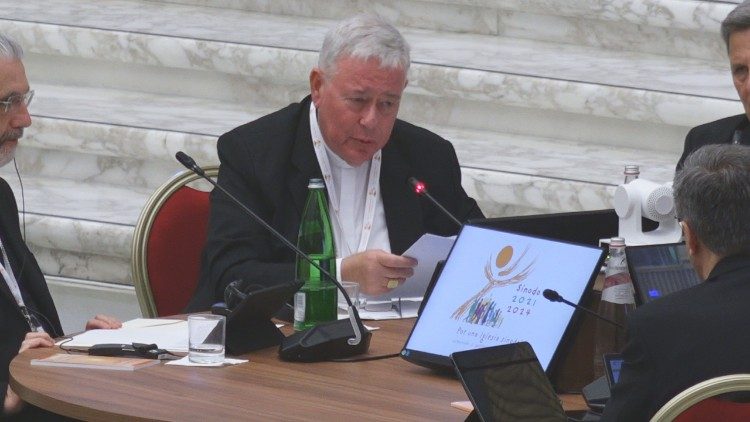
Presentation of the General rapporteur during the morning session of the General AssemblyPresentation of the General rapporteur during the morning session of the General Assembly  (Vatican Media)

Cardinal Hollerich: Church is rooted in places and cultures

The Synod’s General rapporteur, Cardinal Jean-Claude Hollerich, presents the third part of the Instrumentum laboris, “Places,” as participants begin their reflection on the final module of the General Assembly.

By Christopher Wells

With the General Assembly of the Synod entering its third week, Cardinal Jean-Claude Hollerich encouraged participants to not give in to fatigue.

The General rapporteur’s introduction to the fourth module – on the third and final part of the Instrumentum laboris – emphasized the need to engage the work “with the same decision and energy” that has characterized the Assembly so far.

A Church rooted in places and cultures

Cardinal Hollerich noted that this module is focused on “Places,” with the fundamental idea that “the Church cannot be understood without being rooted in a place and a culture (IL, 80).

Carefully explaining each section of this part of the IL, Cardinal Hollerich noted that now, more than in the past, the idea of place “has much less of a spatial and geographic connotation than in the past, not least due to globalism and the new digital reality. He asked synod participants to consider what this means for the Church’s mission, and how we should “rethink” the organizational forms of the Church.

The following paragraphs, Cardinal Hollerich said, deal with the relationships established between places and cultures, and especially among the various local Churches, including the Eastern Catholic Churches. Within the Church, these relationships have the character of a mutual exchange of gifts. He also noted the relationships that exist between the local Churches and the universal Church, and within each local Church.

The service of the Pope

Finally, he said, this final module is set to consider “the service of unity of the Bishop of Rome,” the Pope. Cardinal Hollerich said he interprets Pope Francis to be inviting the Synod participants to approach this exchange in the spirit of “parrhesia,” or frankness, with a view to offering advice on how to make the service of the Pope and the Roman Curia “more effective today.” The Pope, he said, “is entitled to what we truly think, beginning with the life and needs of the People of God in the places we come from.”

The lived experience of synod participants

While the topics of this module might seem technical or of interest only to insiders, the Cardinal said he hoped that Wednesday’s theological-pastoral fora, open to everyone, might help to dispel this impression.

In conclusion, Cardinal Hollerich expressed his opinion that this module, like those that have come before, engages “the lived experiences” of the participants in the General Assembly. “It seems to me,” he said, “that this is the most correct perspective in which to place ourselves to face the work ahead of us.”

Friday, October 27, 2023

Tensions and fractures at the Synod on Synodality


Bishops walking out, 'tiresome' listening: Inside tensions at the synod


Vatican City — October 26, 2023


BY CHRISTOPHER WHITE

It was less than two weeks into Pope Francis' high-stakes Vatican summit on the future of the Catholic Church when multiple reports emerged about participating delegates storming out of the room. 

In one case, a bishop didn't want to be photographed sitting next to a priest with whom he had numerous disagreements. In another, a cardinal believed that the Oct. 4-29 Synod of Bishops was a misnomer because it now included the equal participation of the laity — a criticism that has reverberated throughout the monthlong meeting. 

The incidents weren't exactly a surprise, as the roughly 450 bishops and lay delegates taking part in the assembly had been warned by one of the synod's principal organizers that tensions in the room would emerge.

'We are not afraid of tensions. Tensions are a part of the process, as long as we consider ourselves to be sisters and brothers, walking together.'
—Cardinal Jean-Claude Hollerich 

TWEET THIS

"We are not afraid of tensions," Cardinal Jean-Claude Hollerich of Luxembourg told participants on Oct. 9. "Tensions are a part of the process, as long as we consider ourselves to be sisters and brothers, walking together."

During the second and third weeks of the synodal assembly, issues that include the role of women's ministries in the church and questions surrounding how to respond to LGBTQ Catholics — as well as the very nature of synodality itself — brought to the surface a number of disagreements among its members. 

Francis has asked synod members to refrain from speaking publicly about the nature of the proceedings this month. This account is based on interviews with multiple delegates who requested anonymity because of the pope's request. They each described the synod's revamped and expanded process as a positive development, but one with a steep learning curve. 

For synod organizers — and, indeed, the pope himself — disagreement was all part of the plan. 

The official guidelines for the meeting have assigned the synod's small groups the task of outlining areas of both convergence and divergence — as well as issues that need further study and theological reflection. 

One day after hearing accounts of sharp disagreements, I asked one synod member to corroborate some of the things I had heard.

Indeed, it was all true, the person confirmed, adding: "We're not even at first base here. We can't even get to discussing many of these issues, because so many people in the room haven't been trained in the practice of synodality. That's what this month is providing."

"So, it's sort of a boot camp?," I asked. "Exactly," they replied. 

Some people in the Vatican's Pope Paul VI hall this month, where the synod is meeting, are here because they wanted to be, while others are here because someone else chose them. It's a bit like the draft versus voluntary enrollment.

Many of the bishop members were elected by their fellow prelates to represent their respective countries, as is outlined by the church's Code of Canon Law and Francis' 2018 apostolic constitution defining the structure of the Synod of Bishops, Episcopalis communio

But when the pope decided earlier this year to extend participation — and the right to vote — to lay delegates, the Vatican synod office specified that lay members were to be nominated based on their previously exhibited commitment to the years-long synodal process.

Throughout the month, both bishops and lay members have attested that it's very often the laity who are better versed in the practice of synodality — something Cardinal Mario Grech, who runs the Vatican's synod office, told me earlier this year had been his experience with the process to date. 

"Synodality is ingrained in the nature of the people of God," he said. "In the laity, I felt we are not bringing something new. To the contrary, we were harping a chord in their heart and they were ready to sing and to dance to this music."

And on Oct. 25, multiple synod members confirmed that Grech spoke directly to all the delegates at that morning's session to underscore that the assembly has the full authority of a synod. By including lay members for the first time, Grech said, the synod had expanded its scope in hopes of integrating the entire church.

But for those unaccustomed to this process, and all that it entails, boot camp has been difficult.

As the month has grinded along, there have been multiple reports of synod delegates complaining that the emphasis on listening — where every roundtable member is expected to offer their views and several minutes of forced silence requiring delegates to sit with their words before responding — has been a tiresome process. 

Sharing a different perspective, another bishop told me that unlike past synods, where delegates could sit in the Vatican's synod hall, with stadium style seating, this synod requires an active listening where participants must look at each other face to face and respond to what is being shared.

Another delegate recalled an incident at their roundtable where a priest was watching a bishop — who was serving as the roundtable's secretary — take notes to later report back to the full assembly. The bishop, apparently irritated that a priest was looking over his shoulder, snapped that if he refused to stop monitoring him, he would throw him out. 

"The bishop didn't seem to understand that in this environment, he didn't have the authority to do that," the delegate said. 

On another occasion, a synod participant described to me what they described as the "tyranny of the articulate" — those more accustomed to speaking in public forums — could either inadvertently or intentionally intimidate participants with less experience speaking in such an environment.

Across the board, it seems, this month's bootcamp has echoed what Vatican II expert and Canadian synod delegate Catherine Clifford told my colleague Joshua McElwee and me on our "The Vatican Briefing" podcast at the start of the synod: While the practice of synodality has deep roots in the Catholic tradition, over time the church's synodal muscles "were allowed to atrophy."
 

Francis, said Clifford, has "taken a wager that we will learn to do this, in the doing. We learn by doing." 

Friday, October 13, 2023

Cardinal explains mission and communion in Synodal context


Cardinal Hollerich presents the theme of the third module of the General Assembly of the Synod of BishopsCardinal Hollerich presents the theme of the third module of the General Assembly of the Synod of Bishops 

Hollerich: ‘A synodal Church is a Church sent out in mission’

Cardinal Jean-Claude Hollerich, the Synod’s Relator General, presents the Module B2 of the Instrumentum Laboris, which invites participants to reflect on the topic: “Co-responsibility in Mission: How can we better share gifts and tasks in the service of the Gospel.”

By Christopher Wells

“Our theme is, therefore, mission,” Cardinal Jean-Claude Hollerich said Friday morning in his presentation on the third “module” of the work of the General Assembly of the Synod of Bishops.

The Synod’s Relator General highlighted the fact that the call to mission extends to all the members of the Church, while reminding his listeners that mission is intrinsically connected to the earlier topic of “communion”. The theme of mission, he said, “continually emerged in the work of the second module: communion is not closed in on itself but is impelled towards mission; at the same time, the purpose of mission is precisely to extend the scope of communion.”
 

He noted that the example of the outreach to the “digital continent” can illustrate the idea of mission in a synodal context. The digital world is a new “mission territory” that must be evangelized by those who inhabit it. This, he said, likewise illustrates the concept of “co-responsibility”: “All the baptized are called and have the right to participate in the mission of the Church, all have an irreplaceable contribution to make. What is true for the digital continent is also true for other aspects of the mission of the Church.”

Cardinal Hollerich went on to briefly speak about the five worksheets that will be addressed by the small groups, with each group focusing on a single topic. These include deepening the meaning and content of mission; ministeriality; the role of women; the relation between ordained and baptismal ministry; and the ministry of Bishops.

Finally, Cardinal Hollerich insisted on the need to “continue making space for each other’s words”. The free interventions, he said, should express resonances with the insights shared by the group sessions immediately before the General Congregations. And he explained that it is important that “the reports of the Circuli Minores and the interventions of the rapporteurs increasingly present the points of convergence and divergence, but above all the questions to be explored and the proposals for concrete steps to be taken during the coming year.”

“In this module, we touch on some of the key points of our Synod,” the Cardinal said in conclusion. “Let us not give hasty answers that do not consider all the aspects of these difficult questions”.

Wednesday, April 26, 2023

70 Laypeople will be voting members at the Synod of Bishop's Fall General Assembly


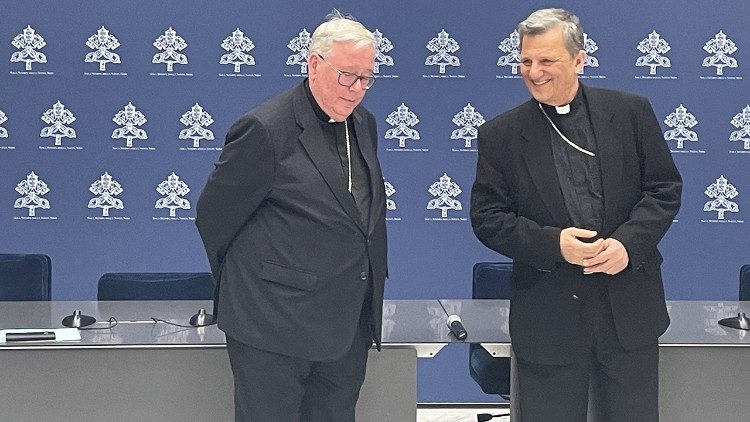
Cardinals Hollerich (L) and Grech (R) present the changes to the Synod at the Holy See Press OfficeCardinals Hollerich (L) and Grech (R) present the changes to the Synod at the Holy See Press Office 

Synod: Laymen and laywomen eligible to vote at General Assembly

The Secretariat for the Synod announces that 70 “non-bishop members” appointed by the Pope—half of whom will be women—will be able to vote at the Synod General Assembly in October.

By Salvatore Cernuzio

Neither the nature nor the name is changing—which remains the Synod of Bishops—but the composition of the participants in the October 2023 General Assembly in the Vatican on the theme of synodality is set to change, since a sizeable group of "non-bishop" members will also take part.

These 70 individuals will include lay people appointed directly by the Pope, 50 percent of whom shall be women and among whom shall be included several young people. All 70 will enjoy voting rights at the Assembly, which will consist of around 370 voting members out of more than 400 total participants.

‘Not a revolution’

These represent the main changes introduced on Wednesday by Pope Francis for the Synod Assembly, which will seal the synodal path he himself launched in the Autumn of 2021.

The changes were presented by Cardinal Mario Grech, Secretary General of the Secretariat for the Synod, and Cardinal Jean-Claude Hollerich, the Synod’s General Relator.

“This is not a revolution but an important change," they specified at a press conference at the Holy See Press Office on Wednesday.

"Non-bishop" members

The new arrangements were communicated on the same day in a letter to the heads of the Continental Assemblies held recently in Africa, Asia, the Middle East, and Oceania.

The letter states that no current regulations have been repealed, and that the 2018 Apostolic Constitution Episcopalis Communio already provided for the presence of "non-bishops" at the Synod.

The 70 non-bishop members will be chosen by the Pope from a list of 140 prepared by the 7 International Reunions of Bishops' Conferences and the Assembly of Patriarchs of Eastern Catholic Churches.

They shall represent “various groupings of the faithful of the people of God (priests, consecrated women, deacons, lay faithful)”, according to the letter.

The Synod Assembly shall also no longer include “auditors”.

A "plenary" assembly of bishops

“In this way, the specifically episcopal nature of the Synodal Assembly is not affected, but is rather confirmed," the General Secretariat of the Synod’s letter emphasizes.

"We are talking about 21 percent of the Assembly remaining a plenary assembly of bishops, with a sizable participation of non-bishops," Cardinal Hollerich reiterated further. "Their presence ensures the dialogue between the prophecy of the people of God and the discernment of the pastors."

Election and appointment

Speaking about the requirement for half of the 70 to be women and the presence of young people, the Cardinals said this is so “because that is the way our world is."

The choice of the 140 candidates, they added, shall take into account each person’s general culture, prudence, and knowledge and participation in the synodal process. As members, they have the right to vote.

This aspect is important, noted Cardinal Grech, adding that he hopes someday “we will be able to do without the vote, since the Synod is a discernment, a prayer.”

Five religious women and five religious men

The five women religious and five men religious elected by their respective organizations of Superiors General (UISG, for women religious; and, USG, for male religious) will also be eligible to vote.

These 10 men and women religious replace the ten clerics of the Institutes of Consecrated Life who attended in past Synod Assemblies.

All elections—to be held in plenary assembly and by secret ballot by the respective Synods, Councils and Bishops' Conferences—must be ratified by the Pope, and their names shall not be made public until the Pope confirms their election.

Facilitators

For the first time, the Synod will include several "facilitators".

Cardinal Grech explained that this choice was born from the experience of the Synod study groups, "which showed us that the presence of experts can create a fruitful dynamic."

"There are bishops who have never participated in the Synod, so we need to facilitate the spiritual dimension," Cardinal Hollerich explained.

He also noted that for the first time there will also be bishops from countries that do not have an Episcopal Conference represented at the Assembly. Cardinal Hollerich added that his Archdiocese of Luxembourg is one of them, along with Estonia and Moldova.

In conclusion, the two Cardinals agreed that "the Church will be more complete, and it will be a joy to have her represented in her entirety in Rome."

Monday, January 30, 2023

The process for the upcoming Synod highlights role of the Bishop


Bishops and faithful together at the opening of the synodal processBishops and faithful together at the opening of the synodal process  (Vatican Media)

Letter from Synod leaders highlights crucial role of Bishops in synodal process

In a letter addressed to all the diocesan and eparchial bishops throughout the world, the General Secretary and the General Relator of the Synod offer considerations on the role of Bishops in the synodal process.

By Christopher Wells

Cardinal Mario Grech and Cardinal Jean Claude Hollerich – respectively the Secretary General and the General Relator of the Synod – have addressed a letter to all the Bishops of the world in which they share “a few considerations for a common understanding of the synodal process, its progress, and the meaning of the current Continental stage.”

The Cardinals begin by noting that, as Vatican II teaches, each Bishop has “responsibility” for their own particular Church as well as “solicitude for the Universal Church.” The very reason for the synod, they explain, is “to enable the exercise of the latter,” with the current synodal process making “the role of Pastors and their participation in the various stages even more crucial.”

"For a Synodal Church": the sole theme of the Synod

In their letter, the Cardinals highlight the sole theme of the Synod: “For a Synodal Church: communion, participation, mission.”

“This is therefore the sole theme we are called to explore in each of the stages within the process.”

The exclusive focus on this theme precludes the possibility of other themes being “surreptitiously introduced” by those who would “exploit the Assembly and disregard the consultation of the People of God.”
 

The Cardinals say “it is understandable” that in the initial phase of the synod, “the scope or margins of the theme were not clearly defined”. However, they say, these have been gradually clarified in subsequent steps. “It is important to remember,” they say, that the syntheses produced in the diocesan stage “are the result of the discernment of the Pastors regarding the contributions made during the consultation of the People of God.”

The Working Document for the Continental Stage, in turn, is meant to give the local Churches the opportunity to listen to others. The themes proposed in that document, they add, “do not constitute the agenda of the next Assembly of the Synod of Bishops.”

Identifying priorities

This process of listening will allow the local Churches to determine what resonates with each of them, allowing the Bishops to identify “the priorities, recurring themes, and calls to action” that can be shared and discussed at the General Assembly in October.

The hope is that “in the Continental Assemblies, the voice of the particular Churches will resound with even greater strength.”

“The more we grow in the synodal style of the Church, the more all of us as members of the People of God – faithful and Pastors – will learn to feel cum Ecclesia [“with the Church”], in fidelity to the Word of God and Tradition.”

This Synod, the Cardinals maintain, aims to respond first and foremost to “the great question challenging the Church since the Second Vatican Council: ‘Church, what do you say of yourself?' ” They say the answer to this question can be found in “the Church that is ‘constitutively synodal’, where all are called to exercise their ecclesial charism in view of carrying out the common mission of evangelization.”

The subject of the synodal process: the People of God

The synod process, they continue, shows how this is possible: “the holy People of God is the subject of the synodal process” precisely through the listening process conducted by each Bishop in his own Church.

The Bishops, then, have a two-fold role in the process: they guide the consultations in their own local Churches, and they exercise their charism of discernment in the succeeding stages, always under the Pope, who has the “prerogative to convoke, preside over, and confirm the synodal assemblies.”

In this way, they say, the Bishops’ ministry “becomes even more decisive for the journey of the People of God.”

In conclusion, the Cardinals emphasize that Bishops, united among themselves and with and under the Pope, represent the “the entire Church in the bond of peace, love, and unity.”