Showing posts with label Basilica of St. Mary Major. Show all posts

Thursday, October 1, 2026

The holy relics of the manger where the Baby Jesus lay moved to accommodate the faithful at St. Mary Major


The relics of the Holy Crib in the Papal Basilica of Saint Mary MajorThe relics of the Holy Crib in the Papal Basilica of Saint Mary Major 

Relic of Holy Crib to be placed closer to the faithful

The relics of the Holy Crib – the manger in which the Baby Jesus was laid at His birth – will be moved closer to the faithful to accommodate the restoration of the niche and reliquary where they are normally kept in the Confessio of Saint Mary Major.

By Vatican News

A temporary exhibition of the relics of the Holy Crib is an opportunity for pilgrims and visitors “to contemplate up close a relic intimately linked with the very identity of Saint Mary Major – the Roman Basilica that, more than any other, has preserved the memory of the Nativity of Christ throughout the centuries.”

According to a press release from the Basilica, the relics of the manger in which Christ was laid at His birth will be moved from their place in the Confessio before the Papal Altar of the Basilica into a side chapel in the right nave, “allowing the faithful to approach the Sacred Cradle in an atmosphere of unique intimacy and quiet contemplation.”

The temporary move will allow the restoration of the historic niche and reliquary in which the relics are normally housed, which are “no longer adequate for ensuring optimal conservation conditions.” According to the statement, “The new case will be designed according to modern standards of stability, security, and microclimate control, while simultaneously integrating with the historic structure and the elaborate architectural design of the Confessio.”

Behind the Sacred Cradle, a new blue mosaic backdrop will be created, composed of vitreous enamels and golden tiles, intended to symbolically evoke the sky of the Nativity.

The Basilica of Christmas and the memory of the manger of Bethlehem

The relics today preserved in Santa Maria Maggiore consist of five thin sycamore wooden elements, traditionally identified as fragments of the manger in which, according to the Gospel story, Mary placed Jesus after his birth. An ancient tradition connects its presence in Rome to the devotion that arose around the places of the Nativity and the figure of Saint Jerome, who lived for a long time in Bethlehem between the 4th and 5th centuries.

The veneration of the manger contributed profoundly to defining the liturgical and devotional identity of the Roman basilica, so much so that Santa Maria Maggiore was already referred to in ancient times as Santa Maria ad Praesepe, “Santa Maria near the Nativity Scene.”

From Valadier to Vespignani: two centuries of art around the Holy Crib

In 1802 Giuseppe Valadier, one of the major protagonists of Neoclassicism in Rome, designed the extraordinary reliquary intended to house the sacred relics: a work conceived in the form of a cradle, a visual evocation of the mystery of the Nativity.

A few decades later, Blessed Pius IX gave the Sacred Cradle a new and solemn monumental setting. During his papacy, in a project that lasted from1861 to 1864, the Roman architect Virginio Vespignani created the large Confessio in front of the Papal Altar using an extraordinary repertoire of polychrome marbles – around seventy varieties, largely coming from the excavations then conducted in Rome and Ostia – creating one of the most significant nineteenth-century interventions inside the Basilica.

A journey of faith and art

“The choice of location also holds evocative iconographic significance: the relic will be placed in dialogue with Pompeo Batoni’s Annunciation, a magnificent work of 18th-century Roman painting,” the statement continues. “Thus, within the basilica, the angel’s announcement to Mary will be followed—in a symbolic sense—by the tangible memory of the Nativity: from the Ecce ancilla Domini to the manger in Bethlehem, from the Annunciation to the Incarnation.”

The press release notes that on Christmas Eve, 24 December, the Holy Crib will be solemnly transferred to the Papal Altar, in keeping with the tradition of the Basilica.

The relics will remain there throughout the whole of the Christmas Season, after which, on Epiphany, they will be returned to their historic place, where they will be placed in the new reliquary with the renewed mosaic sky.

The Basilica’s statement notes that the historic conservation intervention will be carried out under the superintendence of the Directorate of Museums and Cultural Heritage of the Governorate of the Vatican City State, and entrusted to Progetto Arte Poli of VeronaRel

Tuesday, August 4, 2026

Celebrating one of the Roman Basilicas dedicated to Mary and commemorating the August snow in Rome


Ordinary Time: August 5th

Optional Memorial of the Dedication of St. Mary Major


We celebrate today the dedication of one of the four most illustrious churches of Rome. While each diocese and parish keeps its own dedication anniversary, the Church universal commemorates the consecration of the four great Roman basilicas, the mother churches, we may call them, of Christendom, viz., St. John Lateran, St. Peter, St. Paul Outside the Walls, and St. Mary Major. By means of these feasts the Church seeks to link all Christians with the Holy See.

This feast commemorates the miracle of the snowfall that occurred during the night of August 4-5 in the year 358 on the site where the basilica now stands. According to tradition, the Virgin Mary appeared in a dream to two faithful Roman Christians, the patrician John and his wife, as well as to Pope Liberius (352-366), asking that a church be built in her honor on the site where snow would fall on the night of August 4-5. Pope Liberius traced the outlines of the church in the snow and the first basilica was built on that site. It was completed about a century later by Pope Sixtus III (432-440), after the Council of Ephesus in 431 during which Mary was declared to be the Mother of God.

In Rome the Basilica of St. Mary Major will hold its traditional triduum from August 1 to 3 and two days of celebration on August 4 and 5. During the pontifical Mass and the second vespers, the traditional shower of flower petals will descend from the ceiling of the basilica to commemorate the August snowfall in 358.

St. Oswald, king, is mentioned in the Roman Martyrology. St. Bede the Venerable commemorates his deeds. He was sometimes portrayed as a martyr, since he died in battle against the pagan Welsh invaders.

Historically it is also the feast of St. Emygdius who lived in the 3rd and 4th century and was a Christian bishop in Ascoli Piceno in Italy. He converted many people to Christianity with his displays of miracles.


Dedication of the Basilica of Saint Mary Major in Rome
St. Mary Major is important to Christendom for three reasons:

(a) It stands as a venerable monument to the Council of Ephesus (431), at which the dogma of Mary's divine Motherhood was solemnly defined; the definition of the Council occasioned a most notable increase in the veneration paid to Mary.

(b) The basilica is Rome's "church of the crib," a kind of Bethlehem within the Eternal City; it also is a celebrated station church, serving, for instance, as the center for Rome's liturgy for the first Mass on Christmas. In some measure every picture of Mary with the divine Child is traceable to this church.

(c) St. Mary Major is Christendom's first Marian shrine for pilgrims. It set the precedent for the countless shrines where pilgrims gather to honor our Blessed Mother throughout the world. Here was introduced an authentic expression of popular piety that has been the source of untold blessings and graces for Christianity in the past as in the present.


The beginnings of St. Mary Major date to the Constantinian period. Originally it was called the Sicinini Basilica; it was the palace of a patrician family by that name before its transformation into a church by Pope Liberius. The story of its origin is legendary, dating from the Middle Ages. The Breviary gives this version:

Liberius was on the chair of Peter (352-366) when the Roman patrician John and his wife, who was of like nobility, vowed to bequeath their estate to the most holy Virgin and Mother of God, for they had no children to whom their property could go. The couple gave themselves to assiduous prayer, beseeching Mary to make known to them in some way what pious work they should subsidize in her honor.

Mary answered their petition and confirmed her reply by means of the following miracle. On the fifth of August — a time when it is unbearably hot in the city of Rome — a portion of the Esquiline would be covered with snow during the night. During that same night the Mother of God directed John and his wife in separate dreams to build a church to be dedicated to the Virgin Mary on the site where they would see snow lying. For it was in this manner that she wanted her inheritance to be used.

John immediately reported the whole matter to Pope Liberius, and he declared that a similar dream had come to him. Accompanied by clergy and people, Liberius proceeded on the following morning in solemn procession to the snow-covered hill and there marked off the area on which the church in Mary's honor was to be constructed.

Under Pope Sixtus III (432-440) the basilica was rebuilt, and upon the occasion of the definition of Mary's divine Motherhood by the Council of Ephesus, consecrated to her honor (432). He decorated the apse and walls with mosaics from the lives of Christ and His blessed Mother, which even to this day beautify the church and belong to the oldest we possess. As early as the end of the fourth century a replica of the Bethlehem nativity grotto had been added; on this account the edifice became known as "St. Mary of the Crib." To the Christian at Rome this church is Bethlehem. Other names for the basilica are: Liberian Basilica, because it dates to the time of Pope Liberius; St. Mary Major (being the largest church in Mary's honor in Rome); Our Lady of the Snow, because of the miracle that supposedly occasioned its erection.

We could point out how the divine Motherhood mystery dominates all Marian liturgy; for the Theotokos doctrine has kept Mariology Christo-centric in the Church's worship. Although recent popular devotion to Mary has become to a certain extent soft and sentimental and has, one may say, erected its own sanctuary around Mary as the center, devotion to our Blessed Mother in the liturgy has always remained oriented to Christ. In the liturgy the divine Motherhood has always been the bridge from Mary to Jesus. One need only examine Matins in honor of Mary or the Masses from her Common to be reassured. Everywhere Christ takes the central position, and Mary is the Christbearer.
—Excerpted from The Church's Year of Grace, Pius Parsch

Patronage: Italy; diocese of Reno, Nevada; Italy: Arzachena, Atella, Castiglione in Teverina, Conco, Rovereto, San Marco in Lamis, Susa, Torre Annunziata; Buenos Aires, Argentina; Almagro, Spain; Utah

Tuesday, November 4, 2025

Pope Leo XIV prays at the tomb of Pope Francis in St. Mary Major


Pope Leo stopped at the Basilica of St. Mary Major to pray at the tomb of his predecessorPope Leo stopped at the Basilica of St. Mary Major to pray at the tomb of his predecessor 

Pope Leo visits Basilica of St. Mary Major; prays at Pope Francis' tomb

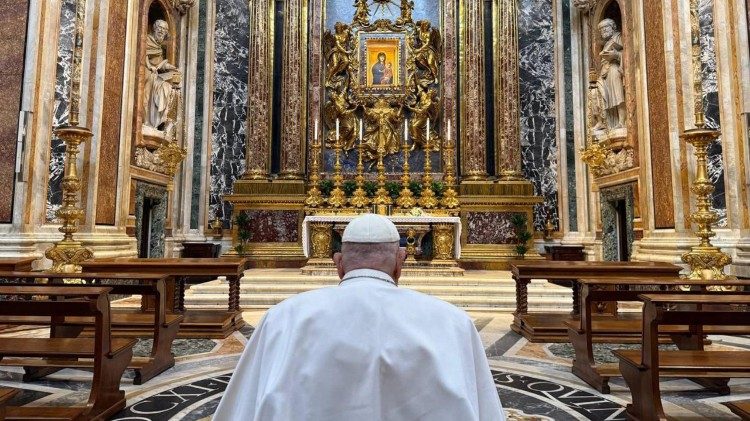
On his way to Castel Gandolfo, the Pope stopped at the Basilica of St. Mary Major to pray at the tomb of his predecessor and in front of the image of Salus Populi Romani.

Salvatore Cernuzio

Before heading to Castel Gandolfo for his customary weekly day of rest, Pope Leo XIV stopped at around 8:05 p.m. this evening at the Basilica of St. Mary Major to pray before the tomb of Pope Francis.

On the marble slab—where a white rose is always placed in memory of Saint Thérèse of Lisieux, a constant spiritual presence in the life of the Argentine pontiff—Pope Leo laid a bouquet of white roses. It was a gesture of homage to his predecessor, buried between the Sforza Chapel and the Pauline Chapel. The latter is home to the icon of Salus Populi Romani, so often visited by Pope Francis before and after each international journey or hospital stay.

According to the Holy See Press Office, Pope Leo also paused in prayer in front of the Marian image before leaving the basilica around 8:15 p.m. and continuing his journey to Castel Gandolfo.

Pope Leo at the tomb of his predecessor

Mass in suffrage for Pope Francis

Earlier in the day, Pope Leo had celebrated a Mass at the Altar of the Chair in St. Peter’s Basilica in suffrage for Pope Francis and the cardinals and bishops who had passed away over the past year.

With “great affection,” the Holy Father offered the Mass for his predecessor, who, he recalled in his homily, “died after opening the Holy Door and imparting the Easter Blessing to Rome and the whole world. Thanks to the Jubilee, this celebration—my first—takes on a special meaning: it carries the flavor of Christian hope.”

Pope Leo prays in front of the image of Salus Populi Romani

This hope, Pope Leo added later in his reflection, was one that Pope Francis and the other prelates who have died in recent months “lived, witnessed, and taught.”

Previous visits to the tomb at the Basilica of St. Mary Major

On 10 May, just two days after his election to the See of Peter, Pope Leo visited the Argentine pontiff’s tomb, which is visited daily by numerous faithful and pilgrims. That afternoon, the newly elected Pope laid flowers on the tomb and paused for a few moments in prayer. He did the same again on 22 June, following the procession for the Solemnity of the Most Holy Body and Blood of Christ, from St. John Lateran to the Basilica of St. Mary Major.

Monday, August 4, 2025

Celebrating the optional memorial of the Dedication of the Basilica of St. Mary Major and the miracle of Our Lady of the Snows


Ordinary Time: August 5th

Optional Memorial of the Dedication of St. Mary Major


We celebrate today the Optional Memorial of the Dedication of the Basilica of St. Mary Major, one of the four most illustrious churches of Rome. While each diocese and parish keep its own dedication anniversary, the universal Church commemorates the consecration of the four great Roman basilicas, the mother churches, we may call them, of Christendom: St. John Lateran, St. Peter, St. Paul Outside the Walls, and St. Mary Major. By means of these feasts the Church seeks to link all Christians with the Holy See.

This feast commemorates the miracle of the snowfall that occurred during the night of August 4-5 in the year 358 on the site where the basilica now stands. According to tradition, the Virgin Mary appeared in a dream to two faithful Roman Christians, the patrician John and his wife, as well as to Pope Liberius (352-366), asking that a church be built in her honor on the site where snow would fall on the night of August 4-5. Pope Liberius traced the outlines of the church in the snow and the first basilica was built on that site. It was completed about a century later by Pope Sixtus III (432-440), after the Council of Ephesus in 431 during which Mary was declared to be the Mother of God.

In Rome the Basilica of St. Mary Major holds its traditional triduum from August 1 to 3 and two days of celebration on August 4 and 5. During the pontifical Mass and the second vespers, the traditional shower of flower petals will descend from the ceiling of the basilica to commemorate the August snowfall in 358.

Dedication of the Basilica of Saint Mary Major in Rome
St. Mary Major is important to Christendom for three reasons:

(a) It stands as a venerable monument to the Council of Ephesus (431), at which the dogma of Mary's divine Motherhood was solemnly defined; the definition of the Council occasioned a most notable increase in the veneration paid to Mary.

(b) The basilica is Rome's "church of the crib," a kind of Bethlehem within the Eternal City; it also is a celebrated station church, serving, for instance, as the center for Rome's liturgy for the first Mass on Christmas. In some measure every picture of Mary with the divine Child is traceable to this church.

(c) St. Mary Major is Christendom's first Marian shrine for pilgrims. It set the precedent for the countless shrines where pilgrims gather to honor our Blessed Mother throughout the world. Here was introduced an authentic expression of popular piety that has been the source of untold blessings and graces for Christianity in the past as in the present.

The beginnings of St. Mary Major date to the Constantinian period. Originally it was called the Sicinini Basilica; it was the palace of a patrician family by that name before its transformation into a church by Pope Liberius. The story of its origin is legendary, dating from the Middle Ages. The Breviary gives this version:

Liberius was on the chair of Peter (352-366) when the Roman patrician John and his wife, who was of like nobility, vowed to bequeath their estate to the most holy Virgin and Mother of God, for they had no children to whom their property could go. The couple gave themselves to assiduous prayer, beseeching Mary to make known to them in some way what pious work they should subsidize in her honor.

Mary answered their petition and confirmed her reply by means of the following miracle. On the fifth of August — a time when it is unbearably hot in the city of Rome — a portion of the Esquiline would be covered with snow during the night. During that same night the Mother of God directed John and his wife in separate dreams to build a church to be dedicated to the Virgin Mary on the site where they would see snow lying. For it was in this manner that she wanted her inheritance to be used.

John immediately reported the whole matter to Pope Liberius, and he declared that a similar dream had come to him. Accompanied by clergy and people, Liberius proceeded on the following morning in solemn procession to the snow-covered hill and there marked off the area on which the church in Mary's honor was to be constructed.

Under Pope Sixtus III (432-440) the basilica was rebuilt, and upon the occasion of the definition of Mary's divine Motherhood by the Council of Ephesus, consecrated to her honor (432). He decorated the apse and walls with mosaics from the lives of Christ and His blessed Mother, which even to this day beautify the church and belong to the oldest we possess. As early as the end of the fourth century a replica of the Bethlehem nativity grotto had been added; on this account the edifice became known as "St. Mary of the Crib." To the Christian at Rome this church is Bethlehem. Other names for the basilica are: Liberian Basilica, because it dates to the time of Pope Liberius; St. Mary Major (being the largest church in Mary's honor in Rome); Our Lady of the Snow, because of the miracle that supposedly occasioned its erection.

We could point out how the divine Motherhood mystery dominates all Marian liturgy; for the Theotokos doctrine has kept Mariology Christo-centric in the Church's worship. Although recent popular devotion to Mary has become to a certain extent soft and sentimental and has, one may say, erected its own sanctuary around Mary as the center, devotion to our Blessed Mother in the liturgy has always remained oriented to Christ. In the liturgy the divine Motherhood has always been the bridge from Mary to Jesus. One need only examine Matins in honor of Mary or the Masses from her Common to be reassured. Everywhere Christ takes the central position, and Mary is the Christ bearer.
—Excerpted from The Church's Year of Grace, Pius Parsch

Monday, April 28, 2025

Second Vespers on Sunday was prayed at the tomb of Pope Francis


Cardinals visit the tomb of Pope Francis, pray Second Vespers

Members of the College of Cardinals pay homage to Pope Francis visiting his tomb at the papal Basilica of Saint Mary Major, followed by praying Second Vespers together.

Vatican News

During the late afternoon of the Second Sunday of Easter, Divine Mercy Sunday, members of the College of Cardinals went to the papal Basilica of Saint Mary Major to pay their homage to Pope Francis at his tomb open to the public since seven in the morning.

They then gathered there for evening prayer, Second Vespers, led by the Basilica's Coadjutor Archpriest, Lithuanian Cardinal Rolanda Makrickas.

Behind them, groups of worshippers joined in, while others continued to arrive during the celebration to pay their respects to Pope Francis. An estimated twenty thousand people had already visited the tomb since the early morning.

Saturday, April 26, 2025

Burial of Pope Francis at St. Mary Major


Pope Francis is buried in St Mary Major

After funeral mass, Pope Francis’ mortal remains were carried through Rome to the Basilica of Saint Mary Major, where he was laid to rest near the icon of Mary Salus Popoli Romani.

By Francesca Merlo

After a solemn but beautiful mass, Pope Francis’ mortal remains made their way across the Eternal City to his final resting place: the Basilica of Saint Mary Major.

150,000 people lined the streets to bid a final farewell to Pope Francis, who on Sunday, the day before he died, had driven around St. Peter's Square in his popemobile, where he, perhaps unknowingly said goodbye to the faithful.

The procession travelled through the ancient ruins of Rome, past the monument of the fallen soldiers in Piazza Venezia - this Pope who so tirelessly advocated for peace; past the ancient Roman Forum and the Colosseum, where his beautiful meditations for the Via Crucis, denouncing the economy of indifference and calling for an economy of peace, had been read out just one week ago. Then, up to the Basilica of Saint Mary Major, where his coffin was raised towards the crowd for a final goodbye. Inside the Basilica, too, the Pope’s coffin was held for a few moments before the Pauline chapel, facing the icon of Mary Salus Popoli Romani, before being taken to the chapel next door, to be buried.

At 1.00pm, the Rite of the Burial of the Roman Pontiff's casket began.
The rite took place according to the prescriptions of the Ordo Exsequiarum Romani Pontificis, presided over by the Cardinal Camerlengo, in the presence of those indicated in the relevant Notice from the Office for the Liturgical Celebrations and the family members of the deceased Pope. It concluded at 1.30pm.

Pope Francis now lies to rest in the burial niche in the side aisle between the Sforza Chapel and the Pauline Chapel holding the icon of Mary Salus Popoli Romani. We can be sure that the two of them will never leave each other’s sides.

Friday, April 25, 2025

Pope Francis made sure the poor & marginalized were included in his funeral


The Basilica of Saint Mary Major where Pope Francis will be buriedThe Basilica of Saint Mary Major where Pope Francis will be buried  (ANSA)

Poor to bid last farewell to Pope Francis on the day of his funeral

After the solemn funeral Mass at St. Peter’s on Saturday, 26 Apri, Pope Francis remains will be transferred in procession to the Basilica of St. Mary Major where a group of poor and marginalized people will pay their last respects before his burial in the church, as he expressed in his last wishes.

By Salvatore Cernuzio

Being the “least” in society will become a privilege on the day of Pope Francis’ funeral and burial. Around forty people will gather on Saturday morning  April 26, on the steps of Saint Mary Major Basilica in the Esquilino Roman neighbourhood. The group will include poor people, homeless, prisoners, migrants and transgender individuals, who will will pay their last tribute and express their gratitude to Pope Francis. For many of them, he was like a “father.”

Holding a white rose, they will be the last to bid farewell to the late Pope after the funeral Mass at St. Peter’s, just before his burial between the Pauline Chapel (the chapel of Salus Populi Romani, a Marian icon venerated by Romans and by Francis) and the Sforza Chapel of the Liberian Basilica, in accordance with the Pope’s wishes.

Surrounded by his children

“The poor hold a privileged place in God’s heart,” and therefore “also in the heart and teachings of the Holy Father, who chose the name Francis so as never to forget them,” stated a communiqué from the Holy See. Bishop Benoni Ambarus, Secretary of the Commission for Migrations of the Italian Episcopal Conference and delegate for charitable initiatives, gave more details to Vatican media. He had been at Francis’ side on December 26 during one of the most emblematic moments of his pontificate — the opening of the Holy Door at Rebibbia prison, in Rome.

“I find this a very moving choice, because Pope Francis is being received by the Mother he loved so much (Salus Populi Romani) and by his favourite children, who will surround him on this final journey. I think it’s something truly beautiful...,” said Bishop Ambarus.

The poor accompanying Pope Francis in his last journey

The idea for this final encounter came from an echange between the Romanian-born  bishop and Bihop Diego Ravelli, the Master of Pontifical Liturgical Celebrations, to “strengthen the presence of the poor at the funeral or in some other meaningful way.” The decision was made to include “a representation of various categories of vulnerable people — the poor, the homeless, migrants, prisoners or former prisoners, or poor families,” as if all his favourite people were accompanying him in his final journey.

Migrants or homeless people — almost all of those in the group have had the chance to meet Pope Francis at least once, noted Bishop Ambarus.

Also present will be “a small group of transgender individuals I know, who live with a community of nuns and whom we support,” the Bishop explained. However, the final list of attendees at Saint Mary Major has not yet been confirmed, especially regarding the prisoners from Rome’s Rebibbia prison, who are still awaiting authorization.

Bishop Ambarus, still moved by the Pope’s decision to turn a prison into a kind of “cathedral,” echoed the “emptiness” now felt by the prisoners who participated in the opening of the Holy Door and the Jubilee. “Those living in prison feel orphaned — that’s what they write to me, what they tell me. They feel like they’ve lost a father but are still holding on to the hope the Pope gave them.” And this hope includes the belief that “civil society and all of us do not forget them, as Pope Francis often urged us to remember.”

The late Pope’s contributions over the years to the  needy

Throughout his pontificate, Pope Francis supported prisoners in concrete ways, including financial contributions. “The Holy Father,” emphasized Ambarus, “always invited everyone to take action — and he did so himself. Most of this help remains known only to God, but some of it was made public. What is certain is that he always contributed personally. As he used to say: charity passes through the wallet, and he never held back.”

As an example the Bishop recalled that  one of the first major gestures he made during the Covid pandemic ” was the creation of the Jesus the Divine Worker Fund, endowed with one million euros for the Diocese of Rome, to assist the unemployed, undocumented workers, those in precarious jobs, and people struggling to pay bills, buy food, or access healthcare. “The Pope also gave us a million euros to renovate the former clergy house and turn it into apartments for poor families. But it wasn’t just in Rome — Pope Francis’s entire pontificate is filled with contributions across the world,” not to mention the “major reforms in the administration of Church assets to benefit the most vulnerable.”

Saturday, April 12, 2025

The Pope prays ahead of Holy Week in front of Salus Populi Romani


Pope Francis at the Basilica of St Mary MajorPope Francis at the Basilica of St Mary Major 

Pope prays at St Mary Major ahead of Holy Week

Pope Francis goes to the Basilica of St Mary Major to pay homage to the Salus Populi Romani ahead of the start of Holy Week.

By Vatican News

On Saturday afternoon, on the eve of Palm Sunday and the beginning of Holy Week, Pope Francis visited the Basilica of Saint Mary Major in Rome.

According to a statement released by the Holy See Press Office, the Pope entered the Basilica to pray before the icon of the Virgin Mary, Salus Populi Romani.

The Holy Father’s devotion to Salus Populi Romani (Our Lady Protectress of Rome) is well known. Upon being discharged from Rome’s Gemelli Hospital three weeks ago, he had paused briefly outside the Basilica on his way back to his residence, Casa Santa Marta, in the Vatican. On that occasion, he gave a bouquet of flowers to Cardinal Rolandas Makrickas, Coadjutor Archpriest of the Basilica, to be placed before the sacred icon.

A long-standing devotion

Saturday's visit marked the 126th time the Pope has visited the papal Basilica to pay tribute to the icon of Our Lady. Since the day after his election—14 March 2013—he has made it a point to pray before Salus Populi Romani before and after each Apostolic Journey

Pope Francis’s most recent visit to the Basilica, the latest of more than one hundred such occasions, took place on 14 December 2024. On that occasion, he prayed before his 47th Apostolic Journey to Ajaccio, Corsica, where he was to close the Congress on “Popular Religiosity in the Mediterranean.”

Sunday, October 6, 2024

Pope Francis leads Rosary for peace


Pope Francis leads Rosary prayer for peace for ‘world in danger’

Pope Francis leads the recitation of a Rosary for peace at the Basilica of St. Mary Major, and prays that violence and hatred may be extinguished from human hearts.

By Devin Watkins

“Transform the hearts of those who fuel hatred, silence the din of weapons that generate death, extinguish the violence that brews in the heart of humanity, and inspire projects for peace in the actions of those who govern nations.”

Pope Francis made that supplication for peace on Sunday evening as he prayed the Rosary at the Basilica of St. Mary Major.

He was joined by participants in the Synod on Synodality taking place in the Vatican this month.


‘Wipe tears of those who mourn’

In his prayer for peace, the Pope brought the sorrows and hopes of peoples at war to the Blessed Virgin Mary, as he sat at the feet of the ancient icon of Maria Salus Populi Romani.

“We lift our gaze to you, immerse ourselves in your eyes, and entrust ourselves to your heart,” he prayed, noting that in her earthly life, Mary drew near to those who suffered.

Pope Francis said humanity currently has great need of her loving gaze, which calls us to trust in her Son, Jesus Christ.

“Fly to our aid in these times oppressed by injustices and devastated by wars,” he prayed. “Wipe the tears from the suffering faces of those who mourn the loss of their loved ones, awaken us from the stupor that has darkened our path, and disarm our hearts from the weapons of violence”.

The Holy Father expressed his concern that our world is in danger, as we have lost the “joy of peace and the sense of fraternity.”

He prayed that humanity may learn to “cherish life and reject war, care for those who suffer, the poor, the defenseless, the sick, and the afflicted, and protect our Common Home.”

In conclusion, Pope Francis asked Mary, Queen of the Rosary, to untie “the knots of selfishness and disperse the dark clouds of evil” and to fill us with her tenderness.

Pope Francis’ prayer to invoke peace

O Mary, our Mother, we come again here before you. You know the sorrows and struggles that weigh heavily on our hearts in this hour. We lift our gaze to you, immerse ourselves in your eyes, and entrust ourselves to your heart.

You, too, O Mother, have faced difficult trials and human fears, but you were courageous and bold. You entrusted everything to God, responded to Him with love, and offered yourself without reservation. As the intrepid Woman of Charity, you hurried to help Elizabeth, promptly addressing the needs of the couple during the Wedding at Cana; with steadfastness of heart, on Calvary you illuminated the night of sorrow with the Easter hope. Finally, with maternal tenderness, you gave courage to the frightened disciples in the Upper Room and, with them, welcomed the gift of the Spirit.

And now we beseech you: heed our cry! We have need of your loving gaze that invites us to trust in your Son, Jesus. You who are ready to embrace our sorrows, fly to our aid in these times oppressed by injustices and devastated by wars, wipe the tears from the suffering faces of those who mourn the loss of their loved ones, awaken us from the stupor that has darkened our path, and disarm our hearts from the weapons of violence, so that the prophecy of Isaiah may quickly be fulfilled: “They shall beat their swords into plowshares and their spears into pruning hooks; one nation shall not take up sword against another, nor shall they train for war again” (Isaiah 2:4).

Turn your maternal gaze upon the human family, which has lost the joy of peace and the sense of fraternity. Intercede for our world in danger, so that it may cherish life and reject war, care for those who suffer, the poor, the defenseless, the sick, and the afflicted, and protect our Common Home.

We invoke you for the mercy of God, O Queen of Peace! Transform the hearts of those who fuel hatred, silence the din of weapons that generate death, extinguish the violence that brews in the heart of humanity, and inspire projects for peace in the actions of those who govern nations.

O Queen of the Holy Rosary, untie the knots of selfishness and disperse the dark clouds of evil. Fill us with your tenderness, uplift us with your caring hand, and grant us your maternal caress, which makes us hope in the advent of a new humanity where “… the wilderness becomes a garden land and the garden land seems as common as forest. Then judgment will dwell in the wilderness and justice abide in the garden land. The work of justice will be peace…” (Isaiah 32:15-17).

O Mother, Salus Populi Romani, pray for us!