Showing posts with label Bangladesh. Show all posts

Tuesday, September 9, 2025

Pope Leo XIV reaffirms Catholic position to walk the path of peace to large Interreligious Conference


Pope Leo's message was read at the interreligious conference in Dhaka, BangladeshPope Leo's message was read at the interreligious conference in Dhaka, Bangladesh 

Pope Leo: ‘Peace, not conflict, is our most cherished dream’

Pope Leo XIV reaffirms the Catholic Church’s commitment to walk the path of peace with other religions, in a message to an interreligious conference in Bangladesh.

By Devin Watkins

Pope Leo XIV sent a message on Tuesday to the “Conference on Interreligious Dialogue and Harmony,” held in Dhaka, Bangladesh, on September 6-12.

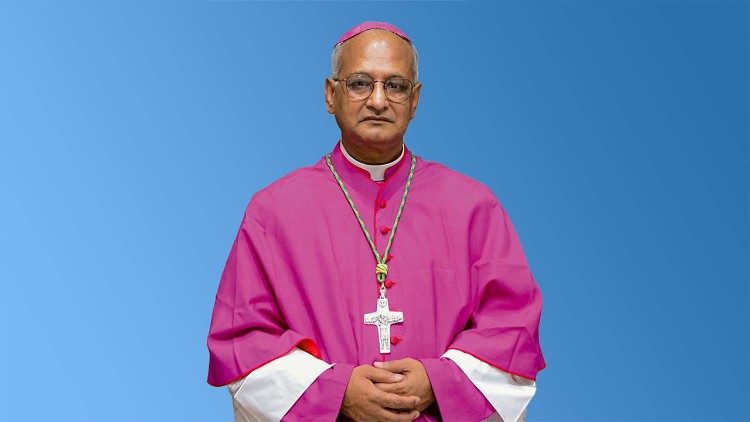
Cardinal George Koovakad, Prefect of the Dicastery for Interreligious Dialogue, read the Pope’s message at the event, which he attended with Msgr. Indunil Janakaratne Kodithuwakku Kankanamalage, Secretary of the same Dicastery.

The Pope expressed his support for interreligious dialogue and the event’s theme—“Promoting a Culture of Harmony between Brothers and Sisters”—and wished participants the gift of a peace that is “unarmed and disarming, humble and persevering.”

The chosen theme, he said, arises “from the conviction that our human community is truly one—in origin and in destiny under God.”

Pope Leo noted that the human family shares both the opportunity and the responsibility to nurture a culture of harmony and peace, pointing out that “culture” can be considered in two senses.

“Culture can mean the rich heritage of arts, ideas, and social institutions that characterize each people,” he said. “At the same time, culture can be understood as a nurturing environment that sustains growth.”

The Pope invited religious believers to carefully cultivate a growth-sustaining culture by ensuring the “sunlight of truth, the water of charity, and the soil of freedom and justice.”

He pointed to times when distrust and suspicion have won out between cultures, saying weeds of disharmony then choke out peace.

“Together, as companions in interreligious dialogue,” he said, “we are like gardeners tending this field of fraternity, helping to keep dialogue fertile and to clear away the weeds of prejudice.”

The Pope praised the interreligious conference in Bangladesh as a “beautiful witness” that differences in creed or background need not divide us.

When people of difference cultures and religions encounter one another in dialogue, they join forces against division, hatred, and violence, he said.

“Where others have sown distrust, we choose trust,” said the Pope. “Where others might foster fear, we strive for understanding; where others view differences as barriers, we recognize them as avenues of mutual enrichment.”

Pope Leo XIV then noted that a culture of harmony requires shared experiences, not only shared ideas.

One genuine measure of interreligious friendship, he said, is when people of different faiths work together to serve the vulnerable of society, praising those in Bangladesh who have stood together in times of natural disaster or tragedy.

“Such gestures build bridges—between faiths, between theory and practice, between communities—so that all Bangladeshis, and indeed all humanity, may pass from suspicion to trust, from isolation to collaboration,” he said.

Pope Leo XIV then renewed the Catholic Church’s commitment to walking the path of peace and dialogue alongside other religions.

“At times, misunderstandings or past wounds may slow our steps,” he said. “Yet let us encourage one another to persevere. Every group discussion, every joint service project or shared meal, every courtesy shown to a neighbor of another religion, these are bricks of what Saint John Paul II called ‘a civilization of love’.”

In conclusion, the Pope assured the interreligious leaders gathered in Dhaka of his fraternal love and prayed that God might bless Bangladesh with “ever-deepening harmony and peace.”

Sunday, May 28, 2023

Pope Francis appeals for prayers and assistance for the victims of Cyclone Mocha


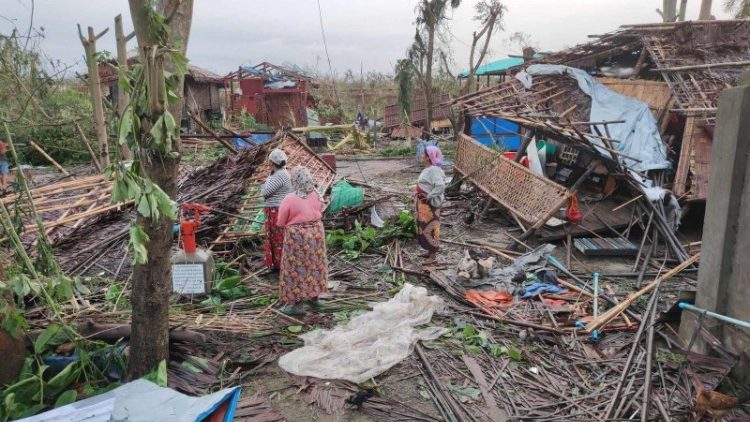
Aftermath of Cyclone Mocha in MyanmarAftermath of Cyclone Mocha in Myanmar  (Copyright © Partners Relief & Development)

Pope appeals for solidarity for communities affected by Cyclone Mocha

Pope Francis launches an appeal to authorities to facilitate the delivery of humanitarian aid to peoples struck by a powerful cyclone in the Bay of Bengal that has wreaked death and destruction in areas between Myanmar and Bangladesh.

By Linda Bordoni

Pope Francis appealed to authorities handling the access of humanitarian assistance to facilitate the delivery of aid to peoples struck by Cyclone Mocha in the Bay of Bengal.

Speaking during the Regina Coeli prayer on Sunday, the Pope noted that “more than 800.000 people,” in addition to the many Rohingya refugees fleeing violence in Myanmar and who arrive in Bangladesh in “precarious conditions” are in need of help.


“I invite you to pray for the people living on the Myanmar-Bangladesh border who have been hard hit by a cyclone,” he said.

Death and destruction

41 people were killed and around 700 were injured when the powerful Cyclone Mocha made landfall between Cox’s Bazar in Bangladesh and Kyaukpyu township in Myanmar on 14 May. An OCHA report estimates it has affected some 5.4 million people in Myanmar with 3.2 million in need of humanitarian assistance.

In Bangladesh, according to that report, the cyclone affected approximately 2.3 million people, and destroyed about 12,000 houses. A pre-existing high needs level means that Rohingya refugees living in camps are the most affected.

Pope's appeal for aid distribution

“While I renew my sympathy to these populations, I appeal to those responsible to facilitate access to humanitarian aid,” Pope Francis said.

He concluded with an appeal “to the sense of human solidarity and ecclesial solidarity, to come to the aid of these brothers and sisters of ours.”

Tuesday, August 24, 2021

The Pope, on behalf of the Church, sends financial aid to several poorer countries


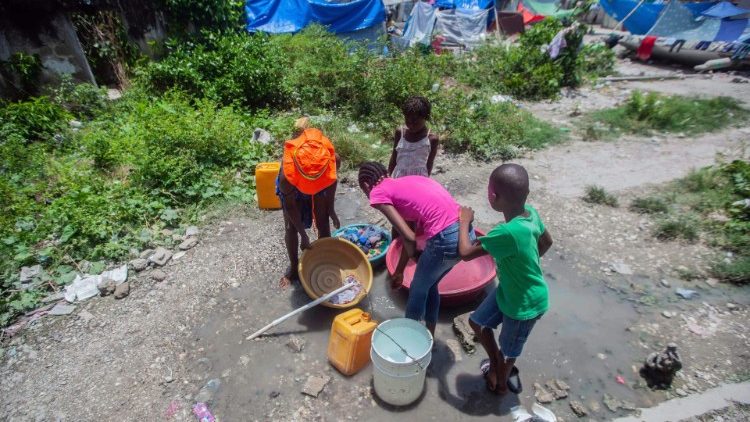
Haiti, already one of the poorest countries in the world, faces a new humanitarian crisis following a deadly earthquakeHaiti, already one of the poorest countries in the world, faces a new humanitarian crisis following a deadly earthquake  (AFP or licensors)

Pope donates aid to Haiti, Bangladesh, Vietnam

The Dicastery for Promoting Integral Human Development details humanitarian aid sent by Pope Francis to assist people in Haiti, Bangladesh, and Vietnam, who are suffering from natural disasters and the effects of the Covid-19 pandemic.

By Gabriella Ceraso

The Pope's concern for the battered and forgotten Caribbean island of Haiti has also taken concrete form, after an appeal for solidarity launched at the Angelus on August 15 with the invocation of Our Lady's protection.

In a statement released on Tuesday, the Dicastery for Promoting Integral Human Development, headed by Cardinal Peter Turkson, notes that Pope Francis has decided to send a preliminary contribution of 200,000 euros for the relief of the population in this phase of the post-earthquake emergency, a phase that is linked to the already difficult situation due to the Covid-19 pandemic that has caused about 600 victims in the collapsed health situation on the island.

The earthquake, which struck on the morning of 14 August 14 with a magnitude 7.2 on the Richter scale, and was also felt in Jamaica, had its epicenter about 150 km west of the Haitian capital Port-au-Prince, and devastated entire regions of the south and southwest. A still provisional tally, which has been increasing day-by-day, now numbers 2,207 dead, 344 missing and more than 12,000 injured. The damage is incalculable. Entire inland areas have been razed to the ground and homes have come down with avalanches of land already made fragile by aggressive deforestation that has marked the island for years. And what the earthquake did not destroy, the tropical storm that hit the archipelago in recent days did.

The international solidarity that the Pope had urged from the beginning, is working, but with many difficulties due to both the uncontrolled criminal gangs present throughout the territory and the difficulties of connections for the disaster that has been created. The support of Francis is therefore necessary and desired. In its statement, the Dicastery explains that the funds “will be distributed in collaboration with the Apostolic Nunciature among the dioceses most affected by the disaster, [and] will be used to assist the earthquake victims.” The contribution “is intended to be an immediate expression of the feeling of spiritual closeness and paternal encouragement towards the people and territories affected” by the disaster. Accompanied by prayer, the humanitarian aid – being gathered by Bishops’ Conferences and numerous charitable organizations and other entities throughout the Church, will be used in support of the “beloved Haitian population.”

Support for Bangladesh and Vietnam

Along with Haiti, Pope Francis is also providing immediate relief for two other countries in great difficulty. An initial offering of emergency aid of about 60 thousand euros has already been dispatched to the people of Bangladesh, recently hit by Cyclone Yaas. Over one million affected by the cyclone are already in conditions of extreme difficulty due to the spread of Indian variant.

Vietnam is another country close to the heart of Pope Francis. The Holy Father has sent initial aid package of 100,000 euros to the country, which is in a state of serious distress due to the socio-economic consequences related to the Covid 19 pandemic, which has caused more than 8000 victims here.

Monday, July 13, 2020

Important Archbishop from Bangladesh dies of Coronavirus

Archbishop Moses Costa of Chittagong, passed away on July 13, 2020, in Dhaka, Bangladesh. Archbishop Moses Costa of Chittagong, passed away on July 13, 2020, in Dhaka, Bangladesh. 


Bangladesh Archbishop passes away after recovering from Covid-19


Archbishop Moses Costa of Chittagong died on Monday at the age of 69. Bangladesh's Catholic community is greatly grieved by his death.


By Vatican News
The Catholic Church of Bangladesh is mourning the loss of an archbishop who died just weeks after recovering from Covid-19.   Archbishop Moses Costa of Chittagong, in south-east Bangladesh, died on Monday in a hospital in the capital Dhaka, after suffering a series of strokes. He was 69.
He became the senior-most clergyman of the Catholic Church of Bangladesh to die during the coronavirus pandemic.
The Holy Cross archbishop was flown by helicopter in critical condition and admitted to the ICU of Square Hospital in Dhaka on June 13.  Suffering from severe respiratory distress he was tested positive with coronavirus the following day. 
His condition improved significantly and he tested negative for the virus on June 22.  He continued to remain in hospital for further treatment.
However, his condition took a drastic turn on July 8 and he was transferred to the ICU again. According to the medical board, he suffered multiple strokes caused by a brain haemorrhage on July 9 and passed away Monday morning
He will be buried in Chittagong on Tuesday evening, Chittagong Archdiocesan officials said.

An irrecoverable loss

The archdiocesan website announced his death saying his passing away has left “all the faithful in a state of tremendous shock”.
“Chittagong Archdiocese is now without a shepherd! The whole Christian community of Bangladesh especially the faithful of Chittagong Diocese is under deep sorrow and pain.”
“His death is a great loss for the Christian community as well as the whole of Bangladesh. His death is an irrecoverable loss for all of us,” the archdiocesan community said.
Manik Willver D’Costa, the pastoral coordinator of Chittagong, commended his archbishop’s “extraordinary efforts in laying a strong socio-economic foundation for the Church and revolutionizing the systematic reorganization of Church apparatus”.  In this, Archbishop Costa encouraged a spiritual awakening and missionary zeal in the clergy, the religious and the laity.

Youth formation

The pastoral coordinator pointed out that the archbishop’s simplicity and cordial manners endeared him to others, especially the young people.  According to the late archbishop, Catholic youth formation was not just about teaching, but “a journey and growing up with Jesus Christ”.
The Bangladesh Catholic Student Movement, a Church-affiliated youth group called the late archbishop “a pioneer of the Bangladesh Church and guiding light for youth leadership,” in a statement.
Archbishop Costa’s death has sent shockwaves among Bangladeshi Catholics at home and abroad. Hundreds posted tributes on social media.

Biography

Born on November 17, 1950, the youngest of 10 children, Moses Costa entered the Little Flower Minor Seminary of Bandura in Dhaka district in 1963.  He joined the Holy Cross Congregation in 1971, professed his final vows in 1981 and was ordained a priest on February 5, that year.
He served as assistant parish priest in two parishes from 1981 to 1984. 
He was sent for higher studies to Rome, where he obtained licentiate degrees in pastoral theology and spirituality at St. Thomas Aquinas University in 1986 and in psychology and counselling at the Pontifical Gregorian University in 1989.
Back home, Father Moses taught psychology and pastoral theology at the National Major Seminary in Dhaka and became director of the Holy Cross Seminary and Holy Cross Scholasticate.  He also became rector of the National Major Seminary and a member of the Holy Cross Congregation General Council.
On July 20, 1996, Saint Pope John Paul II appointed Father Costa as the 6th bishop of Dinajpur Diocese, where he served until 2011.
Bishop Costa was appointed the 5th bishop of Chittagong in 2011 and became an archbishop when Pope Francis elevated Chittagong to an archdiocese in 2017.
The late archbishop was the secretary-general of the Catholic Bishops’ Conference of Bangladesh (CBCB) and also the chairman of its Commission for Health Care.