Showing posts with label Azerbaijan. Show all posts

Sunday, August 10, 2025

After Sunday Angelus, Pope Leo XIV mentions Armenia, Azerbaijan, Haiti


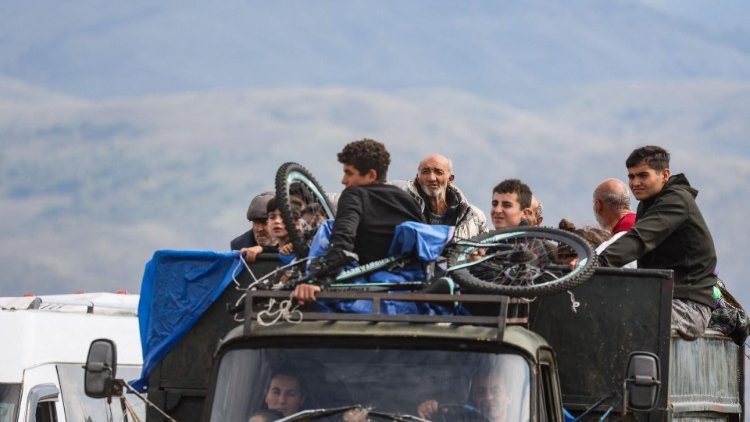
Armenian refugees flee Nagorno-Karabakh following Azerbaijan's 2023 offensiveArmenian refugees flee Nagorno-Karabakh following Azerbaijan's 2023 offensive  (AFP or licensors)

Pope Leo hails Armenia-Azerbaijan peace deal

At the Sunday Angelus, the Pope makes a heartfelt appeal to international decision-makers to take responsibility for seeking solutions to conflicts. He expresses satisfaction over the new peace deal between Armenia and Azerbaijan, but also deep sorrow for the violence that continues to devastate Haiti.

By Francesca Sabatinelli

War must be rejected as a “means of resolving conflicts.” That was the urgent appeal issued by Pope Leo XIV to the international community and its leaders, delivered following the Sunday Angelus prayer. The Pope called on leaders to take responsibility and work actively toward peace, a goal he urged the faithful never to stop praying for.

“Let us continue to pray for an end to all wars,” the Pope said. The 80th anniversary of the bombings of Hiroshima and Nagasaki, he noted, has stirred a global awakening to the need to firmly reject war as a solution to conflict. “Those in positions of power must never lose sight of the consequences their decisions have on people’s lives,” he said. “They must not ignore the needs of the most vulnerable or the universal longing for peace.”

Armenia and Azerbaijan: A Path to Peace

Pope Leo then pointed to the agreement signed on August 8th by Armenian Prime Minister Nikol Pashinyan and Azerbaijani President Ilham Aliyev as a sign of hope. Their joint declaration, he said, is a significant step forward and one that “we all hope will contribute to a stable and lasting peace in the South Caucasus.”


Grief for Haiti

The Pope also turned his attention to the ongoing crisis in Haiti, expressing deep sorrow over the suffering of a population “increasingly overwhelmed by despair.” He condemned the country’s widespread “violence of all kinds, human trafficking, forced displacement, and kidnappings.”

“I make a heartfelt appeal to all responsible parties to release the hostages immediately,” the Pope said. He also called on the international community to provide tangible support to help create the social and institutional conditions “that will allow the Haitian people to live in peace.”

Wednesday, October 5, 2016

Wednesday Papal General Audience

English Summary of Pope’s General Audience
This visit to Georgia and Azerbaijan complemented my visit to Armenia in June, and fulfilled my desire to visit all three nations of the Caucasus to confirm the Catholic community and to encourage all the people in their journey toward peace and fraternity.’
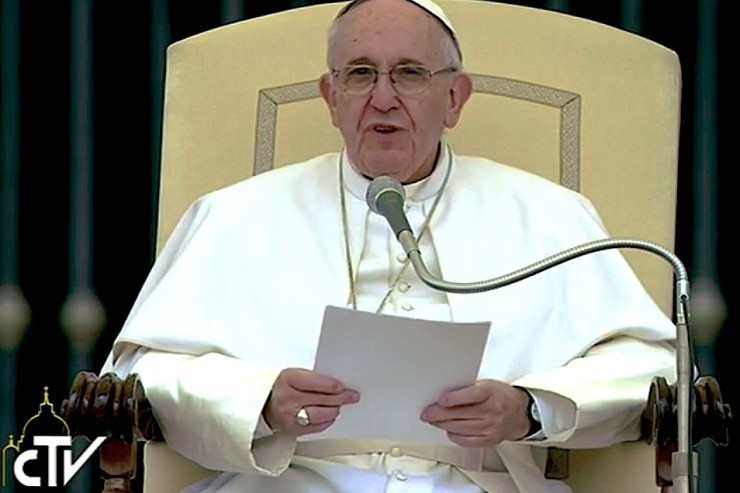
Pope at Audience CTV
CTV Pope - General Audience
Here is the Vatican-provided English-language summary of Pope Francis’ General Audience this morning in St. Peter’s Square:
***
Dear Brothers and Sisters: I thank the Lord for the grace of my recent visit to Georgia and Azerbaijan, and I renew my gratitude to the civil and religious authorities of both countries, in particular to the Patriarch of All Georgia, Ilia II, and to the Sheikh of the Muslims of the Caucasus.
This visit complemented my visit to Armenia in June, and fulfilled my desire to visit all three nations of the Caucasus to confirm the Catholic community and to encourage all the people in their journey toward peace and fraternity. Though Georgia and Azerbaijan enjoy ancient historical, cultural and religious roots, they have only just celebrated twenty-five years of independence, and are experiencing great challenges. The Catholic Church is called to be close to them, especially through works of charity and promoting the good of the human person, in communion with the other Churches and Christian communities, and in dialogue with other religious communities. In Georgia, our cooperation is naturally with our Orthodox brothers and sisters, and so Patriarch Ilia’s presence at the airport upon my arrival was a very important sign, as well as our visit to the Patriarchal Cathedral and our meeting which was very moving. Our unity is seen in the blood of so many Christian martyrs of different Christian confessions, especially the Assyrian-Chaldean, with whom we prayed for peace in Syria, Iraq and the whole Middle East. In Azerbaijan, a primarily Muslim country, I was able to participate in an interreligious meeting and to celebrate Mass with the small Catholic community. Our communion of faith inspires us to deepen our encounter and dialogue with all who believe in God, so that together we can build a more just and fraternal world. May God bless Armenia, Georgia and Azerbaijan, and guide his holy people in those countries.
Speaker: I greet the English-speaking pilgrims and visitors taking part in today’s Audience, particularly those from England, Scotland, Ireland, Norway, Australia, China, Indonesia, Malaysia, the Philippines and the United States of America. Upon all of you, I invoke the mercy and peace of the Lord, praying that you may share these gifts with all whom you will encounter. May God bless you!
[Original text: English] [Vatican-provided text]

Monday, October 3, 2016

Using imagery to preach his message

In Caucasus, Pope Uses Visual Imagery to Emphasize Key Messages
What world will we offer future generations, Pope asks interreligious meeting in Azerbaijan
SS. Papa Francesco - Incontro Interreligioso Sceicco e Comunita Religiose-Azeirbagian

02-10-2016


@Servizio Fotografico - L'Osservatore Romano
L'Osservatore Romano
Pope Francis showed his poetic side during his trip this weekend to the Caucasus, using visual imagery to drive home two of the main reasons for his trip: a pull for Christian unity, and an appeal to live in peace and understanding.
Catholics in both Georgia and Azerbaijan are a very small minority.
Georgia is primarily Georgian Orthodox (84% of the population) and Catholics there make up less than 1% of the population.
Azerbaijan is mostly Muslim (97% of the population, primarily Shiite) and Catholics there only number in the few hundreds.
Christian unity was a main theme during the Holy Father’s time in Georgia, and the trip spotlighted the difficulties on the path to Orthodox-Catholic unity, coming just days after the Georgian Orthodox Church was in disagreement with the accord reached by the Catholic-Orthodox Commission for theological dialogue, regarding primacy and synodality in the first millennium.
The Patriarch’s welcome of the Pope was warm and the two appeared together on various occasions during the Holy Father’s brief stay in Georgia, but there was a notable absence of a Georgian Orthodox delegation at the Pope’s public Mass.
The Holy Father’s last stop in Georgia was a visit Saturday night to the Patriarchal Cathedral, where, according to tradition, Our Lord’s tunic was buried along with one of Georgia’s most revered saints, St. Sidonia. Drawing on the Church Fathers, the Pope used the imagery of this tunic — which as the Gospel tells us was without seam, woven from top to bottom — to exhort his listeners to work and pray for Christian unity.
Read story here: https://zenit.org/articles/pope-refers-to-christs-tunic-in-plea-for-christian-unity/

Light shining through

Today, in the Muslim country, the Pope again called on his poetic side, offering a visual image to promote a peace rapport between society and religions.
“I refer to the precious artistic windows that have been here for centuries, crafted simply out of wood and tinted glass (Shebeke),” he explained.
https://en.wikipedia.org/wiki/Shabaka_(window)#/media/File:Shaki_khan_palace_1.jpg
The Pope noted how when these windows are made with traditional methods, “there is a peculiar characteristic: neither glue nor nails are used, but the wood and the glass are set into each other through time-consuming and meticulous effort. Thus, the wood supports the glass and the glass lets in the light.”
“In the same way,” he said, “it is the task of every civil society to support religion, which allows a light to shine through, indispensable for living. In order for this to happen, an effective and authentic freedom must be guaranteed. Artificial kinds of ‘glue’ cannot be used, which bind people to believe, imposing on them a determined belief system and depriving them of the freedom to choose; nor is there a need for the external ‘nails’ of worldly concerns, of the yearning for power and money.”
God cannot be used, the Pope said. “He cannot be used to justify any form of fundamentalism, imperialism or colonialism. From this highly symbolic place, a heartfelt cry rises up once again: no more violence in the name of God! May his most holy Name be adored, not profaned or bartered as a commodity through forms of hatred and human opposition.”

Better world

The Holy Father said that prayer and dialogue are “profoundly interconnected: they flow from an openness of heart and extend to the good of others, thus enriching and reinforcing each other.”
And he said that a true peace is “founded on mutual respect, encounter and sharing, on the will to go beyond prejudices and past wrongs, on the rejection of double standards and self-interests; a lasting peace, animated by the courage to overcome barriers, to eradicate poverty and injustice, to denounce and put an end to the proliferation of weapons and immoral profiteering on the backs of others.”
“The blood of far too many people cries out to God from the earth, our common home,” the Pope stated, adding that we must build together a future of peace.
“Now is not the time for violent or abrupt solutions, but rather an urgent moment to engage in patient processes of reconciliation,”  he said. “The real question of our time is not how to advance our own causes, but what proposals for life are we offering to future generations; how to leave them a better world than the one we have received. God, and history itself, will ask us if we have spent ourselves pursuing peace; the younger generations, who dream of a different future, pointedly direct this question to us.”

On ZENIT’s web page:
Full text: https://zenit.org/articles/popes-address-at-interreligious-meeting-in-azerbaijan/

Sunday, October 2, 2016

Sunday Angelus delivered from Azerbaijan

Pope’s Angelus in Azerbaijan
‘Someone may think that the Pope wastes so much time: travelling so many kilometres to visit a small community of 700 people, in a country of 2 million … But the Pope, in this, imitates the Holy Spirit: he also descended from heaven to a small community in that closed periphery of the Cenacle.’
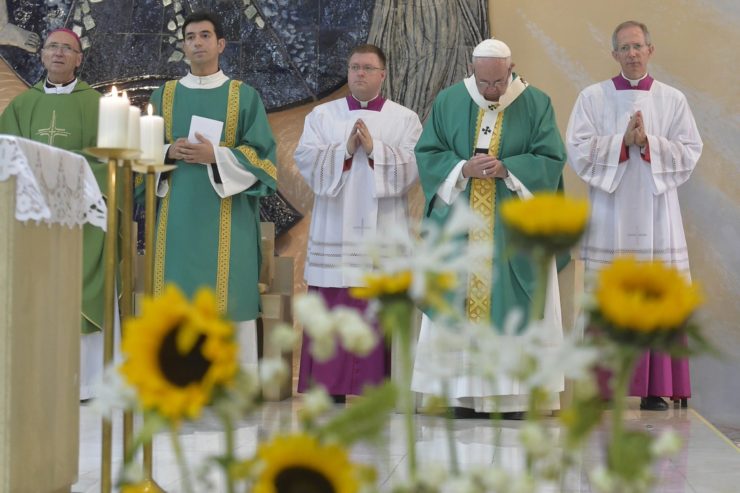
SS. Papa Francesco - Santa Messa chiesa Immacolata-Viaggio Apostolico in Azeirbagian

02-10-2016


@Servizio Fotografico - L'Osservatore Romano
At the end of the Mass in the Church of Baku, in Azerbaijan, at the Salesian Centre and before the final blessing, the Holy Father Francis led the recitation of the midday Angelus. Below is the text of the words pronounced by the Pope:
***
Dear Brothers and Sisters,
In this Eucharistic celebration I have given thanks to God with you, and also for you: here the faith, after the years of persecution, has accomplished wonders. I wish to recall the many courageous Christians who trusted in the Lord and were faithful in the face of adversity. As did Saint John Paul II, I offer you the words of the Apostle Peter: “Honour to you who believe” (1 Pt 2:7; Homily, Baku, 23 May 2002).
Our thoughts turn now to the Virgin Mary, who is venerated in this country not only by Christians. To her we address the words of the Angel Gabriel who brought her the good news of salvation, prepared for humanity by God.
In the light that radiates from the maternal gaze of Mary, I offer a warm greeting to you, dear faithful of Azerbaijan, as I encourage each of you to witness joyfully to faith, hope and love, united among yourselves and with your Pastors. I greet and thank in a particular way the Salesian family, who take such good care of you and who promote various good works, and the Missionary Sisters of Charity: continue with enthusiasm your work in the service of all!
Let us entrust these intentions to the intercession of the Most Holy Mother of God and let us invoke her protection upon your families, the sick and the elderly, and upon all those who suffer in body or spirit.
[Angelus]
[Blessing]
Someone may think that the Pope wastes so much time: travelling so many kilometres to visit a small community of 700 people, in a country of 2 million. Yet it is a community which is not uniform, because among you there are several languages spoken: Azeri, Italian, Spanish… many languages. It is a community on the peripheries. But the Pope, in this, imitates the Holy Spirit: he also descended from heaven to a small community in that closed periphery of the Cenacle. And to that community, which was fearful, felt poor and perhaps persecuted or rejected, the Holy Spirit imparts fortitude, power, and bold eloquence to go forth and proclaim the name of Jesus! And the doors of that community in Jerusalem, which were closed for fear or shame, were thrust wide open releasing the power of the Spirit. The Pope wastes time as the Holy Spirit did in those days!
Only two things are necessary: Mary was among that community. Don’t forget our Mother! And in that community resided charity, a fraternal love, which the Holy Spirit poured into their hearts. Have courage! Go ahead! Without fear, go ahead!
[Original text: Italian] [Vatican-provided text]

Pope Francis in Azerbaijan; celebrates Sunday Mass

Pope’s Homily at Mass in Azerbaijan
‘Where there is no service, life is useless.’
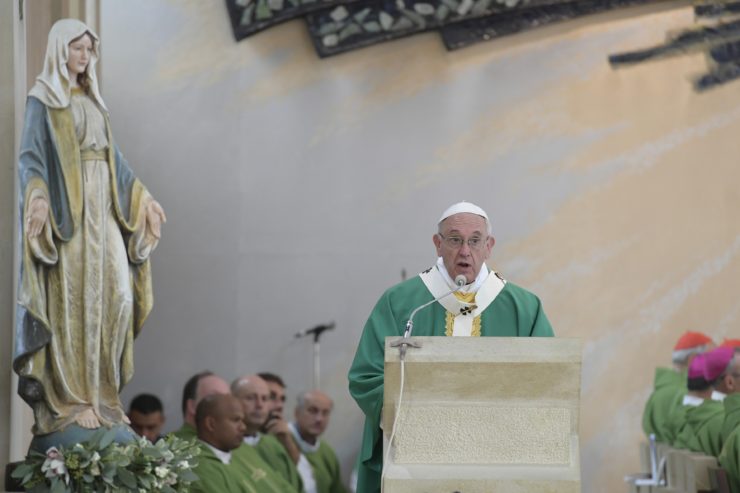
SS. Papa Francesco - Santa Messa chiesa Immacolata-Viaggio Apostolico in Azeirbagian

02-10-2016


@Servizio Fotografico - L'Osservatore Romano
Pope Francis this morning celebrated Mass in Azerbaijan.  Here is a Vatican translation of his homily:
__
The word of God presents us today with two essential aspects of the Christian life: faith and service. With regard to faith, two specific requests are made to the Lord.
The first is made by the Prophet Habakkuk, who implores God to intervene in order to re-establish the justice and peace which men have shattered by violence, quarrels and disputes: “O Lord, how long”, he says, “shall I cry for help, and you will not hear?” (Hab 1:2). God, in response, does not intervene directly, does not resolve the situation in an abrupt way, does not make himself present by a show of force. Rather, he invites patient waiting, without ever losing hope; above all, he emphasizes the importance of faith, since it is by faith that man will live (cf. Hab 2:4). God treats us in the same way: he does not indulge our desire to immediately and repeatedly change the world and other people. Instead, he intends primarily to heal the heart, my heart, your heart, and the heart of each person; God changes the world by transforming our hearts, and this he cannot do without us. The Lord wants us to open the door of our hearts, in order to enter into our lives. And this act of opening to him, this trust in him is precisely “the victory that overcomes the world, our faith” (1 Jn 5:4). For when God finds an open and trusting heart, then he can work wonders there.
But to have faith, a lively faith, is not easy; and so we pass to the second request, which the Apostles bring to the Lord in the Gospel: “Increase our faith!” (Lk 17:6). It is a good question, a prayer which we too can direct to the Lord each day. But the divine response is surprising and here too turns the question around: “If you had faith…”. It is the Lord who asks us to have faith. Because faith, which is always God’s gift and always to be asked for, must be nurtured by us. It is no magic power which comes down from heaven, it is not a “talent” which is given once and for all, not a special force for solving life’s problems. A faith useful for satisfying our needs would be a selfish one, centred entirely on ourselves. Faith must not be confused with well-being or feeling well, with having consolation in our heart that gives us inner peace. Faith is the golden thread which binds us to the Lord, the pure joy of being with him, united to him; it is a gift that lasts our whole life, but bears fruit only if we play our part.
And what is our part? Jesus helps us understand that it consists of service. In the Gospel, immediately following his words on the power of faith, Jesus speaks of service. Faith and service cannot be separated; on the contrary, they are intimately linked, interwoven with each other. In order to explain this, I would like to take an image very familiar to you, that of a beautiful carpet. Your carpets are true works of art and have an ancient heritage. The Christian life that each of you has, also comes from afar. It is a gift we received in the Church which comes from the heart of God our Father, who wishes to make each of us a masterpiece of creation and of history. Every carpet, and you know this well, must be made according to a weft and a warp; only with this form can the carpet be harmoniously woven. So too in the Christian life: every day it must be woven patiently, intertwining a precise weft and warp: the weft of faith and the warp of service. When faith is interwoven with service, the heart remains open and youthful, and it expands in the process of doing good. Thus faith, as Jesus tells us in the Gospel, becomes powerful and accomplishes marvellous deeds. If faith follows this path, it matures and grows in strength, but only when it is joined to service.
But what is service? We might think that it consists only in being faithful to our duties or carrying out some good action. Yet for Jesus it is much more. In today’s Gospel, and in very firm and radical terms, he asks us for complete availability, a life offered in complete openness, free of calculation and gain. Why is Jesus so exacting? Because he loved us in this way, making himself our servant “to the end” (Jn 13:1), coming “to serve, and to give his life” (Mk 10:45). And this takes place again every time we celebrate the Eucharist: the Lord comes among us, and as much as we intend to serve him and love him, it is always he who precedes us, serving us and loving us more than we can imagine or deserve. He gives us his very own life. He invites us to imitate him, saying: “If anyone serves me, he must follow me” (Jn 12:26).
And so, we are not called to serve merely in order to receive a reward, but rather to imitate God, who made himself a servant for our love. Nor are we called to serve only now and again, but to live in serving. Service is thus a way of life; indeed it recapitulates the entire Christian way of life: serving God in adoration and prayer; being open and available; loving our neighbour with practical deeds; passionately working for the common good.
For Christians too, there are no shortage of temptations which lead us away from the path of service and end up by rendering life useless. Where there is no service, life is useless. Here too we can identify two forms. One is that of allowing our hearts to grow lukewarm. A lukewarm heart becomes self-absorbed in lazy living and it stifles the fire of love. The lukewarm person lives to satisfy his or her own convenience, which is never enough, and in that way is never satisfied; gradually such a Christian ends up being content with a mediocre life. The lukewarm person allocates to God and others a “percentage” of their time and their own heart, never spending too much, but rather always trying to economize. And so, he or she can lose the zest for life: rather like a cup of truly fine tea, which is unbearable to taste when it gets cold. I am sure, however, that when you look to the example of those who have gone before you in faith, you will not let your hearts become lukewarm. The whole Church, in showing you special affection, looks to you and offers you encouragement: you are a little flock that is so precious in God’s eyes.
There is a second temptation, which we can fall into not so much because we are passive, but because we are “overactive”: the one of thinking like masters, of giving oneself only in order to gain something or become someone. In such cases service becomes a means and not an end, because the end has become prestige; and then comes power, the desire to be great. “It shall not be so among you”, Jesus reminds all of us, “but whoever would be great among you must be your servant” (Mt 20:26). This is the way the Church grows and is adorned. Returning to our image of the carpet, and applying it to your fine community: each of you is like a magnificent silk thread. Only if you are woven together, however, will the different threads form a beautiful composition; on their own, they are of no use. Stay united always, living humbly in charity and joy; the Lord, who creates harmony from differences, will protect you.
May we be aided by the intercession of the Immaculate Virgin Mary and by the saints, especially Saint Teresa of Calcutta, the fruits of whose faith and service are in your midst. Let us recall some of her noble words to summarize today’s message: “The fruit of faith is love. The fruit of love is service. The fruit of service is peace” (A Simple Path, Introduction).
[01527-EN.02] [Original text: Italian]