Showing posts with label Archdiocese of Oklahoma City. Show all posts

Tuesday, January 13, 2026

President of USCCB, Archbishop Paul Coakley, meets with President Donald Trump at the White House


President Trump Meets With Archbishop Coakley

The meeting was closed to the press, but White House spokesperson Karoline Leavitt told EWTN News correspondent Owen Jensen she would ask the president about providing a readout of the meeting.


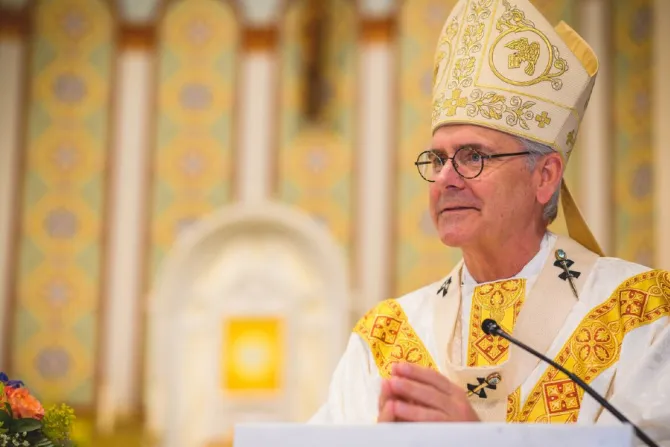
Archbishop Paul Coakley of Oklahoma City, president of the United States Conference of Catholic bishops, meets with President Donald Trump on Jan. 12, 2026. (Photo: Archdiocese of Oklahoma City / Archdiocese of Oklahoma City)

Archbishop Paul Coakley and President Donald Trump met on Jan. 12 to discuss areas of “mutual concern,” which likely included topics related to immigration enforcement and Venezuela’s sovereignty. 

The archbishop of Oklahoma City, Coakley, who was elected president of the United States Conference of Catholic Bishops (USCCB) in November 2025, visited with Trump at the White House on Monday.

Chieko Noguchi, USCCB spokesperson, said in a statement after the meeting: “Archbishop Coakley had the opportunity for introductory meetings with President Trump, Vice President [JD] Vance, and other administration officials, in which they discussed areas of mutual concern, as well as areas for further dialogue. Archbishop Coakley is grateful for the engagement and looks forward to ongoing discussions.”

The meeting was closed to the press, but White House spokesperson Karoline Leavitt told EWTN News correspondent Owen Jensen she would ask the president about providing a readout of the meeting. 

Pope Leo XIV has said immigrants must be treated with dignity and encouraged all people in the United States to heed the U.S. bishops’ message on immigration. 

Archbishop Coakley, appearing on CBS News’ Face the Nation on Dec. 21, 2025,    predicted immigration would be a discussion topic with Trump and said: “I think we have opportunities to work together. We have opportunities to speak frankly with one another.”

After U.S. military action to capture Venezuela’s president, the pope on Jan. 4 called for full respect for Venezuela’s national sovereignty and for the human and civil rights of its people. 

Earlier in the day on Jan. 12, Pope Leo XIV met with Venezuelan opposition leader María Corina Machado at the Vatican.

Tuesday, June 6, 2023

Oklahoma approves taxpayer-funded Catholic charter school; the 1st of it's kind in the U.S.


Oklahoma approves first publicly funded Catholic school in US

By 


June 5 (Reuters) - An Oklahoma school board on Monday approved the Catholic Church's application to create the first taxpayer-funded religious charter school in the U.S.

Opponents of the school have vowed a legal challenge which promises to be a long court battle testing the U.S. Constitution's concept of separation of church and state.

Oklahoma's Statewide Virtual Charter School Board approved the plan to create the St. Isidore of Seville Catholic Virtual School in a 3-2 vote.

The board in April had rejected the first plan submitted for the school, saying they needed more details, including on the special education department.

Roman Catholic organizers proposed creating St. Isidore to offer an online education for kindergarten through high school initially for 500 students and eventually 1,500.

Board members have emphasized repeatedly that they were not voting on the constitutionality of such a school, but only whether the application met the board's standards.

Charter schools are publicly funded, independently run schools established under the terms of a charter with a local or national authority.

Any legal fight could test the scope of the U.S. Constitution's First Amendment "establishment clause," which restricts government officials from endorsing any particular religion, or promoting religion over non-religion.

Church officials have said they hope the case will reach the U.S. Supreme Court, where a 6-3 conservative majority has taken an expansive view of religious rights, including in two rulings since 2020 concerning schools in Maine and Montana.

The school would cost Oklahoma taxpayers up to $25.7 million over its first five years of operation, its organizers said.

The idea came from the Catholic Archdiocese of Oklahoma City. The law school at the University of Notre Dame, a Catholic institution in Indiana, helped with the application.

Thursday, May 4, 2023

Archbishop of Oklahoma City hits home run in his call to respond to gender dysphoria with empathy but without compromising God's reality


Archbishop Coakley: Respond with love to those with gender dysphoria without compromising truth


Archbishop Paul Coakley of Oklahoma City in an interview this week called for responding to those experiencing gender dysphoria with empathy but without compromising on the reality of God’s creation of humanity as male and female. 

“We can show love and compassion and concern as a parent, as a pastor, as a friend, without jettisoning our commitment to the truth,” Coakley told Montse Alvarado of EWTN News In Depth. 

“I think we can show affection and tenderness and compassion without succumbing to the pressure and that parents often feel subjected to by a young person, a child whom they love very much, who is obviously suffering.”

Coakley released a pastoral letter April 30 on the topic titled “On the Unity of the Body and Soul: Accompanying Those Experiencing Gender Dysphoria.” Coakley said the letter, which was in the works for several months, came in response to questions from some Catholic school principals in his diocese who have faced questions about how to respond to, for example, children in Catholic schools wishing to identify as a different gender.

In his interview with EWTN News In Depth, Coakley said his document is “seeking a broader audience [of] parents, teachers, pastors, anyone who’s accompanying, working with young people.”

In the letter, Coakley spoke about the Church’s teaching on sex and gender, which is that God created humans male and female in his image, as composites of body and soul. 

In a section of the letter addressed directly to those experiencing gender dysphoria, Coakley said it is vital not to dismiss the pain experienced by people who feel they are the wrong gender and affirmed that “each person who identifies as transgendered is loved by God and is a person Jesus Christ died to redeem … As a Church, we want to walk alongside you as you struggle with gender dysphoria.”

“We must avoid the extremes: to ignore the pain of the person and dogmatically assert that biological sex is the end of the conversation or to jettison the truth of the body in the false hope of relieving pain,” Coakley wrote in his letter.

“A Catholic response must both affirm God-given sex and recognize the struggle of the person in front of us. It requires listening with empathy as well as extending the invitation to receive God’s gift of the sexed body.”

Addressing parents who are struggling to respond to a child experiencing gender dysphoria, Coakley advised them to be open and listen to their child’s struggles but also to seek counseling and not to adopt pronouns different from the child’s biological sex. 

Coakley encouraged a compassionate approach that does not discount what the child is feeling, saying Catholics must “insist on the doctrinal integrity of our position, but at the same time recognizing the importance of being understanding and listening to a child and where they’re hurting.”

“Don’t shy away from the opportunity to engage [your] sons and daughters on these topics … I think nothing can be lost by taking time to listen and to try to understand,” he said. 

Though he presents some scientific evidence to support the idea that children should not seek medical interventions to change their gender, Coakley said the letter was more focused on the Church’s teaching and how to stay true to it in a loving manner. 

“I think we can benefit by some clarity that science can give about the meaning of sex, biological sex, and where gender comes from and things of that sort. But our focus is really on the doctrinal foundations for a solid pastoral approach that is willing to speak the truth in love, and we can’t separate the two,” he said. 

Speaking on EWTN News In Depth, Coakley advised parents to be prepared to talk to their children about these issues, taking care to discern the timing of when a child might be ready to discuss them. 

“Parents need to be in communication with their sons and daughters, to be engaging them regularly and making time for not just this kind of conversation, but about the things that matter, things that are important. Any conversation, I think I say in here about gender should be just a small subset of conversations that need to be taking place in the family all the time.”

He also said he hopes other bishops will consider releasing similar guidance. 

“I’ve already heard from several bishops in the last 24 hours who have thanked me for this, and I wouldn’t be surprised if some of them will find their own way to disseminate what I’ve tried to articulate in their own dioceses and in their own local settings,” he noted. 

“I think our priests and our parishes need the reassurance that this kind of guidance from a bishop can offer because they’re the ones that are on the front lines in their parishes dealing with this in a much more regular way than I am dealing with it.”

Friday, September 22, 2017

Tomorrow is the beatification of this Oklahoma Priest; Blessed Stanley Rother, pray for us

The Oklahoma priest who could become the first American-born man to be canonized a 


American-born priest Stanley Rother conducting a baptism in Guatemala. Father Rother was murdered in his rectory there in 1981 and is now being considered for sainthood. (Photo courtesy of Archdiocese of Oklahoma City)
A priest from Okarche, Okla., a very small town perhaps most famous for the succulent fried chicken at Eischen’s Bar, could help to revitalize the U.S. Catholic Church as the first man and first priest born in this country to be canonized a saint.
Perhaps an unlikely candidate to spur such a momentous movement, Father Stanley Rother, a humble priest from the Archdiocese of Oklahoma City who was murdered in Guatemala in 1981, will be one step closer to that status on September 23 during his beatification, a Catholic Church blessing process that recognizes a dead individual’s entrance into heaven and lets devotees pray to that person for protection.
“It’s a source of great joy and encouragement for the church in Oklahoma and, indeed, the Catholic church in the United States to have a church priest who came from very ordinary beginnings achieve something truly extraordinary,” said Paul S. Coakley, archbishop of the Archdiocese of Oklahoma City. “He was not an extraordinary man. He was an ordinary man. But he was extraordinarily faithful to what he perceived to be God’s will for his life and God’s plan. He demonstrated such sacrificial love and selfless service. It lifts us all up and helps us aspire to be our best selves.”

With the acknowledgement that Rother was killed “in odium fidei” (in hatred of the faith), Pope Francis declared him a martyr on December 1, 2016, and paved the way for this next step toward sainthood to take place at the Cox Convention Center in Oklahoma City. During the beatification Mass, an apostolic letter will declare Rother to have earned the honorific “blessed,” and church leaders will acknowledge a feast day dedicated to him on the liturgical calendar in Oklahoma. A contingent from Guatemala will join the hundreds of priests and thousands of faithful in attendance, along with Cardinal Angelo Amato, the prefect in charge of the Congregation for the Causes of Saints who will be in Oklahoma City as Pope Francis’s delegate.
The Vatican’s canonization process is particularly abstruse, but, in this instance, Rother’s potential elevation may be just the strategic boost needed in the American Catholic community, whose numbers have been plummeting – down about 10 percent since the 1990s amid church sex scandals and the rise of secularism.
Of course, a martyr must have a posthumous miracle attributed to him to reach sainthood. A sick person who asks for Rother’s intercession and recovers from a seemingly fatal disease in a manner that can’t be attributed to medical science, natural causes, or another saint or servant of God would constitute such a miracle. Although no concrete miracle has yet to be floated for Rother, devotees will be invited to submit their examples to the local diocese where an alleged miracle has occurred to be considered in a rigorously vetted process that includes scientific and theological commissions. If the miracle is approved at the diocesan level, the miracle goes through a similar process at the Congregation for the Causes of Saints and then all the way up to the pope for approval. Though nothing is guaranteed, Rother does have one major advantage working in his favor.
Focus on Latin America
Given that Pope Francis is the first pope from Latin America, there has been more focus on priests who historically sacrificed themselves there while combating anti-religious regimes. By contrast, John Paul II canonized saints from around the world, with a special focus on Asian martyrs, but largely neglected those who served in Latin America.
“It is true that Pope Francis may be more familiar with the causes from his region, as would be normal, which could make him more interested when they are presented to him,” said Greg Burke, director of the Vatican Press Office.
And Rother’s work in Guatemala was particularly valiant considering the dangerous circumstances. After Rother was ordained a priest in 1963 in Oklahoma, he moved to Guatemala in 1968 to serve the Tz’utujil community in Santiago Atitlán from 1968 until 1981, when he was murdered at 46 years old in an attack attributed to right-wing extremists from the country’s paramilitary units.

As tensions flared in Guatemala during the country’s civil war and his indigenous congregation supported liberal rebels, Rother found himself placed on a death list. Though he briefly returned to Oklahoma in 1981, he operated with an unwavering mindset amid the danger: “A shepherd cannot run from his flock.”
American-born priest Stanley Rother at a festival in Guatemala. Rother was murdered in his rectory there in 1981. (Photo courtesy of Archdiocese of Oklahoma City, OK)
After midnight on June 28, 1981, three masked gunmen broke into the rectory and shot him twice – once in the jaw and another time in the left temple. His corpse was flown to Oklahoma to be buried in Okarche’s Holy Trinity Cemetery, and his heart was removed and buried under the altar of his Tz’utujil church. In preparation for his beatification, the Archdiocese of Oklahoma City reinterred his body at Resurrection Cemetery in Oklahoma City, but his actual heart remains in Latin America where he served.
Pope Francis’s past shortcomings in Latin America may also make him more enthusiastic about Rother’s cause. The pontiff has been criticized for not standing up to the military junta in Argentina during the 1970s when he was provincial superior of the Society of Jesus there and thus has an added incentive to recognize priests who faced religious persecution in Latin America. As such, his support for Rother’s canonization would be “poetic justice,” said Kathleen Sprows Cummings, director of Notre Dame’s Cushwa Center for the Study of American Catholicism and the author of “Citizen Saints: Catholics and Canonization in America,” forthcoming from the University of North Carolina Press.
By church standards, Rother is proceeding swiftly toward sainthood. Since 1588, when the Catholic Church created the Congregation for the Causes of Saints, it has taken an average saint 181 years from the time of death to be canonized. Many canonizations occur centuries after a person has died: Pope Francis recently canonized 813 saints – the so-called Martyrs of Otranto – whom Ottoman soldiers murdered in 1480 for refusing to convert to Islam. Elizabeth Ann Bayley Seton, who died in 1821 and who in 1975 became the first American-born woman to be canonized, reached that milestone more than 150 years after her death. Rother, by contrast, has been dead for fewer than 40 years.

Support for Rother has helped speed his movement through the many rungs in the process. The Sololá-Chimaltenango diocese in Guatemala, where Rother served, heartily offered a forum transfer for his sainthood cause to the Archdiocese of Oklahoma City on September 3,  2007, and in 2014,  the Congregation for the Causes of Saints received a formal Positio dossier, a collection of documents to detail a candidate for sainthood’s heroic virtues and deem the person “venerable.” The theologians on the Congregation approved the cause on June 23, 2015. Pope Francis’s declaration of martyrdom the next year certainly didn’t hurt. Now after the beatification, those supporting Rother’s cause will look to solicit miracles to put before local dioceses and then before the Congregation for the Causes of Saints.
Catholic-American patriotism
Rother’s candidacy for sainthood would be a boon for U.S. Catholicism. While there are other male saints identified as Americans given that they served in the U.S., they were all transplants born elsewhere: St. John Neumann was born in Bohemia (in what is now the Czech Republic), St. Damien de Veuster of Molokai was born in Belgium, St. Junipero Serra was born in Spain, Isaac Jogues was born in France.
This is not at all a trivial point, as many in the heartland, where Catholicism has waned in part due to church abuse cases, want to identify with a homegrown priestly role model and are looking to Rother to galvanize enthusiasm for the church. Given that Catholicism in the United States has recently come under fire from the Vatican for being too closely allied with dangerous right-wing politics, Pope Francis’s support for Rother’s cause would also show a modicum of support for the American Catholic church. Furthermore, given the fallen status of the American priesthood, this is also an opportunity to try to restore the good name to the Catholic clergy in the States.
“Admittedly for the Catholic Church in the United States and the history of the past years of the clergy sexual abuse scandal and things of that sort, I think it’s a great source of encouragement as well,” Coakley said. “Here’s a priest that we can look to as a genuine hero who became what all of us as priests aspire to be. So this is a good story to be told and a good source of encouragement for priests and for young people.”
The Bishop of Little Rock, Anthony B. Taylor, who was formerly a priest in the Archdiocese of Oklahoma City and who met Rother and conducted interviews in Guatemala on behalf of his canonization cause, agrees.
“[Rother] is an especially powerful witness for our priests, especially in a time when we very much need models of priestly courage and holiness,” Taylor said. “And he was such an ordinary man, a plain old American like you and me. . . . But he stuck with his flock in their most difficult times, and today’s priests are called to do the same thing.”
Experts look to these canonizations as having the potential to boost morale among church congregants, as was hoped for when Seton was canonized in 1975 after Vatican II when the church was in crisis, Cummings said.

Monday, March 13, 2017

First US-born martyr to be beatified

Fr. Stanley Rother, first US-born martyr, to be beatified in September


Fr. Rother baptizing. Courtesy of the Archdiocese of Oklahoma City Archives.

    Father Stanley Rother, the Oklahoma-born martyr who served as a priest in Guatemala, will be beatified in Oklahoma City on Sept. 23, 2017.

    The beatification announcement was made by the Archdiocese of Oklahoma City on March 13. Fr. Rother was a priest of the archdiocese. The beautification Mass will take place at 10 a.m. at the Cox Convention Center.

    In December 2016, Pope Francis officially acknowledged Fr. Rother’s martyrdom, making him the first recognized martyr to have been born in the United States.

    Fr. Rother was from the unassuming town of Okarche, Okla., where the parish, school and farm were the pillars of community life. He went to the same school his whole life and lived with his family until he left for seminary.

    Surrounded by good priests and a vibrant parish life, Stanley felt God calling him to the priesthood from a young age. But despite a strong calling, Stanley would struggle in the seminary, failing several classes and even out of one seminary before graduating from Mount St. Mary's seminary in Maryland.

    Hearing of Stanely’s struggles, Sister Clarissa Tenbrick, his 5th grade teacher, wrote him to offer encouragement, reminding him that the patron of all priests, St. John Vianney, also struggled in seminary.

    “Both of them were simple men who knew they had a call to the priesthood and then had somebody empower them so that they could complete their studies and be priests,” Maria Scaperlanda, author of The Shepherd Who Didn't Run, a biography of the martyr, told CNA in an interview last year.

    “And they brought a goodness, simplicity and generous heart with them in (everything) they did.”

    When Stanley was still in seminary, St. John XXIII asked the Churches of North America to send assistance and establish missions in Central America. Soon after, the dioceses of Oklahoma City and Tulsa established a mission in Santiago Atitlan in Guatemala, a poor rural community of mostly indigenous people.

    A few years after he was ordained, Fr. Stanley accepted an invitation to join the mission team, where he would spend the next 13 years of his life.

    When he arrived to the mission, the Tz'utujil Mayan Indians in the village had no native equivalent for Stanley, so they took to calling him Padre Francisco, after his baptismal name of Francis.

    The work ethic Fr. Stanley learned on his family’s farm would serve him well in this new place. As a mission priest, he was called on not just to say Mass, but to fix the broken truck or work the fields. He built a farmers' co-op, a school, a hospital, and the first Catholic radio station, which was used for catechesis to the even more remote villages.

    “What I think is tremendous is how God doesn't waste any details,” Scaperlanda said. “That same love for the land and the small town where everybody helps each other, all those things that he learned in Okarche is exactly what he needed when he arrived in Santiago.”

    The beloved Padre Francisco was also known for his kindness, selflessness, joy and attentive presence among his parishioners. Dozens of pictures show giggling children running after Padre Francisco and grabbing his hands, Scaperlanda said.

    “It was Father Stanley’s natural disposition to share the labor with them, to break bread with them, and celebrate life with them, that made the community in Guatemala say of Father Stanley, ‘he was our priest,’” she said.

    Over the years, the violence of the Guatemalan civil war inched closer to the once-peaceful village. Disappearances, killings and danger soon became a part of daily life, but Fr. Stanley remained steadfast and supportive of his people.

    In 1980-1981, the violence escalated to an almost unbearable point. Fr. Stanley was constantly seeing friends and parishioners abducted or killed. In a letter to Oklahoma Catholics during what would be his last Christmas, the priest relayed to the people back home the dangers his mission parish faced daily.

    “The reality is that we are in danger. But we don’t know when or what form the government will use to further repress the Church…. Given the situation, I am not ready to leave here just yet… But if it is my destiny that I should give my life here, then so be it.... I don’t want to desert these people, and that is what will be said, even after all these years. There is still a lot of good that can be done under the circumstances.”

    He ended the letter with what would become his signature quote:

    “The shepherd cannot run at the first sign of danger. Pray for us that we may be a sign of the love of Christ for our people, that our presence among them will fortify them to endure these sufferings in preparation for the coming of the Kingdom.”

    In January 1981, in immediate danger and his name on a death list, Fr. Stanley did return to Oklahoma for a few months. But as Easter approached, he wanted to spend Holy Week with his people in Guatemala.

    “Father Stanley could not abandon his people,” Scaperlanda said. “He made a point of returning to his Guatemala parish in time to celebrate Holy Week with his parishioners that year – and ultimately was killed for living out his Catholic faith.”

    The morning of July 28, 1981, three Ladinos, the non-indigenous men who had been fighting the native people and rural poor of Guatemala since the 1960s, broke into Fr. Rother's rectory. They wished to disappear him, but he refused. Not wanting to endanger the others at the parish mission, he struggled but did not call for help. Fifteen minutes and two gunshots later, Father Stanley was dead and the men fled the mission grounds.

    Scaperlanda, who has worked on Fr. Stanley’s cause for canonization, said the priest is a great witness and example: “He fed the hungry, sheltered the homeless, visited the sick, comforted the afflicted, bore wrongs patiently, buried the dead – all of it.”

    His life is also a great example of ordinary people being called to do extraordinary things for God, she said.

    “(W)hat impacted me the most about Father Stanley’s life was how ordinary it was!” she said.

    “I love how simply Oklahoma City’s Archbishop Paul Coakley states it: ‘We need the witness of holy men and women who remind us that we are all called to holiness – and that holy men and women come from ordinary places like Okarche, Oklahoma,’” she said.

    “Although the details are different, I believe the call is the same – and the challenge is also the same. Like Father Stanley, each of us is called to say ‘yes’ to God with our whole heart. We are all asked to see the Other standing before us as a child of God, to treat them with respect and a generous heart,” she added.

    “We are called to holiness – whether we live in Okarche, Oklahoma, or New York City or Guatemala City.”

    Friday, December 2, 2016

    American Priest cleared for Beatification; declared a martyr by Pope Francis

    Pope recognizes martyrdom of Oklahoma priest killed in Guatemala

    Friday, December 02, 2016 6:30 AM

    Father Stanley Rother (Image from the cover of “The Shepherd Who Didn’t Run” by María Ruiz Scaperlanda)
    Father Stanley Rother (Image from the cover of “The Shepherd Who Didn’t Run” by María Ruiz Scaperlanda)
    Pope Francis has recognized the martyrdom of Father Stanley Rother of the Archdiocese of Oklahoma City, making him the first martyr born in the United States.
    The Vatican made the announcement Dec. 2. The recognition of his martyrdom clears the way for his beatification.
    Father Rother, born March 27, 1935, on his family’s farm near Okarche, Oklahoma, was brutally murdered July 28, 1981, in a Guatemalan village where he ministered to the poor.
    He went to Santiago Atitlan in 1968 on assignment from the Archdiocese of Oklahoma City. He helped the people there build a small hospital, school and its first Catholic radio station. He was beloved by the locals, who called him “Padre Francisco.”
    Many priests and religious in Guatemala became targets during the country’s 1960-1996 civil war as government forces cracked down on leftist rebels supported by the rural poor.
    The bodies of some of Father Rother’s deacons and parishioners were left in front of his church and soon he received numerous death threats over his opposition to the presence of the Guatemalan military in the area.
    Though he returned to Oklahoma for a brief period, he returned to the Guatemalan village to remain with the people he had grown to love during the more than dozen years he lived there.
    He was gunned down at the age 46 in the rectory of his church in Santiago Atitlan. Government officials there put the blame on the Catholic Church for the unrest in the country that they said led to his death. On the day he died, troops also killed 13 townspeople and wounded 24 others in Santiago Atitlan, an isolated village 50 miles west of Guatemala City.
    Many priests and religious lost their lives and thousands of civilians were kidnapped and killed during the years of state-sponsored oppression in the country.
    While his body was returned to Oklahoma, his family gave permission for his heart and some of his blood to be enshrined in the church of the people he loved and served. A memorial plaque marks the place.
    Father Rother was considered a martyr by the Church in Guatemala and his name was included on a list of 78 martyrs for the faith killed during Guatemala’s 36-year-long civil war. The list of names to be considered for canonization was submitted by Guatemala’s bishops to St. John Paul II during a pastoral visit to Guatemala in 1996.
    Because Father Rother was killed in Guatemala, his cause should have been undertaken there. But the local Church lacked the resources for such an effort. The Guatemalan bishops’ conference agreed to a transfer of jurisdiction to the Oklahoma City archdiocese.

    Monday, September 22, 2014

    Homily from yesterday's response to Satanic black mass

    Archbishop Coakley's Homily at Holy Hour in Reparation for Black Mass

    "Satanists, and their master, know who is present. They acknowledge the Real Presence of the Lord Jesus, not to adore him, but only to mock and to scorn in hatred"

    Washington, D.C., (Zenit.org)        
    Here is the homily of the Eucharistic Hour preached Sunday by Oklahoma City's Archbishop Paul Coakley. The Holy Hour and a procession were held in reparation as the city's civic center hosted a black mass that day.


    * * *
    Praised be Jesus Christ!  It is my great privilege to welcome you to St. Francis of Assisi Church and to spend this hour together with the Lord in prayer and adoration.  Thank you for being here.  Your presence is a powerful witness of faith in the midst of what has been a particularly challenging time for our community.  I would like to gratefully acknowledge the participation of our Catholic people from around the Archdiocese but also those of you who have come from near and far to join us today.  I am especially grateful for the presence of my brother bishops (and their support), Archbishop Beltran, Bishop Slattery of Tulsa, Bishop Kemme of Wichita and so many priests, deacons and religious women and men.  It is a special blessing to recognize here so many Christian leaders and believers from other churches and ecclesial communities who have come to join us in prayer as well.
    We gather today in the presence of our Eucharistic Lord who is the source of our unity, imperfect though it might be, and our bond of charity.  We just heard our Lord proclaim:  “I am the living bread that came down from heaven; whoever eats this bread will live forever; and the bread that I will give is my flesh for the life of the world.” For Catholics these words from the sixth chapter of St. John’s Gospel are the very heart of our understanding and appreciation of the Holy Eucharist.  Jesus does not speak metaphorically when he says, “Whoever eats my flesh and drinks my blood has eternal life, and I will raise him on the last day.  For my flesh is true food and my blood is true drink.  Whoever eats my flesh and drinks my blood remains in me and I in him.”  It is truly Jesus whom we encounter and receive in the Holy Eucharist.
    At times, Christians have argued over the theological significance of these words.  Satan, on the other hand, hears these words and trembles.  The Eucharist has been at the heart of the current controversy over the so-called black mass (which to our shame as a city) is being allowed to proceed this evening at the Civic Center Music Hall. That blasphemous and sacrilegious ritual is a mockery of the Catholic Mass that requires for its consummation the corruption and desecration of the Eucharist.  Why?  Because Satanists, and their master, know who is present.  They acknowledge the Real Presence of the Lord Jesus, not to adore him, but only to mock and to scorn in hatred.
    I think many people in our community haven’t understood the persistence of our efforts nor the depth of our outrage over this blasphemy largely because they do not share our faith.  They do not understand, or accept, what we believe to be true.  They do not share our faith in what we Catholics (and many other Christians) acknowledge to be the greatest gift that the Lord has entrusted to the Church:  the gift of his own Body and Blood in the Blessed Sacrament.  The Eucharist, instituted by the Lord at the Last Supper and entrusted to the Apostles is truly the Lord’s abiding Presence among us.  It is really and substantially spiritual food for our pilgrim journey and the pledge of future glory in the Heavenly Banquet.  It is the bread of angels given to men.
    We are not here, however, to protest.  Let us put aside, for the moment, our outrage.  We are here to praise and to adore.  We are here to give thanks for the gift of our faith and the priceless treasure of the Lord’s abiding presence with us in the Sacrament of His Body and Blood.  We are gathered before our Eucharistic Lord to listen to his holy Word and open ourselves to the promptings of his Spirit so that we might become more faithful and authentic witnesses of his love and mercy in the midst of our broken and suffering human family.    We are also here to offer our petitions to the Lord, that he might deliver us from the power of sin and, yes, from all demonic influences.  We are here to offer our prayers in reparation for the blasphemous outrages being committed against our Lord, against his Church and the Eucharist in these days.  Our city has also been the target of these dark forces of hatred that seek not to build up, but only to destroy.  We beg the Lord’s protection through the intercession of his Holy angels and saints.
    We are gathered as witnesses to hope at a time when darkness seems to be gaining ground both here and around the world.  We know that Christ is victorious!  He has conquered Satan.  He has destroyed the reign of sin and the power of death through his holy Cross and glorious Resurrection.  Through faith and Baptism we already share in his victory.  The war has been won, though skirmishes will continue until Christ comes again in glory to reign forever.  In the meantime we have been enlisted to bear the standard of the Cross and our share of the sufferings of Christ for the sake of his Body, the Church.
    We gather here in prayer.  We gather to adore, to praise and to give thanks, to beg the Lord’s mercy on our city, our nation and our world.  We pray for our own continuing conversion that we might be holy and courageous witnesses.
    Our faith is not meant to be (and cannot remain) contained within the walls of this beautiful church.  Our Eucharistic Procession through the neighborhood beyond these walls which will follow in a few minutes is a reminder that we, the Church, are present in the world as light, as salt and as leaven to bring hope and the offer of Christ’s salvation to all we meet.  Let us pray that we might embrace our mandate to live as missionary disciples in the midst of the world so that we might draw all people to Jesus Christ and to safe harbor in his Church.

    Friday, September 19, 2014

    Oklahoma City black mass still a go for this weekend

    Archbishop Coakley Issues Final Appeal Before Black Mass


    With Oklahoma City officials still not willing to cancel, spiritual leader urges continued prayer.

     
    John Burger
    September 18, 2014
    Archdiocese of Oklahoma City
    ADVERTISEMENT
    The archbishop of Oklahoma City is continuing to ask the faithful for prayers as the day draws closer when, in his words, a publicly-performed satanic ritual will invoke “powers of evil and invite them into our community.”

    In a final appeal before Sunday’s performance of the “Black Mass” at the Oklahoma City Civic Center, Archbishop Paul S. Coakley urged Catholics to “demonstrate our faith in the power of the Lord’s grace by praying for the conversion of those who are perpetrating this sacrilege and are bound by the Evil One.”

    He also warned anyone who may be attending the ritual that they are putting their souls in danger.

    For months, the archbishop and others have been appealing to city officials for cancellation of the performance, scheduled for Sunday evening at 7 in an 88-seat theater within the Civic Center. Officials have declined to cancel the reportedly sold-out performance, saying that as a public facility, the Civic Center is required to rent to organizations and individuals as long as they abide by the law and the center’s policies and procedures.

    Jennifer Lindsey-McClintock, a spokeswoman for the Oklahoma City Parks & Recreation Department and the Civic Center Music Hall, told Aleteia today that they are anticipating protests on Sunday and that there will be a police presence to ensure the safety of groups who will be there to protest.

    “As a professional event facility, our staff is trained to handle multiple scenarios, including those of a controversial nature,” she said. “From a basic event standpoint, we are treating this much like most other events that come through our hall, with the inclusion of additional security being provided by the Oklahoma City Police Department.”

    She said that only individuals who hold a ticket to the event will be allowed inside the building and that members of the Oklahoma City Police Department will be inside the theater to monitor the event for any illegal activity.

    In order to comply with local laws, the group had to make a few changes to the ritual they intend to perform. Instead using a naked woman as an altar, she'll be wearing lingerie, and vinegar will substitute for urine.

    “Event staff will check [the vinegar] prior to the event taking place,” McClintock said.

    Nearly 103,000 people have signed an online petition to halt the black mass. Negotiations the archbishop conducted with city officials did not sway them, and the archdiocese, through a law firm, also had to contend with the satanic sect that is performing the black mass, the Dakhma of Angra Mainyu, which claimed to be in possession of a consecrated Host it promised to desecrate during the ritual. Facing a lawsuit, the sect handed over the Host, which it claimed to have obtained from a priest in a foreign country who is a member of the Dakhma.

    The leader of the Dakhma, Adam Daniels, is a registered sex offender, convicted in 2009 of "sexual battery of persons over the age of 16," according to the state's sex offender registry, which notes that he has satanic tattoos "all over body."

    Archbishop Coakley, along with Bishop Edward Slattery in nearby Tulsa, Okla., have urged Catholics to fight the project with prayer and fasting. Both outlined a novena of prayer that the faithful could take part in, individually and in their parishes, leading up to the feast of the Assumption last month.

    “All the parishes have conducted holy hours (or will before Sunday),” said Kelly Fanning, a spokeswoman for Christ the King Catholic Church in Oklahoma City, told Aleteia today. “The holy hour at Christ the King was attended by about 75 people and the holy hour at the cathedral by about 60.”

    Thursday, August 21, 2014

    Good news from Oklahoma City; great job Archbishop Coakley


    OKLAHOMA CITY (Aug. 21, 2014) – Archbishop Coakley announced Thursday that the consecrated Host at the center of a lawsuit filed in Oklahoma County District Court has been returned.
    An attorney representing the head of the satanic group presented the Host to a Catholic priest Thursday afternoon. The lawsuit sought return of the Host following multiple public statements by the head of the local satanic group that they planned to defile and desecrate the consecrated Host during a satanic ‘black mass’ scheduled next month in Oklahoma City.
    With the return of the Host and an accompanying signed statement from the satanic group leader that the group no longer possesses a consecrated Host, nor will they use a consecrated Host in their rituals, the archbishop agreed to dismiss the lawsuit with prejudice.
    “I am relieved that we have been able to secure the return of the sacred Host, and that we have prevented its desecration as part of a planned satanic ritual,” said Archbishop Paul Coakley of the Archdiocese of Oklahoma City. “I remain concerned about the dark powers that this satanic worship invites into our community and the spiritual danger that this poses to all who are involved in it, directly or indirectly.”
    Archbishop Coakley has made repeated requests for the city’s leaders to cancel the satanic ritual in a publicly funded facility.
    “I have raised my concerns … and pointed out how deeply offensive this proposed sacrilegious act is to Christians and especially to the more than 250,000 Catholics who live in Oklahoma.”
    On Sept. 21, the day the satanic ritual has been scheduled, the archbishop invites the Catholic community as well as all Christians and people of good will to join him in prayer for a Eucharistic Holy Hour at 3 p.m. at St. Francis of Assisi Church, 1901 NW 18, followed by an outdoor Procession and Benediction.
    “For more than 1 billion Catholics worldwide, the Mass is the most sacred of religious rituals,” the archbishop said. “It is the center of Catholic worship and celebrates Jesus Christ’s redemption of the world by his death and resurrection. We are grateful for the gift of the Eucharist and pray that this threatened sacrilege will heighten our appreciation and deepen our faith in the Lord’s Eucharistic presence among us.”


    Read more: http://www.patheos.com/blogs/publiccatholic/2014/08/archbishop-coakley-satanists-have-returned-consecrated-host/#ixzz3B5bgbr78

    Wednesday, August 20, 2014

    Archbishp goes to court to stop the evil in Oklahoma City

    Oklahoma archbishop brings suit to stop Black Mass


    Catholic World News - August 20, 2014
    Archbishop Paul Coakley of Oklahoma City has filed a lawsuit in an Oklahoma court to stop the Black Mass scheduled for the Oklahoma City Civic Center in September. The lawsuit argues that the organizers of the Black Mass, who have claimed to have possession of a consecrated host, can only have obtained it by fraud. “Our legal theory is very simple,” explained Michael Caspino, a lawyer for the archdiocese: “A consecrated Eucharist belongs to the Church.” Archbishop Coakley told the National Catholic Register that if the organizers of the Black Mass are truthful in saying that they obtained a consecrated host, then they are holding stolen property. “They cannot complete their satanic ritual without a consecrated host, and they have no means of acquiring one except through theft,” he said.

    Tuesday, August 5, 2014

    Statement by Archbishop Coakley on proposed Oklahoma City black mass

    Archbishop Coakley on planned “Black Mass” at Civic Center:
    “We are astonished and grieved by this proposed sacrilegious event”
     OKLAHOMA CITY (July 1, 2014) –A ticketed “Black Mass” is slated to occur Sept. 21 at the Oklahoma City Civic Center, according to the Civic Center website.
     Today, Archbishop Paul Coakley expressed his astonishment and disappointment at this event and called on community leaders to reconsider whether it is an appropriate use of public space.
     “For more than 1 billion Catholics worldwide and more than 200,000 Catholics in Oklahoma, the Mass is the most sacred of religious rituals,” the archbishop said. “It is the center of Catholic worship and celebrates Jesus Christ’s redemption of the world by his death and resurrection. In particular, the Eucharist – which we believe to be the body, blood, soul and divinity of Jesus Christ – is the source and summit of our faith.

     “That’s why we’re astonished and grieved that the Civic Center would promote as entertainment and sell tickets for an event that is very transparently a blasphemous mockery of the Mass,” he continued. “The ‘Black Mass’ that is scheduled for the Civic Center in September is a satanic inversion and distortion of the most sacred beliefs not only of Catholics, but of all Christians.
     “In a spirit of hope, I ask those who are allowing this event to reconsider whether this is an appropriate use of public space. We trust that community leaders – and, in particular, the board members of the Oklahoma City Civic Center – do not actually wish to enable or encourage such a flagrantly inflammatory event and can surely remedy this situation.
     “If the event does move forward, we will have to consider other peaceful, prayerful and respectful options to demonstrate our opposition to this publicly supported sacrilegious act.
     “In the meantime, I call on all Catholics in central and western Oklahoma – as well as all men and women of good will – to pray for a renewed sense of the sacred and, in particular, to pray that the Lord might change the hearts and minds of the organizers of this event.”

    Tulsa Bishop responds to planned Black Mass in Oklahoma City

    Bishop Slattery Brings Out the Big Guns Against Satanic Mass in Oklahoma City        
    slattery
    On September 21st, a Satanic “Black Mass” is scheduled to take Oklahoma City’s Civic Center.
    Bishop Edward Slattery of the neighboring Diocese of Tulsa isn’t about to take it lying down. Here’s the letter he issued on the matter on the diocesan website:
    As has been widely reported, a Satanic Black Mass has been scheduled for September 21 in Oklahoma City’s Civic Center. As a part of Satanic worship, a Black Mass attempts to invert the action and meaning of the Eucharist in order to mock Christ’s sacrifice and worship Satan through an orgiastic ritual of pain and perversion. It blasphemes everything which we hold as sacred and redemptive; and the spiritual dangers it poses ought not be dismissed. Since the Civic Center has not responded positively to the pleas of the Archbishop of Oklahoma City not to host this event in a tax-payer supported public venue, I am asking the faithful Catholics in the Diocese of Tulsa to fight this blasphemy through prayer and fasting:
    1. Please keep the nine days prior to the Feast of the Assumption as an extraordinary period of prayer and penance. I am asking every Catholic to abstain from all meat and meat products from August 6 through the 14th. I am also asking that you consecrate your hunger with a daily recitation of a decade of the rosary and the familiar Prayer to Saint Michael. Printed copies of these prayers are available in the bulletin and at the entrances of the church. Be strong and encourage your friends to also be strong.
    2. On Assumption Day, August 15th, we will ask Our Lady on her Feast, to intercede for us and protect us. On that day I in the Cathedral, and every priest in his own parish, will pray a special prayer written by Pope Leo XIII for the defense of the Church against the attack of the Enemy and his apostate angels.
    3. Should these prayers and this period of fasting not effect the cancellation of this event, then I will ask every priest in the Diocese to conduct a Eucharistic Holy Hour on September 21 at the same time (7:00 p.m.) as this profanity is being celebrated in Oklahoma City. Wherever possible, I ask that Eucharistic Processions – especially outdoor processions – be arranged as part of these holy hours. Let us give a public witness to our faith in the Eucharist which is being so profoundly mocked and ridiculed by this event.
    From the snares of the devil, deliver us, O Lord!
    This is how you fight evil. This is what being a true shepherd looks like. The steps that the good bishop is asking his flock to take are a little intimidating, but as he says in his accompanying letter to the priests of his diocese, “Prayer is our only weapon. Please pray with me – the matter at hand is serious!”
    Indeed, in spiritual warfare, prayer is both sword and shield.
    It will come as no surprise to our readers that Bishop Slattery is also a proponent of the traditional Latin Mass and a more traditional celebration of the Missal of Paul VI. In 2011, he said as much in an interview with the National Catholic Register:
    They shouldn’t have viewed the old liturgy, what we call the Tridentine Mass or Missal of Pope John XXIII, as something that needed to be fixed. Nothing was broken. There was an attitude that we had to implement Vatican II in a way that radically affects the liturgy.
    There is a demonstrative relationship between those priests and bishops who are rooted in the Church’s tradition and the belief that Satan and his armies at work in the world, and must be fought with the weapons the Church has long provided.
    More than one exorcist has said that holy water blessed in the old rite is the most efficacious against demonic manifestation. The old rite of baptism includes a multiple exorcism of the baptized, to free them not only from original sin, but Satan’s dominion over all of us, who come into this world under its (and thus his) power. Father Gabriel Amorth has said that only the old rite of exorcism gives a priest the power he needs to do his work effectively in casting out demons.
    The Leonine prayer of exorcism which Bishop Slattery is sending to the priests (and which is to be said ONLY by priests!) of his diocese is itself taken from the 1962 Rite of Exorcism, and has its origins with Pope Leo XIII, who was said to have had a terrifying vision of Satan entering the Church, whereupon he composed the prayer to St. Michael the Archangel as well as prayers of exorcism for priests and laity alike to use in their fight against Satan.
    We are grateful for the actions of Bishop Slattery, and we hope that Catholics around the world will join the faithful of the Diocese of Tulsa in prayer and fasting for the end of this sacrilege, and all others like it.
    UPDATE – 8/5/2014 @ 10:20AM: The original post indicated that Oklahoma City is part of the Diocese of Tulsa. This was an error. Oklahoma City is within the Archdiocese of Oklahoma City. You can read the statement of Archbishop Coakley of Oklahoma City on the scheduled “Black Mass” here.