The Pope's Monthly Intentions for 2025

November
For the prevention of suicide
Let us pray that those who are struggling with suicidal thoughts might find the support, care, and love they need in their community, and be open to the beauty of life.
For the prevention of suicide
Let us pray that those who are struggling with suicidal thoughts might find the support, care, and love they need in their community, and be open to the beauty of life.

Today is the Solemnity of All Saints. The Church celebrates all the saints: canonized or beatified, and the multitude of those who are in heaven enjoying the beatific vision that are only known to God. During the early centuries the Saints venerated by the Church were all martyrs. Later the pope set November 1 as the day for commemorating all the Saints. We all have this "universal call to holiness." What must we to do in order to join the company of the saints in heaven? We "must follow in His footsteps and conform [our]selves to His image seeking the will of the Father in all things. [We] must devote [our]selves with all [our] being to the glory of God and the service of [our] neighbor. In this way, the holiness of the People of God will grow into an abundant harvest of good, as is admirably shown by the life of so many saints in Church history" (Lumen Gentium, 40).
"This perfect life with the Most Holy Trinity—this communion of life and love with the Trinity, with the Virgin Mary, the angels and all the blessed—is called "heaven." Heaven is the ultimate end and fulfillment of the deepest human longings, the state of supreme, definitive happiness" (CCC 1024).
Remember to pray for the Poor Souls in Purgatory from November 1 to the 8th.
All Saints Day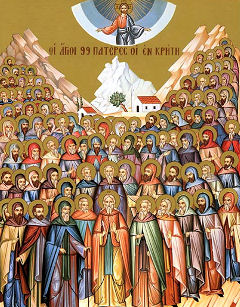 During the year the Church celebrates one by one the feasts of the saints. Today she joins them all in one festival. In addition to those whose names she knows, she recalls in a magnificent vision all the others "of all nations and tribes standing before the throne and in sight of the Lamb, clothed with white robes, and palms in their hands, proclaiming Him who redeemed them in His Blood."
The feast of All Saints should inspire us with tremendous hope. Among the saints in heaven are some whom we have known. All lived on earth lives like our own. They were baptized, marked with the sign of faith, they were faithful to Christ's teaching and they have gone before us to the heavenly home whence they call on us to follow them. The Gospel of the Beatitudes, read today, while it shows their happiness, shows, too, the road that they followed; there is no other that will lead us whither they have gone.
According to various authors including Father Francis X. Weiser, SJ, the "Commemoration of All Saints" was first celebrated in the East. The feast is found in the West on different dates in the eighth century. The Roman Martyrology mentions that this date is a claim of fame for Gregory IV (827-844) and that he extended this observance to the whole of Christendom; it seems certain, however, that Gregory III (731-741) preceded him in this. At Rome, on the other hand, on May 13, there was the annual commemoration of the consecration of the basilica of St. Maria ad Martyres (or St. Mary and All Martyrs). This was the former Pantheon, the temple of Agrippa, dedicated to all the gods of paganism, to which Boniface IV had translated many relics from the catacombs. Gregory VII transferred the anniversary of this dedication to November 1.
Highlights and Things to Do:
A Guide to Plenary Indulgences for the All Souls' "Octave", November 1-8
Visiting a Cemetery: An indulgence, applicable only to the Souls in Purgatory, is granted to the faithful, who devoutly visit a cemetery and pray, even if only mentally, for the departed. The indulgence is plenary each day from November 1-8; on other days of the year it is a partial indulgence.
Visiting a Church on November 2: A plenary indulgence, applicable only to the souls in purgatory, is granted to the faithful who, on All Souls' Day (or, according to the judgment of the ordinary, on the Sunday preceding or following it, or on the solemnity of All Saints), devoutly visit a church or an oratory and recite an Our Father and the Creed.
Praying for the Faithful Departed: A partial indulgence, applicable only to the souls in purgatory, is granted to the faithful who,
Indulgence Requirements:
|
|
|
|
|
|
|
|
|
|

The Vatican’s Dicastery for the Doctrine of the Faith has announced that it will present a new doctrinal note “referring to Mary’s cooperation in the work of salvation.”
The document is titled Mater Populi Fidelis (“Mother of the Faithful People”), with the Italian subtitle Nota dottrinale su alcuni titoli mariani riferiti alla cooperazione di Maria all’opera della salvezza. It will be unveiled from 11.00 to 12.30 in the morning at the Jesuit General Curia, with free entry and a reception to follow. The Vatican Press Office will release the full text of Mater Populi Fidelis at noon on 4 November.
Cardinal Víctor Manuel Fernández, Prefect of the Dicastery, will preside at the presentation. He will be joined by Professor Maurizio Gronchi of the Pontifical Urbaniana University, a consultor to the Dicastery, and by Msgr Armando Matteo, Secretary of the Dicastery’s Doctrinal Section.
Observers note that the timing and title of the note have drawn interest in how it will address the question of Mary’s role in redemption. Theologians and commentators are speculating whether Mater Populi Fidelis will touch on the controversial title “Co-Redemptrix” (Co-Redeemer). The term, long used in Catholic devotion, has been debated for decades. Supporters have petitioned the Vatican to define Mary’s cooperation in salvation as dogma, while critics warn that the title may exaggerate her role and risk damaging ecumenical relations with other Christian denominations.
Some hope the new note might affirm or clarify the concept of Co-Redemptrix; others expect it will avoid the issue, mindful of ecumenical sensitivities. Vatican correspondent for Per Mariam, Michael Haynes, has pointed out that in 1913 the Holy Office, now the Dicastery for the Doctrine of the Faith, granted a partial indulgence to a prayer of reparation to Our Lady ending with the words: “I bless thy holy Name, I praise thine exalted privilege of being truly Mother of God, ever Virgin, conceived without stain of sin, Co-Redemptrix of the human race.”
The theological background is complex. Although devotion to Mary’s cooperation in salvation is centuries old, the term “Co-Redemptrix” has never been formally defined by the Church. Medieval liturgies sometimes called Mary “Redemptrix” alongside Christ, with the prefix “co-” added from the fifteenth century to make clear that she is not herself the Redeemer. The title received limited official recognition—for example, in a 1908 Vatican decree on Our Lady’s Seven Sorrows—but the Second Vatican Council declined to define it, preferring broader language in Lumen Gentium.
The debate over Co-Redemptrix was a point of contention during the Council. Many conservative bishops and theologians pressed for Mary to be proclaimed Co-Redemptrix, Mediatrix, and Advocate as a fifth Marian dogma. Petitions for such a definition reportedly gathered signatures from attending bishops, but by a narrow vote the Council decided to integrate Marian teaching into the broader Dogmatic Constitution on the Church (Lumen Gentium) rather than issue a separate schema on Mary.
Lumen Gentium ultimately called her “Mediatrix,” acknowledging her maternal intercession and cooperation in Christ’s saving work, but avoided the stronger title “Co-Redemptrix,” which many Council Fathers feared could obscure Christ’s unique redemptive role and complicate ecumenical dialogue. This marked a deliberate moderation of pre-conciliar enthusiasm for defining the title as dogma.
In modern papal teaching, the issue has been treated with caution. Pope John Paul II used the term “Co-Redemptrix” several times in the 1990s, raising hopes among supporters, but his successor, then-Cardinal Ratzinger, warned that the term was “too far from Scripture” and risked confusing the faithful. Pope Francis has likewise stated that “Christ is the only Redeemer” and described Mary as given to the Church “as a mother, not as … co-redeemer.”
Ecumenical concerns continue to discourage formal definition, as many theologians fear that advancing a new Marian dogma could strain relations with Orthodox and Protestant communities. With this in mind, Vatican correspondents will be watching closely when Mater Populi Fidelis is unveiled on 4 November.

Washington, D.C. Newsroom, Oct 29, 2025 / 14:59 pm
Catholics who do not gather for anti-enforcement rallies organized by high-ranking Catholic prelates are a “silent majority,” according to conservative Catholic immigration experts.
As the Trump administration’s immigration enforcement efforts continue to intensify, Catholics across the country have committed to observe days of prayer and public witness for migrants through efforts such as the One Church One Family initiative spearheaded by the western Jesuits. However, according to some conservative Catholic immigration experts, the number of Catholics who are opting out of such vigils are “a silent majority.”
The initiative calls on dioceses, parishes, schools, religious communities, and other Catholic institutions to host and promote “public actions that lift up the dignity of migrants,” such as “a vigil in front of a detention center, a prayer service at a place where migrants were publicly detained, or a rosary accompanying people who are going to immigration court hearings.”
“I think that there are a large number of American Catholics who are supportive of what the president is doing with respect to immigration,” Center for Immigration Studies Resident Fellow in Law and Policy Andrew Arthur told CNA. “I think he received a majority of Catholic votes in the last election, depending on which poll you look at.”
Immigration enforcement, he pointed out, acted as a major touchstone of President Donald Trump’s 2024 campaign. That Trump did not lean more heavily on this key issue in the 2020 campaign was also considered “one of the key failings” of his second White House attempt.
While Catholics who oppose the Trump administration’s enforcement efforts have been forthright in their advocacy for migrants, organizing vigils, Eucharistic processions, and protests, Arthur observed that the demographic of Catholics who support the administration are “not a monolith” and do not organize demonstrations in the same way.
“I don’t really know that there’s a huge Catholic enforcement group that I could point to,” he said in terms of open advocacy for enforcement. “But that’s more or less to be expected. In my mind, it’s the silent majority in this country.”
“One of the things that we see is that the Catholic Church, anecdotally, that we see that the Catholic Church, that especially younger Catholics are more conservative, and therefore, more in line with law enforcement, generally, and immigration enforcement, in particular,” he continued. “But there’s no reason to form a group to support what the administration is actually doing.”
Regarding the concerns posed by many groups, including the United States Conference of Catholic Bishops, Arthur insisted that there is “nothing that Donald Trump or ICE or [border czar] Tom Homan, another good Catholic, are doing that is contrary to the laws that Congress has written.” Despite the widespread critical narrative, Arthur denied there being anything particularly exceptional or specific to the Trump administration’s approach to enforcement.
“I have been involved in immigration and enforcement for 33 years and served under four different presidents, beginning with George H.W. Bush,” he said. “There’s nothing about immigration enforcement today [that’s different from enforcement] under H.W., Clinton, George W. Bush, or Barack Obama.”
“This is what the law requires. This is what the agents are doing,” he continued, adding: “I think really the only exceptional part is the response that they’re receiving for it.”
Addressing concerns surrounding enforcement from a Catholic perspective, former U.S. Acting Deputy Secretary of Homeland Security Ken Cuccinelli told CNA: “I am aware of the two basic points contained in the paragraph in the Catholic catechism on immigration: 1) Wealthier nations should be generous with their immigration policies; and 2) Migrants should respect the laws and customs of the nation to which they are emigrating.”
“I believe America is historically the most generous nation on Earth when it comes to inviting in people from all over the world, so we meet the first Catholic expectation,” he continued, adding: “However, an illegal alien by definition does not meet the second expectation found in the catechism, and thus the need on the part of America to enforce the law at a large scale.”
Cuccinelli emphasized the need for America’s immigration system to work for Americans first as well as the economic pitfalls for poor working-class Americans of allowing large-scale “low skill” illegal immigration.
In the end, Cuccinelli, who also previously served as director of U.S. Citizenship and Immigration Services, told CNA he hopes the Trump administration’s efforts to demonstrate its commitment to the rule of law will prompt a return to “gradually move back to a legal immigration regime soon.”
The director of Franciscan University of Steubenville’s Center for Criminal Justice, Law, and Ethics, Charles Nemeth, also weighed in on the subject from a Catholic perspective, telling CNA: “If this be about justice, it is better to adopt the Aristotelian-Thomistic view that justice is about what is ‘due’ — nothing more and nothing less. Illegals commence their journey already in a faulted state — for they have jumped the line and disregarded our laws and traditions.”
In order for a society to be just, he said, it must look to the common good of the nation-state first rather than “the individualized needs or demands of those lacking a legal right to assimilate without the adherence to the rules and regulations that border entry calls for.”
Nemeth stated that the Biden administration’s “open-door policy” subverted the rights of U.S. citizens by permitting mass migration, which he said resulted in “a dramatic rise in crime and social unrest and made a comedy of the rule of law.” He further cited undocumented migrants’ access to benefits such as health care, food stamps, and education “while our own citizens are being crushed by the costs of the same services.”
“It is one thing to display compassion,” referencing Catholics who protest the administration’s enforcement efforts, “but quite another to undermine the social fabric of a society that allows special rules for special categories of inhabitants.
By Christopher Wells
Driven by the conviction that proclaiming Jesus Christ “is an integral part of the Christian message of salvation,” Catholic universities are called to become “journeys of the mind toward God,” Pope Leo told members of Organization of Catholic Universities of Latin America and the Caribbean (ODUCAL) on Friday morning.
The Holy Father explained that Catholic higher education proposes no less than “to seek the integral development of the human person, forming intellects with a critical sense, believing hearts, and citizens committed to the common good – and all this with excellence, competence, and professionalism.”
He highlighted, among goals of the educational network, the aim of advancing Catholic higher education and serving society “by creating encounters between faith and culture, in order to proclaim the Gospel within the university setting.”
“This shared journey already speaks volumes,” he said, “because it expresses the very mission for which the university was born within the Catholic Church: to be an ‘incomparable center of creativity and the dissemination of knowledge for the good of humanity,’ in which ‘the combined effort of intellect and faith allows people to reach the full measure of their humanity.’”
Citing his predecessor Francis, Pope Leo said the Catholic university “remains one of the best instruments that the Church offers our time and is an expression of that love which animates every action of the Church, namely, God’s love for every person.”
Acknowledging the challenges facing education today, Pope Leo encouraged ODUCAL to “continue the mission the Church entrusts to you” with creativity, firm in the knowledge “that grace sustains you.”
After thanking them once again for their efforts in pursuing “this great task,” Pope Leo entrusted them to the Blessed Virgin Mary, Seat of Wisdom, before offering his Apostolic Blessing.
By Isabella H. de Carvalho
In prepared remarks consigned to members of the International Youth Advisory Body (IYAB), Pope Leo encourages young people to focus on synodality, mission, and participation in order to counter isolation, be close to Christ, and help the Church reach out to those on the margins.
The Holy Father on Friday chose to speak extemporaneously with IYAB, a body linked to the Dicastery for the Laity, the Family and Life that aims to bring the perspective of young people to the Holy See on various issues central to the Church’s mission. Since Tuesday, the IYAB has been meeting in Rome to reflect on topics that affect young Catholics, with the three themes of synodality, mission, and participation as the focus of their discussions.
In his prepared remarks, Pope Leo writes to the members of IYAB, “You represent many of your peers, and through you, they also can ‘speak’ to the Church.” He assured them, “Your voice is heard and taken seriously. Your presence and contribution are invaluable.”
Pope Leo emphasized that for young people, “the synodal Church” can be “a challenge, a catalyst”, as “it encourages them not to live their faith in isolation”, especially in the social media and digital age.
He recognized that “in recent years, many young people have approached the faith through social media, successful programs, and popular online Christian witnesses.”
However, he warned that “the danger” with this “is that a faith discovered online is limited to individual experiences, which may be intellectually and emotionally reassuring, but are never ‘embodied’.” This means it remains “detached from the ‘ecclesial body’” and not “lived alongside others in real-life situations, relationships or sharing.”
“All too often, social media algorithms merely create a sounding board for individuals, picking up on personal preferences and tastes, and ‘sending them back’ magnified and enriched with appealing proposals,” he continued. “Yet, everyone remains alone with themselves, prisoners of their own inclinations and projections”.
For the Pope, the antidote to this danger can be “experiences of lived synodality” which help “overcome the barriers of the self and encourage young people to become effective members of the family of Jesus Christ”.
The Pope also pointed out that young people in a synodal Church are also “called to speak on behalf of their peers,” especially “the weak, the poor, and the lonely, refugees and those who struggle to integrate into society, or to access educational opportunities.”
“All too often, these voices are drowned out by the noise of the powerful, the successful and those who live in ‘exclusive’ realities,” he reflected.
A synodal Church wants “to listen to what the Holy Spirit says to young people” and “welcome their charisms, the gifts that are specific to their age and their sensibilities,” the Pope insisted.
Synodality, he added, helps show that, “in the image of the Holy Trinity, the Church is also a communion of persons, of the faithful of every age, language, and nationality, who journey together, enriching one another and sharing their spiritual gifts.”
The Pope then highlighted how “authentic synodality” is guided by the Holy Spirit and thus it “leads to mission.” “It is not a question of the rules governing meetings. Instead, it is about making room for God’s action by listening to the Spirit,” he wrote, adding that the Holy Spirit always leads to “Jesus, who is the Truth.”
In order to discern, “in every age, how to bring the Gospel to everyone”, Pope Leo encouraged young people to “have open hearts, ready to listen both to the ‘inspirations’ of the Spirit and the deep ‘aspirations’ of each person.”
“You must look beyond appearances in order to seek the true answers that give meaning to life,” he emphasized. “You must have hearts that are open to God’s call and not engrossed in your own plans, and are willing to understand and sympathize before forming judgements”.
“The concept of mission also entails freedom from fear, because the Lord loves to call us to forge new paths,” he continued, urging young people to be “leaders of creativity and courage.”
The Pope thanked the group of young people for their work, “which will provide new energy and momentum to the missionary heart of the Church.” He pointed out that the IYAB is part of a wider spiritual youth movement, which includes World Youth Day and regular youth ministries, and thus “keeps the Church forever young.”
In this regard, Pope Leo XIV stressed the importance for this group of young people to, “above all,” recognize that they are participating in the life and universal mission of the Church, directed at men and women all over the world.
“Where does authentic ecclesial participation come from? I would say that it stems from being close to the Heart of Christ. Its origin, then, is spiritual, not ideological or political,” he wrote.
The Pope in fact urged the members of IYAB, to look upon the young people of our time and their “hopes, dreams, and difficulties” with “Christ’s same compassion and try to envisage how the Church, inspired by faith, can go out to meet them.”
He explained how, in the Gospel, Christ looks beyond “the small circle of disciples in front of Him”, as He desires that His message of salvation, unity of faith, and mutual love should reach “all people, including those who are far away and those who will come in the future.”
“The Lord always carries the whole world in His heart. This is the source of participation,” the Pope continued.
He thus invited the young people to become Jesus’ “friends through prayer, the Sacraments, and daily life” in order to “begin to feel as He feels”. This means to be “concerned for, and touched by, the suffering of others, their needs and aspirations” and it gives “rise to the desire to participate, to be part of the Church’s universal mission”.
“This involvement is also a sign of human and spiritual maturity,” he wrote. “While children are only concerned with their own needs, mature persons know how to share the problems of others and make them their own,” Pope Leo continued, encouraging the group of young people to “immerse” themselves in Christ.