Tuesday, January 31, 2023

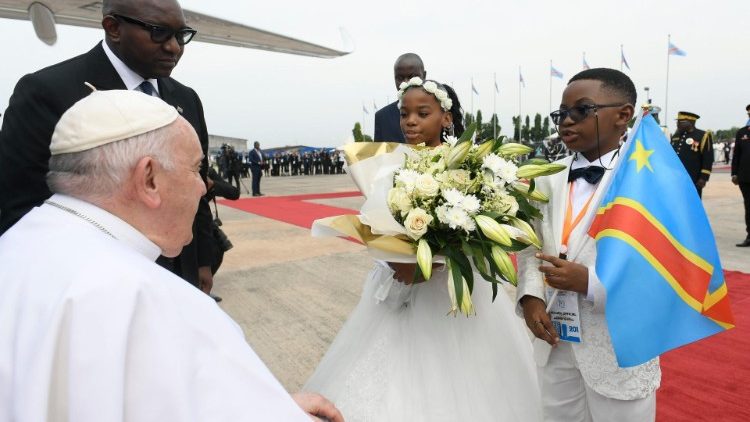
Pope Francis has arrived in DRC to begin his apostolic journey


Pope Francis arrives in the Democratic Republic of CongoPope Francis arrives in the Democratic Republic of Congo  (Vatican Media)

Pope Francis arrives in the Democratic Republic of Congo

Pope Francis arrives in the Democratic Republic of Congo, beginning his 40th Apostolic Journey abroad and his fifth Journey to Africa.

By Deborah Castellano Lubov 

Pope Francis has arrived in Kinshasa, as he begins his Apostolic Journey to the Democratic Republic of Congo.

The flight landed at the “Ndjili” International Airport in the DRC's capital of Kinshasa at 2:33 PM local time.

The ITA-Airways papal flight had left Rome's Fiumicino International Airport at 8:29 AM local time Tuesday morning, carrying the Pope and more than 70 journalists. 

The Holy Father will first visit the nation from 31 January to 3 February, following in the footsteps of Pope St. John Paul II, who visited there in 1980 and 1985. 

Fifth visit to African continent

Pope Francis visit to the African nations of South Sudan and the Democratic Republic of Congo (DRC) marks his 40th Apostolic Journey abroad, and fifth, to Africa.

In Kinshasa, the Pope was received by a welcoming ceremony.

The Pope then pays a courtesy visit to President Felix Tshisekedi, and address the country's authorities, civil society, and diplomatic corps.

At the completion of this Journey on Sunday, marking the Pope Francis' fifth visit to Africa, he will have visited 60 countries since the start of his pontificate.

In 2015, he went to Kenya, Uganda and the Central African Republic, and in 2017 visited Egypt. Then, in March 2019, he made an Apostolic Journey to Morocco, and later to Mozambique, Madagascar and Mauritius in September 2019.

Fulfilling desire to visit DRC

The Pope was forced to postpone this visit to DRC and South Sudan, originally scheduled for July 2022, due to intense knee pain.

At the time, the Holy Father sent the Vatican Secretary of State, Cardinal Pietro Parolin, to both countries on his behalf, expressing his disappointment to have been unable to make the visit, as well as his great desire to travel to both nations as soon as possible.

Some 20% of the world’s Catholic live on the African continent, and that percentage is increasing.

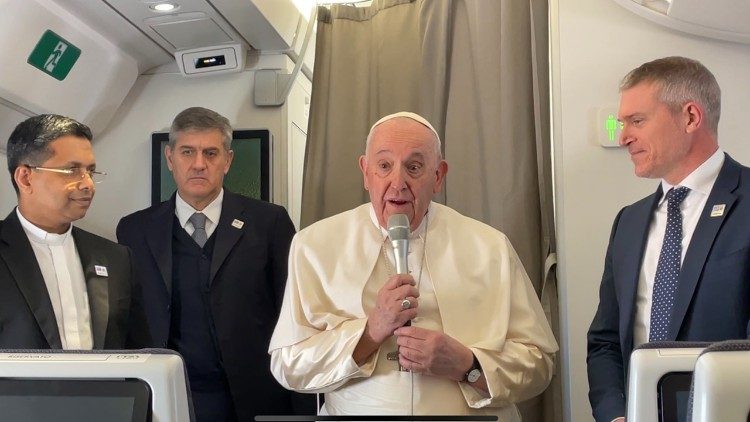
Pope Francis offers greetings and prayers onboard flight to Democratic Republic of Congo


File photo of Pope Francis greeting journalists aboard papal flightFile photo of Pope Francis greeting journalists aboard papal flight 

Pope prays for migrants in greetings to journalists on papal plane

Pope Francis prays for migrants who have died while seeking to cross the Sahara Desert and Mediterranean Sea, as he greets journalists aboard the papal plane en route to the Democratic Republic of Congo.

By Deborah Castellano Lubov

As he flew over the Sahara, at the start of his 40th Apostolic Journey abroad, Pope Francis asked for a prayer for people who have died trying to cross the desert and the Mediterranean Sea.

The Pope made the request on Tuesday while aboard the papal plane bound for the Democratic Republic of Congo (DRC).

As he offered words of gratitude to the more than 70 journalists on the flight, hailing from some 12 countries, the Pope said, “We pray for those people."

While expressing gratitude to be able to make this long-desired Apostolic Journey to the DRC and South Sudan, the Holy Father also expressed disappointment to no longer be able to visit the Congolese city of Goma due to violence in the area.

Keeping with tradition, the Pope exchanged a brief greeting with each journalist, as they came up to greet him aboard the flight.

The Pope thanked the press for their work, which enables the visit to reach people around the world.

Closeness to migrants

The ITA-Airways papal flight left Rome's Fiumicino International Airport at 8:29 AM local time Tuesday morning, carrying the Pope and more than 70 journalists.

The flight is scheduled to arrive at “Ndjili” International Airport in the DRC's capital of Kinshasa around 3 PM local time.

On Tuesday morning, before leaving his Vatican residence at the Casa Santa Marta, Pope Francis met with about ten migrants and refugees from the Democratic Republic of Congo and South Sudan, who are supported, along with their families, by the Jesuit-run Centro Astalli in Rome. 

Cardinal Konrad Krajewski, the Prefect of the Dicastery for Charity, accompanied the group for their visit with the Pope.

Monday, January 30, 2023

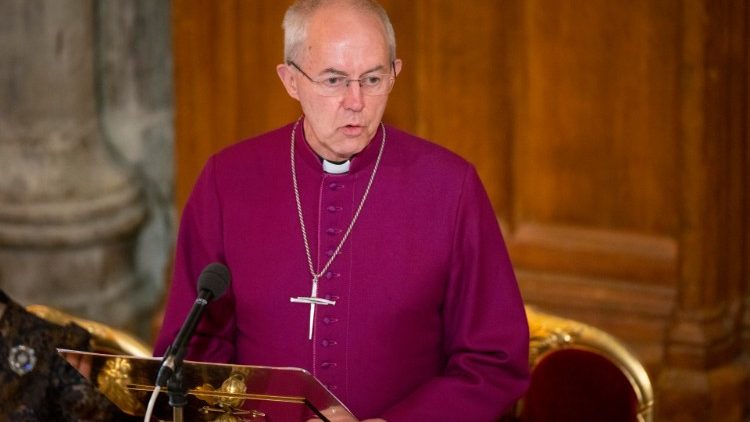
Archbishop of Canterbury asks for prayers too as he heads for South Sudan to meet the Pope


Archbishop Justin WelbyArchbishop Justin Welby  (ANSA)

Abp. Welby asks for prayers ahead of Ecumenical Pilgrimage to South Sudan

Ahead of the historic joint visit to South Sudan with Pope Francis and the Moderator of the General Assembly of the Church of Scotland, the Archbishop of Canterbury urges people to pray for South Sudanese people enduring ongoing conflict and famine.

By Lisa Zengarini

As he prepares to embark on the Ecumenical Pilgrimage of Peace to South Sudan, with Pope Francis and the Moderator of the General Assembly of the Church of Scotland, Dr Iain Greenshields, the Archbishop of Canterbury Justin Welby has urged the  faithful to join in prayer for the people in the conflict-torn African nation.

The three Church leaders will be visiting South Sudan from 3rd to 5th February as part of the Pope’s Apostolic Journey to the Democratic Republic of the Congo and South Sudan which begins on Tuesday 31st January.  

The unprecedented Ecumenical Pilgrimage, also marks the first-ever visit by a Roman Catholic Pope to the country .

A much awaited visit

In a statement released on Sunday, the Primate of the Anglican Communion expressed his profound gratefulness for visiting the people of South Sudan with Pope Francis, and Dr Greenshields, recalling that they have prayed for several years for this visit, which has been postponed twice since 2018.

The Archbishop of Canterbury explained they are making their Ecumenical Pilgrimage of Peace “as servants” to “amplify the cries of the South Sudanese people” who continue to suffer from conflict, flooding and famine.

Noting that over the past three years and even since July 2022, violence has intensified in many parts of South Sudan, the English Primate said they hope to review and renew the commitments made by South Sudanese leadership during the spiritual retreat convened in the Vatican in 2019 , and the commitments they have made to their people since then.

“We come as brothers in Christ to worship together and witness to the God who reconciles us. The communities of South Sudan have a legacy of powerful witness to their faith. Through working together, they have been a sign and instrument of the reconciliation God desires for their whole country and all of creation. We hope to build on and reenergise that legacy.”

An ecumenical pilgrimage of peace

Archbishop Welby also highlighted the ecumenical dimension of the visit: “After centuries of division, leaders of three different parts of the Church are coming together in an unprecedented way, and in so doing are seeking to be part of answering another prayer – Jesus’ prayer – that his followers might be one

“We come as followers of Jesus, the Prince of Peace, knowing that his Holy Spirit is at work in South Sudan and has the power to transform hearts”, the Primate concluded.

Archbishop Welby will be accompanied in South Sudan by his wife, Mrs Caroline Welby, who has made several previous visits to the county to support women in the Church in their role as peacebuilders, particularly the wives of South Sudan’s Anglican bishops and archbishops. Mrs Welby has said that the women of South Sudan are “incredible women of strength”, many of whom bear the trauma of displacement, sexual violence and the daily fear of mistreatment in their own communities.

Besides all the joint public engagements with Pope Francis and Rev. Greenshields during the visit, Archbishop Welby is expected to preside a worship service  at All Saints Anglican Cathedral in Juba on Saturday 4th February.

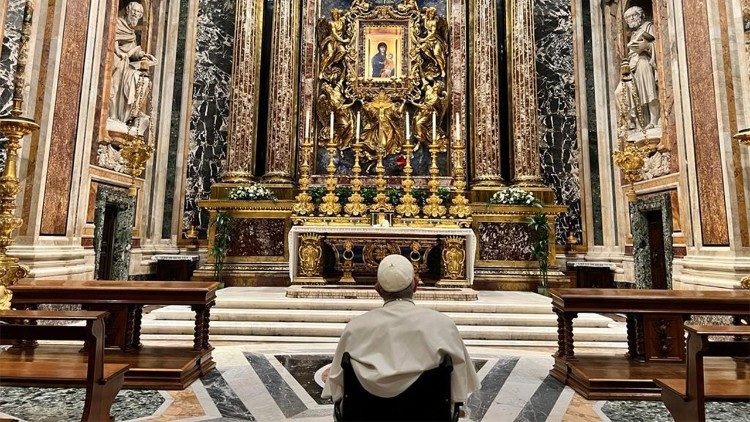
Pope Francis prays at St. Mary Major as he leaves on trip to Africa


Pope Francis visits the Basilica of Saint Mary Major on the eve of his 40th Apostolic Journey abroadPope Francis visits the Basilica of Saint Mary Major on the eve of his 40th Apostolic Journey abroad 

Pope Francis entrusts his journey to DRC and South Sudan to Our Lady

Pope Francis visits the Basilica of Saint Mary Major in Rome, where he entrusts his upcoming journey to DRC and South Sudan to Our Lady.

By Francesca Merlo

On the eve of his departure for his 40th Apostolic Journey abroad, Pope Francis paid a visit to the Roman Basilica of Saint Mary Major to entrust his visit to the Democratic Republic of Congo and to South Sudan to the Blessed Virgin Mary.

According to a statement by the Holy See Press Office, the Holy Father spent some time in prayer before the icon of Maria Salus Populi Romani.  

Pope Francis is set to depart from Rome on Tuesday morning on a six-day Apostolic Journey. 

DRC and South Sudan

This will be the first visit of a Pope to the Democratic Republic of Congo since 1985, when John Paul II travelled to the nation, known then as Zaire. The second leg of the journey will be the first-ever papal visit to South Sudan.

The Pope is visiting the people of these African countries as a “pilgrim of peace,” carrying with him a message of reconciliation and hope.

In a letter addressed to the populations of both countries prior to his departure, Pope Francis noted the DRC “suffers from armed clashes and exploitation", especially in the east of the country, and that South Sudan, has been “wracked by years of war” and “longs for an end to the constant violence that forces many people to be displaced and to live in conditions of great hardship."

The first leg of the visit will take the Pope to the Democratic Republic of Congo from 31 January to 3 February.

Then, on Friday, he travels to South Sudan until 5 February for a visit which seeks to help restore hope in the world’s youngest nation.

Our final Saint of the Day for January


St. John Bosco


Feastday: January 31
Patron: of apprentices, editors and publishers, schoolchildren, magicians, and juvenile delinquents
Birth: August 16, 1815
Death: January 31, 1888
Beatified: June 2, 1929 by Pope Pius XI
Canonized: April 1, 1934 by Pope Pius XI


John Bosco, also known as Giovanni Melchiorre Bosco and Don Bosco, was born in Becchi, Italy, on August 16, 1815. His birth came just after the end of the Napoleonic Wars which ravaged the area. Compounding the problems on his birthday, there was also a drought and a famine at the time of his birth.

At the age of two, John lost his father, leaving him and his two older brothers to be raised by his mother, Margherita. His "Mama Margherita Occhiena" would herself be declared venerable by the Church in 2006.

Raised primarily by his mother, John attended church and became very devout. When he was not in church, he helped his family grow food and raise sheep. They were very poor, but despite their poverty his mother also found enough to share with the homeless who sometimes came to the door seeking food, shelter or clothing.

When John was nine years old, he had the first of several vivid dreams that would influence his life. In his dream, he encountered a multitude of boys who swore as they played. Among these boys, he encountered a great, majestic man and woman. The man told him that in meekness and charity, he would "conquer these your friends." Then a lady, also majestic said, "Be strong, humble and robust. When the time comes, you will understand everything." This dream influenced John the rest of his life.

Not long afterwards, John witnessed a traveling troupe of circus performers. He was enthralled by their magic tricks and acrobatics. He realized if he learned their tricks, he could use them to attract others and hold their attention. He studied their tricks and learned how to perform some himself.

One Sunday evening, John staged a show for the kids he played with and was heartily applauded. At the end of the show, he recited the homily he heard earlier in the day. He ended by inviting his neighbors to pray with him. His shows and games were repeated and during this time, John discerned the call to become a priest.

To be a priest, John required an education, something he lacked because of poverty. However, he found a priest willing to provide him with some teaching and a few books. John's older brother became angry at this apparent disloyalty, and he reportedly whipped John saying he's "a farmer like us!"

John was undeterred, and as soon as he could he left home to look for work as a hired farm laborer. He was only 12 when he departed, a decision hastened by his brother's hostility.

John had difficulty finding work, but managed to find a job at a vineyard. He labored for two more years before he met Jospeh Cafasso, a priest who was willing to help him. Cafasso himself would later be recognized as a saint for his work, particularly ministering to prisoners and the condemned.

In 1835, John entered the seminary and following six years of study and preparation, he was ordained a priest in 1841.

His first assignment was to the city of Turin. The city was in the throes of industrialization so it had slums and widespread poverty. It was into these poor neighborhoods that John, now known as Fr. Bosco, went to work with the children of the poor.

While visiting the prisons, Fr. Bosco noticed a large number of boys, between the ages of 12 and 18, inside. The conditions were deplorable, and he felt moved to do more to help other boys from ending up there.

He went into the streets and started to meet young men and boys where they worked and played. He used his talents as a performer, doing tricks to capture attention, then sharing with the children his message for the day.

When he was not preaching, Fr. Bosco worked tirelessly seeking work for boys who needed it, and searching for lodgings for others. His mother began to help him, and she became known as "Mamma Margherita." By the 1860s, Fr. Bosco and his mother were responsible for lodging 800 boys.

Fr. Bosco also negotiated new rights for boys who were employed as apprentices. A common problem was the abuse of apprentices, with their employers using them to perform manual labor and menial work unrelated to their apprenticeship. Fr. Bosco negotiated contracts which forbade such abuse, a sweeping reform for that time. The boys he hired out were also given feast days off and could no longer be beaten.

Fr. Bosco also identified boys he thought would make good priests and encouraged them to consider a vocation to the priesthood. Then, he helped to prepare those who responded favorably in their path to ordination.

Fr. Bosco was not without some controversy. Some parish priests accused him of stealing boys from their parishes. The Chief of Police of Turin was opposed to his catechizing of boys in the streets, which he claimed was political subversion.

In 1859, Fr. Bosco established the Society of St. Francis de Sales. He organized 15 seminarians and one teenage boy into the group. Their purpose was to carry on his charitable work, helping boys with their faith formation and to stay out of trouble. The organization still exists today and continues to help people, especially children around the world.

In the years that followed, Fr. Bosco expanded his mission, which had, and still has, much work to do.

Fr. Bosco died on January 31, 1888. The call for his canonization was immediate. Pope Pius XI knew Fr. Bosco personally and agreed, declaring him blessed in 1929. St. John Bosco was canonized on Easter Sunday, 1934 and he was given the title, "Father and Teacher of Youth."

In 2002, Pope John Paul II was petitioned to declare St. John Bosco the Patron of Stage Magicians. St. Bosco had pioneered the art of what is today called "Gospel Magic," using magic and other feats to attract attention and engage the youth.

Saint John Bosco is the patron saint of apprentices, editors and publishers, schoolchildren, magicians, and juvenile delinquents. His feast day is on January 31.