Friday, August 2, 2024

A beautiful landmark begins to rise honoring Mary in Syria


Between earth and sky: ‘Lady of the East’ statue rises in Syria


Souhail Lawand

A new landmark honoring the Virgin Mary will be inaugurated in a grand celebration that begins Aug. 1 and runs through Aug. 4 in the town of Al-Hwash near the city of Homs, Syria.

The site, named “Lady of the East,” features several facilities, the most prominent being a colossal statue of the Virgin Mary, which will be erected during the celebration.

The concept for the landmark originated from Al-Hwash native Khalil Michel Nakad, who pledged to “build a shrine for the Mother of the Redeemer” in gratitude for her support during a severe health crisis that nearly claimed his life. What began as a simple shrine evolved into a grand structure perched on a hill approximately 1,300 feet above sea level.

The central structure of the site is an 11-story tower standing about 170 feet tall. Visitors can reach the top via stairs or an elevator, where they will be greeted by breathtaking natural scenery when looking straight ahead.

Gazing upward, they will see a 26-foot-tall white statue of the Virgin Mary made of iron and covered with reinforced fiberglass, brought from Lebanon three years ago.

The statue is scheduled to be transported from the Wadi al-Nadara (Valley of the Christians) area to the site in a grand procession and will be installed atop the tower on the morning of Aug 2. 

The celebrations will kick off Saturday evening with performances by scout bands from Al-Hwash, Anaz, and Al-Mazina, alongside the Mar Elian Choir from Homs and the Mosaic Music Band. The festivities will include singing performances by artists Mirna Al-Mallouhi and Rona Nofal, culminating in a fireworks display.

The site also includes a Byzantine-style church that can accommodate about 300 worshippers. Morning prayers will be held in the church on Saturday, with supplications for the protection of the region and all of Syria, and the installation of sacred relics. The church will be officially consecrated on Sunday morning, Aug. 4.

In addition to the tower and the church, the site features a plaza at the base of the tower, a souvenir shop offering unique items dedicated to the Lady of the East, and a large multipurpose hall that can host up to 150 people.

Other facilities include administrative offices, restrooms, storage rooms, gardens, and a parking lot. The site is equipped with an advanced lighting system, surveillance networks, signage, and is powered by clean renewable energy.

The Catholic faith of the greatest female gymnast of all-time, Simone Biles


Faith keeps Olympian Simone Biles flying high

AUGUST 1, 2024


U.S. gymnast Simone Biles reacts after competing in the artistic women's gymnastics beam final Aug. 3, 2021, during the 2020 Tokyo Olympics. Biles won a bronze medal for that routine. (CNS photo/Lindsey Wasson, Reuters)

PARIS (CNS) -- U.S. Olympic gymnast and Paris gold medalist Simone Biles said she credits God and her faith for her success.

Biles, a Catholic, told The Cut in 2021, “I don’t physically understand how I do it. It (is) a God-given talent.”

The high-flying 27-year-old, who trains in Spring at her World Champions Centre gym, said when she travels, she sometimes takes with her a statue of St. Sebastian, the patron saint of athletes, and she also carries a rosary her mother gave her. Biles and her family attend St. James Catholic Church in Spring.

Biles, who won gold in the women's gymnastics all-around competition in Paris on Aug. 1 and helped lead the U.S. women to a team gold July 30, made those comments to Us Weekly in 2016.

"My mom, Nellie, got me a Rosary at church. I don't use it to pray before a competition. I'll just pray normally [by] myself, but I have it there in case," the three-time Olympian told the magazine in an interview. Her parents have told media that they often pray the Rosary for Simone.

Her remark about her patron saint was part of a list in a 2016 article about Biles posted by the magazine online with the headline, "25 Things You Don't Know About Me."

Biles' hometown is Spring, Texas, which is in the Archdiocese of Galveston-Houston. The London-based Catholic Herald described her as "a Sunday Mass-goer." Other news accounts said that Sunday is the only day she does not practice gymnastics so she can go to church with her family.

After the painful sexual abuse scandal rocked U.S. gymnastics, the Houstonian told Hoda Kotb of NBC’s Today in that she felt “called by God” to continue gymnastics, even when she wanted to quit following the pandemic-related delay of the 2020 Olympics and in Tokyo, where she publicly admitted that she struggled with her mental health and athletics, stepping out of competition.

According to news reports, Biles was born in Columbus, Ohio, to parents who struggled with addiction. Her father left and young Simone bounced back and forth from her mother's house to foster homes. When she was 5 or 6, her grandparents, Ronald and Nellie Biles, adopted her and her younger sister, Adria, and they moved to Texas.

According to her Team USA bio, Biles was homeschooled. Besides a sister, she has two brothers, Ronald and Adam.

About her interest in gymnastics, she said: "My first experience with gymnastics was when I was in daycare. We took a field trip to a gym, and I was hooked," she told Us Weekly.

But she added: "Gymnastics is just one part of my life, and I'm having as much fun with it as possible. At some point, I'll have to go get a real job."

Her favorite routine is the floor, she said. Biles is described as determined, disciplined and something of a perfectionist.

"She's always been headstrong," her mom, a retired nurse, told Texas Monthly magazine. "When she makes up her mind, it's, like, oh my gosh -- the whole world could be upset and she'd still do it. My other kids would listen. Her, no. She makes her mind up and that's it."

Biles' approach to her sport has paid off. She is now the most decorated U.S. Olympic gymnast in history, with nine Olympic medals. 

Thursday, August 1, 2024

Some folks just can't let "women deacons" go...


The Vatican synod agenda calls for transparency. But on women deacons, it's lacking.

BY CHRISTOPHER WHITE


A woman holds a sign in support of women deacons as Pope Francis leads his general audience in St. Peter's Square at the Vatican Nov. 6, 2019. (CNS/Paul Haring)

 One of the clarion calls included on the agenda for October's Synod of Bishops is for the church to consider how to build a greater culture of transparency and accountability. But when it comes to women deacons, a number of leading theologians, scholars and activists believe the Vatican's doctrinal office is failing to practice what the synod is trying to preach.

Earlier this year, Pope Francis established 10 study groups to examine some of the most contentious issues that surfaced at the first session of the synod on synodality in October 2023, including one to consider the question of women deacons.

The membership of the study groups had been kept secret for over three months, but at the conclusion of the July 9 press conference to present the agenda for the Oct. 2-27 synod assembly, when reporters could no longer ask questions, the Vatican published the names of the individuals participating in each group — with one critical exception.

Under "group five" — which has been tasked with considering "some theological and canonical matters regarding specific ministerial forms" and, in particular, "theological and pastoral research on the access of women to the diaconate," no individual members were listed.

Instead, a note explained that "the in-depth study of the issues at hand-particularly the question of the necessary participation of women in the life and leadership of the church has been entrusted to the Dicastery for the Doctrine of the Faith, under the coordination of the Secretary for the Doctrinal Section, Msgr. Armando Matteo." 

The memo also announced a forthcoming document on the role of women in the church would be published. An official from the Dicastery for the Doctrine of the Faith said that Matteo was unavailable to respond to NCR's request for comment.

According to Casey Stanton, co-director of Discerning Deacons, a project dedicated to engaging Catholics in conversations about the role of women and the diaconate, "the lack of transparency with this particular study group does not inspire trust or confidence in the institutional church’s commitment to be synodal."

"Synodality requires us to risk being vulnerable, to engage theologically in light of pastoral realities, and to hold difficult questions with openness," she told NCR.

Frustration over the lack of transparency on how the doctrinal office is handling the topic of women deacons is nothing new and dates back over two decades.

In 2002, the International Theological Commission concluded a study of the diaconate that considered the question of women deacons, which was followed by two different commissions Francis established in 2016 and 2020. The work of the two commissions has never been made public

"Three quinquennia of the Congregation for the Doctrine of the Faith have considered the question of restoring women to the ordained diaconate," said Phyllis Zagano, who was appointed by Francis to serve on the original 2016 Vatican commission to study women deacons and is one of the world's leading scholars on the female diaconate.

"One would hope that their findings would be considered along with whatever was presented on behalf of the two more recent commissions," she told NCR via email. "Despite the existence of ordination liturgies used for both male and female deacons, since the time of the Council of Trent there has never been any agreement on the history of ordained women."

"If, as has been reported, the two recent commissions presented an historical analysis, then their reports, like the 2002 statement of the International Theological Commission, would have been inconclusive," she continued.

During the first session of the synod on synodality, the question of women deacons surfaced throughout the monthlong assembly. A final synthesis report specifically called for the results of earlier papal and theological commissions to be presented at the 2024 synod.

While the study groups are expected to present preliminary findings this October, it remains unclear what the Vatican's doctrinal office plans to make public. 

In an NCR interview earlier this year, Canadian theologian and synod delegate Catherine Clifford said she believed the creation of the study groups to study some of the synod's hot button issues means their work must be "open, transparent and accountable so that we have more insight into how these decisions are being made."

"I have a responsibility as a delegate to say, 'look all these secret studies have gone on and we don't know what the upshot has been,' " Clifford said at the time. "The way these issues have been dealt with over the last 50 years has undermined the confidence of the baptized faithful."

British theologian Tina Beattie expressed dismay at the fact that the work of the commission's has yet to be made public — and at the prospect that it may remain secret.

"It's hard not to conclude that both reports included evidence in favor of a female diaconate, but that the magisterium's mind is made up so this is just a window-dressing exercise," she told NCR. "I think it shows arrogance and contempt for those of us who have a genuine interest in these theological issues and debates."

"It's hard not to conclude that these commissions are placebos," Beattie added. 

Compounding the frustration for Beattie and others are remarks Francis made in a May CBS interview where he explicitly voiced his opposition to women deacons, if it is linked to Holy Orders. At the time, the pope's words caught many by surprise as they came amid the ongoing work of the synod where the topic remained an open conversation.

During a July 16 lecture at John XXIII College in Perth, Australia, Jesuit Fr. Frank Brennan expressed "fatigue and frustration" following the pope's interview and the decision to relegate the question of women deacons to the Vatican's doctrinal office, rather than the full work of the synod assembly.

"I now more readily understand why so many women in the church are frustrated or angry or both," Brennan said. "The question about women deacons deserves an answer now."

"Is not the October session of the Synod the appropriate time to think about it?" Brennan said. "And would not the October session be the appropriate time to release the findings of the two commissions held by the pope to consider the question of women deacons?" he asked.

"Is this not the bare minimum required for a transparent and inclusive, synodal church?" Brennan continued. "We need to demand better process from the top if we are to be a synodal church."

Stanton, who has spent the last four years hosting hundreds of synodal listening sessions with thousands of Catholics, said she still has high hopes for the synod but believes it will be "defeating" if the synod process addresses this topic in an "insular and closed" manner.

"I hope the Dicastery for the Doctrine of the Faith can lean into this invitation to greater vulnerability, even as they stand as the authority on matters of church teaching," she said.

"Can they model for us the humble conversion towards becoming a more synodal church?" she asked. 

Archbishop Aymond speaks out about Olympics blasphemy


A Message from the Archbishop Gregory Aymond, Archbishop of New Orleans


Words cannot fully express my shock and anger upon watching the depiction of “The Last Supper” during the Olympic Opening Ceremonies. A week earlier, thousands had united in prayer and adoration before the Eucharist, asking the Lord to heal and forgive our sins. Then, seven days later, nearly 1 billion people across the world witnessed the public mockery of the Mass. It is our duty as Christians to respond to this profound evil, and we should do so with love and charity. As we are told in the Gospels, some demons are cast out only through prayer and fasting. I ask all believers to pray and fast in reparation for this sin.


Another Saint for Friday


St. Eusebius of Vercelli

Feastday: August 2
Patron: of Vercelli
Birth: 283
Death: 371


Christians who breathed a sigh of relief when Constantine proclaimed Christianity the state religion, believing this would end the bloodshed and martyrdom. But it was all too short a time until they were facing persecution once more -- from others who claimed to be Christian.

When Christianity became the state religion, many people adopted it for political reasons. Others adopted it without truly understanding it. Under these circumstances heresy found fertile ground. One of the most powerful heresies was Arianism which claimed that Jesus was not God (a heresy that has never completely died out). The Arians were powerful people, including nobles, generals, emperors. They commanded armies and senates. True Christianity was in real danger of being stamped out once again.

Eusebius had learned how to stand as a Christian from his father, who died a martyr in Sardinia. After his father's death, he grew up in Rome where he was ordained a lector. This was a time when bishops were elected by the people and local clergy. When the people of Vercelli saw how well he served their Church, they had no doubt about choosing him as bishop.

Pope Liberius also noticed his abilities and sent him on a mission to the Emperor Constantius to try to resolve the troubles between Arians and Catholics. Seeming to agree, Constantius convened a council in Milan in 355. The powerful Arians however weren't there to talk but to force their own will on the others. A horrified Eusebius watched as his worst fears were confirmed and the Arians made this peace council into a condemnation of Saint Athanasius, their chief opponent. Eusebius, unafraid of their power, slapped the Nicene Creed down on the table and demanded that everyone sign that before condemning Athanasius. The Nicene Creed, adopted by a council of the full Church, proclaims that Jesus is one in being with the Father -- directly contradicting the Arian teaching.

The emperor then tried to force Eusebius, Saint Dionysius of Milan, and Lucifer of Cagliari to condemn Athanasius under pain of death. They steadfastly refused to condemn a man who far from being a heretic was supporting the truth. Instead of putting them to death, the emperor exiled them.

In exile in Scythopolis in Palestine, Eusebius lived with the only Catholic in town. Any comfort he had from visits of other saints was destroyed when the local Arians stripped him half naked and dragged him through the streets to a tiny cell. The Arians finally let him go after he spent four days without food. But a few weeks later they were back, breaking into his house, stealing his belongings and food, and imprisoning him again.

Eusebius was exiled to two other places before Constantius' successor Julian let him and the other exiled bishops return home in 361. The problem was not over and Eusebius spent his last years working hard to counteract the damage the Arians had done and continued to do. After working with Athanasius and taking part in councils, he became a latter-day Saint Paul traveling all over in order to strengthen the faith and spread the truth.

Eusebius died on August 1, 371.


Friday Saint of the Day


St. Peter Julian Eymard


1811-1868, Founder. Born in LaMure, France, he worked at his father's trade as cutler until eighteen when he went to the seminary at Grenoble and was ordained in 1834. He served as a parish priest for several years then joined the Marists and in 1845 became their provincial at Lyons. He established the Sevants of the Blessed Sacrament whose nuns devoted themselves to perpetual adoration.

The unique feast of "St. Peter in Chains" on August 1st


St. Peter in Chains


To please the enemies of the Christians, Herod Agrippa had put St. James to death, and now he planned to do the same to St. Peter, the Head of the Church. Once he had him in prison, he set a heavy guard about him to make sure he would not escape. But all the Christians of Jerusalem were begging the Lord to save St. Peter, and their prayers were answered.  The night before he was to be condemned, St. Peter was peacefully sleeping in his prison cell between his two guards bound tightly by two chains. He was unafraid of death and ready to do God's will. Suddenly an angel appeared and tapped him on the side to awaken him. He told him to get up at once, put on his cloak and sandles and follow him. At the same moment, both the chains fell from his hands! Out the two went, past two sets of guards, to the gate. This iron gate opened to them by itself and the angel led St. Peter out to the street. Then he disappeared. Up to then, Peter had thought he might be dreaming, but now he new that God had really sent an angel to free him! What joy and gratitude filled his heart! At once, the Apostle went to the home of Mary, St. Mark's mother, where many Christians were praying for his safety. He knocked at the door and a young woman named Rhoda came to ask who it was, without opening the door. When she heard St. Peter's voice, she ran joyfully to tell the others. They, however, could not believe the news. "It must be his angel," they said when she kept insisting. Meanwhile St. Peter knocked again. At last they let him in, and their happiness was immense when they saw it was truly St. Peter himself! He told them how the angel had freed him, and altogether they blessed and thanked the Lord. The feast day is August 1st.

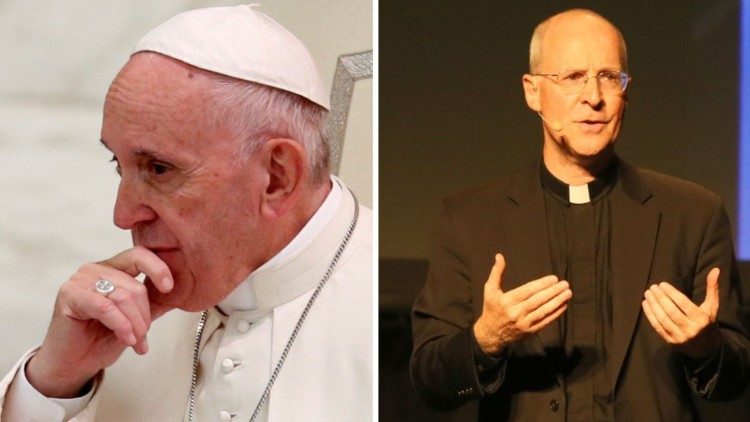
Pope Francis sends greetings to a ministry for LGBTQ Catholics run by Fr. James Martin, SJ


Photo collage of Pope Francis and Fr. James Martin, SJPhoto collage of Pope Francis and Fr. James Martin, SJ 

Pope Francis sends greetings to participants in “Outreach” conference

Replying to a message from Fr. James Martin, who carries out his mission among the LGBTQ community in the United States, Pope Francis says he is spiritually united with those participating in the meeting at Georgetown University from August 2 to 4.

By Vatican News

Pope Francis greeted Jesuit Father James Martin on the occasion of the “Outreach” Conference for LGBTQ Catholics, taking place at Georgetown University in Washington, DC, on August 2–4. Cardinal Wilton Gregory, Archbishop of Washington, is due to celebrate Mass for participants.

Fr. Martin, who carries out his apostolate among the LGBTQ community, wrote to the Pope, asking if he would like to send his greetings to the conference.

Pope Francis sent a brief response, which was released on Thursday, saying he was pleased by the fact that Cardinal Gregory would be celebrating Mass for them.

The Pope said he is “united in prayer” with those participating in the conference: “May Jesus bless you and the Holy Virgin care for you.”

This is the fourth time that Pope Francis has sent his regards to an “Outreach” event.

On other occasions, the Pope has invited the Jesuit priest, whom he has named a Consultor of the Dicastery for Communication (Vatican News’ parent organization), to transmit God’s “style” of closeness, mercy, and affection to the LGBTQ community.


Vatican issues a clarification about "Holy Doors" ahead of Jubilee 2025


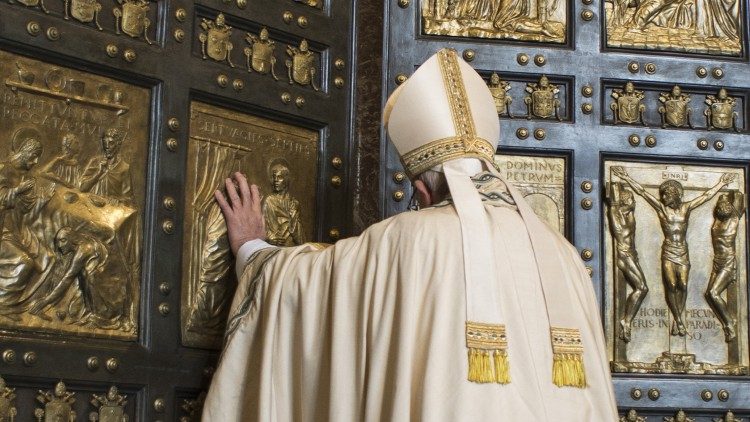
Pope Francis opened the Holy Door at St. Peter's Basilica for the Jubilee of Mercy on December 8, 2015Pope Francis opened the Holy Door at St. Peter's Basilica for the Jubilee of Mercy on December 8, 2015 

Vatican issues clarification on Holy Doors during 2025 Jubilee

The Vatican's Dicastery for Evangelization issues a clarifying note regarding the 2025 Jubilee, specifying that Holy Doors will only be open at the four Papal Basilicas in Rome and in one prison.

By Deborah Castellano Lubov

Ahead of the upcoming Ordinary Jubilee of 2025, Pope Francis, in his Bull of Indiction, entitled 'Spes non confundit' ('Hope does not disappoint'), indicated as the Holy Door "that of St. Peter's Basilica and the other three Papal Basilicas, namely St. John Lateran, St. Mary Major, and St. Paul Outside the Walls, with the exception of the Holy Father's expressed desire to personally open a Holy Door in a prison 'to offer prisoners a concrete sign of closeness'."

This was reaffirmed in a note issued Thursday, 1 August, by the Dicastery for Evangelization's Section for Fundamental Questions regarding Evangelization in the World.

The note specifically provided guidance regarding the opening of the Holy Door in places besides Rome.

"Given the imminent start of the Jubilee 2025," the Dicastery's note began, "the question has recently been raised about the possibility of planning the configuration and opening of the Holy Door in Cathedral Churches, International and National Shrines, as well as in other particularly significant places of worship."

St. Peter's and Papal Basilicas

"In this regard, while sensitively considering the pastoral and devotional motivations that may have suggested such commendable aspiration," it continued, "it is nevertheless deemed necessary to recall the precise indications established by the Holy Father in the Bull Spes non confundit"which reasserts the sites of Holy Doors for the imminent Jubilee.

In the text, the Dicastery also took the opportunity to recall that "the peculiar and identifying sign of the Jubilee Year, as handed down since the first Jubilee of the year 1300, is the indulgence that 'intends to express the fullness of God's forgiveness which knows no bounds,' through the Sacrament of Penance and signs of charity and hope."

Given this, they urge faithful to consult "the particular places and different modalities indicated by the Decree of the Apostolic Penitentiary of May 13, 2024," in order to "fully live this moment of grace."

A Jubilee overview

In Spes non confundit, Pope Francis announced that the Jubilee Year will begin with the opening of the Holy Door of St Peter’s Basilica on Christmas Eve, 2024.

The Holy Door of Saint Peter’s Basilica is opened by the Pope only at the beginning of a Jubilee Year. It is usually the first door to be opened to indicate the beginning of the Holy Year. This first evidence of the rite happening in St Peter’s was in the year 1500 during the papacy of Alexander VI.

Later, on 29 December, the Pope will open the Holy Door of the Archbasilica of St John Lateran, the Cathedral of Rome. On the same day, every Cathedral and co-Cathedral throughout the world will have Mass celebrated by the local Bishop to mark the opening of the Jubilee.

On the Solemnity of Mary the Mother of God, 1 January 2025, Pope Francis will open the Holy Door for the Basilica of St Mary Major, with the Holy Door for the Basilica of St Paul’s Outside the Walls being opened on Sunday, 5 January, the Vigil of Epiphany.

“In the course of the year,” Pope Francis had written, “every effort should be made to enable the People of God to participate fully in its proclamation of hope in God’s grace and in the signs that attest to their efficacy.”

On 28 December 2025, the Jubilee will end in the particular Churches throughout the world, with the Holy Doors of St John Lateran, St Mary Major, and St Paul’s Outside the Walls being closed on that same date.

Finally, the Jubilee Year will formally conclude in Rome on the Solemnity of Epiphany, 6 January 2026.