Friday, February 3, 2023

Papal visit to Congo marked by indescribable gratitude and joy


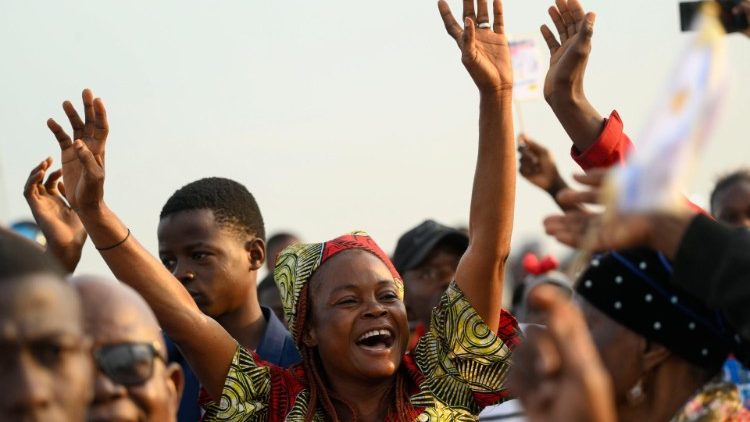
Celebrations at the Mass at N'dolo airportCelebrations at the Mass at N'dolo airport  (VATICAN MEDIA Divisione Foto)EDITORIAL

DR Congo: Human value in the joy of an encounter

Today the Pope leaves the Democratic Republic of Congo for South Sudan. In Kinshasa, indescribable gratitude and joy for this meeting, which has shattered predatory and possessive ways of thinking.

By Massimiliano Menichetti – Kinshasa

Africa, seen from the Democratic Republic of Congo, is very different than when viewed from the outside. All it takes is a day to completely change your perspective, and make it possible to recognise what from many other latitudes, paradoxically, escapes your notice and is forgotten: here the human heart is capable of rejoicing at an encounter.

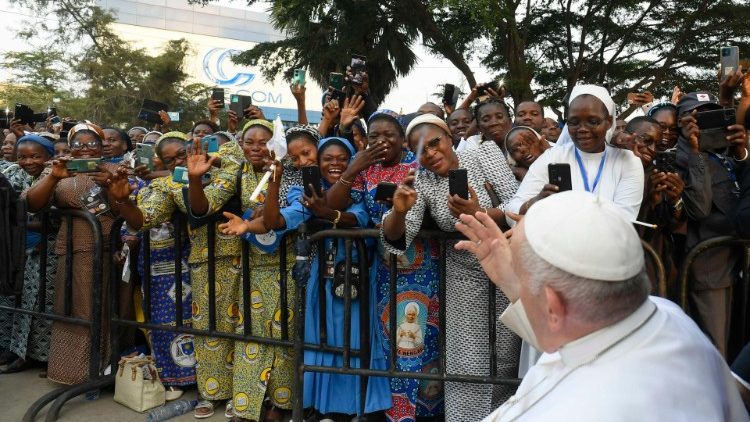
Peace, harmony, and fraternity, indeed, arise from relationships, which here can be touched and seen. In the land of diamonds you celebrate if a friend comes to visit, you’re honoured by the visit of a relative, a grandfather, who shares his story, the wisdom of a lifetime. The word joy has not been emptied of meaning, it is not superficial: it's rich, because it’s not attached to an ephemeral moment, but to humankind. It is the joy of the encounter which filled the streets, the flyovers, the airport in N'dolo, and the Martyrs' Stadium during the visit of Pope Francis.

In this country, where a European would probably not find the 'indispensable comforts' to which they’re accustomed, it's possible to get to the living root of everything, both good and bad. Perhaps this is because people have not been anaesthetised by the opulence of well-being, or because here time is not yet entirely marked by the frenzy of doing, but by the breath of the sun, of nature. Kinshasa is a chaotic and disorderly city, where shacks, on dirt and asphalt roads, alternate with piles of rubbish, buildings under construction, neat houses and concrete skeletons.

The traffic seems to have no rules, and the vehicles, if they're not bottled up, move quickly, darting continuously left and right. Most of the cars are dented, their wing mirrors tied on with wires and tape, and the doors of the buses are often open to allow as many people as possible to be crammed in, some sticking out. The police and military man the streets with long truncheons which they wave at those who violate directives. Sometimes four people travel on one motorbike. Children play behind coloured metal sheets marking out empty spaces, and women carry sacks of all sizes on their heads. The gaze of the inhabitants is always the same: it pierces you.

In this land, where the contradictions of mineral wealth and poverty, war and the beauty of nature, live side by side, what prevails is the unstoppable drive of the people, all projected forward. 'The Democratic Republic of Congo will be a paradise'. This hope is not an expectation, a chimera, but what one hears from an entire generation, from those who, carrying Christ, build day after day amidst the rubble, corruption, the discarded people, violence, abuse, exploitation and tribal division. But perhaps it is precisely this that frightens those who plunder, crush and silence Africa, those who seek to relegate it to a problem to be solved or states to be helped.

Everyone here remembers the two visits of St John Paul II, but also the very recent one by Cardinal Parolin, who came in July to represent Francis, who had postponed his trip because of knee pain. The Vatican’s Secretary of State brought with him the promise that the Holy Father would come. 'It has been a year,' sighed the Pontiff on the plane to Kinshasa. The Pope has been true to his word, and this people has not forgotten it; they feel honoured, respected, loved. Francis has nourished the certainty of a brighter future in this country,  where the church is thriving, nourished the awareness of the bond in Christ.

This continent is growing enormously, and not only in terms of GDP. Opportunities, however, will not come from coltan, oil, or precious stones – although these will certainly be tools - but from human memory, the desire for encounter, vitality, youthfulness, from the desire of these peoples, which will allow all of humanity to experience new challenges, to change, to grow, to develop. This is the reversal of perspective brought by the Pope, who has indicated the light of Christ as the beacon to follow, because in Him colonial and predatory logics are dissolved, allowing humanity to become itself, in relation with others.

Pope Francis wraps up trip to DRC and moves on to South Sudan


Pope Francis waving to the faithful in the Democratic Republic of CongoPope Francis waving to the faithful in the Democratic Republic of Congo  (Vatican Media)

Pope Francis bids farewell to Democratic Republic of Congo

Pope Francis concludes his Apostolic Journey to the Democratic Republic of Congo, as he boards his the papal plane bound for his long-awaited ecumenical pilgrimage in South Sudan.

By Deborah Castellano Lubov 

Pope Francis has bid farewell to the Democratic Republic of Congo, marking the end of the first leg of his two-nation 40th Apostolic Journey abroad.

The Pope's flight departed from the “Ndjili” International Airport in the DRC's capital of Kinshasa on Friday at 10:49 AM local time.

It was carrying the Pope and more than 70 journalists. 

The Holy Father visited the DRC from 31 January to 3 February, following in the footsteps of Pope St. John Paul II, who visited the Central African nation in 1980 and 1985. 

Meaningful visit to DR Congo

In the country, the Pope was warmly received. For his Mass at Ndolo Airport, more than one million people gathered, and the Bishops from the neighbouring countries, which have suffered unspeakable violence and conflict, united around Pope Francis.

The Holy Father urged the nation to forgive others, themselves, and their history, insisting Jesus would enable them to start over, and encouraged them to be "missionaries of peace" and to live out "a great amnesty of the heart."

The Pope also addressed words for those who call themselves Christians but are engaged in violence, telling them to "lay down the arms, and welcome mercy."

In the DRC, the Pope paid a courtesy visit to President Felix Tshisekedi, giving a discourse to the country's authorities, civil society, and diplomatic corps, and also addressed young people, bishops, clergy and religious, consecrated men and women.

He urged young people to dream of a new future, and to resist corruption, hatred and ethnic rivalries.

The Holy Father also listened to the heartwrenching stories of victims of violence in the east of the country, which has been plagued by ethnic and territorial struggles.

Throughout these intense days, Pope Francis constantly expressed his closeness to the poor and exploited, appealing for the turning of a new page.

'En route' to South Sudan

The Holy Father's flight will land in South Sudan this afternoon.

At the completion of this Journey on Sunday, marking Pope Francis' fifth Apostolic Visit to the African continent, he will have visited 60 countries since the start of his pontificate.

In 2015, he went to Kenya, Uganda and the Central African Republic, and in 2017 he visited Egypt. Then, in March 2019, he made an Apostolic Journey to Morocco, and later to Mozambique, Madagascar and Mauritius in September 2019.

Next stop, ecumenical pilgrimage

For years, Pope Francis has expressed his strong desire to travel to predominantly Christian South Sudan, but the unstable situation in the country, along with the pandemic, complicated plans for a visit.

In April 2019, the Pope hosted a spiritual retreat in the Vatican for the political leaders and ecclesiastical authorities of South Sudan.

At the retreat in the Casa Santa Marta, the Pope knelt at their feet and begged them to work for peace and to be worthy fathers of their nation.

The Pope will spend three days in South Sudan on an ecumenical pilgrimage for peace with the Archbishop of Canterbury, and the Moderator of the General Assembly of the Church of Scotland, before returning to the Vatican.

Long-awaited Journey

The Pope was forced to postpone this visit to DRC and South Sudan, originally scheduled for July 2022, due to intense knee pain.

At the time, the Holy Father sent the Vatican Secretary of State, Cardinal Pietro Parolin, to both countries on his behalf, expressing his disappointment to have been unable to make the visit, as well as his great desire to travel to both nations as soon as possible.

Some 20% of the world’s Catholic live on the African continent, and that percentage is increasing.

Thursday, February 2, 2023

On Friday another Saint of the Day


St. Ansgar


Ansgar was born of a noble family near Amiens. He became a monk at Old Corbie monastery in Picardy and later at New Corbie in Westphalia. He accompanied King Harold to Denmark when the exiled King returned to his native land and engaged in missionary work there. Ansgar's success caused King Bjorn of Sweden to invite him to that country, and he built the first Christian Church in Sweden. He became Abbot of New Corbie and first Archbishop of Hamburg about 831, and Pope Gregory IV appointed him Legate to the Scandinavian countries. He labored at his missionary works for the next fourteen years but saw all he had accomplished destroyed when invading pagan Northmen in 845 destroyed Hamburg and overran the Scandinavian countries, which lapsed into paganism. He was appointed first Archbishop of Bremen about 848, and the See was united with that of Hamburg by Pope Nicholas I. Ansgar again returned to Denmark and Sweden in 854 and resumed his missionary activities, converting Erik, King of Jutland. Ansgar's success was due to his great preaching ability, the austerity and holiness of his life, and the miracles he is reputed to have performed. Though called "the Apostle of the North" and the first Christian missionary in Scandinavia, the whole area lapsed into paganism again after his death at Bremen on February 3rd. His name is also spelled Anskar.

Prayer used for the blessing of the throat

 PRAYER OF BLESSING

1633 With the crossed candles touched to the throat of each person, the celebrant says immediately:

Through the intercession of Saint Blase, bishop and martyr, may God deliver you from every disease of the throat and from every other illness:

In the name of the Father, and of the Son, + and of the Holy Spirit.

Each person responds: Amen.

On his feast day we have the blessing of throats: St. Blaise


St. Blaise


Feastday: February 3
Patron: of throat illnesses, animals, wool combers, and wool trading
Death: 316


Saint Blaise was the bishop of Sebastea and a doctor. The first known record of the saint's life comes from the medical writings of Aëtius Amidenus, where he is recorded as helping with patients suffering from objects stuck in their throat. Many of the miraculous aspects of St. Blaise's life are written of 400 years after his martyrdom in the "Acts of St. Blaise."

Saint Blaise is believed to begin as a healer then, eventually, became a "physician of souls." He then retired to a cave, where he remained in prayer. People often turned to Saint Blaise for healing miracles.

In 316, the governor of Cappadocia and of Lesser Armenia, Agricola, arrested then-bishop Blaise for being a Christian. On their way to the jail, a woman set her only son, who was chocking to death on a fish bone, at his feet.

Blaise cured the child, and though Agricola was amazed, he could not get Blaise to renounce his faith. Therefore, Agricola beat Blaise with a stick and tore at his flesh with iron combs before beheading him.

In another tale, Blaise was being led to the prison in Sebastea, and on the way came across a poor old woman whose pig had been stolen by a wolf. Blaise commanded the wolf return the pig, which it did -alive and uninjured - to the amazement of all.

When he reached Sebastea, the woman came to him and brought two fine wax candles in an attempt to dispel the gloom of his darkened cell.

In the Middle Ages, Blaise became quite popular and his legend as a beast tamer spread. He was then referred to as the "saint of the wild beast."

Many German churches are dedicated to Saint Blaise, sometimes called Saint Blasius.

In Great Britain, the village of St. Blazey got its name from Saint Blaise, and a church dedicated to the saint can be found in Decon hamlet of Haccombe, near Newton Abbot.

There is a Saint Blaise's Well in Kent, and the water is believed to have medicinal properties. A Blessing of the Throats ceremony is held every February 3 at Saint Etheldreda's Church in Londan and Balve, Germany.

A Catholic middle school was named after Saint Blaise in Bradford, West Yorkshire. The name was decided upon when the link between Bradford and the woolen industry was connected to the way St. Blaise was martyred: with woolcomb.

Saint Blaise is often depicted holding two crossed candles in his hand, or in a cave with wild animals. He is also often shown with steel combs. The similarity of the steel combs and the wool combs made a large contribution to Saint Blaise's leadership as the patron saint of wool combers and the wool trade.

Bishop in South Sudan is walking 93 miles to meet the Pope


Catholic bishop embarks on 93-mile ‘Walking for Peace’ pilgrimage to meet Pope Francis in South Sudan


At the launch of the "Walking for Peace" pilgrimage, Catholic Bishop Christian Carlassare of Rumbek in central South Sudan, right, is joined by Anglican Bishop Alapayo Manyang Kuctiel of Rumbek, left, and Rin Tueny, the governor of Lakes State , center. The pilgrimage took off from Rumbek Jan. 25, 2023, in the company of 80 youth. They were walking 12 to 15 miles and then driving 13 to 16 miles daily for nine days to meet Pope Francis in the capital of South Sudan, Juba, upon his arrival Feb. 3. They planned to reach the capital Feb. 2. (OSV News photo/courtesy Sister Orla Treacy, Twitter)


Across regions where armies recently fought deadly battles, a Catholic bishop in South Sudan has embarked on a long and grueling trek to meet the pope.

Bishop Christian Carlassare of Rumbek is walking for nearly 93 miles of the 260 that separate his diocese in the center of the country and the capital city of Juba.

The 46-year-old member of the Comboni Missionaries of the Heart of Jesus started the walk in the company of 80 youth Jan. 25.

In what is called the Ecumenical Pilgrimage of Peace Feb. 3-5, Pope Francis will visit South Sudan’s capital, Juba, in the presence of Anglican Archbishop Justin Welby of Canterbury and the Rev. Iain Greenshields, moderator of the General Assembly of the Church of Scotland. The apostolic trip will follow one to Congo, where the pope landed Jan. 31.

At the launch of the “Walking for Peace” pilgrimage, the bishop was joined by Anglican Bishop Alapayo Manyang Kuctiel of Rumbek; Rin Tueny, the governor of Lakes State; and Sister Orla Treacy, an award-winning Irish Loreto sister who has devoted her life to educating young women threatened by early and forced marriages.

The bishop and his team hope to reach the capital Feb. 2, a day before Pope Francis, Archbishop Welby and Rev. Greenshields are scheduled to arrive. On Jan. 31, the seventh day of the pilgrimage, Sister Orla tweeted: “Wonderful day 7, arrived in Mingkaman. Home to so many IDPs (Internally Displaced People), a simple and beautiful journey. We are all appreciating what we have at home.”

Bishop Carlassare told OSV News that the young people who take part in such an experience are courageous and inspiring.

“Through the tiredness and the pain that is there, there is also great joy, and I myself really feel transformed and pushed by this joy of the youth,” he said, speaking from the town of Yirol, where the group arrived Jan. 29, the fifth day of the pilgrimage.

The day before, on Jan. 28, Sister Orla wrote on Twitter that the group is “tired, blistered, sore” but that they had “a beautiful welcome” from the local community of Yirol.

In South Sudan, Catholics, members of the Church of England and Presbyterian churches form a large part of the Christian community. South Sudan is the world’s newest nation with a population of 11 million.

“We are aware we are going in the name of all the dioceses. Not everybody could go, but we are honored to go to receive the blessing of this visit and to carry it back,” said the Italian-born Bishop Carlassare, who was shot in his leg at his residence in Rumbek on April 26, 2021, just a month after the Vatican appointed him to lead the diocese. The attack forced the rescheduling of his consecration as bishop of the South Central diocese.

Since his consecration on March 25, 2022, the bishop has urged for peace and reconciliation. Bishop Carlassare said that in the journey, they had realized how much this small team of walking youth and religious represented the hope of the country and the church.

Everyday the pilgrims have walked between 12 and 15 miles, usually in the morning. They cover the rest of the distance (between 13 to 16 miles daily) by car in order to reach the Christian communities. In the communities, the young participants of the pilgrimage have been performing plays that focused on the message of peace.

“The people remain really impressed by these dramas. They are astounded and really appreciate the power of these youth and the hope they are bringing to the communities as they go for the visit of the pope,” Bishop Carlassare said, explaining that the purpose of the journey is to walk together and also pray, reflect and inspire the communities.

According to the bishop, Christian life demands that the followers do things differently, especially amid difficulty.

“We are called as children of God to recognize the brotherhood and fraternity that binds all of us together. It is so beautiful to be recognized as brothers and sisters when we work for reconciliation,” he said.

The East African country has experienced civil war since 2013. According to various reports, more than 400,000 people have died due to the war, and more than 4 million have been internally displaced or fled the country.

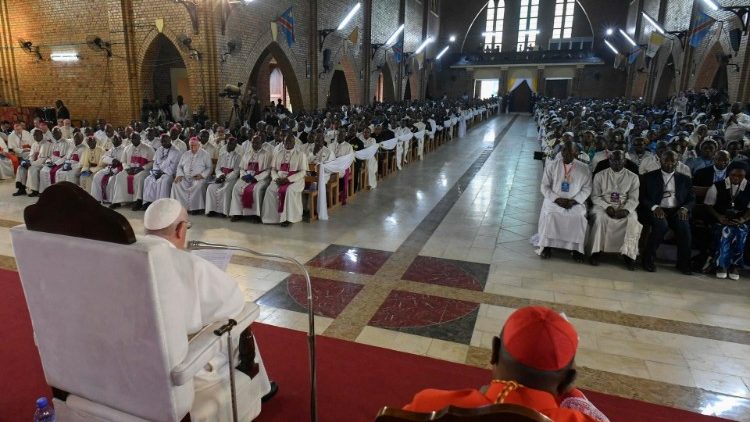
Pope Francis holds meeting with Priests, deacons, seminarians and consecrated religious in Congo (DRC)


Pope Francis addresses clergy and religious in Kinshasa CathedralPope Francis addresses clergy and religious in Kinshasa Cathedral

Pope to clergy and religious in DR Congo: The Church needs you!

Pope Francis encourages priests, deacons, consecrated persons and seminarians to put Christ at the centre of their lives and to be joyful witnesses of the Gospel.

By Christopher Wells

On the Feast of the Presentation of the Lord, Pope Francis met with priests, deacons, consecrated persons, and seminarians in Kinshasa’s Cathedral of Our Lady of the Congo.

Reflecting on the encounter between Simeon and the Christ Child, which is commemorated in the feast, the Holy Father drew out the lesson: “When we place Jesus at the centre of our lives, our outlook changes, and despite all our efforts and difficulties, we feel enveloped by His light, comforted by His Spirit, encouraged by His Word, and sustained by His love.”

He reminded those with religious vocations that, despite “enormous challenges,” there is nonetheless “great joy in the service of the Gospel.” Clergy and religious, the Pope said, are called to be witnesses of God’s love, by anointing His people today “with the balm of consolation and hope.

Servants of the people

Pope Francis emphasized that priests, sisters, missionaries, and others called to religious service are called to be servants of the people, “to act as signs of Christ’s presence, of His unconditional love, His reconciliation and forgiveness, and His compassionate concern for the needs of the poor.”

But this service, he said, will always be lived in the face of challenges and difficulties, including spiritual mediocrity, worldly comfort, and superficiality.

These challenges can be overcome, he said, through prayer, both public and private; through forgetting oneself and devoting one’s life to others; and by being “educated, well-trained, and passionate” witnesses of the Gospel.

“These challenges have to be faced” he continued, “if we want to serve people as witnesses of God’s love.”

“To be good priests, deacons and consecrated persons, words and intentions are not enough: your lives must speak louder than your words.”

‘You are precious and important!’

Acknowledging the difficulties faced by the people of the Democratic Republic of the Congo, Pope Francis reminded the clergy and religious of Jesus, the Good Samaritan, pausing to care for the wounds of the oppressed.

“Brothers and sisters, the ministry to which you are called is precisely this,” he said: “To offer closeness and consolation, like a light that keeps shining amid the encircling gloom.”

Offering his heartfelt thanks to priests, deacons, religious men and women, and seminarians, Pope Francis urged them not to be discouraged “because we need you!”

Speaking in the name of the whole Church, he insisted, “You are precious and important.” And he invited them to “always be channels of the Lord’s consoling presence, joyous witnesses of the Gospel, prophets of peace amid the storms of violence, disciples of love, ever ready to care for the wounds of the poor and suffering.”

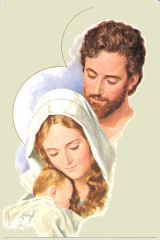
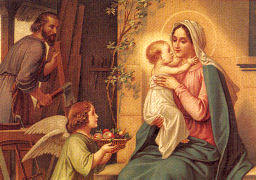
In large part, because of today's feast of the Presentation, February Catholic devotion is dedicated to the Holy Family


Month of the Holy Family

     
"May the Holy Family, icon and model of every human family, help each individual to walk in the spirit of Nazareth."
Highlights
Prayer of the Month
Consecration of the Family to the Holy Family
Lord Jesus Christ, Who, being made subject to Mary and Joseph, hallowed domestic life by Your ineffable virtues; grant that we, with the assistance of both, may be taught by the example of Your holy Family and may attain to its everlasting fellowship; Who lives and reigns world without end. Amen — Roman Missal
Prayer for a Happy Death
Grant unto us, Lord Jesus, ever to follow the example of Thy holy Family, that in the hour of our death Thy glorious Virgin Mother together with blessed Joseph may come to meet us and we may be worthily received by Thee into everlasting dwellings: Who lives and reigns world without end. Amen — Roman Missal
Documents
Websites

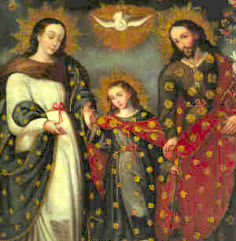
The month of February (Overview - Calendar) is dedicated to the Holy Family. The special devotion which proposes the Holy Family of Jesus, Mary, and Joseph as the model of virtue of all Christian households began in the 17th century. It started almost simultaneously in Canada and France: the Association of the Holy Family was founded in Montreal in 1663, and by the Daughters of the Holy Family in Paris in 1674. This devotion soon spread and in 1893 Leo XIII expressed his approval of a feast under this title and himself composed part of the Office. On account of the flight into Egypt this feast has been observed by the Copts from early times. The feast was welcomed by succeeding Pontiffs as an efficacious means for bringing home to the Christian people the example of the Holy Family at Nazareth, and by the restoration of the true spirit of family life, stemming, in some measure, the evils of present-day society.

In the words of His Holiness Pope Leo XIII, "Nothing truly can be more salutary or efficacious for Christian families to meditate upon than the example of this Holy Family, which embraces the perfection and completeness of all domestic virtues."

The Hidden Life of the Holy Family

The home of Nazareth is the school where we begin to understand the life of Jesus—the school of the Gospel. First, then, a lesson of silence. May esteem for silence, that admirable and indispensable condition of mind, revive in us...A lesson on family life. May Nazareth teach us what family life is, its communion of love, its austere and simple beauty, and its sacred and inviolable character...A lesson of work. Nazareth, home of the Carpenter's Son, in you I would choose to understand and proclaim the severe and redeeming law of human work. — Paul VI at Nazareth, January 5, 1964
Since the Holy Family observed the Jewish law in its perfection, we can deduce quite accurately what prayers they recited. The Psalms, of course, were the favorites. Three times a day Jesus, Mary, and Joseph said the Tephillah, "The Prayer," consisting of eighteen long invocations and blessings. Joseph (and later Jesus when He attained to manhood) was obliged to say the Shema, a sort of profession of faith in the one true God, twice daily.

A very interesting Jewish custom of prayer that must have been observed in the house at Nazareth was that of the Mezuzah, "the doorpost," and the "phylacteries," small square calfskin boxes with Scripture texts written on parchment inside them.

On the doorpost of the house at Nazareth was fastened a wooden tube containing a rolled parchment inscribed with the passage quoted above from the Book of Deuteronomy and another passage (11:13-21) citing the blessings of serving God. On entering and leaving the house the members of the Holy Family would piously touch this Mezuzah, saying, "May God keep my going out and coming in from now on and forevermore." All this was intended to show reverence for the word of God.

Such was the vocal and the more or less formal prayer which Jesus, Mary, and Joseph offered in their home at Nazareth. In their hearts, however, they prayed always. Just as the Heart of Jesus was constantly united with His divinity, so were the hearts of Mary and Joseph so closely bound to God that their every action was a prayer. — Excerpted from Reflections on the Life of Jesus, Mary, and Joseph, Francis L. Filas, S.J.

Imitation of the Holy Family

The Holy Family models for us what family life should exemplify. It is a school of virtue for both parents and children. There we find God, and learn how to connect with God and with others. The family is where love is freely given without self-interest. It is where we learn to love, to pray and to practice the gift of charity. Pope John Paul II has said, “The family, more than any other human reality, is the place in which the person is loved for himself and in which he learns to live the sincere gift of self” (Nov. 27, 2002).

We should ask ourselves if our own families model that of the Holy Family. We need to be open to God’s grace to value the positive and to accept our mistakes — and to be willing to rectify them. Parenting is a very challenging responsibility and at times errors are made despite the best intentions. Recognizing this, children should trust their parents and never forget that parents want only what is best for them.

Which leads us to what may be the most important family virtue — forgiveness. Living so intimately within the family nucleus naturally gives rise to unpleasant situations where someone is apt to be offended. St. Paul knew this when he told us to “bear with and forgive one another.” The health of our family may depend on how quickly we learn to forgive without harboring feelings of resentment.

No family can thrive and grow without constant work. Even the material details that take time and effort are essential to keeping the family strong. Everyone has to pull together for the good of the family — even to the point of putting ahead of our own needs and ambitions the happiness of other family members, setting aside our own selfish desires.

It is also important to pray as a family, especially the holy rosary. Prayer will help us to intensify our closeness with each other and to learn to forgive.

During this Year of the Eucharist it is essential to discover the relationship between the Eucharist and family life. Pope John Paul II wrote, “In the eucharistic gift of charity the Christian family finds the foundation and soul of its communion and its mission” (Letter on the Family, No. 57). — Excerpted from The Holy Family models what family life should be, Archbishop Charles J. Chaput, O.F.M. Cap.

The prayer of the blessing of the candles on Candlemas Day (February 2nd, the Presentation of the Lord)

 In the name of the Father, and of the Son, and of the Holy Spirit.

Then the Priest greets the people in the usual way, and next he gives an introductory address, encouraging the faithful to celebrate the rite of this feast day actively and consciously. He may use these or similar words:

Dear brethren (brothers and sisters),
forty days have passed since we celebrated the joyful feast
of the Nativity of the Lord.
Today is the blessed day
when Jesus was presented in the Temple by Mary and Joseph.
Outwardly he was fulfilling the Law,
but in relation he was coming to meet his believing people.
Prompted by the Holy Spirit,
Simeon and Anna came to the Temple.
Enlightened by the same Spirit,
they recognized the Lord
and confessed him with exultation.
So let us also, gathered together by the Holy Spirit,
proceed to the house of God to encounter Christ.
There we shall find him
and recognize him in the breaking of the bread,
until he comes again, revealed in glory.

After the address the Priest blesses the candles, saying, with hands extended:

Let us pray.
O God, source and origin of all light,
who on this day showed to the just man Simeon
the Light for revelation to the Gentiles,
we humbly ask that,
in answer to your people's prayers,
you may be pleased to sanctify with your blessing + these candles,
which we are eager to carry in praise of your name,
so that, treading the path of virtue,
we may reach that light which never fails.
Through Christ our Lord.
R. Amen.