Showing posts with label Candlemas. Show all posts

Sunday, February 1, 2026

The Feast of the Presentation of the Lord


Ordinary Time: February 2nd

Feast of the Presentation of the Lord


Today the Church celebrates the Feast of the Presentation of the Lord which occurs forty days after the birth of Jesus and is also known as Candlemas Day, since the blessing and procession of candles is included in today's liturgy. See the Prayer Section for the full rite of the Procession and Blessing of Candles at Mass.

Founded by Pope St. John Paul II in 1997, today is the World Day of Prayer for Consecrated Life. He attached it to "Candlemas Day" because the consecrated men and women are to be the light in the world, imitating Jesus, the Light of the World. The World Day of Prayer is moved to the following Sunday to be celebrated in the parishes. See USCCB for more resources.

The previous (1962) liturgical calendar refers to this feast as the "Purification of Mary." This is known as a "Christmas feast" since it points back to the Solemnity of Christmas. Many Catholics practice the tradition of keeping out the Nativity creche or other Christmas decorations until this feast day.

On February 2nd another secular tradition unfolds, Groundhog Day, known well to schoolchildren and adults alike. The fate of Spring hangs in the balance as a burrowing animal looks for its shadow. But where did this tradition come from? See NCRegister for an article that explains this tradition.

The Roman Martyrology also commemorates St. Catherine de Ricci (1522-1590), a native of Florence, Italy, who became a Dominican tertiary in 1535 and eventually filled the offices of novice-mistress and prioress. She was famous for her ecstasies in which she beheld and enacted the scenes of our Lord's passion. It is said that she met St. Philip Neri, in a vision who was still alive in Rome. Three future popes were among the thousands who flocked to her convent to ask her prayers.


Commentary on the Mass Readings for the Feast of the Presentation of the Lord:
Today's First Reading from the prophet Malachi 3:1-4 gives us an important insight to understand profoundly the mystery of the Lord’s Presentation in the Temple by Mary and Joseph, in accordance with the canons of Mosaic Law. The text, taken from the Prophet Malachi says, "I am sending my messenger to prepare the way before me; and suddenly there will come to the temple the Lord who you seek" (Mal 3:1). From all the Gospels, we know that it is the Precursor, St. John the Baptist who was born 6 months before Jesus, that God sent to prepare His way. Putting these evangelical facts together, we can comprehend the words of the Prophet Malachi. The Lord God promised that He would send a Precursor to prepare His way. Since there is only 6 months between the birth of St John the Baptist and Jesus it is clear that the prophecy meant that suddenly after the Precursor, the Lord Himself will come. So, soon after the Baptist’s birth, God entered His temple. Jesus’ presentation signifies God’s entrance to His temple. God made man entered His temple, presenting Himself to those who were really searching for Him.

Today’s Gospel from Luke 2:22-40 introduces us to different people and events that in themselves provide numerous lessons and themes for further reflection. First of all, Mary and Joseph respect the Mosaic Law by offering the sacrifice prescribed for the poor: a pair of turtledoves or two young pigeons.

Simeon and Anna were two venerable elderly people dedicated to prayer and fasting and so their strong religious spirit rendered them able to recognize the Messiah. In this sense we can see in the Presentation of Jesus in the Temple an extension of the ‘Pro Orantibus Day’ (For those who pray) that is celebrated on the feast of the Presentation of Mary (21 November). On this day, the Church demonstrates its gratitude to all those in the community that dedicate themselves in a privileged way to prayer, to those who have a particular religious vocation to the contemplative life. In the figure of the venerable Simeon, Jesus’ presentation in the temple, also reminds us that prayer and contemplation are not just a waste of time or an obstacle to charity. On the contrary, time could not be better spent than in prayer as true Christian charity is a consequence of a solid interior life. Only those who pray and offer penance, like Simeon and Anna, are open to the breath of the Spirit. They know how to recognize the Lord in the circumstances in which He manifests Himself because they possess an ample interior vision, and they have learned how to love with the heart of the One whose very name is Charity.
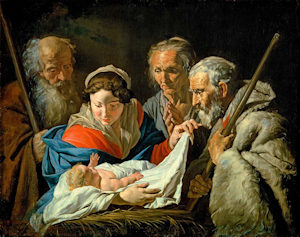
At the end of the Gospel Simeon’s prophecy of Mary’s sufferings is emphasized. Pope John Paul II taught that, ‘Simeon's words seem like a second Annunciation to Mary, for they tell her of the actual historical situation in which the Son is to accomplish his mission, namely, in misunderstanding and sorrow.’ (Redemptoris Mater, n16) The archangel’s announcement was a fount of incredible joy because it pertained to Jesus’ messianic royalty and the supernatural character of His virginal conception. The announcement of the elderly in the temple instead spoke of the Lord’s work of redemption that He would complete associating Himself through suffering to His Mother. Therefore, there is a strong Marian dimension to this feast and so in the previous Liturgical Calendar it is called the Purification of the Blessed Virgin Mary. This refers to the other aspect of the presentation that consists of the ritual purification of Jewish women after they had given birth. In Mary’s case this purification was not necessary, but it indicates the renewal of her total offering of herself to God for the accomplishment of His Divine Plan.

Simeon’s prophecy also announces that Christ will be ‘a sign of contradiction’. St Cyril of Alexandria, in one of his homilies, interpreted the words ‘sign of contradiction’ like a noble cross, as St Paul wrote to the Corinthians ‘a stumbling block to Jews and foolishness to Gentiles’ (1 Cor 1:23) […] It is a sign of contradiction in the sense that those who loose appear as foolish while in those who recognize its power [the cross] reveals salvation and life’ (cf. PG 77, 1044-1049).
—Excerpted from Congregation for the Clergy


Meditation: The Encounter between Chaos and Light
In everyday modern life we are hardly aware that on February and we celebrate an ancient feast, common to the Church of both East and West, which used to have a great significance in the rural calendar: Candlemas. Tributaries from many historical sources have flowed together into this feast, with the result that it sparkles with many colors. Its immediate reference is to the event when Mary and Joseph brought Jesus to the Temple in Jerusalem forty days after his birth to perform the prescribed sacrifice of purification.

The liturgy focuses mainly on one detail of Luke's portrayal: the meeting between the Child Jesus and the aged Simeon. Thus in the Greek-speaking world the feast was called Hypapanti (the encounter). In this juxtaposition of the Child and the old man, the Church sees the encounter between the passing heathen world and the new beginning in Christ, between the fading age of the Old Covenant and the new era of the Church of all nations.

What this expresses is more than the eternal recurrence of death and becoming; it is more than the consoling thought that the passing of one generation is always succeeded by a new one with new ideas and hopes. If that were all, this Child would not represent a hope for Simeon but only for himself. But it is more: it is hope for everyone, because it is a hope transcending death.

This brings us to a second aspect of this day which the liturgy illuminates. It takes up the words of Simeon when he calls this Child "a light to enlighten the Gentiles." Accordingly this day was made into a feast of candles. The warm candlelight is meant to be a tangible reminder of that greater light which, for and beyond all time, radiates from the figure of Jesus. In Rome this candlelit procession supplanted a rowdy, dissolute carnival, the so-called Amburbale, which had survived from paganism right into Christian times. The pagan procession had magical features: it was supposed to effect the purification of the city and the repelling of evil powers.* To remind people of this, the Christian procession was originally celebrated in black vestments and then in purple—until the Council's liturgical reform. Thus the element of encounter, again, was evident in this procession: the pagan world's wild cry for purification, liberation, deliverance from dark powers, meets the "light to enlighten the Gentiles", the mild and humble light of Jesus Christ. The failing (and yet still active) aeon of a foul, chaotic, enslaved and enslaving world encounters the purifying power of the Christian message.

It reminds me of something the playwright Eugene lonesco wrote. As the inventor of the Theatre of the Absurd, he articulated the cry of an absurd world and was increasingly aware that it was a cry for God. "History", he said recently, "is a process of corruption, it is chaotic, unless it is oriented to the super-natural." The candle-lit procession in black garments, the symbolic encounter between chaos and light which it represents, should remind us of this truth and give us courage to see the supernatural, not as a waste of time, distracting us from the business of ameliorating the world, but as the only way in which meaning can be brought to bear on the chaotic side of life.
—From Seek That Which Is Above by Joseph Cardinal Ratzinger (Pope Benedict XVI)


Presentation of the Lord
The feast was first observed in the Eastern Church as "The Encounter." In the sixth century, it began to be observed in the West: in Rome with a more penitential character and in Gaul (France) with solemn blessings and processions of candles, popularly known as "Candlemas." The Presentation of the Lord concludes the celebration of the Nativity and with the offerings of the Virgin Mother and the prophecy of Simeon, the events now point toward Easter.

"In obedience to the Old Law, the Lord Jesus, the first-born, was presented in the Temple by his Blessed Mother and his foster father. This is another 'epiphany' celebration insofar as the Christ Child is revealed as the Messiah through the canticle and words of Simeon and the testimony of Anna the prophetess. Christ is the light of the nations, hence the blessing and procession of candles on this day. In the Middle Ages this feast of the Purification of the Blessed Virgin Mary, or 'Candlemas,' was of great importance.
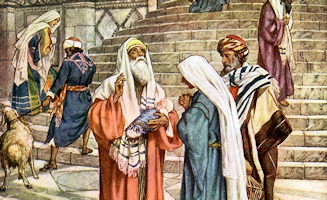
"The specific liturgy of this Candlemas feast, the blessing of candles, is not as widely celebrated as it should be, except of course whenever February 2 falls on a Sunday and thus takes precedence. There are two ways of celebrating the ceremony, either the Procession, which begins at a 'gathering place' outside the church, or the Solemn Entrance, celebrated within the church."
—From Ceremonies of the Liturgical Year

Until 1969, the ancient feast of the Presentation of Our Lord, which is of Oriental origin, was known in the West as the Feast of the Purification of Our Lady, and closed the Christmas Cycle, forty days after the Lord's birth. This feast has for long been associated with many popular devotional exercises. The faithful:

  • gladly participate in the processions commemorating the Lord's entry into the Temple in Jerusalem and His encounter with God, whose house He had come to for the first time, and then with Simeon and Anna. Such processions, which in the West had taken the place of licentious pagan events, always had a penitential character, and were later identified with the blessing of candles which were carried in procession in honor of Christ, 'the light to enlighten the Gentiles' (Lk 2, 32);
  • are sensitive to the actions of the Blessed Virgin in presenting her Son in the Temple, and to her submission to the Law of Moses (Lk 12, 1-8) in the rite of purification; popular piety sees in the rite of purification the humility of Our Lady and hence, 2 February has long been regarded as a feast for those in humble service.

Popular piety is sensitive to the providential and mysterious event that is the conception and birth of new life. Christian mothers can easily identify with the maternity of Our Lady, the most pure Mother of the Head of the mystical Body—notwithstanding the notable differences in the Virgin's unique conception and birth.

These too are mothers in God's plan and are about to give birth to future members of the Church. From this intuition and a certain mimesis of the purification of Our Lady, the rite of purification after birth was developed, some of whose elements reflect negatively on birth.

The revised Rituale Romanum provides for the blessing of women both before and after birth, this latter only in cases where the mother could not participate at the baptism of her child.

It is a highly desirable thing for mothers and married couples to ask for these blessings which should be given in accord with the Church's prayer: in a communion of faith and charity in prayer so that pregnancy can be brought to term without difficulty (blessing before birth), and to give thanks to God for the gift of a child (blessing after birth).
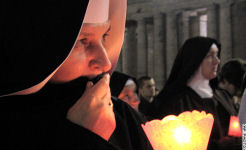
In some local Churches, certain elements taken from the Gospel account of the Presentation of the Lord (Lk 2, 22-40), such as the obedience of Joseph and Mary to the Law of the Lord, the poverty of the holy spouses, the virginity of Our Lady, mark out 2 February as a special feast for those at the service of the brethren in the various forms of consecrated life.

The feast of 2 February still retains a popular character. It is necessary, however, that such should reflect the true Christian significance of the feast. It would not be proper for popular piety in its celebration of this feast to overlook its Christological significance and concentrate exclusively on its Marian aspects. The fact that this feast should be 'considered [...] a joint memorial of Son and Mother' would not support such an inversion. The candles kept by the faithful in their homes should be seen as a sign of Christ 'the light of the world' and an expression of faith.
—Excerpted from Directory on Popular Piety and the Liturgy


Theme of Light
The Feast of the Presentation of the Lord's second major theme is Light. We are well familiar with the beautiful symbolism associated with light. Light means Christ and the supernatural life of grace. Today the Church, responding to Simeon's words, "The Light for the enlightenment of the Gentiles," keeps a genuine "light feast." (The feast was instituted to supplant the pagan Lupercalia, a licentious frolic featuring nocturnal torchlight parades. This explains why at the blessing of the candles and in the procession the celebrant and his ministers used to wear violet, the penitential color.)

Candles are blessed for liturgical use and are also distributed to the faithful. In homes they should be lighted on the occasion of family devotions, in times of storm, household crises, or other dangers; also at the Communion of the sick and at the administration of the Sacrament of the Anointing of the Sick. The Church, moreover, wishes these candles to remind us of our baptismal candles; for the candles we held at baptism signified our heavenly adoption and our duties in the lay priesthood of Christ. Year after year we again receive a baptismal candle so that "with burning lamp" we may hasten to meet the Bridegroom when He comes for the heavenly nuptials.

In the older missal, on two occasions during today's Mass the faithful would light their candles and hold them, at the Gospel and during the Canon until Communion. For in the Gospel and during the Canon Christ is present in a special way. It is the reason why at a High Mass lighted candles and burning incense are introduced. The message which the Church wishes to tell you is this: Actually, you ought to hold burning candles in your hands at every Mass; ordinarily, however, acolytes perform that function in your stead. This feast, however, the lay people had an opportunity to exercise the office of universal or lay priesthood.—Today's Mass, therefore, is truly a "Candle-Mass," practically the only in the entire year.
—Excerpted from The Church's Year of Grace, by Pius Parsch

Sunday, February 2, 2025

How is Candlemas similar to Groundhog Day


February 2nd: Groundhog Day or Candlemas?

“If Candlemas be fair and bright, Come winter, have another flight.
If Candlemas bring clouds and rain, Go winter, and come not again.”

Groundhog Day or Candlemas?

On February 2nd a quaint tradition unfolds, known well to schoolchildren and adults alike. The fate of Spring hangs in the balance as a burrowing animal looks for its shadow. But where did the this tradition come from?

For centuries, February 2nd  has been celebrated as Candlemas, a Christian Feast Day. Candlemas is also called the Feast of the Presentation, because it honors the day that Mary and Joseph presented the infant Jesus at the Temple. In bringing their child to the Temple and offering a sacrifice, Jesus’ parents were following the Mosaic law (specifically Leviticus 12:6). As the Gospel of Luke recounts:

And when the time came for their purification according to the Law of Moses, they brought him up to Jerusalem to present him to the Lord.” (Luke 2:22)

The painting at the top of this article shows the holy man Simeon blessing the Christ child at the Temple.

Why is Candlemas on February 2nd?

The date of Candlemas is always February 2nd because it is exactly 40 days (inclusive) after Christmas on December 25th. The Mosaic law stated that 40 days was the period of purification after the birth of a child, and so the presentation took place 40 days after Jesus was born. Incidentally, February 2nd is also halfway between the winter solstice and the spring equinox, so the date has always had significance for ancient people.

So What’s the Connection to Groundhog Day?

Candlemas became linked to weather predictions about the end of winter because of an old English poem:

If Candlemas be fair and bright,
Come winter, have another flight.
If Candlemas bring clouds and rain,
Go winter, and come not again.

It makes sense that early February was a good time to prognosticate about the weather, especially as February 2nd marks the midpoint between Winter and Spring. And the English poem appears to be the source of the shadow connection: “fair and bright” = sun = shadows = more winter, while “clouds and rain” = no sun = no shadows = spring arriving soon. It seems counterintuitive (why should a sunny day mean more winter?), but this is the exact pattern that Groundhog Day follows.

On one Sunday we celebrate the Presentation of the Lord, Candlemas and World Day of Consecrated Life


Ordinary Time: February 2nd

Feast of the Presentation of the Lord

Other Titles: Candlemas

facebook sharing button Share
twitter sharing button Tweet
linkedin sharing button Share
pinterest sharing button Pin
email sharing button Email
sharethis sharing button

MASS READINGS

February 02, 2025 (Readings on USCCB website)

PROPERS [Show]

COLLECT PRAYER

Feast of the Presentation of the Lord: Almighty ever-living God, we humbly implore your majesty that, just as your Only Begotten Son was presented on this day in the Temple in the substance of our flesh, so, by your grace, we may be presented to you with minds made pure. Through our Lord Jesus Christ, your Son, who lives and reigns with you in the unity of the Holy Spirit, God, for ever and ever.

show

Recipes (5)

show

Activities (25)

show

Prayers (11)

show

Library (5)

show

Blog & Podcasts (10)


Today the Church celebrates the Feast of the Presentation of the Lord which occurs forty days after the birth of Jesus and is also known as Candlemas Day, since the blessing and procession of candles is included in today's liturgy. See the Prayer Section for the full rite of the Procession and Blessing of Candles at Mass.

The Feast of the Presentation of the Lord supersedes the Fourth Sunday in Ordinary Time. Feasts of the Lord that fall on a Sunday in Ordinary Time and in the Christmas season replace the Sunday liturgy. See A Sunday Feast: the Presentation of the Lord.

Founded by Pope St. John Paul II in 1997, today is the World Day of Prayer for Consecrated Life. He attached it to "Candlemas Day" because the consecrated men and women are to be the light in the world, imitating Jesus, the Light of the World. The World Day of Prayer is moved to the following Sunday to be celebrated in the parishes. See USCCB for more resources.

The previous (1962) liturgical calendar refers to this feast as the "Purification of Mary." This is known as a "Christmas feast" since it points back to the Solemnity of Christmas. Many Catholics practice the tradition of keeping out the Nativity creche or other Christmas decorations until this feast day.

On February 2nd another secular tradition unfolds, Groundhog Day, known well to schoolchildren and adults alike. The fate of Spring hangs in the balance as a burrowing animal looks for its shadow. But where did this tradition come from? See uCatholic for an article that explains this tradition.

The Roman Martyrology also commemorates St. Catherine de Ricci (1522-1590), a native of Florence, Italy, who became a Dominican tertiary in 1535 and eventually filled the offices of novice-mistress and prioress. She was famous for her ecstasies in which she beheld and enacted the scenes of our Lord's passion. It is said that she met St. Philip Neri, in a vision who was still alive in Rome. Three future popes were among the thousands who flocked to her convent to ask her prayers.


Commentary on the Mass Readings for the Feast of the Presentation of the Lord:
Today's First Reading from the prophet Malachi 3:1-4 gives us an important insight to understand profoundly the mystery of the Lord’s Presentation in the Temple by Mary and Joseph, in accordance with the canons of Mosaic Law. The text, taken from the Prophet Malachi says, "I am sending my messenger to prepare the way before me; and suddenly there will come to the temple the Lord who you seek" (Mal 3:1). From all the Gospels, we know that it is the Precursor, St. John the Baptist who was born 6 months before Jesus, that God sent to prepare His way. Putting these evangelical facts together, we can comprehend the words of the Prophet Malachi. The Lord God promised that He would send a Precursor to prepare His way. Since there is only 6 months between the birth of St John the Baptist and Jesus it is clear that the prophecy meant that suddenly after the Precursor, the Lord Himself will come. So, soon after the Baptist’s birth, God entered His temple. Jesus’ presentation signifies God’s entrance to His temple. God made man entered His temple, presenting Himself to those who were really searching for Him.

Today’s Gospel from Luke 2:22-40 introduces us to different people and events that in themselves provide numerous lessons and themes for further reflection. First of all, Mary and Joseph respect the Mosaic Law by offering the sacrifice prescribed for the poor: a pair of turtledoves or two young pigeons.

Simeon and Anna were two venerable elderly people dedicated to prayer and fasting and so their strong religious spirit rendered them able to recognize the Messiah. In this sense we can see in the Presentation of Jesus in the Temple an extension of the ‘Pro Orantibus Day’ (For those who pray) that is celebrated on the feast of the Presentation of Mary (21 November). On this day, the Church demonstrates its gratitude to all those in the community that dedicate themselves in a privileged way to prayer, to those who have a particular religious vocation to the contemplative life. In the figure of the venerable Simeon, Jesus’ presentation in the temple, also reminds us that prayer and contemplation are not just a waste of time or an obstacle to charity. On the contrary, time could not be better spent than in prayer as true Christian charity is a consequence of a solid interior life. Only those who pray and offer penance, like Simeon and Anna, are open to the breath of the Spirit. They know how to recognize the Lord in the circumstances in which He manifests Himself because they possess an ample interior vision, and they have learned how to love with the heart of the One whose very name is Charity.

At the end of the Gospel Simeon’s prophecy of Mary’s sufferings is emphasized. Pope John Paul II taught that, ‘Simeon's words seem like a second Annunciation to Mary, for they tell her of the actual historical situation in which the Son is to accomplish his mission, namely, in misunderstanding and sorrow.’ (Redemptoris Mater, n16) The archangel’s announcement was a fount of incredible joy because it pertained to Jesus’ messianic royalty and the supernatural character of His virginal conception. The announcement of the elderly in the temple instead spoke of the Lord’s work of redemption that He would complete associating Himself through suffering to His Mother. Therefore, there is a strong Marian dimension to this feast and so in the previous Liturgical Calendar it is called the Purification of the Blessed Virgin Mary. This refers to the other aspect of the presentation that consists of the ritual purification of Jewish women after they had given birth. In Mary’s case this purification was not necessary, but it indicates the renewal of her total offering of herself to God for the accomplishment of His Divine Plan.

Simeon’s prophecy also announces that Christ will be ‘a sign of contradiction’. St Cyril of Alexandria, in one of his homilies, interpreted the words ‘sign of contradiction’ like a noble cross, as St Paul wrote to the Corinthians ‘a stumbling block to Jews and foolishness to Gentiles’ (1 Cor 1:23) […] It is a sign of contradiction in the sense that those who loose appear as foolish while in those who recognize its power [the cross] reveals salvation and life’ (cf. PG 77, 1044-1049).
—Excerpted from Congregation for the Clergy


Presentation of the Lord
The feast was first observed in the Eastern Church as "The Encounter." In the sixth century, it began to be observed in the West: in Rome with a more penitential character and in Gaul (France) with solemn blessings and processions of candles, popularly known as "Candlemas." The Presentation of the Lord concludes the celebration of the Nativity and with the offerings of the Virgin Mother and the prophecy of Simeon, the events now point toward Easter.

"In obedience to the Old Law, the Lord Jesus, the first-born, was presented in the Temple by his Blessed Mother and his foster father. This is another 'epiphany' celebration insofar as the Christ Child is revealed as the Messiah through the canticle and words of Simeon and the testimony of Anna the prophetess. Christ is the light of the nations, hence the blessing and procession of candles on this day. In the Middle Ages this feast of the Purification of the Blessed Virgin Mary, or 'Candlemas,' was of great importance.

"The specific liturgy of this Candlemas feast, the blessing of candles, is not as widely celebrated as it should be, except of course whenever February 2 falls on a Sunday and thus takes precedence. There are two ways of celebrating the ceremony, either the Procession, which begins at a 'gathering place' outside the church, or the Solemn Entrance, celebrated within the church."
—From Ceremonies of the Liturgical Year


Until 1969, the ancient feast of the Presentation of Our Lord, which is of Oriental origin, was known in the West as the Feast of the Purification of Our Lady, and closed the Christmas Cycle, forty days after the Lord's birth. This feast has for long been associated with many popular devotional exercises. The faithful:

  • gladly participate in the processions commemorating the Lord's entry into the Temple in Jerusalem and His encounter with God, whose house He had come to for the first time, and then with Simeon and Anna. Such processions, which in the West had taken the place of licentious pagan events, always had a penitential character, and were later identified with the blessing of candles which were carried in procession in honor of Christ, 'the light to enlighten the Gentiles' (Lk 2, 32);
  • are sensitive to the actions of the Blessed Virgin in presenting her Son in the Temple,World Day  and to her submission to the Law of Moses (Lk 12, 1-8) in the rite of purification; popular piety sees in the rite of purification the humility of Our Lady and hence, 2 February has long been regarded as a feast for those in humble service.

Popular piety is sensitive to the providential and mysterious event that is the conception and birth of new life. Christian mothers can easily identify with the maternity of Our Lady, the most pure Mother of the Head of the mystical Body—notwithstanding the notable differences in the Virgin's unique conception and birth.

These too are mothers in God's plan and are about to give birth to future members of the Church. From this intuition and a certain mimesis of the purification of Our Lady, the rite of purification after birth was developed, some of whose elements reflect negatively on birth.

The revised Rituale Romanum provides for the blessing of women both before and after birth, this latter only in cases where the mother could not participate at the baptism of her child.

It is a highly desirable thing for mothers and married couples to ask for these blessings which should be given in accord with the Church's prayer: in a communion of faith and charity in prayer so that pregnancy can be brought to term without difficulty (blessing before birth), and to give thanks to God for the gift of a child (blessing after birth).

In some local Churches, certain elements taken from the Gospel account of the Presentation of the Lord (Lk 2, 22-40), such as the obedience of Joseph and Mary to the Law of the Lord, the poverty of the holy spouses, the virginity of Our Lady, mark out 2 February as a special feast for those at the service of the brethren in the various forms of consecrated life.

The feast of 2 February still retains a popular character. It is necessary, however, that such should reflect the true Christian significance of the feast. It would not be proper for popular piety in its celebration of this feast to overlook its Christological significance and concentrate exclusively on its Marian aspects. The fact that this feast should be 'considered [...] a joint memorial of Son and Mother' would not support such an inversion. The candles kept by the faithful in their homes should be seen as a sign of Christ 'the light of the world' and an expression of faith.
—Excerpted from Directory on Popular Piety and the Liturgy


Theme of Light
The Feast of the Presentation of the Lord's second major theme is Light. We are well familiar with the beautiful symbolism associated with light. Light means Christ and the supernatural life of grace. Today the Church, responding to Simeon's words, "The Light for the enlightenment of the Gentiles," keeps a genuine "light feast." (The feast was instituted to supplant the pagan Lupercalia, a licentious frolic featuring nocturnal torchlight parades. This explains why at the blessing of the candles and in the procession the celebrant and his ministers used to wear violet, the penitential color.)

Candles are blessed for liturgical use and are also distributed to the faithful. In homes they should be lighted on the occasion of family devotions, in times of storm, household crises, or other dangers; also at the Communion of the sick and at the administration of the Sacrament of the Anointing of the Sick. The Church, moreover, wishes these candles to remind us of our baptismal candles; for the candles we held at baptism signified our heavenly adoption and our duties in the lay priesthood of Christ. Year after year we again receive a baptismal candle so that "with burning lamp" we may hasten to meet the Bridegroom when He comes for the heavenly nuptials.

In the older missal, on two occasions during today's Mass the faithful would light their candles and hold them, at the Gospel and during the Canon until Communion. For in the Gospel and during the Canon Christ is present in a special way. It is the reason why at a High Mass lighted candles and burning incense are introduced. The message which the Church wishes to tell you is this: Actually, you ought to hold burning candles in your hands at every Mass; ordinarily, however, acolytes perform that function in your stead. This feast, however, the lay people had an opportunity to exercise the office of universal or lay priesthood.—Today's Mass, therefore, is truly a "Candle-Mass," practically the only in the entire year.
—Excerpted from The Church's Year of Grace, by Pius Parsch

Highlights and Things to Do:

  • Ask your parish priest to bless the candles that you will be using on your home altar/prayer table this year. Candles for liturgical uses formerly were required to be primarily of beeswax, but post Vatican II the candles need to be made of wax but the exact composition is determined by the local Ordinary. For cleaner burning, longer lasting, and less pollutants, beeswax is still the best option.
  • Have a family Candlemas procession, found in the prayer links.
  • Read Luke 2:22-35, the account of the presentation including the Canticle of Simeon.
  • Meditate on the constant fiat of Our Lady of Sorrows, who embraced the will of God even as Simeon predicted that a sword would pierce her heart.

Thursday, February 1, 2024

Feast of the Presentation of the Lord


Ordinary Time: February 2nd

Feast of the Presentation of the Lord

 Other Titles: Candlemas


MASS READINGS

February 02, 2024 (Readings on USCCB website)

PROPERS [show]

COLLECT PRAYER

Feast of the Presentation of the Lord: Almighty ever-living God, we humbly implore your majesty that, just as your Only Begotten Son was presented on this day in the Temple in the substance of our flesh, so, by your grace, we may be presented to you with minds made pure. Through our Lord Jesus Christ, your Son, who lives and reigns with you in the unity of the Holy Spirit, God, for ever and ever.

show

RECIPES (5)

show

ACTIVITIES (25)

show

PRAYERS (11)

show

LIBRARY (5)

show

BLOG & PODCASTS (10)


Today the Church celebrates the Feast of the Presentation of the Lord which occurs forty days after the birth of Jesus and is also known as Candlemas Day, since the blessing and procession of candles is included in today's liturgy. See the prayer's section for the full rite of the Procession and Blessing of Candles at Mass.

Founded by Pope St. John Paul II in 1997, today is the World Day of Prayer for Consecrated Life. He attached it to "Candlemas Day" because the consecrated men and women are to be the light in the world, imitating Jesus, the Light of the World. The World Day of Prayer is moved to the following Sunday to be celebrated in the parishes. See USCCB for more resources.

The previous (1962) liturgical calendar refers to this feast as the "Purification of Mary." This is known as a "Christmas feast" since it points back to the Solemnity of Christmas. Many Catholics practice the tradition of keeping out the Nativity creche or other Christmas decorations until this feast day.

On February 2nd another secular tradition unfolds, , known well to schoolchildren and adults alike. The fate of Spring hangs in the balance as a burrowing animal looks for its shadow. But where did this tradition come from? See the link below for an article that explains this tradition.


Thoughts on the Liturgy

Today's First Reading from the prophet Malachi 3:1-4 gives us an important insight to understand profoundly the mystery of the Lord’s Presentation in the Temple by Mary and Joseph, in accordance with the canons of Mosaic Law. The text, taken from the Prophet Malachi says, "I am sending my messenger to prepare the way before me; and suddenly there will come to the temple the Lord who you seek" (Mal 3:1). From all the Gospels, we know that it is the Precursor, St. John the Baptist who was born 6 months before Jesus, that God sent to prepare His way. Putting these evangelical facts together, we can comprehend the words of the Prophet Malachi. The Lord God promised that He would send a Precursor to prepare His way. Since there is only 6 months between the birth of St John the Baptist and Jesus it is clear that the prophecy meant that suddenly after the Precursor, the Lord Himself will come. So, soon after the Baptist’s birth, God entered His temple. Jesus’ presentation signifies God’s entrance to His temple. God made man entered His temple, presenting Himself to those who were really searching for Him.

Today’s Gospel from Luke 2:22-40 introduces us to different people and events that in themselves provide numerous lessons and themes for further reflection. First of all, Mary and Joseph respect the Mosaic Law by offering the sacrifice prescribed for the poor: a pair of turtledoves or two young pigeons.

Simeon and Anna were two venerable elderly people dedicated to prayer and fasting and so their strong religious spirit rendered them able to recognize the Messiah. In this sense we can see in the Presentation of Jesus in the Temple an extension of the ‘Pro Orantibus Day’ (For those who pray) that is celebrated on the feast of the Presentation of Mary (21 November). On this day, the Church demonstrates its gratitude to all those in the community that dedicate themselves in a privileged way to prayer, to those who have a particular religious vocation to the contemplative life. In the figure of the venerable Simeon, Jesus’ presentation in the temple, also reminds us that prayer and contemplation are not just a waste of time or an obstacle to charity. On the contrary, time could not be better spent than in prayer as true Christian charity is a consequence of a solid interior life. Only those who pray and offer penance, like Simeon and Anna, are open to the breath of the Spirit. They know how to recognize the Lord in the circumstances in which He manifests Himself because they possess an ample interior vision, and they have learned how to love with the heart of the One whose very name is Charity.

At the end of the Gospel Simeon’s prophecy of Mary’s sufferings is emphasized. Pope John Paul II taught that, ‘Simeon's words seem like a second Annunciation to Mary, for they tell her of the actual historical situation in which the Son is to accomplish his mission, namely, in misunderstanding and sorrow.’ (Redemptoris Mater, n16) The archangel’s announcement was a fount of incredible joy because it pertained to Jesus’ messianic royalty and the supernatural character of His virginal conception. The announcement of the elderly in the temple instead spoke of the Lord’s work of redemption that He would complete associating Himself through suffering to His Mother. Therefore, there is a strong Marian dimension to this feast and so in the previous Liturgical Calendar it is called the Purification of the Blessed Virgin Mary. This refers to the other aspect of the presentation that consists of the ritual purification of Jewish women after they had given birth. In Mary’s case this purification was not necessary, but it indicates the renewal of her total offering of herself to God for the accomplishment of His Divine Plan.

Simeon’s prophecy also announces that Christ will be ‘a sign of contradiction’. St Cyril of Alexandria, in one of his homilies, interpreted the words ‘sign of contradiction’ like a noble cross, as St Paul wrote to the Corinthians ‘a stumbling block to Jews and foolishness to Gentiles’ (1 Cor 1:23) […] It is a sign of contradiction in the sense that those who loose appear as foolish while in those who recognize its power [the cross] reveals salvation and life’ (cf. PG 77, 1044-1049).
—Excerpted from Congregation for the Clergy


Presentation of the Lord
The feast was first observed in the Eastern Church as "The Encounter." In the sixth century, it began to be observed in the West: in Rome with a more penitential character and in Gaul (France) with solemn blessings and processions of candles, popularly known as "Candlemas." The Presentation of the Lord concludes the celebration of the Nativity and with the offerings of the Virgin Mother and the prophecy of Simeon, the events now point toward Easter.

"In obedience to the Old Law, the Lord Jesus, the first-born, was presented in the Temple by his Blessed Mother and his foster father. This is another 'epiphany' celebration insofar as the Christ Child is revealed as the Messiah through the canticle and words of Simeon and the testimony of Anna the prophetess. Christ is the light of the nations, hence the blessing and procession of candles on this day. In the Middle Ages this feast of the Purification of the Blessed Virgin Mary, or 'Candlemas,' was of great importance.

"The specific liturgy of this Candlemas feast, the blessing of candles, is not as widely celebrated as it should be, except of course whenever February 2 falls on a Sunday and thus takes precedence. There are two ways of celebrating the ceremony, either the Procession, which begins at a 'gathering place' outside the church, or the Solemn Entrance, celebrated within the church."
—From Ceremonies of the Liturgical Year


Until 1969, the ancient feast of the Presentation of Our Lord, which is of Oriental origin, was known in the West as the feast of the Purification of Our Lady, and closed the Christmas Cycle, forty days after the Lord's birth. This feast has for long been associated with many popular devotional exercises. The faithful:

  • gladly participate in the processions commemorating the Lord's entry into the Temple in Jerusalem and His encounter with God, whose house He had come to for the first time, and then with Simeon and Anna. Such processions, which in the West had taken the place of licentious pagan events, always had a penitential character, and were later identified with the blessing of candles which were carried in procession in honor of Christ, 'the light to enlighten the Gentiles' (Lk 2, 32);
  • are sensitive to the actions of the Blessed Virgin in presenting her Son in the Temple, and to her submission to the Law of Moses (Lk 12, 1-8) in the rite of purification; popular piety sees in the rite of purification the humility of Our Lady and hence, 2 February has long been regarded as a feast for those in humble service.

Popular piety is sensitive to the providential and mysterious event that is the conception and birth of new life. Christian mothers can easily identify with the maternity of Our Lady, the most pure Mother of the Head of the mystical Body—notwithstanding the notable differences in the Virgin's unique conception and birth.

These too are mothers in God's plan and are about to give birth to future members of the Church. From this intuition and a certain mimesis of the purification of Our Lady, the rite of purification after birth was developed, some of whose elements reflect negatively on birth.

The revised Rituale Romanum provides for the blessing of women both before and after birth, this latter only in cases where the mother could not participate at the baptism of her child.

It is a highly desirable thing for mothers and married couples to ask for these blessings which should be given in accord with the Church's prayer: in a communion of faith and charity in prayer so that pregnancy can be brought to term without difficulty (blessing before birth), and to give thanks to God for the gift of a child (blessing after birth).

In some local Churches, certain elements taken from the Gospel account of the Presentation of the Lord (Lk 2, 22-40), such as the obedience of Joseph and Mary to the Law of the Lord, the poverty of the holy spouses, the virginity of Our Lady, mark out 2 February as a special feast for those at the service of the brethren in the various forms of consecrated life.

The feast of 2 February still retains a popular character. It is necessary, however, that such should reflect the true Christian significance of the feast. It would not be proper for popular piety in its celebration of this feast to overlook its Christological significance and concentrate exclusively on its Marian aspects. The fact that this feast should be 'considered [...] a joint memorial of Son and Mother' would not support such an inversion. The candles kept by the faithful in their homes should be seen as a sign of Christ 'the light of the world' and an expression of faith.
—Excerpted from Directory on Popular Piety and the Liturgy


Theme of Light
The Feast of the Presentation of the Lord's second major theme is Light. We are well familiar with the beautiful symbolism associated with light. Light means Christ and the supernatural life of grace. Today the Church, responding to Simeon's words, "The Light for the enlightenment of the Gentiles," keeps a genuine "light feast." (The feast was instituted to supplant the pagan Lupercalia, a licentious frolic featuring nocturnal torchlight parades. This explains why at the blessing of the candles and in the procession the celebrant and his ministers used to wear violet, the penitential color.)

Candles are blessed for liturgical use and are also distributed to the faithful. In homes they should be lighted on the occasion of family devotions, in times of storm, household crises, or other dangers; also at the Communion of the sick and at the administration of the Sacrament of the Anointing of the Sick. The Church, moreover, wishes these candles to remind us of our baptismal candles; for the candles we held at baptism signified our heavenly adoption and our duties in the lay priesthood of Christ. Year after year we again receive a baptismal candle so that "with burning lamp" we may hasten to meet the Bridegroom when He comes for the heavenly nuptials.

In the older missal, on two occasions during today's Mass the faithful would light their candles and hold them, at the Gospel and during the Canon until Communion. For in the Gospel and during the Canon Christ is present in a special way. It is the reason why at a High Mass lighted candles and burning incense are introduced. The message which the Church wishes to tell you is this: Actually, you ought to hold burning candles in your hands at every Mass; ordinarily, however, acolytes perform that function in your stead. This feast, however, the lay people had an opportunity to exercise the office of universal or lay priesthood.—Today's Mass, therefore, is truly a "Candle-Mass," practically the only in the entire year.
—Excerpted from The Church's Year of Grace, by Pius Parsch

Tuesday, January 16, 2024

Good question. When does Christmas season really end?


On what feast does the Christmas season really end?


Question: There seems to be two ends to the season of Christmas: the feast of Baptism of the Lord, and the feast of the Presentation of the Lord, known as Candlemas. Why do some consider the later feast to be the final end of the Christmas season if Ordinary Time resumes after the feast of Christ’s baptism? And why doesn’t the liturgical season of Christmas get a longer season, similar to the seven weeks of Easter? 

— Name, location withheld 

Answer: According to the norms issued by the Church, “The liturgical season of Christmas begins with the vigil Masses on Christmas Eve and concludes on the Feast of the Baptism of the Lord.” Hence, the feast of the Baptism of the Lord does mark the definitive end of the Christmas liturgical cycle. While it is true that the feast of the Presentation of the Lord (Candlemas) occurs 40 days after Christmas, it is a kind of looking back to Christmas, not an extension of it. It is like the feast of Annunciation, part of the Christmas cycle, which is inserted into the Lenten season. The elimination of Epiphanytide (in 1970) may be the reason some try to extend Christmas to Feb. 2, but even then, Epiphanytide was not Christmastide. While Christmas is shorter, Easter is the great high feast of the Church and that for which Christ was born: to suffer, die and rise for our salvation. It is suitable that it be celebrated highly and, in a way, contains Christmas.

Thursday, February 2, 2023

The prayer of the blessing of the candles on Candlemas Day (February 2nd, the Presentation of the Lord)

 In the name of the Father, and of the Son, and of the Holy Spirit.

Then the Priest greets the people in the usual way, and next he gives an introductory address, encouraging the faithful to celebrate the rite of this feast day actively and consciously. He may use these or similar words:

Dear brethren (brothers and sisters),
forty days have passed since we celebrated the joyful feast
of the Nativity of the Lord.
Today is the blessed day
when Jesus was presented in the Temple by Mary and Joseph.
Outwardly he was fulfilling the Law,
but in relation he was coming to meet his believing people.
Prompted by the Holy Spirit,
Simeon and Anna came to the Temple.
Enlightened by the same Spirit,
they recognized the Lord
and confessed him with exultation.
So let us also, gathered together by the Holy Spirit,
proceed to the house of God to encounter Christ.
There we shall find him
and recognize him in the breaking of the bread,
until he comes again, revealed in glory.

After the address the Priest blesses the candles, saying, with hands extended:

Let us pray.
O God, source and origin of all light,
who on this day showed to the just man Simeon
the Light for revelation to the Gentiles,
we humbly ask that,
in answer to your people's prayers,
you may be pleased to sanctify with your blessing + these candles,
which we are eager to carry in praise of your name,
so that, treading the path of virtue,
we may reach that light which never fails.
Through Christ our Lord.
R. Amen.

Wednesday, February 1, 2023

Candlemas and Groundhog Day

 How Candlemas Day Turned Into Groundhog Day


Published: Jan 26, 2021, 9:43 PM

“If Candlemas be fair and bright, come winter, have another flight. If Candlemas bring clouds and rain, go winter, and come not again.” - English folk song


If a day to predict the arrival of spring weather sounds familiar, it probably calls to mind Groundhog Day. However, for centuries, February 2nd was celebrated as a Christian Feast Day known as Candlemas. The day also bore significance outside of Christianity, marking the halfway point between the winter solstice and the spring equinox. It was celebrated as an ancient Roman festival of light.


The name ‘Candlemas’ refers to the traditional processions and blessing of candles that came to characterize the feast day. It also is called the Feast of the Presentation, because it honors the day that Mary and Joseph presented the infant Jesus at the Temple according to Mosaic law.


Candlemas Day was always celebrated on February 2nd, exactly 40 days after Christmas on December 25th. Mosaic law stated that 40 days was the period of purification time after the birth of a child.


Candlemas also presented an opportunity to predict weather. According to the New England Historical Society, New Englanders who once lived in old houses looked at how far the sun would shine in through cracks in the structure to determine how far the snow would continue to blow in through to the month of May.


Like many religious celebrations, Candlemas has a secular alternative in Groundhog Day. Groundhog Day was first recognized in the United States during the late 1800s and was popularized in Pennsylvania by German settlers who had their own Candlemas Day rhymes related to the weather. The Germans connected weather prognostication to the local hedgehog. When German immigrants arrived in America, there were no hedgehogs, so they used the groundhog, the closest representative animal they could find. The tradition grew so popular it was eventually commercialized. Thousands began to flock to Punxsutawney, PA, to watch Punxsutawney Phil make his prediction