Wednesday, September 7, 2022

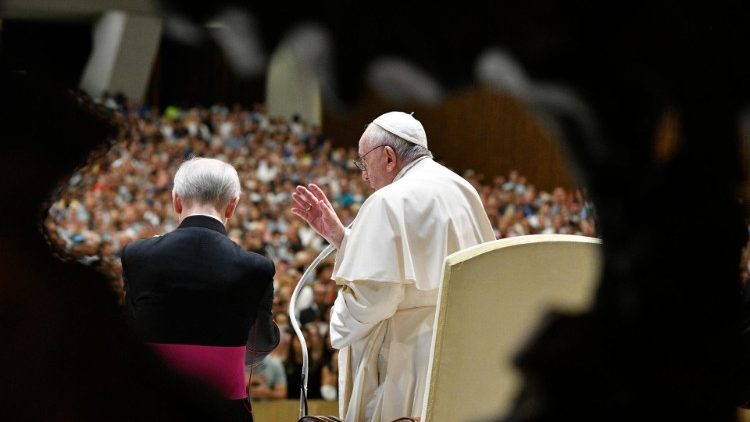
Wednesday Papal General Audience 09.07.2022


Pope at Audience: Discernment helps us recognize God in unexpected events

Pope Francis sheds light on the theme of discernment during his catechesis at the weekly General Audience by recalling the example of St. Ignatius of Loyola, and highlights how God works through unforeseen events and mishaps.

By Benedict Mayaki, SJ

Pope Francis continued his cycle of reflections on the theme of discernment during his catechesis at the General Audience on Wednesday.

St. Ignatius of Loyola

The Holy Father recalled the example of St. Ignatius of Loyola, and the decisive episode of the saint’s life when he was home convalescing after his leg was injured in battle. To chase away boredom, St. Ignatius asked for something to read and unfortunately, only the lives of saints was to be found in the house.

In the course of reading, St. Ignatius began to discover another world that captivated him and seemed to compete with that of knights, and he became fascinated by the figures of Sts. Francis and Dominic, with a desire to imitate them.

Saint Ignatius sensed within himself an alternation of thoughts, and he began to notice differences. In his autobiography, the saint notes that when he thought about the things of the world, he felt much pleasure, but afterward, he felt dry and sad. Instead, when he thought of going to Jerusalem barefoot and practicing other austerities, he found pleasure not only while thinking of them, but also when he had ceased.

Time and the end point of thoughts

Pope Francis noted that two aspects are noticeable in St. Ignatius’ experience. First, time, because thoughts of the world are attractive at first but they lose their lustre and leave one empty and discontented.

“Thoughts of God, on the contrary, rouse first a certain resistance, but when they are welcomed, they bring an unknown peace that lasts over time.”

The other aspect is the end point of thoughts, added the Pope. There is a development of discernment, and we understand what is good for us not in an abstract, general way, but in the journey of our life.

In fact, St. Ignatius in the rules for discernment lays out an important premise: "In the persons who go from mortal sin to mortal sin, the enemy is commonly used to propose to them apparent pleasures, making them imagine sensual delights and pleasures in order to hold them more and make them grow in their vices and sins. In these persons, the good spirit uses the opposite method, pricking them and biting their consciences through the process of reason."

“There is a history that precedes one who discerns, a history that is indispensable to know, because discernment is not a sort of oracle or fatalism, like casting one’s lot on two possibilities.”

Indeed, the great questions arise when we have travelled a stretch of the road in life, and it is to that journey we must return to understand what we are looking for.

Fr St. Ignatius, who was not thinking of God when he found himself injured after battle, his first experience of God was by listening to his own heart which showed him a reversal – that things that were attractive at first sight left him disillusioned, whereas in others, less dazzling, he found lasting peace.

God works in unplanned events

Another aspect of discernment is the “apparent randomness in the events of life,” Pope Francis said.

During St. Ignatius’ convalescence, there were no books of knights, only lives of saints – a mishap that held a possible turning point - and it is only after some time that Ignatius realized this, at which point he devoted his full attention to it.

“God works through unforeseen events, and also in mishaps,” stressed the Pope, pointing at the passage from the Gospel of Matthew of the man plowing his field and coming across a buried treasure. The man subsequently recognizes it as the windfall of his life and acts accordingly, selling everything and buying the field.

Concluding, Pope noted that discernment is the “aid in recognizing the signals with which the Lord makes Himself known in unexpected, even unpleasant situations, as the leg injury was for St. Ignatius, and a life-changing encounter can arise from them forever."

Tuesday, September 6, 2022

Wednesday Saint of the Day

St. Cloud


Feastday: September 7
Patron: of against carbuncles; nail makers; Diocese of Saint Cloud, Minnesota
Birth: 522
Death: 560


On the death of Clovis, King of the Franks, in the year 511 his kingdom was divided between his four sons, of whom the second was Clodomir. Thirteen years later he was killed fighting against his cousin, Gondomar, leaving three sons to share his dominions. The youngest of these sons of Clodomir was St. Clodoald, a name more familiar to English people under its French form of Cloud from the town of Saint-Cloud near Versailles. When Cloud was eight years old, his uncle Childebert plotted with his brother, to get rid of the boys and divide their kingdom. The eldest boy, Theodoald was stabbed to death. The second, Gunther fled in terror, but was caught and also killed. Cloud escaped and was taken for safety into Provence or elsewhere.

Childebert and his brother Clotaire shared the fruits of their crime, and Cloud made no attempt to recover his kingdom when he came of age. He put himself under the discipline of St. Severinus, a recluse who lived near Paris, and he afterwards went to Nogent on the Seine and had his heritage where is now Saint-Cloud. St. Cloud was indefatigable in instructing the people of the neighboring country, and ended his days at Nogent about the year 560 when he was some thirty-six years old. St. Cloud's feast day is September 7th.

Loyola U. of New Orleans remembers Catholic Mayor Moon Landrieu


Moon Landrieu: A dedicated public servant for social justice, equality


Dear Loyola community,

I am writing to share with you the passing of the Honorable Maurice “Moon” Landrieu, who died peacefully at home on Labor Day at 92 following an extraordinary life. 

Our hearts and prayers go out to his family and friends, especially his wife of 68 years, Verna Satterlee Landrieu, whom he met right here on campus as a young man, his nine children, including College of Law Dean Madeleine Landrieu, and his 37 grandchildren and 15 great-grandchildren, many of whom continue to grace our campus in various ways. 

As many of you know, Moon Landrieu has long been publicly celebrated as one of the university’s most prominent and decorated alumni, having served two terms as Mayor of New Orleans during the 1970s, and served as U.S. Secretary for Housing and Urban Development under U.S. President Jimmy Carter. This, in addition to his service as a New Orleans City Councilman, Louisiana State legislator and Louisiana state appellate judge. 

His leadership goes down in history. He stood up to anti-integrationists as a young man, led the city at a pivotal time of desegregation, and—together with his family—helped with the recovery and rebuilding of New Orleans following Hurricane Katrina, among myriad achievements. Even in his 90s, he provided valuable counsel to all manner of public servants, from local city staff to university and U.S. presidents. 

But to hear him and the Landrieus tell it, everything that mattered to him most, starting with his large and loving family, is somehow tied to Loyola. He often shared that his time here as a student working with the Jesuits especially opened his eyes to injustice—and called him to a life of service and doing for others. 

At Loyola, he formed remarkable and lifelong friendships, including best friends Dr. Norman Francis (for whom we will name the Francis Family Hall in October) and the late Louisiana Supreme Court Chief Justice Pascal Calogero. These men, each in their own way, drew on their God-given talents and legal skills gleaned on our campus to help drive incredible and important change for Loyola, our city, state, and nation. 

A bench outside Marquette Hall celebrates the most important friendship of all. Dedicated to “where it all began,” it’s a permanent marker of an incredible love story. Moon Landrieu—who famously pitched for the Jesuit High School varsity baseball team, then joined the Wolf Pack on a baseball scholarship in 1948—liked to joke that he started hanging around the Student Government Association, (and later became its President), so he could get to know Verna, a student leader and scholar devoted to her faith. They married in 1954, following Moon’s law school graduation, and had nine children in 11 years. 

All of the Landrieu children are called to some form of service, whether privately or in the public eye— including former U.S. Senator Mary Landrieu; former Lieutenant Governor and New Orleans Mayor Mitchell “Mitch” Landrieu, who now serves as a special adviser to President Joe Biden; Madeleine, our law dean and a former state court appellate judge, and Maurice, Jr., Assistant U.S. Attorney for Orleans Parish. Many of them are also members of the Wolf Pack.

Four Landrieu children—Mitch, J.D. ‘85, and his wife Cheryl Quirk ‘85, Madeleine, J.D. ‘87 and husband Paige Sensenbrenner J.D. ‘87, Martin J.D. ‘88 and Maurice, J.D. ‘92— are graduates of the College of Law. Michelle “Shelley” Landrieu ‘81 majored in communications as an undergraduate.

Among the grandchildren, Erica Sensenbrenner Bergeron J.D. ‘18, and her husband Nick Bergeron J.D. ‘17, Tyler Landrieu J.D. ‘18, and Kristen Landrieu, J.D. ‘20 recently graduated from the College of Law, where Adam Landrieu is now a student. Mary Frances Seiter received her MBA from Loyola last spring and now works at the law school. Her brother Charlie Seiter, who graduated in 2019 and received the Ignatian Award for Outstanding Senior, played Varsity Baseball for the Wolf Pack. Sisters Jennifer Barkley Youngberg ‘11 and Victoria Barkley ‘14 also graduated from Loyola. 

Over the years, Loyola has honored Moon Landrieu many times and in many ways, bestowing on him our highest honors, including two honorary degrees and the Integritas Vitae, Adjutor Hominum and St. Ives Awards. And he honored us, teaching and speaking at the law school, mentoring students, leading projects and calling us to service.

On the day of the funeral, we will honor him one more time by lowering the flag to half mast and ringing the bells of Holy Name of Jesus Church of Jesus Church, where he will be celebrated with a funeral Mass for a life well lived. 

With prayers,

Father Justin Daffron, S.J.
Interim President
Loyola University New Orleans 

Cardinal Archbishop of Westminster with some Catholic advice for Britain's new Prime Minister


Cardinal urges Truss to heed Catholic social teaching as crisis looms


The Archbishop of Westminster invoked Catholic Social Teaching as the basis for a response to the cost-of-living crisis.


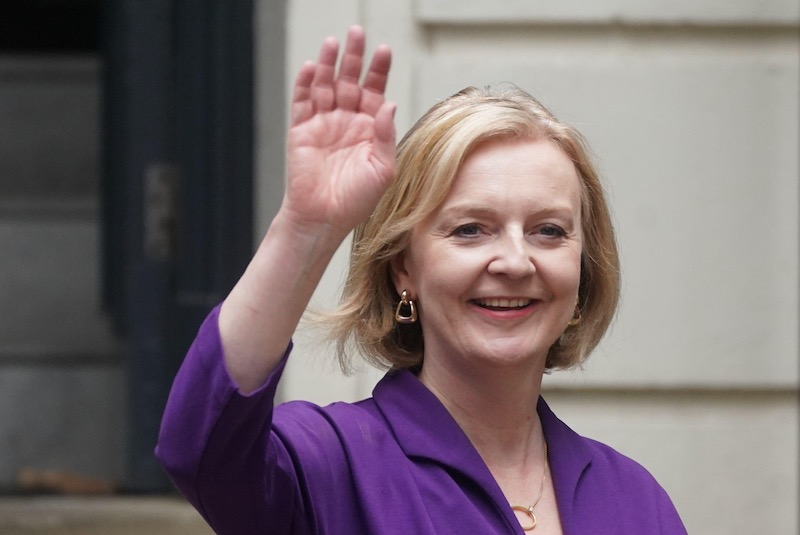
The Archbishop of Westminster, Cardinal Vincent Nichols, has assured the new prime minister Liz Truss of his prayers as he invoked Catholic Social Teaching as the basis for a response to the cost-of-living crisis.

While offering Ms Truss congratulations on behalf of the bishops of England and Wales on her victory in the Conservative Party leadership contest, Cardinal Nichols said that her appointment “comes at a time when many crises have to be faced” and when “the needs of the poorest in society must be given urgent attention”.

He said that the Church recognised “the complexity of the causes, both short- and long-term, that bring about the crisis”. Catholic Social Teaching, he said, “indicates key principles which help to fashion just solutions to urgent and dire need”.

The cardinal continued: “The time for giving priority to factional interests has passed. Today our focus should be on the elderly, families who have the care of children, and all those least able to absorb the huge increase in the cost of living that we face.”

He specified the level of welfare benefits and the two-child cap on universal credit as areas for action.

Cardinal Nichols said that the Catholic principle of subsidiarity could be applied to support for small businesses and to the welfare system and public services, “to make delivery more effective and more efficient”.

He praised the work of Catholic parishes and charitable agencies “based on the firm conviction of the inherent dignity of every person” and urged “all Catholics to give whatever time and financial resources they can to charitable endeavours that support those who are affected by the current crisis”.

“The spiritual needs of the poor and their special gifts should never be forgotten,” he said, citing Pope Francis’s encyclical Evangelii Gaudium which described the “special openness to the faith” of the poor.

“I trust that our parish communities will always be open to those suffering from hardship and in particular need of companionship and spiritual support at this time. They can help us to understand the humility we must have before God.” The cardinal asked for prayers for all those suffering in the present crisis.

Asked about her religious convictions at a hustings during the leadership contest, Ms Truss said: “I share the values of the Christian faith and the Church of England, but I’m not a regular practising religious person.”

Cardinal Nichols asked for the intercession of St Thomas More for all in public life and of St Bernadette for the poor.

WYD 2023 Pope Francis jokes that maybe Pope John XXIV will be going


Pope Francis jokes that either he or John XXIV will attend World Youth Day next year


Rome Newsroom, Sep 5, 2022 / 07:59 am (CNA).

With the next World Youth Day less than a year away, Pope Francis has promised that a pope will be in attendance but joked that it may be “Pope John XXIV.”

Pope Francis told CNN Portugal in a television interview that aired on Sept. 4 that he plans to attend the 2023 World Youth Day, the largest international Catholic youth gathering scheduled to take place in Lisbon next August.

“I plan to go. The pope is going to go — either Francis or John XXIV — but the pope is going,” he joked.

The quip was made after months of speculation in the media that the 85-year-old pope could be close to retirement. Pope Francis told journalists on his return from Canada in July that he is “open” to the possibility of retiring if he discerns that it is God’s will.

Pope Francis did not explain why he guessed his successor could be named Pope John XXIV. He has made this joke several times since he canonized St. Pope John XXIII, the last pope who took the name John, who reigned from 1958 to 1963.

The pope said in the interview that next year’s World Youth Day presents a great opportunity “for the youth from different parts of the world to connect.”

The multi-day gathering, established by St. Pope John Paul II in 1985, is typically held on a different continent every three years with the presence of the pope. At some past World Youth Days, attendance has reached into the millions.

The meeting in the Portuguese capital of Lisbon is scheduled for Aug. 1-6, 2023.

Speaking about World Youth Day, Pope Francis said: “When you go to a meeting with young people, you have to be prepared to listen to another language. Young people have their own language. And that comes from their own culture because there is a youth culture. And that also comes from their own creativity.”

He added: “We must speak with the youth language … They have their culture and a progressive language that goes forward, right? So, you have to listen to them in their way of interpreting things and answer to them in ways that they can understand. I cannot answer to a young person facing a difficulty with an old theology book… They won’t understand … you have to answer them in a language that they understand and according to the experiences they are living, right?”

The CNN Portugal interview, recorded on Aug. 11, also touched on clerical abuse and the war in Ukraine. The second half of the interview is scheduled to air on the night of Sept. 5.

Archbishop in Kazakhstan looking ahead to visit by Pope Francis


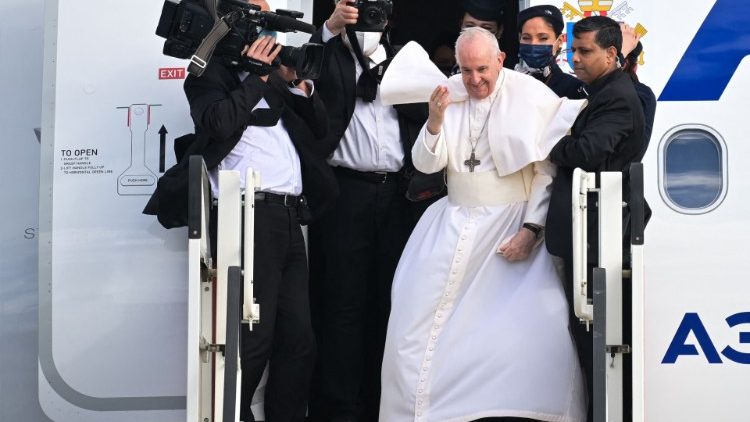
Pope Francis before boarding ITA flight for an apostolic journey (File photo)Pope Francis before boarding ITA flight for an apostolic journey (File photo)  (AFP or licensors)

Archbishop Peta: Pope's visit to Kazakhstan a 'great blessing'

In an interview with Vatican News, Archbishop Tomasz Peta, the head of Kazakhstan's largest and only Archdiocese - Astana - calls Pope Francis' trip to the Central Asian nation next week 'a great blessing' for Catholics and entire country, saying the interreligious Congress he will attend "can be a sign which points to God as to the source of peace."

By Deborah Castellano Lubov

Archbishop Tomasz Peta of Astana spoke to Vatican News ahead of Pope Francis' upcoming Apostolic Journey to Kazakhstan, which takes place on 13-15 September.

In a wide-ranging interview, Archbishop Peta reflected on the Pope's visit and the reality for practicing Catholics in Kazakhstan.

Pope Francis makes his 38th Apostolic Visit abroad to Kazakhstan's capital of Nur-Sultan to participate in the 7th Congress of Leaders of World and Traditional Religions, and to express his closeness to the Central Asian nation's small Catholic community.

Catholics make up around 1 percent of the country's population of 19 million, which is about 70 percent Muslim and 25 percent Christian, primarily Russian Orthodox.


In addition, Polish-born Archbishop Peta, who was ordained a priest by the late Cardinal Stefan Wyszyński, and then Bishop by Pope St. John Paul II, also shares a personal anecdote.

Q: What is the importance of Pope Francis' visit to Kazakhstan from your point of view?

A visit of Pope Francis is always a historical event, even more in a country, where the Catholics are a “small flock”. This fact confirmed the visit of Pope John Paul II in 2001, which indicated to the presence of the Catholic Church in the country of the “Great Steppe”, strengthening her in the faith.

I am, therefore, convinced that the visit of Pope Francis is a great blessing for us Catholics and for the entire Kazakhstan. Taking into consideration the dramatic international situation, the current visit bears the hope for peace and reconciliation on a global scale.

We are very grateful, that the Holy Father will bless in the Cathedral of Nur-Sultan the new icon – the triptych of the “Mother of the Great Steppe”. This icon is destined for our National Shrine of the Queen of Peace in Ozyornoye. It will remind us of the Papal visit. In this manner we will pray in Ozyornoye in the spiritual union with the Pope for peace and in the intentions of the Pope.

Q: What is the importance of this interfaith Congress and the Pope's presence and participation within it?

The Congress of the Leaders of World and Traditional Religions (already the seventh in the capital of Kazakhstan) is not a platform of theological discussions. In my opinion, it can be a sign which points to God as to the source of peace.

Although the efforts of the politicians are necessary, they are insufficient. An intense prayer of the believers for peace is required. The participation of the Holy Father Francis in the Congress raises the level of this event and points to the care of the Church for peace and the welfare of all humankind.

Q: How is Pope Francis seen in Kazakhstan?

For the Catholics of Kazakhstan, Pope Francis is the Head of the Church – the Successor of Peter. With joy and hope we expect the Pope.

It is notable that for the Kazakh authorities the Holy Father represents an authority. This is shown in the assiduous manner with which the Government is preparing the visit of the Pope.

Q: From when you arrived in Kazakhstan, what has struck you most? Can you share with us what you have seen?

I arrived in Kazakhstan in 1990, still in the time of the Soviet Union. At that time there were no ecclesiastical structures. On the territory of five Republics of the Soviet Union there ministered around 15 local priests, citizens of the Soviet Union. In many cities and villages there existed communities of the faithful.

Where in the time of the Communism people prayed in a special manner the Rosary, the faith and the feeling of belonging to the Church were preserved. This bore then its fruits in the conditions of the freedom of religion and conscience after Kazakhstan gained independence (in the year 1991). Quickly were established parishes and built churches and chapels.

Q: What is it like to be a practicing Catholic in Kazakhstan?

In Kazakhstan, we enjoy religious freedom. Nevertheless, it is not easy to be a Catholic in our country. Why? Catholics are less than one percent. The 19 million citizens of Kazakhstan are a mosaic of 130 nationalities / 70% are native population – Kazakhs / and belonging to 18 officially registered religions.

To be a Catholic signifies to make a mature choice. During the years of the independence of our country several millions of its citizens went to their historical homelands. Among them were several thousand Catholics. In this time the Catholic Community became more international. The Catholics of Kazakhstan belong to ten different nationalities, including also representatives of the Kazakh nation. One can no longer call us, as before, “German” or “Polish” Church.

Q: In Central Asia, how have you seen the Pope's appeals for peace regarding the war in Ukraine?

The war in Ukraine is a great tragedy. One can say that it is a wound on the body of all humankind. We believe, that the visit of the Holy Father Francis will strongly contribute to an end of the war in Ukraine and to the obtainment of the long-awaited peace.

Q: You are Polish and were ordained by the famous-Cardinal Stefan Wyszyński, a dear friend of Pope St. John Paul II, Karol Wojtyla...Please tell us more about this and his impact on your vocation and work?

I am happy that I was ordained by holy bishops: as priest by Cardinal Wyszynski [in the year 1976] and as bishop by Pope John Paul II [in the year 2001]. It is a great grace to have had the possibility of communicating in one’s life, with good – holy persons.

I am thinking in that moment for instance of my grandmother Viktoria and of my mother Helena. Cardinal Wyszynski was always a profound, but at the same time, a simple and joyful person. He was able to listen. He was very attentive and respectful towards other persons. One small example. The seminarians who served at the Mass of the Cardinal in his residence, afterwards took part in the common breakfast. Often there participated bishops and invited guests. The conversations were very serious and important and we seminarians were allowed to be present.

This was for us a sign of a great respect towards us on the part of the Cardinal.

Once, after Holy Mass, the Cardinal came personally to us, two seminarians, as if “apologizing” that today we will not take breakfast together. There arrived Archbishop Luigi Poggi, and we have to prepare ourselves for the meeting with the authorities.  But you will eat in another room. The Cardinal didn’t send us after Holy Mass to the Seminary, but personally took care, about the breakfast for us, and additionally assigned another person to join us.

Pope declares abuse by clergy/Church leaders is a monstrosity


2022.08.31 Udienza Generale

Pope: Abuse by men and women in the Church is a 'monstrosity'

In an interview with CNN Portugal broadcast on Monday evening, Pope Francis says the Church is suffering due to sexual abuse and abuse of authority and power by men and women in the Church. The wide-ranging interview also covers topics such as World Youth Day, the importance of dialogue, and Synod on synodality.

By Christopher Wells

Pope Francis emphatically repeated the Church’s commitment to “zero tolerance” when it comes to priests who abuse others, in an interview with CNN Portugal broadcast on Monday evening.

“I want to be very clear about this: Abuse by churchmen and churchwomen — abuse of authority, abuse of power and sexual abuse – is a monstrosity, because the churchman or churchwoman, whether priest, religious man or woman, or layman or laywoman, is called to serve and to create unity, to make grow, and abuse always destroys,” the Pope said.

“Abuse is a tragic reality of all times, but also of our time,” Pope Francis continued, noting that most abuse occurs in the family or in the neighbourhood and is found in sports, clubs, and schools. However, although only a small percentage occurs in the Church, the Pope said that even one case of abuse in the Church is a “monstrosity.”

In response to abuse, the Pope said it is necessary to recognize the reality of abuse in modern society; to ensure that abuse is other sectors, such as the family is not covered up; and for the Church to address abuse in the areas it is responsible. The Holy Father reiterated the Church’s commitment to zero tolerance of abuse, saying “a priest cannot continue to be a priest if he is an abuser. He can’t.”

The Pope's interview with CNN Portugal was broadcast on Monday evening, but recorded on 11 August.

World Youth Day

Ahead of World Day 2023, set to take place in Lisbon, Portugal, Pope Francis credited Pope St John Paul II with the inspiration to bring young people together from all over the world, to strengthen them and support them. He said the creativity of young people is “a sign they are anchored in the present, looking to the future… it helps them to find themselves and feel strong enough to make their way towards the future.”

He insisted that “the Pope is going” to World Youth Day 2023: “Either Francis is going or John XXIV is going,” he said, alluding to the possibility that there might be another Pope by the time of the event. “But the Pope is going.”

Pope Francis spoke, too, about the need to speak to young people in their own language, which comes from their own youth culture. “So you have to listen to them in their way of interpreting things and respond to them in a way that they can understand… and according to the experiences they are living today.”

How does the Pope pray?

Asked about his prayer life, Pope Francis said he prays the Liturgy of the Hours every day, and also prays the Rosary and meditates on the Bible. “In other words,” he said, he prays in different ways. “I place myself before God and sometimes I get distracted, but He doesn’t get distracted, and that consoles me,” he said, adding “everybody has to pray as the Holy Spirit inspires them.”

The Pope then spoke about how one can know that the Holy Spirit is speaking to us. The Holy Spirit speaks all languages, he said, but knows how to bring harmony out of differences. This harmony, the Pope said, is the ecclesial sense – a sense that is absent from those who have a religious sense, but lack the Holy Spirit.

Pope Francis returned to the theme of the harmony produced by the Spirit in response to a question on the ongoing synod. He said the Synod on Synodality has its roots in Pope St Paul VI’s recognition that the Latin Church “had lost the synodal dimension.” They current synod, Pope Francis explained, is intended “to finish the catechesis on synodality.”

The Synod, Pope Francis insisted, is not a parliament, where everyone says what they want. Instead, in a synod, all seek the harmony that is produced by the Holy Spirit. So, he said, “in the Synod there is diversity in what each one says, but it is the Spirit who creates harmony.”

The importance of dialogue

The Pope also insisted on the importance of dialogue, especially in regard to a question about what he would say to the presidents of Russia and Ukraine. The Pope noted that both presidents had visited him in Rome before the current war. “I believe that dialogue always leads to progress,” but noted that dialogue is often difficult.

The Pope said he was unsure if he would be able to visit Kyiv or Moscow, noting that he was having health issues with his knee once again after his journey to Canada. Nonetheless, he said he is doing what he can and asking everybody to do what they can. “Together we can do something,” he said, adding that he is accompanying the situation with his pain and with his prayers.”

Ahead of WYD: Open the window!

The interview with Pope Francis also covered a number of other topics, including the importance of good liturgy, the role of women in the Church, and his daily routine.

Finally, asked about what message he has for the Church of Portugal ahead of World Youth Day, Pope Francis said, “look at the window. Look at the window. And ask yourself: 'Does my life have an open window?' If it doesn't, open it as soon as possible. Don't be with your nose to the wall, of a problem, of whatever it is. Know that we are walking towards the future, that there is a path. Look at the path…Open the window! Look beyond your nose, beyond! Look, open up, keep the horizon, and widen your heart.”

Monday, September 5, 2022

Saint of the Day for Tuesday


St. Eleutherius


A wonderful simplicity and spirit of compunction were the distinguishing virtues of this holy man. He was chosen abbot of St. Mark's near Spoleto, and favored by God with the gift of miracles. A child who was possessed by the devil, being delivered by being educated in his monastery, the Abbot said one day: "Since the child is among the servants of God, the devil dares not approach him." These words seemed to savor of vanity, and thereupon the devil again entered and tormented the child.

The Abbot humbly confessed his fault, and fasted and prayed with his whole community till the child was again freed from the tyranny of the fiend. St. Gregory, the Great, not being able to fast on Easter-eve on account of extreme weakness, engaged this Saint to go with him to the church of St. Andrew's and offer up his prayers to God for his health, that he might join the faithful in that solemn practice of penance.

Eleutherius prayed with many tears, and the Pope, coming out of the church, found that he was enabled to perform the fast as he desired. It is also said that St. Eleutherius raised a dead man to life. Resigning his abbacy, he died in St. Andrew's monastery in Rome about the year 585.

Labor Day and the great Papal Encyclical Rerum Novarum


Labor Day is a great day for Catholics to read Rerum Novarum

A Labor Day tradition: celebrate Rerum Novarum
The Gold Standard on the Church and Labor: Rerum Novarum by Pope Leo the Great
http://www.vatican.va/holy_father/leo_xiii/encyclicals/documents/hf_l-xiii_enc_15051891_rerum-novarum_en.html

One of the first things I remember being asked to study in diaconate formation is the great social justice encyclical Rerum Novarum by Pope Leo XIII, Leo the Great!

It is the true gold standard on the Catholic Church's teachings on labor, the rights of workers and the dignity of work as well as the first of the great papal encyclicals over 100 years promoting the body of work known as social justice.

It is a good Labor Day read for those of you fortunate enough to take some time today and read through this treasure.  As my diaconate instructor would tell us, see if you can find the many rich pearls imbedded in this encyclical!

Happy Labor Day!