reflections, updates and homilies from Deacon Mike Talbot inspired by the following words from my ordination: Receive the Gospel of Christ whose herald you have become. Believe what you read, teach what you believe and practice what you teach...
Pope: Social and political inertia turn parts of the world into desolate byways
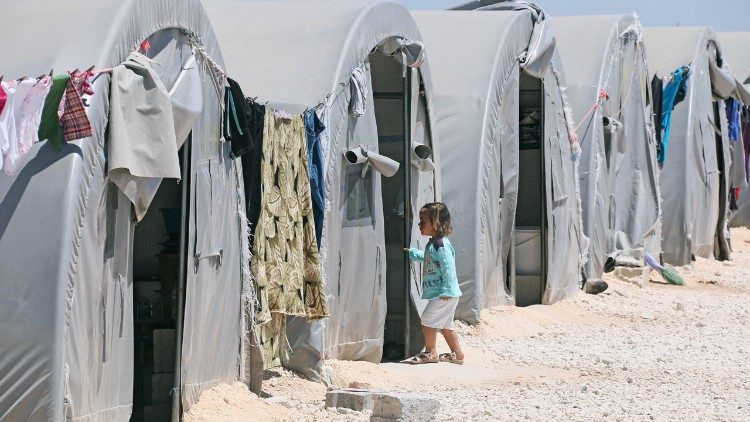
Pope Francis thanks promoters of the “Open Hospitals in Syria” project for their work in the suffering nation, and says domestic and international disputes and the robbing of opportunities are leaving great numbers of marginalized people and nations stranded by the roadside.
By Linda Bordoni
Pope Francis reflected on the ongoing suffering of the Syrian people after 12 years of violent conflict, and upheld the commitment and the healthcare offered to all Syrians in need by a Catholic-run initiative called “Open Hospitals in Syria.”
Greeting members of the AVSI Foundation that promotes and runs the initiative, which is supported by various Holy See institutions, as well as the apostolic nuncio to Syria, Cardinal Mario Zenari, the Pope decried the wounds inflicted on the nation.
If we consider the number of the dead and wounded, the destruction of entire quarters and villages as well as important infrastructures, including healthcare institutions, it is natural to ask: “Syria, who can now heal you?"
He noted that the crisis in Syria continues to be one of the most serious worldwide, “in terms of destruction, growing humanitarian needs, social and economic collapse, and poverty and famine at dire levels.”
The Pope did not neglect to mention the phenomenon of internally displaced persons and refugees of which, he said, there are some 14 million: “more than half of the Syrian population prior to the conflict.”
“In the face of such immense suffering, the Church is called to be a ‘field hospital’ and to heal wounds both physical and spiritual.”
Quoting from the Gospel of Matthew, the Pope said that from the time of the Apostles the Church has remained faithful to the mandate she has received from Jesus to cure the sick and to give without payment.
He noted that the “Open Hospitals” project is committed to supporting the three Catholic hospitals that have operated in Syria for some hundred years, as well as four walk-in clinics, all of which provide their service to all, free of charge.
"Your programme is precisely that of ‘Open Hospitals’. Open to those who are sick and poor, without distinction of ethnic or religious affiliation.
“This,” the Pope said, “is the hallmark of a Church that seeks to be a home with open doors, a place of human fraternity.
Pope Francis also spoke of the need, within the Church’s charitable institutions, that everyone - and above all the poor - must feel “at home” and experience a climate of dignified welcome.
He noted that, in Syria, many Muslims have been assisted by the “Open Hospitals” project and that this also impacts positively on the social fabric of the community, as it fosters coexistence between different ethnic and religious groups.
Pope Francis thanked those present for their gift, an icon of Jesus the Good Samaritan. He reflected on how the man in the Gospel parable, “beaten, robbed and left half-dead by the side of the road, can serve as another tragic image of Syria, beaten, robbed and abandoned for dead on the roadside. Yet not forgotten or abandoned by Christ, the Good Samaritan, and by so many other good Samaritans: individuals, associations and institutions.”
“Several hundred of these good Samaritans, including several volunteers, have lost their lives helping their neighbours. Our gratitude goes to all of them.”
The dangers of social and political inertia
Recalling the Encyclical Fratelli tutti in which he wrote, “The story of the Good Samaritan is constantly being repeated,” the Pope commented on the fact that said, “social and political inertia are turning many parts of our world into a desolate byway, even as domestic and international disputes and the robbing of opportunities are leaving great numbers of the marginalized stranded on the roadside” (No. 71).
"I asked everyone to consider that all of us have a responsibility for the wounded, those of our own people and all the peoples of the earth,” he added.
In the face of so many serious needs, he continued, we may feel our contribution is a mere drop of water in the desert: “Yet even the rocky Syrian desert, after the first spring rains, is clothed in a blanket of green. So many small drops, so many blades of grass!”
Pope Francis concluded the audience by offering those present a painting gifted to him by an Italian artist, Massimiliano Ungarelli, that depicts Saint Joseph with the child Jesus on His shoulders during the flight into Egypt, saying it reminds him of the image of a Syrian father fleeing the war with his son on his shoulders.
“This image of a Syrian father fleeing with his son is how I think St. Joseph had to flee to Egypt: he didn't leave in a carriage, no. He was like this, precariously fleeing. […] I would like to offer it to you so that when you look at this Syrian father and his son you think every day of this flight to Egypt, of this people who suffer so much.”
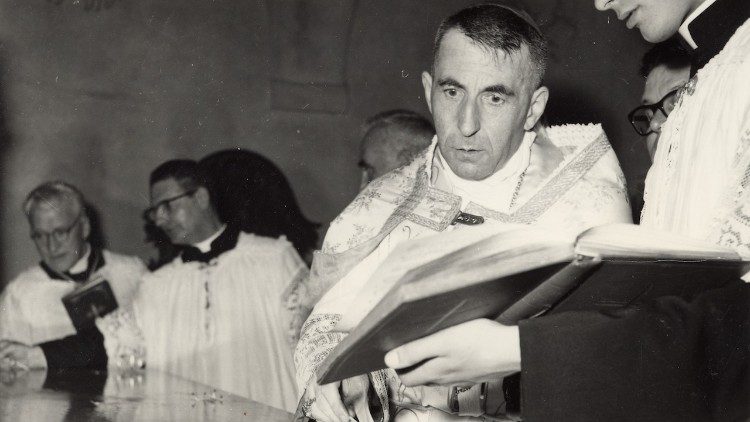
Bishop Vittorio Veneto - Future Pope John Paul I (John Paul I Vatican Foundation)
POPE
Pope John Paul I: “A servant” for the people
As the day for his beatification arrives, newly-released audio from then-Bishop Albino Luciani, future Pope John Paul I, provides a sketch of a pastor living in service to others.
By Andrea Tornielli
"My mother never told me to go and become a priest, never; but she was so good, she loved the Lord so much that when He called me, I spontaneously took this path...".
The voice is unmistakable and one that many faithful still fondly remember.
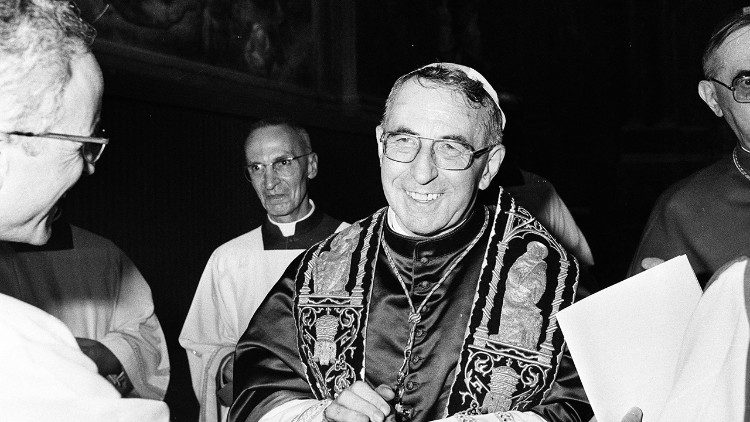
It is those who, during the 34 days of his pontificate, were beginning to know and love John Paul I, the pope who will now be beatified by his successor, Pope Francis.
It is the voice of Albino Luciani who, on the 29 June 1968, in the large parish church of Santa Maria del Piave in the diocese of Vittorio Veneto, Italy, ordained Don Giuseppe Nadal a priest.
Eleven minutes of a homily provide a sketch of the soon-to-be Blessed.
An audio recording that we can listen to in full here, dated over fifty years ago but still contains words that are very relevant today: they speak of shepherds, "with the smell of sheep," and help us to enter into the heart of the new Blessed Pope.
Mothers as models of faith
Fr. Giuseppe, 79 – now a parish priest in the village of Pieve di Soligo, Italy after serving nearly a decade as a “Fidei donum” missionary in Burundi – provided Vatican Media with the audio recorded in his home parish on the day of his ordination.
At the beginning of the recording, then-Bishop Luciani provides words of reflection for the new priest's family and for the sacrifices they made for him.
The bishop recalls a French writer who had said, "There are some mothers who have a priestly heart and transpose it into their children."
Then he recalls his own mother, Bortola Tancon, whose witness of faith had led him to embrace the priesthood: "It seemed to me that for me there was no other way. The Lord used the family environment."
Priests as servants of the other
"I truly hope," then-Bishop Luciani added, "that the Lord will help the new priest, like the priests I consecrated this morning, and make them dedicated to the people and capable of serving. You hear they say the phrase ministers of God: ministers mean 'servants;' servants of God and servants of the people. A priest is a good priest when he is a servant of others; if he is a servant of himself, he is not is not at the right place."
Bishop Luciani quotes a "holy priest" – Don Francesco Mottola, a priest who would also become later “Blessed” – who had written: "The priest must be like bread, the priest must let himself be ‘eaten’ by the people."
Therefore, he added, "The priest must be available to people at all times; he gave up his family on purpose to be available to other families."
In the homily there is an explicit mention of priestly celibacy: "Some people say, 'Priests don't get married because the Church doesn't value marriage: The Church is afraid to put marriage next to these holy things': not true, not true! St. Peter was married; that's not it. Instead, we think this: the family is a sublime and great thing, and that's precisely why if someone is a father of a family, he has enough to do his duty: children to educate, children to raise; it's all committed to that thing there, it's too big a family for one to be with a family and be able to do such great assignments as the priesthood. It's one thing or the other."
"So," the Bishop of Vittorio Veneto continued, "I repeat: let the priest be the servant of all. This is especially his task, his place: to serve. And the people know how to understand, when they see that the priest is really a servant who undoes himself for others. Then they say, 'We have a good priest;' then they are happy, then they truly are happy."
Living life as an example
After insisting that a Bishop should make "many examinations" and listen to "what people think of him" before ordaining someone a priest, Bishop Luciani insists on living life as a personal testimony; that is, the importance of embodying in life what he professes and preaches.
And he does so with traits that describe his humility.
For the preached word, "first, possibly, it must be lived; I cannot say to you and others, 'Be good,' if I am not good enough first; and if you knew at times what an embarrassment even for the bishop, to stand before people and say, 'Be good, be better, I perhaps have not done enough, even I am not good enough.' It would be wonderful if I, before lecturing others, had done everything I say to others. This is not always possible. You have to be content with the effort; we have also temper, we have also weakness. But the priest, if he wants to be a priest, must not show up to preach to others if he himself has not first at least tried – by repeated effort – to do what he asks others to do."
Finally, a suggestion: in pastoral life and in the celebration of the sacraments, "in confession above all," one must be gentle and treat people well: "I always tell my priests, 'Dear brothers... people must be treated well. If it is true that we are servants we must treat people well; it is not enough to dedicate ourselves to people, but to be gentle with people even if some people are sometimes ungrateful."
And if "there is not always right gratitude, we do not have to work for that gratitude. The Lord is waiting for us there, to see if in spite of everything we are able to continue to do some good to people."
The conclusion is a prayer and a wish to "have priests who are truly holy and truly servants of the people."
Pope John Paul I reminds us of the essence of the Gospel
The beatification of John Paul I is an invitation to rediscover the humility that allows the virtues of faith, hope and charity to be concretely translated into life.
By Andrea Tornielli
On 8 February 1970, in St. Mark's Basilica, in his first homily as Patriarch of Venice, Albino Luciani repeated the words he had said eleven years earlier to the faithful of Vittorio Veneto as soon as he had become their bishop: The Lord prefers that certain things not be engraved in bronze or in marble but in the dust, so that if the writing had remained, it would have been clear that the merit was all and only God's. I am the dust; the great episcopal dignity and the Diocese of Vittorio Veneto are wonderful things that God deigned to write on me; if a little good comes out of this writing, it is clear even now that it will be all due to the grace and mercy of the Lord.
It is in these words, 'I am the dust', that can be discovered the great secret of the Christian life that Albino Luciani gave witness to throughout his life.
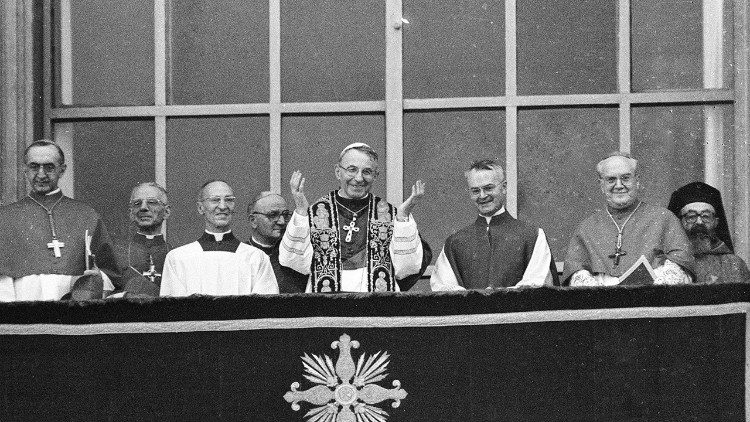
The holiness of John Paul I - a Christian who became Pope on 26 August 1978 and who now, 44 years later, will be declared blessed - is the simple story of a man who trusted God and entrusted himself to Him in every step of his life. This entrustment took place in the awareness of his own littleness. "Without me you can do nothing," Jesus told his friends. "Get behind me, Satan!" the Nazarene ordered Peter, after the latter had reproached him for having foretold his passion and death. These are two precious indications, which Albino followed throughout his existence. The grace of recognising oneself as a sinner, in need of everything; the grace of not counting on one's own strength, on one's own skill, on one's own strategies, but on the help and presence of Another, have enabled this priest, bishop and pope to bear witness to the face of a serene and trusting Church: a Church that lives the Gospel in daily life and does not need fireworks to show it exists; a Church capable of bringing closeness, consolation and hope to all, starting with the smallest, the poorest, the excluded and those who are considered unpresentable.
"The advance of spirituality is measured by the practice of humility," said St Francis de Sales, Luciani's favourite saint. For him, a man of great culture and preparation capable of speaking in a simple and colloquial manner, making himself understood by all, it was just like that. The recognition of the altars for this son of the Venetian Church, alien to any protagonism, who had never aspired to prominent posts and who, before being elected almost unanimously in the conclave, meditated on leaving as a missionary for Africa once he had reached the canonical age of resignation from Venice, is a sign of hope for everyone. Because, as the vice-postulator of the cause for canonisation Stefania Falasca reiterated, it is not the Pope or his pontificate that is to be beatified, but a Christian who adhered to the Gospel with his whole self, recognising himself as "dust". A Christian who by praying every day: 'Lord, take me as I am and make me as you wish me to be', became the instrument through which the God of mercy wrote beautiful pages and today more relevant than ever, for the Church and for the world.
Pope John Paul I: ‘Beatification overcomes fake news about his death’
The Holy See Press Office brings together several key people in the beatification of Pope John Paul I, which takes place in the Vatican on Sunday, to explore his legacy and dispel the suspicions surrounding his unexpected death after the briefest pontificate in modern history.
By Salvatore Cernuzio
He has gone down in history as the Pope of the 34-day pontificate, as the "Smiling Pope" or, even worse, as the Pope whose sudden death led to numerous conspiracy theories.
The imminent beatification helps to better know and even discover the imposing figure of John Paul I, as well as his teaching, spiritual depth, and theological learning.
The Holy See Press Office held a press conference on Friday, which saw Cardinal Beniamino Stella, the postulator of his cause, joined by Stefania Falasca, the deputy postulator; Lina Petri, his niece; Sister Margherita Marin, the first person to find his lifeless body; and, Fr. Juan José Dabusti, an Argentine priest who prayed for the healing of the little girl miraculously cured by the soon-to-be Blessed John Paul I.
Granddaughter Lina: "He helped Jews during the war"
The press conference offered the opportunity for two women whom Albino Luciani knew well to share their memories of the man who would become Pope John Paul I.
Sister Margherita Marin, a nun of the Congregation of the Sisters of the Child Mary, was an assistant at the papal apartment, when she and Sister Vincenza Taffarel found the lifeless body of the Pope on 28 September 1978.
His niece, Lina Petri, daughter of his sister Antonia, recalled the postcards sent from Rome "from her uncle," as well as his advice, their chats about St. Augustine and St. Thomas.
Ms. Petri also spoke about a phone call her uncle the Pope had with her sister, in which he mentioned the meeting in Belluno between Hitler and Mussolini and said in dialect, "We are in the hands of two madmen!"
Ms. Petri also spoke about her uncle's assistance to people in distress during the war, especially Jews.
Cardinal Stella: "His message important for today's world"
Cardinal Beniamino Stella shared his thoughts on the cause for beatification, saying that Pope Benedict XVI gave a deposition about his predecessor.
This, he noted, was the first time in which “a Pope has given de visu testimony about another Pope.”
The cause for beatification, which has received impetus from the Church in Brazil and as far afield as Argentina, has moved slowly. However, it is precisely the slow pace which has allowed for painstaking work.
"The cause of Pope John Paul I," stressed Cardinal Stella, "was neither longer than others, nor shorter and easier than others. It involved in-depth research without discounts: accurate, conscientious, scrupulous, conducted according to the historical-critical method, and based on a serious investigation of the archival sources, a focused bibliographic research and a rich testimonial panorama."
Piecing together history
It was precisely the acquisition of the sources and an impressive amount of documents, now collected by the John Paul I Vatican Foundation, that enabled the "analytical analysis" which allowed for a proper historical reconstruction, said Ms. Falasca.
"On the level of historiographical interest," stressed the deputy postulator and vice president of the Vatican foundation, "John Paul I has had a modest space. His work, personality and thought have been little visited." T
he cause for canonization has therefore rendered "a service to historical truth, acquiring all the documentation to really talk about John Paul I." The goal, above all, she said, was to “completely reconstruct an itinerary of which the pontificate was the tip of an iceberg."
Thanks to scientific research, said Ms. Falasca, it was possible to upend the fake news about death by poisoning that "persisted for a long time."
She called this conspiracy theory a lie which “has engulfed for so many years the consistency and magisterial caliber of this man and this Pope."
"It is incredible that 44 years after his death we are still wondering why he was murdered," she exclaimed, saying the sources helped overcome the false narrative.
Reports and medical records
In the case of Luciani's death, the postulators spoke of acquiring medical records, court depositions, doctors’ reports, including those of the pontifical primary physician, Dr. Mario Fontana and Dr. Renato Buzzonetti – who had drawn up the cause of death and clinical status, medical history, and provided for the preservation of the late Pope’s body.
"Some people ask: ‘why wasn't an autopsy performed?’ There was no law then, since John Paul II introduced it in 1983. Also, an autopsy is requested on suspicion, and Fontana and Buzzonetti, in their death report, wrote that they did not think it was necessary," Falasca said.
The viewing of the corpse, the description of the stains that made it possible to re-establish the time of death, led the two professionals to decree Luciani's as "sudden death." And "when you write like that in forensics, it's always natural death," the journalist stressed, "It was a heart attack."
Pope John Paul I himself, who enjoyed "good health although with some past history," had warnings of a heart attack the night before through a hint of chest pain which he mistook for rib-cage pain.
He did not give it too much thought, and went to bed greeting the sisters as he did every night and telling Sister Margaret his last sentence, "Tomorrow we will see each other, if the Lord still wishes it, and we will celebrate Mass together."
Ironed shirts
Speaking in a feeble voice, the nun reported these strong memories, along with short but significant anecdotes that restore the image of the man Albino Luciani.
For example, one time in the afternoon, seeing the nun ironing, the Pope, who was going back and forth with papers in his hand, said, "Nun, I make you work so hard.... But don't iron that shirt so well because it's hot, I sweat, and I need to change them often. Iron only the collar and cuffs, since the rest can't be seen, you know."
A yellowed sheet of paper with notes on the theological virtues
John Paul I often walked about with sheets of paper in hand, and he was found dead with one clutched in this hand.
The paper contained notes on the virtue of prudence at the center of the catechesis of the following Wednesday's General Audience. In the Foundation's archives – which cover the period from 1929 to 1978 – diaries, notepads, notes, and transcripts have been recovered that show how everything Luciani said "was never left up to improvisation."
From among these notes was taken the relic which will be presented to Pope Francis on Sunday: not a fragment of bone or a body part as is usually the case, but a white piece of paper, yellowed by time, about ten centimeters in size, in which the Pope wrote an outline for a spiritual reflection on the three theological virtues that recalls the magisterium of the General Audiences.
"It is the emblem of his entire spirituality and his search for the seven lamps of sanctification," said Ms. Stefania Falasca. “It was the outline of his pontificate."
Blessed’s portrait is work of a Chinese artist
St. Peter's Square on Sunday will display the portrait painted by Chinese artist Yan Zhang, the making of which was shown in an evocative video by journalist Teresa Tseng.
The film was shown in the Holy See Press Office, along with a video sent from Buenos Aires by young woman, Candela Giarda, who received the miracle which cleared the path for John Paul I’s beatification, along with her mother, Roxana Sosa, who were unable to come to Rome because of a fracture in the girl's foot.
Fr. Dabusti: " Holy Spirit suggested I pray for the sick child"
The story of the young girl, who was then suffering from a malignant refractory epilepsy, and her miraculous healing was told by Father Juan José Dabusti.
The Argentine priest recounted how he was faced with her mother’s desperation, as she called him to her daughter's bedside after doctors told her she would not live through the night.
He suggested they should pray together to Albino Luciani.
"Looking at her in that condition, I was inspired to turn to John Paul I to ask for the healing of her child, and together with her, and some nurses present, I prayed to him," the priest recounted. "Until that moment I had never prayed to John Paul I for a healing. Why did I propose to Roxana to pray there for Luciani to intercede for Candela's healing? I don't know. It was the Holy Spirit."
Pope Saint Gregory I, also known as the Great, was the Pope of the Catholic Church between 590 and 604 AD.
Gregory was born around 540 in Rome. The exact date of his birth is unknown. Although the Western Roman Empire had collapsed long before his birth, many ancient Roman families still commanded great wealth and influence in the city. Gregory was born into one such family. His great-great-grandfather was Pope Felix III who reigned from 483 to 492. (Astute readers may suspect this to be a scandal, but this was at a time before the clergy took vows of celibacy.)
His father was named Gordianus, and he was a senator and a Prefect of Rome. Gordianus also held a position in the Church with the title of Regionarius, but there are no records from the time which describe the post. Gregory's mother was Silvia, also from a noble family. Silvia's sister (Gregory's aunt), Pateria are both recognized as saints in the Catholic and Orthodox churches. Gregory had a brother, but nothing is recorded, neither his name or his fate.
Gregory's family was very wealthy and owned estates on the island of Sicily which provided income.
When Gregory was just two years old in 542, the Plague of Justinian swept through the region. This plague was caused by a now-extinct strain of Yersinia Pestis, more commonly known as the Black Death. The plague was the most severe outbreak of deadly disease the world had ever known and remained the worst such incident until the Black Death in the 14th century. About a third of the population in Italy was wiped out by the disease.
In addition to disease, the barbarian Ostrogoths sacked Rome in 546. The Franks attempted an invasion in 554. Both of these incursions were short lived. It is unclear how these massive events impacted Gregory's development as a child, but it is thought his family retreated to Sicily during part of that time. Peace followed in Italy after these upheavals.
Gregory was well educated and excelled in all his studies. He also became an expert in law. He excelled so much he became the Prefect of Rome, just as his father had been. Gregory was only 33 years old.
After Gregory's father had died, Gregory had the family villa in Rome converted into a monastery. Today the monastery still stands as the San Gregorio Magno al Celio. This famous monastery fell into ruin in the following centuries but was restored during the 17th and 18th centuries.
As a monk, Gregory was hard and strict. When a monk on his deathbed confessed to stealing three pieces of gold, Gregory ordered he be left to die alone. After the poor monk had died, Gregory ordered his body thrown on a dung heap along with the three coins. Then, in a turn of heart, Gregory offered 30 Masses for the deceased monk.
Pope Pelagius II, who reigned from 579 to 590, chose Gregory to serve as an ambassador to the imperial court in Constantinople.
The Pope had a problem with the Lombards invading from the west. Gregory was ordered to request military aid from the emperor. But the emperor felt there were greater threats to the east, and he refused Gregory's request.
In 590, Pope Pelagius II died, and Gregory was proclaimed pope by acclamation. This was not something Gregory wanted, but he accepted the burden nevertheless.
Gregory made clear he preferred the monastic life in a series of writings praising it. He also referred to himself as a servant of God. The habit remains in practice to this day and many clergy still refer to themselves as servants.
Pope Gregory was famous for the emphasis he put on missionary work. He sent many people out to bring many to Jesus and into the Church. Anglo-Saxon Britain was, at that time, still on the frontier of Christendom. It was Pope Gregory who dispatched St. Augustine (of Canterbury) to Kent in 597 (not to be confused with St. Augustine of Hippo).
Pope Gregory made many changes to the Mass, some of which remain today, The position of the Our Father in the Mass remains where Pope Gregory placed it.
He emphasized the aspect of service to the poor for deacons. The number of deacons was increasing in number and they were seen as less essential as extensions of the Bishop than they were in the early Church. Deacons were often tasked with giving alms to the poor, and at least one was assigned to each church and ordained for this purpose.
Pope Gregory may have also established "cantus planus," known in English as plainchant. Most today know this style of singing as Gregorian Chant. The melodious, monophonic music is known throughout the Church and closely associated with medieval monasteries. Gregorian chant gives us the oldest music we still have in the original form, some dating to the centuries just after the death of Gregory. It remains a matter of some dispute just how involved Pope Gregory was in the development of the style. Some music historians argue the credit is a misattribution that rightly belongs to his less famous successor of a century later, Gregory II.
Pope Gregory was well known for his alms to the poor, and he gave quite generously of the riches donated to the Church by the wealthy people of Rome. Everything from money to land was given to the poor in some fashion. He made clear to his subordinates that their duty was to relieve the distress faced by the poor.
He ordered his clergy to go out into the streets to find and care for the poor in person. Any clergy who were unwilling to go into the streets and help the poor were replaced. Assets of the Church were liquidated to provide income for alms. Clergy doing this work were paid four times a year and given a gold coin as a sort of bonus.
When a famine struck Rome in the 590s, Pope Gregory ordered the Church to use its assets to feed the poor. At that time, the Church controlled nearly two thousand square miles of land, overseen by the clergy and used to generate income. Now, instead of selling the produce of the land, Pope Gregory ordered it shipped to Rome and given away for free. In this way, he saved thousands of people from certain death.
Pope Gregory himself refused to eat until his monks returned from their work of handing out food.
He also made certain to dine with a dozen poor people at each meal.
Gregory is widely considered the be the first medieval pope, and he was a prolific writer.
Because of his great respect for the poor, it was Pope Gregory and the Church that became the most respected --and obeyed force in Rome and across Italy.
From the time of Gregory onwards, the people looked to the Church for government rather than the distant and indifferent emperors in Constantinople.
Pope Gregory suffered from arthritis in his last years. He died on March 12, 604 AD. He was immediately proclaimed a saint by means of popular acclaim.
Saint Gregory's relics remain in St. Peter's Basilica to this day.
In 1969, the Second Vatican Council moved Saint Gregory's feast day from March 12 to September 3 so it would not fall during Lent. During Lent, there are no obligatory memorials. The Eastern Orthodox Church also venerates Saint Gregory, honoring him on March 12.
Both Anglican and Lutheran Christians also venerate Pope Saint Gregory.
He is the patron saint of musicians, singers, students, and teachers.
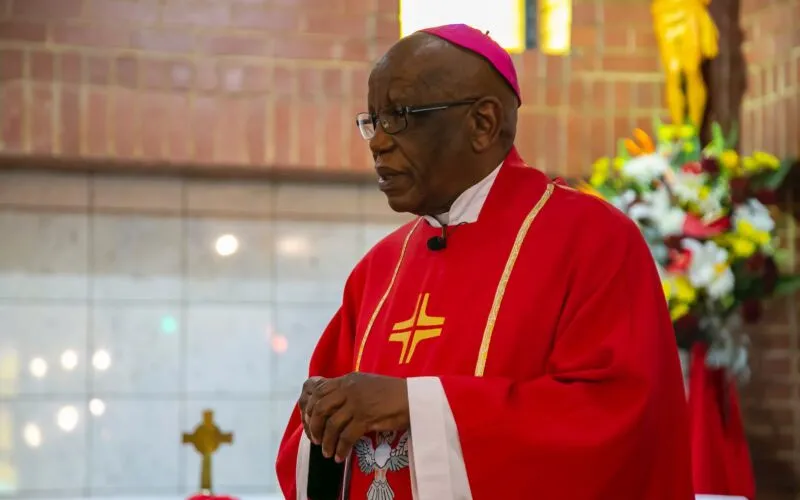
There is need to foster for mutual respect and collaboration between Deacons and Priests in the Catholic Church, shunning “personality clashes” the Archbishop of South Africa’s Johannesburg Archdiocese has said.
In his address at the Annual General Meeting (AGM) of the Permanent Deacons of Johannesburg Archdiocese, Archbishop Buti Joseph Tlhagale also reminded Deacons to be keen on their ministry of service.
“It is important that there be a good working relationship between the Priest and the Deacon. The two should develop a certain style of work, a working relationship, and a sharing of responsibilities,” Archbishop Tlhagale said in the message shared with ACI Africa Tuesday, August 30.
The Local Ordinary of Johannesburg cautioned members of the Clergy against “personality clashes”, saying these “should also be avoided”.
Archbishop Tlhagale added, “Priests should also be careful not to assume an attitude of a boss but rather should see a Deacon as a collaborator, a fellow Cleric. Pulling rank in the event of a misunderstanding should never be entertained.”
He continued, “Deacons are to proclaim the Gospel of Christ, the plan of God's salvation not only in words but by example and personal testimony.”
In his address during the August 20 AGM that was held at Don Bosco Youth Centre Wakerville, Johannesburg Archdiocese, the South African Archbishop called on Permanent Deacons in his Metropolitan See to be of service to all members of “the whole Church”.
“Deacons are pressed upon to serve the whole Church, to serve orphans, to visit the sick by bringing them the Eucharist and to care for the needy and the poor,” said the member of theMissionary Oblates of Mary Immaculate (OMI).
Permanent Deacons need to “take care of migrants and refugees, to perform works of charity thereby becoming witnesses of Christ,” he said, and urged them to provide a “healing ministry” to victims of gender-based violence (GBV).
The 74-year-old Archbishop who started his Episcopal Ministry in April 1999 as Archbishop of South Africa’s Bloemfontein Archdiocese explained, “Domestic violence has become a common occurrence, no, a common curse. What needs to be arrested is the frightening, brutal spectacle of femicide, a definite indicator of a sickening moral depravity of some menfolk.”
“When such incidents happen, families and communities find themselves at the crossroads. Intense feelings of revenge abound. Families are left with anger, frustration and deep scars,” he went on to say, and added, “A sorely needed ministry of healing could be provided by Deacons as well.”
The South African Church leader urged Permanent Deacons to “embrace works of charity with enthusiasm and to work in a coordinated manner with other existing charitable groups to better serve the poor and the marginalized” in their ministry.
“The Office of the Deacon is nothing other than the ministry of Jesus Christ. Deacons are ministers of the mysteries of Jesus Christ. Deacons are ministers of the Church of God,” Archbishop Tlhagale said, citing Pope Paul VI’s Apostolic letter establishing the new norms for the Order of Deacon,Ad Pascendum.
“The Pope also draws attention to the teaching that deacons should behave in such a way that, if your ministry obliges you to lay down your lives for a brother, you should do so,” he said, adding that Deacons should be ready to sacrifice “because we are the imitators of Christ who suffered and died for us all”.
In his address, the Local Ordinary of Johannesburg Archdiocese told Permanent Deacons to serve the faithful at the Parish and Diocese levels.
“In practice, Deacons avail themselves to serve at Parish level only, thus depriving the whole Diocese of their accumulated human experience, expertise, pastoral care and spiritual leadership,” Archbishop Tlhagale said, adding, “There is an urgent need for the diaconate ministry to be broadened in order to embrace the challenges that arise at the diocesan level.”